
If you're pricing a roof replacement for a warehouse, factory, retail centre, or strata complex in NSW, you're not choosing between two pretty brochures. You're committing capital to an asset that affects maintenance planning, tenant comfort, energy use, insurance conversations, and how often you'll need to shut down access for remedial work.
That's why the Zincalume vs Colorbond decision gets mishandled so often. Too many comparisons stop at “one is cheaper” and “one comes in colours”. For commercial property, that's not enough. The better question is which system gives you the strongest lifecycle value for your building, your operating conditions, and your compliance obligations.
The practical answer depends on what hurts your site most. On some projects, upfront budget pressure is real and Zincalume is the right call. On others, heat load, public-facing appearance, chemical exposure, or long-term maintenance access make Colorbond the smarter investment. The material itself is only part of it. Ultimately, the issue is what the roof will cost you to own, not just what it costs to buy.
Table of Contents
- The High Stakes of Your Next Commercial Roof
- Understanding the Core Materials Zincalume and Colorbond
- Detailed Comparison The Key Decision Factors
- Lifecycle Cost and Return on Investment Analysis
- Installation and Maintenance Implications
- Commercial Use Cases and Clear Recommendations
- Making the Right Choice for Your Property
The High Stakes of Your Next Commercial Roof
A commercial roof decision usually lands on someone's desk at the worst time. Lease pressure is building. Maintenance issues are already annoying tenants or operations staff. Water ingress has turned a repair problem into a capital works problem. At that point, most owners want certainty fast.
The problem is that roofing quotes often make unlike-for-like products look interchangeable. A bare-metal system and a pre-painted system can both be presented as “metal roofing”, even though they behave differently in service, in heat, and under ongoing maintenance. If you manage a large footprint building, those differences matter more than the sheet profile alone.
Here's where owners usually get stuck:
- Budget pressure: You need to control the initial spend without buying a roof that creates higher operating costs later.
- Business continuity: You can't afford repeat access, frequent remedial work, or disruptive maintenance across an occupied site.
- Compliance exposure: Commercial and industrial properties in NSW need roofing choices that align with the building's use, environment, and upgrade pathway.
- Asset presentation: For retail, strata, and investor-held assets, the roof also affects appearance and perceived upkeep.
Practical rule: If the roof serves a business, the cheapest quote isn't automatically the lowest-cost decision.
On a remote warehouse with limited public exposure and straightforward access, Zincalume can make strong financial sense. On a logistics facility with high summer heat load, or a retail site where presentation matters, Colorbond often justifies itself differently. The key is to assess the roof as an operating asset, not just a construction line item.
A good decision balances four things at once. Capital cost, expected maintenance, thermal impact, and suitability for the environment. If one of those gets ignored, the roof can still look fine on handover and underperform over the next decade.
Understanding the Core Materials Zincalume and Colorbond
What Zincalume actually is
Most clients assume Zincalume and Colorbond are two completely different metals. They're not. That misunderstanding leads to poor comparisons and vague advice.
ZINCALUME® steel is an alloy of 55% aluminium, 43% zinc, and 1.6% silicon, while COLORBOND® steel uses that same ZINCALUME® core and adds a pre-painted, baked-on topcoat for colour and enhanced protection, as outlined in this technical comparison of Zincalume and Colorbond.
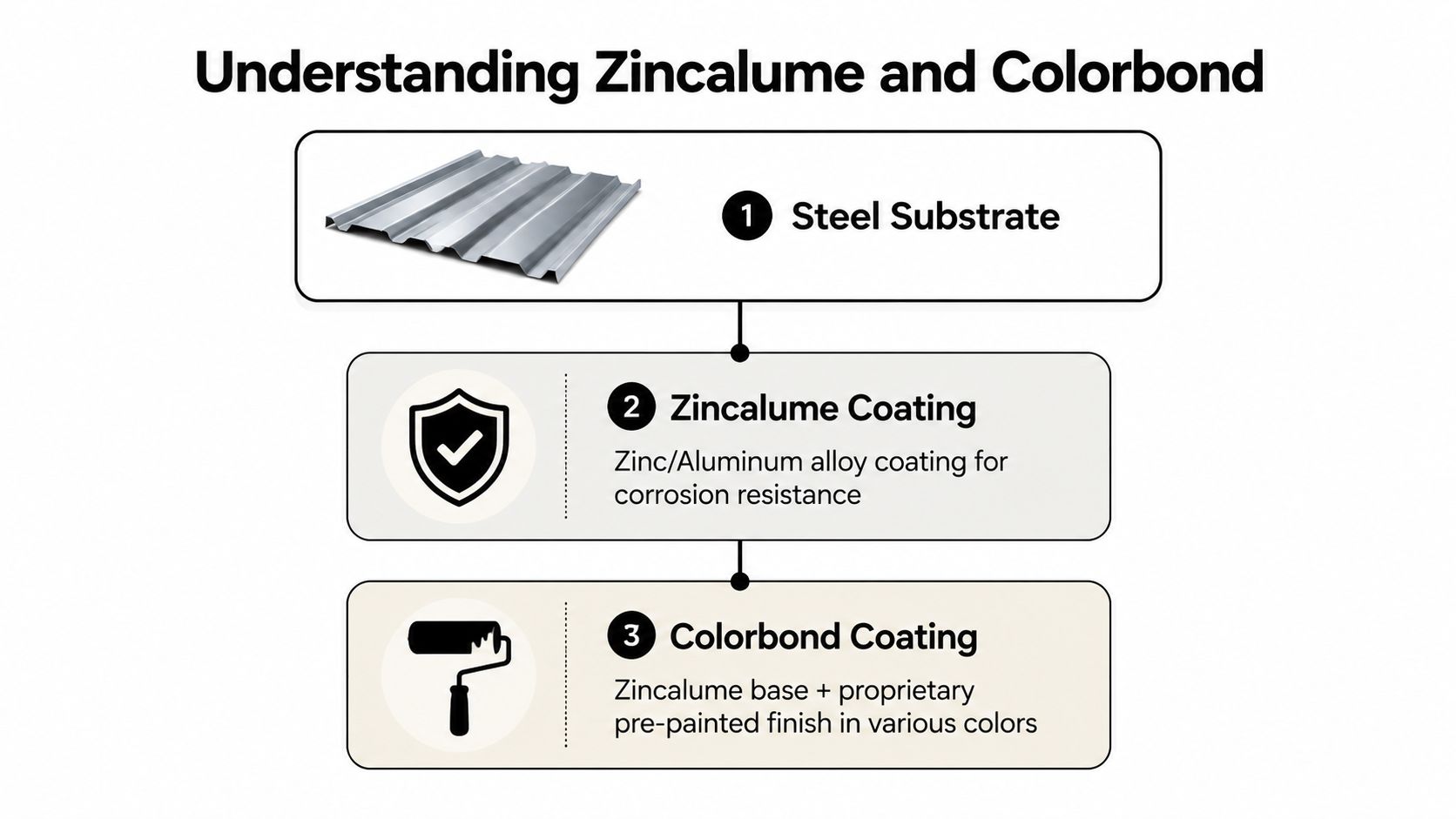
In simple terms, Zincalume is the corrosion-resistant steel base system. It's the workhorse material. It has a metallic finish, strong durability credentials, and broad use across industrial and commercial buildings where function matters more than colour selection.
That makes it a practical choice when the roof is large, visible appearance is secondary, and the owner wants a proven metal system without paying for a factory-applied decorative finish.
What Colorbond adds on top
Colorbond starts from that same core and adds the finish layer that changes how the roof performs in real-world commercial settings. The topcoat doesn't just alter the look. It changes the maintenance profile, the thermal behaviour when lighter colours are selected, and how the roof presents on higher-visibility properties.
A useful way to think about it is this:
- Zincalume: The base high-performance steel system
- Colorbond: The same core, but with a finished outer layer that adds colour choice and extra surface protection
- Commercial consequence: You're choosing between a durable bare-metal solution and a more refined system with broader design and operational benefits
For owners comparing specifications, that distinction matters. It also matters when reviewing alternatives like painted metal roofing systems for commercial buildings, because not all painted products carry the same reputation, finish quality, or suitability for long-term commercial use.
The right comparison isn't “metal roof versus metal roof”. It's “bare protective alloy finish versus protective alloy finish plus factory-applied coating”.
That's why one product often suits budget-led warehouses and another suits retail centres, strata properties, and projects where heat gain or visual presentation carries more weight. Once you understand that relationship, the rest of the decision becomes much clearer.
Detailed Comparison The Key Decision Factors
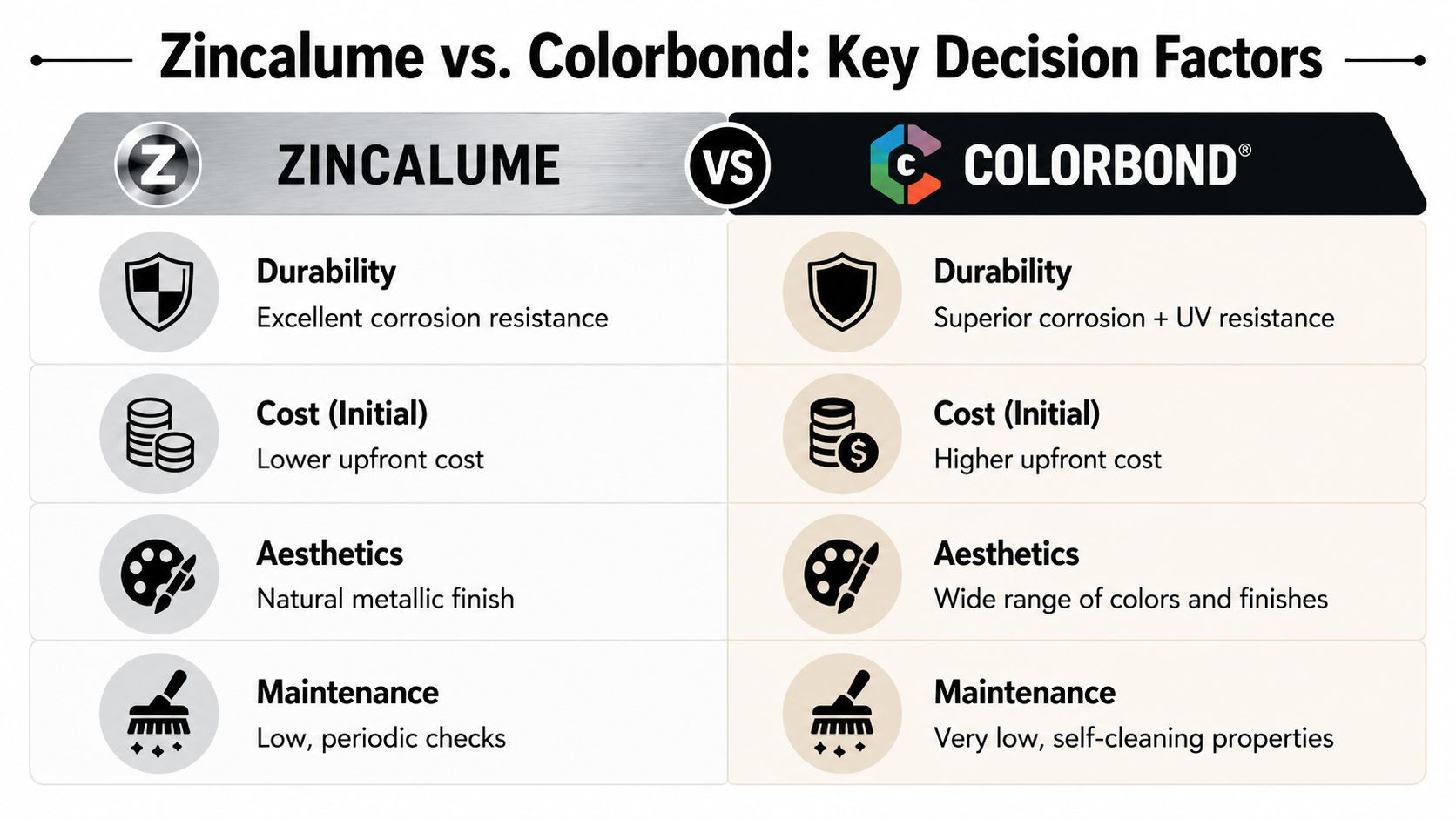
Below is the quick view most commercial clients want before they get into the finer detail.
| Feature | Zincalume | Colorbond |
|---|---|---|
| Material base | Aluminium-zinc-silicon alloy coated steel | Zincalume steel core with pre-painted baked-on finish |
| Durability focus | Strong corrosion resistance and long service life | Same core protection plus added finished surface |
| Thermal performance | Standard metallic finish | Light colours can improve thermal performance |
| Appearance | Natural metallic look | Wide colour selection |
| Upfront cost | Lower | Higher |
| Best fit | Large budget-sensitive roofs | Visible, heat-sensitive, or higher-spec assets |
Durability and corrosion resistance
For raw durability, Zincalume has a strong record in Australian conditions. Zincalume® steel offers a service life approximately four times longer than traditional galvanised steel, making it a long-standing benchmark for commercial roofing durability in Australia. The corrosion resistance comes from the aluminium content in the coating, which significantly retards corrosion, as explained in the verified industry data provided for this article.
That makes Zincalume a sensible option on large commercial roofs where owners want a proven, low-intervention material and don't need a coloured finish. It's particularly appealing where access is difficult and replacement cycles are expensive.
Colorbond benefits from the same core, then adds a finished surface layer. In practice, that means it isn't replacing a weak substrate with a better one. It's building on the same corrosion-resistant foundation and adding another level of functional value, especially where surface exposure, presentation, or thermal goals matter.
For broader specification context, it helps to compare these systems against other commercial metal roofing options used across Australia.
Thermal performance and operating cost
The Zincalume vs Colorbond conversation thus becomes a business decision, not just a materials discussion.
NSW commercial warehouses with uncoated Zincalume roofs can experience internal temperature spikes up to 8°C higher than those with light-coloured Colorbond roofs, potentially increasing HVAC energy costs by 15% for large logistics sites, based on the verified NSW warehouse data supplied for this article.
That gap matters most on logistics facilities, warehouses, and large industrial buildings with long roof spans and high internal heat load. If a site is already battling summer temperatures, staff comfort issues, or refrigeration and mechanical plant demand, roof colour and finish stop being cosmetic choices.
Later in the section, this video gives a useful visual overview of the product differences and practical considerations.
Color choice also affects surface heat. Verified data for this article notes that light-coloured Colorbond roofs can lower roof surface temperatures by up to 20°C to 30°C compared with a standard dark Zincalume finish, and cooling costs in commercial settings can reduce by 10% to 25% when the roof selection supports better solar reflectance.
On large buildings, thermal performance shows up every month on the power bill. It isn't just a comfort issue.
Appearance and building presentation
This factor matters more than many industrial owners first admit. A roof is a major visual plane on low-rise commercial buildings. On strata complexes, retail sites, schools, and customer-facing premises, that influences asset presentation from the street and from neighbouring buildings.
Colorbond gives architects, owners, and strata committees flexibility. The verified data for this article notes more than 22 standard colour options. That allows a lighter roof where thermal performance is the priority, or a coordinated palette where planning, branding, or streetscape expectations matter.
Zincalume has a single metallic appearance. That isn't a flaw. In the right context, it's exactly the point. On hard-working industrial assets, the clean metallic look can be perfectly appropriate and economically sensible.
Initial cost and ownership profile
For many projects, upfront cost is what starts the conversation. It shouldn't be what ends it.
Verified data for this article states that Zincalume has a ~30% lower initial cost than Colorbond in the relevant comparison. That's a meaningful difference on broad roof areas. If you're covering a major warehouse or replacing extensive roofing across multiple structures, the saving is real and immediate.
But the lower buy-in doesn't automatically mean lower ownership cost. If the building is heat-sensitive, highly visible, or exposed to harsher site conditions, the premium for Colorbond may be justified by lower operational and maintenance burden over time.
A good procurement decision asks two questions together:
- What does the roof cost to install now?
- What will the roof cost the business to own over the period you plan to hold the asset?
That's the point where Zincalume vs Colorbond becomes a strategy choice, not a product preference.
Lifecycle Cost and Return on Investment Analysis
The cheapest roof on day one can be the expensive roof by year five. That's common on commercial properties because owners often compare supply-and-install rates but underweight access costs, cleaning cycles, operational heat load, and the cost of maintenance around live tenancies or active production.

Where Zincalume wins financially
Zincalume usually wins the initial-capital argument. On a large, straightforward roof area, that matters. If the building has low sensitivity to internal heat swings, limited public visibility, and no unusual environmental abuse, the lower entry cost can make it the stronger commercial decision.
This is especially true when the owner's priorities are clear:
- Keep capital expenditure down: Large roof spans magnify the upfront price difference.
- Use a proven material: Zincalume remains a widely accepted solution for industrial roofing.
- Avoid paying for features you won't use: If colour choice and enhanced presentation have little value, there's no point pretending they do.
Where Colorbond pays back
The payback case for Colorbond is strongest where the site conditions punish a bare-metal finish or where internal temperature directly affects operating cost.
While Zincalume has a ~30% lower initial cost, pre-painted Colorbond roofs in high-abuse industrial zones can incur 40% less maintenance expenditure over 15 years due to superior resistance to chipping and chemical corrosion, based on the verified data provided for this article.
That's a serious distinction for factories, processing environments, and dusty or chemically aggressive sites. It also matters on buildings where maintenance access is awkward or disruptive. Every avoided maintenance event saves more than labour. It saves administration, access setup, safety controls, and interruption.
There's also the energy side. If your building would benefit from a more reflective roof surface, the ownership case changes again. On some sites, owners also consider adding a reflective roof coating strategy where thermal management is a broader building objective, though that doesn't replace choosing the right base roof system in the first place.
Owner's lens: Capital cost is only one line in the budget. Maintenance disruption and energy drag are operating costs, and they often run longer than the original quote is remembered.
How to assess ROI properly
A proper commercial roofing ROI review should include:
Planned hold period
If you expect to own the property for the long term, lifecycle cost matters more than entry price.Site environment
Coastal exposure, dust, airborne contaminants, and chemical activity all affect the maintenance profile.Internal heat sensitivity
Warehousing, logistics, manufacturing, and occupied commercial space don't all respond the same way to roof heat gain.Access cost for future works
A roof that is harder to maintain or repair becomes more expensive than the material schedule alone suggests.Presentation requirements
Investor-grade, tenant-facing, or brand-sensitive properties often justify the premium finish.
That's the framework that separates a smart specification from a cheap one.
Installation and Maintenance Implications
Handling during installation
From an installer's point of view, Zincalume is generally more forgiving during handling. It doesn't have a decorative pre-finished top surface that crews must protect from scuffs and scratches during every lift, cut, and fixing sequence.
Colorbond needs tighter site discipline. Sheet handling, storage, separation from swarf, and general traffic management all matter more because the finish is part of the product value. A careless crew can compromise the appearance before practical completion, even if the roof remains watertight.
That doesn't make Colorbond difficult to install. It means installation quality control matters more visibly. On commercial work, that affects labour attention, sequencing, and defect management.
Maintenance reality on working sites
Both materials are low-maintenance when specified correctly and installed properly, but they don't age in exactly the same way in service.
Zincalume's appeal is its straightforwardness. On many industrial roofs, maintenance mainly comes down to inspection, debris control, drainage performance, and keeping an eye on penetrations, flashings, and fasteners. If the building is in a harsher environment, those inspections become more important.
Colorbond's surface can offer practical benefits in sites where appearance, grime visibility, or environmental exposure matters. But surface damage requires a different mindset. If the finish gets scratched or marked during later service works, repairs can be more noticeable and need more care to manage well.
A sensible maintenance program should focus on:
- Drainage points: Keep gutters, sumps, and box gutters clear so water doesn't sit where it shouldn't.
- Roof traffic control: Limit uncontrolled foot traffic, especially around service penetrations and access paths.
- Trade coordination: HVAC, electrical, and solar contractors often cause avoidable roof damage if roofing protection isn't managed.
- Routine inspections: Catch minor flashing, fastener, or seal issues before they become leak events.
Most commercial roof damage isn't caused by the base material. Other trades, blocked drainage, and delayed maintenance cause more trouble than the sheet itself.
Compatibility also matters. The roof sheet, flashings, gutters, insulation build-up, and penetrations need to be specified as one roof system. Owners get into trouble when they compare sheet material in isolation and ignore the rest of the assembly.
Commercial Use Cases and Clear Recommendations
Large-scale warehousing
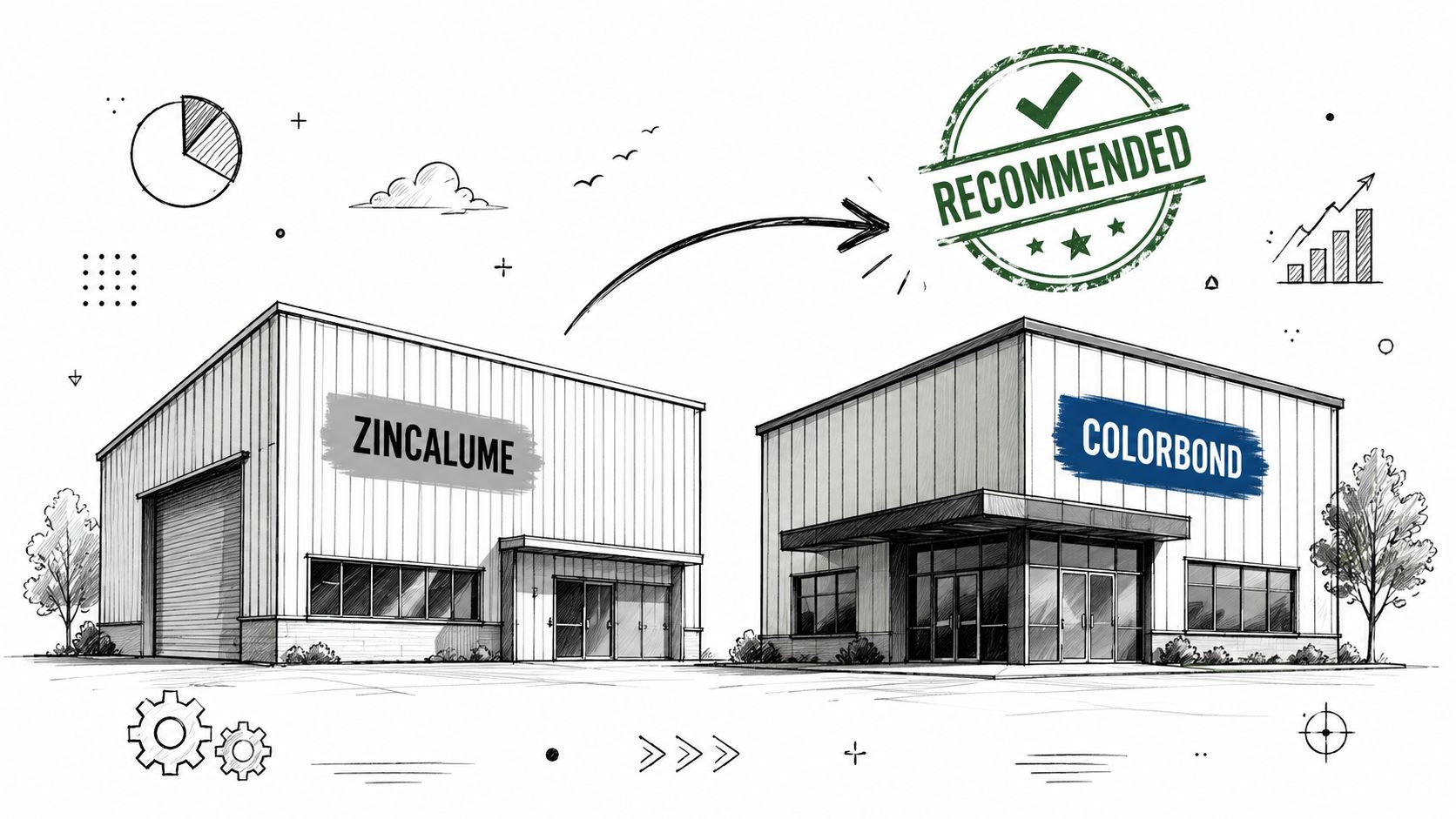
If the site is a basic warehouse with tight capital constraints, Zincalume can be the right decision. It gives you a durable roofing material without paying for a finish layer you may not need.
That said, warehouses are also where thermal performance can swing the decision hard. NSW commercial warehouses with uncoated Zincalume roofs can experience internal temperature spikes up to 8°C higher than those with light-coloured Colorbond roofs, potentially increasing HVAC energy costs by 15% for large logistics sites, according to the verified data provided for this article.
If the warehouse is mechanically cooled, carries temperature-sensitive stock, or has a workforce that feels summer heat stress, Colorbond deserves serious consideration. On those projects, roof selection affects operations, not just aesthetics.
Factories and high-abuse industrial sites
On sites with chemical exposure, airborne residue, heavy dust, or more demanding maintenance conditions, Colorbond often has the stronger lifecycle case. The added finish can reduce long-term maintenance burden in environments that are harder on roofing surfaces.
For these projects, I'd rarely recommend deciding on upfront price alone. Maintenance access costs, shutdown risk, and the realities of live industrial operations can quickly outweigh the saving achieved at procurement.
Retail, strata, and visible assets
Colorbond usually fits these assets better. The reason isn't fashion. It's asset presentation, tenant expectations, and the ability to align roof appearance with the rest of the building envelope.
For strata committees and owners of visible commercial properties, the roof is part of the building's perceived condition. A neat, coordinated finish often supports the broader upgrade outcome better than a purely utilitarian metallic surface.
Asbestos roof replacement projects
Asbestos roof replacement changes the conversation because the job is already compliance-heavy. Once removal controls, access management, waste handling, and replacement logistics are in play, it makes sense to choose a roof system that aligns with the building's next long operating cycle.
For these projects, the best choice depends on what the building becomes after replacement:
- Industrial shed with basic operating demands: Zincalume may be enough.
- Occupied facility with heat issues or visibility concerns: Colorbond often gives the better long-term result.
- Investor-held property undergoing a broader upgrade: A finished roof can support both presentation and lower downstream intervention.
The key is not to treat asbestos replacement as a like-for-like swap by default. It's often the best chance the owner will get to reset the roof system properly.
Making the Right Choice for Your Property
The Zincalume vs Colorbond decision comes down to where your building creates cost over time.
Choose Zincalume when your main priority is controlling upfront capital spend on a large commercial roof, and the building doesn't place much value on colour choice, premium presentation, or stronger thermal performance. It suits straightforward industrial assets well.
Choose Colorbond when the roof needs to do more than keep water out. If the property is exposed, visible, heat-sensitive, or harder and more expensive to maintain, the higher initial cost can make better sense over the life of the asset.
The mistake is treating both materials as interchangeable because both are steel roofing products. They aren't interchangeable in ownership outcome. They solve different commercial problems.
A proper recommendation should account for the building use, internal heat load, maintenance access, environmental exposure, and how long you expect to hold the asset. That's what turns a product comparison into a sound property decision.
If you need a site-specific recommendation, Commercial Roofers can inspect your building, assess the operating conditions, and provide a clear, compliant recommendation for roof replacement or upgrade across commercial and industrial properties in NSW.