
A warehouse manager rings after a southerly blows through western Sydney. There's a brown stain widening across the ceiling grid, one strip light's dead, and the forklift aisle below is still in use because the deliveries don't stop for weather. That's the point where roof leak repair stops being a roofing task and becomes a triage call, because water doesn't sit politely where you first see it.
In NSW commercial buildings, the stain is rarely the whole story. The leak might be active, it might be a condensation problem from HVAC or skylights, or it might be a broader building-envelope failure around a penetration or box gutter. The right response is to decide which one you're dealing with before anyone starts smearing sealant over the visible mark, because the stain is usually downstream of the actual breach.
Practical rule: treat the first sign of water as a location clue, not a repair point.
If you need a quick way to think about it, use triage. Check whether it's still leaking, check whether power or equipment is affected, and check whether internal containment can be done safely while a licensed roofer is mobilised. That mindset matters in Australia, where the Australian Climate Council identifies storms as one of the country's most costly natural hazards and the Insurance Council of Australia has repeatedly identified severe weather as a major driver of claims, making fast intervention economically sensible rather than optional (commercial roofing and leak repair context).
Table of Contents
- When the Ceiling Stains and the Clock Starts
- Emergency Response Before Anyone Touches the Roof
- Diagnosing the Leak Without Trusting the Stain
- Matching the Repair Method to the Roof System
- The Repair Workflow That Actually Holds
- Costs, Timelines and Working with Your Insurer
- Stopping the Next Leak Before It Starts
When the Ceiling Stains and the Clock Starts
A call comes in after a storm front rolls across Sydney's west. The maintenance team has found a wet patch in a warehouse office ceiling, and by the time someone grabs a ladder, the stain has already spread through the tile edge and into the light fitting. That's the kind of job where the first mistake is usually speed, because people want to fix what they can see instead of working out where the water entered.
The visible mark is often only the last stop on the journey. Water can move through insulation, along conduit, around penetrations and into ceiling grid before it shows itself, which is why a local patch at the stain often misses the failure point. In commercial buildings, that matters because a small leak can become a broader water-ingress claim if it reaches electrical systems, ceiling voids, insulation or stored inventory.
Practical rule: the stain tells you where water ended up, not where the roof failed.
The triage questions are simple, but they're the ones that keep a minor issue from becoming a bigger one. Is it still actively leaking after the weather has passed. Is power affected in the wet zone. Can the internal area be safely contained while the roof is assessed. If the answer to any of those is uncertain, the leak needs a controlled response, not a quick patch by whoever happens to be onsite.
A lot of commercial owners in NSW already know this instinctively after a big weather event. Independent roofing market guides consistently show that minor leak repairs are usually far cheaper than delayed remediation, while storm-related deterioration can expand the scope sharply once water gets into the building envelope (commercial roof leak repair economics). The job stops being about the stain and becomes about protecting the building from secondary damage.
What the first hour is really for
The first hour is for confirmation, containment and communication. It's not the hour for a tidy permanent fix, because the permanent fix depends on knowing the entry point and the roof system. If the building manager can keep the area safe, preserve evidence and get the right roofer on site, the repair scope usually stays smaller and cleaner.
For NSW asset teams, that's the difference between a maintenance task and a disruption event. If you're trying to work out what kind of leak you're looking at before anyone climbs up, this detection guide is the sort of practical starting point that helps separate visible damage from actual ingress paths.
Emergency Response Before Anyone Touches the Roof
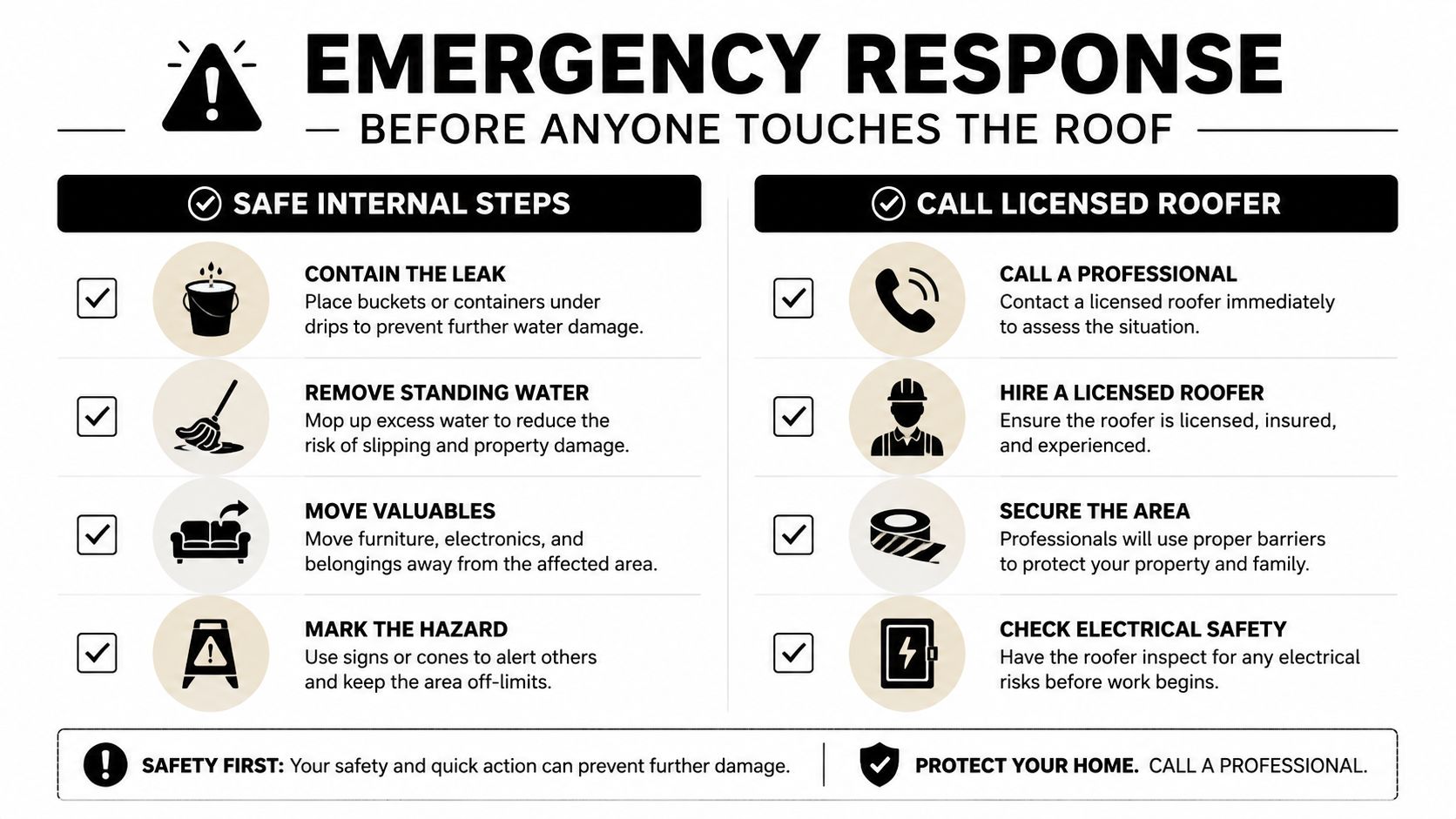
The safest response starts inside the building. If water is tracking near lights, machinery, switchboards or tenant work areas, isolate the affected circuit and keep people out of the drop zone until the ceiling and electrics are checked. A dripping ceiling tile can fail suddenly once the void fills, and that's a nuisance when it lands in a bucket, but a hazard when it lands on someone standing underneath.
Containment should be deliberate, not improvised. Move stock, furniture and sensitive equipment out of the wet area, then place containers where the drip is cleanly captured instead of spread across flooring. If the ceiling is bulging, don't punch it blindly. The safer move is controlled drainage by a licensed tradesperson, because aggressive opening can dump water straight into wiring or finished surfaces.
The other immediate job is documentation. Take photos of the stain, the affected room, the roof access point if it's visible from the ground, and any damaged inventory or fitout elements. That record helps later if the insurer asks when the leak was first noticed or whether the damage was storm-related, gradual or connected to maintenance history.
What not to do
Do not send someone onto a wet metal roof without the right fall protection. Do not drill random holes in a ceiling or roof sheet to “let the water out”. Do not smear solvent-based sealants near electrical equipment or ignition sources. Those shortcuts create secondary damage, and they can turn a roof problem into a workplace safety issue.
A temporary tarp patch is different. Used correctly by a competent roofer with fall protection, it can buy time until conditions are safe for the permanent repair. That's a stopgap, though, not a finish.
If your internal team needs a safety reference before anyone goes near the roof access, this roof-anchor guidance is a sensible companion to your site procedure.
The internal protocol should be boring
That's a good thing. A one-page response sheet for building managers should say who isolates power, who clears the area, who calls the roofer, and who photographs the damage. The less room there is for improvisation, the less likely the same mistake gets repeated by the next person on duty.
Diagnosing the Leak Without Trusting the Stain
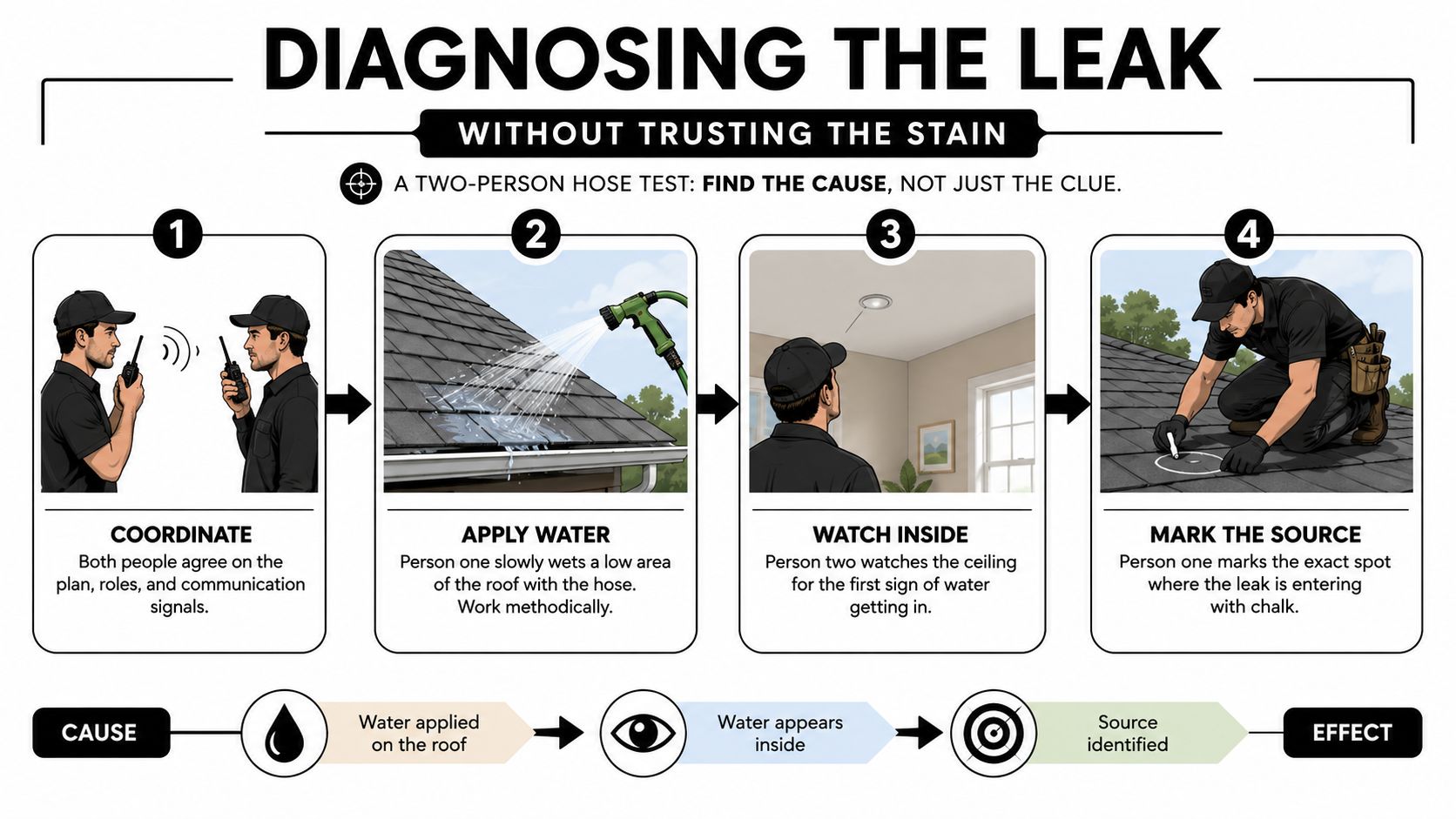
The visible water mark is usually downstream of the breach. That's why chasing the stain itself is such a common failure in roof leak repair, especially on commercial roofs where water can travel sideways through a void before it shows up indoors. The reliable field method is a two-person hose test, with one person inside watching the attic or ceiling line and another person wetting short roof sections from downslope upward until the first drip appears (two-person hose test method).
Water almost never enters where the stain appears. Find the upstream point first, then repair there.
The logic is straightforward. If you start at the wet mark and repair only that area, you're often fixing the consequence rather than the cause. Working upslope makes more sense because it follows the path water would take in service, and it narrows the field fast enough for a roofer to mark the actual entry point before opening up the roof.
Leak, condensation or envelope failure
This is the part most generic how-to content skips. A wet ceiling isn't always a puncture or broken tile. In commercial buildings, it can be condensation driven by HVAC, skylights or poor moisture movement, or it can be a broader building-envelope failure around gutters, penetrations or concealed roof-system details. That distinction matters because the repair scope changes from a local fix to ventilation, drainage or enclosure work.
The cleaner way to think about it is this. If the wetness appears only after rainfall and can be traced by hose testing to one entry point, you're probably dealing with a roof breach. If the moisture appears during cooler conditions or around air-conditioned zones without corresponding rain, the cause may be condensation or poor air movement. If the ingress shows up around multiple details, the issue may be a system-level envelope failure rather than one broken component.
For flashing-specific problems, roof flashing types is useful background because flashing is often where the roof system fails before the field material does.
What to capture before scope is agreed
Photos of the stain matter, but so does evidence of roof condition around the suspected area. Look for rust at fasteners, lifted edges, cracked sealant, blocked drainage, loose laps and any penetrations that look patched more than once. A good roofer should be willing to explain why the observed symptom points to one repair scope rather than another.
Practical rule: don't approve a repair until the roofer can show you the likely entry path and explain why the stain is downstream of it.
That same discipline protects strata managers and warehouse owners from paying for a cosmetic fix when the building needs a more complete diagnosis.
Matching the Repair Method to the Roof System
Commercial roofs in NSW fail in different ways, so the repair has to match the system in front of you. A Colorbond roof with loose fixings does not behave like a membrane roof with a split seam, and neither behaves like a tiled roof or an older asbestos-clad structure. Good repair work starts with the failure mode, not with the tube of sealant.
On real commercial jobs, the first question is whether you are dealing with a roof breach, condensation, or a broader envelope problem. If water shows up after rain and testing points to one entry point, the repair can usually stay local. If the wetting appears in cooler conditions, or around air-conditioned spaces without rain, the fix may belong to ventilation or building-envelope work instead of the roof skin itself. If the leak shows up across several details, the system is ageing as a whole and a small patch will not hold for long.
| Roof System | Common Failure Points | Typical Repair | Trigger for Replacement |
|---|---|---|---|
| Colorbond and standing-seam metal | Failed fasteners, degraded sealant joins, box gutter sumps | Replace fixings, rework joins, repair or replace damaged pans and flashing | Widespread corrosion, repeated leaks across multiple details |
| Membrane roofs, such as TPO, EPDM and PVC | Seam failure, punctures, poor lap detailing | Patch welding or targeted membrane replacement | Recurrent seam failure or broad membrane deterioration |
| Tiled commercial roofs | Broken or displaced tiles, failed ridge or flashing details | Replace damaged tiles and restore associated flashing | Extensive tile fatigue or structural substrate issues |
| Asbestos-clad roofs | Damaged sheets, failed overlaps, aged roof skin | Licensed removal and replacement to Australian standards | Any scope that crosses into regulated asbestos disturbance |
Metal roofs need detail work, not surface dressing
On Colorbond and standing-seam roofs, the usual failures sit at fasteners, joins and box gutter details. A smear of sealant over the leak point may slow the water down for a while, but it does not fix the lifted edge, the failed fixing or the joint underneath. On many Sydney industrial sheds, the practical repair is a targeted replacement of the failed pan, flashing or fixing set, then a check of the surrounding areas for early corrosion and secondary leaks.
That is a judgement call on site. If the damage is local, keep the repair local. If water is coming back through several laps, gutters or transitions, the roof is telling you the system has aged past a simple spot repair.
Membranes need the right patch, not a cover-up
Membrane roofs need compatibility and proper surface prep. A correct patch or welded repair is a targeted intervention that bonds to the existing system. A coat of sealant over a failed membrane usually does not last, because the split, contamination or lap defect is still active under the coating, and the roof movement keeps working against the repair.
The detail matters more than the product label. If the seam has let go, the patch has to address the seam. If the puncture is isolated, a local membrane repair can be enough. If the membrane is broadly aged, brittle or repeatedly failing at the same joins, replacement starts to make more sense than chasing one leak after another.
Tiled and asbestos roofs have different rules
Tiled commercial roofs can often be repaired locally if the substrate and flashings are still sound. Broken or displaced tiles are one thing, but once the underlay, battens or flashing details are failing as well, the scope grows quickly. The repair needs to suit the tile system, not just the stain on the ceiling below it.
Asbestos-clad roofs are a different job altogether. The handling rules decide who can touch the roof and how far the work can go, so the repair stops being a simple maintenance call once the scope crosses into regulated asbestos disturbance. In that situation, the work becomes licensed removal and replacement to Australian standards, not a patch-and-go repair.
Commercial Roofers handles leak repairs across NSW and also manages asbestos roof removal and replacement to Australian standards, which matters when the repair scope turns into compliance work.
The Repair Workflow That Actually Holds
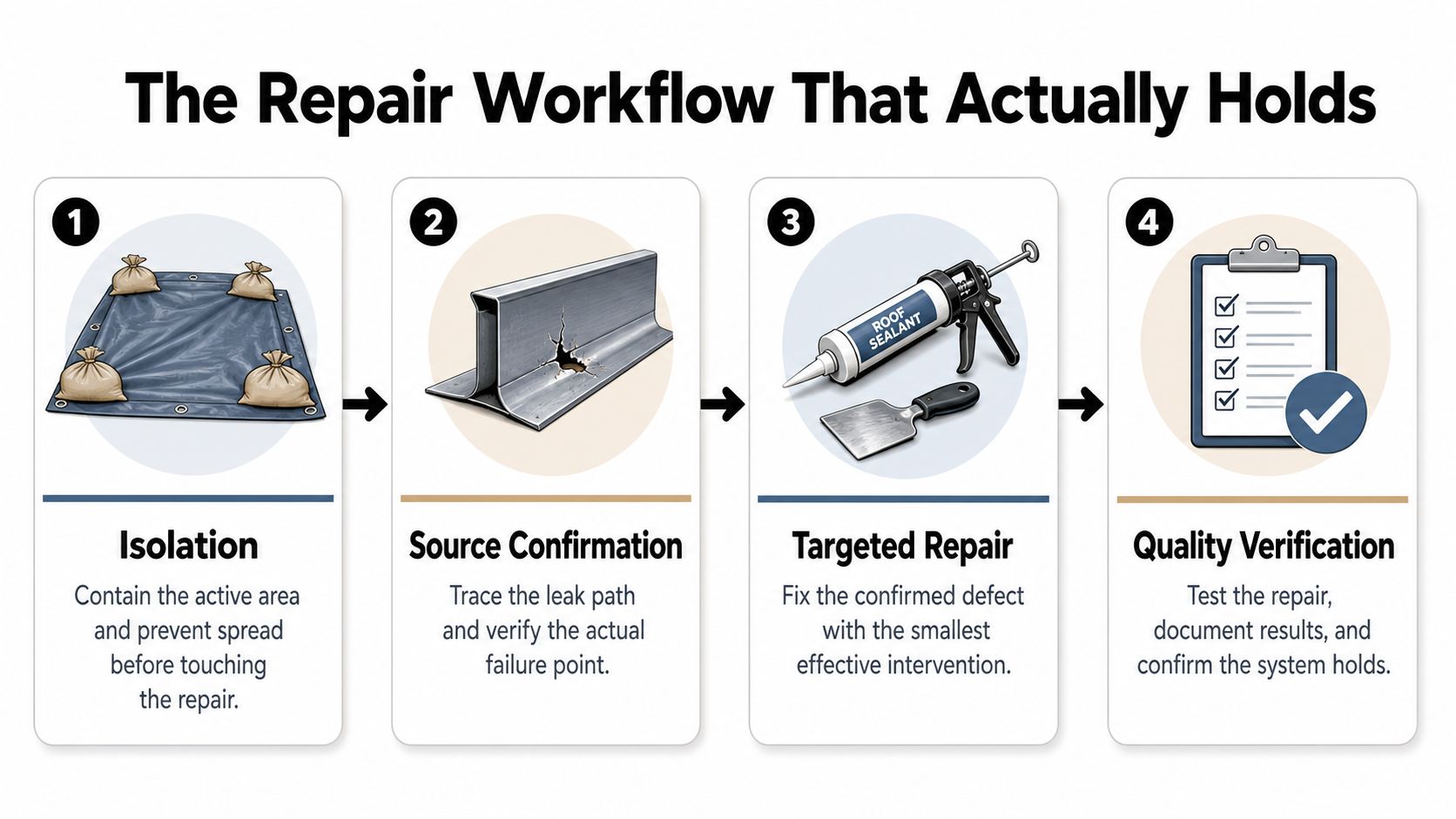
A competent repair starts by isolating the source area and marking it clearly. That marking matters because roof teams work faster and safer when they can see the tested path, not just the interior symptom. Once the source is confirmed, the failed component comes out. The aim is to remove what failed, not bury it under a cosmetic layer.
Replace the failing part, not the memory of it
That sounds blunt because it needs to be. If the flashing is cracked, replace the flashing. If the membrane is split, patch or replace the affected section with matching material. If the tile or metal sheet is beyond recovery, swap it rather than trying to save a sheet that's already compromised. Good repair work is selective, not sentimental.
The final phase is verification. A repair is not complete until the leak no longer reproduces under simulated rainfall, which means a repeat hose test or controlled water test after the work is done. If the test still produces water inside, the source was either higher up the roof or tied to a detail that wasn't exposed in the first pass.
What a proper handover includes
A clean handover should show the repaired area, the testing result and any adjacent issues that are starting to age. The roofer should be able to point to photos of the old failure point and the finished repair, then explain whether nearby joins, sumps or penetrations need follow-up. That record is useful for the owner, the manager and the insurer, because it links the repair to a tested outcome rather than a vague promise.
Practical rule: no verification, no closure.
If the test fails, don't force the job to end. Open the scope back out, move upstream and test again. That extra hour is usually cheaper than redoing a sealed-up ceiling later.
Costs, Timelines and Working with Your Insurer
The cost of a commercial roof leak repair in NSW usually isn't driven by the patch itself. It's driven by access, timing and complexity. A small repair can be straightforward on paper, but once you add after-hours callout timing, storm-event demand, scaffold, boom lift access or traffic control, the repair budget shifts quickly toward the setup rather than the material.
Timelines work the same way. Matching older Colorbond profiles or specialty membranes can take time, and older roofs may need a short emergency mitigation first, followed by a permanent rectification once materials are available. That's not indecision. It's often the most practical way to keep the building dry while the right parts and access are organised.
How insurance conversations usually go better
Document the leak early, keep the photos, and be clear about whether the event followed a storm or was noticed during normal operation. That distinction matters because insurers look differently at sudden weather damage and gradual wear. If the roofer attends the assessor visit, the scope conversation usually gets sharper because the repair path can be explained in practical roof terms instead of generic building language.
The other point to keep in mind is compliance. If the roof is asbestos-containing and the repair scope disturbs more than a small local area, the job can shift from repair into licensed removal and replacement, which is a different project altogether. That's where the right contractor saves time by stopping the scope drift early.
The cheapest repair quote is not always the cheapest outcome if the access, compliance and replacement path haven't been thought through.
For owners comparing options, Commercial Roofers is one contractor that combines inspection, diagnosis, leak repair and asbestos roof replacement work under the same project team, which can reduce the handoff problems that often slow down commercial jobs.
Stopping the Next Leak Before It Starts
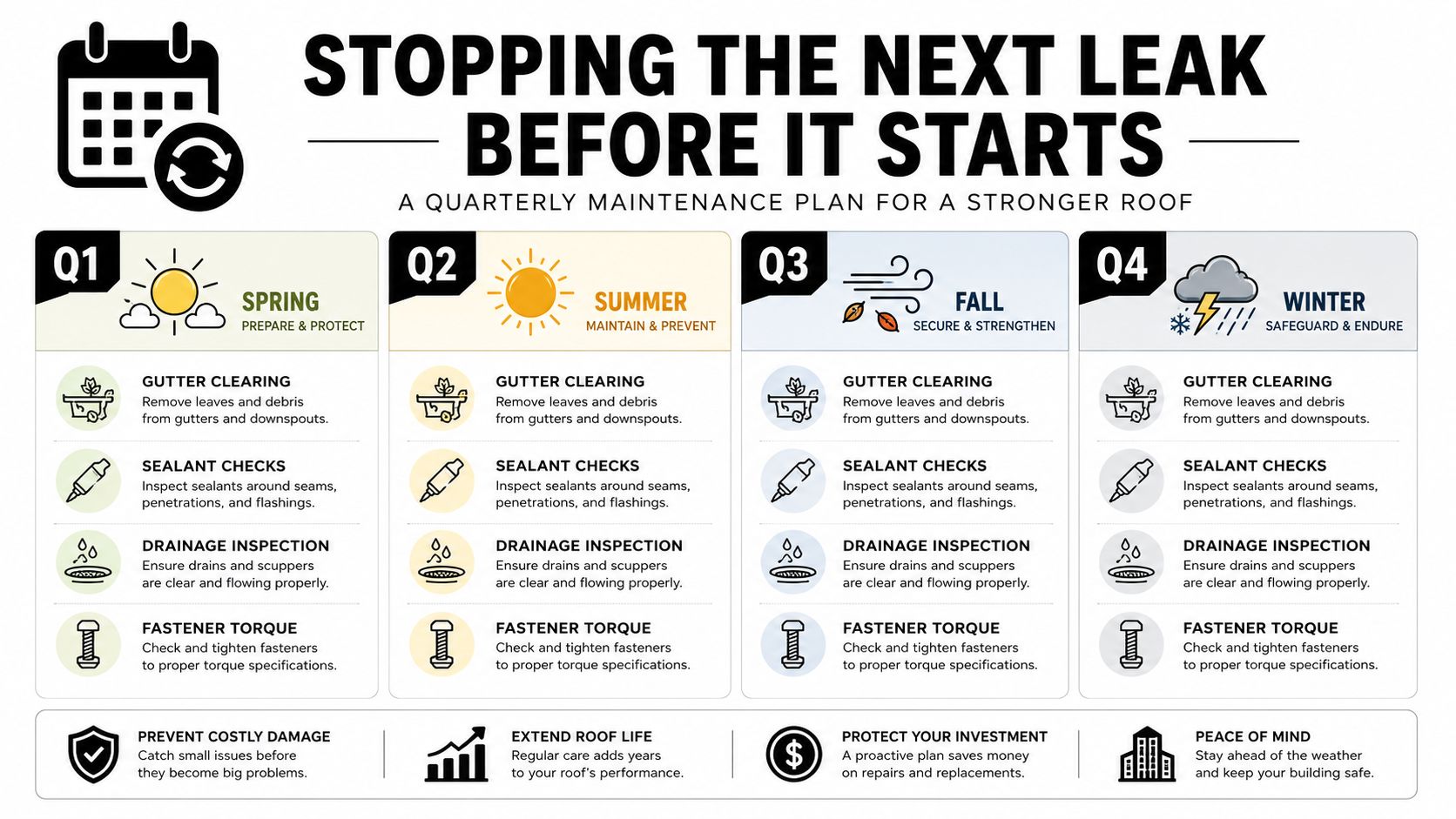
The easiest leak to repair is the one your team finds before water enters the building. In NSW, that means a scheduled inspection rhythm built around weather, with extra attention after major storm events. A thorough inspection should go beyond a quick look at the sheet metal and cover fasteners, sealant joins, box gutter sumps, parapet capping, penetration flashings and drainage performance.
What a good maintenance round actually checks
The practical checklist is simple. Clear gutters before debris builds up, inspect drainage after heavy rain, check sealant joins for movement, and look at fasteners where thermal cycling tends to loosen details over time. On larger commercial roofs, the value is in repeatability. The same areas fail first, and the same areas need watching first.
That's why well-run portfolios treat maintenance as an operating cost, not a capital surprise. Minor repairs done proactively are usually easier to manage than emergency callouts after water has already moved into the ceiling, fitout or stock area. The repair work itself may be small, but the disruption from waiting rarely is.
A practical six-month and twelve-month rhythm
Use the six-month check for cleaning, visible damage and drainage performance. Use the twelve-month check for a fuller inspection report, including fastener condition, flashing integrity and any signs that a local repair is starting to spread. If a storm has just passed through, move that inspection forward rather than waiting for the calendar.
The right relationship with a roofer is ongoing. Not firefighting, just steady maintenance backed by fast response when weather changes the picture. If your site needs a practical plan for leak diagnosis, repair and prevention across a commercial roof portfolio, organise a site inspection and ask for a written scope that separates emergency mitigation from permanent rectification.
If you're dealing with a live leak, a recurring stain or a roof that keeps failing after storms, book a commercial inspection and get the source identified properly before the damage spreads. The team at Commercial Roofers works across NSW on leak repairs, roof replacements, asbestos removal and maintenance reporting, so you can turn a one-off emergency into a clear repair plan instead of another ceiling patch.