
The usual advice to pressure-wash a dirty roof skips the most important decision: whether the surface should be washed at all. On a commercial site, aggressive cleaning can strip a protective patina, damage a coating or push water through otherwise serviceable laps. If the roof material is uncertain, washing can create a much bigger problem than the dirt you started with.
Good metal roof cleaning starts with identification, access planning and a clear treatment decision. The job is to remove harmful contamination without sacrificing the roof's weatherproofing, coating system or safe use of the building below.
Table of Contents
- Assess Roof Metal and Asbestos Risk First
- Choose the Cleaning Method by Roof Metal and Condition
- Manage Falls, Water Restrictions and Runoff Before Work
- Clean the Commercial Metal Roof Step by Step
- How Often to Clean and What to Record
- Confirm the Method Statement Before You Book
Assess Roof Metal and Asbestos Risk First
- Identify the roof material. Establish whether you're dealing with steel, aluminium, zinc, copper, Zincalume, painted Colorbond or fibre-cement. Use drawings, original sheet markings and the building's material register where available, but don't treat building age or appearance as proof.
- Check the coating. Record chalking, cracking, bubbling and exposed substrate. Distinguish surface dirt from a deteriorating finish before choosing a detergent or promising a uniform result.
- Map defects and drainage. Inspect laps, fasteners, sealants, penetrations, skylights and visibly sagging or fragile sheets. Mark blocked gutters, drainage restrictions and stormwater inlets whose destination hasn't been confirmed.
- Photograph and resolve uncertainty. Take overview photographs and close-ups that show where defects sit on the roof. Request existing material records or arrange appropriate sampling through a competent specialist before finalising a cleaning quote.
- Apply the asbestos gate. If fibre-cement could contain asbestos, stop conventional cleaning and arrange specialist assessment. Don't let a contractor use a trial wash to identify the material.
Why the asbestos gate comes first
SafeWork NSW's prohibited-equipment guidance prohibits high-pressure water spray, compressed air and specified abrasive equipment on asbestos-containing materials, subject to the applicable approved controls and exceptions. A routine pressure-cleaning setup isn't a substitute for those controls.
Pressure cleaning can erode the cement surface and carry contaminated slurry beyond the roof. Gutters, paving, vegetation and neighbouring properties can become part of the contamination area, turning a maintenance task into specialist remediation.
Suspected material needs controlled access and trained personnel, with appropriate licensing where required. Don't interpret a low-pressure alternative as permission for ordinary cleaners to proceed on an unidentified roof.
If replacement becomes the appropriate path, understand the scope of asbestos roof removal and replacement before combining it with other roof work. Cleaning and removal require different planning, waste arrangements and site controls.
Make the assessment usable
A useful inspection record connects each photograph to a roof location and a decision. “Rust near gutter” is less useful than a marked roof plan showing the affected sheet, adjacent penetration and drainage route.
For teams struggling to turn site notes into a clear handover, Truespeak's guide to improve roof inspection report turnaround is a relevant workflow resource. Faster reporting should come from organised evidence, not omitted checks.
Release decision: Go when the substrate and coating are confirmed and the required controls are ready. Pause when identification or documentation is incomplete. Stop conventional cleaning when asbestos is suspected or sheets are fragile.
Choose the Cleaning Method by Roof Metal and Condition
| Roof condition | Recommended method | Pressure and water | Key caution |
|---|---|---|---|
| Painted steel or Colorbond with light dirt | Manual debris removal, then non-abrasive detergent and rinse | Lowest effective pressure, ridge to eave | Use a detergent the coating maker approves |
| Zincalume or galvanised sheet with moss or algae | Compatible biocide, dwell time, then rinse | Low-flow rinse | Check coating condition before any stronger chemical |
| Copper, zinc, lead or aluminium with stable patina | Gentle rinse and soft brush only where needed | Low pressure only | Do not strip the protective patina |
| Coastal or industrial fallout containing salt or sulphates | Low-pressure rinse plus inspection | Low pressure | Residue can accelerate corrosion at fasteners and laps |
| Rusted iron or steel | Remove loose rust, then repair and recoat | Cleaning alone is not the fix | Washing can leave bare steel exposed |
| Galvanic contact between dissimilar metals | Separate or replace the component | No wash-down as treatment at the contact point | Moisture at contact drives galvanic corrosion |
| Suspected asbestos-cement | Stop and arrange specialist assessment | No high-pressure water, jets or compressed air | NSW prohibitions apply unless the relevant approved controls or exceptions apply |
Protect the surface rather than chasing a uniform colour
A dirty painted roof and a weathered copper roof can look equally uneven while needing completely different treatment. The Queensland Government's minor repairs to metalwork guidance distinguishes rust requiring treatment on ferrous metals from stable protective patinas on metals including copper, zinc, lead and aluminium.
Stable patina isn't dirt. Don't chemically strip it just because a building manager wants every panel to match. Use gentle cleaning only to remove deposits sitting on the surface, and investigate any powdering, pitting or localised deterioration separately.
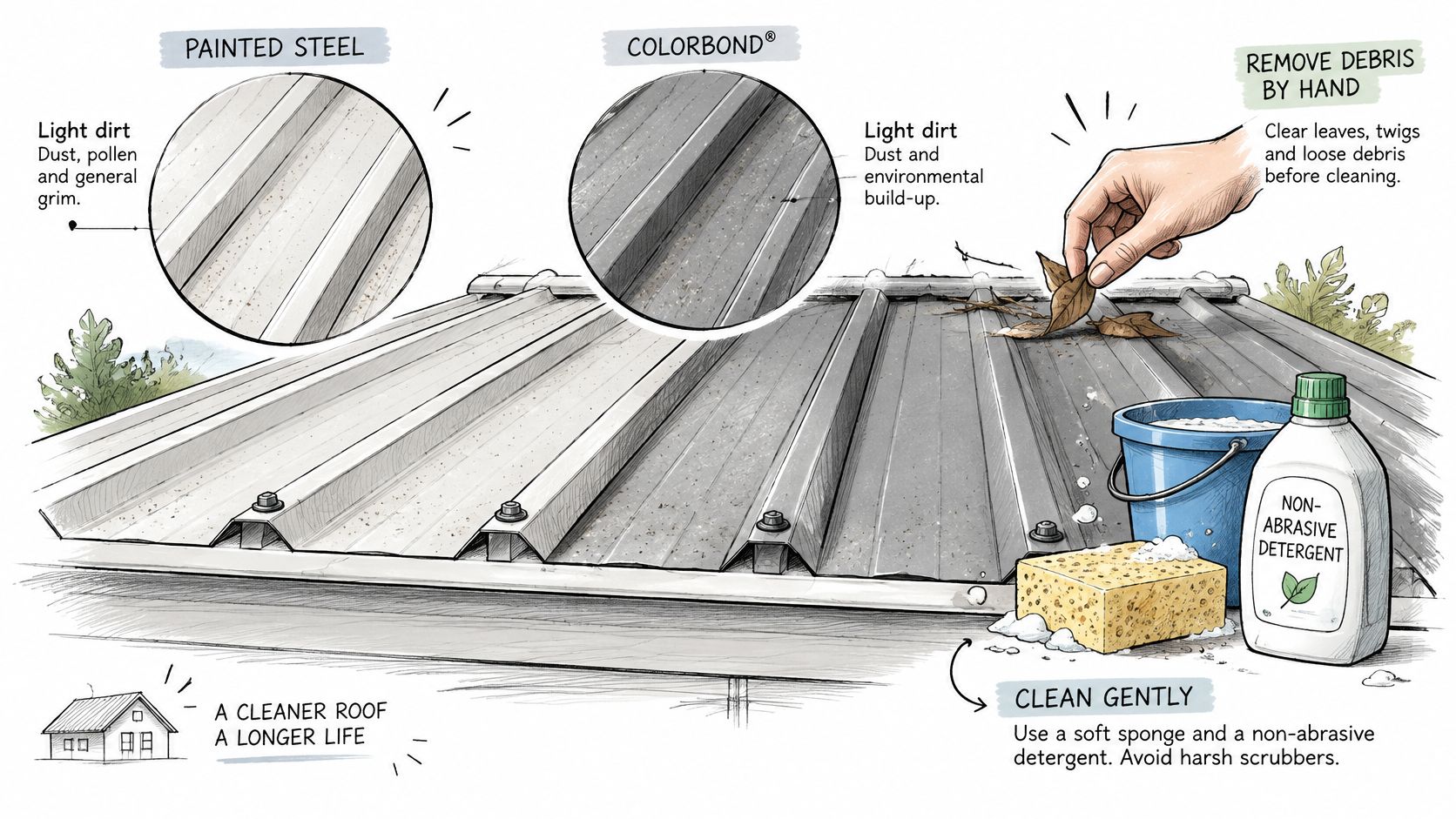
For painted steel, the coating manufacturer's cleaning instructions should determine the product and technique. Check warranty conditions before work, rather than assuming that a cleaner described as suitable for metal is suitable for that particular finish.
Gentle contact cleaning is useful where the coating permits it.
Treat corrosion as a repair decision
Salt and industrial contamination need attention at joints, not just on the open sheet. The Queensland Government roofing technical note explains that corrosion continues while water is present and accelerates in air contaminated by sulphates and chlorides.
Rust staining also needs diagnosis. Scrubbing the orange mark away won't correct a failed fastener washer, damaged coating or corroded flashing. Where treatment is appropriate, prepare back to sound metal and use a compatible primer and protective coating system; a zinc-rich primer may form part of that specified repair.
Mixed-metal defects need a different response again. If incompatible components meet in a damp location, cleaning doesn't remove the cause. Have the junction assessed for separation or component replacement, including the route water takes from one metal onto another.
Before treating the whole roof, test a small, representative area. Check it after rinsing and drying for colour change, coating softening, residue and whether the deposit lifted.
The result should support a clear decision: wash the contamination, repair the coating, replace the defective component or leave the protective patina alone. A stronger chemical isn't the automatic next step when a mark remains.
Manage Falls, Water Restrictions and Runoff Before Work
Safe access comes before cleaning equipment. A roof that looks continuous from the ground can contain corroded sheets, brittle areas and fragile skylights. Don't allow the crew to establish its walking route by stepping across it.
Specify suitable access, designated walkways or engineered crossings, and restraint or fall-arrest arrangements selected for the site. Where fall arrest is used, the plan must also address rescue rather than stopping at harness provision.
Establish a controlled work area
The access plan should identify where people may stand, how equipment reaches the roof and which areas must remain untouched. Review the building's roof access systems alongside the cleaning scope, particularly where routine maintenance has previously depended on temporary ladders.
- Fragile areas: Keep workers off suspect sheets and unprotected skylights. A harness doesn't make a weak roof safe to walk on.
- Industrial residue: Identify deposited material before disturbing it. Select respiratory and skin protection from the hazard assessment and product safety information.
- Occupied areas: Establish exclusion zones below the work and coordinate loading docks, entrances and pedestrian routes with the building manager.
- Weather limits: Record conditions that trigger postponement or shutdown, including wind affecting spray control and rain affecting footing or capture capacity.
Keep roof traffic to the access paths needed for the task. Moving hoses, buckets and machinery repeatedly across a deteriorated roof creates unnecessary exposure for workers and the coating.
Confirm water use and capture arrangements
Check the applicable water authority's current rules before mobilisation. The Bureau of Meteorology's water restrictions database shows that restrictions differ between service areas and can limit or prohibit hosing roofs and other hard surfaces.
Record the water source, permitted use and trigger-controlled equipment in the method statement. Don't assume a commercial booking creates an exemption, and don't substitute an unsuitable chemical method just because water use is restricted.
Runoff planning needs more than a filter dropped into a downpipe. Identify what the water may contain, where it will collect, how it will be transferred and where the resulting waste can lawfully go.
A slower method with controlled water use is preferable to a fast wash that sends contamination through an occupied site.
Protect nearby vehicles, façades and landscaping, but don't rely on covers as the primary containment system. Keep contaminated water out of stormwater, and arrange suitable collection and disposal for the contaminants present. If the site can't provide safe access or effective containment, postpone the clean or redesign the method.
Clean the Commercial Metal Roof Step by Step
Use this sequence only after the roof has been released for the selected cleaning method. The written work instructions should connect the cleaning area, drainage controls and inspection requirements so the crew isn't improvising at the roof edge.
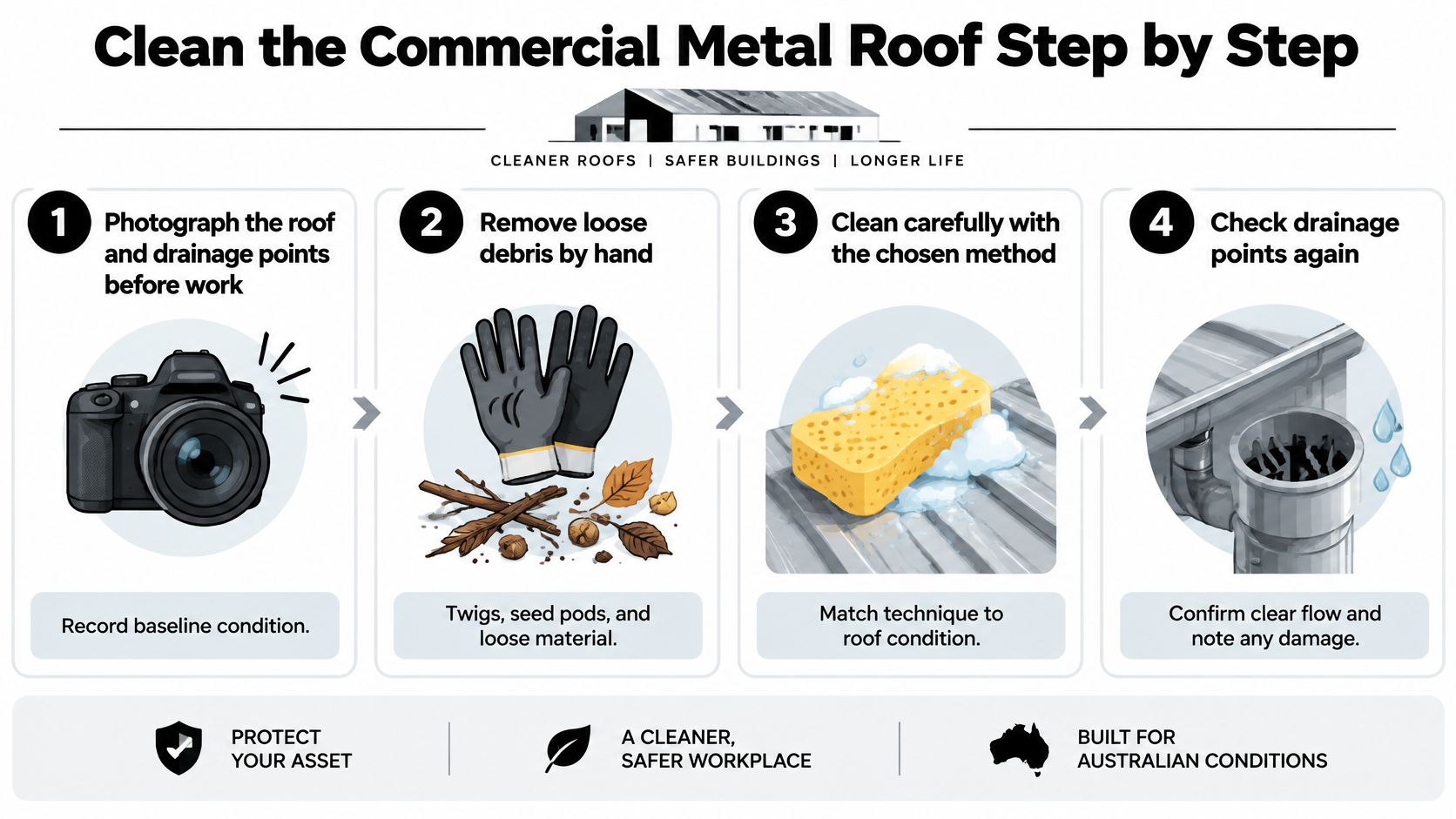
The illustrated sequence provides a simple site briefing aid.
Carry out the clean in controlled stages
Photograph the baseline. Record the roof, gutters, drainage points and existing damage before moving debris. Include interior leak locations where relevant, because an exterior photograph alone won't establish whether a wet patch was already present.
Remove loose debris by hand. Lift twigs, seed pods, stones and old nails into a container, then use a soft broom on suitable surfaces. Don't drag sharp material along the sheets or sweep it into gutters for someone else to remove.
Set the drainage controls. Protect or temporarily isolate the nominated downpipes and stormwater inlets before introducing chemicals. Maintain a controlled drainage path, because blocking outlets without collection capacity can create ponding or overflow.
Apply the selected cleaner. Use the manufacturer-compatible non-abrasive detergent or biocide at its specified dilution and allow the required dwell time. Work in manageable areas so the product doesn't dry unintentionally, and don't mix chemicals to make a stronger solution.
Rinse with the roof's drainage direction. Work from the ridge towards the eaves at the lowest effective pressure permitted for the surface. Keep the spray directed down the sheet rather than upward beneath laps, flashings or penetration seals.
Collect residue before restoring drainage. Capture contaminated water and remove retained solids using the agreed waste method. Check that filters or collection devices haven't clogged, and reopen outlets only once the discharge path is ready.
Inspect and photograph the result. Examine laps, fasteners, flashings, penetrations, gutters and any newly visible coating defects. Record repairs separately from cleaning completion, rather than describing an exposed defect as something the wash has fixed.
Debris removal is protective maintenance, not just preparation for a better-looking wash. The Western Australian Government's corrugated roofing guidance explains that objects resting against sheets can create moisture-holding crevices that accelerate loss of the protective zinc coating.
Close out the work properly
The Asbestos and Silica Safety and Eradication Agency's practical guidance reinforces why material identification must precede cleaning equipment selection. A generic pressure-washing demonstration should never override the site's substrate assessment or approved method.
Use the video as supporting visual context, not as the work instruction for an unidentified commercial roof.
A completed clean leaves the work area free of loose debris, drainage functioning and no unexplained new wet patches. Any remaining ponding, coating failure or suspected leak belongs on the defect list, with dated photographs and a recommended next action. Don't sign off those conditions as resolved merely because the roof looks cleaner.
How Often to Clean and What to Record
Set cleaning frequency from exposure and inspection findings, not a universal calendar. A coastal building, a shaded strata complex and an inland warehouse don't accumulate the same contaminants. Even different roof slopes on the same property may need different attention.
Cleaning frequency by commercial site type
| Site type | Suggested interval | Main trigger | What to check |
|---|---|---|---|
| Coastal or salt-exposed | Set from salt accumulation and coating inspections | Airborne salt and humidity | Fasteners, coating chalking, rust spots |
| Heavy industrial or chemical fallout | Set from contamination assessment and repeat findings | Fallout and acid rain | Coating breakdown, runoff routes, corrosion |
| General low-pitch warehouse with organic debris | Revisit before debris recreates persistent wet areas | Leaves, seed pods and ponding | Gutters, ponding areas, laps |
| Shaded strata or heavy tree cover | Schedule around observed leaf and seed accumulation | Leaf and seed debris | Gutters, downpipes, moss growth |
| Inland, steep pitch, light debris | Clean when inspection identifies harmful deposits | Dust and light soiling | Coating condition, flashings |
Treat these as condition-based scheduling rules, not fixed manufacturer intervals. Start with the roof's maintenance requirements, then shorten the return period where photographs show recurring contamination or drainage obstruction.
Low-pitch sections deserve particular attention because debris can remain where water drains slowly. On steeper, lightly contaminated areas, repeated washing may offer less value than inspection and targeted removal of deposits.
Keep records that support maintenance and warranty decisions
Retain a dated roof plan, before-and-after photographs, product names, dilution details, batch information where available, the cleaning method and any repair notes. Store the relevant coating-maker instructions with the job record, including written clarification where the proposed method falls outside published guidance.
A structured roofing and maintenance approach helps separate recurring cleaning from defects requiring repair. For contractors organising inspection photographs, work orders and handovers, JobsiteStack's guide to choosing tools for a roofing business provides useful context for selecting a recordkeeping workflow.
Warranty check: A clean-looking roof doesn't prove the method complied with the coating's care requirements. Keep evidence of what was used and how it was applied.
For budget context, Your Local Roofers' cost guide priced Australian metal/Colorbond roof cleaning in 2024 at approximately $2.20–$6.50 per square metre, depending on soiling. Treat that as a historical guide, not a current commercial-site quote; access, containment and repair scope need their own assessment.
Confirm the Method Statement Before You Book
Don't book a wash on the strength of a square-metre price alone. The contractor needs to identify the roof material and explain how the proposed method suits its condition. If they can't establish the substrate before cleaning, reject the proposal.
The method statement should be specific enough that the building manager can understand what will happen, what will stop the work and what evidence will be handed over. A generic document naming a pressure washer and a harness doesn't answer those questions.
Questions that need clear answers
- Material assessment: What confirms the sheet material, and has any asbestos uncertainty been resolved?
- Surface compatibility: Which detergent or biocide will be used, and what supports its suitability for the coating?
- Access and weather: How will workers reach each area, avoid fragile surfaces and respond to unsuitable conditions?
- Water and waste: How will runoff be captured, and who is responsible for collection and disposal?
- Competency and cover: Which licences are relevant to the work, and what insurance covers the proposed activities?
- Handover: Will the report distinguish completed cleaning, unresolved defects and recommended repairs?
The estimate should match those answers. GetBill's guidance on how to set clear pricing in project estimates is useful for separating the base scope, exclusions and approval process for additional work.
Separate cleaning from remedial work
Specify whether the price includes only contaminant removal or also coating preparation, corrosion treatment and minor repairs. Decide how newly exposed defects will be documented and approved before the crew encounters them.
We offer Colorbond roof cleaning in Sydney and roof inspection services, while our scheduled metal roof maintenance includes inspection, cleaning and minor adjustments. An assessment gives the cleaning scope a sound starting point without assuming every surface needs the same treatment.
The booking decision should rest on an identified material, an appropriate method and a usable inspection record. Book the assessment first, then authorise the work that the roof needs.
Commercial Roofers offers roof inspections and Colorbond roof cleaning in Sydney, helping building managers establish the right scope before committing to a wash. Visit Commercial Roofers to book a roof assessment, and keep the dated photo record with your building's maintenance documents.