
You're probably looking at a roof issue that isn't dramatic enough to shut a site down, but it's annoying enough to keep coming back. Maybe a warehouse owner wants to know if the leak is a simple flashing problem, maybe a strata manager needs evidence before approving repairs, or maybe an insurer wants clearer proof than a few phone photos taken from the ground. That's where a drone roof inspection stops being a gadget exercise and becomes a practical way to document what's happening on a commercial roof.
The key question isn't whether a drone can take pictures. It's whether the report gives you evidence you can use for maintenance decisions, insurance discussions, and defect triage on a real Australian roof with plant, parapets, glare, and access limits. On that point, the answer depends on how the flight is planned, what the sensor can see, and how the findings are documented under Australia's commercial operating rules, including the CASA Remotely Piloted Aircraft Systems framework and its standard 120 m height limit for commercial operations, plus the approvals needed for higher-risk work (RoofVista guide on AI roof inspections and drones in 2026).
Table of Contents
- Why Commercial Properties Need Drone Roof Inspections
- Technical Capabilities of Modern Drone Inspection Systems
- CASA Compliance and Safety Requirements
- What Drone Inspections Actually Detect on Commercial Roofs
- The Inspection Process and Professional Deliverables
- Cost Factors and Return on Investment
- Choosing a Qualified Drone Inspection Contractor
Why Commercial Properties Need Drone Roof Inspections
A warehouse owner usually doesn't call for a roof inspection until something has already gone wrong. Water stains appear on stock cartons, a tenant reports dripping near a penetration, or a storm throws up enough concern that someone wants the roof checked before the next rainfall. On a big site, sending people onto the roof straight away can mean ladders, exclusion zones, disrupted operations, and real fall exposure, which is why a drone roof inspection has become the first sensible move on many commercial jobs in Australia (RoofVista guide on AI roof inspections and drones in 2026).
Where drones help the most
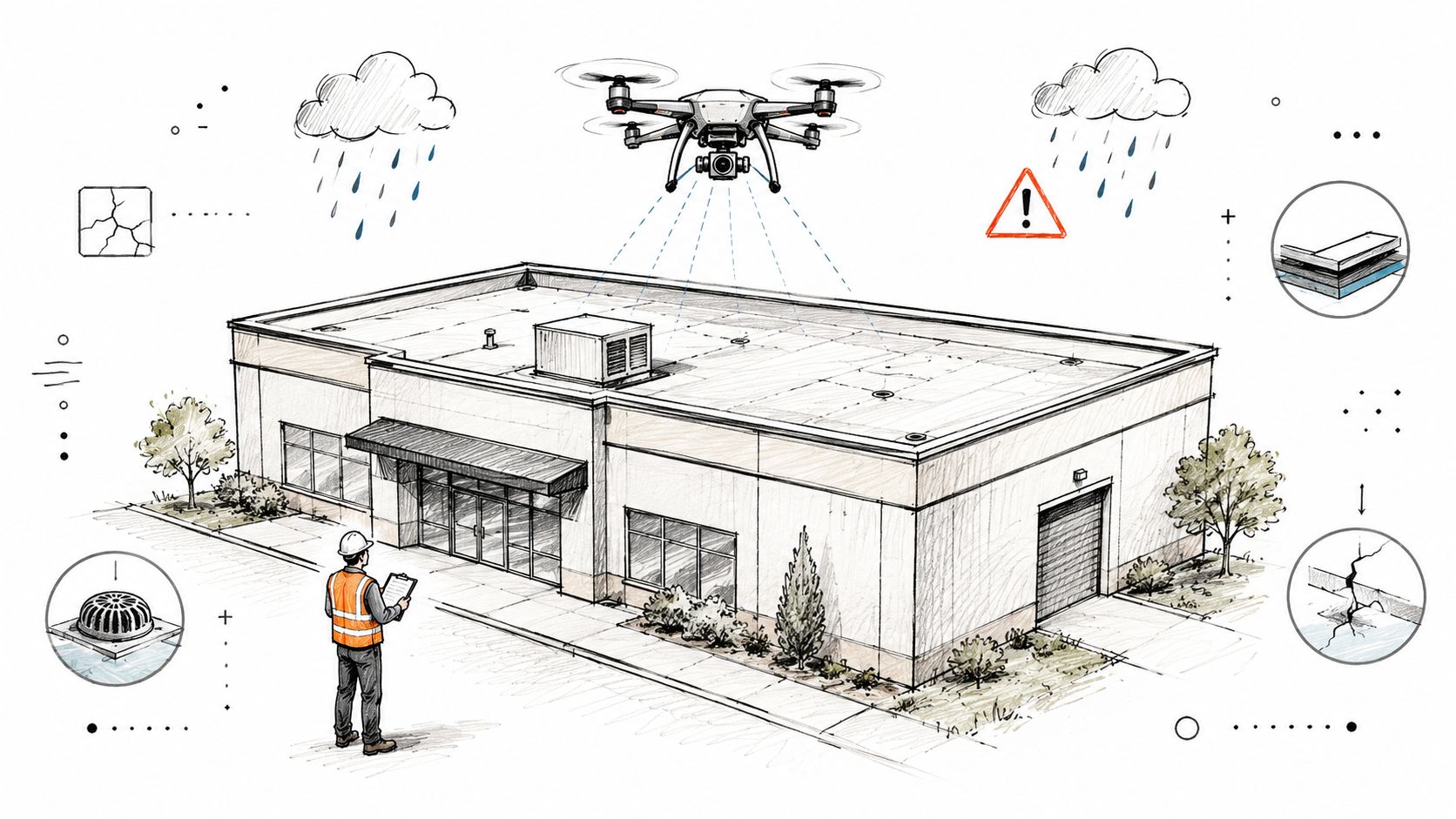
Large-format logistics sheds, factories, strata complexes, and buildings with rooftop HVAC plant are the obvious candidates. The roof area is often too wide to inspect efficiently from access hatches alone, and the critical issues are usually at edges, gutters, flashings, and penetrations rather than the broad centre of the field.
That matters because the business problem is rarely “is there a roof?”. It's “where is the defect, how urgent is it, and do we need a roofer, a plumber, or an insurer involved first?”. A drone gives you visual evidence before anyone commits to scaffold, edge protection, or a full roof access plan.
Practical rule: if the roof is hard to walk, hard to see, or hard to access without interrupting operations, the drone is usually the right first pass.
What changes for strata and industrial sites
Strata buildings often have restricted perimeter access, multiple roof levels, and owners who need clear documentation before approving spend. Industrial sites add another layer, with rooftop services, solar arrays, metal decks, and safety exclusions that make traditional roof walking slower and riskier.
For those assets, the drone doesn't replace judgement. It reduces uncertainty. You can inspect the problem areas first, then decide whether a closer manual check is justified. That's a better workflow than sending a crew onto a roof just to discover the issue is localised to one parapet or one blocked gutter line.
The strongest use cases are post-storm triage, routine condition monitoring, and pre-repair scoping. That is where a drone report is most defensible, because it shows what the roof looks like now and helps narrow down the next action without guessing.
Technical Capabilities of Modern Drone Inspection Systems
A commercial roof inspection only becomes useful when the equipment can capture detail, not just imagery. The baseline is a high-quality RGB camera, because many defects are visual before they're anything else. DJI's enterprise inspection system lists a 20 MP 4/3-inch RGB camera, a 48 MP tele camera, and laser rangefinding to 1800 m at 20% reflectivity, which gives inspectors a serious toolset for documenting roof edges, penetrations, and surface conditions (DJI roof inspection system).
What RGB, thermal, and ranging each do
RGB imagery shows the obvious faults, membrane damage, open laps, lifted flashings, rust streaking, and deterioration around plant. The tele camera matters when you can't safely hover close enough to a parapet or when you need a tighter look at a problem without physically entering a congested roof zone.
Thermal imaging is the other layer. For Australian commercial roofs, a practical setup is to fly at about 50 to 120 m AGL with 70 to 80% front and side overlap, calibrate emissivity to around 0.95 for concrete or asphalt roof materials, and use a thermal range of -20°C to 60°C to capture both sun-heated anomalies and cooler leak or insulation signatures (DroneDeploy thermal roof inspection guide). Those settings are about visibility and clean data, not marketing flair.
Why accuracy is a workflow issue
The value of a better sensor stack is not just prettier files. It is the ability to tie a defect to a place on the roof with enough precision that a contractor can return to the same penetration or gutter line later. Guidance for commercial roof work commonly recommends 640×512 thermal resolution or better and RTK-level positioning for centimetre-scale spatial accuracy, because that combination reduces ambiguity when you're documenting leaks, hail impact, or flashing failures across a large roof (DJI roof inspection system).
A strong drone report doesn't just show damage. It lets a roofer, insurer, or facility manager find that damage again without arguing over where it was.
Photogrammetry adds another layer by stitching overlapping images into an orthomosaic. In practice, the overlap settings and flight altitude do the heavy lifting. Higher overlap supports cleaner reconstruction, while lower altitude reduces ground sampling distance, which improves visible detail. That's why the flight plan matters as much as the sensor itself.
CASA Compliance and Safety Requirements
Australia's commercial drone work is not a free-for-all, and that's a good thing for property owners. The CASA Remotely Piloted Aircraft Systems framework gives the legal structure for commercial flight, including the standard 120 m height limit and the approvals needed for higher-risk work, which matters when the roof sits near controlled airspace or the building has site-specific hazards (RoofVista guide on AI roof inspections and drones in 2026). For a buyer, that means compliance is part of the deliverable, not just a paperwork extra.
What a property manager should verify
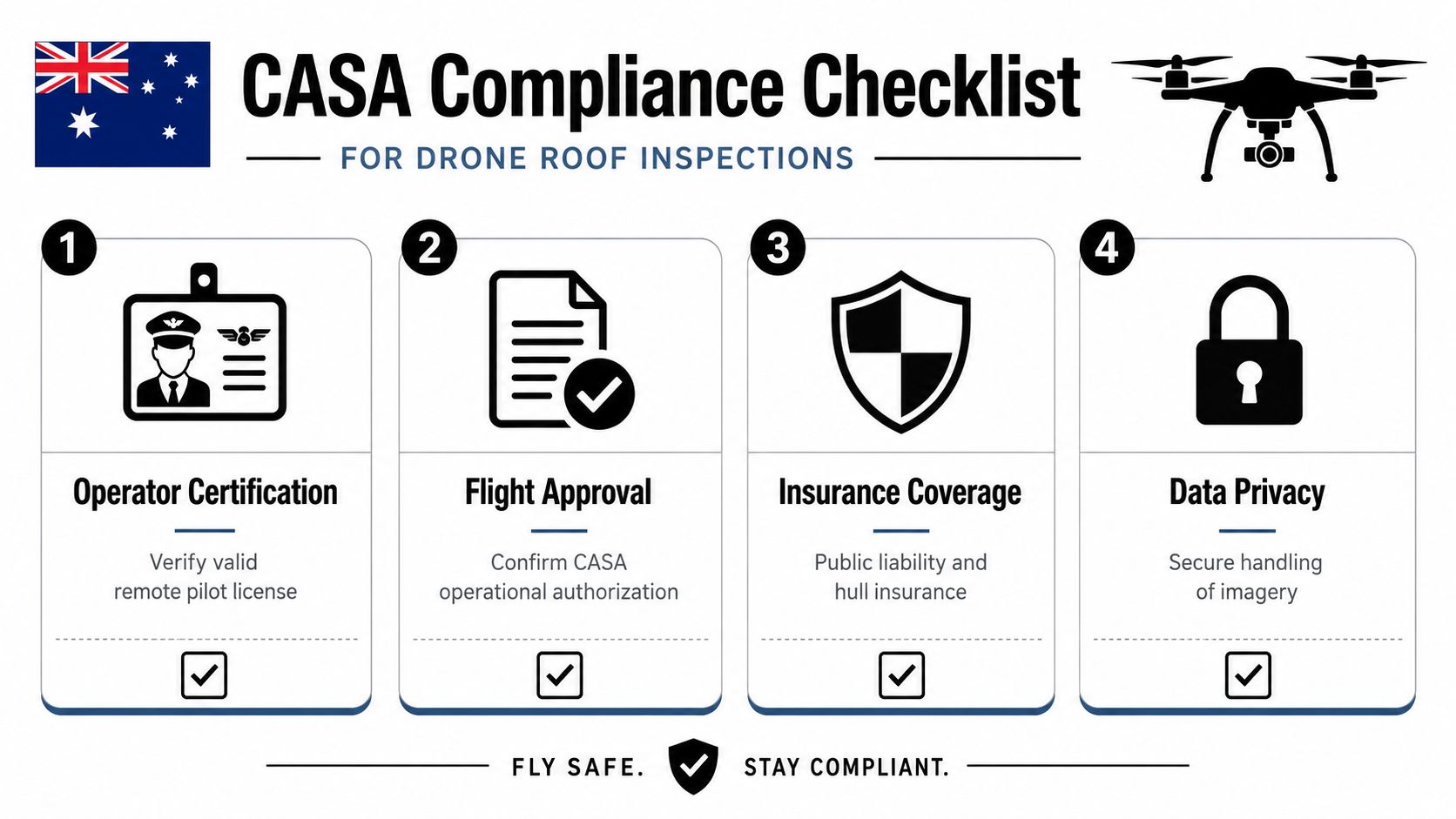
The operator should be able to show certification, insurance, and a compliant operating plan before anyone launches. If the site sits under airport influence, inside controlled airspace, or in a restricted zone, the flight plan needs to reflect that reality instead of pretending every roof is the same.
For older buildings, asbestos is another real issue. A drone doesn't disturb the roof surface the way a physical access crew might, so it can be a sensible first look when the material condition is unknown. That doesn't remove the need for proper management if a follow-up physical inspection is required, but it can keep unnecessary foot traffic off a suspect roof.
Why safety and legality affect report quality
A report is only as defensible as the flight that produced it. If the operator cuts corners on airspace checks or flies without proper approvals, the imagery may still look fine, but the report becomes harder to rely on in an insurance discussion or defect dispute.
That is why the compliance conversation should include data handling too. Roof imagery often shows tenant areas, plant equipment, and access points, so the operator should explain how imagery is stored and shared. One useful reference point for site managers is this roof safety anchor guide, because it reminds you that aerial access doesn't replace other fall-risk controls when people eventually need roof access.
The legal value of a drone inspection is simple. If the flight is compliant, the report is easier to defend. If it isn't, the images may still help you internally, but they're much weaker as evidence.
What Drone Inspections Actually Detect on Commercial Roofs
A drone finds the defects that show themselves from above or at an angle. It is strong on visual condition, moderate on thermal clues, and weak on anything that requires physical probing. On flat and low-slope commercial roofs, that means membrane tears, ponding water, flashing separation, gutter blockages, and visible surface degradation are all well within reach, especially when the operator shoots the roof edges and penetrations from more than one direction.
Common commercial roof defects detected by drone inspection
| Defect Type | Detection Method | Typical Findings |
|---|---|---|
| Membrane tears | RGB and oblique views | Open splits, punctures, worn seams |
| Ponding water | RGB, post-rain review | Standing water, poor falls, blocked drainage |
| Flashing separation | RGB close-up imagery | Lifted edges, failed laps, exposed fixings |
| Gutter blockages | RGB perimeter capture | Debris build-up, overflow risk, trapped water |
| Insulation issues | Thermal imaging | Hot or cool anomalies that suggest hidden loss |
| Penetration problems | Multi-angle capture | Cracked sealant, movement, loose collars |
Where the drone is strong, and where it isn't
Thermal imaging can reveal moisture trapped beneath membranes, insulation voids, and thermal bridging around penetrations and parapets, but it still needs interpretation. A heat signature is a clue, not a verdict. You often still need a roofer to confirm whether the anomaly is water, reflectance, shade, or an equipment effect.
Metal roofs are the trickiest because glare can make surface interpretation messy, especially in bright Australian sun. Solar arrays add another layer of complexity, since panels, mounting legs, and cabling can hide the exact problem area or create shadow patterns that confuse a quick pass. For that reason, recent Australian guidance has shifted toward low-angle passes, perimeter photos, and repeated views of damage areas, not just a single top-down sweep (ARIS Detect drone roof inspection guide).
For leak triage, a drone is excellent when the problem is visible or thermally distinct. It is weaker when the roof needs a hands-on moisture test, substrate probing, or close inspection under heavily obscured plant. That's why a good inspection report should say what it saw, what it suspects, and what still needs manual confirmation. A broader roof leak detection guide is useful here because leak origin and leak entry aren't always the same point on the roof.
The Inspection Process and Professional Deliverables
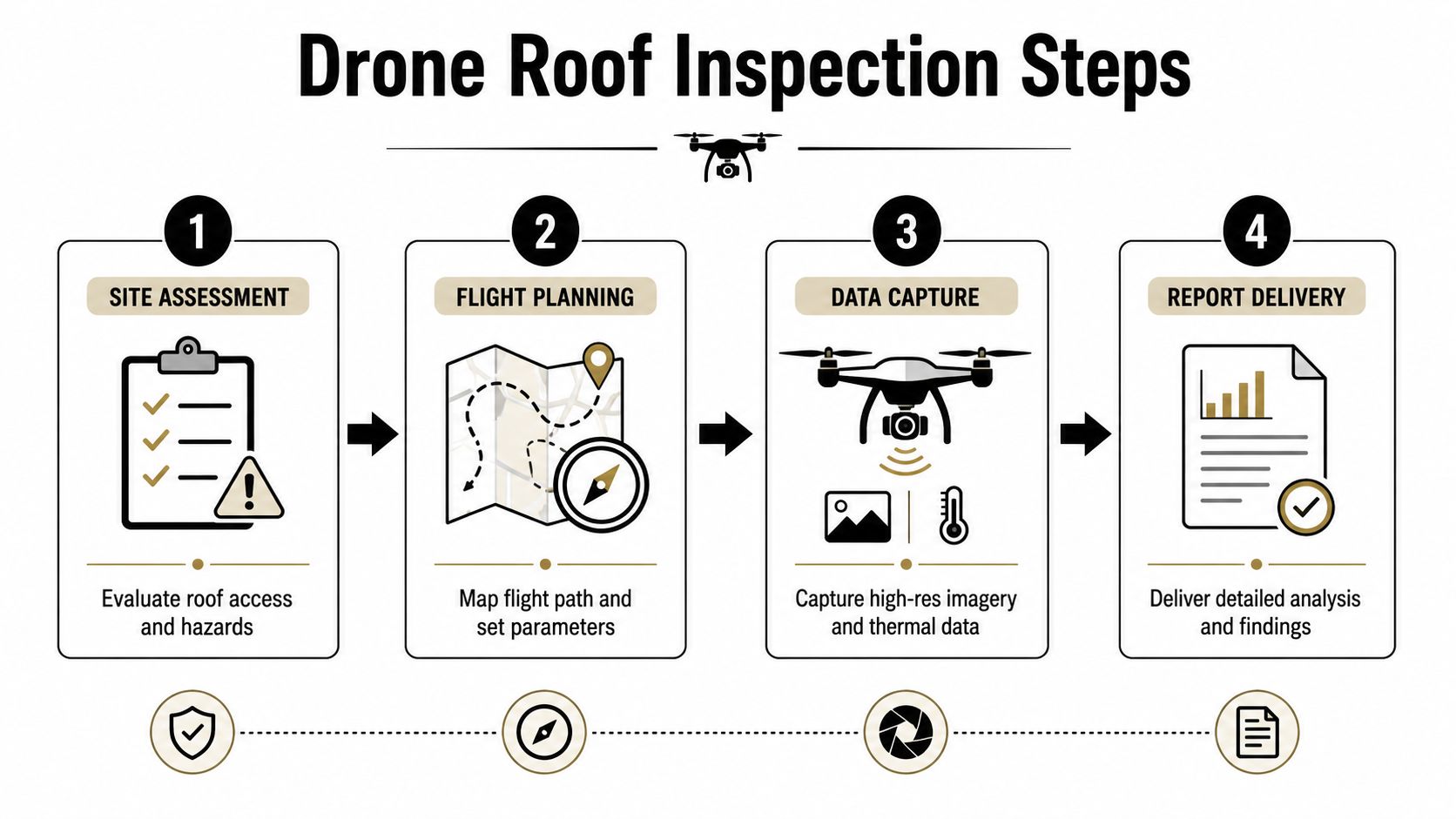
A professional drone roof inspection starts before the drone leaves the case. The operator should check the airspace, review site hazards, plan the flight path, and decide how the roof will be documented from edge to centre. On commercial sites, that means thinking about parapets, plant, access hatches, skylights, service risers, and the areas where shadows or reflective surfaces can reduce clarity.
What happens before and after the flight
The site assessment should identify exclusion zones and any rooftop features that will need extra passes. Flight planning should then map the roof in a way that captures edges, gutters, and penetrations, not just the middle of the membrane. That matters because most actionable defects sit at interfaces.
During capture, the operator should use multi-angle imagery rather than assuming one overhead pass is enough. The best commercial reports usually combine straight-down and oblique views, then repeat views of suspect areas so the reader can compare them later. This is also where ground control points or RTK positioning help, because a measured location is more useful than a pretty picture.
After the flight, the imagery is processed into outputs that a manager or contractor can use. That usually includes orthomosaic maps, thermal overlays where relevant, annotated defect markers, and high-resolution stills with location references. The professional standard is not “here are some images”, it's “here is what the roof condition means and where the follow-up should happen”.
Useful deliverable standard: if the report can't help a contractor find the defect again, scope the repair, or explain the issue to an insurer, it isn't finished.
For strata and commercial owners, the most valuable deliverables are the ones that support the next decision. That can be maintenance planning, contractor quoting, or a claim file. Anything less is just inspection theatre.
Cost Factors and Return on Investment
The cost of a drone roof inspection depends on roof size, complexity, access difficulty, thermal requirements, and how much reporting you want attached to the imagery. A simple visual pass is cheaper than a thermal survey with detailed annotation, and a small uncomplicated roof costs less to document than a sprawling warehouse with rooftop services and restricted perimeters.
Why the numbers usually make sense
The financial comparison is not drone versus nothing. It is drone versus ladder access, elevated work platform use, scaffold, rope access, and the operational downtime that can come with each of those. On a commercial building, every extra access requirement adds time, risk, and coordination overhead. The drone often wins because it changes the first question from “how do we get up there?” to “what do we need to prove?”
Routine monitoring is one of the best-value applications because it catches changes early. Post-storm triage is another, since you can rapidly decide which roofs need immediate attention and which can wait. Pre-purchase due diligence also makes sense, because the buyer wants current condition evidence before settlement, not a vague assurance that the roof “looks okay”.
For a broader pricing mindset, this roof maintenance cost guide is a useful complement, because the cheapest inspection is not always the cheapest decision if it misses the defect.
What good value looks like
A good quote usually shows the method, deliverables, and compliance assumptions. It should tell you whether thermal imaging is included, whether measurements are provided, whether the output is annotated, and whether the operator can support follow-up questions from a contractor or insurer.
Poor value is easy to spot. It's the quote that promises “full inspection” but only delivers a few glossy photos. It's also the one that ignores site complexity, because a warehouse roof with plant and solar rarely needs the same level of effort as a small open span roof.
If the inspection helps you avoid an unnecessary roof walk, shorten the time to scope repairs, and provide defensible evidence to other stakeholders, it's usually money well spent.
Choosing a Qualified Drone Inspection Contractor
A qualified operator should understand both drone rules and commercial roofing detail. That means CASA certification, appropriate insurance, and real experience on warehouses, strata assets, and industrial roofs, not just general aerial photography. If the contractor can't explain how they'll handle controlled airspace, rooftop hazards, or privacy-sensitive imagery, keep looking.
Questions worth asking
- What certifications do you hold? You want a clear answer on operator licensing and commercial approvals.
- What sensor package do you use? The operator should know whether the job needs RGB only, thermal, or more advanced ranging.
- What will the report include? Look for defect annotation, location references, and practical repair guidance.
- How do you secure the data? Roof imagery should be handled carefully, especially on sites with tenants or sensitive plant.
- Have you worked on commercial roofs like mine? Experience with metal decks, parapets, plant, and solar arrays matters.
Red flags that save you time
Basic photos with no interpretation are a warning sign. So is an operator who treats every roof the same or can't explain the difference between a visual condition check and evidence that supports an insurance file. A proper commercial inspection should be readable by a facility manager, a roofer, and an insurer without each party having to decode the drone work separately.
Sample reports tell you a lot. You want clear defect labels, useful images, and enough detail that a maintenance team can decide what to do next. If the report looks like a social media album, it's not enough for a commercial roof.
If you need a commercial roofing team that understands how aerial findings translate into real repairs, maintenance planning, and compliance-sensitive work, speak with Commercial Roofers. They handle inspection-led roof decisions across Sydney and NSW, from urgent leak response to complex commercial roof projects, so you can move from drone imagery to the right fix without guessing.