
A lot of commercial roof replacements start the same way. A warehouse manager spots a fresh stain on the insulation blanket, a strata committee gets another tenant complaint after heavy rain, or a café owner realises the leak isn’t “one bad flashing” anymore. By that point, the roof has already moved from maintenance issue to business risk.
That risk isn’t limited to water ingress. A failing roof can interrupt operations, damage stock, complicate insurance conversations, create WHS exposure for staff and contractors, and force rushed capital decisions. In Australian conditions, the roof also affects heat load, internal comfort, and how hard your building services have to work through summer.
For many owners, developers, and strata managers, metal roofing in Australia makes sense not because it’s fashionable, but because it gives a practical path to control those risks. The right system can deliver a cleaner maintenance profile, stronger compliance outcomes, and a more predictable lifecycle than patching an ageing roof year after year.
Table of Contents
- Your Commercial Property’s First Line of Defence
- Choosing Your Metal Roofing System in Australia
- Evaluating Key Performance Metrics for Commercial Roofs
- Navigating Australian Standards and Compliance
- Managing Costs and Lifecycle Value of Metal Roofing
- Special Focus Asbestos Roof Replacement
- Selecting the Right Commercial Roofing Contractor
Your Commercial Property’s First Line of Defence
A commercial roof usually gets ignored until it starts costing money in visible ways. The signs are familiar. Stains near roof penetrations, rust around old fixings, sagging insulation, recurring leak calls after every storm, or tenants complaining that the top floor or warehouse bay is too hot by midday.
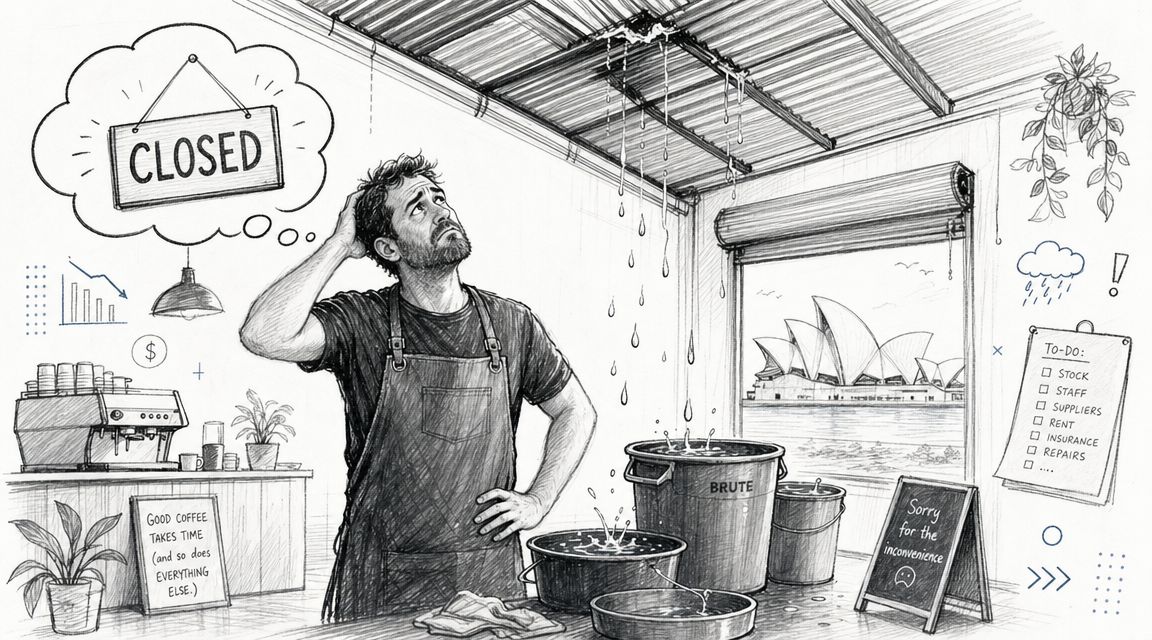
For an owner, that’s rarely just a roofing problem. It becomes an operations problem. Deliveries have to be moved. Electrical risks need checking. Ceiling damage spreads. Temporary repairs start stacking up, but the underlying roof assembly keeps ageing.
Roof failure usually arrives before total collapse
Most commercial roofs don’t fail in one dramatic event. They decline in stages. Flashings open up, sheets move, fasteners loosen, drainage points choke, and patch repairs create a roof with mixed ages and mixed performance. At that stage, replacing the system often gives better value than chasing leaks one by one.
That’s one reason metal roofing remains central to commercial asset strategy in Australia. The broader roofing market was valued at AUD 7.22 billion in 2025 and is forecast to grow at a 4.50% CAGR from 2026 to 2035, reaching about AUD 11.21 billion by 2035, according to Expert Market Research’s Australia roofing market outlook. For owners, that points to a large replacement and upgrade cycle tied to thermal performance, lower energy costs, and building efficiency, not just weatherproofing.
Practical rule: If your maintenance spend is rising while leak frequency stays the same, you’re not maintaining a roof anymore. You’re financing its decline.
Metal roofing is a business decision, not just a building product
The strongest commercial roof replacements are planned around asset outcomes. You’re not only selecting a sheet profile or colour. You’re deciding how the building will handle weather exposure, service penetrations, access for maintenance, tenant expectations, and future compliance demands.
That’s why smart clients look at the roof in the same way they look at plant replacement or façade remediation. It’s a capital project with operating consequences. If you need a broader view of how roofing choices affect safety, continuity and whole-of-asset costs, this guide on industrial roofing services protecting assets and reducing long-term costs is a useful companion.
A good metal roof does three jobs well. It keeps water out, manages environmental load, and stays serviceable without constant intervention. A poor one might still look acceptable on handover, but it will show its weaknesses at penetrations, laps, edges, and drainage lines long before the owner expects.
Choosing Your Metal Roofing System in Australia
Not all metal roofs solve the same problem. In commercial work, the right choice depends on the building’s use, exposure, visual requirements, maintenance access, and budget discipline. Clients often ask for “Colorbond” when what they really need is a decision on profile, thickness, fixing method, and detailing standard.
What actually changes between systems
Pre-finished steel such as COLORBOND® is often the default option for commercial and industrial roofs because it balances appearance, corrosion resistance, and practical availability. BlueScope’s Australian-made COLORBOND® roofing EPD states that the product range is manufactured in Australia for roofing and walling with base metal thicknesses from 0.30 mm to 1.00 mm using a hot-dipped aluminium-zinc-magnesium AM100 coating system, as outlined in the COLORBOND® environmental product declaration. On commercial projects, the key issue isn’t the brand name alone. It’s matching the correct BMT to purlin spacing, access demands, and load conditions.
Corrugated and similar exposed-fix systems remain common where function matters more than architectural finish. They suit warehouses, workshops, agricultural buildings, and many replacement jobs where the existing structure and budget call for a straightforward, serviceable roof. They’re familiar, widely used, and practical to repair, but exposed fasteners and simpler detailing mean workmanship matters a lot.
Standing seam systems sit at the premium end. They’re chosen when the roof is highly visible, the design demands a cleaner architectural line, or the project needs concealed fixing and strong weather-tight detailing on more complex forms. They can be an excellent solution, but they’re often overspecified on basic industrial buildings where the return doesn’t justify the premium.
For owners comparing suppliers, it helps to review examples of commercial metal roofing services in Sydney that cover clip lock, trim deck, and corrugated applications rather than treating all metal roofing systems as interchangeable.
Commercial Metal Roofing System Comparison
| System | Typical Cost | Best For | Key Benefit |
|---|---|---|---|
| COLORBOND® pre-finished steel | Mid to premium depending on profile and BMT | Warehouses, offices, strata, retail, industrial replacements | Strong balance of finish, durability, and commercial suitability |
| Corrugated or similar exposed-fix sheeting | Often lower upfront than premium concealed-fix systems | Budget-conscious industrial buildings, utility structures, straightforward reroofing | Functional, familiar, and generally easier to service |
| Standing seam | Premium | Architectural commercial projects, visible roofscapes, complex forms | Concealed fixing and a refined finish |
How to choose without overbuying
The common mistake is buying a premium product stack for a building that doesn’t need it, or worse, buying the cheapest assembly for a building with high consequence of failure.
Ask the building three questions:
- What happens if the roof leaks? A self-storage facility, food business, data-heavy tenancy, or stockholding warehouse has a much lower tolerance for failure than a basic shed.
- How visible is the roof to tenants, customers, or adjacent properties? A corporate office or mixed-use site may justify a more refined system.
- How often will people walk on it after handover? Service-heavy roofs with HVAC, solar, and multiple penetrations need durable detailing and sensible traffic planning.
The best-performing roof on paper can still be the wrong commercial decision if the building won’t recover the added cost.
A disciplined specification usually wins. That means selecting the roof system for the asset class, using the correct BMT, setting realistic performance expectations, and spending money where failures usually start. In practice, that’s penetrations, edges, box gutters, fastener strategy, insulation build-up, and access control after completion.
For metal roofing Australia projects, system choice should never be reduced to colour charts and brochure language. The roof has to suit the building’s risk profile. That’s the primary decision.
Evaluating Key Performance Metrics for Commercial Roofs
Commercial owners usually hear broad promises about strength, efficiency, and longevity. Those claims only matter when they translate into performance on your actual building. A roof over a logistics shed in western Sydney, a coastal strata block, and a manufacturing site with rooftop plant won’t face the same stresses.
Durability starts with the site, not the brochure
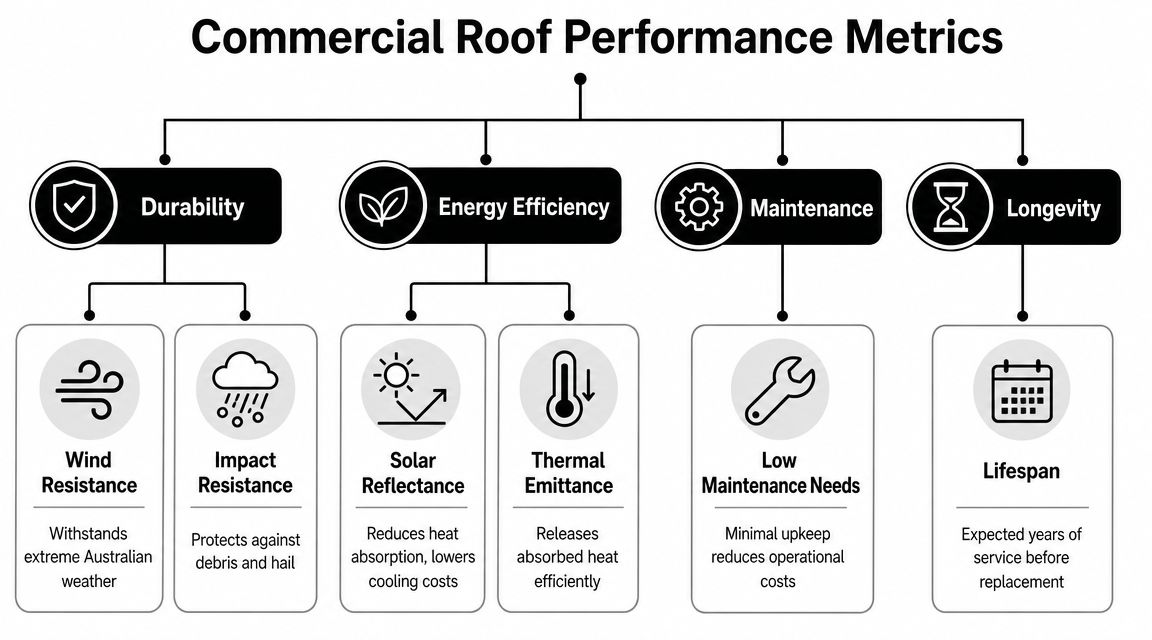
Durability in commercial roofing comes from system design and installation discipline. Wind exposure, edge conditions, sheet profile, fixing layout, drainage design, and rooftop traffic all affect how a metal roof performs over time.
The basic test is simple. Can the roof carry the loads and stay watertight where failure usually starts. That means not just on open sheet runs, but at penetrations, ridge details, flashings, gutters, transitions, and service interfaces.
Three performance checks deserve attention early:
- Wind resistance matters most at corners, perimeters, and exposed elevations. Those are the zones where shortcuts in fixing schedules and restraint details show up first.
- Impact resistance is relevant on sites exposed to hail, falling debris, or regular maintenance traffic. A roof can remain structurally intact but still become costly if deformation leads to ponding or flashing failure.
- Fire behaviour becomes more important when the building sits in a higher-risk area or when insurers and occupiers take a conservative view of asset protection.
A roof rarely fails across the whole field first. It fails at the detail that someone assumed was minor.
Thermal and acoustic performance
Heat management is where many metal roofing discussions become too simplistic. A metal roof on its own isn’t a thermal strategy. The performance comes from the full build-up, including roof colour, insulation blanket, sarking where relevant, ventilation approach, and how penetrations are handled.
On warehouses and large-format commercial buildings, the difference between a well-considered and poorly considered roof build-up shows up in internal comfort, plant runtime, and tenant complaints. Lighter, more reflective finishes can help reduce heat absorption, but they don’t replace insulation or sensible ventilation planning. Dark roofs, heavy internal heat loads, and poorly detailed roof spaces usually create predictable overheating issues.
Acoustic performance works the same way. Complaints about “noisy metal roofs” usually trace back to incomplete build-ups, insufficient insulation, or bad detailing around roof elements rather than the metal skin itself. In commercial settings, rain noise can often be managed well when the roof assembly is designed as a system rather than just a sheet selection exercise.
A practical review should consider:
- Internal use of the building. Offices, schools, retail tenancies, and healthcare-adjacent uses often need tighter acoustic and thermal outcomes than basic storage.
- Rooftop services. Plant, ductwork, and penetrations can compromise both thermal continuity and weather-tightness if they’re treated as afterthoughts.
- Future upgrades. Solar, additional mechanical services, and access systems should be anticipated before the reroof, not improvised after it.
The strongest commercial roof specifications define performance by outcome. Not just what sheet goes on, but how the whole roof assembly will behave in service.
Navigating Australian Standards and Compliance
Compliance is where good intentions often get replaced by hard project reality. Commercial owners don’t need to memorise every clause, but they do need to know what must be verified before work starts and what should be documented before final payment.
What compliant actually means on a live project
For Australian commercial metal roofing, the key framework includes AS/NZS 1562.1:2018 for design and installation and AS/NZS 1170 for structural loads. Industry guidance also makes the practical point that a roof system can still fail if the fastener schedule, sheet thickness, and restraint details are not matched to the calculated site loads, as discussed in this overview of Australian standards for metal roofing compliance.
That matters because many project failures don’t come from using a recognisable product. They come from assuming the product alone guarantees compliance. It doesn’t. A compliant outcome depends on design assumptions being carried through into procurement and installation.
For owners, that means asking direct questions:
- Has the roof been assessed for the site’s wind conditions and edge zones?
- Do the nominated sheets, fixings, and support details match that assessment?
- Will penetrations, gutters, flashings, and terminations be installed to the same standard as the main roof field?
If any of those answers are vague, the risk usually lands with the owner later.
Documents worth asking for
A proper commercial roofing package should leave a paper trail that’s easy to follow. If it doesn’t, future disputes become much harder to resolve.
Ask for these items in plain language:
- Scope clarity. The quote should state what is being removed, retained, replaced, and made good.
- Engineering or design confirmation where needed. Especially on replacement projects involving changed loads, altered fixings, or structural rectification.
- Product identification. The sheet profile, coating type, BMT, insulation build-up, and accessory materials should be clear.
- WHS controls. Live-site sequencing, fall protection, exclusion zones, and access controls need to be planned before the first sheet is removed.
- Completion records. Handover should include warranties where applicable, maintenance guidance, and any relevant compliance documentation.
Site advice: If the proposal is light on detail around fixings, edge restraint, penetrations, or safety controls, it’s usually light on the work itself.
Owners also need to remember that compliance isn’t only about code. It affects insurability, defect liability, and future asset transactions. A roof that was “installed fine” but poorly documented can become a problem during due diligence, lease negotiations, or claims management.
In metal roofing Australia projects, compliance should be treated as part of risk transfer. If the contractor can show exactly how the system has been designed, installed, and verified, you’re in a much stronger position after handover.
Managing Costs and Lifecycle Value of Metal Roofing
A warehouse owner approves the lowest reroof quote, then spends the next five years paying for leaks around penetrations, repeated shutdowns for patching, and arguments about what was excluded. That pattern is common on commercial roof replacements. The contract sum matters, but whole-of-life cost matters more.
What actually moves the price
On industrial and commercial jobs, price usually shifts because the building is difficult to reroof, not because sheet metal changed by a small margin. I look first at access, staging, safety controls, service congestion, weather exposure during the works, and the condition of the structure below the roof line. Those items usually decide whether a job runs cleanly or turns into a variations problem.
Costs rise quickly where the site includes:
- Restricted access with limited crane positions, tight boundaries, or no practical laydown area
- Complex roof geometry with box gutters, parapets, step-downs, skylights, plant supports, and dense penetrations
- Substrate remediation such as corroded purlins, failed insulation, damaged safety mesh, or wet building fabric
- Live operating conditions where the works must be staged around tenants, production lines, loading docks, food safety controls, or trading hours
- Temporary weather protection needed to keep operations running while sections of roof are opened
For owners, these are risk items as much as cost items. They affect programme length, exposure to water ingress, insurance implications during construction, and how much supervision the contractor needs on site each day.
Lifecycle value is an asset decision
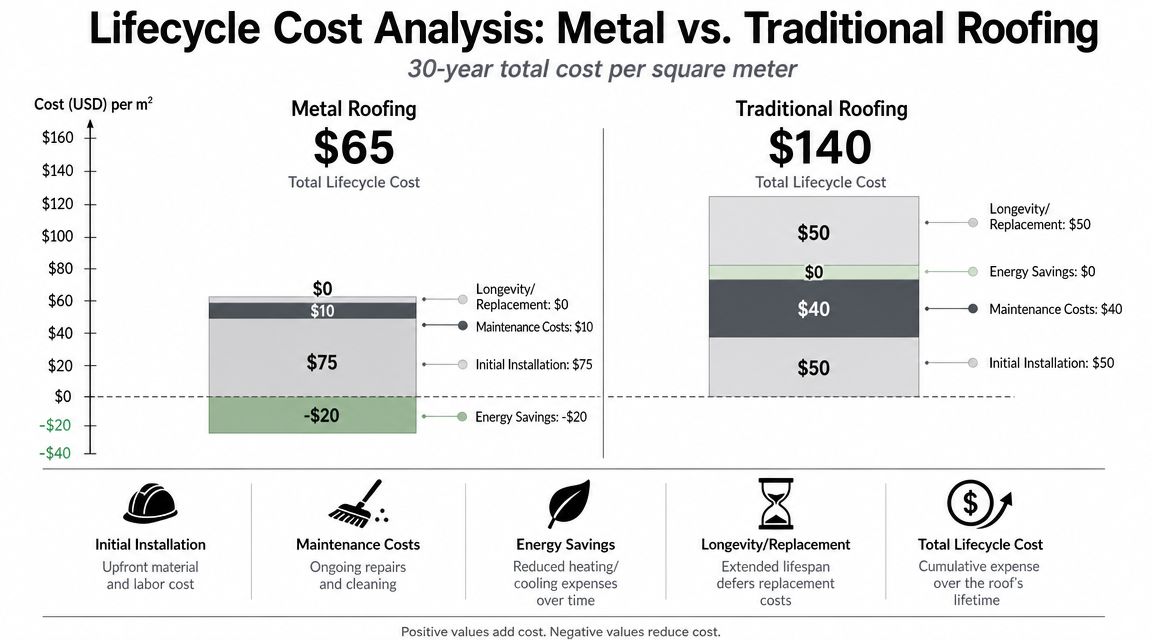
A metal roof should be assessed like a long-term building asset. The useful question is not “What is the cheapest installed rate?” The useful question is “What will this roof cost to own over its service life, and what business risk does it remove or create?”
That framework changes procurement decisions. A roof system with better corrosion performance, stronger detailing at gutters and penetrations, and fewer weak points for future service trades can reduce maintenance callouts and claims activity. Better insulation build-ups can also cut HVAC load and improve occupant comfort, which matters on large-format industrial and commercial assets where energy waste is expensive.
Cheap quotes often leave out the parts that protect lifecycle value. Common examples include reduced temporary works, weaker flashing scope, less make-good, lighter supervision, or optimistic assumptions about the condition of the existing roof build-up. The saving is visible at tender time. The consequence shows up later as defects, delays, water damage, or disputes over exclusions.
If you want a clearer way to assess scope against price, this guide to commercial roof repair cost factors is a useful benchmark.
Where owners either save money or lose it
The biggest financial wins usually come from decisions made before the first sheet is ordered.
One is matching the roof system to the exposure conditions. Coastal sites, heavy industrial environments, and buildings with high internal humidity place different demands on coatings, fixings, and ventilation strategy. Another is reducing future trade damage by planning safe access paths, plant platforms, and service zones from the start. If technicians are forced to walk directly on the roof every time they service equipment, maintenance costs usually climb.
Insurance and compliance also sit inside lifecycle value. A roof replacement that improves fire performance, drainage reliability, and documentation quality can strengthen the asset’s position during renewal discussions, claims handling, and due diligence. That matters on investment property, logistics facilities, manufacturing sites, and strata-held commercial stock where roof failure can affect far more than repair cost alone.
Maintenance should be disciplined, not reactive
A new metal roof is not maintenance-free. It is lower maintenance when the design is sound and the site team manages it properly after handover.
A practical maintenance plan includes regular inspections, gutter and sump cleaning, checks around penetrations and roof-mounted services, and controls for foot traffic by other trades. The aim is simple. Keep water moving, catch detail failures early, and stop avoidable damage before it becomes a leak event.
I tell clients to budget for planned upkeep, not emergency response. Planned maintenance is predictable. Internal water damage, production disruption, and repeated callouts are not.
The strongest commercial outcome usually comes from a roof package that balances capex with long-term performance. In metal roofing Australia projects, that means choosing a system that suits the building’s use, exposure, and compliance obligations, then protecting that investment with good detailing, realistic staging, and maintenance that is carried out.
Special Focus Asbestos Roof Replacement
Older industrial buildings across Australia still carry asbestos cement roofing or walling. Owners often know it’s there, but many delay action because the project seems disruptive, expensive, or difficult to stage around operations. That hesitation is understandable, but once the roof is deteriorating, every delay makes planning harder.
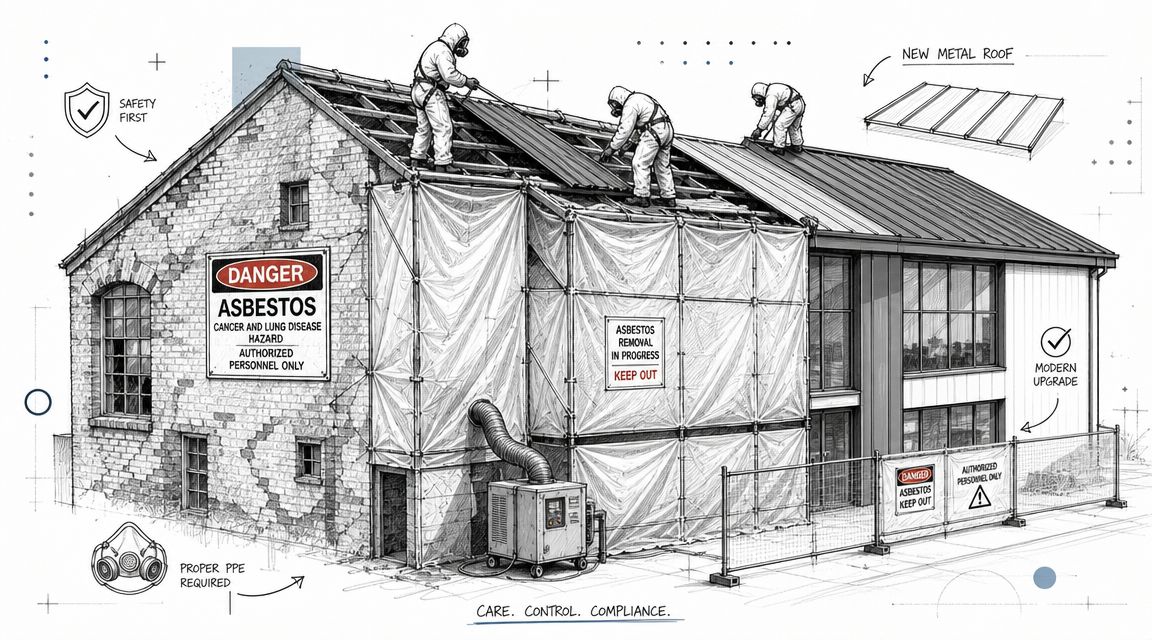
One of the biggest gaps in public advice is the commercial decision framework itself. Owners need more than generic statements about modern materials. They need guidance on capex timing, operational disruption, compliance exposure, and risk transfer. That specific need is highlighted in this discussion on commercial asbestos roof replacement decision-making.
Why these projects fail when owners rush them
Asbestos roof replacement goes wrong when people treat it like a normal reroof with extra paperwork. It isn’t. The sequencing, containment, licensing, disposal, tenant communication, and weather planning all need tighter control.
Common failure points include:
- Poor staging that leaves parts of the building exposed longer than necessary.
- Weak communication with tenants, staff, or adjacent occupiers.
- Unclear scope boundaries between removal, structural rectification, and installation trades.
- Underestimated shutdown requirements for plant, access zones, or stock movement.
For many owners, the value of replacement isn’t just hazard removal. It’s the chance to reset the building envelope properly. Once the asbestos roof is removed, you can address insulation, daylighting strategy, penetrations, drainage, and future service coordination in one planned package instead of patching around a legacy problem.
A practical replacement sequence
A controlled asbestos replacement project usually follows a clear order.
- Confirm the roof condition and extent of affected materials. Assumptions are risky on older assets.
- Set the operating strategy. Decide whether the site stays live, partially live, or shuts down in stages.
- Lock in licensed removal and disposal pathways. This should be verified before installation programming is finalised.
- Plan the replacement roof as an upgrade, not a like-for-like swap. Insulation build-up, sheet selection, access provisions, and future rooftop services are all considerations for resolution.
- Coordinate handover properly. Owners need records, not just a finished-looking roof.
A short visual overview can help clarify what a controlled removal process involves:
Replace asbestos roofing when you can plan it, not when weather damage or tenant pressure removes your options.
For industrial and commercial buildings, metal roofing is usually the logical replacement because it allows owners to pair hazard removal with a stronger, cleaner-performing roof system. The commercial gain is broader than compliance. You reduce legacy risk, simplify future maintenance, and improve the building’s leasing and operating profile at the same time.
Selecting the Right Commercial Roofing Contractor
A commercial reroof can fail long before the first sheet is fixed. It usually happens in pre-construction, when a contractor underestimates staging, misses safety controls, or prices the job without understanding how the site operates. On occupied industrial assets, those mistakes turn into delays, water ingress claims, tenant disruption, and arguments about variations.
That is why contractor selection is a risk decision, not just a procurement exercise. If you are replacing an ageing metal roof or removing asbestos, the contractor you appoint will affect insurance exposure, compliance records, shutdown planning, and the long-term maintainability of the asset.
What to verify before you sign
Material supply is only one part of the outcome. On most commercial projects, the bigger variable is whether the contractor can plan and control the work properly under live-site conditions.
Check these points before you commit:
- Licensing and scope alignment. Confirm the contractor is licensed for the roofing work being proposed. If asbestos is part of the project, confirm the removal licence sits with the correct party and that responsibilities are clearly split between removal, disposal, and reroofing.
- Insurance cover. Ask for current certificates for public liability, workers’ compensation, and any policy requirements specific to your site, principal, or tenant arrangements.
- Relevant project history. A crew that handles small residential reroofs may not be ready for industrial access constraints, staged handovers, live warehouses, or high-compliance client environments.
- Site supervision. Identify who will run the project on site. The person who prices the work is often not the person coordinating subcontractors, safety controls, and daily sequencing.
- Programme logic. Review the construction programme for weather allowances, crane or EWP access, lead times, occupied-area restrictions, and contingency for hidden conditions.
In the Sydney market, Commercial Roofers is one contractor that states it handles commercial and industrial reroofing, maintenance, and asbestos roof replacement using systems such as clip lock, trim deck, and corrugated metal roofing. Treat that as a starting point for review, not a substitute for due diligence.
How to read a quote properly
A low number on page one does not tell you much. The true comparison sits in the assumptions, exclusions, and gaps.
Read each quote like a contract summary. If the contractor has been vague during tender, that vagueness usually becomes a variation claim later.
Look closely at whether the proposal covers:
- Removal and disposal scope with enough detail to avoid disputes over what was included.
- Flashings, cappings, box gutters, and penetrations as defined items, not broad allowances.
- Temporary weatherproofing if the building remains operational during the works.
- Structural rectification assumptions where purlins, fixings, or substrate defects may be uncovered after strip-off.
- Access and safety measures such as edge protection, EWPs, scaffolding, crane lifts, exclusion zones, and traffic management.
The better quote is usually the one that is harder to read quickly because it is more specific. It names materials, identifies interfaces with existing services, explains staging, and sets out the process for latent conditions. That level of detail protects the owner as much as the contractor.
If two tenders are close in price, choose the contractor that has shown clearer control of delivery risk and cleaner documentation. On a commercial reroof, that usually produces the better financial result over the life of the asset.
The right contractor does more than install a new roof. They coordinate shutdowns, protect occupied areas, manage compliance paperwork, and hand over records your facilities team can use. That is what supports asset value after practical completion.
If you’re planning a commercial or industrial roof replacement in Sydney, Commercial Roofers can help assess the existing roof, scope replacement options, and advise on metal reroofing or asbestos roof replacement requirements for your site.
Powered by Outrank tool