

A ceiling stain in the top-floor office. Damp insulation above a warehouse bay. A tenant calling to say water is dripping near stock. That's usually when commercial roof tile repair moves from “something to look at later” to a live operational problem.
For a Sydney building manager, the issue isn't just how to repair roof tiles. It's how to deal with damage without creating a bigger problem through unsafe access, a non-compliant contractor, or a patch that fails in the next storm. On a commercial site, every decision touches safety, insurance, tenant disruption, and the long-term condition of the asset.
Table of Contents
- Your Guide to Commercial Roof Tile Repair
- Safe Inspection and Damage Assessment
- Temporary Fixes Versus Permanent Repairs
- Essential Materials Tools and Hidden Dangers
- Budgeting for Roof Tile Repairs in Sydney
- When to Call a Professional Commercial Roofer
Your Guide to Commercial Roof Tile Repair
A common commercial scenario goes like this. A tenant reports a ceiling stain after a storm, facilities staff spot a few slipped tiles from the car park, and the first instinct is to send someone up for a quick patch. On a commercial property in NSW, that decision can create a bigger problem than the leak itself if access, documentation, and contractor controls are handled poorly.
Tile roofs rarely fail in one obvious spot. The early signs are usually scattered across the building. A cracked tile after hail, a ridge issue that starts letting in water, or repeated moisture marks in different tenancies often point to a system problem rather than a single broken component. On larger sites, that carries extra weight because access is more difficult, disruption affects operations, and any shortcut can end up as a WHS issue, an insurance dispute, or both.
Commercial owners and building managers need a triage mindset. The first question is not how fast someone can swap a tile. The first question is whether the roof defect is isolated, whether people can inspect it lawfully and safely, and whether the visible damage is only the front edge of a wider failure. If leak patterns are unclear, start with a documented commercial roof leak detection approach before approving repair works.
What building managers need to focus on
A sound decision usually turns on a few practical points:
- Scope of failure: One cracked tile is different from recurring leaks across separate roof planes or tenancies.
- Operational risk: Water entry above stock, plant, switchboards, offices, or common areas changes the urgency and the repair method.
- Compliance exposure: On a NSW commercial site, roof access and repair work sit under WHS duties, contractor management, and safe work at heights requirements.
- Roof age and hidden defects: Older tile roofs may also have deteriorated bedding, pointing, sarking, battens, or substrate issues that are not visible from one leak point.
- Hazardous materials risk: Some older commercial properties raise asbestos concerns, which changes who can inspect, sample, remove, and repair materials.
Practical rule: Treat every reported leak as a property risk, a safety risk, and a record-keeping issue before treating it as a simple maintenance job.
That approach saves money more often than a rushed patch does. Cheap repairs on commercial roofs tend to shift cost, not remove it. The bill shows up later as internal water damage, repeat access setup, after-hours call-outs, tenant complaints, or arguments with insurers over whether the defect was known and left unresolved.
The difference between a patch and a proper repair
Residential advice often assumes a house roof, easy access, and one person replacing a visible tile. Commercial sites are different. A proper repair decision may involve access permits, SWMS, isolation of work areas below, confirmation of contractor insurance, and checking whether the failed tile is part of a broader ridge or section problem.
Good tile repair work starts with evidence, not guesswork. Photos, leak history, defect mapping, and a clear record of who assessed the roof all help building managers make the right call and protect the asset. That record also matters if the issue grows into an insurance claim or a dispute over maintenance responsibility.
The goal is simple. Fix the roof in a way that stands up technically, legally, and financially.
Safe Inspection and Damage Assessment
The first mistake on commercial roofs is rushing straight to the damaged area. The second is sending maintenance staff up without the right controls. Both create avoidable risk.
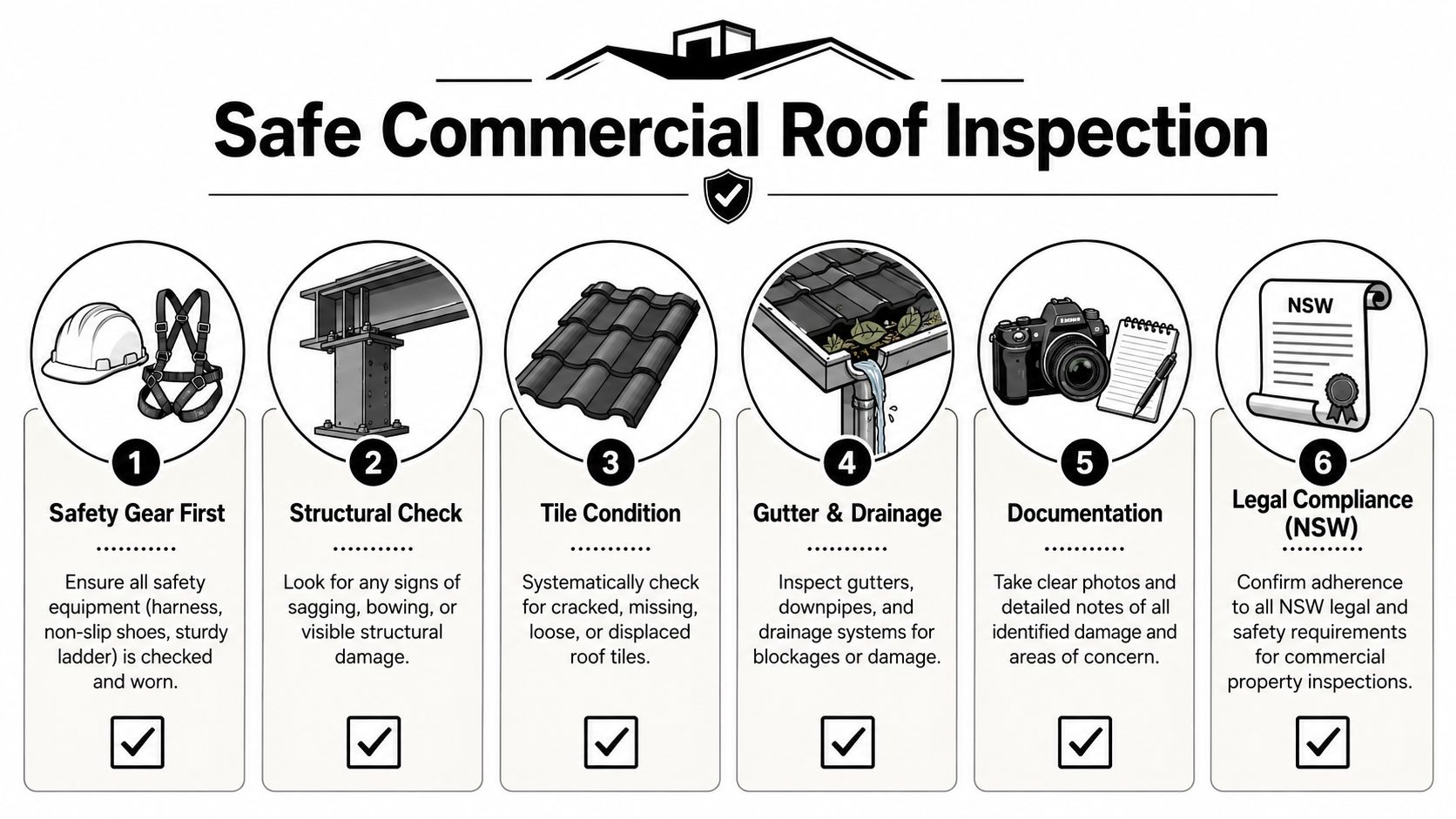
For commercial properties in NSW, the safety gap in many DIY guides is a serious liability issue. Regulations require a harness for work above 2 metres, and relying on DIY material that skips that rule can expose owners and managers to liability, fines, and insurance problems, as noted in this NSW-focused roof tile safety guide.
Start inside and from the ground
A disciplined assessment usually begins without stepping onto the roof at all. That's safer, faster, and often more informative than people expect.
Inside the building, check for:
- Water stains: Ceiling marks, wall staining near upper levels, or damp plasterboard.
- Insulation moisture: Wet insulation above offices or mezzanine areas often shows leak spread, not just the entry point.
- Light penetration: Daylight through roof lines or around ridge areas can point to displacement or gaps.
- Pattern of complaints: One isolated leak is different from leaks appearing in multiple rooms or bays.
From the ground, use binoculars or zoom photography to look for cracked tiles, slipped courses, ridge capping movement, blocked gutters, and obvious debris lines. On larger sites, drone photography may help if it's operated within the relevant rules and site controls.
If you're tracking internal signs first, this guide on how to detect roof leaks is useful for narrowing down the likely path before ordering access equipment.
Why NSW commercial sites are different
Residential advice often assumes the owner decides, climbs up, and makes a quick call. A commercial site doesn't work that way. The property owner, strata committee, facility manager, or principal contractor can all carry responsibilities around who accessed the roof, under what method, and with what controls.
That's why a proper commercial inspection usually includes:
| Inspection element | Why it matters |
|---|---|
| Photo documentation | Creates a record for insurers, tenants, and maintenance planning |
| Access planning | Prevents ad hoc roof entry and unsafe ladder use |
| Damage mapping | Separates isolated tile failure from broader roof movement |
| Compliance review | Confirms the task needs formal controls before work starts |
Roof work stays simple only until someone gets hurt or water reaches the structure.
There's another practical point. Tile damage is not always where the leak shows internally. Water can track along underlay, battens, or structural elements before it appears inside. That's why random spot repairs based only on the visible drip point often miss the true entry path.
A good assessment also looks for categories of damage, not just individual breakages:
- Cracked or chipped tiles after storm or impact.
- Missing tiles where water entry risk is immediate.
- Displaced tiles caused by movement or failed fixing.
- Ridge and capping issues that suggest wider instability.
- Sagging sections that may indicate structural trouble, not just tile failure.
If the roof shows multiple categories at once, the conversation changes from “replace a tile” to “investigate the roof system”.
Temporary Fixes Versus Permanent Repairs
Urgent leaks create pressure. Stock is at risk, tenants want answers, and nobody wants rain getting into electricals or ceilings. That's why temporary fixes keep getting used. Sometimes they're necessary. The problem is when a temporary measure gets treated like a finished repair.
What a temporary fix can do
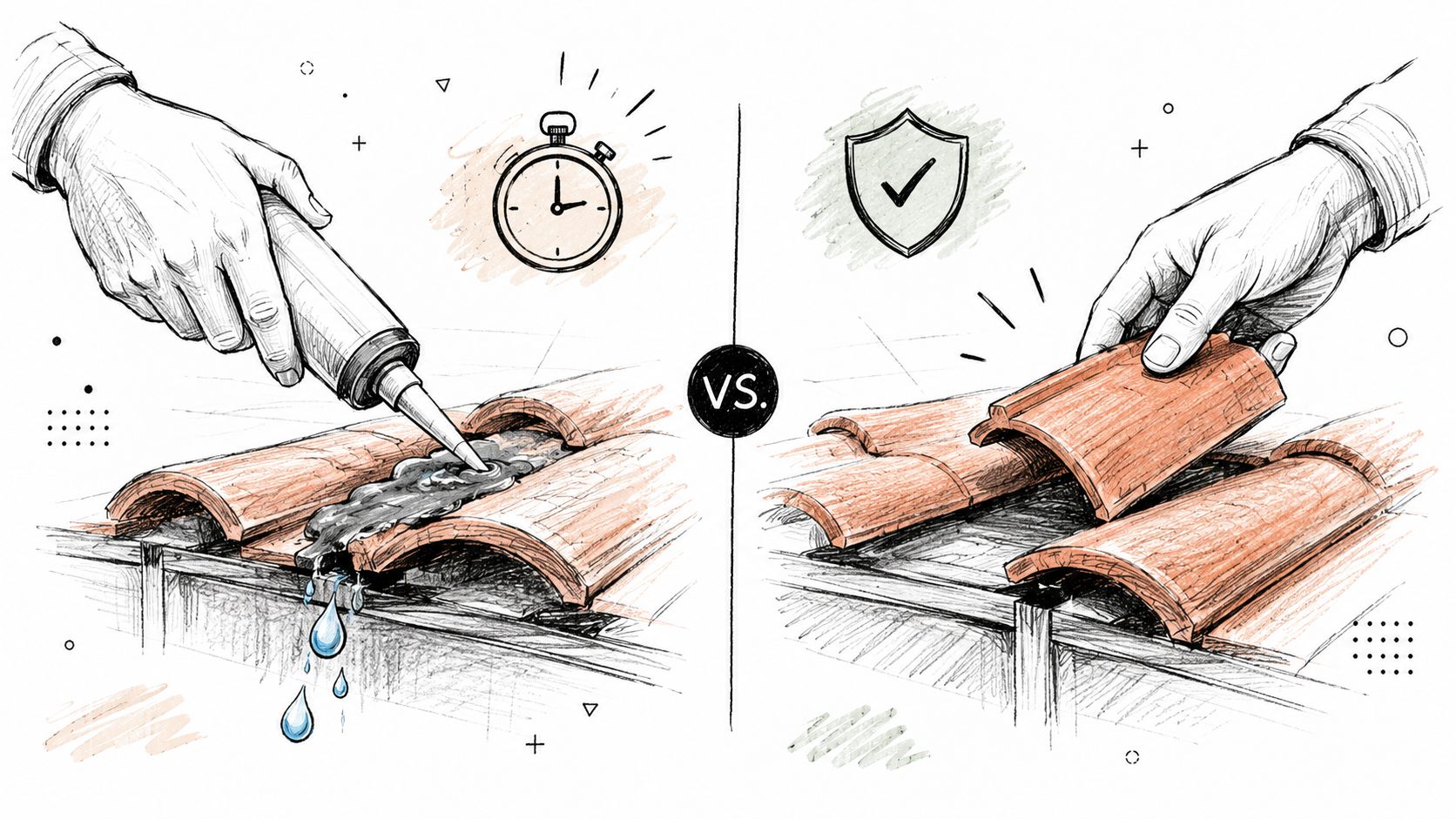
For small cracks, a specialised roofing sealant or adhesive can create a short-term watertight barrier. That's recognised as an emergency measure in Australian tile repair practice, but it is temporary only. The professional standard is set out in this roof tile repair method guide.
A temporary fix has a valid role when:
- Rain is imminent: You need to reduce immediate water entry.
- Access is restricted: The site needs controlled access planning before permanent works.
- Matching tiles aren't on hand: The roof still needs to be made safe while replacements are sourced.
That doesn't make sealant a substitute for replacement. It buys time. It doesn't restore the original interlocking, water-shedding design of the roof.
What a permanent repair requires
A proper tile repair is more exact than commonly assumed. The damaged tile is not just pulled out and swapped casually. The surrounding tiles are carefully removed or lifted to avoid cracking adjacent units. The damaged tile is extracted. A matching replacement is slid into place and locked in. Then the surrounding tiles are reset in the original alignment so the roof pattern and weatherproofing remain intact.
That exact-match requirement is the detail many failed repairs ignore. Wrong profile, wrong thickness, or poor alignment can direct water under the laps instead of over them.
For a more detailed look at replacement strategy, see this page on roof tile replacement.
A tile roof works as an interlocking system. If one replacement tile doesn't sit correctly, the leak path can get worse, not better.
Here's the practical comparison:
| Approach | Works for | Main limitation |
|---|---|---|
| Emergency sealant | Short-term weatherproofing | Doesn't restore full tile integrity |
| Loose patch or mismatched tile | Very little | Often fails under movement and weather |
| Proper replacement with matching tile | Durable local repair | Depends on safe access and correct materials |
Temporary repairs also create a common budgeting trap. A cheap patch often hides the need for proper re-entry, extra labour, and additional damage rectification later. In commercial settings, that can mean returning after another leak, reopening access permits, and dealing with tenant complaints twice instead of once.
The smart call is simple. Use temporary treatment only to stabilise the problem, then schedule permanent repair roof tiles work under proper site controls.
Essential Materials Tools and Hidden Dangers
Tile repairs succeed or fail on details. Not broad ideas. Details. The right tile profile, the right bedding method, the right pointing product, and the right treatment of aged roof materials all matter more than whether someone got onto the roof quickly.
Matching materials matters
A commercial tile roof should be repaired with materials that fit the existing system, not whatever happens to be available first. Profile mismatch is one problem. Colour mismatch is cosmetic. Shape, lap, and interlock mismatch are functional failures.
If ridge work is involved, the standard is more technical than many low-cost quotes admit. Professional tile roof restoration uses a precise 3/1 sand/cement mix for re-bedding ridge caps, followed by flexible pointing material rather than rigid mortar, and a four-layer coating system where restoration is part of the scope, according to this Australian tile repair cost and method guide.
That same source points to a common failure point that many non-specialists miss. Spray technique on tile noses matters because those areas need extra-thick coverage. Miss that, and water ingress can return earlier than expected.
A practical materials checklist usually includes:
- Matching replacement tiles: Same profile and compatible fit.
- Bedding materials: Used correctly where ridge or capping work is required.
- Flexible pointing compounds: Better suited to movement than old rigid methods.
- Compatible fasteners and fixings: Chosen for the roof type and exposure conditions.
- Coating products only where justified: Restoration coatings need proper prep and application, not cosmetic overspray.
If you're comparing profiles before ordering replacements, this overview of different types of roof tiles helps narrow down what should and shouldn't be mixed.
Asbestos changes the job immediately
On older commercial and industrial sites, hidden danger is the part people underestimate. If there's any reason to suspect asbestos-containing material in the roof system or adjacent components, stop the job and verify before disturbance.
That matters because the wrong action on a suspect roof doesn't just create a poor repair. It can create a health risk, a legal problem, and a contamination issue across the site. Cutting, drilling, breaking, or removing suspect material without the right licence and process isn't a maintenance shortcut. It's a serious mistake.
If there's uncertainty about asbestos, uncertainty is the answer. Stop disturbing the material until it's properly assessed.
This is also where contractor selection matters. Commercial Roofers is one Sydney option that handles commercial roofing and asbestos roof removal within broader roof replacement and repair scopes, which is relevant when tile issues sit alongside older hazardous materials. The bigger point is not who you choose. It's that the contractor must be set up for commercial compliance, not domestic handyman work.
The hidden-cost version of this problem is common. A manager approves “simple tile repairs”, then the crew finds broader ridge instability, incompatible old materials, or suspect sheeting nearby. The job then pauses midstream. Delays follow because the site tried to price a small patch before confirming the actual conditions.
Budgeting for Roof Tile Repairs in Sydney
A building manager usually sees the leak first and the liability later. By the time water marks show inside a commercial tenancy, the repair budget is no longer just about replacing a few tiles. It can also involve access controls, documentation, tenant coordination, and proving the work was done properly if an insurer or investigator asks questions later.
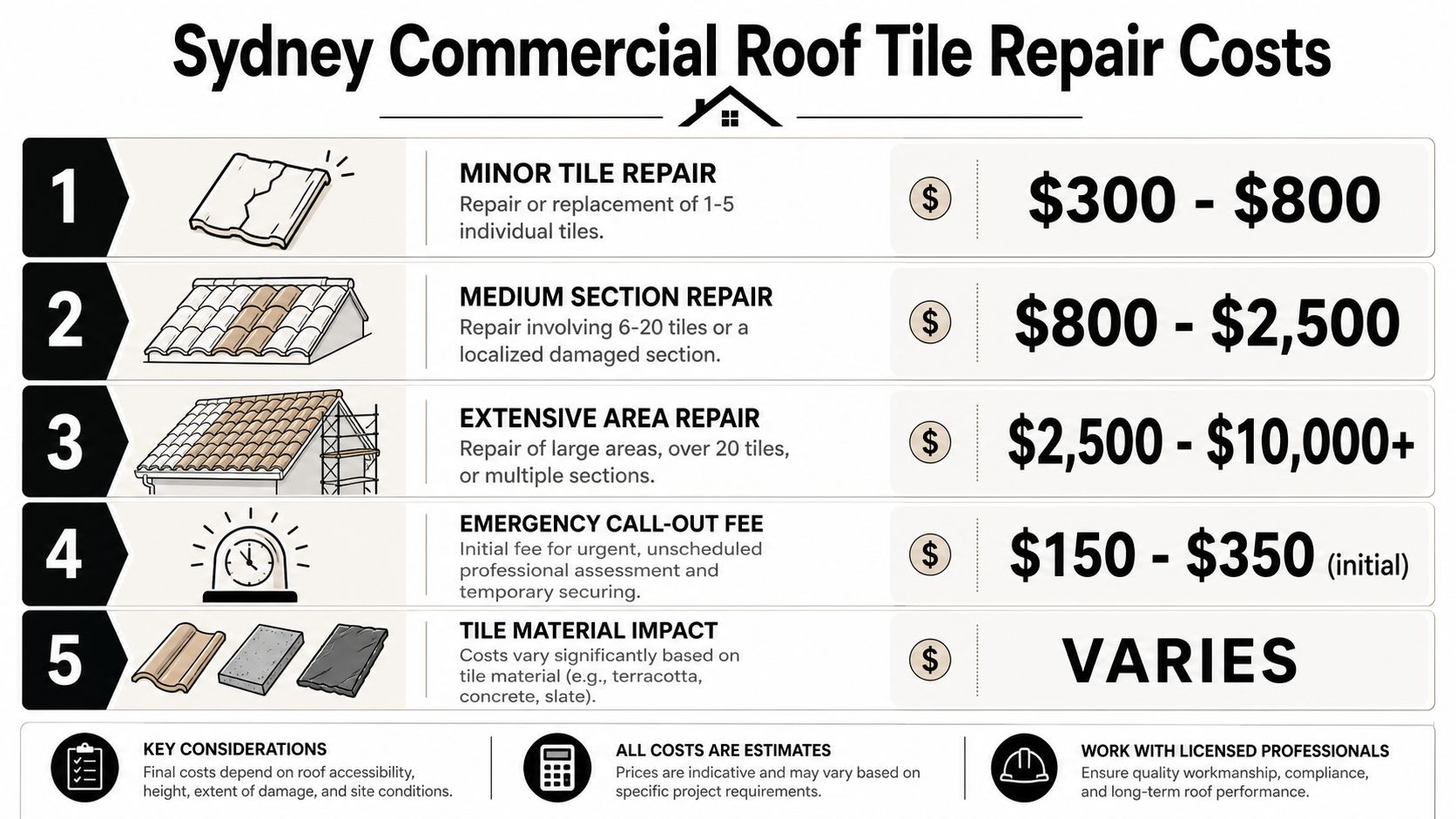
Sydney tile roof work still starts with broad pricing ranges. Simple tile replacement typically costs $250 to $500, while full roof restoration for tiled roofs generally starts at $8,000 and can reach $13,500 in Sydney, based on this Sydney roof restoration cost guide.
What the market looks like
Headline numbers only help if the scope is clear. On commercial sites, two quotes that look similar on page one can be pricing very different jobs.
Typical ranges in Sydney include:
- Simple tile replacement: $250 to $500 for straightforward tile replacement.
- Medium-sized repairs: $700 to $2,000 where multiple tiles or ridge capping are involved.
- Larger structural repairs: $2,000 to $5,000+ when severe water damage or sagging frames need attention.
- Standard restoration projects: $4,000 to $10,000 for standard properties, rising to up to $11,000 for larger roofs.
- Sydney tiled roof restoration: often $8,000 to $13,500 due to local labour rates and the work involved in rebedding and repointing.
Tile work also tends to cost more per square metre than metal repair because it is slower, more fragile, and more dependent on skilled handling. That matters when a cheap quote assumes quick access and isolated breakages, but the roof turns out to need matching tiles, ridge work, and wider rectification.
Why the cheapest quote often costs more
Low quotes usually leave out the items that protect the owner, not just the roof. On a commercial property in NSW, that can mean weak site controls, vague scope language, no allowance for compliant access, and no record of what was inspected versus what was excluded.
Check the quote line by line:
| Quote item | Why it matters |
|---|---|
| Tile matching | Prevents water-shedding failure from incompatible replacements |
| Ridge and capping work | Needed if movement or bedding failure is part of the leak |
| Access and safety controls | WHS compliance is part of the job cost, not an optional extra |
| Scope of underlying damage | Water may have already affected framing or substrates |
| Restoration inclusions | Surface prep and application standard affect service life |
| Exclusions and assumptions | Clarifies what the contractor is not taking responsibility for |
Owners often get caught when a contractor patches visible damage, invoices for a low figure, and leaves behind unresolved movement, brittle ridge lines, or moisture damage below the tiles. If the leak returns, the first invoice was not a saving. It was the opening cost.
Budgeting should also cover the commercial consequences of the work. Access equipment, restricted work zones, after-hours scheduling, tenant notice, weather delays, and site induction time all affect the final number. If there is an incident, poor documentation can create a second financial hit through insurance disputes or questions about whether the property was maintained with reasonable care.
Good budgeting is not about chasing the smallest repair number. It is about paying for a scope that stands up technically, legally, and commercially.
When to Call a Professional Commercial Roofer
A warehouse manager usually calls us after the second or third leak, when ceiling tiles are stained, stock has been shifted twice, and the first cheap patch has already failed. By that point, the issue is often bigger than a cracked tile. It becomes a WHS risk, a compliance issue, and a record-keeping problem if someone asks what was inspected, what was disturbed, and who signed off on the work.
On a commercial site in NSW, that threshold comes earlier than many owners expect. Once there is height risk, suspected substrate movement, repeated water entry, or any chance the roof system contains asbestos-related materials, the job needs a licensed contractor with the right access method, safe work procedures, and documentation. Insurance assessors and investigators do not give much weight to informal fixes if the roof was clearly showing signs of broader failure.

Triggers that mean stop and escalate
Bring in a professional commercial roofer when any of these conditions are present:
- The repair involves work at height: Access, fall protection, exclusion zones, and supervision are part of the job on a commercial property.
- Leaks are showing up in more than one area: Multiple entry points usually mean the problem sits in the roof system, not in one isolated tile.
- Ridge capping or bedding is failing across sections: Widespread movement needs a coordinated repair scope.
- The roof line looks uneven, dipped, or sagged: Tile replacement should wait until the structure is assessed.
- There is any asbestos concern: Stop work until the material is identified and handled under the correct controls.
- The building is occupied or operational: Tenants, staff, visitors, vehicles, and stored goods change how the repair must be planned and staged.
What you are paying for
A commercial roofer is engaged to do more than swap out damaged tiles. The work includes safe access, site-specific risk controls, fault finding, and a repair method that stands up if the leak returns and the file is reviewed later by an insurer, strata committee, or regulator.
That distinction matters on industrial and multi-tenant sites. A bad repair can lead to more than water ingress. It can shut down part of the building, damage stock, create slip hazards, and expose the owner or manager to hard questions about whether the property was maintained with reasonable care.
If the signs point to movement, widespread deterioration, or repeated failure, treat the job as a commercial roofing problem, not a handyman task. That decision usually costs more on day one and less over the life of the roof.
If your site needs someone to assess tile damage, confirm whether the issue is isolated or widespread, and carry out compliant commercial roof work in Sydney, Commercial Roofers handles inspections, leak response, tile repairs, restoration, and larger replacement scopes for commercial and industrial properties across NSW.