
A lot of commercial property owners assume an anchor point on the roof is a solved problem once it's been installed. That assumption is where the risk starts. In a Working At Heights Association audit of 3,245 roof anchors, only one in three was fit for use, and 2,260 were found unusable for fall arrest purposes, which is 69.6% of the anchors inspected (WAHA audit summary).
For a strata manager, warehouse owner, facilities manager, or developer in NSW, that figure changes the conversation. Safety roof anchors aren't a minor accessory. They sit at the intersection of worker safety, WHS duties, contractor management, and insurance exposure. If your building needs roof access, you need to know whether anchors are required, whether the existing system is compliant, and whether the people installing or certifying it are following the rules themselves.
Table of Contents
- The Hidden Dangers on Your Commercial Roof
- What Exactly Is a Safety Roof Anchor
- Anchor Types for Commercial and Industrial Roofs
- Navigating Australian Standards and Regulations
- Correct Selection and Siting of Roof Anchors
- Inspection Maintenance and Recertification
- Key Questions for Your Commercial Roofing Contractor
The Hidden Dangers on Your Commercial Roof
Most liability around roof access doesn't come from dramatic failures. It comes from routine assumptions. Someone needs to service an HVAC unit, inspect flashing, clear a box gutter, or assess a leak after rain. The roof gets accessed because it always has been, and nobody stops to ask whether the fall protection system is suitable, current, or even connected to the building structure properly.
That's why the WAHA audit matters so much. If only one in three anchors checked were suitable for use, then a metal eye on a roof tells you almost nothing by itself. It might be compliant. It might be obsolete, corroded, poorly fixed, never load tested, or installed into the wrong substrate.
For NSW commercial owners, the issue isn't just technical. It's legal and financial. If contractors, employees, or maintenance trades go onto your roof and the fall protection setup is inadequate, every decision around access, contractor selection, inspections, and records comes under scrutiny.
Practical rule: Treat every existing roof anchor as unverified until a qualified inspection program and current documentation prove otherwise.
A common mistake is to think the roofer, the HVAC contractor, and the building owner each carry separate slices of responsibility. In practice, those duties overlap. The contractor must work safely. The building owner or person controlling the premises must also provide a safe environment for work. If either side assumes the other has checked the anchors, the gap stays open.
What usually goes wrong
- Old systems stay in service too long: Anchors installed years ago are often left untouched until a tender, incident, or major defect forces a review.
- Visual presence gets mistaken for compliance: A stainless eye bolt can look fine from ground level and still be unsuitable for fall arrest.
- Access needs change over time: A roof that once needed rare access can become a regular work area once plant, solar, or drainage issues are added.
- Records go missing: If nobody can produce inspection tags, test results, layout drawings, or certification records, the risk position gets weak very quickly.
The biggest hidden danger is confidence without evidence. On roofs, that combination gets people hurt and leaves owners explaining why they let work proceed.
What Exactly Is a Safety Roof Anchor
A safety roof anchor is the fixed point that a worker connects to when using a fall protection system. The simplest way to explain it is this: it's the roof equivalent of the solid part of a seatbelt system. You still need the rest of the setup, but without a sound anchor, the whole system fails.
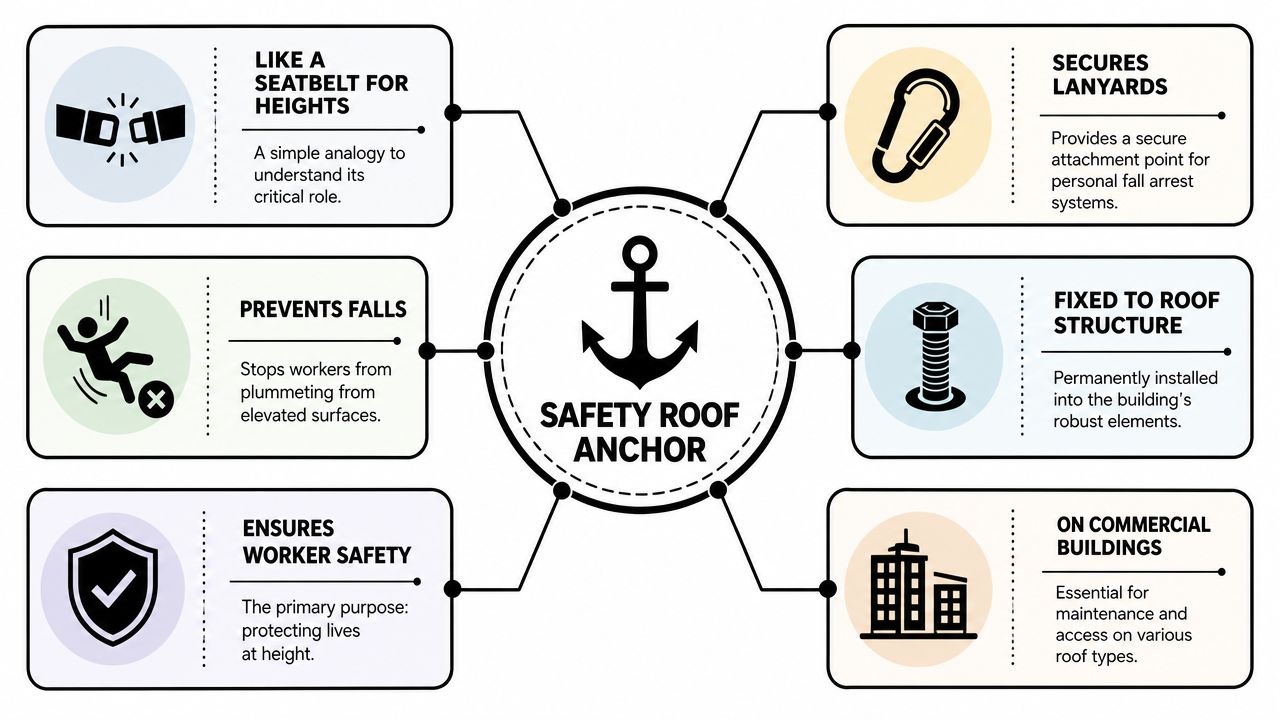
An anchor isn't there to make roof access convenient. It's there to provide a reliable attachment point for a worker's equipment when there's a risk of falling from height. On commercial buildings, that usually means maintenance access, inspection work, leak investigation, plant servicing, facade work, or roofing works.
Fall arrest and fall restraint
These terms get mixed up on site, but they mean different things.
| System | What it does | Practical outcome |
|---|---|---|
| Fall restraint | Stops the worker from reaching the edge or fall zone | The preferred setup where possible because the worker shouldn't be able to fall |
| Fall arrest | Allows access into a risk area but is designed to stop a fall if one occurs | Requires the anchor and the rest of the system to handle arrest forces properly |
For owners and strata managers, that distinction matters because the anchor selection, placement, and rescue planning change depending on how the system is meant to work.
An anchor is only one part of the system
A compliant roof safety setup is never just “the anchor”. It includes the anchor, but it also depends on the user's harness, lanyard or connecting device, the condition of hardware, the roof layout, clearance below, and the way the work is performed.
An anchor can be perfectly installed and still be the wrong solution if it creates a swing fall risk, allows access over a fragile section, or is used with the wrong equipment.
That's where many non-specialists get caught. They ask, “Do we have anchor points?” when the better question is, “Do we have a safe, documented system for the work that occurs on this roof?”
What an owner should understand
- It must connect to something strong: The anchor has to transfer forces into the building structure, not just the weatherproof outer layer.
- It must suit the task: A single point for occasional access is different from a layout designed for repeated maintenance across a large roof.
- It must remain serviceable: Corrosion, movement, damaged fasteners, substrate issues, and undocumented alterations can all make an anchor unsuitable.
- It doesn't authorise unsafe work by itself: Workers still need training, inspection, and a safe access method.
If you remember one thing, remember this: a safety roof anchor is not a hardware purchase. It's part of a controlled risk system.
Anchor Types for Commercial and Industrial Roofs
Commercial roofs don't all need the same anchor solution. A concrete plant room roof, a large metal warehouse, and a retail complex with multiple service zones each create different loading paths, access patterns, and hazards. That's why anchor selection should always start with the roof structure and the actual tasks being done.
Permanent anchors and where they suit
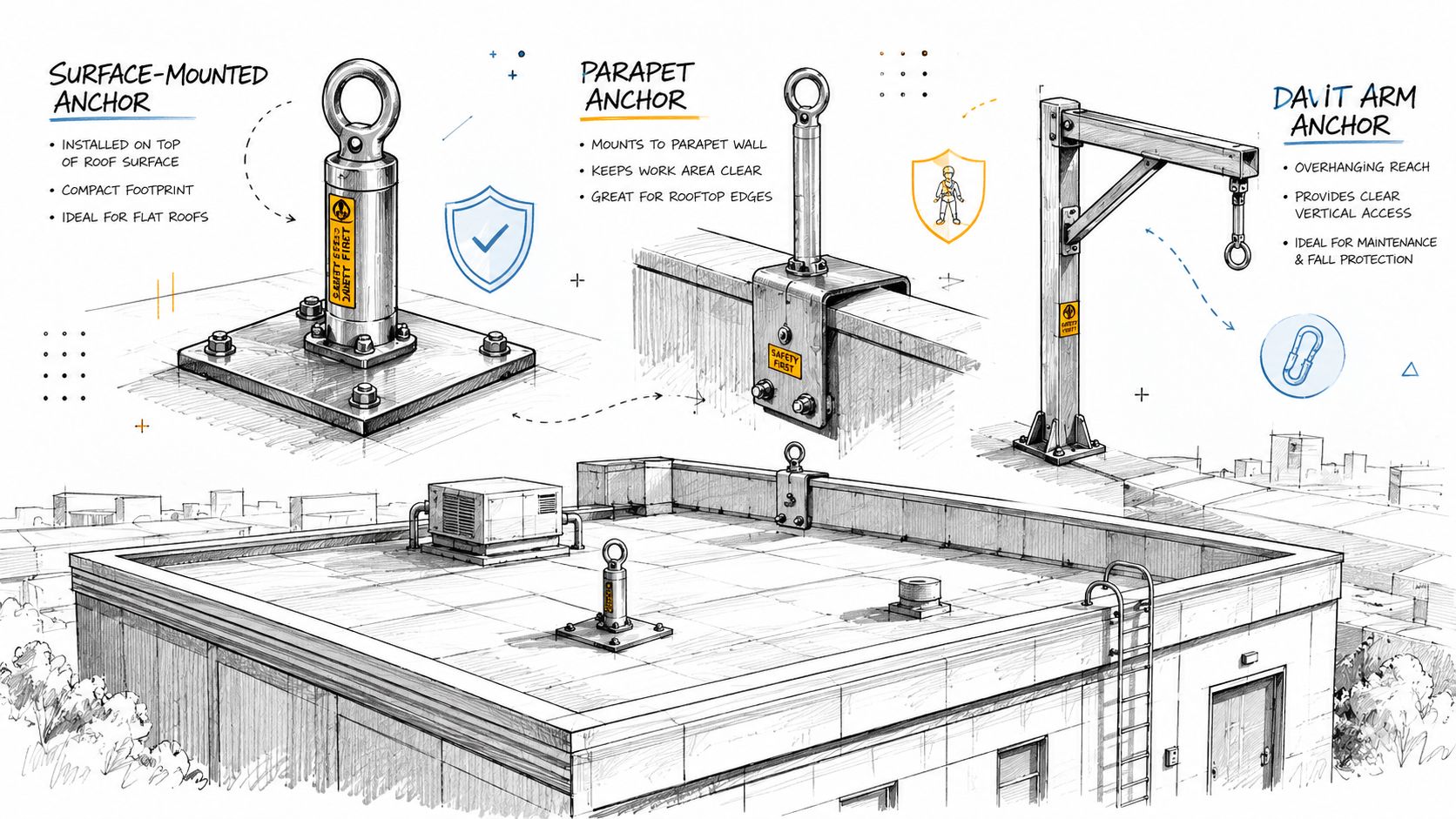
On commercial and industrial sites, you'll usually see a few broad categories.
- Single-point anchors: Used for defined access spots such as near plant, hatches, ladder exits, or isolated work zones.
- Static line systems: Better where workers need to move along a path, such as across long warehouse roofs or around repeated service points.
- Temporary anchors: Sometimes used during specific works, but they still need proper design, suitable substrate, and a safe installation method.
Single-point anchors are often enough where access is limited and predictable. Static lines make more sense where a person needs continuous movement across a larger section of roof without disconnecting and reconnecting repeatedly. The wrong choice usually shows up as awkward workarounds on site. Workers either can't reach the area safely, or they disconnect where they shouldn't.
Metal roofs need structure not just sheeting
This is one of the biggest practical issues on NSW commercial buildings. Warehouses and factories commonly have metal roofing, and owners often assume an anchor can be fixed wherever there's convenient sheet coverage. That's not how compliant installation works.
For commercial metal roofing in Australia, anchors must be engineered to engage structural purlins or rafters, not just the roof sheeting, because pull-out through sheeting alone typically fails to meet the 15kN minimum ultimate strength required for temporary anchorage devices under the relevant standards (LiftQuip Australia Height Safety Product Selection Guide).
That single point changes how competent contractors approach the job. They don't start with the bracket. They start with the substrate, the fastener pull-out values, the roof build-up, and the load path into the structure.
Apex locations are often preferred because they reduce bending effects and can improve the way forces transfer into the roof structure. Edge and eave zones can create harsher loading conditions during a fall event, especially on large-span industrial roofs.
Here's a useful visual overview of roof anchor configurations and how they're used in practice:
What works and what doesn't
| Approach | What works | What fails |
|---|---|---|
| On metal roofs | Fixing into structural members after engineering review | Treating roof sheeting as the primary support |
| For repeated maintenance routes | Matching anchor layout to actual travel paths | Installing isolated points that force unsafe reaching or unclipping |
| For mixed roof zones | Accounting for skylights, brittle sheets, penetrations, and edges | Assuming one anchor type suits every area |
| For procurement | Asking for layout drawings and structural basis | Buying a product first and asking where it can go later |
Owners don't need to become anchor designers. They do need to recognise the warning signs of a shortcut. If the conversation never gets down to purlins, rafters, substrate integrity, and work paths, it's probably too shallow.
Navigating Australian Standards and Regulations
The compliance side of roof access usually sounds more complicated than it is. For most owners, the important point is simple. Your anchor system has to meet the relevant Australian requirements, be inspected properly, and be supported by records that show the system is fit for service.
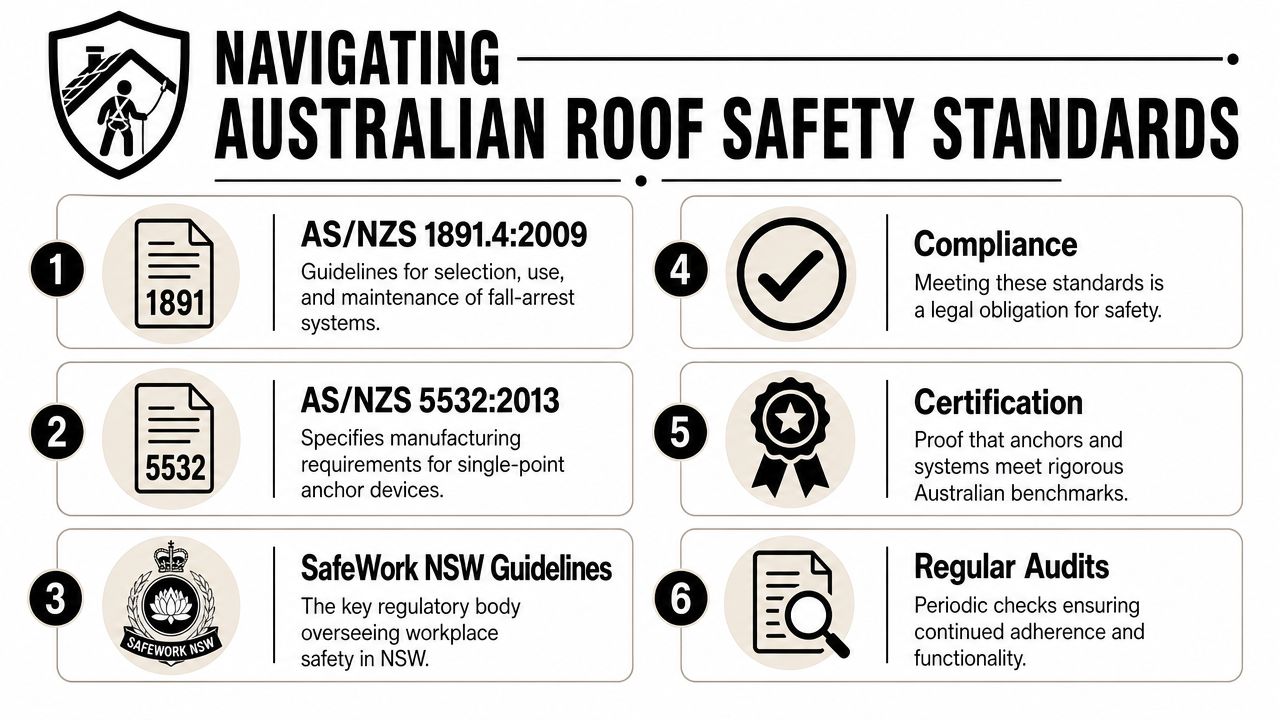
According to SafeWork NSW guidance on fall arrest anchors, safety roof anchors in Australia must comply with the strength requirements of AS/NZS 1891.4 or AS/NZS 5532. SafeWork NSW also states that AS/NZS 1891.4 remains the relevant standard for installed systems, with inspection programs that include annual load testing for chemical and friction anchors, and that roof anchor points should be inspected approximately every six to 12 months by a qualified technician.
Which standard matters on an existing building
Owners often hear both standards mentioned and assume they operate the same way. They don't.
- AS/NZS 5532 deals with manufacturing requirements for anchor devices.
- AS/NZS 1891.4 remains the practical benchmark for installed systems in service, including inspection and maintenance obligations.
That distinction matters most on older buildings. A system may have been installed before newer product requirements applied, but it still has to remain safe, suitable, and maintained under the current inspection framework for installed systems.
Compliance is judged by what's installed, how it performs, and whether it's being maintained properly. Not by how confident someone felt on installation day.
What the inspection schedule means in practice
For owners, “six to 12 months” should trigger a documented maintenance cycle, not an informal reminder. Someone needs to own the calendar, the contractor engagement, the records, and the follow-up actions where defects are found.
A practical compliance file should include:
- Anchor identification: Locations, tags, and drawings that let contractors confirm they are using the correct points.
- Inspection records: Current inspection outcomes from a qualified technician.
- Testing records: Especially where chemical or friction anchors require annual load testing.
- Out-of-service actions: Clear evidence that any failed or questionable anchor has been isolated from use.
There's another rule many owners learn too late. If any component has arrested a fall, it must be removed from service immediately. In practice, re-certification after a fall event is rare, so prudent site management assumes that affected equipment is no longer available for use until formally dealt with.
Who carries the responsibility
The person controlling the premises can't outsource accountability by saying a contractor “looked experienced”. If roof access is part of the building's operation, the owner, strata committee, facilities manager, or principal contractor needs to ensure there's a compliant system and current documentation behind it.
That doesn't mean you personally inspect anchors. It means you make sure competent people do, and that your files would stand up if SafeWork NSW, an insurer, or a lawyer asked for them.
Correct Selection and Siting of Roof Anchors
One of the most expensive mistakes in roof safety is installing anchors everywhere “just in case”. The second most expensive is assuming they aren't needed because roof access is only occasional. Good decisions sit in the middle. They start with the legal trigger for access and then work back to the safest practical system.
When anchors are legally required
Anchors aren't automatically mandatory on every roof. In NSW, the trigger is whether there is a regular expectation that the roof will be inspected or accessed. That's the point highlighted in this NSW strata discussion on roof anchor obligations. If access is expected for tasks such as HVAC maintenance, landlords are legally required to install and maintain anchors, but the exact threshold for when that expectation is triggered often creates confusion.
That confusion is common on strata and mixed-use sites. A roof with no plant and almost no traffic may not need the same permanent system as a warehouse roof with condensers, ducts, antennae, solar equipment, and gutters that need regular attention.
Use this as a decision filter:
- Recurring service tasks: If technicians are expected to return routinely, that supports the case for a permanent access and anchor strategy.
- Reactive access only: If roof entry is exceptional, the risk assessment may point to alternative temporary controls for specific jobs.
- Multiple contractors over time: If different trades will access the same roof, consistency and documented controls matter even more.
- Fragile roofing or complex layouts: These conditions raise the need for proper planning regardless of how often access occurs.
Where anchors should sit on the roof
Correct siting isn't just about where a person wants to clip on. It's about reducing fall distance, limiting swing, keeping workers away from fragile zones, and transferring loads into parts of the building that can handle them.
On many metal commercial roofs, positions near the apex are often preferred because they can reduce bending effects and support safer movement patterns. But “often preferred” doesn't mean automatic. The right location depends on the roof profile, pitch, purlin spacing, penetrations, service routes, and the tasks being done.
A sound design process usually asks:
- Where do workers enter the roof?
- Where do they need to travel?
- Can the task be done in restraint rather than arrest?
- What structure sits below the proposed fixing point?
- How would a worker be rescued if something goes wrong?
Good siting starts with the work task, not the hardware catalogue.
Another overlooked point is structural verification before installation. The anchor may be rated, but the roof beneath it still has to resist fall forces. On warehouses with ageing sheets, patched penetrations, corrosion around fixings, or modified roof build-ups, that assessment can't be skipped.
If you're reviewing proposed works, ask for the basis of design, not just the product name. And if your building needs related roofing works before any anchor system can be relied on, it helps to understand the broader process around roof installation on commercial buildings.
Inspection Maintenance and Recertification
A compliant anchor on day one can become a liability a few years later. On NSW commercial buildings, that matters because owners and strata committees often assume the installer's invoice proves the system is safe to use. It does not. Once the system is on your roof, you carry the ongoing duty to keep it serviceable, documented, and suitable for the work being done.
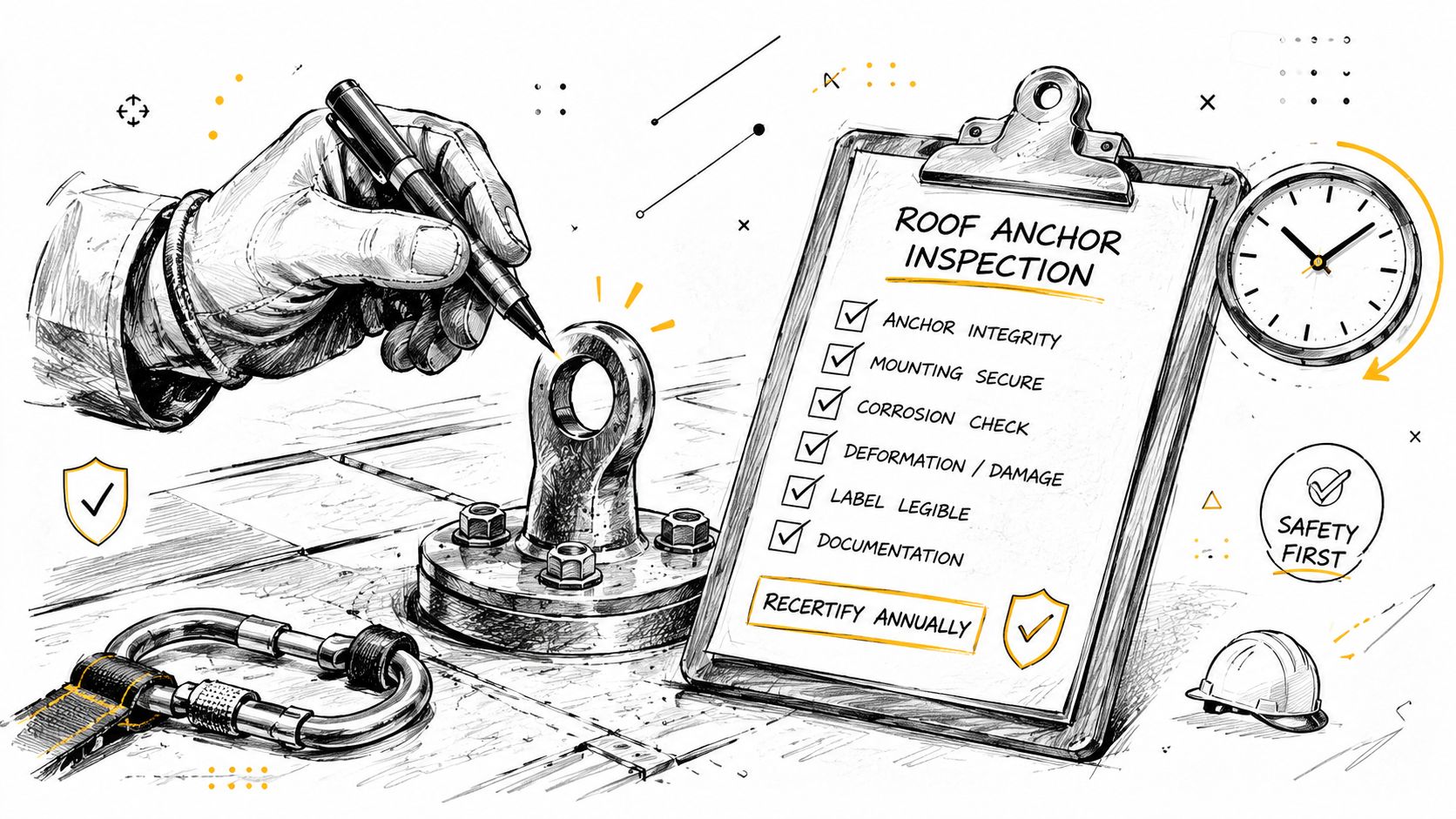
The audit mentioned earlier makes the risk plain. A large share of installed anchors were found unfit for use. That result usually comes from the same failures I see on site. No inspection schedule, no clear asset register, missing tags, corrosion left unchecked, and roof works carried out around anchors without any follow-up assessment.
What a worker checks before use
Every access starts with a pre-use check by the person clipping on. This is a quick safety check, not a formal certification, but it still prevents a lot of bad decisions.
They should look for:
- Visible damage: Bent components, cracked sealant zones, loose fasteners, movement at the base, or corrosion.
- Problems with connected equipment: Frayed harness webbing, damaged lanyards, distorted karabiners, or missing energy absorbers.
- Identification problems: Missing tags, unreadable labels, or no way to confirm the point is still in service.
- Signs of recent disturbance: New penetrations, patched roof sheets, added plant, or other trades working around the anchor location.
If there is any doubt, the anchor stays out of service until a qualified person assesses it.
What a qualified technician checks
Periodic inspection goes further than a visual glance. The technician checks the anchor body, fixings, surrounding roof condition, signs of overload, compatibility with the original design intent, and whether the inspection and testing regime required for that system has been followed.
Documentation carries real weight here. If there is no inspection history, no asset ID, no certification record, and no evidence of repairs, prudent contractors will not let their workers rely on that point. From an owner's side, that gap creates a serious exposure. If someone falls and the anchor was overdue, undocumented, or previously flagged, the legal and insurance consequences become much harder to defend.
Many NSW owners encounter the installer paradox. You may be arranging anchors because roof access is unsafe, but the workers installing, inspecting, or replacing those anchors still need protection during the job. If your contractor cannot explain how they will safely access the roof before the new system is certified, stop there and ask more questions.
Defects need a clear process. Tag failed anchors out of service. Restrict access where needed. Record the defect. Then repair or replace the system without delay. Grey areas on roofs cause accidents.
Anchor upkeep also needs to sit inside the wider roof maintenance budget. If water ingress, sheet corrosion, substrate movement, or previous patch repairs are affecting the anchor zone, fixing the anchor alone will not solve the problem. Owners who plan for commercial roof maintenance costs and lifecycle planning usually spend less than owners who treat anchor compliance as a last-minute service call.
Key Questions for Your Commercial Roofing Contractor
A lot of owners ask contractors the wrong questions. They ask how quickly the job can be done, what the anchor product is, or whether the contractor has “done plenty of these before”. Those questions don't tell you much. The better questions test whether the contractor understands compliance, structure, documentation, and site safety under real working conditions.
Questions that expose real competence
Ask these before any installation, inspection, or recertification work starts:
- How will you protect your workers while installing the new anchors? This is the sharpest screening question you can ask.
- What standard are you assessing the installed system against? You want a clear, confident answer that reflects the requirements discussed earlier.
- How do you verify the roof structure can support the anchor loads? On metal roofs especially, the answer should go beyond surface fixings.
- What documents will I receive at handover? Expect records, identification details, and certification material, not just an invoice.
- How do you handle failed or suspect anchors already on the roof? The contractor should have a clear isolation and rectification process.
- Who performs the inspections and testing? You need qualified people, not guesswork delegated on the day.
A competent contractor will answer these directly. They won't dodge into jargon or act as if the questions are unnecessary.
The answer that should stop the job
One issue separates disciplined operators from risky ones. It's the installer paradox. A critical and often fatal error is when installers use the anchor they are currently fitting as their own fall protection. That practice is prohibited by AS/NZS 1891.4. The new anchor must not be used until fully installed and certified, and installers must use an independent temporary system such as an EWP or scaffold, as explained in this SWMS guidance on anchor installation safety.
If a contractor suggests they'll clip onto the new anchor while fitting it, the conversation should end there.
“What are your installers tied off to while the anchor is being installed?” is one of the most valuable questions a building owner can ask.
That one question tells you whether the contractor understands the law, the physics, and the practical reality of working at height.
A few more signs of a reliable contractor:
| Good sign | Red flag |
|---|---|
| Explains temporary protection during installation | Says the new anchor will protect the installer during fit-off |
| Requests roof drawings, access details, and task information | Prices from photos alone with no structural discussion |
| Talks about records, tags, and inspection intervals | Treats certification as a one-off formality |
| Reviews travel paths and rescue implications | Focuses only on where the bracket can be bolted |
For owners in Sydney and across NSW, contractor selection is part of compliance. If you appoint a business that takes shortcuts, you don't just buy poor workmanship. You inherit risk. If you need a starting point for assessing local capability, review what to look for in a commercial roofer near you.
If you need practical advice on safety roof anchors, roof access risks, or compliant roofing works on a commercial property in NSW, speak with Commercial Roofers . Their Sydney-based team handles commercial and industrial roofing with in-house crews, clear documentation, and a strong focus on safe access, regulatory compliance, and long-term roof performance.