
Commercial and industrial roof replacement in Sydney typically starts at $80 to $220 per square metre for re-sheeting warehouses and factory roofs, with bulk rates dropping to $70/m² on projects above 1,000m². If you're pricing a standard 500 to 1,000m² warehouse re-roof, a realistic 2026 budget is usually $45,000 to $140,000 for demolition, disposal, new sheeting, flashings and box gutters.
If you're reading this, the roof probably isn't a theoretical problem anymore. You've got leaks over stock, rust around laps and fasteners, ponding near gutters, or a building report that says the roof has reached the point where patching it is just buying time.
That's where most online advice becomes a problem. Search results for roof replacement cost in Sydney are dominated by house-focused guides. They talk about terraces, tiles, and suburban homes. They don't deal with warehouses, factories, strata industrial complexes, low-slope sheets, long runs, crane access, tenant coordination, or asbestos controls on active commercial sites.
For business owners and facility managers, the issue isn't just cost. It's cost plus risk. You're balancing capital works, WHS obligations, weather exposure, access restrictions, and the practical question of whether your operations can keep running while the roof gets replaced. That's a very different conversation from a residential reroof.
Table of Contents
- Why Residential Cost Guides Fail for Sydney Businesses
- Commercial Roof Replacement Costs in Sydney 2026
- The 5 Key Drivers of Your Final Quote
- Comparing Material Options Colorbond And Beyond
- Example Projects Commercial Roof Replacement Case Studies
- How to Budget and Get Accurate Quotes
- Securing Your Asset Your Next Steps
Why Residential Cost Guides Fail for Sydney Businesses
The biggest mistake commercial owners make is using residential pricing to frame a commercial budget. That comparison breaks down immediately.
Residential guides in Sydney usually focus on homes costing $11,000 to $46,000, but they don't address the pricing structure or site conditions that shape commercial and industrial reroofing, including scale, box gutter systems, and architectural cladding that domestic guides leave out, as noted by Trade Vault's Sydney roofing cost overview.
A house roof is usually a smaller envelope with simpler access, fewer stakeholders, and less operational pressure. A warehouse roof is different. The footprint is larger. Sheet lengths are longer. Drainage is often handled through internal box gutters that have to be rebuilt properly, not patched. You may need traffic management, crane lifts, exclusion zones, after-hours sequencing, or staged works so tenants can keep trading.
Practical rule: If the building stores stock, houses plant, or stays occupied during works, your budget has to account for business continuity as well as roofing labour and materials.
There's also the compliance layer. Commercial jobs involve SWMS, site inductions, fall protection, edge protection, access equipment, and often more supervision. On older sites, asbestos changes everything. On multi-tenant strata sites, access and communication can take almost as much planning as the installation itself.
For that reason, roof replacement cost Sydney searches often lead owners in the wrong direction. The question isn't “what does a new roof cost on a house?” The question is “what does it take to replace a weathered roof on a live commercial site without creating a bigger operational problem than the one you started with?”
Commercial Roof Replacement Costs in Sydney 2026
A facility manager prices a warehouse roof at a simple per metre rate, then the first site walk changes the brief. The roof has internal box gutters, old penetrations around plant, and a section suspected to contain asbestos. That is how commercial roofing budgets shift in Sydney. The quoted rate is only the starting point.
For warehouses, factories, and large commercial buildings, budget on a square metre basis first, then pressure-test the scope. On Sydney industrial work, the spread is wide because access, drainage design, compliance controls, and programming around live operations can change labour and preliminaries fast.
Current market ranges for commercial metal re-sheeting in Sydney generally sit between $80 and $220 per m². Larger roofs can achieve lower unit rates where access is straightforward and the scope is clean. A standard 500 to 1,000m² warehouse re-roof commonly falls somewhere between $45,000 and $140,000 for removal, disposal, new sheeting, flashings, and gutter-related works already allowed for in the contract sum, as noted earlier.
What the base rate usually covers
On a straightforward industrial re-roof, the budget allowance often includes:
- Strip and disposal of existing roof sheets
- New metal roof sheeting, typically Colorbond or Zincalume
- Standard flashings at ridges, barges, aprons, and penetrations
- Gutter work where replacement is clearly included in scope
- Installation labour, fixings, standard site set-up, and routine safety measures
That base rate often excludes the items that turn a manageable job into a difficult one. Structural steel repairs, insulation upgrades, membrane treatment to low-slope sections, crane lifts, after-hours staging, and temporary weatherproofing are common examples.
Asbestos is another major cost line. Older Sydney industrial roofs can carry asbestos in roof sheeting, backing materials, or adjacent components, and removal has to be priced separately with the right controls and licensed handling. If that risk is on your site, review typical asbestos roof removal costs in Sydney before treating any roofing allowance as realistic.
Practical budgeting ranges for 2026
The table below is a budgeting tool, not a substitute for a site inspection or a documented scope.
| Facility Size (m²) | Typical Per Metre Rate (inc. removal) | Estimated Total Project Cost |
|---|---|---|
| 500m² warehouse or factory unit | $80 to $220/m² | $45,000 to $110,000 |
| 1,000m² warehouse | $80 to $220/m² | $80,000 to $220,000 |
| Over 1,000m² industrial site | From $70/m² on bulk projects, up to $220/m² depending on scope | Varies by access, box gutters, material grade, and compliance scope |
Use those numbers carefully.
A larger roof can reduce material handling and improve procurement efficiency, but the savings disappear quickly if the building stays occupied during works. Staged handovers, exclusion zones, tenant coordination, wet-weather planning, and reopening critical areas each day all add cost.
Scope definition also matters. Re-sheeting can mean removing old metal and installing new sheets over an otherwise serviceable roof build-up. Full roof replacement usually reaches further into the system. It can include substrate checks, widespread flashing replacement, box gutter reconstruction, overflow compliance upgrades, and rectification around penetrations and plant supports.
That distinction affects budget, programme, and risk.
On commercial sites, the lowest-looking rate is often missing the items that cause disputes, variations, and downtime once the roof is open.
The 5 Key Drivers of Your Final Quote
A commercial roof quote is built around risk, not just area.
Two Sydney warehouses can have the same square metres and land far apart on price once you account for occupied tenancy, roof-mounted plant, box gutter rectification, asbestos controls, and how much of the building must keep operating during the works. That is the gap residential guides miss.
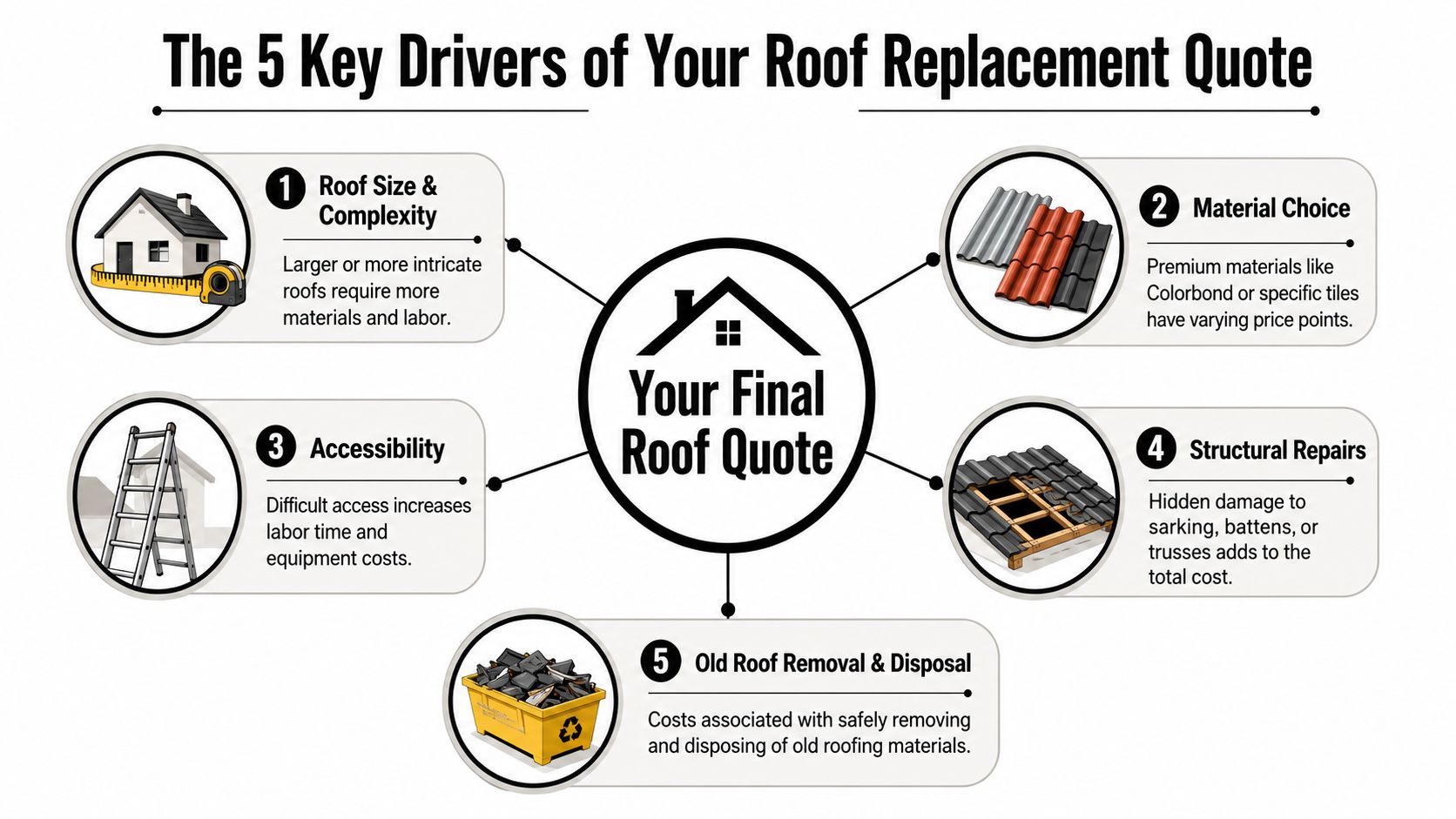
1. Roof size and geometry
Scale helps, but only on simple roofs.
A large, open-span warehouse roof with clear access and few penetrations is usually faster to strip and re-sheet than a smaller site chopped up by exhaust fans, skylights, services, parapets, valleys, and stepped roof lines. Every penetration needs flashings and weather seals. Every transition slows production and increases the chance of finding hidden corrosion once sheets come off.
Geometry also drives temporary waterproofing strategy. On a straight gable roof, crews can work in controlled sections and close each area quickly. On mixed-pitch industrial roofs with box gutters and low-slope junctions, sequencing gets tighter because water management becomes part of the construction method, not just the finished design.
2. Material selection
Material choice changes more than supply cost. It affects install speed, structural load, corrosion performance, thermal performance, and how much detailing is needed around edges and penetrations.
Standard steel sheeting is often the budget baseline for warehouses and factory units. Costs rise when the scope moves to higher-grade corrosion-resistant steel, insulated panel systems, standing seam profiles, or membrane systems on low-slope areas. Those assemblies can solve real building problems, but they also change labour hours, accessory count, and inspection requirements.
The right question is not which product is cheapest per metre. It is which system suits the building use, exposure conditions, and required service life without creating avoidable maintenance cost later.
3. Access and site logistics
Access is where many budgets go off track.
Quotes rise fast on sites with limited laydown area, tight truck access, live loading docks, overhead power, neighbouring properties, or restricted crane positions. If the building must stay operational, the contractor may need staged work zones, after-hours shifts, noise controls, internal protection, and daily make-safe procedures before staff return. Those measures protect business continuity, but they reduce installation speed.
Occupied commercial sites also carry a heavier safety burden than a vacant shed. Pedestrian separation, SWMS compliance, edge protection, permits, inductions, and tenant coordination all take time and supervision.
If asbestos is even a possibility, deal with it before final scope sign-off. A proper survey and removal plan affects contractor selection, programme, and site controls from day one. A useful starting point is this guide to asbestos removal cost factors in Sydney.
4. Asbestos and compliance controls
On older industrial properties, asbestos can shift the whole job.
The issue is not limited to removal labour. It changes licensing requirements, isolation zones, air monitoring, waste handling, clearance procedures, and the order of works. On a live site, it can also affect how tenants, staff, or production areas are separated from the roofing zone.
Commercial asbestos roof removal in NSW is tightly regulated. Large sites often need third-party monitoring and stricter containment than owners expect, which is one reason budgets can blow out if asbestos is treated as a minor provisional item, as outlined in Yellow Pages' discussion of roof replacement and asbestos cost complexity.
Treat asbestos as a separate compliance scope inside the roof project, with its own programme, controls, and approvals.
5. Hidden upgrades after strip-off
The most expensive items are often concealed until demolition starts.
Common examples include rusted purlin ends, failed blanket insulation, degraded fastener lines, non-compliant overflow provision, and box gutters that have lost fall or are already patched beyond practical repair. None of that is visible with confidence from the ground or during a quick walkover.
A disciplined quote makes these latent conditions clear before work starts. It sets out what has been allowed for, what has been excluded, and how variations will be assessed if the strip-off exposes structural or drainage defects. That protects both sides. The owner gets fewer surprises, and the contractor is not forced to argue over work that could not be measured accurately at tender stage.
Comparing Material Options Colorbond And Beyond
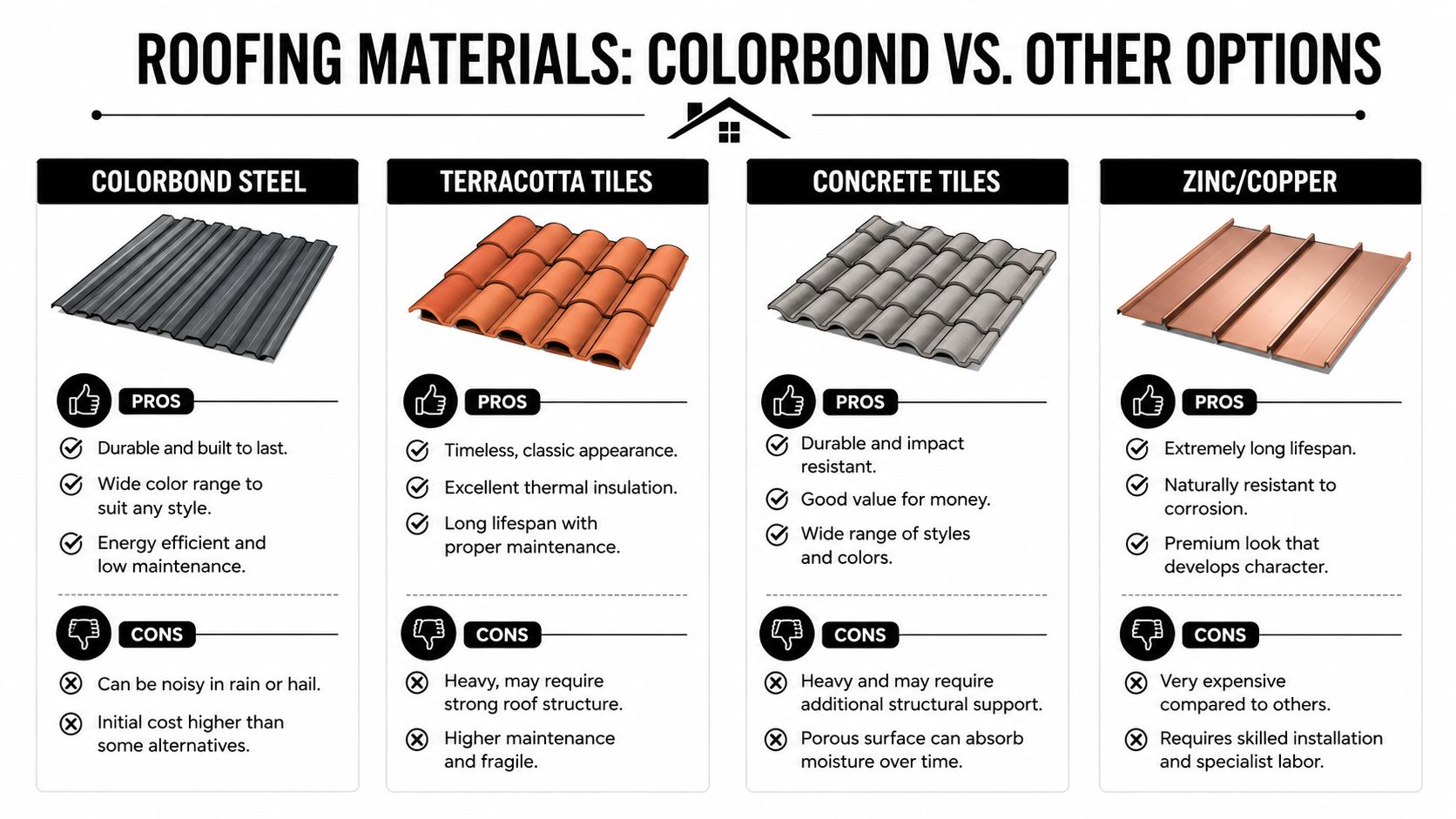
Material selection drives more than appearance. It affects install speed, corrosion resistance, thermal behaviour, maintenance planning, and how forgiving the roof will be over the next service life.
Steel systems for mainstream industrial roofs
For most Sydney commercial and industrial buildings, Colorbond and Zincalume remain the practical workhorses. They suit warehouses, factories, light industrial units, and large-format commercial buildings because they're comparatively light, fast to install, and available in profiles that work across a wide range of spans and pitches.
Colorbond usually gets the nod where owners want stronger finish options, branding alignment, or higher corrosion performance in tougher environments. Zincalume remains a sensible choice where budget and functional performance take priority over colour finish.
If you're weighing those two products directly, a side-by-side comparison of Zincalume vs Colorbond for commercial roofing helps frame the decision properly.
Where insulated panels and membranes fit
Insulated sandwich panels suit buildings where temperature control matters. Food production areas, cold-chain facilities, and some manufacturing environments benefit from a roof build-up that combines outer skin, core insulation, and internal liner in one system. The verified Sydney commercial data places sandwich panels at $140 to $280/m² in relevant applications, cited earlier from the Sydney commercial roofing cost source.
Membrane systems such as TPO and PVC fit low-slope roof areas where metal sheeting isn't the best waterproofing strategy. These systems need proper substrate preparation, detailing, and seam welding. They're not interchangeable with standard industrial roof sheets. Used in the right context, they solve specific drainage and movement problems well. Used in the wrong context, they create maintenance headaches.
Architectural metals and non-standard finishes
Some commercial projects sit outside mainstream warehouse roofing. High-end retail, healthcare, education, and architect-designed developments may specify standing seam, VM Zinc, Equitone, aluminium, or copper elements. Those systems don't compete on the same terms as basic industrial roof sheeting. They're selected for envelope performance, design intent, and detail quality.
A simple way to think about the options is this:
- Standard steel roofing: Best for mainstream commercial assets where value, speed, and durability matter most.
- Insulated panels: Best where thermal control is operational, not cosmetic.
- Membranes: Best on low-slope sections that need a different waterproofing approach.
- Architectural metals: Best where the building façade and roof are part of the asset's identity.
The right material is the one that suits the building use, exposure conditions, and maintenance reality. Not the one that sounds premium in a quote.
Example Projects Commercial Roof Replacement Case Studies
A commercial reroof gets expensive fast when the building has to keep trading, the drainage design is poor, or the existing roof build-up raises compliance issues. That is why residential examples rarely help Sydney owners of warehouses, factories, strata industrial units, and mixed-use assets.
Warehouse re-roof in Western Sydney
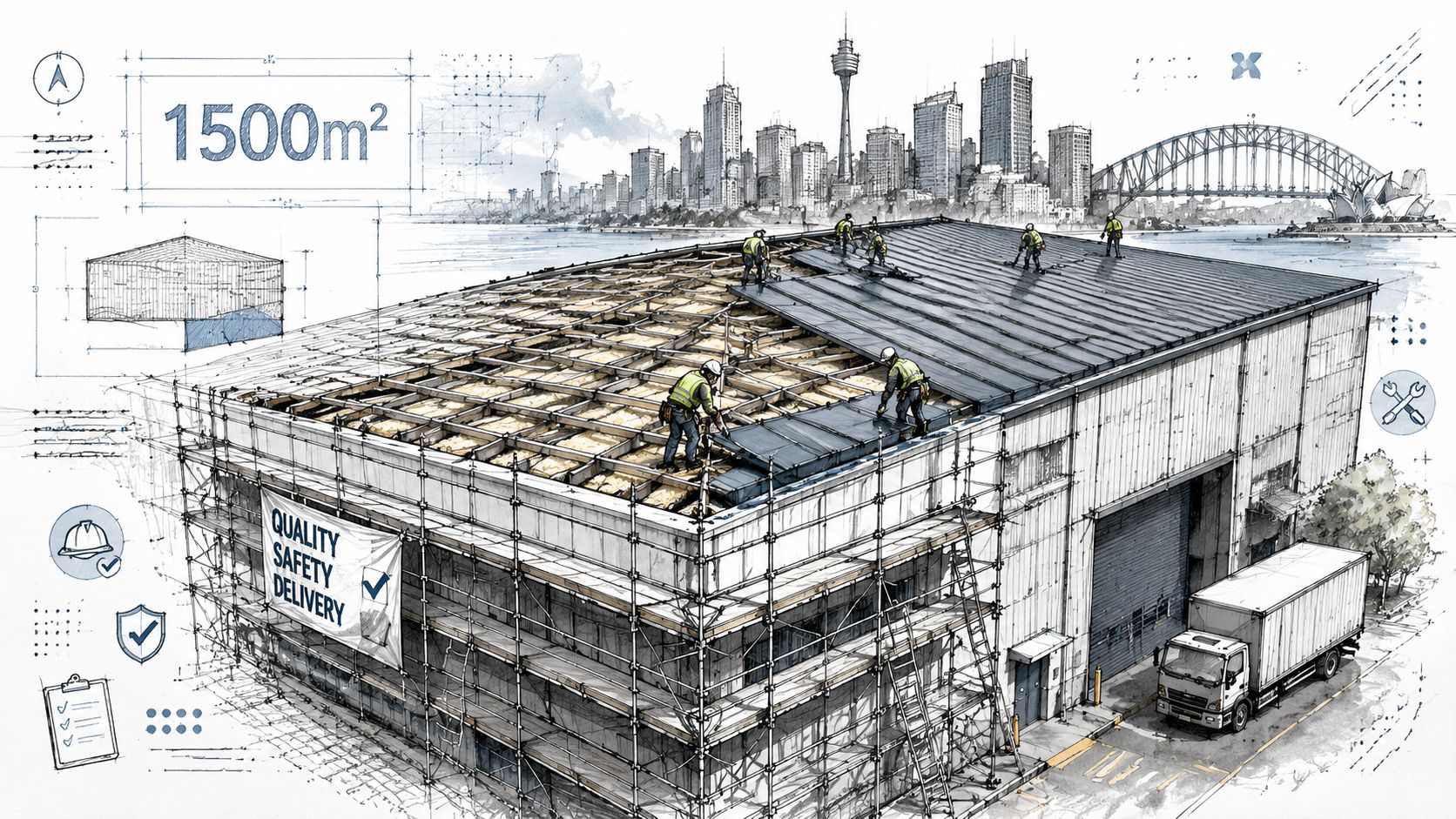
A common Western Sydney brief looks like this. An older metal roof over a distribution or light manufacturing facility has repeated leaks at side laps, roof penetrations, translucent sheets, and internal box gutters. The tenant is still operating. Stock, plant, and forklifts stay in place. The owner wants to stop paying for temporary repairs and deal with the asset properly.
On that type of job, cost usually turns on staging and hidden condition risk more than the new sheet profile itself. Once the old roof comes off, the contractor may find corroded purlin clips, wet blanket insulation, failed safety mesh, or drainage falls that were never right in the first place. A quote that looks sharp on page one can move quickly if those items were not allowed for.
The scope often includes:
- Staged roof removal: Open only the areas that can be made weather-tight the same shift.
- Substrate and structural checks: Inspect purlins, spacer systems, insulation, and fixing lines after strip-out.
- New roof installation: Replace with commercial-grade steel sheeting suited to the building use and exposure.
- Box gutter and flashing upgrades: Rebuild the details that usually caused the leak history.
- Operational controls: Sequence noisy or exposed work around dispatch times, production windows, and sensitive stock zones.
On a large warehouse, scale can help the rate. It only helps if access is clean, the roof geometry is simple, and there is no asbestos, major structural remediation, or shutdown constraint. Once any of those issues appear, the square metre rate stops behaving like a simple bulk-buy exercise.
Owners who want realistic pricing on jobs like this should start with a contractor who handles occupied industrial sites and understands staging, temporary waterproofing, and live-site safety. A commercial roofer near you with experience in active warehouse reroofing is usually a better fit than a contractor geared mainly to houses or small retail awnings.
Strata industrial complex near the coast
Strata industrial projects are harder to price because the roof is only part of the job. The other part is coordination. Different lot owners, tenant access rights, after-hours approvals, traffic management, and communication obligations can add weeks before work even starts.
Coastal exposure adds another layer. Material selection becomes more conservative, fixings and flashings need closer attention, and any proposal to save money with a lower-grade specification should be tested against corrosion risk and maintenance frequency. Cheap sheeting can become an expensive decision on a coastal industrial asset.
If asbestos is present in the roof sheeting, underlay, or associated components, the job shifts into a different category. The budget then has to cover licensed removal, air monitoring where required, clearance processes, waste transport, site isolation, and tighter programming. Business continuity also gets harder because work areas, access paths, and tenant notifications have to be controlled more carefully.
The jobs that stay on budget usually have three things in place early. Clear authority to approve scope changes. A possession and staging plan that matches tenant operations. A documented drainage and detail review, especially around box gutters, sumps, parapets, and boundary interfaces.
That is the commercial difference. On Sydney industrial roofs, the final number is shaped as much by compliance, access, and disruption control as by the roof covering itself.
How to Budget and Get Accurate Quotes
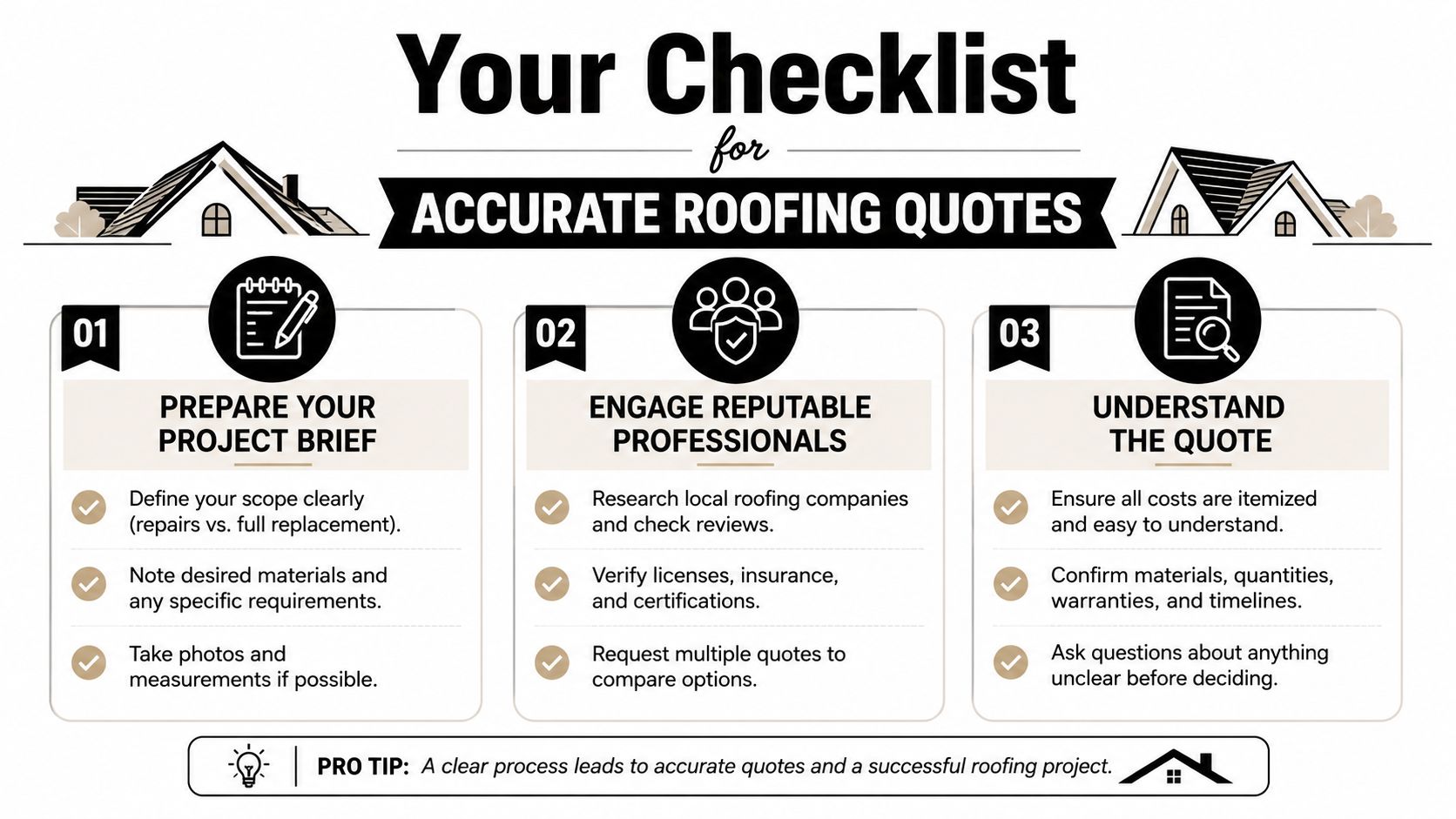
Most budget problems start before the first quote arrives. They begin with a weak brief, missing site information, or an owner comparing numbers that aren't based on the same scope.
Build a budget that reflects real site risk
Start with the verified commercial market range already covered in this article, then stress-test it against your site. Ask yourself whether the building has internal box gutters, difficult access, occupancy constraints, suspect asbestos, or sections that may need a different roof system.
Then prepare a short written brief. It should identify the building use, whether the site must stay operational, any known leak locations, access restrictions, preferred materials, and whether you want patching, partial replacement, or full reroofing. That one document improves quote quality immediately.
What a usable quote should show
A proper quote isn't just a number and a product name. It should let you compare contractors on the same footing.
Look for these inclusions:
- Clear scope of works: Exactly what's being removed, replaced, upgraded, and excluded.
- Material specification: Product type, profile, finish, and where different systems apply.
- Access methodology: Scaffolding, crane use, edge protection, site access assumptions.
- Safety and compliance detail: SWMS, insurances, supervision, and asbestos procedures if relevant.
- Programming and staging: How the contractor will keep the building weather-tight and operational.
- Variation process: How hidden defects or latent conditions will be documented and priced.
If you're still searching for contractors, a focused list of commercial roofers near you in Sydney is more useful than calling general roofers who mainly work on houses.
A quote is only comparable when the scope, exclusions, materials, and access assumptions are all visible.
Questions worth asking before you appoint anyone
Don't just ask for the cheapest number. Ask how they plan to run the job.
- What similar commercial or industrial roofs have you replaced recently? You want relevant experience, not general roofing experience.
- Who will supervise the project day to day? Commercial roofing lives or dies on coordination.
- Do you use in-house crews or subcontract the installation? That affects quality control and communication.
- How do you handle latent conditions once the roof is stripped? There should be a documented process.
- How will you protect operations below the roof during staged works? This matters as much as the final finish.
A disciplined procurement process takes longer at the start, but it usually prevents the expensive surprises later.
Securing Your Asset Your Next Steps
For Sydney commercial properties, roof replacement cost Sydney budgets need to start from the commercial reality, not residential averages. For warehouses and industrial sites, the verified market baseline is $80 to $220 per square metre, with bulk projects over 1,000m² sometimes dropping to $70/m² under the right conditions. That gives you a starting point, not a finished budget.
The final price depends on what's on the building. Access, box gutters, live-site staging, asbestos controls, material grade, and what appears after strip-off will decide where your project lands.
A failing roof is rarely just a maintenance issue. It threatens stock, tenancy, compliance, and continuity. Waiting usually narrows your options. It doesn't improve them.
The next practical move is a detailed inspection, a defined scope, and a quote that shows exactly what is and isn't included.
If you need a commercial-first assessment rather than another residential-style estimate, Commercial Roofers can inspect your site, identify cost drivers, and provide a clear scope for safe, compliant roof replacement across Sydney.