
If you're looking at an ageing commercial roof right now, the decision usually doesn't feel neat or theoretical. It feels expensive, disruptive, and slightly urgent. Maybe you've had a leak over stock, tenants are complaining about heat in the top floor offices, or your maintenance contractor keeps patching the same section and the bill keeps coming back.
That's where a lot of owners make the wrong call. They treat the roof as a repair item instead of an asset decision. On a warehouse, factory, retail complex, school, or strata building, the roof affects more than weather protection. It affects tenant comfort, internal temperatures, maintenance frequency, presentation, and how often you need to spend capital on the same problem.
Painted metal roofing sits right in the middle of that conversation. In Australia, systems such as prepainted steel roofing aren't just chosen because they look cleaner than old galvanised sheet or because the colour suits the facade. The coating system changes how the roof handles sun, grime, salt, humidity, and standing water risk when the design is poor. It also changes how long the roof keeps looking presentable without becoming a constant maintenance job.
Owners often focus on the visible part, which is the colour. True value sits underneath that first impression. The metal base, the metallic coating, the factory-applied paint system, the roof pitch, the fasteners, the flashings, and the site exposure all work together. Get that package right and a painted metal roof can become a long-term asset. Get it wrong and you can end up paying premium money for a roof that fades early, leaks at details, or degrades faster than it should in coastal or industrial conditions.
Table of Contents
- Introduction Why Your Roof Is More Than Just Shelter
- Understanding the System Beyond a Coat of Paint
- Decoding Paint Coatings Polyester SMP and PVDF
- Performance Metrics Durability and Energy Efficiency
- Specification and Installation The Details That Matter
- Cost Analysis Upfront Price vs Long-Term Lifecycle Value
- Conclusion A Framework for Your Roofing Decision
Introduction Why Your Roof Is More Than Just Shelter
A commercial roof usually gets attention only when it starts costing money in obvious ways. Water ingress, rust stains, swollen insulation, mould risk, damaged stock, tenant complaints, and repeated callouts all push the issue to the top of the list. By then, the discussion is often framed around the fastest quote instead of the smartest long-term outcome.
That's a mistake on large Australian assets. A warehouse roof isn't just a weather skin. It's part of the building's operating profile. If it absorbs too much heat, internal conditions become harder to manage. If the coating system can't handle UV or salt exposure, the roof starts ageing visually and functionally well before the owner expected. If the roof geometry is wrong, even a high-grade finish won't save it from trapped moisture around laps and penetrations.
The owner's real question
Most owners aren't really asking, “What roof colour should I choose?” They're asking a tougher question. “What will stop me spending on this roof again too soon?”
That changes the conversation. It shifts focus from surface appearance to lifecycle value. On a commercial property, that means looking at:
- Durability in local conditions: Coastal air, urban pollution, intense sun, and heat cycling all matter.
- Operational impact: Internal heat gain, occupant comfort, and disruption during future repair cycles affect the building long after installation day.
- Maintenance burden: The wrong specification can lock you into recurring patchwork, cleaning, touch-ups, and detail failures.
A roof that looks cheaper on day one can be the more expensive roof by year five if the coating, detailing, or drainage are wrong.
Painted metal roofing is often one of the strongest options for Australian commercial buildings because it can combine corrosion protection, long-term appearance retention, and thermal performance in one system. But that outcome isn't automatic. Owners only get the payoff when the roof is specified as a complete assembly, not bought as a commodity sheet with a colour name attached.
Where owners lose money
The expensive errors are usually ordinary ones. Choosing a lower-grade coating for a harsh coastal site. Installing painted sheet on a roof that doesn't have adequate fall. Treating all prepainted steel as equivalent. Comparing quotes without checking what paint system, substrate, fasteners, and flashings are included.
Those decisions don't fail all at once. They fail slowly, and slowly is what makes them costly. The roof remains “serviceable” while appearance drops, heat load stays high, and maintenance keeps draining budget.
Understanding the System Beyond a Coat of Paint
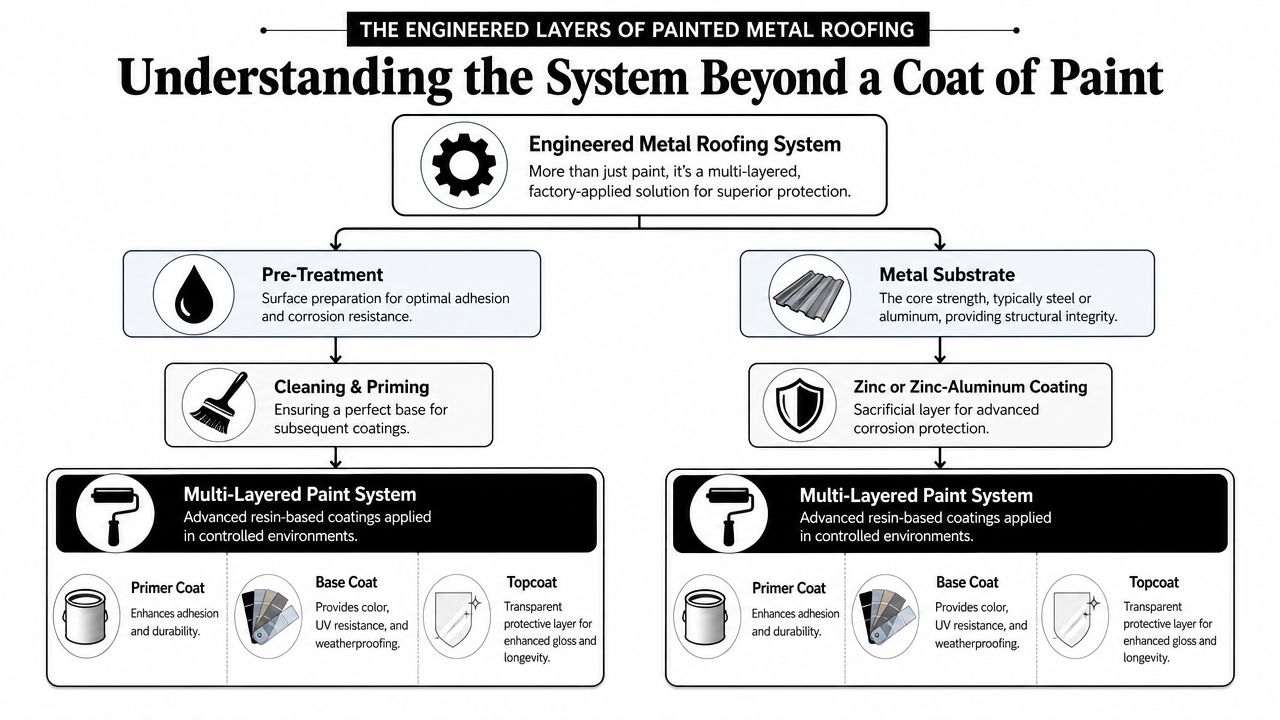
People often describe painted metal roofing as if someone took steel sheet and added colour. That's not what a commercial-grade product is. A proper prepainted roof is an engineered, factory-applied system where each layer has a job.
Think of it more like automotive finishing than site painting. The visible surface matters, but adhesion, corrosion resistance, and substrate protection are built through multiple stages. If one stage is weak, the whole result suffers.
Factory finishes behave differently on site
A commercial painted metal roof generally starts with a steel base that already has a protective metallic coating. From there, the material receives factory-applied organic coatings under controlled conditions. That matters because consistency is part of performance. Film build, curing, adhesion, and surface preparation are more reliable in manufacture than in open-air site conditions.
Products in the Colorbond-type category are based on zinc/aluminium alloy-coated steel with factory-applied organic coatings, and some commercial products carry paint performance warranties of up to 20 years according to technical product literature on prepainted metal roofing systems. That's the practical reason owners should stop thinking of the paint as decoration. It's part of the protection package.
Why the full system matters more than the top colour
The roof doesn't fail because one square metre of topcoat had a bad day. It fails when the system is mismatched to the exposure or the detailing. The metallic coating handles corrosion defence at the steel surface. The paint layer deals with UV, weathering, and appearance retention. The profile and installation handle drainage. The accessories and flashings deal with junctions, movement, and water management.
That's why two roofs that look similar from the car park can perform very differently over time.
A sensible commercial specification checks at least these points:
- Substrate and metallic coating: The base steel and its protective alloy layer are the first line of defence.
- Paint family: Polyester, SMP, and PVDF don't age the same way.
- Profile suitability: Standing seam, trim deck, corrugated, and clip-lock systems have different drainage and detailing behaviours.
- Site exposure: Coastal, industrial, and high-UV locations need tougher coating choices.
- Accessory compatibility: Fasteners, flashings, sealants, and penetrations need to work with the panel system, not against it.
Practical rule: Don't compare prepainted roofing by colour card alone. Compare the substrate, coating family, warranty basis, profile, and site suitability as one package.
Owners who skip that step usually assume they bought a premium roof because the sheet arrived prepainted. That assumption causes trouble later. Factory painting is only an advantage when the entire system has been selected for the building, the environment, and the way water will move across the roof.
Decoding Paint Coatings Polyester SMP and PVDF
If you only remember one technical issue from this article, make it this one. The coating family has a major influence on how a painted metal roof looks and performs over time. In practical terms, it affects fade resistance, chalk resistance, weathering, and how well the roof holds up in demanding environments.
Industry guidance identifies three major paint families for metal roofing: polyester, SMP, and PVDF, with performance broadly stepping up from good to better to best. The same guidance describes PVDF as the most durable, particularly because it better resists degradation from UV, urban grime, salt, high temperatures, and humidity, which makes it highly relevant to Australian coastal and metropolitan projects, as outlined in industry discussion of metal roofing paint families.
Good better best is useful if you use it properly
The “good, better, best” framework helps, but only if you don't turn it into a sales shortcut.
Polyester is often suitable where budget matters and exposure is less aggressive. It can be a reasonable fit for lower-visibility or more utilitarian buildings where appearance retention isn't the main priority. The trade-off is that it won't usually be the first choice where colour stability and long-term visual performance are critical.
SMP, or silicone-modified polyester, sits in the middle. It generally offers stronger performance than standard polyester and can make sense where the owner wants a step up without paying for the highest-spec coating on every project. It's a common middle-ground option when the building is exposed but not extreme.
PVDF is the premium choice when the roof has to stay presentable and resilient under harsher conditions. On projects near the coast, in polluted urban settings, or on buildings where appearance forms part of brand value, PVDF often justifies the added upfront cost because it's designed to resist the things that commonly age painted roofs early.
Paint coating comparison for commercial roofing
| Coating Type | UV & Fade Resistance | Typical Warranty (Years) | Best Use Case |
|---|---|---|---|
| Polyester | Good | Varies by product | Budget-conscious projects and lower-exposure buildings |
| SMP | Better | Varies by product | Commercial roofs needing stronger weathering performance without moving to premium coating cost |
| PVDF | Best | Varies by product | Coastal, metropolitan, high-visibility, and high-UV sites where long-term appearance and durability matter |
A few cautions matter here.
First, warranty length isn’t the whole story. A longer warranty can be useful, but owners should read what it covers. Some warranties focus on perforation or paint performance under specific conditions, not every kind of aesthetic change or installation error.
Second, the harshest part of the site decides the spec, not the average condition. A building near salt exposure, heavy traffic grime, or industrial fallout shouldn’t be specified as if it were inland and clean.
Third, don’t over-specify blindly. If the asset is a basic rear warehouse in a mild environment with no visibility concerns, spending top dollar on the most premium finish everywhere may not produce the best return.
The right coating isn’t the most expensive one. It’s the one that matches the building’s exposure, visibility, ownership horizon, and maintenance strategy.
That’s the commercial view owners need. Paint chemistry is not a cosmetic upsell. It’s one of the main controls over how often the roof becomes your problem again.
Performance Metrics Durability and Energy Efficiency
The benefit of painted metal roofing isn’t abstract. Owners feel it in two places. One is the maintenance budget. The other is the building’s internal conditions.
The thermal side often gets overlooked until someone walks into a top-floor office, mezzanine, or warehouse under-roof area in summer and realises the roof colour choice wasn’t cosmetic at all.
Colour changes building performance
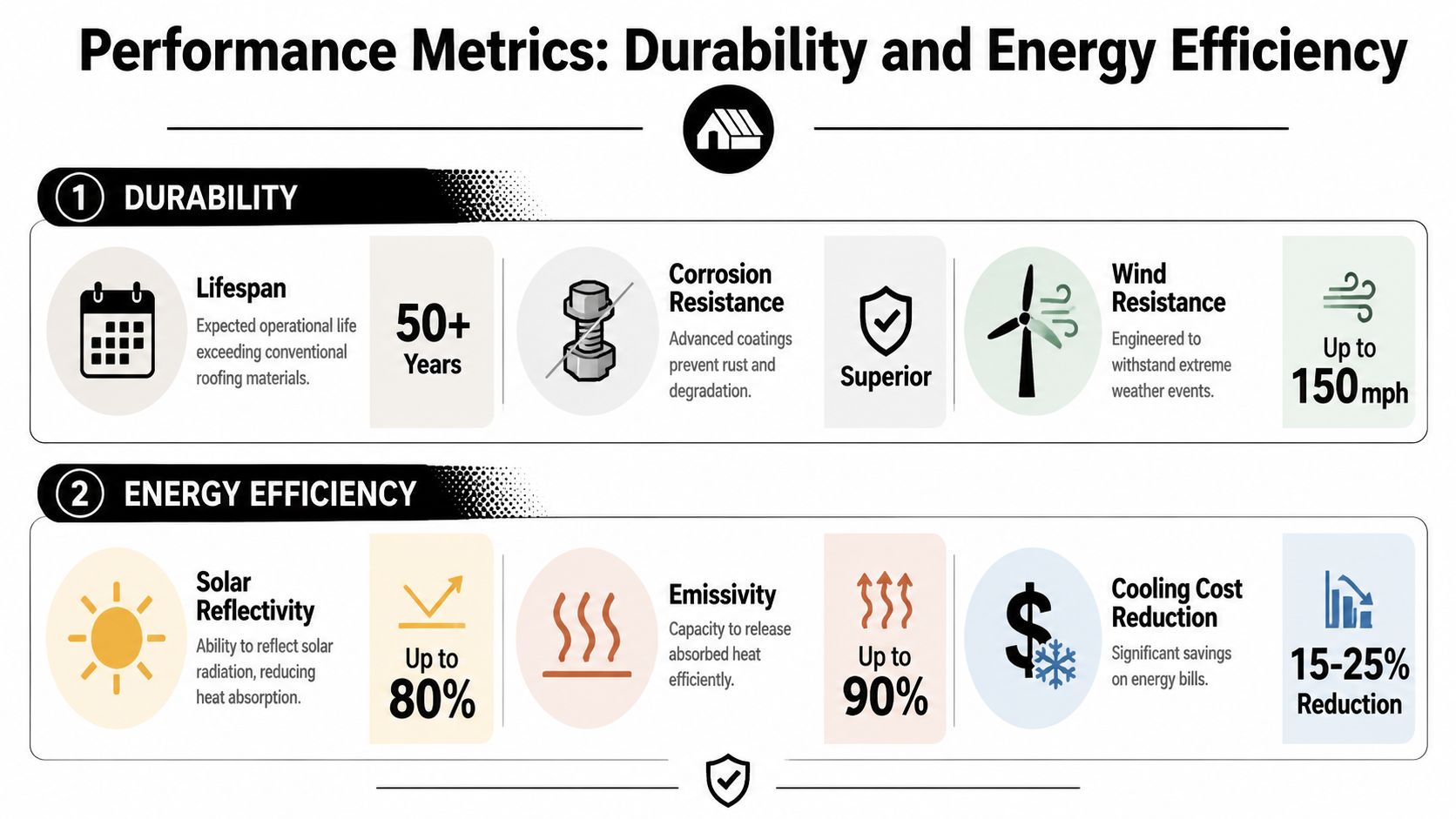
In Australian conditions, roof colour directly affects indoor temperature. In a controlled field study, a white-gloss painted metal roof was measured at 1.7 °C cooler than an unpainted metal roof from 21:00 to 23:59, 1.6 °C cooler from 00:00 to 05:59, and 0.9 °C cooler during the hottest daytime period from 07:00 to 20:30, according to controlled research on roof colour and indoor temperature in metal-roofed buildings.
The same study reported indoor temperatures of 31.5 °C for bare metal roofs, 30.3 °C for red roofs, and 29.8 °C for white roofs in the evening period. That’s a practical result, not a marketing slogan. It shows that the finish on the roof can materially change internal heat gain and comfort in occupied spaces.
For commercial buildings, that matters in several ways:
- Warehouses and factories: Internal heat affects staff comfort and can make certain working zones harder to tolerate.
- Strata and mixed-use assets: Top-floor occupants often notice roof heat before anyone else.
- Retail and light commercial buildings: A hotter roof can increase cooling demand and create uneven comfort across tenancies.
If you’re already dealing with moisture ingress as well as temperature complaints, it helps to understand how roof condition affects the broader asset. Owners comparing repair pathways often look at both heat and leak issues together when reviewing options such as commercial roof leak repair in Sydney.
A short video gives a useful visual overview of how metal roofing systems perform in practice:
Durability is about resistance not marketing
Durability comes from resisting the specific things that attack roofs in service. On painted metal roofing, that means sunlight, contaminants, salt, moisture, heat cycling, and water retention around details.
A high-quality coating system slows down visible ageing and protects the roof’s long-term appearance. It helps reduce the maintenance pattern that owners hate most, which is the constant small spend. Touch-up work, sealant fixes, isolated sheet replacement, corrosion around details, and repainting discussions start earlier when the original system was under-specified.
In practice, durable performance comes from matching three things:
- The coating family to the exposure
- The roof profile to the pitch and drainage path
- The installation details to the manufacturer’s requirements
When those line up, painted metal roofing does more than stay presentable. It becomes easier to manage as a long-term commercial asset.
Specification and Installation The Details That Matter
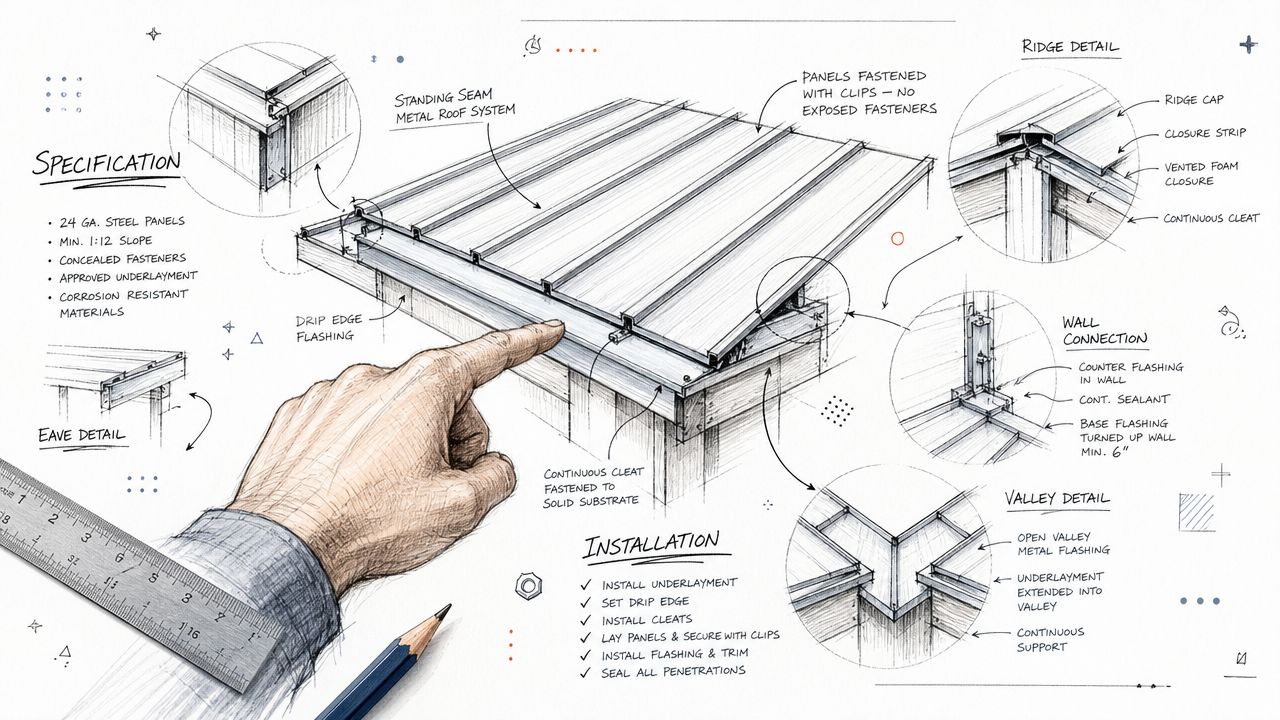
A well-specified roof can still disappoint if the details are sloppy. Sloppy details are often the starting point for many commercial roofing problems. Not with the panel itself, but with the fall, laps, flashings, penetrations, and water paths that nobody thought through properly.
That’s especially important on Australian commercial buildings because many of them have large roof areas with low pitch. Owners often assume painted sheet metal will perform the same way on every geometry. It won’t.
Low slope roofs need discipline
Technical literature commonly specifies a minimum roof slope for metal roofing to maintain drainage and avoid ponding around seams and fasteners. One reference point often cited is 2.5 inches per foot, about 12.5%, with typical applications noted down to 3/12, as described in general metal roofing technical guidance on slope and drainage. The exact acceptable fall depends on the panel profile and fixing method, but the bigger principle is clear. Water has to leave the roof properly.
When it doesn’t, problems stack up:
- Seams stay wet longer, which increases stress on joins.
- Fastener zones remain exposed to moisture, which can accelerate local breakdown.
- Debris sits in low points, holding water where the roof should be drying.
- Leaks become harder to trace, because the entry point and the visible stain are often far apart.
That’s one reason owners looking at metal roofing for Australian commercial buildings should review pitch, profile, and detailing together instead of treating them as separate decisions.
The common mistakes that shorten roof life
Most avoidable failures come from basic coordination issues rather than exotic defects.
One common error is using a standard coating on an aggressive site. A roof close to the coast or in a polluted urban area needs a specification that reflects those conditions. Another is poorly detailed penetrations. Every duct, curb, pipe, and unit support interrupts the roof plane. If those details are improvised, the coating quality won’t save the assembly.
A third problem is buying on sheet price alone. Owners compare panel rates but don’t ask enough about flashings, fastening systems, lap treatment, access provisions, or future maintenance practicality.
A painted roof doesn’t fail because paint is useless. It fails because water was allowed to sit where the system needed it to drain.
Good installation looks boring on paper. Correct falls. Clean detailing. Compatible accessories. Proper sequencing. Clear allowance for maintenance access. That’s exactly what you want on a commercial asset, because roofs that rely on clever site improvisation usually become expensive roofs later.
Cost Analysis Upfront Price vs Long-Term Lifecycle Value
Owners ask about cost first because they have to. Capital budgets are real, and a roof replacement isn’t a minor purchase. But if the comparison stops at the first quote total, the analysis is incomplete.
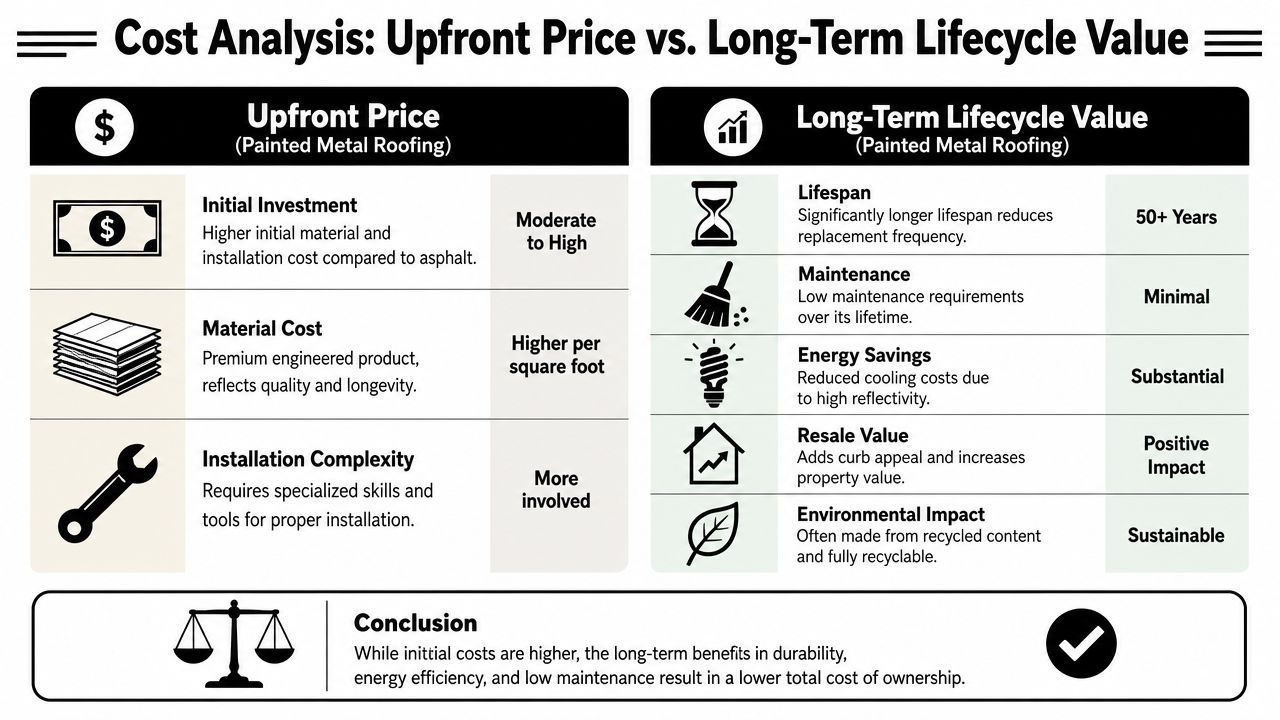
For Australian commercial buildings, the economic case for painted metal roofing is often misunderstood because the decision shouldn’t be limited to colour or initial price. It should be assessed on total lifecycle economics, especially when reroofing an ageing asset where a new energy-efficient roof can affect operational expenses, as discussed in Australian commentary on roofing decisions and lifecycle economics.
What owners should compare before signing
A useful lifecycle comparison asks different questions from a basic quote review.
Start with the obvious item, which is initial cost. Then add the costs that often get ignored during procurement:
- Maintenance exposure: How often is the roof likely to need attention if the coating is only adequate for the site, not ideal for it?
- Repair complexity: Will future issues be local and manageable, or will the system be vulnerable around fasteners, laps, and penetrations?
- Appearance retention: If the building is customer-facing or tenant-sensitive, how much does early fade or chalking matter?
- Energy performance: Lighter, more reflective finishes can change heat gain and internal conditions, which matters more on some assets than others.
- Replacement timing: A cheaper roof that needs earlier major work often loses the upfront savings.
For owners who are trying to structure a business case, a cost review should also consider the broader pattern of roof spending over time, not just the installation contract. A simple way to frame it is to compare the proposed roof against ongoing repair exposure, which is often what prompts owners to start researching commercial roof repair costs in the first place.
When painted metal roofing makes economic sense
Painted metal roofing tends to make the strongest economic sense when at least one of these conditions applies.
The building has a long ownership horizon. In that case, durability and reduced maintenance matter more than shaving the initial contract value.
The site has high solar exposure or occupant comfort issues. Then the finish choice can affect internal performance in a way that carries through operations.
The asset sits in a coastal, urban, or industrial environment. That raises the value of better coating selection because early deterioration is more costly there.
The roof is part of a larger repositioning or reroofing strategy. That’s common with older warehouses, strata assets, and industrial properties where owners want to reset maintenance burden rather than keep feeding it.
Commercial Roofers offers metal roofing installation, roof replacement, maintenance, and roof painting services for commercial and industrial properties, including prepainted metal systems, which makes that kind of lifecycle review part of the practical specification discussion rather than a separate exercise.
The key point is simple. The cheapest compliant quote is not always the cheapest roof to own. Painted metal roofing earns its value when the owner treats coating quality, drainage, installation, and thermal performance as parts of one financial decision.
Conclusion A Framework for Your Roofing Decision
A painted metal roof is worth serious consideration when you stop viewing it as coloured sheet and start viewing it as a managed system. For Australian commercial assets, the biggest gains usually come from getting four things right at the same time. The coating family. The substrate and factory finish. The roof design and drainage. The ownership horizon.
If any one of those is ignored, the roof can still look acceptable on completion day and still become a poor investment later. That’s why owners should be asking sharper questions before the contract is signed.
A practical checklist for owners and strata managers
Use this as a working filter when comparing options.
- Match the coating to the site: A coastal warehouse, urban commercial building, and sheltered inland facility don’t face the same exposure. Don’t specify them the same way.
- Check the drainage design early: Painted metal roofing still needs water to move off the roof quickly. Low-slope areas, laps, box gutters, and penetrations deserve close scrutiny.
- Review the whole assembly: Panel profile, fasteners, flashings, sealants, and accessory compatibility matter as much as the face sheet.
- Ask what the warranty covers: Don’t assume every warranty means the same thing. Read the basis of paint performance and installation compliance.
- Treat colour as a performance choice: On many buildings, lighter finishes can improve internal conditions, not just appearance.
- Compare lifecycle cost, not just contract value: If one option is cheaper upfront but more exposed to maintenance, earlier ageing, or poor thermal performance, it may be the more expensive ownership path.
- Think about future access and serviceability: Commercial roofs rarely stay untouched. Plant access, penetrations, and maintenance routes should be planned, not improvised.
Choose the roof that fits the building, the site, and the years you plan to own it. That’s how painted metal roofing becomes an investment instead of another recurring problem.
Owners who take that approach usually make better decisions. They don’t buy the brightest brochure or the lowest number on a spreadsheet. They buy a roofing system that suits the actual conditions on their asset and the financial horizon they’re managing.
If you’re weighing reroofing, replacement, or a specification upgrade, Commercial Roofers works on commercial and industrial roofing projects across Sydney, including metal roof replacements, new metal roofing, asbestos roof replacement with Colorbond, restoration, and maintenance. A practical next step is to compare your current roof condition, site exposure, and drainage design against the coating and profile options that suit the asset.