
A Sydney storm can leave a strata manager staring at a flooded inbox before sunrise, trying to prove the roof was inspected, trying to explain where the leak came from, and trying to separate a maintenance job from a compliance problem. If the last report is thin, vague, or missing photos, the whole conversation gets harder fast. A commercial roof inspection report template has to do more than list defects, it has to hold up when an insurer, owner, or committee starts asking direct questions.
Table of Contents
- Why a Strong Report Matters for AU Commercial Roofs
- The Building Blocks of a Defensible Template
- Filling the Template Section by Section
- Safety and Compliance Notes You Cannot Skip
- Common Defect Categories and Recommended Actions
- Adding Service Life and Risk Priority to the Report
- Handing the Report to Strata, Insurers and Owners
Why a Strong Report Matters for AU Commercial Roofs
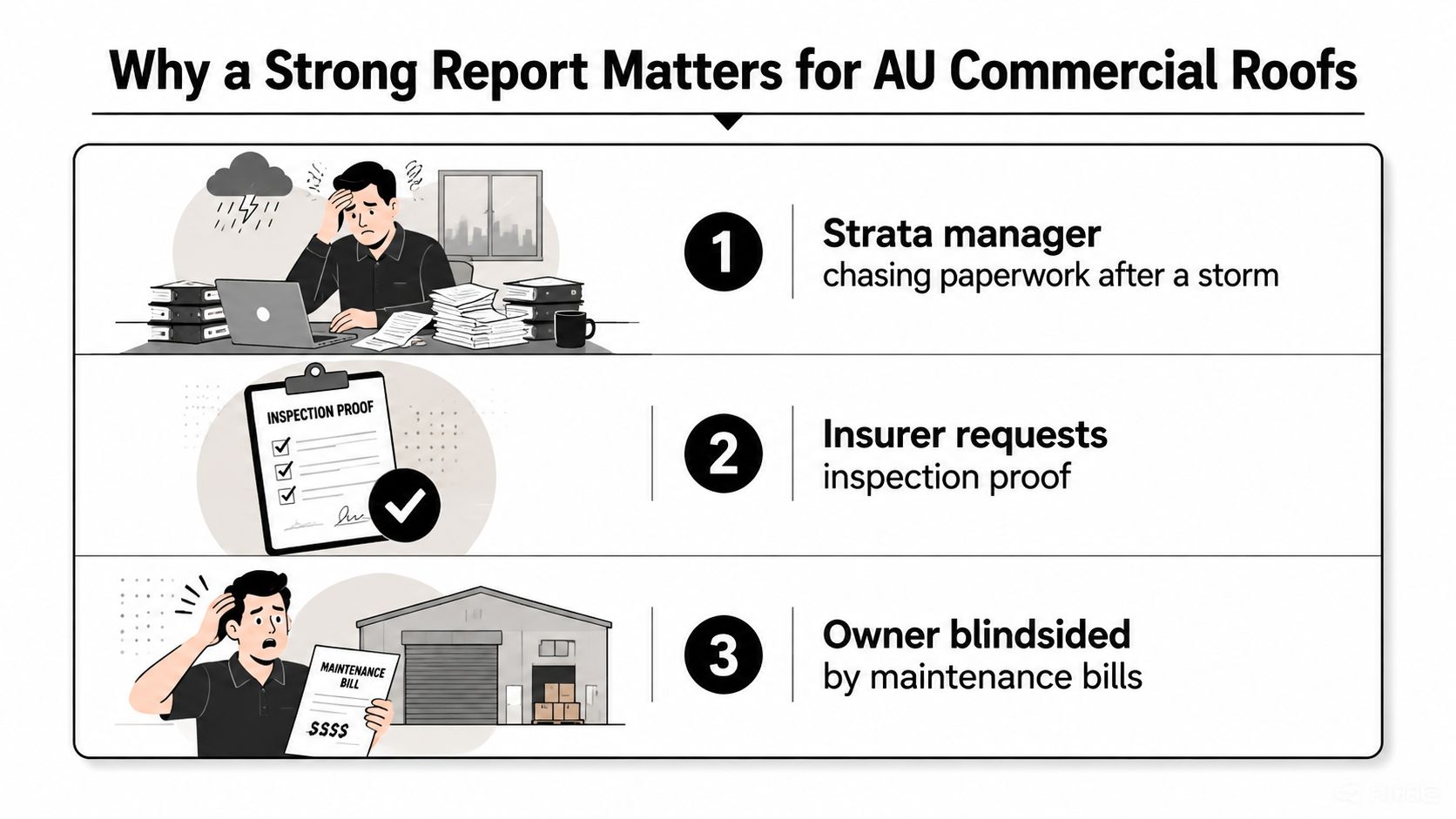
A commercial roof report in NSW isn't just a neat summary for the file. In warehouses, strata complexes, and healthcare facilities, it becomes evidence for compliance decisions, insurer conversations, and the order in which defects get fixed. Under the National Construction Code 2022, which became applicable from 1 May 2023, the report should be tied back to the relevant performance and Deemed-to-Satisfy requirements when weatherproofing, fire safety, or structural adequacy are in play. That framing comes through clearly in Australian reporting guidance for roof inspections, which expects the report to record roof type, inspection date and time, weather conditions, limitations, photos, and defect locations so the paper trail means something later SafetyCulture roof inspection report guidance.
The practical point is simple. A good report helps the owner decide whether a defect is a tidy maintenance job or a real risk to the asset. It also protects the inspector, because access limitations, restricted zones, and missed areas are written down instead of left to memory.
Practical rule: if the report can't show what was inspected, what was not inspected, and why, it's weak evidence.
That matters even more on older commercial roofs. If asbestos is suspected, the report needs to say so plainly, because the inspection record often becomes the first document used to separate routine repair from a managed removal scope. It also matters where drainage is failing, because recurring leaks on flat and low-slope roofs are often rooted in access problems or ponding that were never documented properly.
| Audience | Typical use | What they look for |
|---|---|---|
| Strata manager | Committee decisions and follow-up works | Clear priorities, photos, access notes |
| Insurer | Claim support or risk review | Date, weather, limitations, defect evidence |
| Owner | Budgeting and capital planning | Service-life view, likely cost sequence |
| Builder or roofer | Quoting remedial work | Zone locations, scope clarity, measurable defects |
The result is a document that does real work. It supports compliance, helps justify expenditure, and gives everyone the same starting point when the roof needs attention. That's the standard to aim for in a commercial roof inspection report template built for Australian commercial assets, not a box-ticking sheet that looks tidy on paper and falls apart in a dispute.
The Building Blocks of a Defensible Template
A defensible report starts with structure, not opinions. On large roofs, especially warehouses and strata buildings, the order of the document matters because different readers use different parts of it. The cover and asset profile tell them what was inspected, the findings section tells them what is wrong, and the recommendations section tells them what to do next.
Cover, asset profile, and scope
The first block should identify the property, roof type, and basic asset history. That means the property name, address, roof age, material system, and last re-roof date if it's known. This isn't admin fluff. It gives context to every later comment, especially when the roof has mixed materials, older repairs, or known age-related fatigue.
Findings, photos, and grading
The middle block has to make the defect story easy to follow. Zone-by-zone notes, a defect log with severity, and matched photo references are what make the report defensible for insurers and strata managers NRCIA roof inspection report template guidance. A zone coding system also matters on wide-span commercial roofs, because “north-west corner” is too vague when a builder needs to quote works next week.
Recommendations and sign-off
The final block should state the action, the priority, and who carried out the inspection. A sign-off section with inspector credentials and licence details adds accountability, while a dated inspection history creates a baseline for the next visit. That dated record is what lets an owner compare one inspection to the next instead of guessing whether a defect is getting worse.
A strong template doesn't just describe the roof. It shows how the inspector moved through the roof, what was visible, what was restricted, and why the conclusion is reliable.
The best templates also capture the inspection method, whether that's visual only, drone-assisted, or supported by moisture mapping, because methodology changes the weight of the findings. If access was restricted by plant, fall zones, or tenant controls, that limitation belongs in the document, not in someone's memory. That's how a template stops being a form and becomes a risk record.
Filling the Template Section by Section
Start with the roof system description and keep it plain. If it's a metal deck, membrane, concrete tile, or asbestos-cement system, say exactly that, because the rest of the report only makes sense once the roof type is named correctly. On commercial jobs, a mismatch between the actual system and the written description is one of the fastest ways to lose trust.
Inspection conditions and roof zones
The next entries should lock in the inspection context. Record the date, time, weather conditions, and whether the roof had been affected by recent rain, heat, or storm activity. Then move into zones, not just one general description, because warehouse roofs, parapets, gutters, internal box gutters, penetrations, and plant areas don't fail in the same way.
A useful zone format looks like this, and teams can keep it consistent across every site:
- Zone name: North gutter line
- Condition observed: Rust staining at sheet laps, minor debris buildup
- Photo reference: IMG 04 to IMG 06
- Action: Clean, monitor, and recheck after next rainfall
That kind of consistency helps when multiple inspectors touch the same portfolio. It also keeps the report readable for owners who don't need roofing jargon, just a clear record of where each issue sits.
Sample wording and photos
Use language that states what was seen, where it was seen, and what it means. For a flashing defect, write something like, “Loose flashing at the western parapet termination, sealant split at the upper edge, water staining visible below.” For ponding, write, “Standing water observed at the south internal gutter after recent rain, drainage path partially restricted by debris.” Those sentences are direct, specific, and easy to defend.
The photo register should do real work too. Number the images, add a short caption, and tie each shot to a roof zone. A scale object helps where the defect is small enough that size matters, but don't overcomplicate it. The point is to prove the condition, not make the report look busy.
For drone-supported surveys, the workflow in this commercial roof inspection drone guide shows why photo numbering and roof zoning need to be aligned before the inspection starts. If the images and the field notes don't match, the final PDF looks polished but still wastes time.
Safety and Compliance Notes You Cannot Skip
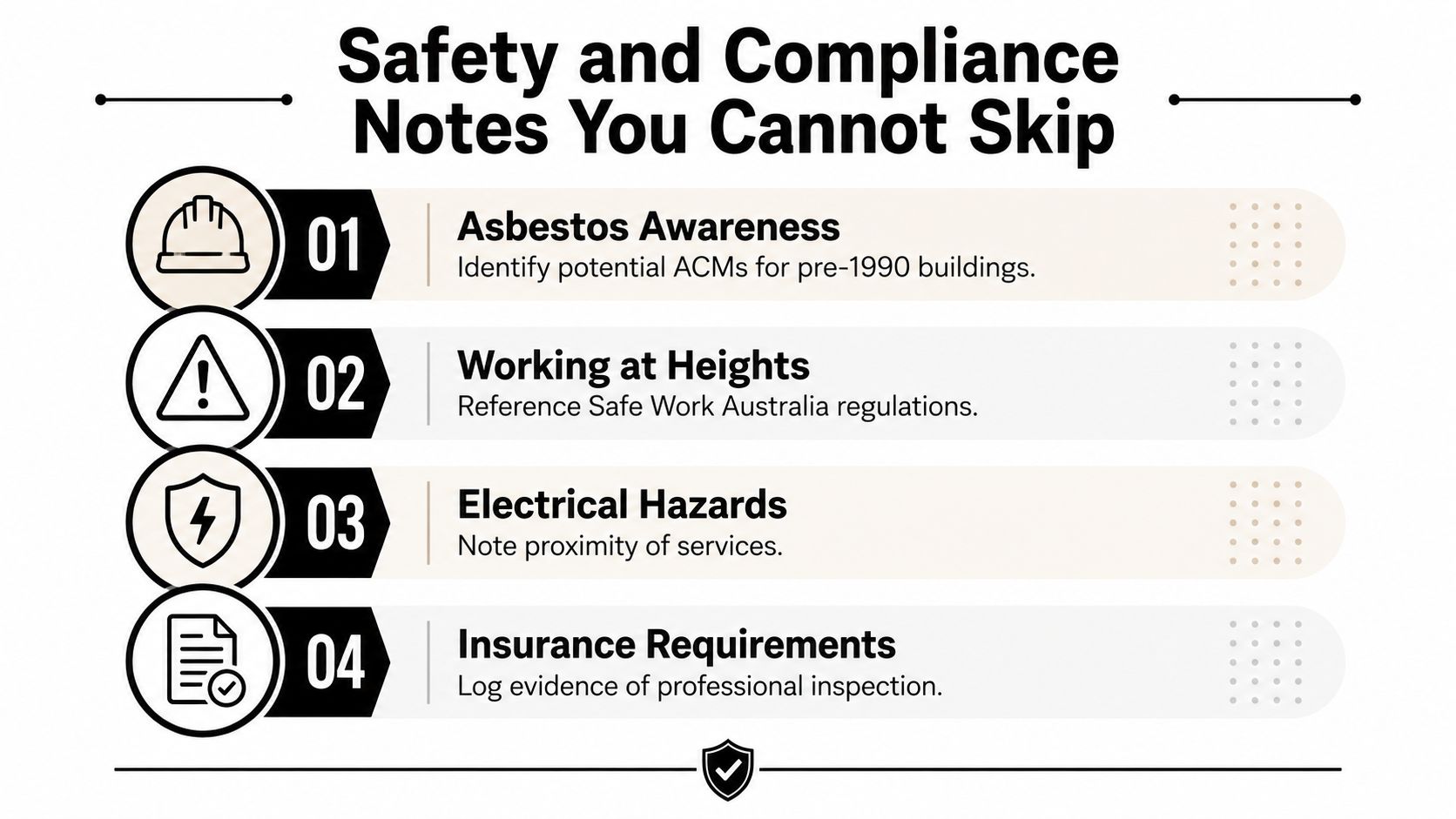
Commercial roof reporting in Australia has to deal with safety and compliance before it gets to aesthetics. If the building is older, asbestos awareness is essential. If the roof is high, wet, brittle, or awkward to access, the report needs to show how the inspection was carried out, not how someone would have liked it to be done.
Asbestos and access controls
If a pre-2003 building has suspicious roof sheets, old flashings, or degraded lining products, the report should flag suspected asbestos-containing material and stop there. Sampling belongs with licensed assessors, not in a casual inspection note. The report should also record that the finding may lead to a separate removal scope, because that changes both cost and timing.
Working-at-heights controls should be logged in a way that reflects reality. Note the access method used, anchor point checks, edge protection, and any areas that couldn't be reached because of plant, fragile surfaces, or tenant restrictions. The exact wording can be simple, such as, “Access constraints, areas not accessed due to plant, fall risk, or tenant restrictions.”
Drainage and code hooks
Drainage findings need compliance weight. AS 4654.2-2012 requires roof drainage systems to be designed and installed so they do not pond or overflow under specified rainfall conditions, so ponding and overflow observations should never sit in a casual comment block Inspection Report app's roof inspection format. A report line like, “Drainage assessed against AS 4654.2-2012 ponding and overflow requirements,” makes the connection explicit.
That same logic applies to NCC 2022 alignment. If a defect affects weatherproofing or structural adequacy, the report should say so in plain English, because those are the issues that move a roof from maintenance into compliance territory. Drainage, penetrations, and access constraints are the three places where reports commonly go soft, and that's where they need the most discipline.
The actual safety wording can be kept tight:
- Asbestos awareness: suspected ACM noted, no disturbance or sampling undertaken
- Heights controls: access method recorded, fall protection in place where used
- Electrical hazards: rooftop services, conduits, and plant proximity noted
- Insurance relevance: inspection date, conditions, and limitations recorded for file use
This roofing standards overview is useful background when a committee or owner wants the standards context without a lecture. The report itself still needs to stay factual, short, and tied to what was seen on site.
Common Defect Categories and Recommended Actions
The cleanest defect logs use the same categories every time. That makes it easier to compare roof to roof, year to year, and site to site. It also stops inspectors from inventing new labels for the same recurring problem.
Drainage, flashings, and cladding
Drainage defects are the first place to look on flat and low-slope roofs. Blocked gutters, failed falls, ponding, and overflow at sumps should be recorded separately because each one points to a different cause and a different fix. A blocked gutter may only need cleaning, while persistent ponding can justify a deeper drainage review or refurbishment.
Flashings and cappings deserve their own line because they fail at edges, parapets, and penetrations long before the whole roof gives up. Loose, corroded, or poorly detailed flashing should be photographed close enough to show the defect and wide enough to show the location. If the fix is simple, say so. If the detail is wrong, say that too.
Penetrations, safety items, and structural age
Penetrations need precise wording. HVAC supports, solar mounts, cable trays, vents, and pipe seals can all leak without looking dramatic from a distance. That's why the report should state whether the seal is intact, whether movement is visible, and whether the surrounding substrate shows staining or corrosion.
Safety items should sit in the same log, not as an afterthought. Anchor points, walkways, and fragile skylights affect the next person onto the roof, which is why they matter to owners and insurers. Structural or age-related issues such as sagging purlins, cracking concrete tiles, or brittle membrane should be clearly separated from localised repair items, because they can change the whole maintenance strategy.
Rule of thumb: if a defect can spread water, movement, or liability into adjacent zones, don't bury it inside a generic “minor issues” paragraph.
A sensible remedial action table can be written in plain language:
- Urgent: active leak, unsafe access point, failed flashing at a wet zone
- Short-term: local reseal, gutter clean, replace damaged fasteners or sealant
- Routine: planned maintenance, minor coating touch-up, monitor after rain
- Monitor: low-risk ageing, stable staining, early wear with no active entry
For detail on flashing types and where they usually fail, this flashing guide helps when the committee wants to know why one edge detail is a repair and another is a replacement. In the report itself, keep the category name, the evidence, and the action aligned. That's what makes the defect log repeatable instead of subjective.
Adding Service Life and Risk Priority to the Report
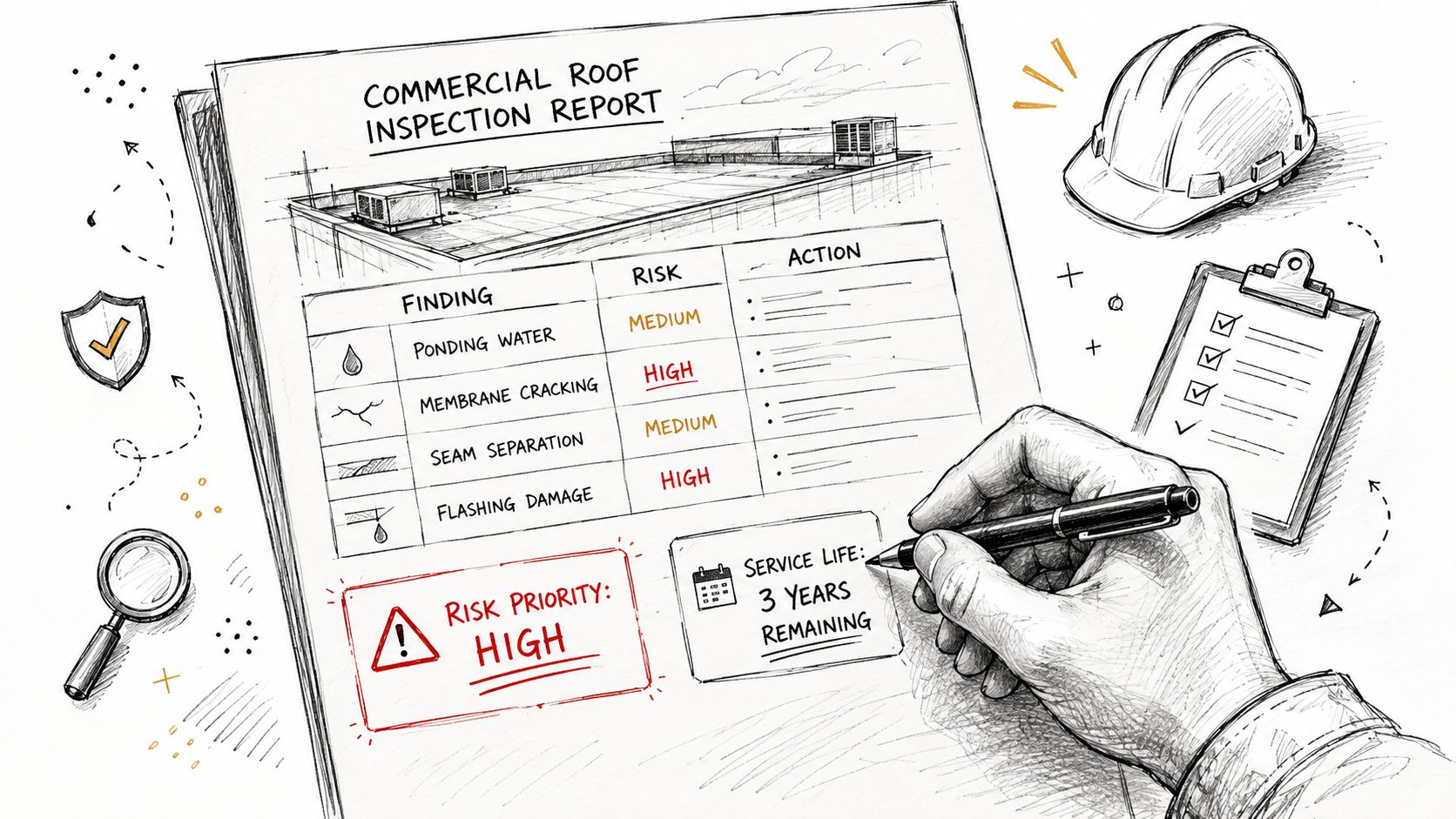
Generic templates stop at condition. That's not enough for owners who need to budget across six, twelve, and twenty-four months. A stronger commercial roof inspection report template adds a service-life line for each zone, then connects the defect to a realistic timing decision.
Turn condition into timing
The useful fields are simple. Add remaining service life by roof zone, a climate-triggered escalation note, and a risk-priority score based on likelihood and consequence. If a roof is already dealing with ponding, corrosion, or repeated overflow, a recent severe rainfall event should push the item higher, not leave it buried in the middle of the list.
That matters more in Australia than in a generic template because roof envelopes are being pushed by severe weather, heat extremes, and the repair pressure that follows them. Owners managing warehouses, logistics sites, and strata assets need the report to say, in plain English, whether a defect is likely to worsen if it's left for another season. The report should also separate “repair soon” from “hold until budget cycle” so the committee can act without guessing.
A small worked example
A metal warehouse roof with failing laps and ponding at the north end doesn't need a dramatic narrative. It needs a phased plan.
- Immediate: inspect the active leak path and clean drainage obstructions
- Short-term: repair failing laps and reseal affected transitions
- Medium-term: recheck after the next major rainfall and confirm whether ponding has returned
- Budget item: if the same zone keeps moving, plan for broader renewal rather than piecemeal patching
That sort of sequencing turns a messy maintenance issue into something an owner can approve. It also helps a strata committee understand that a roof can still be standing while a section is already moving from manageable repair into planned renewal.
Handing the Report to Strata, Insurers and Owners
A good report loses value fast if it lands in the wrong shape. Different readers want different levels of detail, so the handover should be deliberate. Strata committees want the executive summary and the prioritised works list. Insurers want the inspection date, conditions, defect evidence, and access limitations close to the front. Facility managers want the zone-by-zone notes and the photo register because that's what turns a PDF into work orders.
Package it for the audience
The safest approach is to send one final PDF with a simple front page summary and then a body that stays consistent from site to site. For older roofs, set expectations around follow-up visits, with post-storm inspections after major weather and a full re-inspection on a regular cycle for ageing assets. That cadence helps the report become a living record rather than a one-off event.
When a major defect turns up on the day, say it clearly before the crew leaves site. Then write the same point into the report and separate the urgent works scope from the routine items. That avoids the common mess where a serious issue gets buried under routine maintenance language and nobody acts soon enough.
Suspected asbestos should be handled the same way. Note it plainly, avoid alarming language, and state that the material wasn't disturbed or sampled during the inspection. Clear wording keeps the committee informed without turning a roof report into a panic document.
A final send-off checklist helps:
- Front page: date, conditions, roof type, and limitations
- Defects: zone reference, photo number, severity, action
- Compliance: drainage, access, and safety notes captured
- Follow-up: next inspection timing and urgent actions stated
- Attachments: photo register, summary, and any separate urgent scope
A report should make the next decision easier, not just the last inspection look complete.
If you need a roof inspection process that's built for Sydney commercial assets, clear on compliance, and practical enough for strata, insurance, and maintenance decisions, Commercial Roofers can help with inspections, reporting, repairs, and replacement planning across NSW. Get in touch when you want the paperwork and the roof condition to line up properly.