
A warehouse manager notices water marks spreading across the ceiling before the next storm arrives. A strata committee sees rust around fasteners and assumes the only responsible answer is a full roof replacement. Meanwhile, a coating contractor offers a quick clean-and-paint solution without explaining whether the sheets, laps, flashings or drainage system can support another restoration cycle.
That's where commercial roof restoration decisions go wrong. The roof restoration process isn't a cosmetic exercise and it shouldn't start with a product catalogue. It starts with a condition assessment that answers one question clearly: can the existing roof be repaired and protected, or has deterioration progressed far enough that replacement is the safer financial and technical choice?
Table of Contents
- When a Commercial Roof Restoration Makes Sense
- Pre-Inspection and Risk Assessment Before Any Work Starts
- Defining Scope, Proposal and Timeline for Commercial Projects
- Safety Setup, Temporary Protections and Substrate Repairs
- Cleaning, Surface Preparation and Coating Selection
- Quality Assurance, Warranties and Ongoing Maintenance
When a Commercial Roof Restoration Makes Sense
A warehouse roof can look worn without needing replacement. Faded coating, surface dirt, isolated corrosion and failed sealant often indicate maintenance work rather than structural failure. The reverse is also common. A roof that looks acceptable from the ground may have loose fasteners, moving laps or ponding around penetrations.
Roof age can dominate committee discussions because it is easy to understand, but age alone does not decide the scope. The practical question is whether the existing substrate still has enough integrity for repairs, primer and a protective coating system to perform reliably.
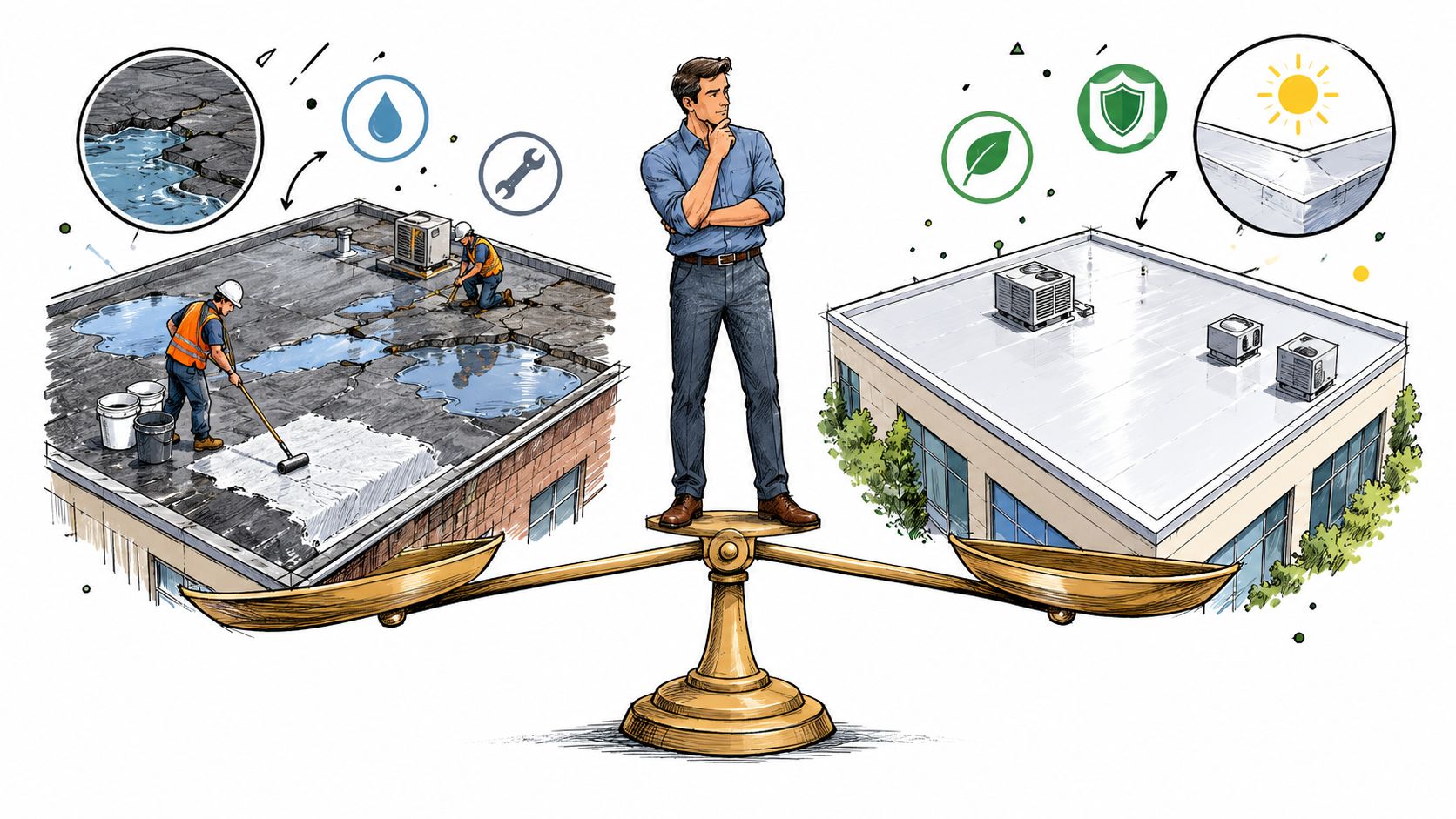
The condition thresholds that change the recommendation
For NSW commercial roofs, sheet thickness loss, fastener pull-out, lap movement, flashing failure, gutter-capacity issues, service penetrations and ponding can push a project beyond cleaning and recoating. These defects may show that the water-shedding system is failing, rather than only the surface finish. The key test is whether targeted repairs can restore dependable performance without leaving weak points across the roof, as explained in guidance on metal roof restoration decisions.
A coating can protect sound metal and bridge minor surface defects. It cannot rebuild severely thinned sheets, restore a failed connection or correct a roof profile that sheds water poorly. Replacing loose fasteners may reveal enlarged holes, sheet movement and broader substrate damage. Sealant over shifted laps can stop water briefly, but it does not replace proper joint repair.
Use the inspection findings to separate isolated defects from systemic deterioration:
- Localised corrosion: Isolated rust may be cut out, treated or repaired within the restoration scope. Widespread section loss needs a replacement assessment.
- Fastener performance: Loose or failed fasteners permit sheet movement and water entry. Pull-out across many areas suggests the roof may not support another restoration cycle.
- Lap and flashing condition: Moving laps, split seals and failed flashings expose vulnerable joints that require detailed repairs.
- Drainage behaviour: Ponding, undersized gutters and blocked outlets can undermine a new coating system, even when the sheets remain sound.
- Penetrations: Air-conditioning plant, vents, skylights and service penetrations each need suitable detailing. A general spray application will not fix poorly formed junctions.
- Roof profile and pitch: Coating cannot correct a profile below its suitable minimum pitch, where capillary leaks may continue after surface treatment.
Practical rule: Restore a roof when its structure, joints and drainage remain serviceable. Choose replacement when repairs would leave widespread weak areas or cost more than renewing the roof.
Scheduling also affects the decision. Cleaning, repairs and coatings need suitable drying conditions. Rain, heavy dew or persistent dampness can delay each stage and trap moisture beneath the system. Property managers should allow time for the roof to dry between preparation, repairs and coating, rather than promising occupants a fixed completion date before the weather window is clear. A rushed application can create adhesion failure and early defects.
What a sound restoration verdict looks like
A credible recommendation identifies the defects to be repaired, the areas that will remain vulnerable and the reasons the proposed system suits the substrate. It should state the conditions that would change the recommendation to replacement, including widespread sheet deterioration or a repair scope that becomes more extensive than renewing the roof.
Heritage properties add an approval question. NSW heritage guidance places watertightness before cosmetic work, and limited repairs matching the existing material and profile may proceed without prior consent in some circumstances. Re-roofing changes the building's fabric, finish and appearance, so council approval may be required. The commercial roof restoration process should therefore account for planning and heritage checks where relevant, not only the repair schedule.
Pre-Inspection and Risk Assessment Before Any Work Starts
A proper inspection begins at ground level. Before anyone climbs onto the roof, the contractor should understand how vehicles, lifting equipment, workers and building occupants will move through the site. Warehouses may have loading docks operating below the work area, while strata properties may have residents, visitors and contractors sharing narrow access routes.
The inspection also needs a safe method for reaching the roof. The assessor should identify fragile surfaces, skylights, unprotected edges, overhead services and areas where internal operations make access difficult. A contractor who skips this stage can produce a visually neat proposal that becomes unsafe or impractical once work starts.
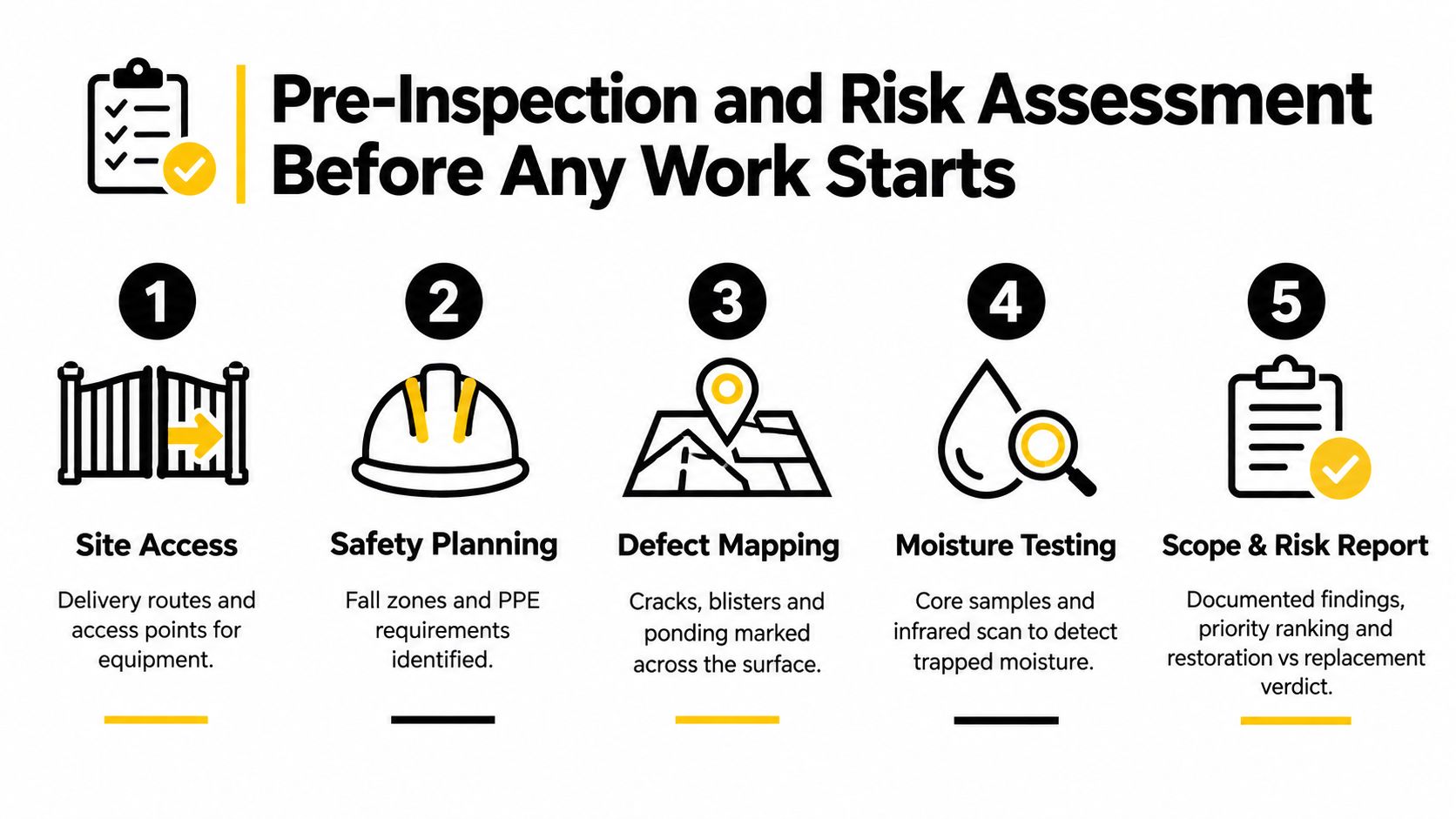
What the inspection should document
The report should connect each defect to a location, photograph and recommended action. “Roof leaks present” isn't enough for a building owner trying to approve a scope. The report should distinguish active leak paths from surface corrosion, blocked drainage, damaged flashings, failed penetrations and moisture that may have travelled beneath the visible entry point.
A useful inspection sequence includes:
- Access and safety review: Record roof access points, exclusion zones, fragile areas, edge risks and requirements for plant or materials.
- Defect mapping: Mark corrosion, open laps, loose fasteners, failed flashings, ponding and damaged sheets on a roof plan.
- Moisture investigation: Trace internal staining and inspect insulation, roof sheets and junctions where trapped moisture is suspected.
- Drainage assessment: Check gutters, box gutters, outlets, downpipes and overflow paths for capacity and blockage.
- Material identification: Confirm whether the roof is metal, tile, asbestos-containing material or a combination of systems.
- Restoration verdict: State whether the roof is suitable for restoration, requires staged repairs or should move towards replacement.
A detailed commercial roof inspection report template can help structure that evidence, but the template doesn't replace competent site judgement. The report must reflect the actual roof, its access conditions and the consequences of leaving each defect untreated.
Asbestos awareness belongs in the first conversation
Older industrial buildings can contain asbestos cement roofing or other asbestos materials. Don't drill, cut, pressure-clean or disturb a suspected material to “see what's underneath”. Arrange appropriate assessment and use licensed professionals where asbestos work is required. If you're unsure about older residential-style roofing materials in an attached building or auxiliary structure, this guide to when to test shingles for asbestos provides useful background, though NSW commercial decisions still need site-specific professional advice.
The planning impact is substantial. Suspected asbestos can change access controls, removal methods, waste handling, programme sequencing and whether restoration remains appropriate. Heritage status can also affect the scope, because keeping a building watertight may be treated differently from changing its roof fabric or appearance under local guidance from NSW council heritage information.
The final inspection pack should include photographs, marked-up plans, moisture or testing observations, access constraints, safety assumptions and a clear restoration-versus-replacement conclusion. That documentation gives owners something more useful than a generic quote. It gives them a defensible basis for action.
Defining Scope, Proposal and Timeline for Commercial Projects
A roof proposal should read like a work plan, not a product advertisement. Once the inspection identifies defects, the contractor needs to turn them into measurable tasks, exclusions and sequencing. The owner should be able to see what will happen to sheets, fasteners, laps, flashings, penetrations, gutters, outlets and the final protective system.
The scope also needs to separate essential repairs from optional improvements. Replacing failed fasteners is different from upgrading drainage. Applying a protective coating is different from installing a membrane system over a section that requires structural sheet replacement. Combining everything under “roof restoration” makes comparisons difficult and creates room for variations.
Read the proposal for omissions
A practical proposal should identify:
- Preparation: Cleaning method, contaminant removal, surface treatment and disposal requirements.
- Repairs: Fasteners, laps, flashings, damaged sheets or tiles, gutters and service penetrations.
- Coating system: Primer, membrane or protective coating, compatibility with the substrate and application conditions.
- Access and safety: Edge protection, fall-arrest measures, lifting, exclusion zones and protection for occupants.
- Weather assumptions: Drying windows, wet-weather delays and how temporary protection will be managed.
- Completion standard: Final inspection, clean-up, touch-ups, documentation and warranty conditions.
- Exclusions: Asbestos, concealed structural damage, internal repairs, electrical work and unforeseen defects where applicable.
Avoid a quote that promises a fixed rapid turnaround without explaining drying and curing requirements. Commercial roofs often contain shaded sections, insulation interfaces and drainage areas that remain damp after cleaning. The coating sequence must follow actual substrate conditions, not a calendar promise.
For strata and larger commercial properties, procurement adds another layer. NSW Government guidance cited in Sydney strata materials says owners corporations must obtain at least two independent quotes for work valued at $30,000 or more, unless the repair is an emergency, as explained in this Sydney roof repair and replacement guidance. That makes a well-defined scope essential. If each contractor prices a different repair philosophy, the committee isn't comparing like with like.
Build a programme around conditions
The programme should show inspection sign-off, preparation, repairs, cleaning, drying, priming, coating and final review. It should also state what happens if rain interrupts the sequence. A realistic contractor will explain which areas can continue, which must be protected and whether a fresh inspection is required before coating resumes.
Owners comparing budgets can use a practical average cost of roof restoration as background, but no generic figure can replace a site-specific scope. Roof size, access, material condition, asbestos risk, drainage work and repair complexity all change the commercial decision.
Safety Setup, Temporary Protections and Substrate Repairs
A warehouse can remain busy while roofing work takes place. Forklifts, staff, residents, customers and delivery vehicles may still operate below the work area, so the contractor must separate roof activities from normal site traffic before materials or tools reach the roof.
The safety setup should cover edge protection, roof access, fall-arrest planning, fragile areas, emergency response and weather monitoring. The supervisor also needs to confirm that controls remain effective as the work area changes. Personal protective equipment must match the task and the site's risk assessment. For head protection, this full brim hardhat safety guide provides general information about coverage and selection. It does not replace Australian safety requirements or the project's PPE plan.
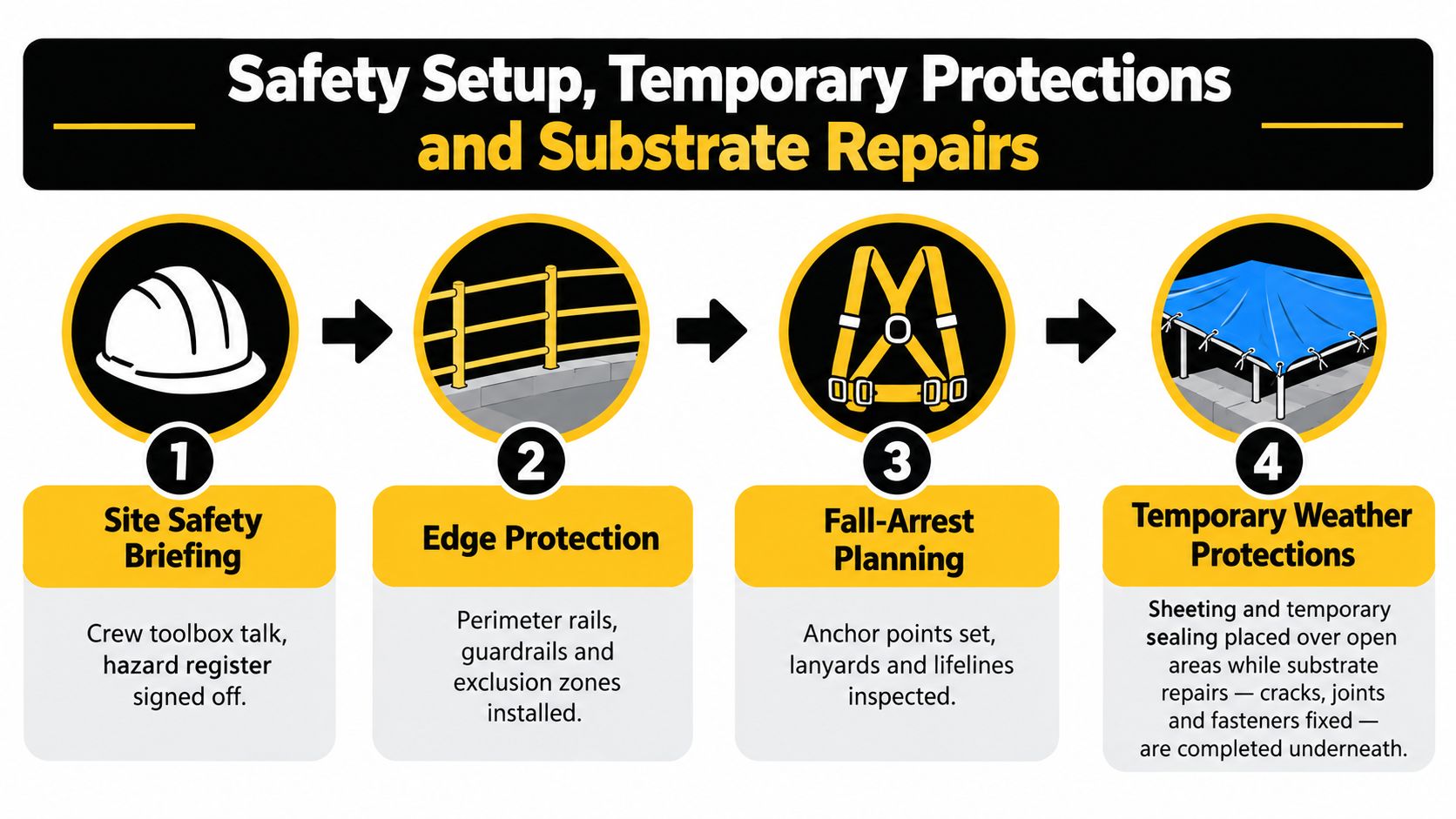
Temporary protection prevents small defects becoming internal damage
A roof section should not be opened without a weather response ready. Exposed laps, penetrations or damaged sheets can allow rain into stock, plant and occupied rooms before permanent repairs are complete. Suitable sheeting, temporary seals and controlled work zones limit that risk.
Temporary protection needs inspection at the end of every shift and after significant weather. Wind uplift, drainage and safe access all matter. A loose tarp can direct water towards an opening rather than away from it. Drying time also affects the programme. If moisture remains beneath a temporary cover or inside a repair area, the next trade cannot safely move straight to priming or coating.
Repair the roof before asking the coating to protect it
The repair sequence should follow the defect map. Work may include replacing failed fasteners, resealing or renewing laps, repairing flashings, restoring gutter junctions, replacing damaged sheets or tiles, and detailing service penetrations. Each repair must suit the existing roof profile and preserve a clear path to drainage.
Metal roof pitch needs close attention. A profile below its required pitch may allow water to track through laps by capillary action. Coating cannot correct that geometry. Defect mapping, cleaning, targeted repairs and surface preparation should be completed before primer and protective coating.
Shortcuts fail in recognisable ways. A contractor may tighten a loose fastener but leave an enlarged hole. Sealant may be applied to a lap while the sheets continue moving. A flashing may be coated without correcting the water path behind it. The roof can look finished while the leak mechanism remains.
The coating is the final protective layer. It isn't a substitute for a roof repair.
Substrate repairs should be signed off before cleaning and priming begin. If the crew finds widespread movement, severe corrosion or drainage defects, the owner should receive a documented change in recommendation. At that point, restoration may no longer be the right decision. Replacement can be the safer and more predictable option when the roof structure, geometry or substrate has too many interconnected failures. Re-coating a roof in that condition only postpones disruption while leaving the underlying risk in place.
Cleaning, Surface Preparation and Coating Selection
Cleaning determines whether the coating bonds to the roof or to a layer of dirt, chalk, salt, algae and loose residue. On a commercial site, the crew also needs to control runoff, protect sensitive equipment and prevent contaminants from entering stormwater systems. The method may involve high-pressure cleaning, deep cleaning or a more controlled approach where the substrate or surrounding operations require it.
The objective isn't to make the roof look bright. It's to remove contaminants, expose defects and create a stable surface for the repair and coating system. Contractors who spend little time on preparation often compensate with product claims, but a premium coating can't overcome loose material or trapped moisture beneath it.
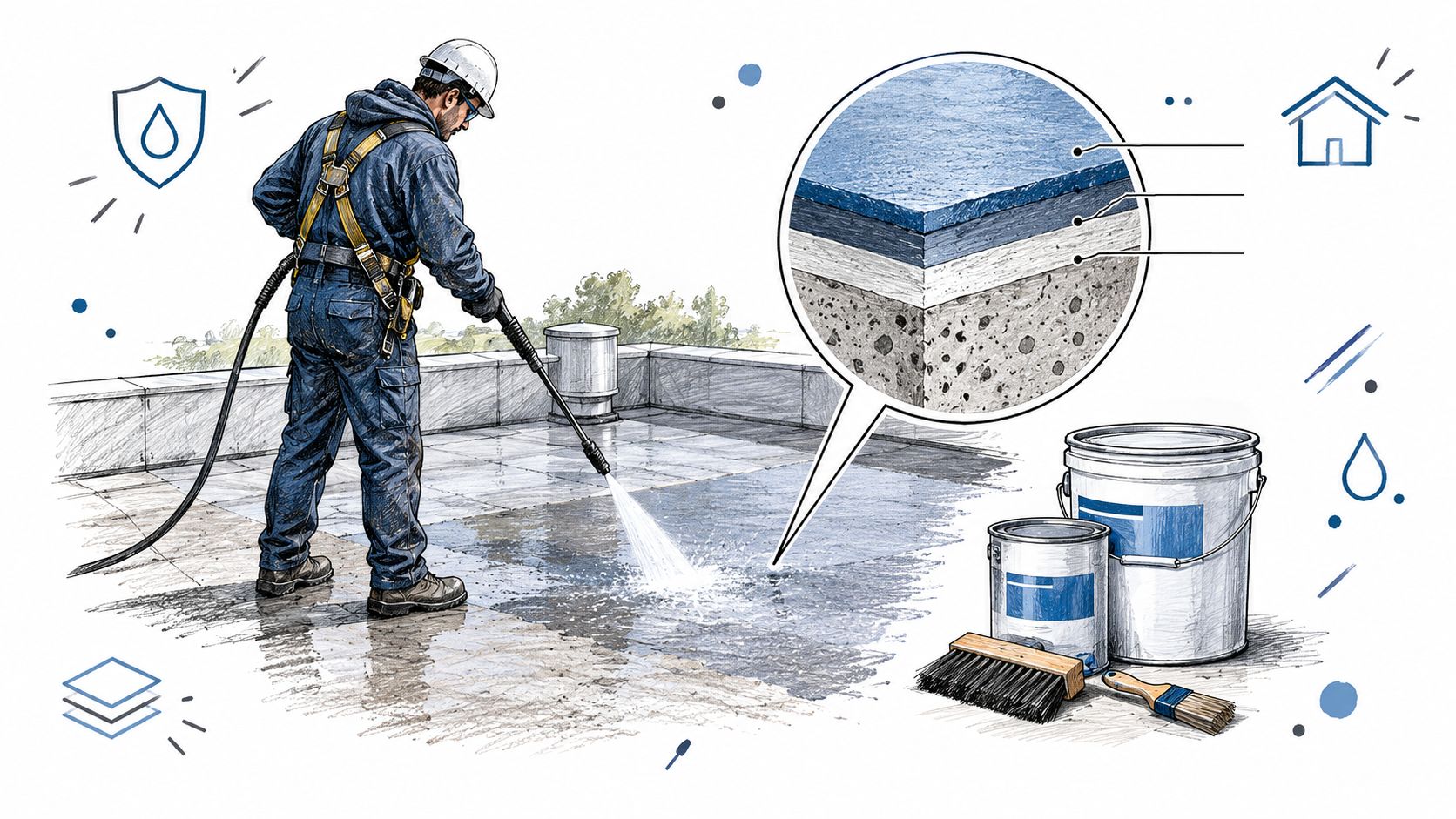
For facilities that need specialist assistance with adjacent hard surfaces, plant areas or access zones, commercial exterior power washing solutions may help coordinate the wider cleaning requirement. Roof cleaning itself still needs to follow the roofing system, runoff controls and manufacturer requirements.
Drying is part of the work, not dead time
After washing, the substrate needs time to dry. Moisture may remain around fasteners, laps, gutters, penetrations, insulation interfaces and shaded sections long after the top surface appears dry. Applying primer or coating too soon can trap moisture, reduce adhesion and create blistering or premature failure.
Weather affects more than whether the crew can stand on the roof. Rain, humidity, shade, wind and temperature influence cleaning, drying, application and curing. Recent Australian roofing guidance notes that commercial restoration can take multiple days, with drying required between coats, as discussed in these roof restoration FAQs. A sound programme includes weather checks, drying allowances and contingency protection rather than treating every day as available coating time.
Select the system for the roof's actual demands
Acrylic systems can suit applications where reflectivity and flexible surface protection are priorities, provided the substrate is sound and compatible. Silicone systems may be considered where ongoing moisture exposure is a significant concern, but the contractor must assess compatibility, surface condition and future recoating requirements. Polyurethane systems can be useful where abrasion or chemical resistance matters, subject to the product specification and the roof environment.
Those are not interchangeable labels. The right selection depends on substrate, movement, ponding risk, exposure, access, chemical conditions and the manufacturer's preparation requirements. A coating should also be selected only after the roof pitch and profile have been checked. If the geometry allows capillary leakage, changing the finish won't correct the cause.
The proposal should name the system, primer, preparation standard, application method and required conditions. It should explain how the crew will handle damp areas, failed sections and areas that cannot receive coating on the planned day. Substrate readiness matters more than brand recognition.
Quality Assurance, Warranties and Ongoing Maintenance
Completion should trigger a handover process, not the end of the contractor's involvement. The final review should check coating continuity, repaired fasteners, laps, flashings, penetrations, gutters and outlets. Where specified, adhesion or other quality tests should be documented, along with photographs of completed details and any areas excluded from the system.
A warranty needs to distinguish materials from workmanship. Ask what each warranty covers, what maintenance the owner must complete, which conditions void it and how the contractor handles a reported defect. A coating warranty won't necessarily cover movement caused by failed sheets, blocked drainage or later building work.
Keep a maintenance log with inspection dates, leak reports, photographs, cleaning records and completed repairs. Early blistering, flash-point leakage, loose fasteners and blocked outlets are easier to address before they become widespread damage. The roof should be inspected after significant repair work and as part of the property's planned maintenance routine.
Before appointing a contractor, verify:
- Licensing and insurance: Confirm the business holds appropriate credentials and cover for the work.
- Crew structure: Ask whether the contractor uses its own trained crews or relies on subcontractors.
- Safety controls: Request evidence of documented site procedures, access planning and hazard management.
- Scope clarity: Compare repair quantities, preparation standards, coating systems, exclusions and completion checks.
- Communication: Choose a team that reports changed conditions before proceeding with variations.
Commercial Roofers offers inspections, reporting, commercial roof restoration, cleaning, painting, guttering and replacement services across Sydney and NSW, with options assessed against the roof's actual condition rather than a blanket coating recommendation.
Commercial Roofers can inspect your warehouse, factory or strata roof, map defects and explain whether restoration is technically sound or replacement is the more responsible path. Visit Commercial Roofers to request a clear scope that accounts for repairs, safety controls, drying time, weather delays and the long-term maintenance plan.