

Most popular advice on how to clean box gutters is wrong for a commercial roof. It tells you to climb a ladder, walk the channel and pressure-wash everything toward the outlet. That approach treats a concealed box gutter like a house eaves gutter, and that's where people get hurt and buildings flood.
A box gutter sits inside the roof footprint. It can hide non-trafficable metal, weak sumps and voids you can't see, and a blockage doesn't spill harmlessly over an outside edge. It sends water indoors. I would judge any clean on two questions first: can anyone reach it without standing in it, and can the crew prove the outlet and overflow work when they leave?
Table of Contents
- Decide If the Box Gutter Can Be Cleaned Safely
- Tools PPE and Checks Before Anyone Starts
- How to Clean Box Gutters Without Damaging the Lining
- Flush Outlets and Prove the Overflow Still Works
- How Often Commercial Box Gutters Need Cleaning
- Defects Asbestos and When Cleaning Must Stop
- Book a Licensed Roof Plumber When Housekeeping Ends
Decide If the Box Gutter Can Be Cleaned Safely
Say a maintenance crew arrives at a Greater Sydney warehouse to clear a concealed box gutter. The metal looks solid, the run is wide enough to stand in, and someone steps into the channel with a scoop. That step is the hazard, not the leaves.
SafeWork NSW reported a fatal 13.1-metre fall through a box gutter and metal sump in 2026, with roof access to be controlled until competent personnel verify the roof structure and drainage supports, according to the SafeWork NSW incident information release. Its controls point to work platforms or scaffolds, compliant walkways, guardrails or covers around penetrations and a documented Safe Work Method Statement. That's a very different starting point from gloves and a ladder.
Why the Channel Is Not a Walkway
Box gutters on warehouses and strata buildings often run between roof sheets, behind parapets or under roof plant. The channel itself can be thin metal over a void, with a sump that was never designed to carry a person. Flashings, corroded sheets and concealed fixings give you no reliable signal from the surface.
Water makes the judgement worse. Standing water hides seams, screws and splits, and wet sludge turns a flat bottom slippery. Even if a worker doesn't fall through, foot traffic can dent the base, crack sealant, flatten the fall and create the ponding you're trying to prevent.
Treat every box gutter as non-trafficable until a competent person proves otherwise in writing.
Make the Access Call Before Quoting the Clean
Box gutter access decisions before cleaning
| Situation | Access decision | Why |
|---|---|---|
| Structure and supports not verified | Elevated work platform or scaffold only; nobody in the gutter | Channel and sump may be non-trafficable |
| Competent person confirms walkway, guardrails and supports | Clean from the protected walkway; still do not step in the channel | Fall protection is designed; the gutter is not a path |
| Fragile sheets, open penetrations, or no SWMS and rescue plan | Stop work | A 13.1-metre fatal fall through a box gutter was reported in NSW in 2026 |
| Overflow, sump or fall needs changing | Do not alter it during cleaning | Hydraulic changes are design work, not housekeeping |
Owners should ask to see the access plan, not just the price. It should name the platform or scaffold, the exclusion zone below outlets and loading areas, who supervises the work, and how a fallen or injured worker is rescued. It should also address skylights, fragile sheets and falling objects, because dropped tools and bagged sludge endanger people below.
I would accept a no-roof-access clean that costs more over a cheaper crew walking an unverified channel. A contractor who plans to pressure-wash from inside the gutter, walk the sump or work from a ladder as the main access method hasn't solved the main risk. Ordinary debris removal waits until that plan exists.
Tools PPE and Checks Before Anyone Starts
The right kit for a commercial channel is mostly dry, manual and designed to keep solids out of the drain. Load it on the platform or walkway, not in the gutter. Anything that cuts, scores or forces debris downstream stays in the ute.
Build a Dry-Clean Kit
- Plastic scoop or trowel: Lifts sludge without gouging metal or membrane linings.
- Stiff hand brush: Moves grit and granules toward the scoop, never toward the outlet.
- Heavy rubbish bags and bucket on a line: Keeps wet loads controlled and stops bags being dragged across fragile sheets.
- Torch and inspection mirror: Checks sumps, rainhead corners and downpipe entries you can't see head-on.
- Marker crayon and camera: Records ponding lines, corrosion and split laps before they're disturbed.
- Garden hose kept aside: Used later for a low-volume flow test, not as the cleaning tool.
A leaf blower has a narrow use. From a protected platform, it can shift loose dry litter off adjacent roof sheets before you start. Never aim it into a downpipe, under flashings or across a boundary where debris lands on cars, stock or neighbouring roofs.
PPE and Site Checks
Minimum PPE is a hard hat, cut-resistant gloves, eye protection, non-slip boots and high-visibility clothing. Add a harness only where the chosen access system still leaves a fall risk and the anchor, training and rescue arrangements suit that system. PPE doesn't make an unverified gutter trafficable.
Before tools come out, check the weather window and stop for lightning, high wind or rain that makes sheets slippery. Isolate the area under outlets, protect stock and pedestrian routes, and sketch every rainhead, sump, overflow slot and downpipe so nothing is missed. Confirm the Safe Work Method Statement names non-trafficable gutters and falling objects, and check whether existing roof access systems are compliant and usable.
Stop rule: If the asbestos register lists the roof or gutter, or debris looks like fibre cement or bitumen sheet, the clean ends and a certified asbestos remover is booked.
Read the asbestos register before disturbing old fibre cement, debris or bitumen. Set a designated wash-down area and wastewater collection point before any rinse begins, with screens or catch bags ready at outlets. Leave behind the pressure washer as a first tool, a wire brush on membranes and a ladder as sole warehouse access. Locate every overflow at this stage, and never tape one over to keep leaves out.
How to Clean Box Gutters Without Damaging the Lining
Learning how to clean box gutters properly means treating the job as a drainage inspection with debris removal built in. The order matters. If you rinse first, you push sludge into the sump. If you scoop without photos, you lose proof of defects that were already there.
The sequence below keeps the lining intact and leaves a record an owner can use.
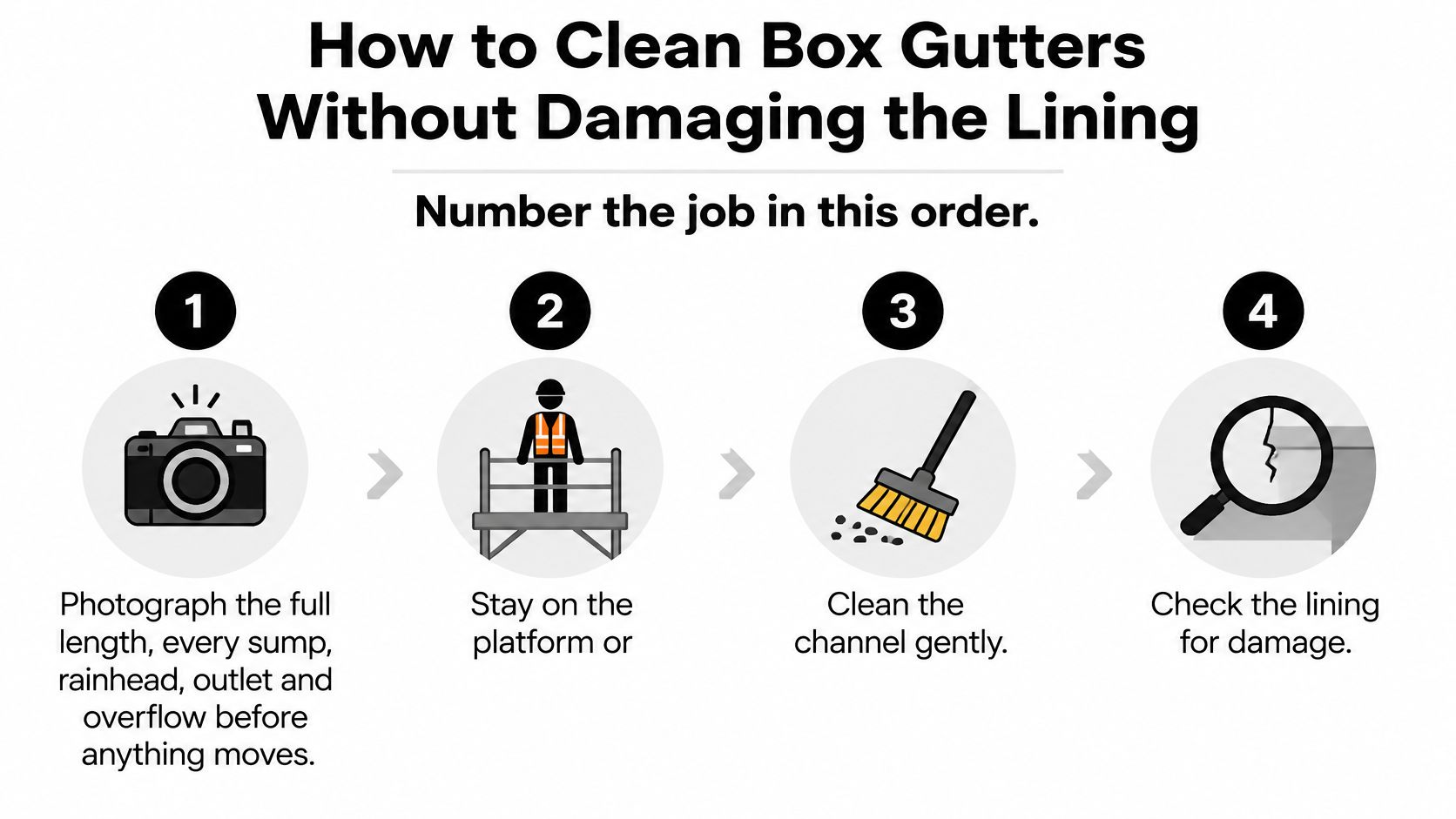
Work in This Order
Photograph everything first: Capture the full length, every sump, rainhead, outlet and overflow before anything moves. Take wide shots to locate the defect and close shots to show depth of debris, corrosion or ponding stains. This prevents later argument about whether the clean caused the damage.
Stay off the channel: Work from the platform or walkway and treat the gutter as non-trafficable even if the metal looks heavy. Reach in with tools sized to the channel width. If you can't reach the middle safely, reposition the platform rather than stepping in.
Lift and bag, don't sweep downstream: Use a plastic scoop or trowel to lift leaves, sludge, bird droppings and roof granules, then bag them on the platform. Work in short sections so wet loads stay manageable. Sweeping toward the outlet turns a scattered load into a compact plug at the sump.
Clear strainers and sumps by hand: Remove material bridging strainers, rainheads and sump lips, and check the downpipe entry with a torch. Debris often mats across the opening while the pipe below is clear. Don't force a rod through a corroded sump or punch a hole to drain standing water.
Rinse only after solids are out: Ease a controlled, low-volume rinse from the high end toward the outlet, with a screen or catch bag intercepting remaining solids. You're checking flow and moving fine silt you can capture, not blasting joints. High pressure can lift laps, strip sealant and drive water under flashings.
Inspect and mark, don't smear: Check laps, sealant, fixings, corrosion, ponding stains and split flashings, then mark defects with crayon and photograph them. Don't smear sealant over a wet joint to tidy the handover. A marked defect with a photo is useful. A hidden defect under fresh sealant is worse than before.
Confirm the fall still works: Water should keep moving to the outlet without leaving persistent pools. Pools in a cleared channel point to frame or support movement, not insufficient scooping. Record the location and extent rather than adding packers or adjusting falls on the day.
That discipline matches the Victorian Government buildings and grounds maintenance guidance, which calls for annual inspection and cleaning, PPE, exclusion zones, checks of internal and box gutters and removal of debris without creating downstream blockages. It also supports manual removal with a scoop or trowel, bagging instead of washing material into stormwater, then clearing rainheads, sumps, outlets and downpipes.
Keep Sludge and Wash Water Out of Stormwater
Collect rust flakes, membrane crumbs, bird waste and wash water in your designated containment area. Send wastewater to sewer only where the local authority allows it, and never let solids reach a kerb outlet. Bag sludge for disposal rather than hosing it down because it's quicker.
Finish with a short defect list the owner can hand to a roof plumber. Name the gutter run, the defect, the photo reference and whether water flowed freely. Don't add screws, screens or fall adjustments during the clean, because each change can alter capacity. A lining that survives the clean and a drain that stays clear are worth more than a channel that only looks clean from above.
Flush Outlets and Prove the Overflow Still Works
A spotless channel proves nothing if the outlet chokes or the overflow can't discharge. Run the test from a controlled position wherever the roof geometry allows, because nobody needs to stand in the gutter to watch water move. Start at the high end with a low-volume flow and observe each sump rather than flooding the roof.
The photo below shows the posture you're aiming for, with testing done from a controlled position while water movement is observed.
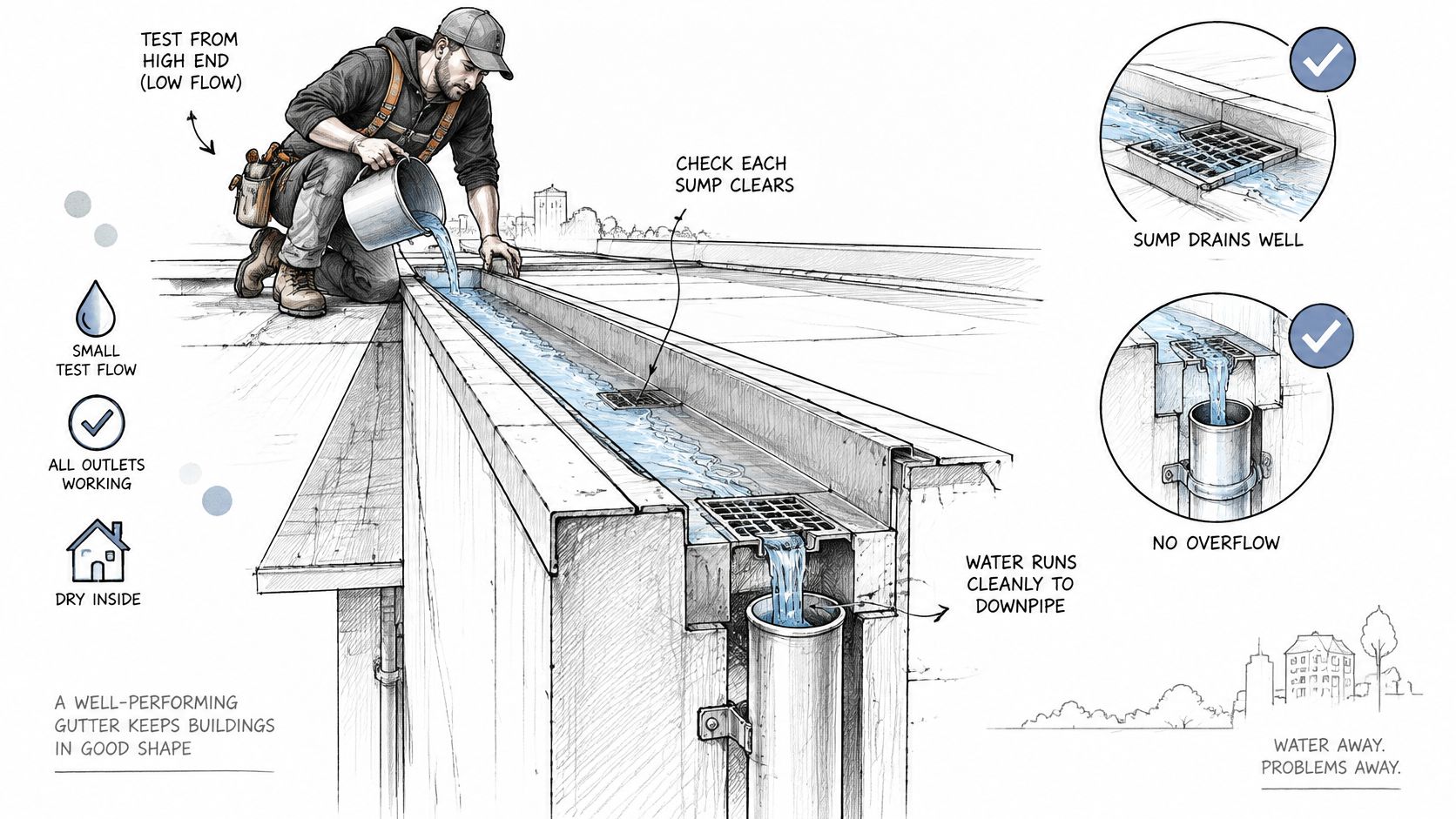
Water should leave at the downpipe and keep moving, without sitting in a belly or spilling back under flashings. Hold the flow long enough to confirm steady discharge at the rainhead or downpipe top, then shut off and check the channel empties fully. Inspect overflow slots, rainheads, end-stop weirs and inverted nozzles next. Each one must remain open and visibly discharge away from the wall, and an overflow you can't watch discharging is one you can't count on.
The NCC housing provisions for gutters and downpipes set the overflow design basis at a 5-minute rainfall intensity with a 1% annual exceedance probability, requiring provisions that prevent water ponding against, entering or damaging the building even when the stormwater drainage system is blocked. Never seal, screen or narrow an opening because leaves collected there.
Overflow reference to check against
| Reference | Value | Status |
|---|---|---|
| NCC housing overflow design basis | 5-minute rainfall at 1% AEP | Current |
This basis helps you question an undersized or altered overflow, and it relates to how box gutter sizes affect capacity. It doesn't authorise a cleaner to resize anything.
Watch the demonstration below before you run your own controlled test.
If an overflow is hidden, undersized or can't be seen discharging, record it for licensed assessment. I treat an unproven overflow as a failed one until a roof plumber confirms otherwise. Close the job with before-and-after photos, the free-flow result at each outlet and the overflow findings, because a clean that hides a failed overflow isn't a successful clean.
How Often Commercial Box Gutters Need Cleaning
Start with at least once a year. That yearly default gives strata managers and warehouse owners a contract date they can enforce. Then shorten it based on what lands on the roof, not on a generic calendar.
Conditions That Pull the Date Forward
Commercial box gutter cleaning intervals
| Site condition | Clean at least | Why it changes |
|---|---|---|
| Few trees, low debris, sound fall | Yearly | Matches the annual inspection benchmark |
| Overhanging trees or bird nesting | Every 3 months | Organic sludge and weak acids build quickly |
| Industrial dust, HVAC plant or nearby works | Every 3 to 6 months | Grit and granules bridge outlets |
| After a severe storm | Within 7 days | One blocked rainhead floods the next event |
| Repeat ponding after a clear channel | Every clean plus a plumber review | Falls can change with frame or soil movement |
Overhanging trees and nesting birds load a sump within a season. The resulting sludge stays wet, holds debris against the lining and attacks metal at laps and fixings. Shorten the interval after two consecutive visits find the outlet already buried, because the site has told you the current cycle is too long.
Industrial loading is less obvious. Roof plant drops granules and filter fibres, nearby earthworks deposit grit, and factory dust settles as a thin layer that washes into a mat at the outlet. The channel can look acceptable along most of its length while the sump is already bridged.
Use Each Visit to Check the Fall
Cleaning frequency isn't only about debris volume. The Victorian local-government heritage information sheet on slating, tiling and roof plumbing advises checking that the gutter still falls toward its outlet, because roof-frame distortion or reactive-soil movement can cause standing water and debris accumulation. It also notes that leaves, bird droppings and airborne pollutants can create weak organic acids and salts that accelerate corrosion, particularly where water remains.
That changes what you record. Photograph debris along the full length and at sumps, rainheads, outlets and overflow paths, then file the flow result with the defect list. Note whether ponding shrinks, stays stable or grows between visits.
A cleaning schedule that never records ponding will miss the defect that cleaning cannot cure.
After a severe storm, re-check within about a week even if the last clean was recent. One blocked rainhead can put the next downpour inside the building. Put dates, photo requirements and post-storm inspections into the maintenance contract so the interval doesn't depend on someone noticing a ceiling stain.
Defects Asbestos and When Cleaning Must Stop
A clean that hides a failed overflow is not a successful clean. Housekeeping ends once the channel, sump and downpipe entry are clear and the overflow is still visible. The moment capacity, fall or waterproofing is wrong, more scooping only gives the owner false confidence, and none of the checks below needs a boot inside the gutter to confirm.
Use the checklist to separate dirt from defects before anyone reaches for sealant.
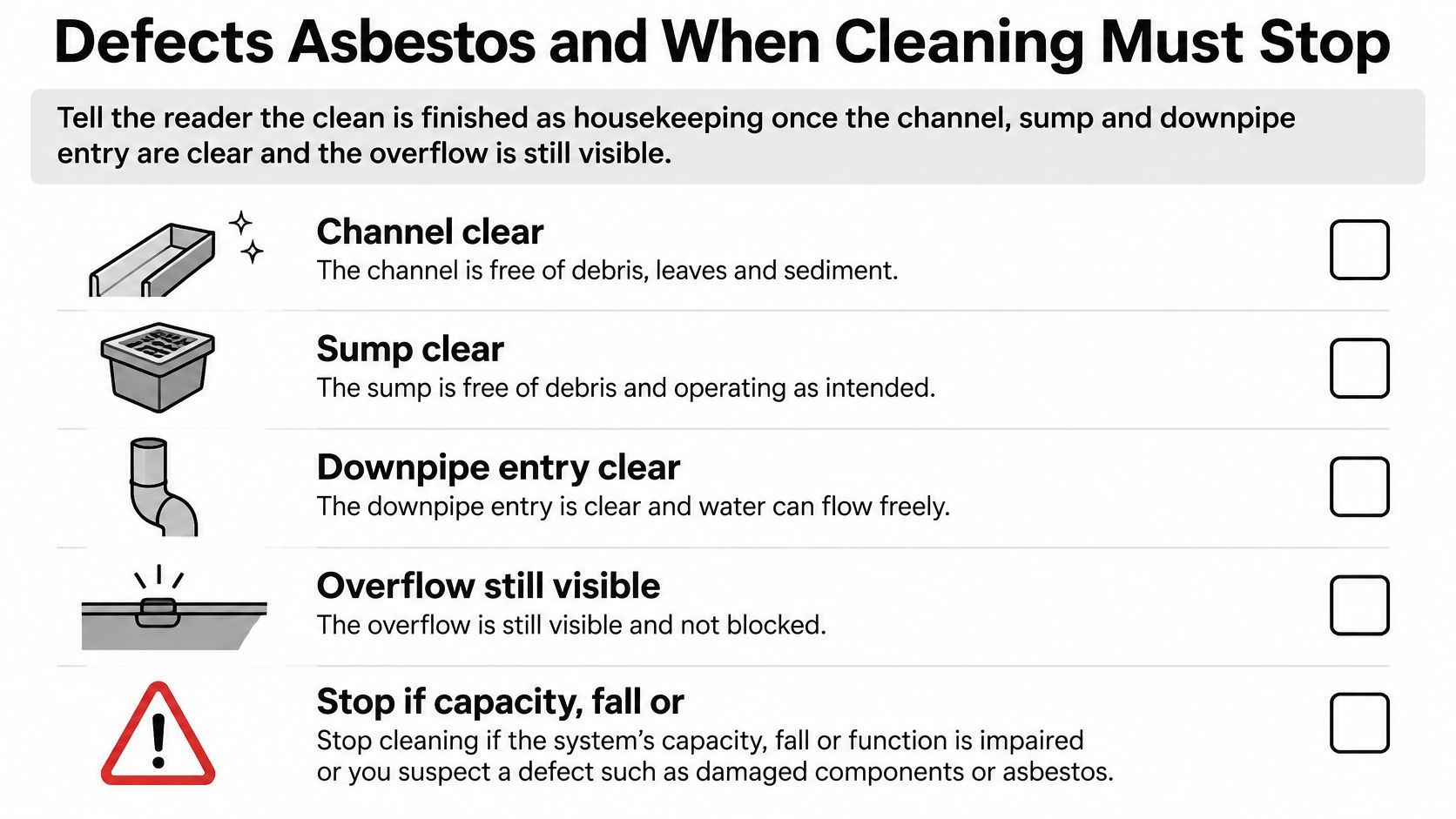
Findings That End the Clean
Findings that end a box gutter clean
| Finding | What it means | Next action |
|---|---|---|
| Cracks, open joints or a rusted sump | Waterproofing or support is failing | Licensed roof plumber; no wet sealant patch |
| Missing, sealed or hidden overflow | Building can flood if the outlet blocks | Assess to AS/NZS 3500.3; do not screen it |
| Ponding after the channel is clear | Fall lost to movement or poor install | Record it; do not pack the gutter |
| Water entering ceilings during the test | Active leak path | Isolate below and book repair |
| Asbestos on the register or suspect debris | Disturbance is licensed removal | Stop; use a certified asbestos remover |
Western Australia's government Maintenance Minimisation Manual says box gutters should permit easy cleaning and maintenance, carry adequate falls to encourage self-flushing and prevent pooling, include alternative relief if blockages occur and discharge overflow outside the building. It also recommends self-cleaning conical sumps and overflow relief that is not itself vulnerable to blockage. Those benchmarks describe what a clean must verify, and they mark the boundary of what a cleaner may touch.
The Plumbing Code of Australia and AS/NZS 3500.3 govern how roof drainage is designed, installed, altered and repaired, so a maintenance crew does not enlarge an outlet, cut a new overflow or pack a low spot to fake a fall. Failed box gutter waterproofing is a licensed roof plumber's job, because only an assessment of the whole drainage path can show whether the fix is a joint, a sump or the fall itself.
Asbestos Is a Full Stop
Read the site register before anyone opens a bag. Suspected fibre-cement debris or an asbestos roof ends the job on the spot, because disturbance is licensed removal work. Commercial Roofers is fully certified to safely remove and replace asbestos roofs, so the job hands over to a certified remover. The duties sit under Australian work health and safety law, SafeWork controls and the asbestos register. US OSHA rules do not govern an NSW roof.
A useful record names the defect, links the photo and states who is now responsible. That handover protects the cleaner, the owner and the next contractor.
Book a Licensed Roof Plumber When Housekeeping Ends
The decision this week is a fork. If the access plan, asbestos register and overflow check are all clear, book the next dry clean from your interval and file the photo record with the stormwater documents. If the gutter is non-trafficable, the sump is rusted, joints are open or water already reaches a ceiling, stop the housekeeping.
We diagnose box gutter problems such as cracks, blockages or joint faults and provide repairs for the damage, so ask any contractor for four deliverables before work starts:
- Written access plan: Names the platform, scaffold or walkway and the rescue method.
- Before-and-after photos: Covers the full run, sumps, outlets and overflows.
- Flow and overflow note: States the test result at each outlet, not just that debris was removed.
- Maintenance and repair split: Separates cleaning from licensed repair work and pricing.
NSW guidance says property owners are responsible for stormwater outlets from their property to the kerb and gutter, according to Inner West Council stormwater guidance. Keep the record with the stormwater file for insurer or council queries. Customers can book a free consultation appointment for box gutter services where an access plan, flow test or replacement discussion is needed.
If your box gutter clean has exposed a rusted sump, open joints, ponding or an overflow you can't verify, we can diagnose the fault and repair the damage instead of clearing leaves again. Book a free consultation for box gutter services and arrange an inspection with an access plan, photo record and flow test through Commercial Roofers .