
The most popular advice on commercial roof cleaning products is backwards. Most guides ask which bottle kills mould fastest, then rank bleach, biocides and detergents by the before and after photo. For a warehouse, factory or strata roof in New South Wales, that photo isn't the test. The test is whether you can catch what comes off the roof, and whether the chemistry matches the sheet underneath it. If you can't catch the wash water, the lowest risk product is sometimes no chemical at all.
Start with the roof and the drain. Work out what the surface is made of, where every downpipe goes, and whether a rainwater tank is connected. Only then does a product shortlist make sense.
Table of Contents
- Product Types Worth Shortlisting
- Which Chemistry Suits Each Roof
- Asbestos Cement Changes the Whole Job
- Labels, Runoff and Claims Checklist
- How Crews Apply and Dilute Treatments
- Choose a Product or a Licensed Crew
Product Types Worth Shortlisting
A fast visual clean doesn't win if the slurry can't be caught. That's the contrarian test you should apply before you compare labels, prices or strength claims. A product that strips black streaks in twenty minutes but sends biocide, zinc and paint residue straight to a stormwater pit has created a bigger problem than the staining it removed.
Put no chemical on the shortlist first, not last. Vacuuming gutters and box gutters, careful mechanical removal of loose moss, and a controlled water only wash can be the right answer where drains can't be isolated. That option still produces dirty water, so it isn't risk free, but it removes one whole layer of chemical load from a site that has no safe capture point.
How the Six Families Compare
Alkaline degreasers lift grease, diesel film and industrial fallout from bare or heavily soiled metal. They're strong for a reason, and that strength is also the trap, because high alkalinity can attack factory coatings, sealants and some membranes, and it leaves a high pH rinse carrying oils and metals.
Low pressure detergents, including low foam soft wash mixes, are the default starting point for coated steel when the soil is dust, pollen, salt and light biological film. They're milder, easier to control, and less likely to change colour or gloss when you dilute them correctly and test first.
Biocides and mould treatments target algae, lichen and mould rather than general dirt. They stay active through the label contact time, which means the surface and any runoff need treating as hazardous until that period ends and the residue is recovered.
Residual anti fungal treatments slow regrowth after a clean. They don't remove soil, so spraying one over a dirty roof and calling it cleaned leaves the food source for growth still in place.
Oxygen bleach, usually based on hydrogen peroxide, oxidises organic staining without chlorine. It can suit places where chlorine must be avoided, but it's still an oxidiser that lifts debris into the rinse water, so it still needs containment.
| Product family | Best used on | Do not use on | Runoff concern |
|---|---|---|---|
| Alkaline degreaser | Greasy bare or industrial metal | Coated Colorbond, membranes, zinc and copper | High-pH rinse plus oils and metals |
| Low-pressure detergent | Coated steel and light soiling | Asbestos cement; unknown coatings without a spot test | Surfactants and suspended roof dirt |
| Biocide or mould treatment | Algae, lichen and mould on a known compatible roof | Rainwater tanks, open stormwater, unverified pesticide claims | Active residue until fully contained |
| Residual anti-fungal | Slowing regrowth after a clean | A dirty roof used as the only step | Longer-lived biocide left on the surface |
| Oxygen bleach | Organic staining where chlorine must be avoided | Metals and membranes not approved on the label | Oxidiser plus lifted organic debris |
| No chemical | Sites where drains cannot be isolated | Heavy grease that water alone will smear | Still contains dirt, metals and biological waste |
Practical rule: Biodegradable on the front of the bottle doesn't make untreated discharge acceptable. If zinc, paint flakes, oil or biocide ride out with the water, you've still discharged a contaminant.
Why Containment Is Part of Selection
For NSW sites, product choice and wastewater control are the same decision. Ballina Council's roof cleaning guidance states that under the Protection of the Environment Operations Act 1997, it is an offence for cleaning materials or contaminated water to flow, fall, be washed or blown into a drain, channel or gutter, with reported maximum penalties of $15,000 to $22,500 for individuals and $30,000 to $45,000 for corporations.
Before anyone applies anything, map the roof drains and downpipes. Isolate stormwater entry points, set up bunding or vacuum recovery, and write down the approved disposal route. A low water, controlled application followed by full collection of rinse water reduces both regulatory exposure and uncontrolled discharge on a large Sydney warehouse roof.
Ask for paperwork with every product you shortlist. That means dilution rate, contact time, surface compatibility, aquatic toxicity information where available, and waste disposal instructions, not just a headline claim on the drum. If you're planning cleaning before recoating, check how surface preparation interacts with industrial roof coating requirements so you don't clean with a product that later causes adhesion problems.
Which Chemistry Suits Each Roof
The roof is the boss of the bottle. Two roofs can show the same black streak and need opposite treatments, because one is factory coated steel and the other is a porous tile that will hold chemical in its surface. Pick the row that matches the actual sheet in front of you, not the stain you want gone.
Coated Steel and Tiles
For factory coated steel such as Colorbond, stay with a mild low pressure detergent or a biocide that the coating maker doesn't forbid. Spot test a hidden sheet first and check colour and gloss after it dries. Keep strong alkali and chlorine bleach off the finish, because edge corrosion and gloss loss often show up weeks later, not on the day.
Concrete tiles hold growth in their pores, so a biocide plus a gentle detergent can work where detergent alone just moves surface dirt around. The limit is mechanical, not chemical. Blasting mortar joints or driving water under tiles creates leaks and joint damage that outlast any cleaning benefit.
Terracotta and glazed tiles dislike acid and strong alkali, which can etch a glaze. A very mild detergent or oxygen bleach at very low pressure is the cautious pair. If mould keeps returning inside the building below, it helps to read wider mold and mildew guidance for landlords as context, but roof chemistry still has to be chosen for the tile, not borrowed from an indoor treatment.
Membranes, Reactive Metals and Edge Cases
Single ply and bitumen membranes want only a cleaner the membrane maker names. Solvents can swell seams, and high pressure can open laps or puncture a sheet that's already aged. If the maker hasn't approved it, don't use it, however mild it sounds.
Zinc, copper and standing seam metals want neutral pH detergent or plain water. Acidic cleaners strip patina and increase the metal load in runoff, which creates a second problem downstream. A dull but intact patina is protective, not dirt.
Solar arrays, sealants, box gutters and rainwater tanks change the plan around the edges. Isolate tanks before any biocide work, protect electrical gear from overspray, and never rinse a treatment into a harvesting system. A product can be right for the main sheet and wrong for the sealant line or tank inlet ten metres away.
| Roof material | Acceptable chemistry | Method limit | Failure to watch |
|---|---|---|---|
| Coated steel such as Colorbond | Mild detergent or label-approved biocide | Low pressure only; spot-test first | Colour shift, gloss loss, edge corrosion |
| Concrete tile | Biocide plus gentle detergent | Low pressure; protect mortar | Chemical held in pores; joint damage |
| Terracotta or glazed tile | Mild detergent or oxygen bleach | Very low pressure | Glaze etch from acid or strong alkali |
| Single-ply or bitumen membrane | Only a manufacturer-approved detergent | No solvents and no high pressure | Seam swell or puncture |
| Zinc, copper or standing seam | Neutral detergent or water only | No acidic cleaners | Patina loss and metal in runoff |
| Asbestos cement | No routine cleaning product | Non-abrasive; pressure washing prohibited | Fibre release and contaminated slurry |
If you can't name the roof material with confidence, you don't have a product decision yet. You have an identification job.
That last row is a stop sign, not a cleaning option. Treat unknown older sheeting as a reason to pause, because the wrong chemistry matched to the wrong method can turn a maintenance task into a contamination event.
Asbestos Cement Changes the Whole Job
Asbestos cement changes the cleaning decision before a product is even chosen. An ageing sheet may look stable, but pressure or abrasive treatment can erode its cement surface and release asbestos fibres. The result is contaminated material, not ordinary roof wash.
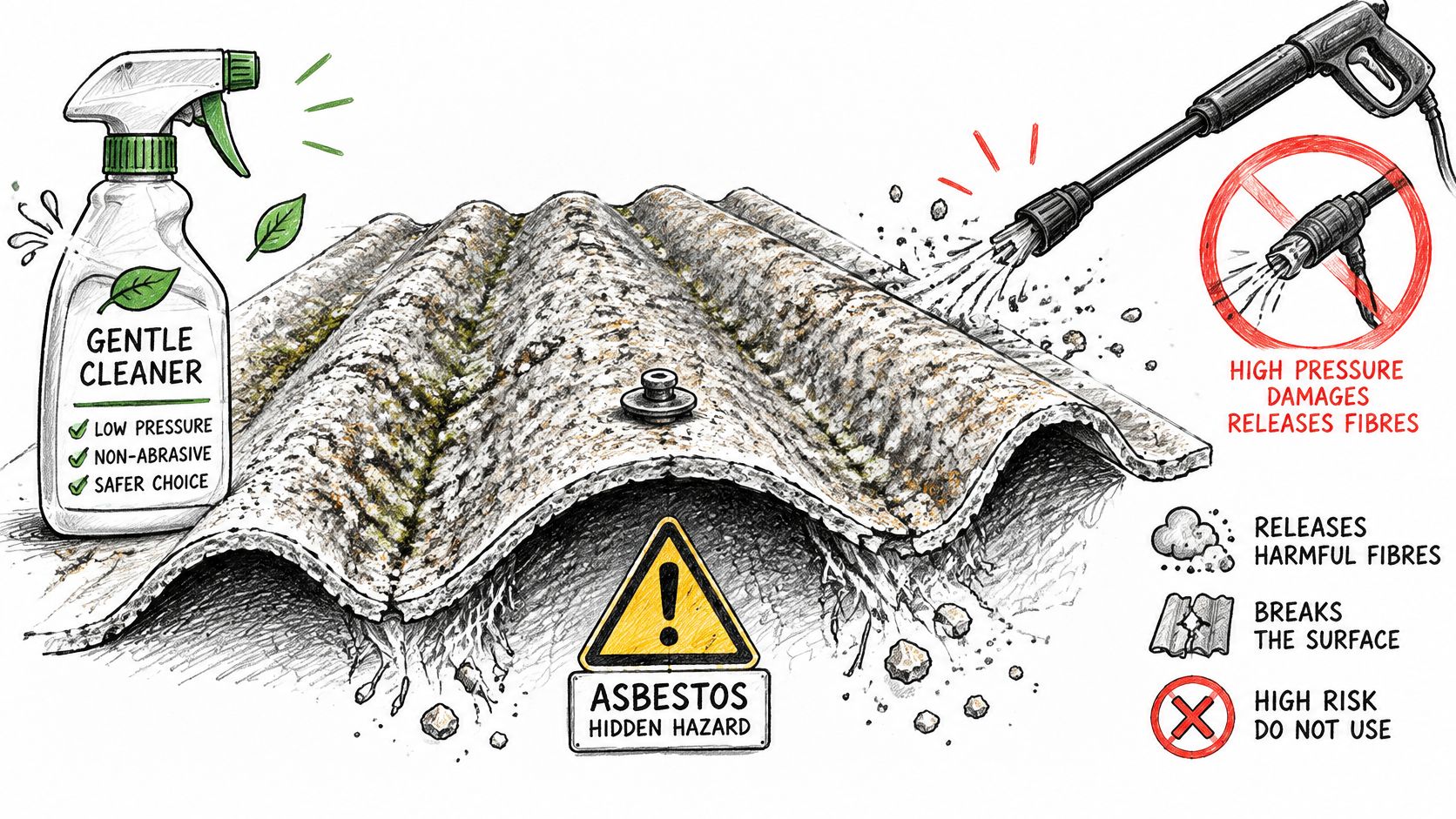
Western Australia's Department of Health guidance in its asbestos cement roof pressure cleaning document states that pressure-water or pressure-air cleaning of asbestos-cement sheeting is prohibited under applicable asbestos and WHS regulations. The method can damage the surface and release fibres into contaminated cement slurry. Pressure cleaning of fibro roofs is widely treated as unsafe for the same practical reason: it can erode the sheet and spread asbestos-containing debris.
A mould-killing product does not make pressure washing safe. Nor does a weaker dilution or a careful operator. The risk comes from the mechanical action on the sheet and the fibres it may release, not from the name or strength of the cleaning product. The lowest-risk choice may be no chemical treatment at all, particularly where wash water could carry contaminated material into drains or other areas.
Identification Comes Before Any Product
- Check building records first: Review the building's age, original specifications, asbestos registers and previous roof reports before anyone accesses the roof.
- Look at the sheet profile safely: Compare its profile, fixings and ageing from a safe access point. Do not break or scrape a sample.
- Arrange an assessment if uncertain: If the material cannot be confirmed, seek a proper asbestos assessment and check asbestos removal compliance requirements before scoping cleaning, encapsulation or replacement.
If asbestos is confirmed, avoid abrading the sheet or creating slurry. Any cleaning, encapsulation or replacement must follow the applicable state WHS framework under a documented control plan. Material removed from the roof is asbestos waste and requires compliant collection and disposal.
Older warehouses and factories may have asbestos cement roofing, so a cosmetic clean before a lease change or sale can carry significant risk. Set the job's end point before discussing treatment, and review asbestos roof removal cost factors when considering replacement rather than pricing a wash that should not happen.
A confirmed non-asbestos Colorbond roof is a different job. A compatible low-pressure detergent or biocidal treatment may be considered after a spot test for colour, gloss and corrosion effects. That option only comes into play once identification has ruled out asbestos.
Labels, Runoff and Claims Checklist
Read the label as a legal document, not as marketing copy. The front panel sells speed. The back panel, the safety data sheet and any permit tell you whether the use you're planning is covered, and what you must control while you do it.
Australia's wider chemical framework is why this file matters. The Australian Government chemicals management roadmap states that more than 40,000 industrial chemicals are available for use in Australia, covering commercial applications including cleaning solutions and surface protection products, and the Industrial Chemicals Environmental Management (Register) Act 2021 established the national IChEMS Register. Commercial users carry responsibilities for introduction, use and disposal, so labels, safety data sheets, approved uses, storage and runoff controls are part of selection, not paperwork for later.
Build the Compliance File in Order
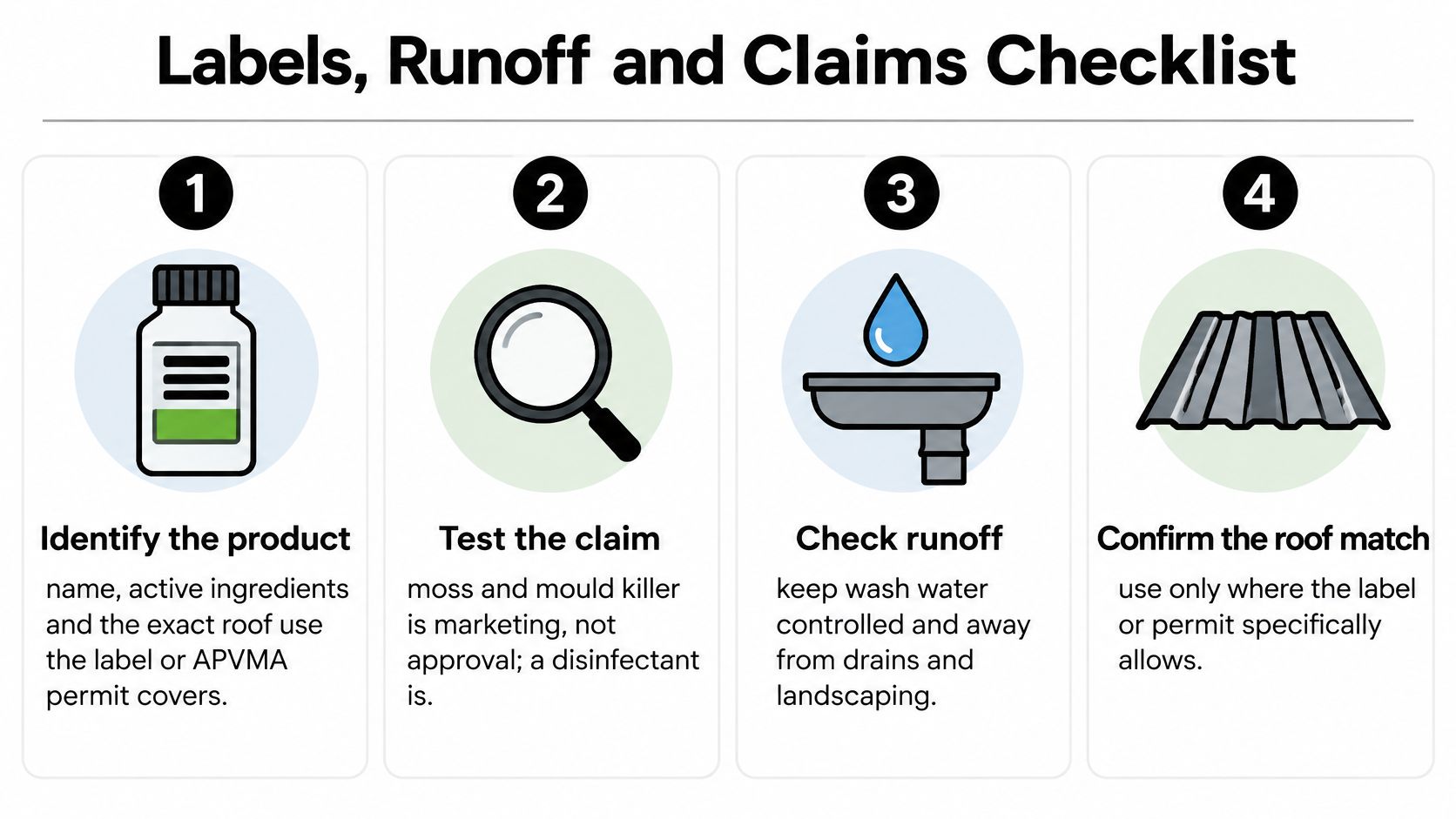
- Identify the product: Record the full product name, active ingredients and the exact roof use the label or APVMA permit covers.
- Test the claim: Treat moss and mould killer as marketing until the label use matches your roof, target organism and method. A disinfectant claim is judged by its registered purpose, so it isn't interchangeable with a general cleaner.
- Pull the SDS: File the current safety data sheet and record dilution, contact time, storage requirements, personal protective equipment and first aid measures.
- Check the day: Compare forecast rain, wind and temperature against label limits, and note proximity to waterways, neighbouring properties and public areas.
- Map the water: Mark every downpipe, box gutter outlet and tank inlet, then isolate or bund each entry before mixing anything.
The NSW drain rule is simple to state and easy to breach. NSW EPA guidance on stormwater drains says only clean rainwater should enter stormwater drains, and wash-down water should be contained and directed to sewer under a council Trade Waste Agreement, treated and recycled, or otherwise managed appropriately. A biodegradable or low foaming formulation doesn't override that rule if roof debris, zinc, paint residue, oils or biocide residues leave the site untreated.
The lowest risk product on a site where runoff cannot be captured may be no chemical product at all. Vacuum cleaning, mechanical scrubbing, steam or a controlled water only approach can carry less downstream risk.
Say black mould covers the north facing slope of a warehouse. A concentrate promises a one pass result, but the slope drains to an open gutter, the downpipe feeds a rainwater tank, and there's no bunded collection point at ground level. The compliant options narrow quickly. You either build a contained, label matched treatment with the tank isolated and rinse water recovered, or you use no chemical and accept a slower mechanical result.
Close the file with a supplier checklist before you order. Ask for product identity, active ingredients, the SDS, the specific label use, dilution range, aquatic toxicity notes where they exist, and a written disposal route. If a supplier can't provide those items, that's your answer about the product, regardless of the cleaning photos.
How Crews Apply and Dilute Treatments
Use one sequence for a confirmed non asbestos roof with a written waste path, and don't improvise the order. Most failures aren't caused by choosing a hopeless product. They happen because a crew mixed too strong, rushed the dwell time, or left a downpipe open while doing otherwise careful work.
A Seven Step Soft Wash Sequence
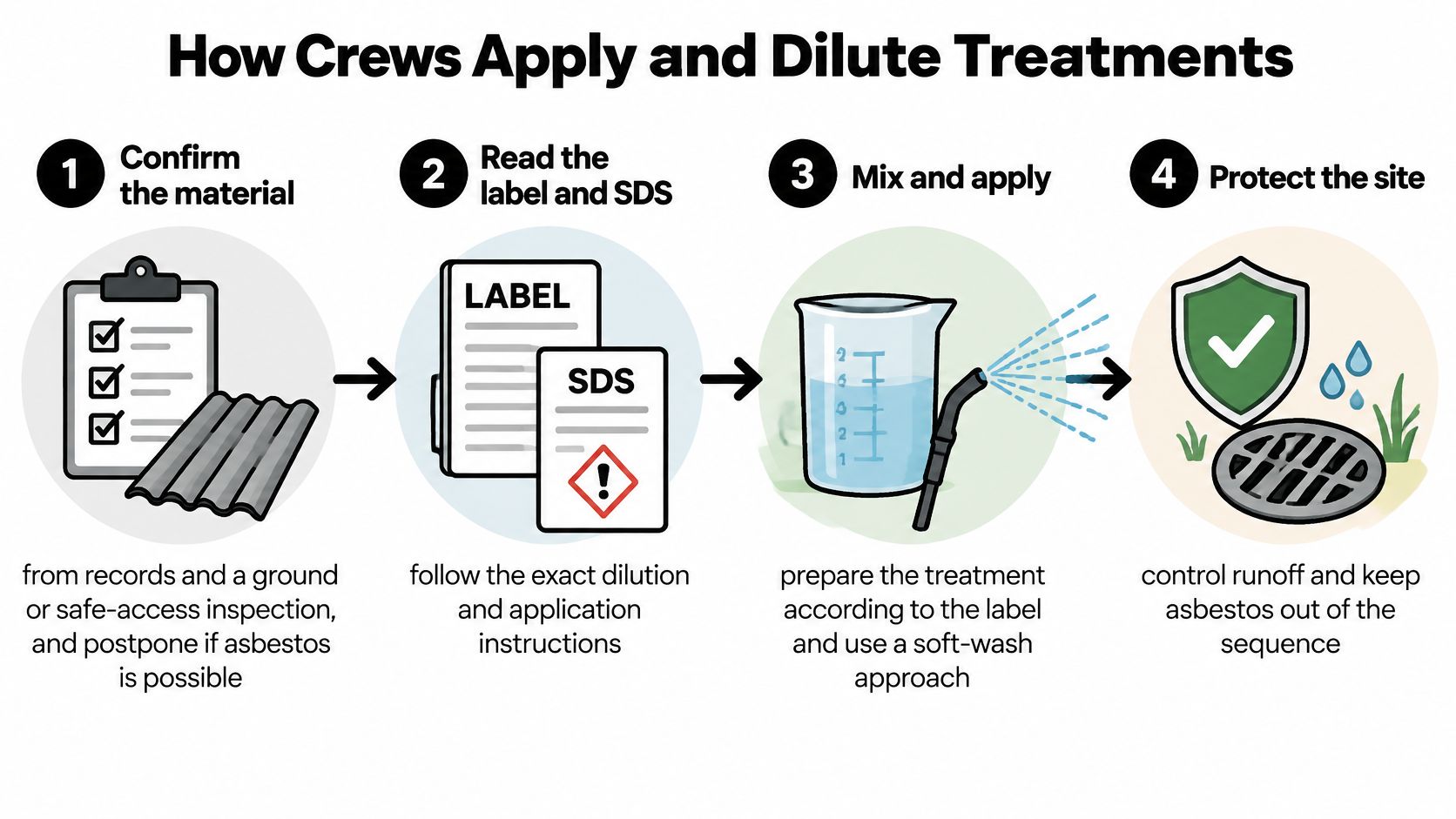
- Confirm the material: Check records and inspect from the ground or a safe access point. If asbestos is possible, postpone the wash entirely. Starting anyway is the failure, because every later step assumes a surface that can be wetted and gently cleaned.
- Read the label and SDS, then mix weak: Use the weakest label rate that can do the job, never stronger than the printed range, and record the batch, mixer and time. A concentrated mix on a hot coated sheet can etch colour and gloss before anyone notices.
- Protect the site: Cover plants, shield solar gear, close open tanks and block every stormwater entry with covers, bunds or recovery hoses. An open downpipe turns a correct mix into an offence.
- Apply low and slow: Work from the bottom of the slope upward on a cool, dry surface so the mix doesn't flash off or streak. Use a low pressure fan pattern rather than a cutting blast, much like the cautious approach described for roof cleaning for Willamette Valley homeowners, adapted here to a larger commercial sheet with containment.
- Hold the contact time: Keep the surface wet for the full label period. If a biocide dries into a crust, growth underneath can survive and you'll pay for a second visit.
- Recover the rinse: Vacuum or bund the rinse water instead of chasing it toward the gutter, then dispose of it on the planned route. Rinsing harder to finish faster is how containment gets overwhelmed.
- Recheck after drying: Inspect colour, gloss, sealant lines and fasteners once the roof is dry. Some coating damage and lifted sealant only become visible after the wet sheen disappears.
Weather holds matter at every step. Postpone for rain that would wash treatment off early, and for wind that would carry overspray across a boundary, onto vehicles or into a neighbouring yard. If pre cleaning is part of a larger programme, align timing and product choice with the roof restoration process so residues don't interfere with primers or membranes applied later.
| Product family | Dilution rate | Contact time | Runoff handling |
|---|---|---|---|
| Alkaline degreaser | Label range only | Shortest label time that lifts grease | Full recovery; high-pH rinse |
| Low-pressure detergent | Weakest label rate that works | Label contact time | Full recovery |
| Biocide or mould treatment | Label range for roof use | Label contact time; keep surface wet | Full recovery; no drain entry |
| Residual anti-fungal | Label range | Label dwell before any rinse | Wash fully recovered; residue stays on surface |
| Oxygen bleach | Label range; no chlorine blends | Label time, kept wet, no drying out | Full recovery |
| No chemical | Not applicable | Not applicable | Water-only or vacuum recovery |
Dilution rule: Stronger isn't a shortcut. It raises coating risk, worker exposure and runoff load while often adding nothing to the end result.
Keep a simple batch record on the day. Write down the product, dilution, start time, weather, contact time and disposal reference. If a tenant, insurer or council officer asks what went on the roof, that one page answers it.
Choose a Product or a Licensed Crew
Buy and apply a labelled product yourself only when every condition lines up. The roof is confirmed non asbestos, the chemistry matches the material table, a spot test passes, drains can be isolated, and someone on site can follow the SDS, dwell time and waste route without cutting corners. If one of those items is missing, you're not saving money. You're transferring risk to the building owner.
Hire a licensed crew when the roof is high, steep or fragile, when asbestos is possible, or when the building is a warehouse, healthcare site or strata complex with shared drainage. Hire one also when runoff would reach stormwater or a tank, and when the stain is really failed coating, active leaks or a damaged membrane. Cleaning won't fix those faults, and washing a failed surface can make diagnosis harder.
What to Demand in Every Quote
- Material assessment: A written statement of what the roof is made of and how that was confirmed.
- Product and SDS: The exact product name, active ingredients and safety data sheet, not a generic description such as eco wash.
- Dilution and contact time: The planned mix rate, dwell period and low pressure method.
- Containment sketch: A simple plan showing isolated downpipes, bunding or vacuum recovery points and protected tanks or landscaping.
- Disposal route: Where recovered wash water goes, and under what approval.
Ask whether the crew brings its own containment equipment, and whether the clean is coordinated with inspections, waterproofing or a later repaint. We offer roof inspection services and roof cleaning services, and we sequence that work so a clean doesn't hide defects that should be recorded first.
Get a written inspection before any concentrate is ordered. That inspection settles the material, the drainage and the waste path, which are the three decisions that determine whether any product belongs on the roof at all.
Before you order a drum or book a pressure washer, talk to Commercial Roofers about a written roof inspection that confirms the material, maps your drainage and sets a contained cleaning method suited to your warehouse, factory or strata roof. Our Sydney crews handle commercial roof cleaning, Colorbond cleaning and the inspections and repairs that should surround it, so you get a clean roof without a compliance headache. Visit Commercial Roofers to arrange your inspection and get a clear, itemised plan for your site.