
You're usually looking into roof restoration at the worst possible moment. A tenant has reported a leak. Water staining has appeared over stock or equipment. A roof inspection has flagged corrosion, loose fasteners, failed flashings, or ponding around penetrations. Then the first replacement quote lands, and suddenly a maintenance issue becomes a capital works problem.
That's where most owners, strata managers, and facilities teams get stuck. They don't just want to know what is roof restoration in theory. They want to know whether it's a real alternative to replacement, whether it will hold up on a commercial building, what it means for compliance in NSW, and where the line is between a smart life-extension project and throwing money at a roof that's already done.
This guide answers that from a commercial perspective. It deals with the practical decision thresholds, the process, the limits, and the material-specific issues that matter on Australian properties.
Table of Contents
- Your Roof Is a Business Asset Not Just an Expense
- Defining Commercial Roof Restoration Beyond Paint
- The Commercial Roof Restoration Process Explained
- Restoration vs Replacement A Clear Comparison
- Special Considerations for Asbestos and Colorbond Roofs
- Costs Lifespan and Compliance for Business Owners
- Is Roof Restoration Right for Your Commercial Property
Your Roof Is a Business Asset Not Just an Expense
A leaking commercial roof rarely stays a roof problem. It turns into damaged ceilings, wet insulation, slip hazards, tenant complaints, mould risk, electrical concerns, and time lost chasing emergency repairs. For an owner, that means the roof is tied directly to rent, operations, safety, and the value of the asset.
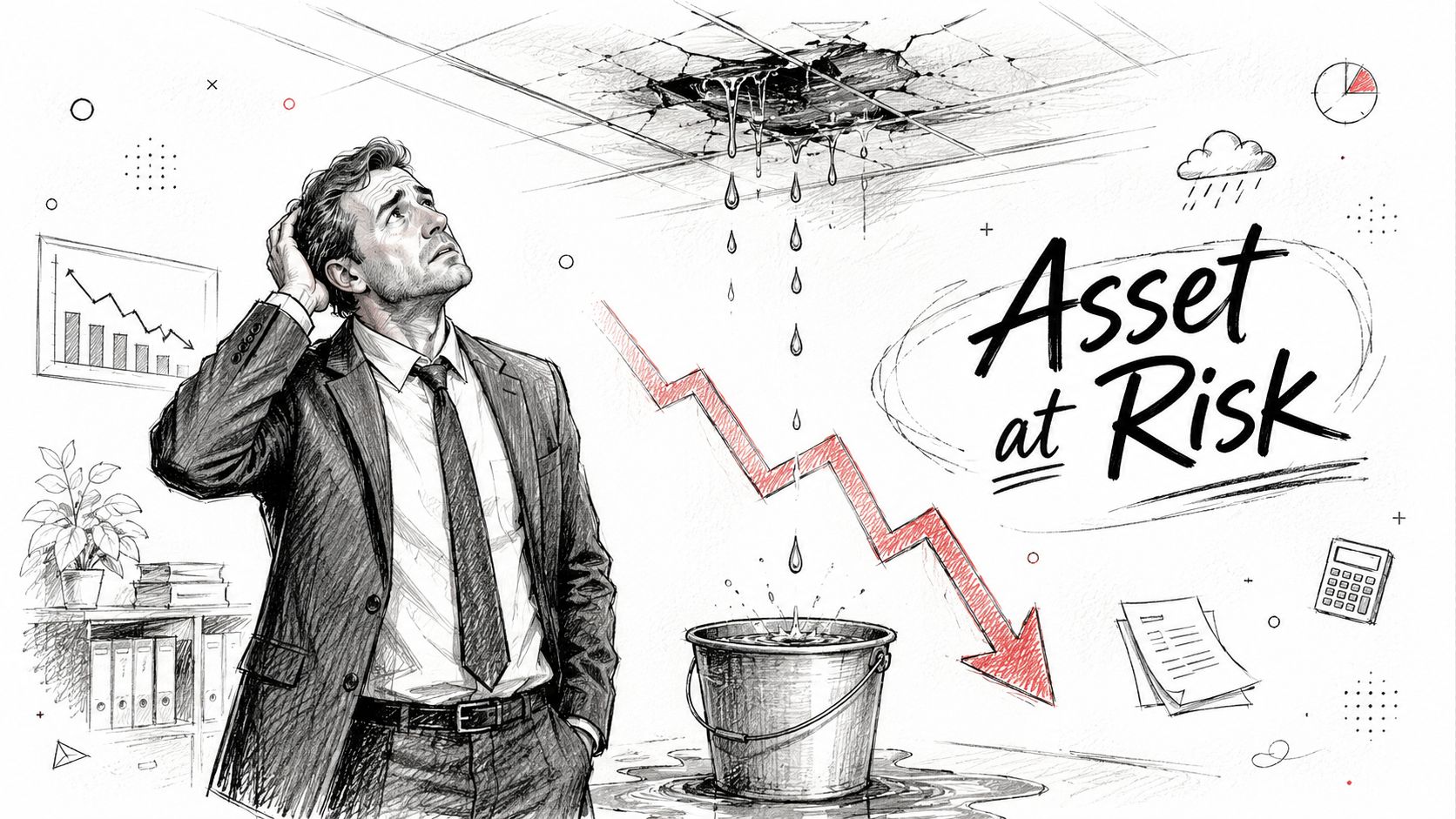
On commercial sites, the pattern is familiar. A warehouse roof starts leaking around laps and penetrations. Someone authorises patch repairs. Six months later the same areas fail again, because the issue wasn't one hole, it was a tired roof system. At that point, many owners assume the only answer is a full replacement, even when the roof structure still has usable life.
That's why restoration matters. It can be a strategic middle path between minor repairs and a complete reroof. It gives you a way to deal with ageing roof coverings, flashings, gutters, fixings, and protective finishes without automatically stepping into the cost and disruption of strip-and-replace work.
The business view matters more than the roofing jargon
If you're responsible for a commercial property, questions are straightforward:
- Can the roof keep operating safely? You need to know whether the substrate is still viable.
- Will the work control disruption? Occupied sites can't always absorb a full replacement programme.
- Does it support planned asset management? Roof decisions should align with maintenance budgets and capital timing.
- Will it hold up under NSW conditions? Sydney roofs take repeated weather exposure, and delayed maintenance usually gets more expensive, not less.
A useful starting point is understanding what drives roof maintenance cost on commercial buildings, because reactive callouts and recurring leak repairs often cost more over time than a properly scoped restoration.
Practical rule: If a roof is still fundamentally serviceable, the smartest money is often spent renewing the system properly, not chasing isolated failures one by one.
Defining Commercial Roof Restoration Beyond Paint
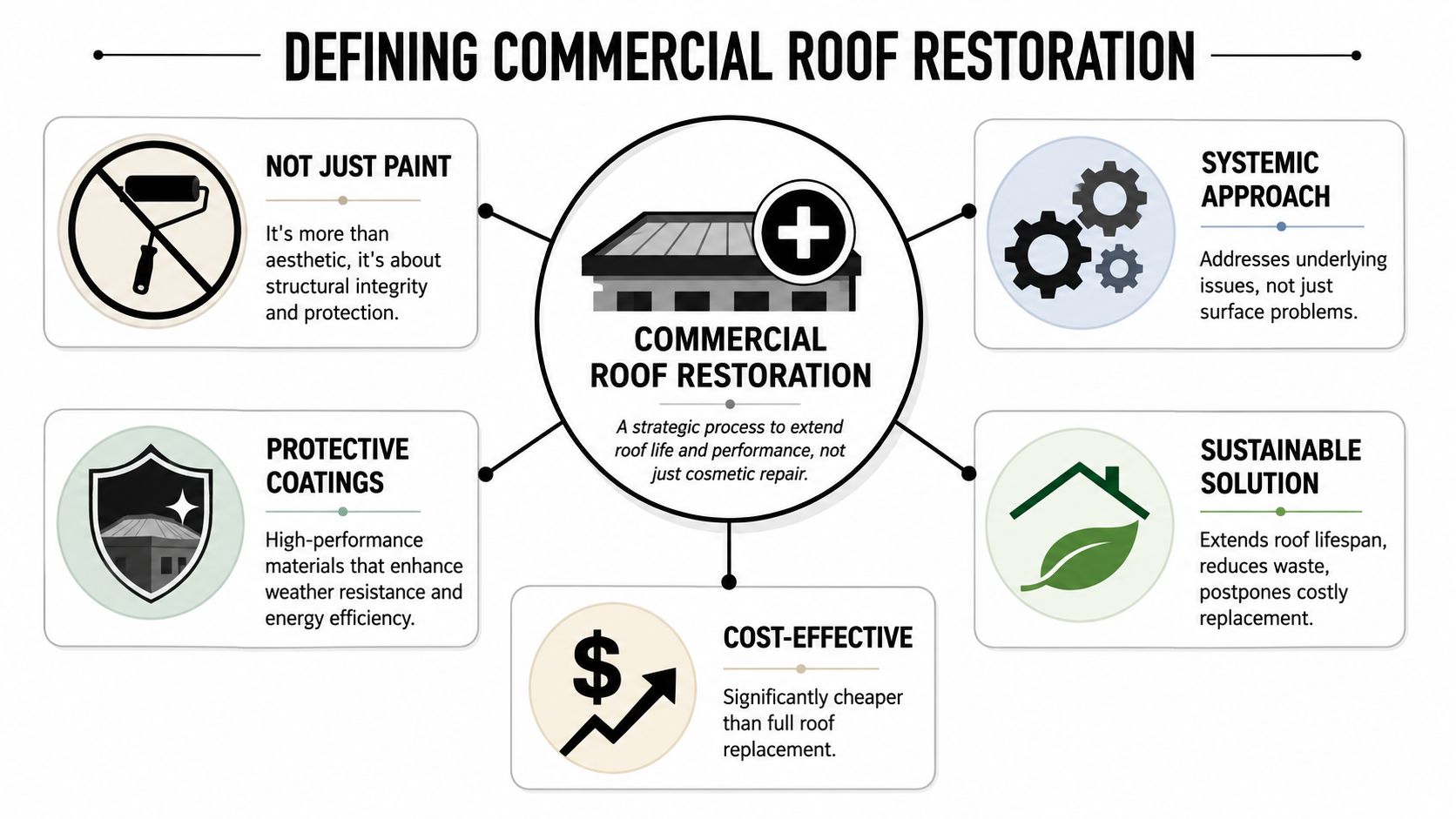
A lot of people hear “roof restoration” and think of washing a roof and rolling on paint. That isn't how commercial restoration should be understood.
In the commercial market, roof restoration is a life-extension activity. In Australia, it sits within a compliance framework shaped by the NCC and related standards, and it targets the roof covering, flashings, fixings, gutters, and coatings to delay major capital replacement, particularly on metal and tiled roofs exposed to harsh weather, as outlined in this Australian roofing compliance overview.
It's closer to an overhaul than a cosmetic touch-up
The simplest analogy is a commercial vehicle or a classic car. If the chassis is still sound, you don't scrap it just because seals, panels, coatings, and fittings have deteriorated. You overhaul what has worn out, protect what remains, and return the asset to reliable service.
That's what restoration does on the right roof.
It usually includes cleaning, defect identification, replacement of failed elements, waterproof detailing, treatment of corrosion or localised damage, and a coating or membrane system that ties the renewed roof together. The purpose isn't appearance, even though the roof often looks far better afterwards. The purpose is to restore weatherproofing, extend service life, and reduce the chance that minor failures become major internal damage.
What restoration usually includes on a commercial roof
The exact scope depends on the substrate, but a proper commercial restoration often covers:
- Cleaning and preparation to remove contaminants, loose material, biological growth, and debris.
- Targeted repairs to flashings, laps, fasteners, penetrations, gutters, joints, and damaged sheets or tiles.
- Waterproof resealing at weak points where leaks commonly start.
- Protective coating or membrane application where the roof type is suitable.
- Final inspection and documentation so the owner knows what was repaired, what remains, and how to maintain it.
For owners of existing metal roofs, there's a practical overlap with painted metal roofing systems and finishes, but restoration is broader than repainting. It addresses roof performance first. Colour and presentation come second.
A roof that still leaks after coating wasn't restored. It was covered.
What roof restoration is not
It's not a substitute for structural rebuilding. It's not a way around unsafe asbestos handling. And it's not a blanket answer for every ageing roof.
The right definition is simple. Commercial roof restoration is a specification-based renewal of an existing roof system where the underlying roof remains a viable candidate for life-extension.
The Commercial Roof Restoration Process Explained
A well-run restoration project is methodical. Good results don't come from the coating brand alone. They come from diagnosis, preparation, detailing, and quality control.
Assessment comes first
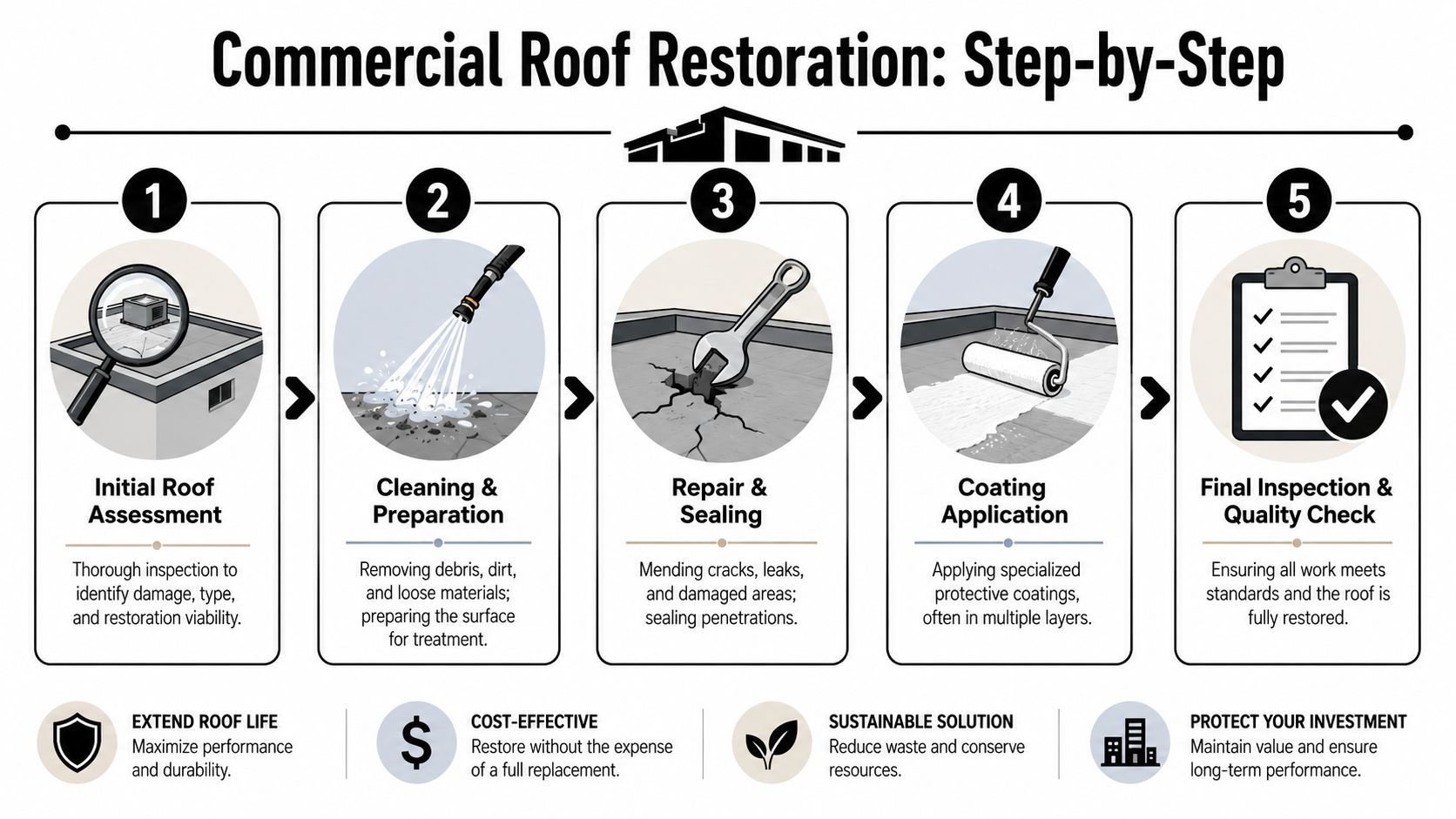
Before anyone talks about coatings or warranties, the roof needs to be assessed properly. That means identifying the roof type, age profile, visible failure points, previous patching, drainage behaviour, signs of corrosion, condition of fasteners, and the state of penetrations and flashings.
On commercial sites, this also means checking how the building is used. A leaking roof over a warehouse office, food area, plant room, healthcare tenancy, or tenanted retail space carries different operational consequences. Access constraints, staging, and safety controls can change the scope as much as the roof defects themselves.
A contractor may also need to determine whether there are materials or conditions that change the compliance pathway, such as asbestos-containing elements or works that affect waterproofing performance in a regulated way.
Here's a visual overview of how that workflow typically unfolds:
Preparation decides the outcome
Most restoration failures start before the first coat is applied. Dirt, oxidation, loose scale, failed sealant, and unstable substrate conditions stop new materials from bonding properly.
Technical specifications for commercial roof restoration place heavy emphasis on surface preparation and membrane continuity. The typical sequence is pressure washing or cleaning, then sealing seams, penetrations, fasteners, transitions, and drains with waterproofing mastic before base and top coats are applied to create a continuous watertight layer. Some specifications also define coating build-up and reinforcement details, and restoration systems may be warrantied for 10, 15 or 20 years, as shown in this guide specification for commercial roof coatings.
Repairs and detailing do the real work
This is the stage clients often don't see, but it's where the project either becomes durable or remains cosmetic.
A proper restoration may involve replacing deteriorated fasteners, re-securing loose sheets, repairing flashings, treating rusted areas, sealing penetrations, and correcting local defects in gutters or laps. On some roofs, detailing around skylights, box gutters, parapets, vents, HVAC curbs, and service penetrations is more important than broad-field coating.
Typical attention points include:
- Sheet laps and side laps where wind-driven rain gets forced into weak joints.
- Fastener lines where washers harden, loosen, or fail.
- Penetrations such as vents, flues, antenna mounts, and mechanical services.
- Drainage transitions where ponding or debris build-up keeps water in contact with the roof.
- Perimeter flashings that move under thermal cycling and often open up first.
Fix the details first. Broad coverage only works when the small failure points are already under control.
Coatings protect the renewed roof
Once the roof is clean, sound, and detailed properly, the coating or membrane system becomes the protective layer that ties the work together. On suitable roofs, this creates a continuous weatherproof surface that helps manage future exposure.
That doesn't mean every roof gets the same treatment. Metal, membrane, concrete, and tiled substrates all behave differently. Product compatibility, movement, moisture condition, and adhesion all matter. A contractor should be able to explain why a given system suits that roof, not just offer a standard package.
For clients comparing providers, asking better questions is key. If a proposal only mentions cleaning and coating, it's incomplete. If it sets out preparation, repairs, detailing, coating sequence, and defect exclusions, it's moving in the right direction.
Restoration vs Replacement A Clear Comparison
For owners and facilities teams, this is the core decision. You're not choosing between “doing something” and “doing nothing”. You're choosing between two very different capital paths.
The correct answer depends on condition, risk, disruption tolerance, and how much life is realistically left in the existing roof.
Where restoration usually makes sense
Restoration usually fits roofs that are ageing but still structurally serviceable. The roof covering may have localised corrosion, failed fasteners, leaking penetrations, deteriorated coatings, or isolated damage, but the roof hasn't crossed into broad system failure.
This is often the right path when the owner wants to extend service life, control downtime, avoid unnecessary tear-off, and align roofing works with a staged asset plan.
When replacement is the only sensible option
There are clear thresholds where restoration should be ruled out. A decision to restore should be voided if there is extensive membrane saturation, widespread substrate corrosion, or significant fastening failure, because restoration won't provide a long-term solution and may even void existing warranties, as noted in this discussion of when roof restoration is not appropriate.
That matters on industrial and commercial sites because the wrong choice doesn't just waste money. It can leave the building exposed while giving the owner false confidence that the roof has been solved.
| Factor | Roof Restoration | Full Roof Replacement |
|---|---|---|
| Primary purpose | Extends service life of a viable existing roof | Replaces the roof system entirely |
| Best fit | Roofs with manageable defects and sound underlying structure | Roofs with broad failure, severe deterioration, or non-viable substrate |
| Upfront spend | Usually lower than full tear-off and replacement | Usually higher because removal, disposal, and new installation are involved |
| Disruption to occupants | Often easier to stage around operations | Usually more disruptive, especially on occupied sites |
| Programme complexity | Can be efficient if defects are well defined | Often more complex due to demolition, weather exposure, and sequencing |
| Waste and disposal | Retains more of the existing roof assembly | Generates more removal and disposal activity |
| Compliance focus | Condition assessment, product suitability, repair detailing, waterproofing performance | Full system design, removal controls, replacement scope, updated installation compliance |
| Risk if misapplied | Can fail early if the roof was never a proper candidate | Higher capital outlay, but appropriate when the roof has reached end of life |
A useful way to think about it is this:
- Restore when the roof is tired
- Replace when the roof is spent
That sounds simple, but the line is technical. The roof has to be inspected by someone who can distinguish repairable deterioration from failure that has spread too far through the system.
Special Considerations for Asbestos and Colorbond Roofs
Australian commercial properties often bring material-specific issues that generic restoration advice ignores. Two of the biggest are asbestos roofs and Colorbond or similar metal roofs. They need different thinking, different risk controls, and different scopes.
Asbestos roofs need a compliance-first decision
If an older commercial or industrial roof includes asbestos-containing materials, restoration is not just a maintenance question. It becomes a safety and legal question first.
In NSW, work affecting asbestos-containing materials must align with state safety and licensing requirements. That means the owner can't treat asbestos roof restoration as a standard pressure-clean-and-coat job. The first decision is whether the material can remain in place under a compliant management or encapsulation approach, or whether condition, damage, or redevelopment plans mean removal is the safer and more defensible option.
On some sites, encapsulation-based restoration can be appropriate where the sheets remain stable and the scope is specifically designed around safe handling and containment. On others, deterioration, cracking, fixings failure, or future building works make replacement the better call.
The important point is that asbestos changes the process. It narrows what can be done, who can do it, and how it must be documented.
Colorbond and other metal roofs fail in specific ways
Colorbond and comparable metal roofing systems are often good restoration candidates, but only when the failure is in the weathering and detailing, not in widespread substrate loss.
Common problem areas include:
- Cut-edge corrosion along sheet edges and laps
- Fastener degradation where seals have hardened or fixings have backed out
- Flashing fatigue around parapets, ridges, and penetrations
- Gutter and box gutter issues where debris and standing water accelerate corrosion
- Previous incompatible repairs involving poor sealants or patch materials
Metal roof restoration needs a substrate-specific approach. Corrosion has to be treated properly. Failed fixings need replacement, not just coating over. Laps and penetrations need waterproof detailing that can cope with movement. Owners looking at metal roofing systems used across Australia should expect different restoration scopes for corrugated sheets, concealed-fix profiles, and older exposed-fix roofs.
A metal roof can look rough and still be restorable. It can also look acceptable from ground level and be close to replacement. The inspection decides that, not the street view.
For buildings with older painted steel roofs, the difference between successful restoration and wasted spend usually comes down to how much metal is still there to save.
Costs Lifespan and Compliance for Business Owners
A common commercial scenario in Australia goes like this. The roof has started leaking in a few spots, tenants are complaining, and the first quote for replacement is large enough to stall the decision. At that point, the question is not "what does restoration cost per square metre?" It is whether restoration buys enough service life, risk reduction, and compliance certainty to justify the spend.
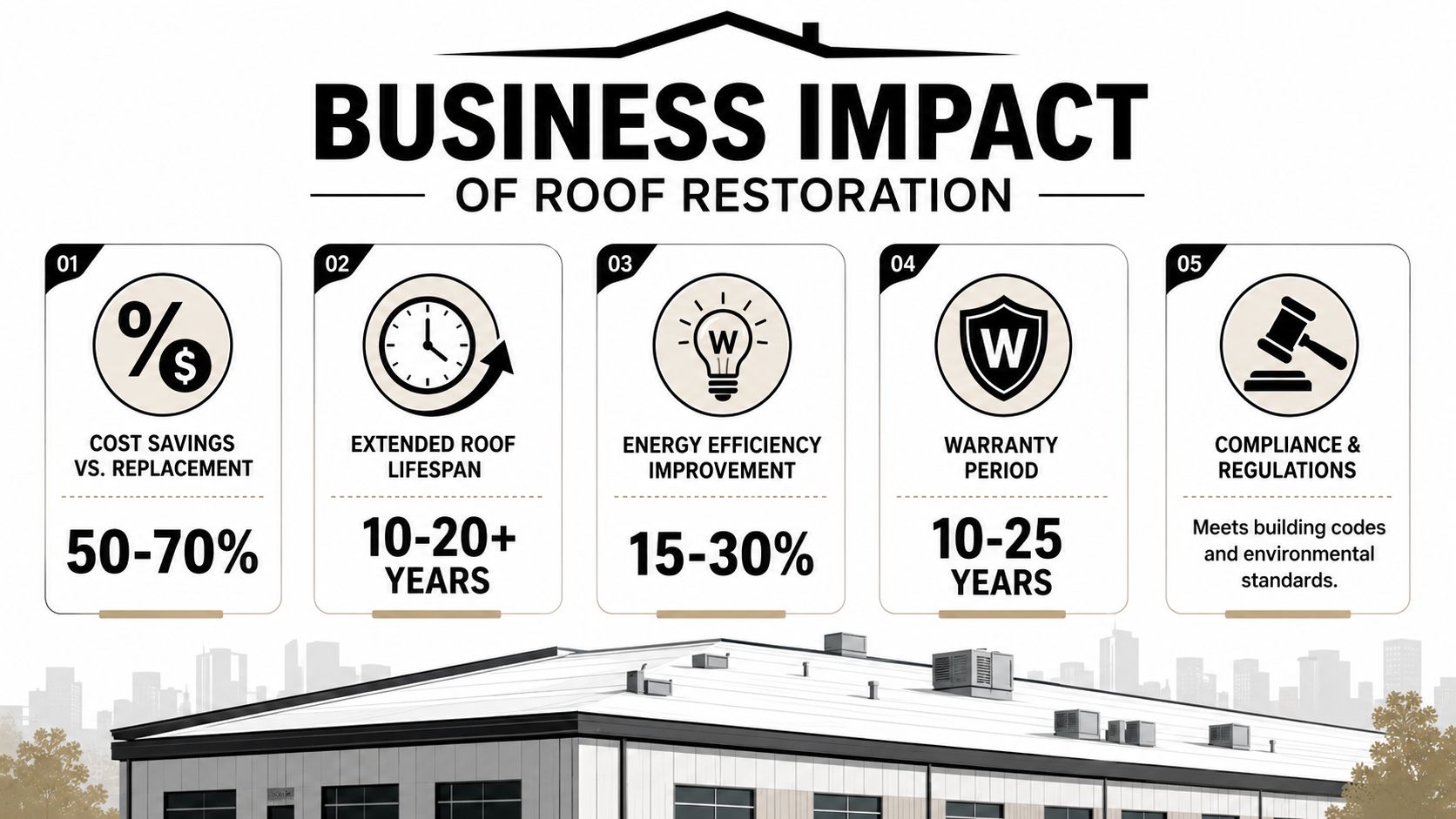
What Drives the Quote
Commercial restoration quotes rise or fall on scope. Roof area matters, but it is rarely the main pricing variable on its own.
Two buildings with the same roof size can land in very different budget ranges if one needs complex access, temporary weatherproofing, staged works around trading hours, asbestos controls, or heavy remediation at laps, penetrations, and gutters. On occupied sites, labour efficiency often drops because crews cannot always work in the fastest sequence.
The main cost drivers are usually:
- Condition of the existing roof. Localised repairs and coating preparation cost far less than widespread fastening replacement, corrosion treatment, sheet change-outs, or wet insulation investigation.
- Access and safety requirements. Edge protection, walkways, lift access, traffic management, and permit conditions add time and equipment costs.
- Roof complexity. Plant platforms, skylights, box gutters, parapets, services, and multiple roof levels create more detail work and more failure points to address.
- Business continuity constraints. Weekend work, after-hours access, noise limits, staged areas, and tenant coordination all affect programme length and labour cost.
- Compliance obligations. Hazardous material procedures, documentation, and work method controls can materially change both scope and sequencing.
This is why low square-metre rates can be misleading. If the quote ignores access, compliance, or defect rectification, the price usually moves later.
How long a restoration can last
For business owners, lifespan is a threshold decision. If restoration gives the building a meaningful extension of service life and keeps the site operational, it can be a sound asset-management choice. If the roof is too far gone, the same spend only delays replacement.
Some commercial systems are warranted for 10, 15 or 20 years when the roof qualifies and the specification is followed. The key phrase is "when the roof qualifies." Warranty term depends on substrate condition, preparation quality, detailing, drainage performance, and whether moisture or corrosion has already compromised the roof beyond a repairable stage.
A roof with unresolved moisture issues, advanced corrosion, or unstable substrate should not be treated as a long-term restoration candidate. In those cases, owners are better off comparing restoration cost against the avoided cost of doing the job twice.
That trade-off matters on older Australian commercial stock, especially where previous patch repairs have hidden the true condition.
Compliance is part of the return
Compliance affects cost, programme, and decision-making. It is not paperwork added at the end.
For commercial properties, the compliance threshold usually becomes sharper in three situations. The roof may contain asbestos. The building may need to remain occupied during works. The owner may need a documented basis for capital planning, insurer discussions, strata approval, or WHS sign-off. In each case, the value of restoration depends partly on whether the scope is defensible and properly documented.
Australian owners should also separate material types early. A weathered Colorbond roof with repairable detailing problems sits in a very different category from an asbestos roof, where the legal and safety settings can narrow the available options. The wrong recommendation here creates risk well beyond the roof itself.
Commercial Roofers is one provider in the NSW market that carries out commercial roof repairs, restoration, inspections, and replacement work on industrial and commercial buildings. Whatever contractor is being assessed, ask for a condition-based recommendation with clear exclusion lines. Owners need to know where restoration stops making financial sense, what compliance controls apply, and what would trigger full replacement instead.
Is Roof Restoration Right for Your Commercial Property
Roof restoration is right when the roof still has a sound base and the problems are repairable. It's wrong when the system has deteriorated too far for coatings and targeted repairs to do anything more than delay a larger failure.
Use this checklist as a quick screen.
- The roof is leaking, but the damage appears localised. You may have a restoration candidate rather than a replacement-only roof.
- The structure still seems serviceable. Surface ageing is different from broad substrate failure.
- You want to control capital spending. Restoration often suits owners trying to extend life without tearing off a full system immediately.
- The site is occupied. If disruption matters, restoration can be easier to stage than replacement.
- You need a compliance-based answer. This is especially important if asbestos, waterproofing risk, or ageing metal roofing is involved.
- You want a decision you can defend. Strata committees, asset managers, and owners all need documented reasons for the chosen path.
If the roof is fundamentally viable, restoration can be a disciplined asset-management decision. If it isn't, replacement is the cheaper answer in the long run, even when the quote is higher upfront.
The only way to know which side of that line your building sits on is a proper inspection. Not a guess from the car park. Not a quote based on aerial images. An inspection that looks at substrate condition, detailing, drainage, fixings, corrosion, penetrations, and compliance risks.
If you need a clear answer on whether restoration or replacement makes sense for your building, speak with Commercial Roofers . They inspect commercial and industrial roofs across Sydney and NSW, then provide a condition-based scope so you can make a practical, compliant decision without guessing.