
A leak rarely starts as a roofing problem in a commercial building. It starts as a stock problem, a ceiling problem, a slip hazard, an electrical risk, a tenant complaint, or a supervisor trying to move pallets away from a drip at 6:30 in the morning.
That's why metal roofing repair needs to be handled as asset protection, not patchwork. If you're responsible for a warehouse, factory, retail centre, school, strata complex, or logistics site, the question isn't just “How do we stop the water?” It's “How do we stop damage, keep the site operating, document the event properly, and make a sound capital decision?”
In Australia, that matters even more because the built environment is old enough to create steady maintenance demand. The national housing stock alone was about 10.8 million dwellings at the 2021 Census, and the average dwelling age was about 30 years, which is one reason roof repairs and maintenance remain a major category as buildings age and exposed roofs accumulate defects over time, according to this roof repair and ageing stock reference. Commercial assets follow the same basic reality. Age, exposure, and deferred maintenance eventually show up at the roof.
Table of Contents
- Introduction When a Drip Becomes a Disaster
- Diagnosing Commercial Metal Roof Failures
- The Critical Decision Repair vs Full Replacement
- A Practical Overview of Metal Roof Repair Methods
- Special Considerations Asbestos and Colorbond Roofing
- Estimating Costs and Project Timelines
- How to Choose a Qualified Commercial Metal Roofer
- Frequently Asked Questions
Introduction When a Drip Becomes a Disaster
Most owners don't call about a roof because they've been thinking about roofing. They call because something has already gone wrong. Water is dripping over a switchboard room. A tenant has sent photos of stained ceiling tiles. Staff have put buckets on the floor. A storm passed through overnight and now you're trying to work out whether the damage is isolated or the start of a larger failure.
A commercial metal roof sits at the top of a long chain of risk. Once it leaks, the problem moves quickly into operations, safety, compliance, and insurance. If you run a warehouse, the priority may be protecting inventory and maintaining dispatch. If you manage strata, it may be documenting damage and triaging multiple tenancies. If you oversee an industrial site, it may be preserving evidence for a claim while keeping plant and people safe.
Practical rule: The first decision isn't repair versus replacement. The first decision is how to stabilise the building without creating a bigger legal, safety, or business interruption problem.
That's where many generic roofing articles fall short. They treat the issue like a domestic leak. Commercial metal roofing repair isn't just about sealant and screws. It's about identifying whether the defect is local or systemic, deciding how much work is justified, and sequencing the job so the site can keep functioning.
The owners who manage this well usually do three things early. They document the condition, they get a diagnosis that goes beyond the visible wet spot, and they resist the temptation to buy the cheapest short-term patch.
Diagnosing Commercial Metal Roof Failures
A stain on the ceiling is a poor map of the actual defect. On commercial metal roofs, water often tracks along purlins, insulation facings, laps, and sheet profiles before it appears inside, sometimes well away from the entry point. If the diagnosis starts and ends at the drip, the repair budget usually gets spent on symptoms.
That matters for more than workmanship. A weak diagnosis can affect insurance documentation, prolong tenant disruption, and leave an owner paying for repeat callouts after the next storm. The aim is to identify whether the issue is isolated, whether there are multiple entry points, and whether any surrounding materials or legacy details change the repair scope.
Start with what you can see safely
A useful first review does not require anyone to climb onto the roof. In many buildings, especially older sites, that creates unnecessary safety exposure and can disturb fragile materials. If the roof may contain asbestos cement products, treat that as a separate risk category and follow guidance from a commercial asbestos roof repair company before arranging intrusive inspection or repair.
From the ground and from inside the building, record what can be observed without guesswork:
- Internal staining: Marks on ceilings, insulation, columns, or wall junctions can show direction of water travel.
- Moisture near penetrations: Vents, skylights, flues, cable trays, and mechanical supports fail regularly because each detail interrupts the sheet and flashing line.
- Overflow evidence at gutters: Staining down external walls often points to drainage problems, blocked gutters, or sump issues.
- Sheet movement or distortion: Lifted edges, buckling, or noise after wind events can indicate fixing failure or sheet movement.
- Rust at laps, trims, or cut edges: Corrosion at these points usually means the protective finish has broken down and the defect may keep spreading.
Keep the notes plain and factual. Where is water appearing. When did it start. What was the weather doing. Has it happened before. Those details help a contractor separate one-off storm damage from an established defect pattern.
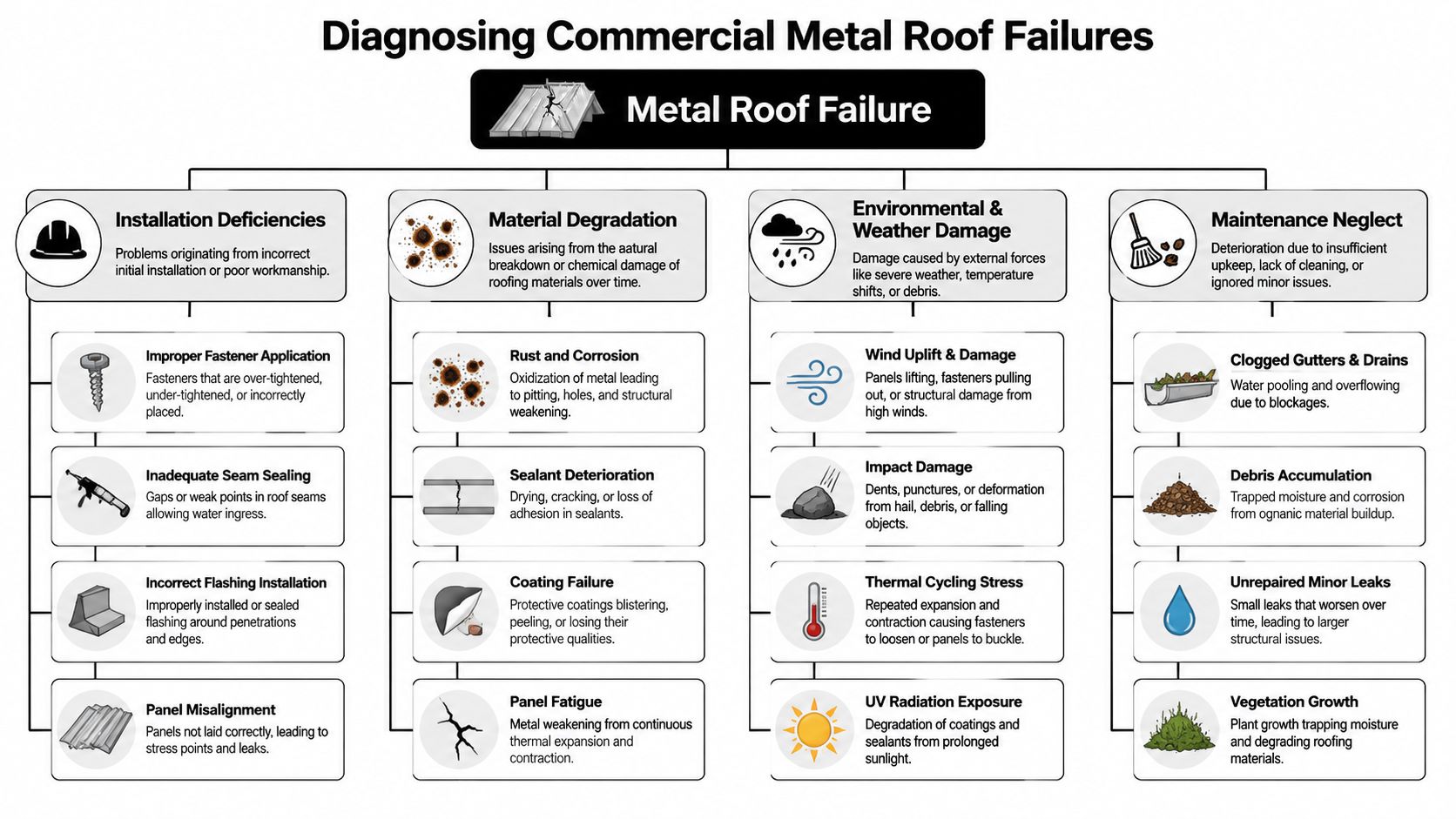
This visual summary helps explain the common root causes.
The failure points that matter most
On commercial sites, the highest-value inspection points are usually fasteners, penetrations, laps, and drainage details. Those are the areas where movement, aging sealants, poor original detailing, and deferred maintenance tend to show up first. Guidance in this technical article on metal roof details reflects what experienced roof managers see in practice. The field of the roof may look serviceable from a distance while water is entering around a loose fixing line, split pipe boot, or failed flashing turn-up.
The climate load in Australia makes that pattern harder to ignore. Government climate risk material points to heavier rainfall, severe storms, heat, and cyclone exposure in many regions, all of which increase stress on sheet fixings, flashings, sealants, and drainage capacity, as outlined in the National Climate Risk Assessment. For owners, the practical takeaway is simple. A roof that survives ordinary weather can still underperform during peak events, which is when business interruption and claim pressure rise.
Common commercial failure modes
| Failure point | What it usually means |
|---|---|
| Fasteners backing out | Movement, vibration, poor original installation, or washer failure |
| Penetration flashings | Aged sealant, split boots, poor detailing, movement around services |
| Laps and seams | Capillary entry, failed sealant, corrosion, or alignment issues |
| Gutters and sumps | Blockage, ponding, corrosion, overflow, or discharge problems |
| Cut edges and trims | Early corrosion where protective coating has broken down |
A competent diagnosis checks how these issues interact. For example, a roof leak over a warehouse aisle may begin at a penetration upslope, worsen because fixings have loosened across the same run, and finally present only after a blocked box gutter overloads in heavy rain. Treating one point and ignoring the others can restore the leak for a week, not the roof for a season.
The contractor worth paying for will inspect the full pathway of water entry and discharge, document probable causes, and note any compliance or access constraints that affect the repair method. That is the standard owners should expect.
The Critical Decision Repair vs Full Replacement
Owners often lose money, not due to their choice of repair or replacement, but because they choose without a framework.
A metal roof can remain a sound asset for a long time if the structure and most of the sheeting are still serviceable. But there's a tipping point where repeated repairs stop being maintenance and start becoming capital waste.
What usually favours repair
Repair is generally the stronger option when defects are localised, the substrate remains sound, and the roof hasn't moved into broad corrosion or repeated leak recurrence. Storm damage is a common example. If a section of flashing has failed, a run of fasteners has loosened, or a few sheets have been damaged by impact, targeted remediation can restore service without the cost and disruption of a full re-roof.
It also helps when the site cannot tolerate long shutdowns. A staged repair approach can keep operations running, preserve cash flow, and buy time for broader capital planning.
When replacement becomes the smarter spend
Replacement starts to make more sense when the roof shows systemic issues rather than isolated defects. That can mean widespread oxidation, recurring failures across multiple penetrations, extensive fixing fatigue, or damage that keeps reappearing in different zones after each weather event.
In Australia, location matters. Around 85% of Australians live within 50 km of the coast, which increases exposure to salt-driven deterioration, and that's one reason the repair-versus-replacement decision becomes harder for ageing metal roofs in corrosive environments, as discussed in this building enclosure paper on roof decision triggers. Coastal commercial buildings can reach a point where patching one corroded area pushes the next weak point into view.
Bushfire exposure can also shift the decision. Owners may need to weigh not only present watertightness but whether the existing roof system still makes sense for the building's risk profile and compliance obligations.
Decision Matrix Metal Roof Repair vs Replacement
| Factor | Favouring Repair | Favouring Replacement |
|---|---|---|
| Leak pattern | One area or a small number of known details | Multiple recurring leak points across the roof |
| Sheet condition | Most sheets sound, limited corrosion | Widespread oxidation, coating breakdown, fatigue |
| Fasteners | Defects concentrated in selected runs | Broad fixing failure across many zones |
| Structure below | Purlins and substrate remain dry and serviceable | Evidence of ongoing substrate deterioration |
| Operational needs | Site needs a staged, low-disruption solution | Owner can plan a capital works programme |
| Financial logic | Extends life meaningfully with contained scope | Repeated repairs no longer represent value |
| Compliance pressure | Existing system can be repaired safely | Existing system creates ongoing compliance risk |
One special case deserves early attention. If the building has an older roof and there's any chance asbestos is involved, the decision tree changes immediately. You can review that issue in this guide to asbestos roof repair company considerations.
Owner's lens: Don't ask whether repair is cheaper today. Ask whether repair still makes sense once you factor in recurrence, disruption, callouts, tenant friction, and the next storm.
A sound contractor should be able to explain not just what they propose to do, but why that scope is commercially defensible. If they can't tell you whether the problem is local or systemic, they haven't diagnosed the roof properly.
A Practical Overview of Metal Roof Repair Methods
Commercial metal roofing repair starts with control. Control of water entry, site access, safety exposure, documentation, and disruption to the tenant or operation below. If those items are handled poorly, even a technically sound repair can become an insurance dispute, a compliance problem, or an expensive interruption to trade.
Emergency stabilisation comes first
After a storm event or an active leak, the first stage is usually temporary but still needs to be deliberate. The job is to reduce further loss, protect stock and equipment, isolate affected internal areas, record visible damage, and make the roof safe enough for a proper inspection. In a commercial setting, the first move should support business continuity and the insurance process, even if the permanent repair is still being scoped.
That usually means temporary waterproofing in selected areas, moisture tracing inside the building, photos tied to location, and a short written record of what was found on the day. Owners who skip that step often create problems later when they need to explain whether the damage came from one event, a maintenance issue, or a longer-term roof defect.
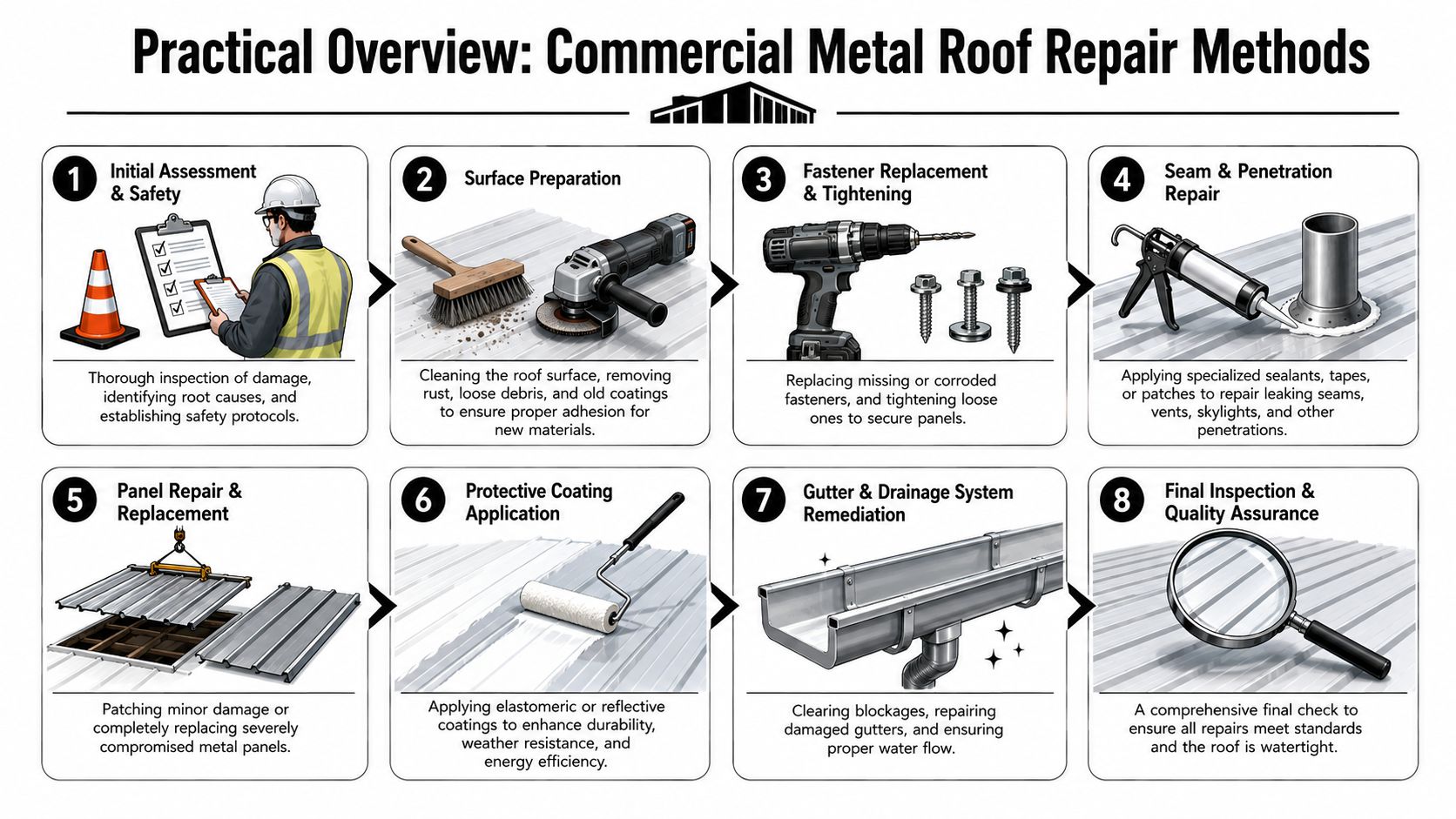
The professional workflow usually looks something like this:
Permanent repairs need proper sequencing
Permanent work depends on the roof type, profile, age, access constraints, and the actual failure mechanism. A lap leak, a failed penetration, widespread fastener fatigue, and corrosion at gutters all require different scopes. Treating them as one generic "metal roof leak repair" usually wastes money and leaves the underlying issue in place.
For owners managing older industrial or warehouse assets, it helps to understand the main commercial metal roofing systems used in Australia. Repair details need to match the roof that is already installed. Fasteners, sealants, replacement sheets, and flashing methods are not interchangeable across every profile.
Typical repair methods on commercial metal roofs
- Fastener replacement: Failed screws and washers are removed and replaced with compatible fixings sized for the existing sheet and support condition.
- Penetration rectification: Pipe boots, vents, skylight flashings, and service penetrations are stripped back and rebuilt where sealant-only repairs have failed.
- Panel repairs: Damaged areas may be patched, isolated sheets may be replaced, or a localised reclad may be required where corrosion or impact damage has gone beyond a minor repair.
- Drainage remediation: Box gutters, sumps, outlets, and overflow provisions are checked and repaired so water can discharge as designed.
- Coating and corrosion treatment: Surface preparation and recoating can extend service life where the metal remains sound and dry. It is a poor choice where sheet thickness has already been materially lost.
Sequencing matters here. High-risk leak points are addressed first. Then the contractor deals with defects that affect durability, such as active corrosion, failed laps, and drainage faults. Cosmetic work sits well behind anything that threatens internal damage, safety, or compliance.
Good contractors also plan around occupancy. They separate noisy works from trading hours where possible, protect sensitive internal areas below active roof zones, manage hot works carefully, and keep photographic records before, during, and after repair. On live commercial sites, the quality of that planning often matters as much as the repair detail itself.
One provider operating in this space is Commercial Roofers, which lists repair, maintenance, inspections, asbestos removal and commercial metal roofing services in NSW. The important question is whether the contractor can diagnose, stage, document, and deliver the work without treating a live commercial property like an empty farm shed.
Temporary waterproofing is useful when it buys time for safe access, insurer review, procurement of matching materials, and a properly defined permanent scope. It becomes expensive when it stays in place by default and no one commits to the real repair.
Special Considerations Asbestos and Colorbond Roofing
Some roofs don't allow ordinary decision-making. Asbestos is the clearest example. Colorbond is a different issue, but it also punishes casual repair work.
Asbestos changes the job completely
If your building dates from an era when asbestos cement roofing was commonly used, stop thinking in terms of ordinary patch repair. Start thinking in terms of identification, compliance, licensed handling, and risk control.
An owner can't treat suspected asbestos like standard sheeting. The legal, health, and documentation consequences are too serious. Even routine access and minor disturbance can create problems if the material hasn't been properly assessed. For strata managers and industrial owners, that risk extends beyond workers on the roof. It reaches occupants, neighbouring lots, contractors, waste transport, and project records.
The practical implication is simple. If asbestos is present or suspected, the cheapest-looking quote may be the most dangerous quote.
Colorbond repairs need product discipline
Colorbond creates a different kind of risk. The roof may be structurally repairable, but poor product matching and poor workmanship can shorten life, spoil appearance, and create warranty issues. A contractor needs to understand the profile, coating system, compatibility of fasteners and sealants, and how to avoid creating new corrosion points during the repair.
That includes basics many people miss. Cutting methods matter. So does how replacement flashings are formed, how swarf is managed, and whether dissimilar metals are introduced into the assembly. If the repair leaves exposed cut edges untreated or uses incompatible components, the roof may be watertight for now and still be heading for premature deterioration.
Owners comparing options on modern steel roofing systems should at least understand the material category they're dealing with. This overview of metal roofing in Australia is a useful reference point for profile types, commercial applications, and why system compatibility matters.
A compliant, well-matched repair doesn't just stop leaks. It protects the roof's remaining service life and avoids creating a second round of defects with the first round of work.
Estimating Costs and Project Timelines
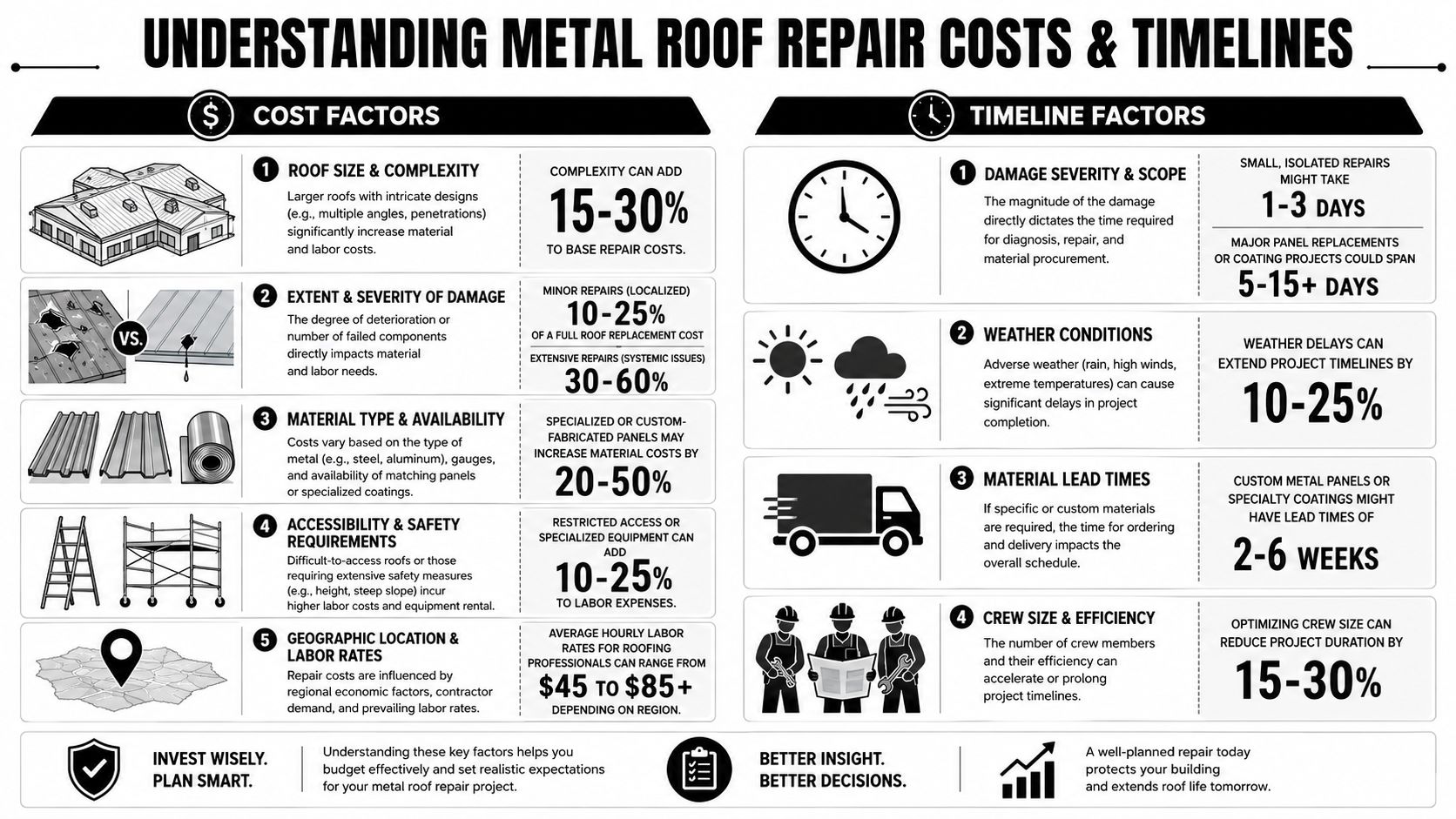
There isn't a single honest price for metal roofing repair. There's only a scope, an access condition, a risk profile, and a set of site constraints. Owners get into trouble when they compare quotes line by line without checking what each contractor has included or ignored.
What drives the quote
The biggest variables are usually the roof layout, access, failure type, and what's discovered once the repair begins. A roof with multiple penetrations, plant platforms, brittle skylights, high traffic zones, or difficult edge protection will take longer and require tighter site controls than a simple open-span warehouse roof.
Thermal movement and corrosion control also affect cost in ways many clients don't see at tender stage. Proper repair requires more than covering the wet area. Guidance for metal roof maintenance recommends checking fasteners, rivets, seams, and flashings at least annually, with more frequent structural inspection in harsher exposure conditions, and it also stresses the need for corrosion-appropriate replacement fixings with correct embedment and washer compression, as outlined in this metal roof maintenance guide.
That matters because a quote can look inexpensive if it excludes the work that prevents recurrence.
Why cheap quotes often become expensive jobs
The fastest way to misread a roofing quote is to focus only on the visible patch. A lower number often means one or more of the following has been minimised:
- Inspection depth: Limited diagnosis, which means hidden failure points stay in place.
- Access and safety: Under-allowed edge protection, access gear, or site controls.
- Material specification: Generic sealants or incompatible fixings in place of system-suitable products.
- Documentation: Little or no reporting for owners, insurers, or facilities teams.
- Staging: No real plan to keep operations running while work is underway.
If you want a clearer picture of how repair pricing is typically broken down, this roof repair cost guide is a useful starting point.
A reliable programme should also include realistic timing allowances for weather, occupied-site restrictions, and procurement of matching materials. The contractor who promises certainty before inspecting access, substrate condition, and operational constraints is usually guessing.
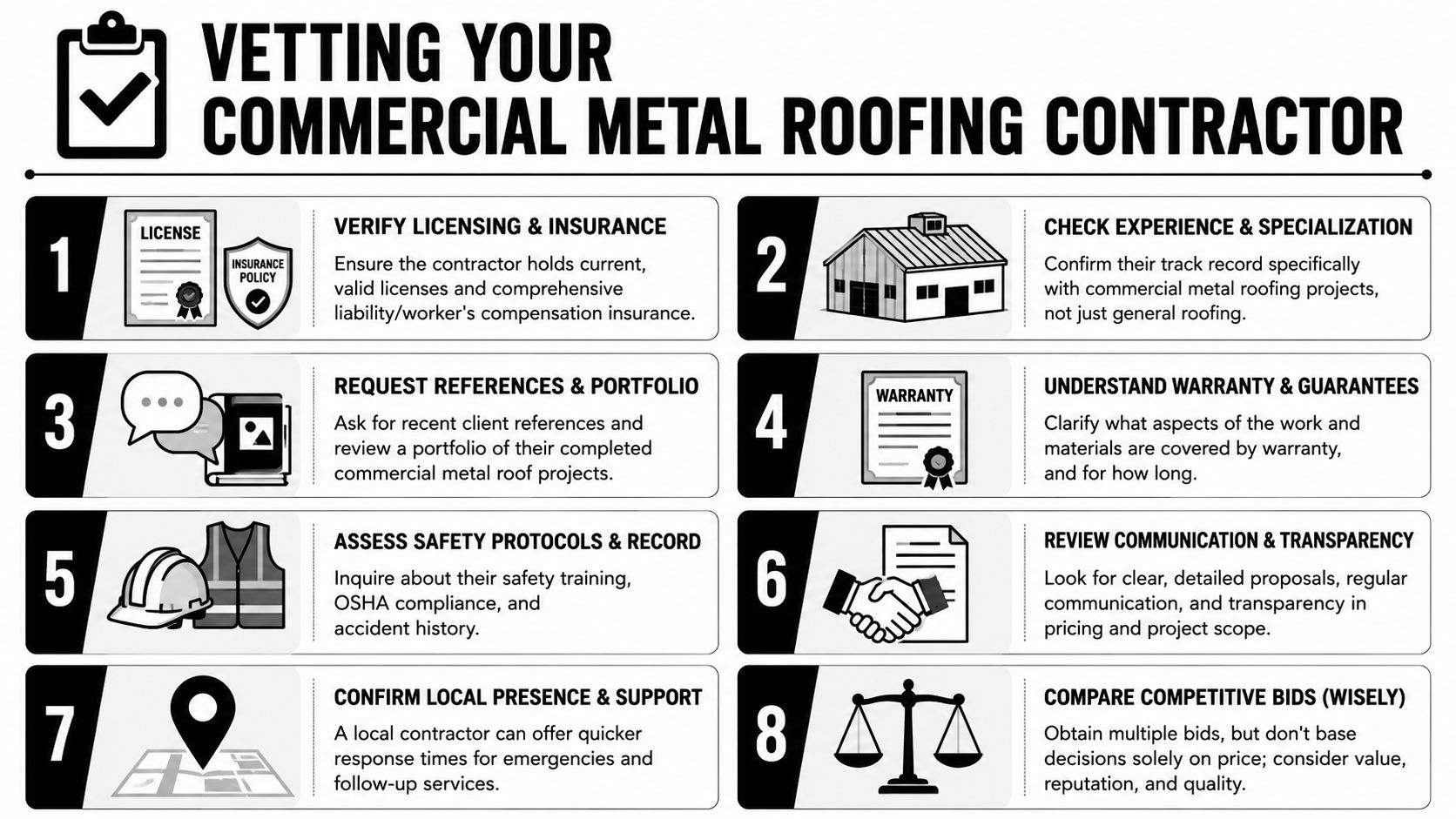
How to Choose a Qualified Commercial Metal Roofer
A commercial roof leak rarely stays a roofing problem. It becomes a tenant issue, a stock issue, an insurance issue, and sometimes a compliance issue if water affects electrical services, access ways, or occupied areas. The roofer you appoint needs to manage that wider risk, not just apply a patch.
Start by treating contractor selection as procurement for a building asset, not a maintenance callout.
What to verify before anyone starts
Licences and insurance are the entry point. They are not the full test. A contractor can be legally trading and still be a poor fit for an occupied commercial site.
Check these points before approving works:
- Licensing and insurance: Confirm the business holds the relevant trade licences and current insurance for commercial roofing work, including public liability and any cover required by your site or head contractor.
- Commercial experience: Ask what proportion of their work is on warehouses, retail centres, strata buildings, schools, and industrial facilities. Residential experience does not automatically translate to live commercial environments.
- Site safety planning: Ask for task-specific risk controls, access methods, and traffic management where needed. Generic SWMS paperwork does not show they understand your building.
- Cause-based scope: The proposal should explain what failed, where the likely water path is, and what will be repaired. If the quote only lists sealant, screws, and labour, the diagnosis is probably thin.
- Reporting standard: You need marked-up photos, defect descriptions, and completion records that facilities teams, insurers, and owners can use.
- System familiarity: Australian metal roofs vary widely. The contractor should understand details such as penetrations, box gutters, laps, fixings, flashings, and the repair limits of older sheet profiles or coated products.
Local conditions matter as well. A roofer working on a coastal NSW site, for example, should be talking about wind-driven rain, corrosion exposure, fixing patterns, and how repairs will perform under the weather conditions that caused the failure in the first place.
What good contractor selection looks like
The better contractors usually ask harder questions. They want to know what sits below the leak, when the building can be accessed, whether tenants are in place, what previous repairs have been attempted, and whether the owner needs documentation for an insurer or body corporate. That is a good sign. It shows they are assessing consequence, not just location.
They should also be prepared to give an uncomfortable recommendation if repair is the wrong financial decision. I would rather hear that a section has reached the end of its serviceable life than approve three low-cost callouts that still leave the building exposed each storm season.
This short video gives a useful visual sense of what professional roof assessment and contractor selection should involve.
Selection test: Choose the roofer who can explain staging, safety, defect cause, documentation, and business interruption risk in plain language. That is the contractor most likely to protect the asset, support a claim if needed, and reduce repeat spend.
Price still matters. In commercial roofing, the cheaper quote often costs more once missed defects, incomplete documentation, tenant disruption, and repeat attendance are added back in.
Frequently Asked Questions
Can a leaking metal roof be repaired during wet weather
Permanent repairs usually need suitable conditions so surfaces are dry and preparation is done properly. In wet periods, a contractor may carry out temporary stabilisation to reduce water ingress and protect the building until the final repair can be completed safely.
Will insurance cover metal roof storm damage
That depends on the policy, the cause of damage, and the evidence available. Owners usually put themselves in a stronger position when they photograph damage early, log dates and weather conditions, and keep records of emergency make-safe work and contractor reports.
How often should a commercial metal roof be inspected
The right interval depends on exposure, age, roof type, and the consequences of failure. Buildings in harsher environments or with a history of leaks usually need closer monitoring than low-risk sites.
Is recoating enough to fix an ageing metal roof
Not always. Coating can be part of a viable strategy, but it won't solve systemic fixing failure, wet substrate, damaged flashings, or advanced corrosion on its own. A roof needs the underlying defects corrected before coating becomes worthwhile.
What should tenants or site staff do when a leak appears
Protect people first. Isolate affected areas where needed, move stock and equipment away from the leak path if safe to do so, place temporary protection internally, and report the location and timing clearly. Don't send unqualified staff onto the roof.
If you need a commercial assessment rather than another short-term patch, Commercial Roofers can inspect metal roof defects, document storm damage, advise on repair versus replacement, and carry out compliant works across Sydney and NSW with minimal disruption to occupied sites.