
A full Colorbond roof replacement in Sydney typically lands around $17,250–$46,000 for a standard home, with supply-and-install pricing around $92–$205 per square metre. For a commercial property, that range is the first budget checkpoint, not the final answer, because access, roof size, and compliance can change the project scope fast.
A worn metal roof usually shows up as more than a leak. Tenants start complaining, maintenance calls keep coming back, and then the replacement job turns into a live-site project with approvals, safety controls, and shutdown windows that need to be managed properly.
Table of Contents
- Why Replace Your Commercial Roof with Colorbond
- Planning and Compliance Before You Start
- Choosing the Right Colorbond Profile and System
- The Commercial Roof Replacement Process Explained
- Budgeting for Your Colorbond Roof and Lifetime Value
- Selecting Your Contractor and Project FAQs
Why Replace Your Commercial Roof with Colorbond
A failing commercial roof rarely fails neatly. It starts with small water marks, patch repairs that do not hold, and access issues that turn every inspection into a disruption. At that point, replace roof with Colorbond stops being a cosmetic decision and becomes a practical capital upgrade for the asset.
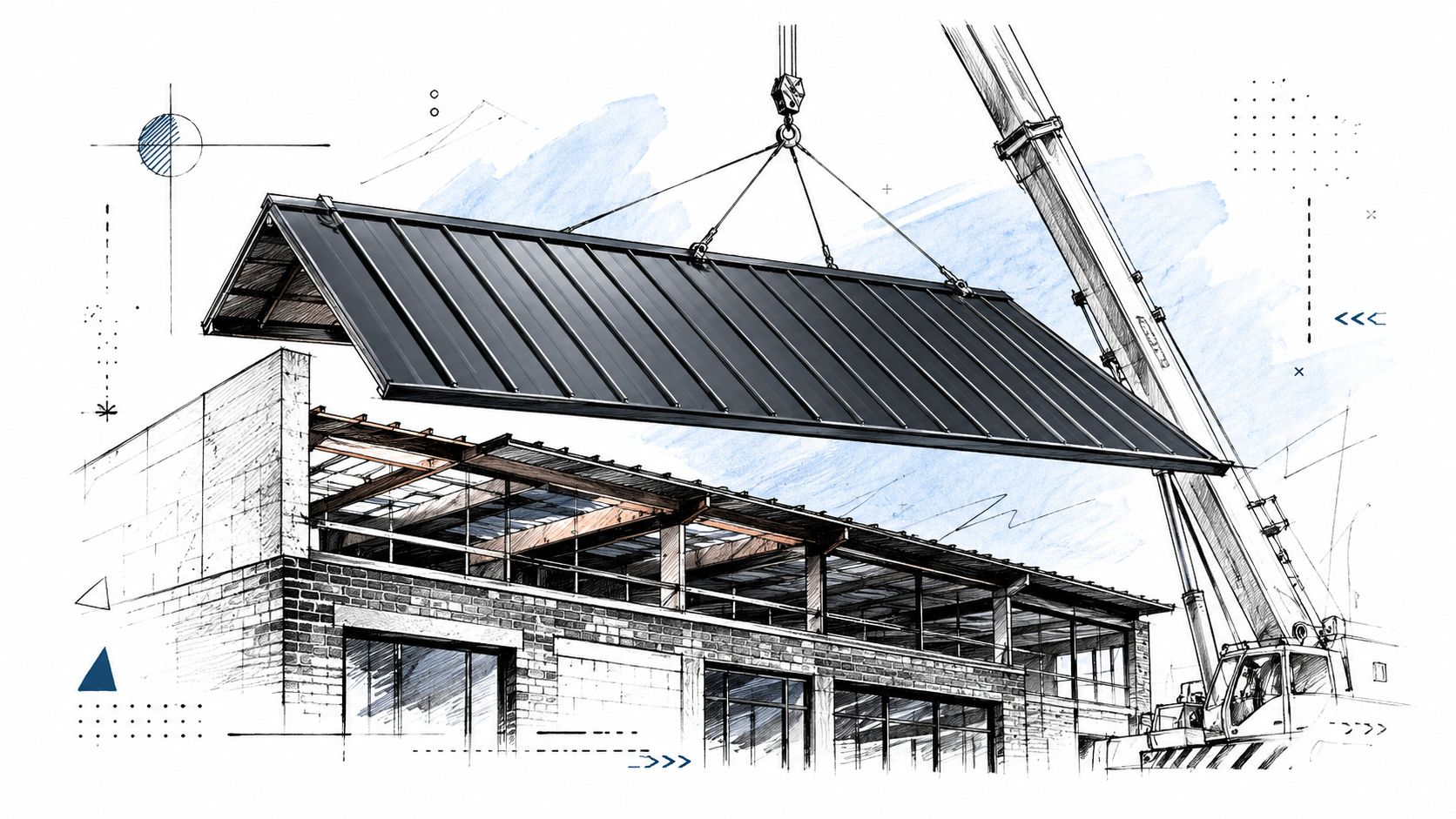
The business case is bigger than leak repair
Colorbond suits commercial work because it gives you a clean, modern finish and a system built for long service life. For budget planning, that matters. Sydney roofing cost reference still gives owners a useful benchmark for comparing quotes, even though a commercial roof is rarely priced like a standard house roof. Sydney roofing cost reference
The better commercial question is whether the roof will reduce ongoing disruption. A quality replacement can do that by cutting down reactive repairs, improving weather protection, and making future inspections simpler. On warehouses, strata buildings, and retail sites, that matters because roof access often affects operations more than the roof itself.
Practical rule: if the roof is old enough that you are repeatedly pricing patch work, replacement usually deserves serious comparison against another repair cycle.
Colorbond also carries a material warranty that is part of its long-term value proposition. For commercial owners, that makes the roof easier to justify as a lifecycle investment rather than just another expense line. Colorbond warranty and pricing overview
For standards and installation checks, use the roof replacement guidance in the roofing standards for Australian commercial projects before you sign off on scope.
Appearance and compliance both matter
A fresh roof can improve the way a site presents to tenants, clients, and insurers. That is not just about appearance, it affects how a well-kept building is viewed during lease negotiations, inspections, and asset reviews.
There is also a safety angle. Old roofing often hides brittle sheets, compromised fixings, or legacy materials that complicate access and maintenance. Replacing with a modern metal system can simplify future work and reduce the friction around compliance conversations.
The value shows up when the roof is no longer a recurring problem. If a site is spending management time chasing leaks, scheduling emergency callouts, or working around ad hoc repairs, Colorbond becomes a strategic upgrade, not just a material swap.
Planning and Compliance Before You Start
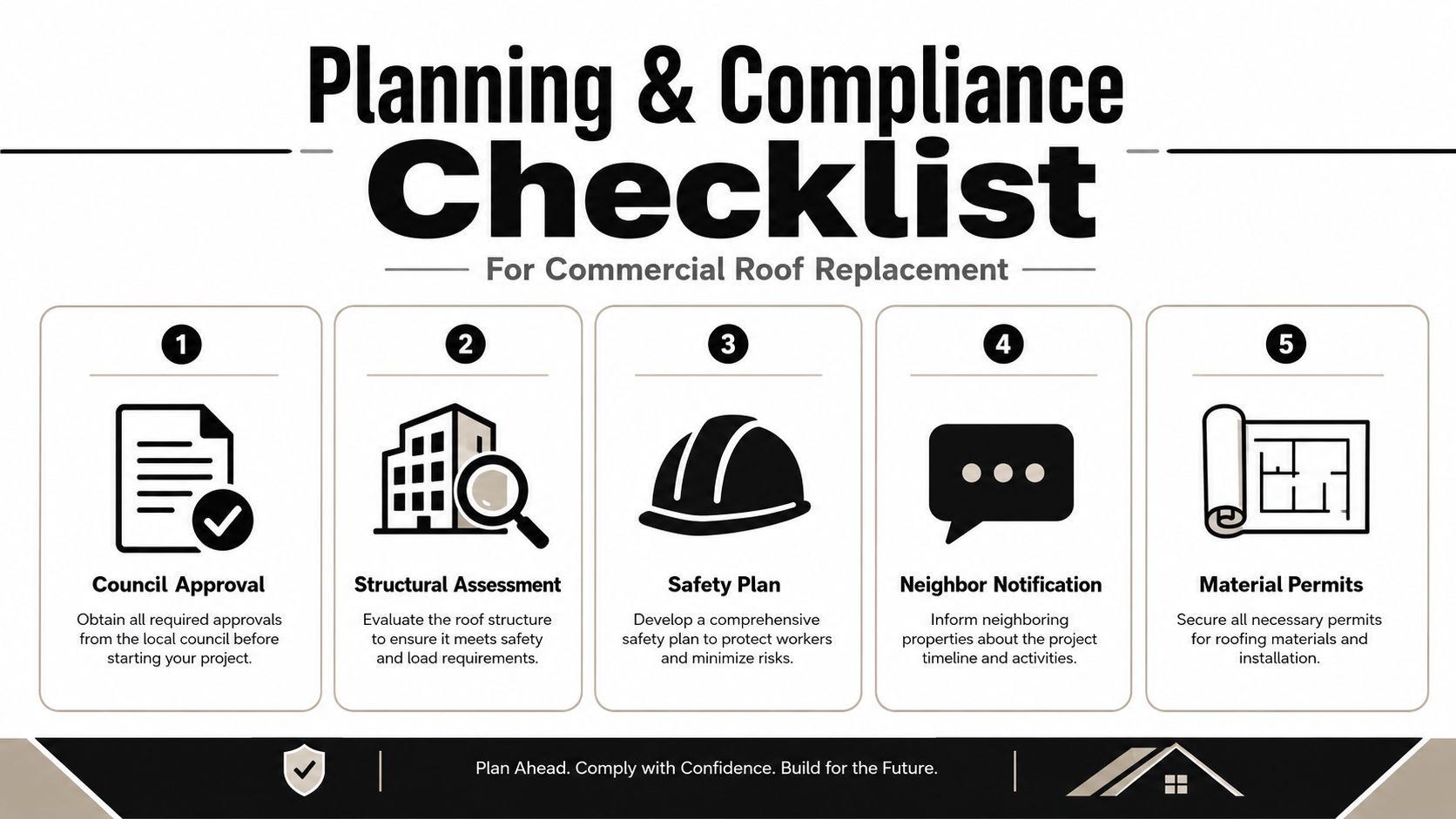
Commercial roof replacement goes wrong when teams treat it like a simple like-for-like swap. Approval triggers, structural scope, and documentation need to be checked before anyone orders sheets or starts stripping the old roof. The easiest mistake is assuming the job is only a roofing issue when it's also a planning and compliance issue.
The 20 percent trigger is the one owners miss
If you are modifying, replacing, rectifying, or upgrading more than 20% of the roof structure, council approval may be required, and that can affect both timing and cost. This is a major compliance gap in a lot of consumer advice, because people focus on product choice and forget that the scope of work itself can trigger review. Council approval trigger guidance
That rule matters even more for commercial owners and strata managers. A roof works package can involve penetrations, flashing changes, structural remediation, and form changes, all of which may push the project into a different approval lane. If the building is older, you should assume the compliance review will need more care, not less.
For a broader standards check, this internal guide on roofing standards in Australia is worth using alongside your project brief.
Check the job against the building, not just the quote
Before procurement, gather the basics that a contractor or certifier will ask for. You need a clear view of roof area, existing structure, access constraints, drainage paths, and whether the work touches structural members rather than only the external sheets.
Get the project defined before you price it. A quote without scope clarity usually turns into variations once the roof is open.
A good commercial roofer should also ask about tenancy hours, exclusion zones, crane access, and whether work can happen in stages. Those questions aren't admin noise, they're what stop a live-site replacement from turning into a safety issue.
Documentation should match the risk
At minimum, the project file should capture the roof scope, the approval pathway, the structural findings, and any material or fire-related requirements that apply to the building. If asbestos is suspected, that needs to be handled as a separate compliance stream, not folded into the roofing schedule.
When you manage that early, you reduce the chance of stop-work delays. You also make it easier to compare contractors, because every quote is being measured against the same scope and the same rules.
Choosing the Right Colorbond Profile and System
Colorbond is not one product in one form. The profile, fixing detail, insulation package, drainage design, and flashings all change how the roof performs on a commercial building. If you choose only by colour, you're buying the wrong thing.
Match the profile to the building type
For warehouses and low-pitch buildings, the roof profile has to suit the way water moves across the surface. A simple corrugated look might suit one building, while a more rigid commercial profile may be a better fit for long spans, larger gutters, and cleaner drainage lines.
Retail and prominent strata sites often care more about visual finish and edge detail. In those cases, profile choice needs to work with the building's presentation, not just the roofline. If you want a broader product comparison, this internal guide on metal roofing in Australia is a useful companion read.
Insulation and moisture control are part of the system
A roof replacement is the right time to fix what sits under the sheets, not just the sheets themselves. Insulation, sarking, and ventilation should be planned together because they affect condensation control, comfort, and the long-term condition of the roof space.
That's especially important on sites with cooler internal environments, storage conditions, or frequent temperature swings. If those layers are treated as optional extras, the roof can look new while still performing badly.
Drainage details matter more than people expect
Commercial roofs often rely on box gutters, parapets, and complex outlet paths. Those details need to be designed for the actual building, not copied from a residential template. A roof that sheds water cleanly on paper can still fail if the drainage components are undersized or poorly coordinated.
A roof system is only as good as its weakest junction, and on commercial buildings that weak point is often the gutter, flashing, or penetration detail.
Don't specify a roof as if it's only a skin. On a real asset, the right Colorbond system is a combination of sheet profile, fixings, insulation, moisture control, and drainage planning working together.
The Commercial Roof Replacement Process Explained
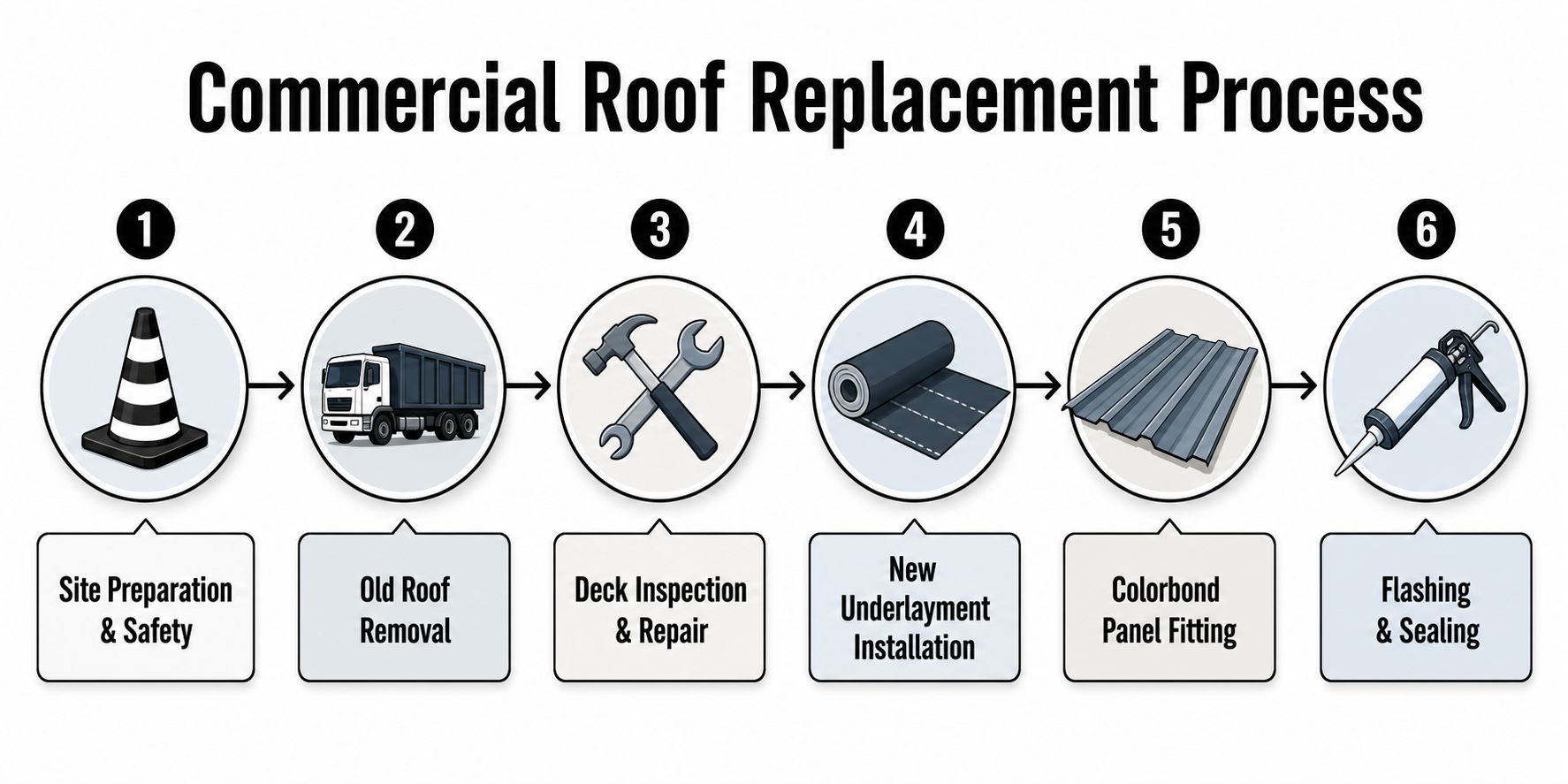
A proper commercial reroof is staged work, not a single event. The sequence matters because every step protects the building from avoidable damage, downtime, and rework. If the contractor rushes the early stages, the final roof usually pays for it later.
Site setup comes first
Before sheets come off, the site has to be made safe. That means access control, exclusion zones, lifting areas, and a clean work sequence so people on the ground aren't moving through active demolition zones. On live commercial sites, that planning is what keeps tenants, workers, and contractors from interfering with each other.
Removal has to be controlled
Old roofing is removed in a way that matches the building's risk profile. If asbestos is suspected, it needs licensed handling and a separate compliance pathway, because that material can't be treated like standard demolition waste. The wrong disposal approach creates legal and safety problems that are far more expensive than the roofing work itself.
Deck checks and underlayment are where quality shows
Once the old roof is off, the deck and supporting structure need inspection. That's when hidden damage, poor fixings, or old water tracking issues become visible. If the substrate is not sound, new sheets on top just hide the problem.
The same applies to insulation and sarking. Those components should be installed as part of the roof system, not added as afterthoughts once the sheets are already fixed down.
Low-pitch roofs demand tighter detailing
For low-pitch Colorbond roofs, technical details like end laps, 45-degree ‘dog's ear' cuts, and storm sealing are critical to prevent water tracking and backflow. Installer guidance on low-pitch detailing also notes that a small increase in project cost, around 2%, can improve performance by 30-40% when those installation specifics are handled properly.
That is why low-pitch work should never be priced like a generic reroof. The geometry is less forgiving, the detailing is more demanding, and the margin for poor workmanship is much smaller. A commercial roof that looks simple from the ground can be technically unforgiving once water starts moving across it.
Good roofing is mostly invisible after handover. Bad roofing shows up the first time the weather turns.
For a visual walkthrough of how the replacement sequence is typically staged on site, the embedded process video below is useful for managers who need to understand the order of operations.
Budgeting for Your Colorbond Roof and Lifetime Value
A commercial Colorbond reroof usually starts with the roof area, then the access path, then the site constraints. On a simple building, the sheet supply is only part of the job. On a live commercial site, access equipment, crane time, traffic control, out-of-hours work, and compliance paperwork can move the budget more than the cladding choice itself.
What drives the budget on commercial jobs
The first number to check is not the sheet price. It is the total scope. If the roof sits over tenants, plant rooms, service penetrations, or occupied work areas, the contractor has to plan around exclusion zones, tie-off points, staging, and weather protection. Those items are easy to miss in an early estimate and expensive to add later.
Commercial roofs also bring more approval pressure than a typical domestic reroof. If the building has asbestos, unsafe access, limited staging space, or structural issues once the old roof comes off, the project can trigger extra handling, disposal, and sign-off steps. That is where a cheap quote can become a false economy. A proper budget separates removal, supply, installation, access, structural repairs, drainage changes, and any compliance work needed before the new sheets go down.
For owners comparing pricing in Sydney, the market ranges discussed in the roof replacement cost in Sydney guide are useful as a starting point, but they should not be copied straight onto a commercial scope. Warehouses, strata buildings, and factories usually carry different access and risk costs, even when the roof area looks similar from the street. That is why two buildings of the same size can produce very different numbers once the site is inspected properly.
Lifetime value comes from the whole system
Colorbond is often chosen because the roof system is meant to last, not because the first invoice is low. The material warranty matters, but only if the structure, fixings, flashings, and water management details are correct. If the substrate is weak, or the contractor leaves out the under-roof components, the roof can still fail early even with a premium sheet profile.
A better budget model looks at the full lifecycle. That means comparing the upfront cost against likely repair frequency, water ingress risk, and disruption to the business if the roof needs attention again. For a strata committee or asset manager, that framing is usually more useful than chasing the lowest number on tender day.
It also helps to separate capital cost from operating risk. A roof that is easier to maintain, easier to inspect, and less likely to leak around penetrations can save money over time, especially on larger buildings with regular service access. The right choice is the one that fits the structure, the compliance requirements, and the expected maintenance burden, not just the line item on the quote.
Selecting Your Contractor and Project FAQs
A commercial roofing quote is only useful if the contractor can deliver the scope safely and legally. On a reroof, the cheapest number often leaves out the hardest part of the job, which is usually access, compliance, and live-site control. That's where due diligence matters.
What to check before you sign
- Licensing and insurance: Ask for current licences and proof of insurance that matches the project scale.
- Asbestos capability: If the building is older, confirm who handles suspected asbestos and how disposal is managed.
- Commercial experience: Look for work on warehouses, strata buildings, factories, or other active sites.
- Scope clarity: Make sure the quote covers demolition, disposal, insulation, flashings, drainage, and any structural repairs.
- Access planning: Ask how crane lifts, exclusion zones, and tenant coordination will be managed.
You should also ask how the contractor will handle variations once the roof is open. That's where weak quoting usually shows up. A solid operator will explain what's included, what could change, and how decisions are approved on site.
Commercial Roofers is one option for Sydney and NSW projects that need in-house crews, asbestos roof removal and replacement, and commercial roof installation planning around roof structure, purlin spacing, penetrations, drainage, and access before procurement and installation. Use that as a comparison point against any other tendered quote, not as a substitute for checking the details yourself.
Project questions that come up most often
How long does a commercial reroof take? It depends on size, access, structural findings, and weather. The safest answer is that a proper schedule is built from the building, not from a generic template.
Can business operations continue during the work? Often yes, but the answer depends on access, noise, and whether the building stays partly occupied. Live-site staging should be agreed before demolition starts.
Can you re-cover over the old roof? Sometimes that comes up in conversation, but it should never be assumed. The structure, condition, and compliance pathway have to be checked first.
What maintenance does a new roof need? Regular inspection of flashings, gutters, penetrations, and seal points is still important. A new roof reduces problems, but it doesn't remove the need for periodic checks.
If you're planning a commercial roof replacement in Sydney or across NSW, speak with Commercial Roofers about a scoped inspection, compliance review, and clear replacement plan. They handle commercial and industrial reroofing, asbestos roof removal, and live-site project coordination, so you can compare options with real information instead of guesswork.