
You've got the quote, the roof is getting harder to ignore, and somebody's asking whether a repaint will buy time or just delay a bigger problem. That's the core decision most facility owners face with an ageing metal roof, a warehouse in use, and money on the line. Metal roof painters are only worth hiring if the roof is still a candidate for coating, and if the contractor treats the job like a technical scope, not a colour change.
Table of Contents
- Whether to Hire Metal Roof Painters
- When Painting Stops Being the Cheaper Option
- What a Credible Pre-Quote Assessment Looks Like
- Coating Systems, Primers and Finish Options Explained
- The Preparation and Application Workflow to Verify
- Safety, Compliance and Live-Site Logistics
- Cost, Contracts, Warranties and the Final Inspection
Whether to Hire Metal Roof Painters
The first mistake owners make is shopping for a painter before deciding whether painting is the right intervention. On a commercial metal roof, repainting sits inside roof restoration and corrosion protection, not simple decoration, because coatings are used to protect the roof from weather exposure and extend service life on industrial and commercial buildings. That framing matters, because a good-looking finish on a failing substrate is a bad investment.
Read the roof, not the quote
Start with the roof condition, then judge the proposal. Water ingress during storm season pushes the issue into the open. Visible rust, chalking, or patchy previous coatings usually means the surface is already ageing out. A sale, lease handover, or refurbishment program also forces a decision, because due diligence exposes deferred maintenance quickly.
Roof painting belongs in roofing contracting activity, alongside installation, repair and maintenance, including treatments on roofs such as coating, painting and spraying. That is the commercially useful lens for NSW owners too. You're not buying a cosmetic service, you're buying a maintenance intervention that should be judged against remaining service life, access risk and disruption.
Practical rule: if the roof has widespread corrosion, brittle fixings, or active seam leaks across a substantial portion of the surface, repainting is likely to hide the symptom rather than solve the problem.
Hold that line when a salesperson tries to make every roof sound paintable. If the roof is still structurally sound and the damage is mostly surface-level, repainting can be sensible. If the roof is tired in a deeper way, you should be looking at metal roof restoration, partial repair, or replacement before you talk colour.
When Painting Stops Being the Cheaper Option
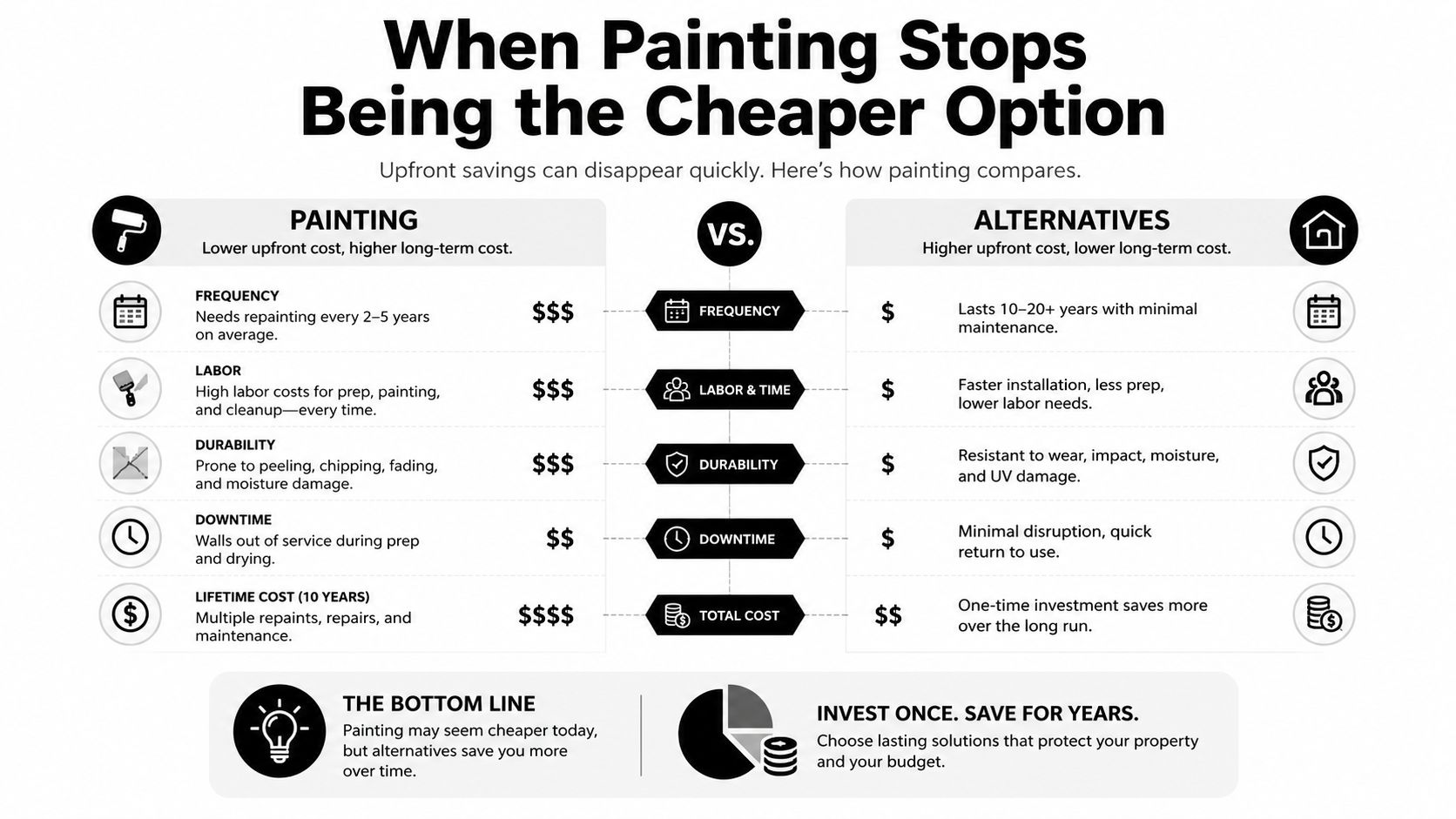
A low paint quote can become the most expensive line on the table if the roof is already past the point where coating makes sense. The choice is not paint versus spending money. It is repainting a roof that should have been repaired, partially replaced, or left alone until the substrate was properly addressed. For warehouse, factory, and strata owners, this is a procurement call, not a maintenance slogan.
Reading the warning signs
Widespread rust bleed, perished sealants, sagging sheets, and loose fasteners are not small cosmetic issues. They tell you the substrate is moving, oxidising, or failing at the points where water gets in first. If a contractor talks only about washing and colour, and says little about substrate condition, they are trying to keep the job simple for themselves.
The safest commercial approach is a documented condition report before any contract is signed. Photos, roof mapping, and a plain assessment of what can still be salvaged force the conversation onto evidence. That matters because older roofs can involve brittle surfaces, corrosion, and hazardous materials management, which changes both the economics and the risk profile. Coating performance also depends heavily on substrate condition and surface preparation, which is why this is never a one-size-fits-all call.
Use condition, not optimism, as the filter
Ask one blunt question, does this roof still have enough clean, stable metal left to hold a coating system properly? If the answer depends on wishful thinking, walk away. Repainting is only defensible when the roof failure is mostly at the finish level, not in the sheet, seam, or fixing.
This restoration guide is worth reading alongside any quote, because restoration is the accurate comparison set, not a fresh paint job versus nothing. Independent technical guidance treats repainting as part of a broader roof restoration and corrosion-protection cycle on industrial and commercial buildings, where coatings help protect against weather exposure and extend service life rather than serving as decoration.
What a Credible Pre-Quote Assessment Looks Like
A serious metal roof painter does not price a commercial roof from the ground, and they definitely don't price it from a photo album. The assessment should start with roof type and profile, because corrugated, standing seam and other metal systems behave differently under coating. From there, the contractor should inspect sheet condition, rust, fasteners, sealants, penetrations and access.
What should be checked on site
A proper pre-quote visit usually covers the surface in sections, not as one vague lump. The contractor should identify where corrosion is active, where the coating has chalked or failed, and where previous repairs have altered the substrate. They should also note the condition of flashings, ridge details and terminations, because those are the spots that decide whether the roof can be coated as a system.
The business questions matter just as much. Occupancy, operating hours, tenant sensitivity, plant protection, and weather windows affect staging and sequencing. For older buildings, asbestos register status and any existing warranty conditions on the cladding should be checked before anyone talks about surface prep. That's the difference between a roofing specialist and a general painter who just happens to own a spray rig.
If the contractor doesn't ask about live operations, access limits, or who will be underneath the work, they're not planning a commercial project. They're guessing.
In NSW, it matters that roof painting sits inside roofing-contracting activity, not as a standalone decorative trade. That's why the best contractors talk in terms of substrate condition, access method, corrosion control and maintenance cycles. They're pricing the roof as an asset, not chasing metres of colour change.
Red flags that should end the meeting
- A phone quote without inspection: No one can assess corrosion, fasteners or sealants properly from a desk.
- No questions about operations: A live site needs staging, timing and tenant coordination.
- No mention of prep sequence: If prep isn't discussed, the job will likely be rushed.
- No written scope: A vague quote invites argument later.
Coating Systems, Primers and Finish Options Explained
Once repainting is justified, the coating spec becomes the quality control point. The wrong system on the right roof still fails. The right system on the wrong substrate also fails. That's why the best decisions start with the roof condition and the environment, then move to primer and finish, not the other way around.
Start with the substrate, then match the system
For weathered or coastal roofs, the system needs to resist UV, moisture and salt exposure. The most defensible sequence is still the same, clean the surface, break down glossy or chalked factory film, then apply a compatible corrosion-inhibiting primer before topcoating. Technical guidance specifically recommends low-pressure wash cleaning, rust removal and a compatible metal primer before topcoating because adhesion failures usually begin at chalk, oxide or fastener contamination rather than in the finish coat itself (technical guide on painting metal roofs).
That's why primer choice is not a colour decision. It's a substrate decision. If the roof has bare metal, weathered areas or corrosion history, the primer has to bond to that condition first. Skipping that stage turns the topcoat into decoration, and decoration doesn't protect steel.
Choose the coating family for the actual environment
Acrylic systems suit many commercial recoats when the roof is stable and the goal is a clean, maintainable finish. Epoxy-modified systems bring stronger adhesion and can be useful where the substrate is more demanding. Polyurethane systems are typically chosen where tougher finish performance is needed. On coastal and high-UV NSW roofs, rust-inhibiting primers are the essential layer, because the primer is carrying the bond and much of the corrosion resistance.
Colour matters too, but not in a vanity sense. Lighter, more reflective colours are usually the better operational choice for warehouses and logistics facilities because they reduce heat gain at the roof surface. That's not a branding decision, it's a building-performance decision.
Painted metal roofing guidance is useful if you want the broader maintenance context, but don't let a broad article replace a substrate-specific spec. One system does not suit every commercial roof.
The Preparation and Application Workflow to Verify
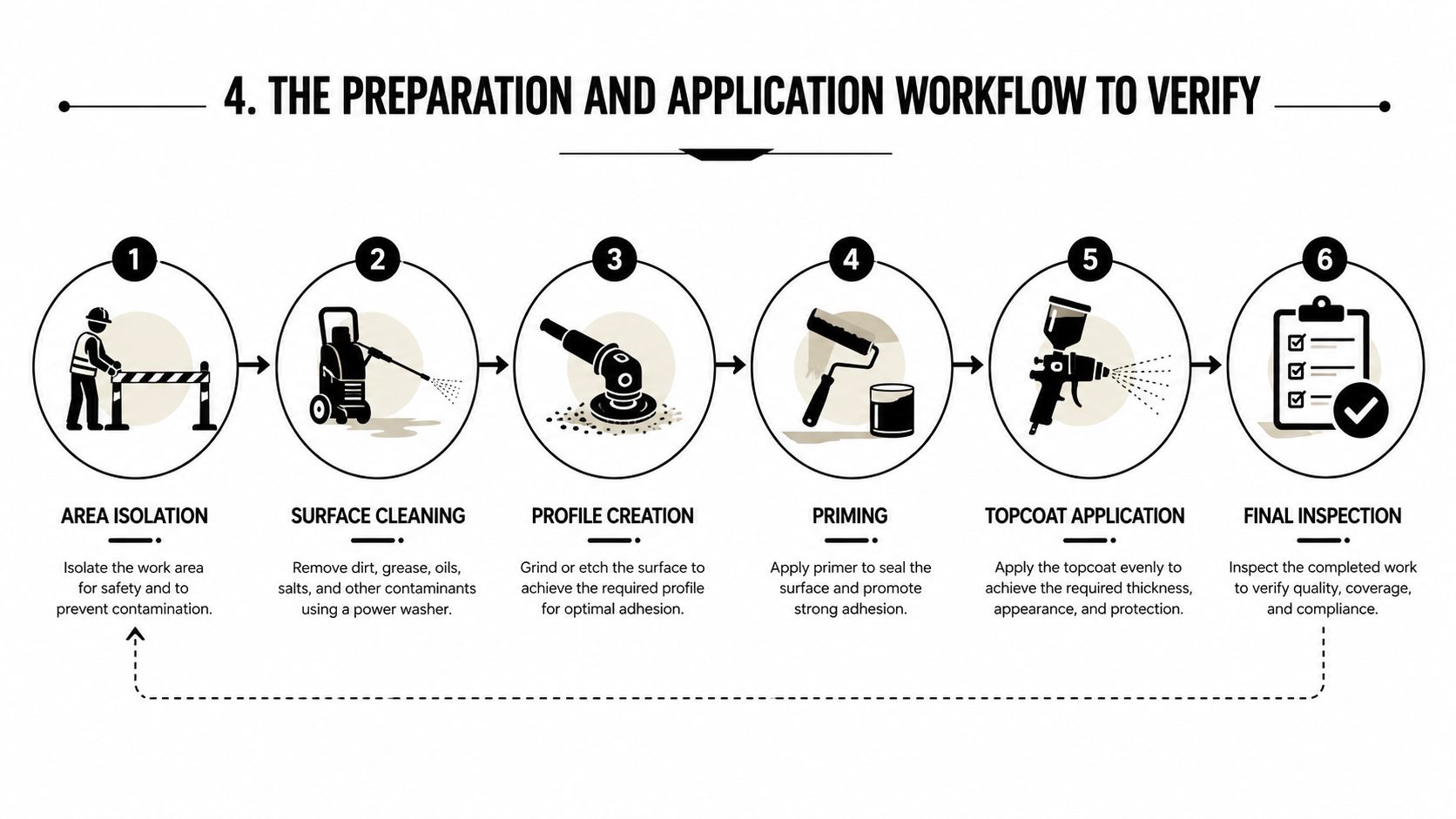
The contractor's sequence matters more than their sales pitch. If they get the prep wrong, the best coating in the world won't save the job. On a commercial roof, the owner should verify the workflow, not just the finished colour.
The sequence that should happen every time
First, the work area should be isolated and anything below protected. Stock, plant, tenant equipment and access routes need to be covered or moved as required. Then rust, loose sealant and damaged fixings should be addressed before any washing starts, because a wash alone won't solve corrosion or failed joints.
After that, the roof should be low-pressure washed and allowed to dry properly. Glossy or chalky factory coatings need mechanical abrasion or chalk-breaking so the new coating can key into the surface. Primer goes on bare or weathered areas, then finish coats follow to the specified build. If the crew reverses that order, you're watching the job fail in real time.
What you can verify without being a roofer
- Daily progress photos: The contractor should show what was prepped, primed and finished each day.
- Weather discipline: No coating should go down in rain, dew or unsuitable heat.
- Documented coverage: The roof area completed should match the day's labour and material use.
- Film build records: The coating thickness should be checked against the spec, not guessed after the fact.
A commercial repaint done properly is not rushed. On one warehouse, tight prep and disciplined sequencing can extend the coating cycle materially compared with a slapdash job, because the failure point isn't usually the colour layer, it's the surface underneath. That's exactly why the workflow has to be verified.
Safety, Compliance and Live-Site Logistics
On an occupied commercial site, safety and continuity are not paperwork. They are the job. A contractor who can't explain access, staging and control measures is a contractor you shouldn't let near your roof.
Safety should be treated as a selection filter
Safe Work Australia's data continues to show falls from height as a leading cause of serious workplace injury in Australia, which is why access planning has to sit at the front of the contractor assessment, not at the end (Safe Work Australia data on falls from height). That means working-at-height controls, SWMS documentation, public liability cover, and proof that the crew is licensed and qualified for the work.
The best crews talk plainly about how they'll manage tie-off points, roof access, exclusion zones and emergency response. They don't act as if that's a side topic. If a contractor seems annoyed by safety questions, they're telling you they're not set up for live-site commercial work.
Live operations need a staging plan
Warehouses, factories, healthcare sites and strata buildings don't shut down for a roof repaint. The contractor needs a plan for noise windows, tenant notification, material storage, and weather contingencies. They also need to sequence work so the site can keep operating without putting people under active work zones.
Good access planning saves more money than clever paint choice, because one avoidable shutdown or incident can wipe out the value of a cheap quote.
A useful internal check is to ask how they'll maintain clear pedestrian paths, where they'll stage gear, and how they'll manage partial completion if the weather turns. A crew that has those answers usually understands commercial roofing. A crew that doesn't is still thinking like a residential painter.
Safety roof anchors guidance is worth reading if you want to understand how access planning should be discussed on site. That conversation should happen before the quote is accepted, not after the first ladder goes up.
Cost, Contracts, Warranties and the Final Inspection
Pricing for metal roof painting should be read by area, profile and labour intensity, not as a flat number pulled from a hat. U.S. market data reports metal roof painting averaging $2,422 per roof, with most projects between $1,197 and $3,669, and unit pricing commonly ranging from $1.20 to $2.70 per square foot depending on roof type and complexity (Angi metal roof paint cost guide). Those figures aren't Australian pricing, but they do show the right commercial logic, the job is valued by surface, access and complexity.
What the contract must spell out
The scope should name the prep method, primer type, finish system, exclusions, weather delay rules and rectification process. If those items aren't written down, you don't have a contract, you have a dispute waiting to happen. Film build, substrate repairs and responsibility for hidden defects should also be clear.
Warranty language that actually matters
Separate the product warranty from the workmanship warranty. They're not the same thing. Product cover is about the coating system. Workmanship cover is about the way the contractor applied it. You also want to know what voids each warranty, whether it transfers to a new owner, and which documents are required on completion.
Common coating choices for commercial metal roofs
| Coating system | Best substrate condition | Typical use case | Key trade-off |
|---|---|---|---|
| Acrylic | Stable metal with sound prep | General commercial recoating | Good value, but depends heavily on prep |
| Epoxy-modified | Weathered or demanding substrate | Stronger adhesion on tougher roofs | More sensitive to correct application |
| Polyurethane | Properly prepared commercial roofs | Durable finish where performance matters | Higher spec, less forgiving of shortcuts |
| Rust-inhibiting primer plus finish coat | Bare, oxidised, or coastal metal | Corrosion control and restoration work | Needs disciplined surface prep |
Before final payment, insist on a handover pack with photos, product data sheets, and any test or inspection records the contractor promised. Then do your own punch-list walk. Look for missed edges, overspray, thin coverage, and any detail the crew tried to rush past. A roof repaint only counts if it was done to the spec, not just sprayed until the truck was empty.
ACTA for Commercial Roofers . If you're weighing repainting against restoration or replacement on a commercial metal roof in NSW, get a proper inspection, a written scope, and a contractor who can explain the substrate, access and coating system without hiding behind sales talk.