
The storm has moved east, but the warehouse roof is still working against you. Water is running beside a lighting circuit, two ceiling tiles are bowing over a loading route, and stock has been pushed away from a spreading wet patch. The facilities manager's first call is often to a roofer, but the first job is more disciplined than that: make people safe, preserve evidence, control the water and define what must happen before permanent repairs begin.
That sequence matters in Australia, where severe weather can expose long-neglected defects. Nearly 40% of Australians have experienced water leaks from heavy rain, while 59% hadn't inspected their roofs in the past year and 11% had never checked them, according to reporting linked to the NRMA and summarised by emergency roofing services guidance. Emergency roof leak repairs are therefore often a response to weather finding a weak point, not proof that the entire roof has failed.
Table of Contents
- What Counts as a Real Commercial Roof Leak Emergency
- First Hour Safety and Containment Actions
- NSW Emergency Remedial Work Rules Explained
- Documenting the Leak for Your Insurance Claim
- Choosing Between SES, Insurer Builders and Licensed Roofers
- Timelines, Costs and Sequencing Permanent Repairs
- Preventing the Next Emergency Before Storm Season
What Counts as a Real Commercial Roof Leak Emergency
A warehouse manager discovers the problem at the worst possible time. Rain is entering through a roof penetration, water is tracking towards a switchboard and a ceiling panel is sagging above a tenant's storage area. The right response isn't to send someone up a ladder with sealant. It's to isolate the affected zone, protect people and call a contractor who can secure the roof envelope when conditions allow.
A real commercial roof leak emergency is defined by operational risk, not by how dramatic the roof looks from the ground.
Use the building, not the roof, as the first test
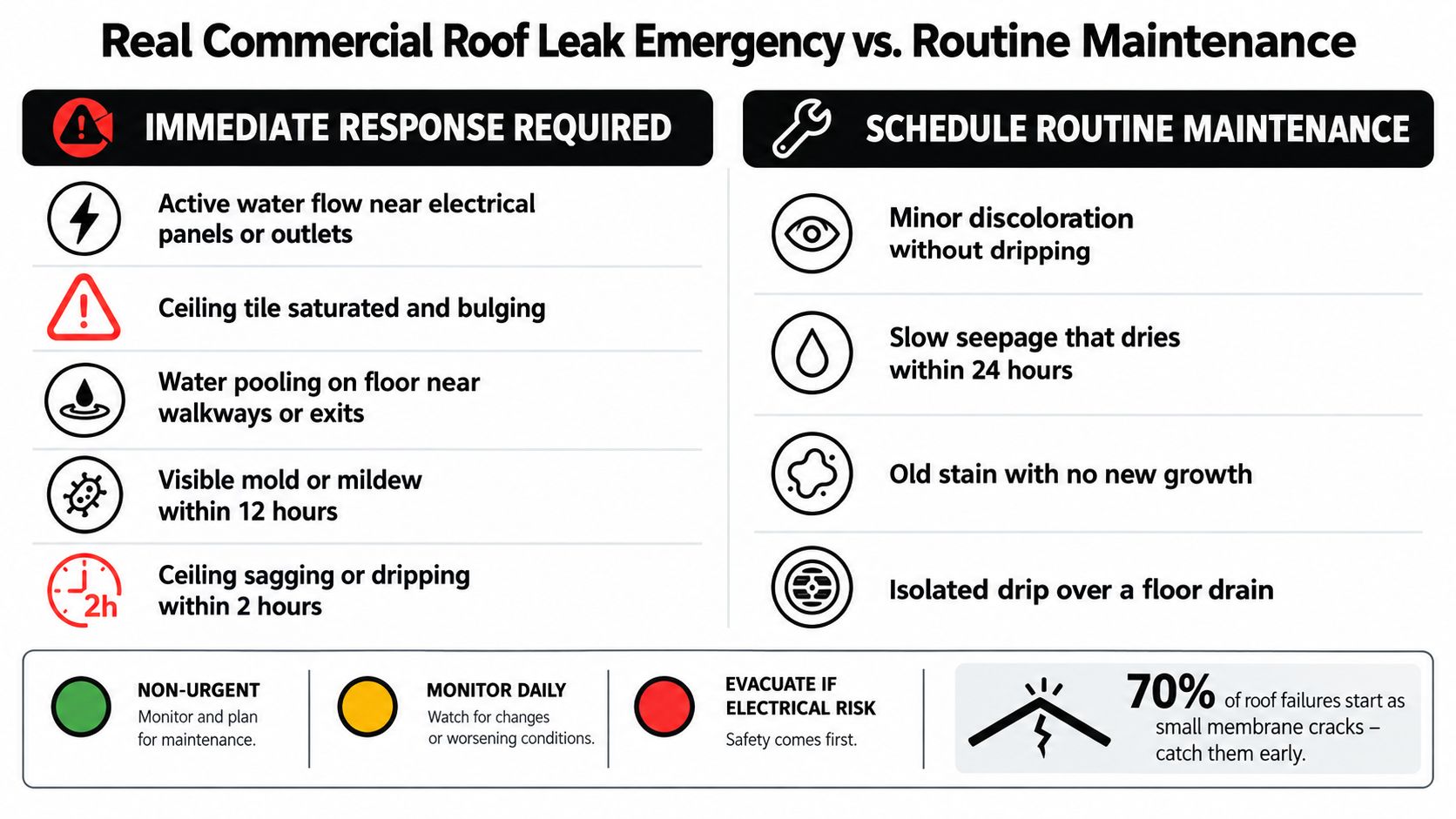
Treat the incident as urgent where:
- Electrical assets are exposed: Active water is reaching outlets, lighting, distribution boards, switchboards, data equipment or plant controls.
- The ceiling is unstable: Saturated tiles, visible sagging, cracking or a bulge above an occupied area can create a falling-material hazard.
- People can slip or be struck: Pooling across walkways, exits, loading areas or access routes needs immediate isolation and containment.
- Stock or fit-outs are at risk: Water affecting inventory, medical areas, tenant improvements, records or machinery can create losses beyond the roof itself.
- The roof has been opened by weather: Wind-lifted sheets, displaced cappings, membrane punctures or damaged flashings can allow every subsequent shower to enlarge the loss.
A slow drip into a safe container, an old stain with no fresh growth and isolated ponding during dry weather can generally wait for a planned inspection. That doesn't make them acceptable defects. It means they don't carry the same immediate life-safety or business-continuity risk.
Decision rule: If you're considering closing the floor below, isolating a tenancy or shutting down a work area, the leak has already crossed the emergency threshold.
For a practical inspection framework before a contractor arrives, use this commercial roof leak detection guide. It helps separate visible symptoms from likely entry points, without encouraging unsafe roof access.
First Hour Safety and Containment Actions
The first hour should be controlled and boring. People get hurt when someone tries to turn a wet, windy roof into a repair site before the building is stabilised.
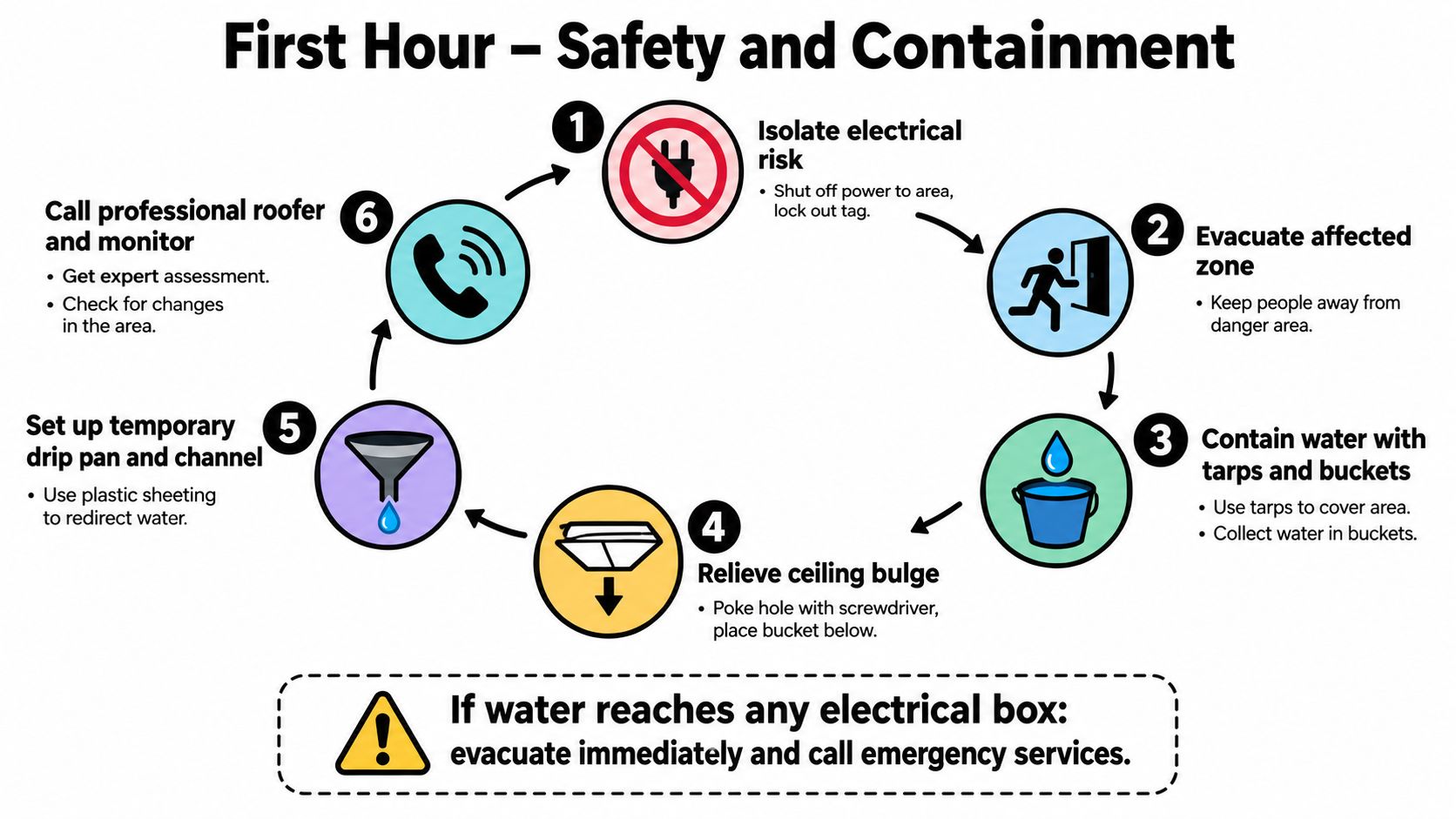
Start at floor level. Isolate the affected area with barriers, signage or a spotter, then keep staff away from wet ceilings, exposed fittings and slippery floors. If water is near an electrical installation, have an authorised person isolate the relevant circuit where it can be done safely. Don't touch wet electrical equipment, and don't enter an area where water has reached electrical boxes.
Contain from a safe position
Use buckets, drip trays and plastic sheeting from the floor or another secure position. Move stock, furniture and equipment away from the water path, but don't discard wet ceiling tiles, insulation, carpet or packaging before the roofer and insurer have had an opportunity to inspect them. The moisture pattern can show where water travelled, and premature disposal can weaken both the technical diagnosis and the claim record.
A bulging ceiling requires caution. If the area is unoccupied, the power is isolated and a competent person can work from a stable position without reaching beneath the bulge, a controlled opening may release trapped water into a container. If those conditions aren't present, isolate the room instead. A ceiling puncture is not a substitute for structural assessment.
Australian commercial roofing guidance commonly treats the first response as a temporary make-safe. That means recording the leak, keeping people clear of wet ceilings and electrical fittings, avoiding roof access in rain, wind or poor light, and using temporary protection only from a safe position. Industry response benchmarks are measured in hours rather than days. One Brisbane contractor states that crews can reach the roof within four hours for temporary weather protection, and another reports making roofs safe within four hours for Brisbane metro call-outs, as described by commercial roofing emergency guidance.
Permanent work should wait for daylight, safe wind conditions and a roof surface that can be properly inspected. Wet membranes, metal sheets and sealants can conceal defects or fail to bond, while roof access without fall protection and a second person on the ground introduces avoidable fall risk.
Before the roofer arrives, prepare the site contact, roof access details, alarm or isolation procedures, known hazardous-material information, photographs, the insurer or broker contact and a simple timeline of what happened. For a broader building response checklist, the first 24 hours water damage guide is useful alongside the roofing contractor's instructions.
NSW Emergency Remedial Work Rules Explained
NSW draws a firm line between emergency remedial work and permanent rectification. Immediate action must be necessary to prevent serious damage, loss of building use or a health and safety risk. The work must stay limited to what's needed to make the building secure, weatherproof and safe until permanent remediation is completed, as outlined in NSW roof leak repair guidance.
That definition changes the site conversation. A contractor can isolate the affected area, stop further ingress with temporary weatherproofing and remove an immediate hazard. They shouldn't expand a make-safe call-out into a full membrane replacement, broad sheet replacement or unrelated maintenance package without the required approvals, scope and insurer direction.
| Work Type | Approval Needed | Timeframe Rule | Engineer Sign-off | Insurance Impact |
|---|---|---|---|---|
| Make-safe weatherproofing | Authority to act under the emergency pathway, with site and owner records retained | Limited to immediate mitigation until permanent work is arranged | Depends on the permanent design and any structural issue | Supports mitigation when separately documented |
| Isolation or removal of an immediate hazard | Appropriate safety controls and competent personnel | Only for the urgent risk | Required where the later repair involves structural or regulated design matters | Keep photographs and a written explanation |
| Permanent roof repair | Owner, strata and insurer approvals as applicable | Scheduled after the cause and scope are established | May be required by the repair design, building condition or regulated work | Must match the approved scope and policy response |
| Roof replacement or major alteration | Full project approvals and compliance documentation | Planned construction programme | Obtain when the design or existing structure requires it | Unauthorised changes can complicate cover and warranties |
For notifiable emergency work, NSW requires the practitioner to upload the building compliance declaration, emergency remedial work document and contractor document to the Planning Portal within seven days of completing the emergency work. That administrative step belongs in the job close-out, not in an afterthought when the claim is already under review.
The safest instruction to a contractor is specific: “Make the building secure and weatherproof, document what you've done, and stop at the emergency boundary.” Ask for before-and-after photographs, the location of temporary measures, materials used, areas not accessed because of unsafe conditions and recommendations for permanent rectification. That record helps the owner, insurer and later repair contractor work from the same facts.
Documenting the Leak for Your Insurance Claim
A claim is easier to assess when the evidence follows the water path. A puddle on the floor proves that water arrived, but it doesn't show where it entered, what it affected or whether the building manager took reasonable steps to limit further loss.
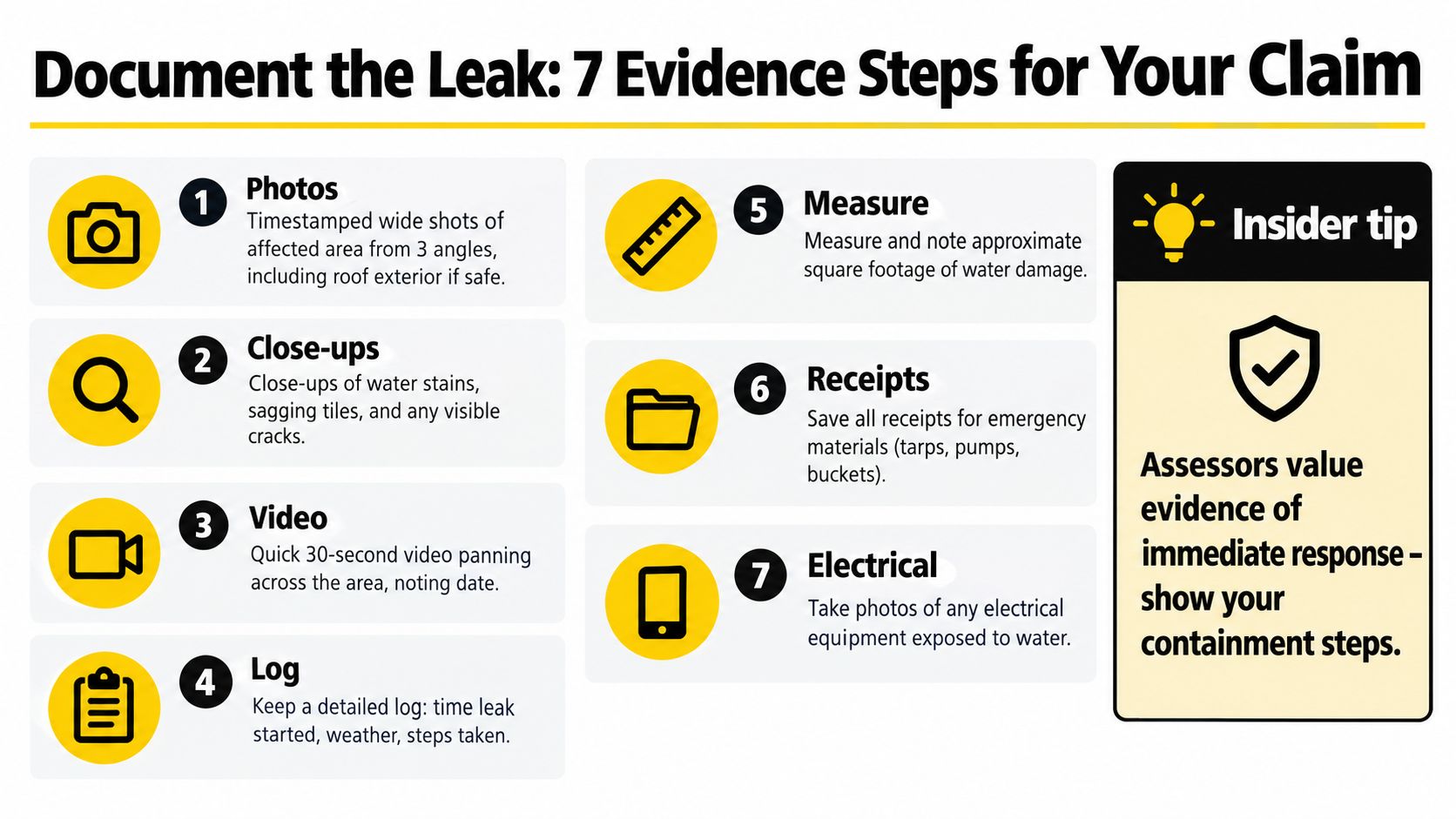
Start before moving damaged items, unless there's an immediate safety reason to act. Take wide photographs from several positions, then close-ups of active drips, ceiling stains, displaced sheets, cracked flashings, damaged penetrations and affected stock. Include a safe ground-level view of the roof exterior. Never climb onto a wet or unstable roof just to obtain a better image.
Build a timeline an assessor can follow
Use one incident log, not scattered messages across several phones. Record the time the leak was first noticed, the weather at the time, the location, the direction of water travel, actions taken, who authorised them and any change after rain eased. Save receipts for buckets, sheeting, pumps, electrical isolation or other emergency materials.
A short video can connect still images. Pan slowly from the room entrance to the affected ceiling, down the wall or column, across the floor and towards the damaged contents. State the date, time and location in the file name or accompanying log. If you use a photo-documentation system, a resource on how to drive revenue with photo docs also shows why consistent, organised site imagery is valuable for operational records.
Give the insurer or broker a verbal notification as soon as practical, then record the reference number, time of call and the person spoken to. Ask whether an assessor, builder or preferred contractor needs to inspect before damaged materials are removed. Don't let a clean-up crew throw away soaked tiles, carpet or insulation because the area looks untidy.
A roofer can hand the building manager this checklist:
- Capture the scene: Timestamped wide shots, close-ups and safe exterior images.
- Trace the route: Photograph the entry point if visible, then each area water travelled through.
- Record the event: Note when the leak began, rainfall conditions and any wind or storm observations.
- List affected assets: Identify stock, equipment, finishes, ceiling systems and electrical items exposed to water.
- Preserve materials: Retain damaged components until the insurer or assessor confirms disposal.
- Log mitigation: Record isolation, barriers, buckets, temporary sheeting, drying and contractor attendance.
- File every document: Keep the emergency invoice, report, photographs, approvals and correspondence together.
For a repeatable handover document, use this commercial roof inspection report template. It gives a contractor and building manager a common format for recording observations and recommended follow-up work.
Choosing Between SES, Insurer Builders and Licensed Roofers
The wrong call-out can create a second delay. NSW State Emergency Service support, an insurer-arranged builder and a specialist commercial roofer each solve a different part of the incident.
In NSW, the SES identifies a leaking or damaged roof as a situation that can qualify for emergency assistance through 132 500. Its volunteers provide temporary emergency measures, while permanent repairs remain the responsibility of the insurer or a private contractor, as reported in this NSW SES emergency assistance summary. That makes SES useful for immediate public safety and temporary protection where the service can attend, but it shouldn't be treated as a commercial roof remediation crew.
Match the provider to the task
| Option | Typical response | Scope of work | Limitations |
|---|---|---|---|
| NSW SES | Emergency assistance according to availability and risk | Temporary measures and immediate safety support | May not be suited to large warehouses, industrial roofs or permanent rectification |
| Insurer-arranged builder | Often mobilised after the claim is opened | Internal make-safe, drying, removal of damaged finishes and coordination | Roof-envelope repair may sit outside the assigned scope |
| Specialist commercial roofer | Emergency attendance arranged directly or through the insurer | Roof inspection, temporary tarping, sheet or membrane make-safe and a permanent scope | Needs safe access, suitable weather and clear authority before expanding work |
The sequence often works best as a coordinated response. The SES can assist with immediate safety where appropriate. The insurer's builder can protect the interior and begin drying. A licensed commercial roofer can assess and secure the roof itself, then report whether the problem is a displaced sheet, failed flashing, blocked drainage, membrane damage or a broader condition issue.
Don't compare providers only by who answers the phone first. Ask what they can legally and safely do on the roof, whether they hold the required licences and insurance, what height-safety system they'll use, whether they'll provide photographs and a written make-safe report, and whether their quote separates temporary work from permanent rectification. Hourly rates vary by contractor, location, access, equipment and after-hours conditions, so a responsible provider should explain the charging basis rather than offer a meaningless fixed promise.
Older roofs need a separate asbestos decision
Older commercial buildings require a material assessment before anyone drills, grinds, sweeps or pressure-washes. Asbestos cement roof work must not involve high-pressure water or compressed air, and uncontrolled power tools or brooms can release fibres, according to the Asbestos Safety and Eradication Agency's asbestos cement roof guidance.
A bonded asbestos-cement sheet doesn't automatically become friable because it leaks. Disturbance can change the risk. External tarping, carefully controlled gutter clearing without grinding and cautious handling of loose material may be possible under the site's asbestos controls. Pressure washing, mechanical sanding, dry sweeping fallen sheeting and cutting penetrations through suspect material can turn a water-ingress problem into a contamination incident.
The roof's age, material register, condition and damage pattern should be given to the contractor before attendance. If friable asbestos work is required, use a licensed asbestos removalist with the appropriate class of licence. Larger removals require advance notification, including the 14-day notification window where that requirement applies. Keep the asbestos assessment, photographs, removal documentation and air-monitoring certificates with the insurance file and building records.
A fast roof response that disturbs suspect asbestos isn't a successful make-safe. It has created a larger incident with a different compliance pathway.
Facilities managers should resist the pressure to “just patch it”. The correct temporary solution may be controlled containment by an asbestos-competent team, not a standard screw, grinder or washdown.
Timelines, Costs and Sequencing Permanent Repairs
Commercial emergency roof leak repairs should be sequenced as a chain of decisions, not treated as one open-ended job. The first attendance makes the building safe. The next inspection identifies the cause and moisture extent. The permanent scope then moves through owner, strata and insurer approval before construction starts.
Response times depend on location, weather, access, roof type and the availability of safe crews. Australian commercial contractors describe emergency attendance and temporary protection in hours for some Brisbane metro call-outs, but that benchmark shouldn't be copied blindly into every Sydney storm. A roof that's unsafe to access may need monitoring and internal containment until conditions improve.
There are no verified cost bands in the supplied data, so a contractor's written quote matters more than a generic online allowance. After-hours labour, traffic control, high-reach platforms, asbestos controls, temporary materials, water extraction and restricted access can all change the price. Ask for each item to be separated.
| Stage | Typical Timeframe | Indicative Cost (AUD) | Trigger to Next Stage |
|---|---|---|---|
| Initial make-safe | As soon as safe access and crew availability allow | Obtain a written site-specific quote | Building is secure and temporary water control is recorded |
| Moisture mapping and diagnostic inspection | After the immediate risk is controlled and roof access is safe | Request a separate inspection allowance | Cause, affected areas and limitations are documented |
| Scope of works | Following inspection and insurer or owner review | Costed as part of the diagnostic or quote process | Parties agree whether repair, replacement or further investigation is needed |
| Competitive quotations | After a clear scope is issued | Compare like-for-like proposals | Preferred contractor and authority are confirmed |
| Permanent repair or replacement | Scheduled around approvals, weather and material availability | Approved project value | Completion records and warranty documents are issued |
Use estimating software such as Exayard roofing estimating software when a contractor needs to organise quantities and compare scope items, but software doesn't replace a roof inspection. A digital take-off is only as reliable as the measurements, roof drawings and assumptions behind it.
Read competing quotes line by line. Check whether each includes access, isolation, removal, disposal, substrate repairs, flashings, penetrations, drainage, testing, clean-up, photographs and certificates. A low make-safe price can become expensive if the contractor drifts into unauthorised permanent work, uses incompatible materials or creates a warranty problem.
Keep the emergency invoice, moisture map, contractor report, insurer instructions, approved scope and completion certificate together. For context on the variables that shape pricing, review this commercial roof leak repair cost guide, then ask your contractor to explain which variables apply to your site.
Preventing the Next Emergency Before Storm Season
Prevention starts with a roof file that reflects the actual building. Keep inspection reports, photographs, repair invoices, product details, warranties, asbestos information and drainage records in one location. After a storm, add the incident log and make-safe documentation. That history helps the next contractor distinguish a new event from an old defect.
A quarterly check can be run by a facilities team at ground level and from safe access areas, while a licensed roofer should inspect roof surfaces, flashings, penetrations, membrane condition, sheet fixings and box gutters. Coastal NSW sites deserve particular attention to blocked drainage, deteriorated sealants, exposed fasteners, failed roof boots and movement around plant supports.
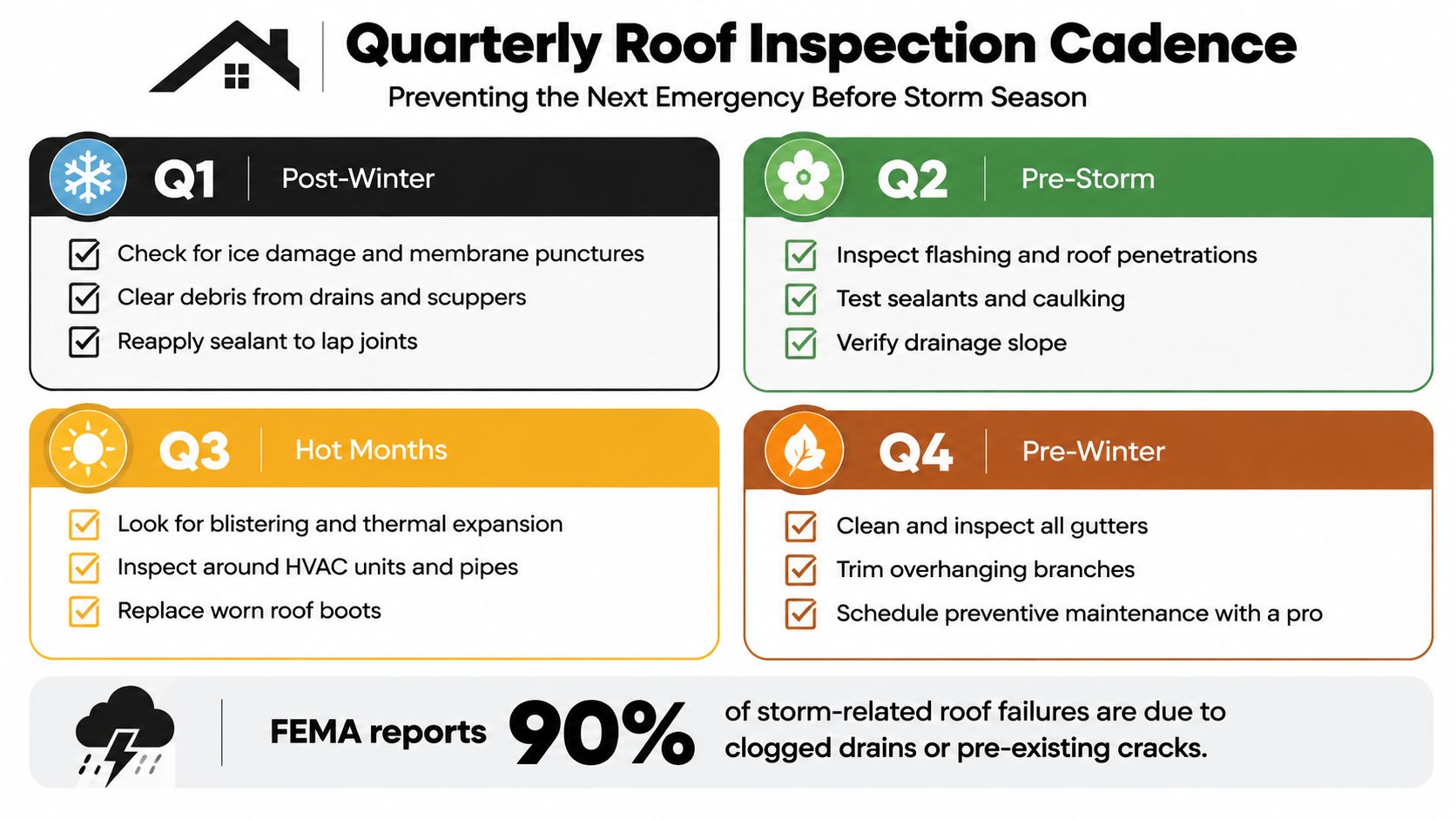
Run the pre-storm check before the warning becomes an incident
Before a Bureau of Meteorology warning reaches your area:
- Clear drainage paths: Remove leaves and debris from valleys, box gutters, sumps, scuppers and downpipe inlets.
- Check vulnerable details: Inspect flashings, roof penetrations, sealants, cappings and visible fixings from a safe position.
- Photograph the baseline: Add current roof and internal-condition photographs to the asset file.
- Confirm access arrangements: Make sure gates, keys, alarms, isolation procedures and contact details are current.
- Pre-stage the response: Save the 24-hour commercial roofer's number and tell security or the after-hours manager who can authorise make-safe work.
- Protect the interior: Identify stock, equipment and records that can be moved quickly if water enters.
A maintenance budget should be based on the roof's area, age, access, material, drainage complexity and known defects. Don't accept an unexplained annual allowance. Ask for a condition-based plan that separates routine cleaning, minor repairs, specialist inspections and capital replacement, then update it after every significant storm.
The strongest prevention programme combines a safe inspection cadence with a clear first-hour procedure. It doesn't promise that a roof will never leak. It means the building team can identify the emergency quickly, preserve evidence, control the water and bring the right specialist to the right part of the problem.
Commercial Roofers offers 24-hour commercial and industrial roof leak response across Sydney and NSW, with services covering make-safe work, detailed inspections, asbestos roof solutions, guttering and permanent repairs. If water is entering your warehouse, strata building or facility, visit Commercial Roofers to arrange a documented assessment and a clear path from emergency containment to approved rectification.