
A ceiling stain appears in a warehouse tenancy after a heavy storm. The property manager calls a contractor, the tenant moves stock, and everyone starts asking whether the roof, flashing, or gutter failed. In many cases, the warning signs were already visible: leaf build-up at a sump, rust below a concealed outlet, a displaced gutter section, or water marks beneath a leaking lap joint.
Commercial gutters aren't decorative edges. They form part of the building's roof drainage system, and Australian requirements place that system within a formal compliance framework. The practical question isn't whether the gutters were cleaned this year. It's whether the building's drainage paths are being inspected and maintained at a frequency that matches the roof, the site, and the consequences of failure.
Table of Contents
- Why Commercial Gutter Maintenance Matters More Than You Think
- A Practical Inspection Checklist for Commercial Gutters
- Cleaning and Minor Repairs Done the Right Way
- Building a Risk-Based Maintenance Schedule
- Compliance, Safety, and Recordkeeping Obligations
- Preventive Upgrades That Pay Off on Commercial Roofs
- Costs, Records, and When to Call a Professional
Why Commercial Gutter Maintenance Matters More Than You Think
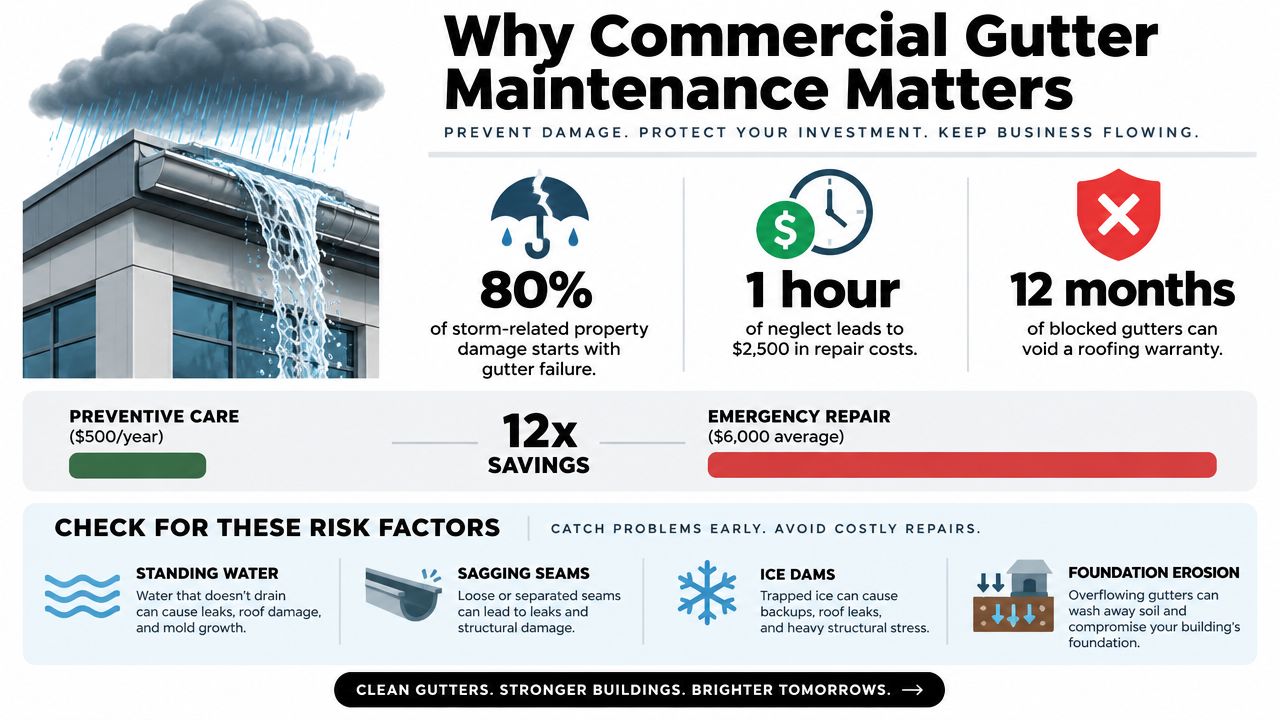
A commercial roof can look sound from the ground while a concealed box gutter is already holding water. Internal gutters, long roof valleys, hidden sumps, and enclosed downpipes can fail without the obvious overflow that would warn a facilities manager. By the time staining appears inside a tenancy, water may already have travelled through insulation, ceiling materials, electrical areas, or stored goods.
The cost of the clean is rarely the main issue. Exposure includes damaged stock, tenant disruption, make-good obligations, insurance excesses, emergency access equipment, and lost operating time. A scheduled inspection gives the building owner an opportunity to identify a blockage or deteriorated joint while the defect is still localised.
Site reality: The most expensive gutter problems often begin where nobody can see the water moving.
Australian roof drainage is governed by AS/NZS 3500.3, which sets requirements for materials, design, installation, and testing of roof drainage systems to the point of connection. The National Construction Code also requires gutters and downpipes to be designed and constructed in accordance with that standard, making it the foundational compliance benchmark for commercial roof drainage in Australia. AS/NZS 3500.3:2021 confirms that guttering is part of a regulated drainage system, not an optional cosmetic feature.
The failure points managers miss
A blocked external gutter is usually easy to spot. Box gutter failure is more deceptive. Water can pond along the back of the trough, overwhelm a concealed sump, or reach a weak lining transition before anyone sees an external leak. Corroded sumps and compacted downpipe chokes create a similar problem, particularly where the roof has a large catchment and a single outlet carries a significant share of the flow.
That makes commercial gutter maintenance a risk-control discipline. The inspection cadence should reflect roof geometry, debris load, storm exposure, access constraints, and building use, rather than relying on an automatic annual booking.
A Practical Inspection Checklist for Commercial Gutters
Start at ground level and work upwards. A good inspection isn't a collection of attractive roof photographs. Each observation should produce a decision, such as clean, monitor, repair, investigate, or escalate to a licensed roofer.
Begin where the water finishes
Walk the building perimeter after rain where possible. Look for overflow marks below joints, damp patches on masonry, soil erosion, ponding near walls, and downpipes discharging against the building rather than into a suitable drainage point. Check whether water exits freely from each outlet, because a downpipe can appear intact while a compacted blockage sits inside a bend or concealed connection.
At mid-level, inspect fascia lines, brackets, external box gutter spigots, end caps, and visible joins. Tide marks on parapets suggest water has reached a location that should remain dry. Rust streaks beneath a concealed sump can indicate corrosion inside the drainage assembly, while a gutter that has pulled away from its support may be carrying excess water or losing its fall.
Inspect the trough and outlet points
At roof level, examine the full gutter channel rather than only the dirtiest section. Remove or record vegetation matting at the high end of long runs, sediment around sumps, leaf-strainer baskets, displaced sections, open laps, and sealant that has shrunk or pulled away from the metal.
Give each box gutter a dedicated check. Confirm that the trough falls towards the sump, the internal overflow weir remains clear, saddle brackets are secure, and the lining transition between sheet metal and membrane is sound. Ponding along the back of a box gutter is an early warning sign, not a harmless puddle.
Use the commercial roof inspection report template to organise findings into a consistent record, then attach location-specific photographs and recommended actions.
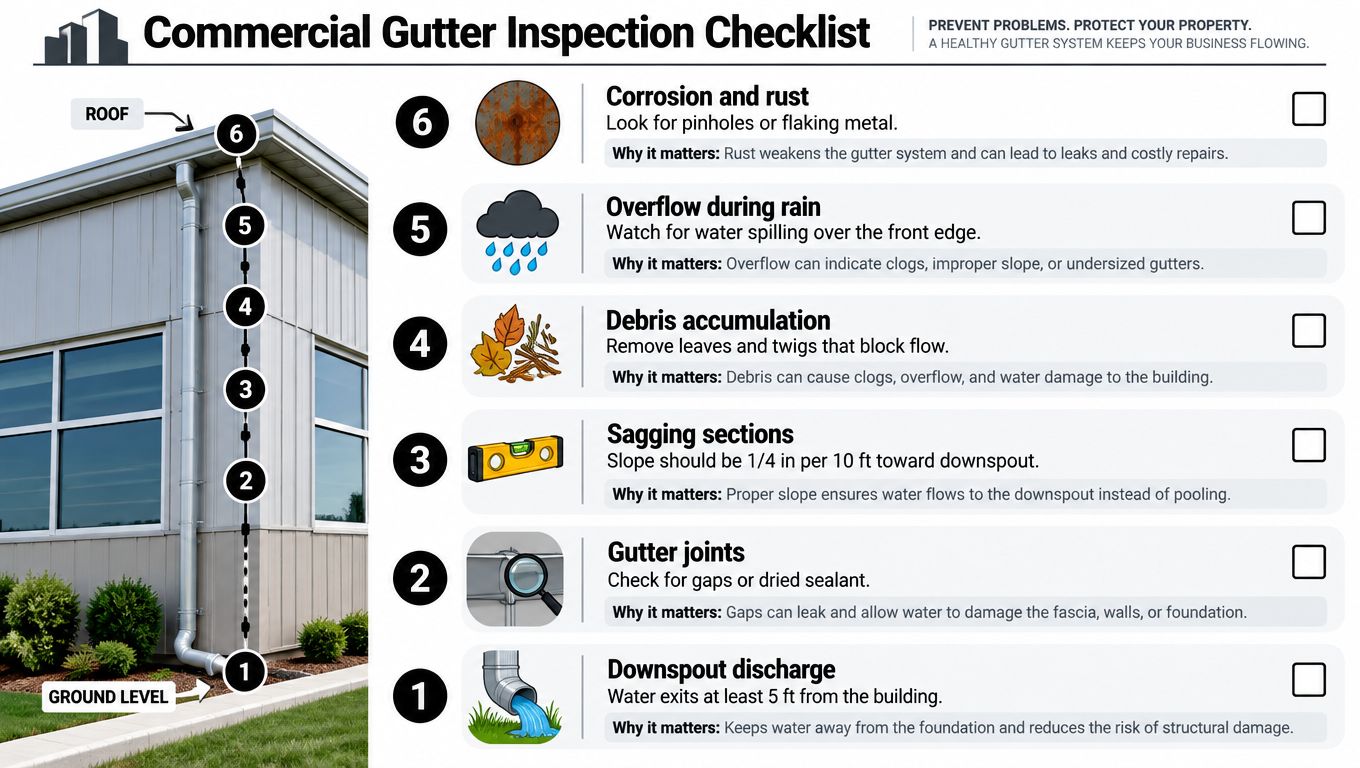
A useful close-out list looks like this:
- Outlet points: Confirm every sump, spreader, and downpipe connection is open and carrying water.
- Joints and laps: Mark staining, failed sealant, open fasteners, or corrosion for resealing or repair.
- Supports: Record sagging, loose brackets, displaced lengths, and movement at fascia connections.
- Overflow provisions: Check that internal weirs and emergency discharge paths aren't obstructed.
- Roof surface: Remove debris that can wash into the drainage path, while noting damaged membranes or flashings for separate investigation.
If an inspection finds recurring overflow after cleaning, don't schedule another clean. The cause may be incorrect fall, inadequate outlet capacity, damaged lining, or a drainage imbalance that requires design or roofing advice.
Cleaning and Minor Repairs Done the Right Way
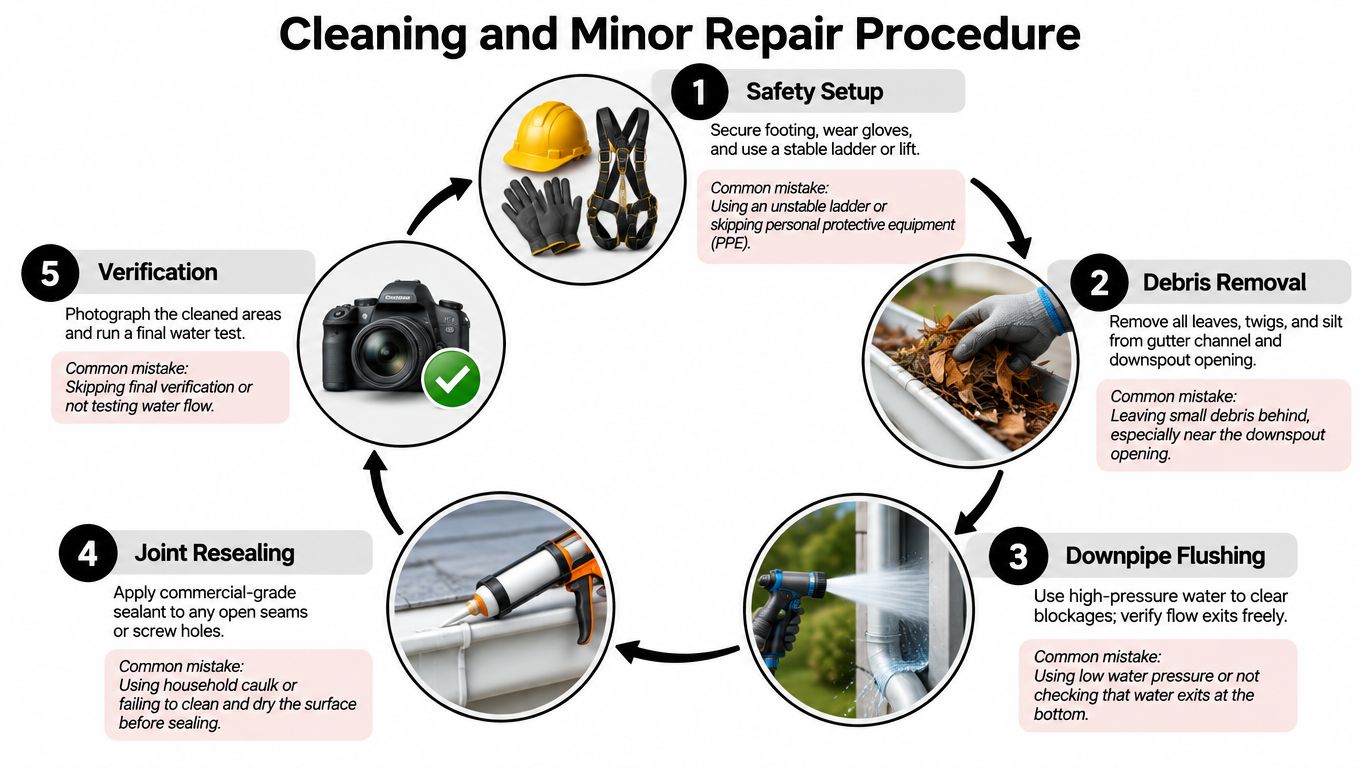
Cleaning a commercial gutter safely requires more than sending a worker up with a bucket. Set an exclusion zone below the work area, identify access routes, check for overhead services, and inspect roof sheeting for brittleness or damage. Where roof access is required, use appropriate fall-protection equipment and procedures, including systems covered by AS/NZS 1891, along with secure ladder placement, tie-off, and a spotter where the site risk requires one.
The crew should also confirm the work area with the facilities manager. Warehouses may have forklifts, loading activity, fragile skylights, asbestos-containing materials, or tenants operating directly below the roof edge. A safe job plan accounts for those conditions before debris removal begins.
A controlled cleaning sequence
Remove wet leaves, silt, and nesting material by hand or with suitable vacuum equipment. Bag wet material off the roof instead of pushing it into the downpipes. In a box gutter, work from the high point towards the sump so debris doesn't accumulate in front of the outlet.
Flush each downpipe with a controlled hose flow and watch where the water exits. Excessive pressure can force apart weak joints or drive water into a building edge, so high-pressure equipment isn't a substitute for finding the actual obstruction. A plumber's snake is more appropriate for a compacted choke inside a suitable downpipe, but a concealed or damaged line may need specialist investigation.
Minor repairs can include resealing a sound lap joint with a compatible silicone or polyurethane product, refixing a loose bracket, replacing a leaf-strainer basket, or patching a small pinhole with a suitable sheet-metal repair kit. Don't seal over active corrosion, movement, failed membrane transitions, or widespread rust. Those conditions usually indicate that the substrate or drainage assembly needs a broader repair.
Practical rule: Sealant is a repair detail, not a cure for a gutter that has lost its shape, fall, or structural support.
The final step is verification. Run water in a controlled manner towards each sump, check that the flow exits freely, inspect repaired joints for seepage, and photograph every completed repair. Hand the report to the facilities manager with defects clearly separated into completed work, monitoring items, and recommended follow-up.
For sites where roof access, equipment, or documentation exceeds the in-house team's capability, it can be sensible to hire a gutter cleaning company with the systems and supervision needed for commercial work.
A short video can help non-roofing staff understand why cleaning and testing are separate tasks.
Building a Risk-Based Maintenance Schedule
An annual clean is a reasonable starting point for a low-risk site, but it isn't a reliable answer for every commercial roof. Australian government maintenance guidance recommends annual servicing of gutters, downpipes, and stormwater systems, while Victorian guidance says roof drainage systems should be cleaned regularly and warns that blocked drainage can contribute to water ingress and other defects. Australian roof drainage guidance supports treating annual servicing as a baseline, with additional attention where exposure or drainage complexity increases.
Set the cadence using four inputs:
- Debris load: Trees, bird activity, nearby construction, and loose roof materials increase blockage risk.
- Roof geometry: Long runs, internal corners, valleys, concealed box gutters, and multiple roof levels create more places for debris and water to concentrate.
- Catchment size: A larger roof moves more stormwater through its outlets, so a partial obstruction can have a greater operational consequence.
- Access constraints: Rope access, boom lifts, fragile sheeting, restricted loading areas, and tenant activity can make frequent visits harder to organise.
Rate each factor as low, medium, or high. Add the points and use the result as a scheduling prompt, not as a substitute for professional judgement.
| Risk Factor | Low (1 pt) | Medium (2 pts) | High (3 pts) | Site Score |
|---|---|---|---|---|
| Debris load | Open roof with little vegetation | Intermittent leaf or bird activity | Heavy tree cover, construction dust, or nesting | ___ |
| Roof geometry | Simple external gutters | Mixed roof levels or long runs | Concealed box gutters, valleys, or complex outlets | ___ |
| Catchment size | Small roof drainage areas | Moderate commercial roof | Large warehouse or industrial catchment | ___ |
| Access constraints | Safe, direct access | Lift or controlled access required | Difficult, fragile, or restricted roof access | ___ |
A lower combined score may support an annual cycle, provided inspections show stable conditions. A medium score suits a more active programme, while a high score should prompt more frequent inspections and cleaning, commonly quarterly or at least every six months depending on the actual site exposure. Independent Australian service guidance recommends intervals from quarterly to every six to twelve months, with warehouses and industrial buildings often needing closer attention because large roofs and concealed box gutters can fail without warning. Commercial gutter maintenance guidance sets out the practical inspection points that support this approach.
Compliance, Safety, and Recordkeeping Obligations
Commercial gutter work sits at the intersection of drainage compliance, workplace safety, and asset management. Under AS/NZS 3500.3, the roof drainage system must be designed and constructed with appropriate materials, sizing, installation, and testing. For a maintenance team, that means a blocked outlet, altered overflow path, failed sump, or unapproved modification shouldn't be treated as an isolated cleaning issue.
Box gutters deserve particular caution because their internal overflow arrangements and concealed linings may be difficult to assess from ground level. If a worker identifies a change to the drainage configuration, evidence of inadequate capacity, or damage at a roof-to-gutter transition, the issue should be referred for competent technical assessment rather than covered with additional sealant.
Safety starts before the ladder
The moment a worker accesses a roof, the task becomes more than ordinary ground-level cleaning. In NSW, the relevant work health and safety framework requires the business conducting the work to manage fall, access, electrical, brittle-surface, dropped-object, and public-interface risks. A site-specific risk assessment, safe work method documentation where required, suitable harness and anchor arrangements, ladder control, and exclusion zones below the work area are practical safeguards.
A homeowner leaning a ladder against a fascia isn't a suitable model for a warehouse or strata complex. Commercial sites have tenants, vehicles, visitors, plant, and valuable stock beneath the work area.
Recordkeeping principle: An invoice proves that somebody attended. It doesn't prove what they inspected, what they found, or whether the drainage path was tested.
Keep dated before-and-after photographs, marked roof plans where useful, defect descriptions, cleaning areas, repair materials, access controls, and the contractor's business and licence details. A documented approach also makes recurring defects easier to identify and supports informed insurance discussions after storm ingress.
For roof access planning, review the guidance on commercial roof safety anchors, then have a competent person confirm that the installed system suits the work method and roof structure.
Preventive Upgrades That Pay Off on Commercial Roofs
Preventive devices make sense when they address a known site risk. They don't make sense when a contractor installs them to avoid understanding why the gutter blocks in the first place.
Aluminium or stainless-steel mesh guards can reduce leaf entry on tree-lined warehouses. They also collect fine debris and can become a mat over the gutter if nobody lifts or inspects them. Guards protect the channel only when the outlet, overflow, fasteners, and surrounding roof remain serviceable.
In NSW bushfire-prone areas, the maintenance conversation also includes ember exposure. Commercial guidance increasingly pairs gutter protection with ember mesh and bird-proofing for warehouses, factories, schools, and strata properties. Where bushfire construction requirements apply, the selection and installation of ember protection should be assessed against the relevant building design and AS 3959 requirements, rather than treated as a generic add-on.
Bird-proofing can prevent nesting material from blocking valleys, sumps, and outlet areas. It can be useful around industrial roofs where nesting happens quickly, but the capping must remain inspectable and shouldn't obstruct emergency overflow routes.
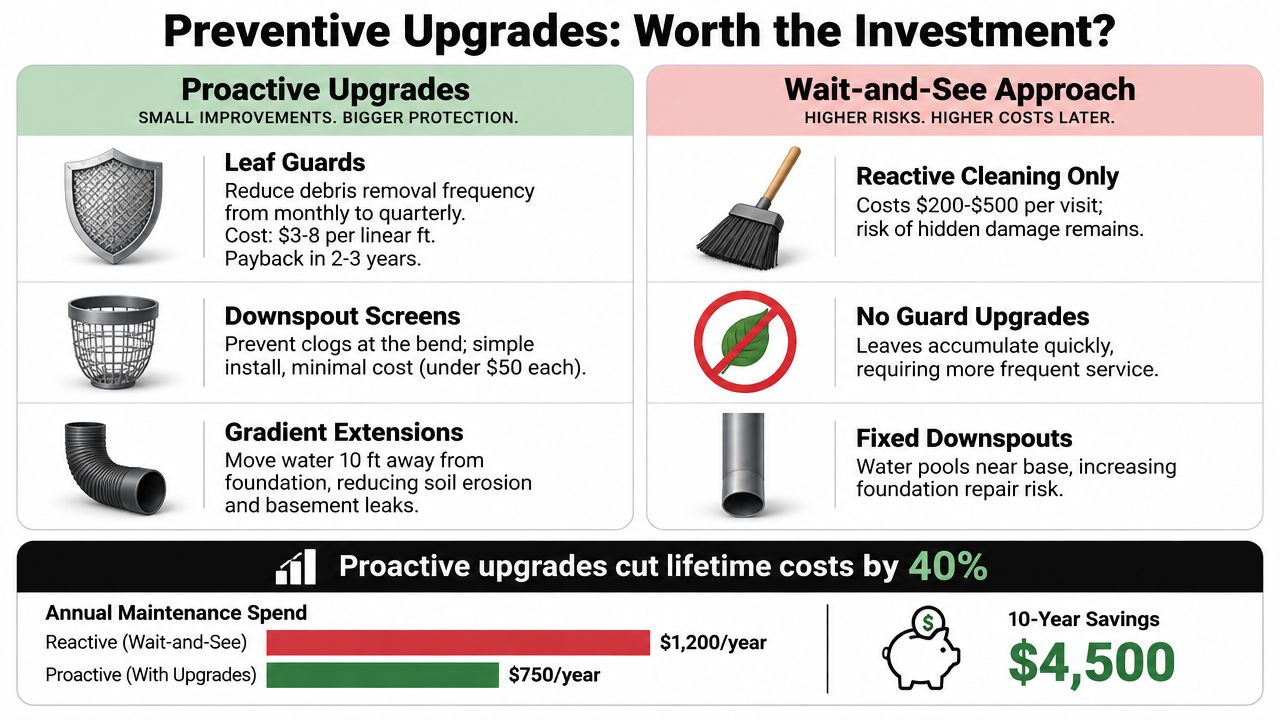
The trade-off is straightforward. Upgrades generally shift work from cleaning to inspection. A guard may reduce loose-leaf entry, but it can also hide compacted sediment. Ember mesh can support bushfire resilience, but it still needs inspection after storms and maintenance activity. Bird-proofing reduces nesting access, yet poor installation can create a new obstruction.
Choose the upgrade only after checking roof geometry, debris type, overflow arrangements, access, and fire exposure. Then set an inspection interval that allows the devices themselves to be checked, rather than assuming installation ends the maintenance obligation.
Costs, Records, and When to Call a Professional
Commercial gutter pricing depends on height, access equipment, total gutter length, roof complexity, contamination, disposal, and whether the crew is cleaning or repairing. Public Australian pricing guidance can help explain the home gutter pricing factors, but commercial work needs a site-specific quote because box gutters, restricted access, and industrial safety controls change the scope.
A defensible record should include the inspection date, areas accessed, contractor details, photographs before and after, debris removed, defects found, repairs completed, unresolved risks, and sign-off from the facilities or strata representative.
| Signal Observed | Likely Cause | Action | Indicative Cost (AUD) |
|---|---|---|---|
| Overflow returns after cleaning | Incorrect fall, outlet restriction, or capacity issue | Arrange drainage and roof assessment | Site-specific quote |
| Sagging box gutter | Support failure, ponding, or structural movement | Stop treating it as routine cleaning and engage a roofer | Site-specific quote |
| Rust at joints or sumps | Corrosion, failed coating, or deteriorated metal | Assess repair versus replacement | Site-specific quote |
| Internal water staining | Concealed leak, failed lining, or overflow path | Investigate promptly and protect affected tenancy | Site-specific quote |
Escalate when the same location keeps overflowing, when corrosion is widespread, when a box gutter has lost its shape, or when staining appears inside the building. These signs point to a roofing or drainage defect, not a housekeeping problem. Guidance on fascia and gutter replacement can help owners understand when local patching has stopped being a sensible long-term option.
The decision rule is simple: clean routine debris, document the result, and refer any recurring, concealed, structural, or internal-water defect to a licensed commercial roofer.
Commercial Roofers offers commercial gutter inspections, cleaning, repairs, replacements, and modern box gutter work across Sydney and NSW, with photo-backed reporting for strata committees, warehouses, and industrial facilities. Visit Commercial Roofers to request an assessment and turn the next gutter service into a documented maintenance plan rather than another emergency response.