
The phone call usually comes after a hard downpour. A warehouse manager opens up in the morning and finds water staining on the insulation blanket, stock damp along one wall, and a slick patch under a downpipe outlet that should never have backed up in the first place. Someone says the gutters “just need a clean”. Sometimes they do. Often they don't.
On commercial buildings, gutter and drainage failures are rarely just housekeeping problems. They're building-envelope failures with operational consequences. Water doesn't stay politely in one spot. It gets into stock, saturates ceilings, stains façades, overloads flashings, and turns a minor roof defect into a downtime problem, a tenant dispute, or an insurance argument.
What catches many owners and strata managers out is that commercial roof drainage in Australia isn't based on guesswork or a one-size-fits-all gutter profile. It's designed around rainfall intensity, roof geometry, outlet capacity, discharge paths, and compliance obligations. That's where the difference sits between a house gutter that overflows onto a garden bed and a commercial system that can push water into a warehouse, office suite, or plant room.
Table of Contents
- Beyond a Drip The True Cost of Failed Commercial Gutters
- Designing Commercial Gutters for Peak Rainfall
- Choosing the Right Gutter Materials and Profiles
- Navigating Australian Gutter and Drainage Compliance
- Identifying and Preventing Common Gutter Failures
- Your Commercial Gutter Inspection and Maintenance Plan
- A Checklist for Hiring the Right Commercial Roofer
Beyond a Drip The True Cost of Failed Commercial Gutters
A failed box gutter doesn't announce itself neatly. It starts with overflow at a low point, water bypassing an outlet, or a sump choking on debris because the system had no spare capacity in the first place. By the time someone notices the ceiling stain, the water has already travelled.
On a commercial site, that sets off a chain reaction. Staff move stock. Tenants log defects. Maintenance teams chase the visible leak instead of the hydraulic cause. If the water reaches electrical services, plant, lift overruns, or internal linings, the clean-up bill quickly stops looking like a simple gutter repair. If you've ever tried to weigh up whether patching is enough, a breakdown of commercial roof repair cost factors helps put that decision in context.
The bigger issue is that commercial roof drainage capacity is often under-answered for Australian buildings, particularly when people ask how to size gutters and downpipes for actual local rainfall intensity rather than relying on generic maintenance advice. The National Construction Code requires roof drainage to be designed to AS/NZS 3500.3, and the Bureau of Meteorology's Intensity-Frequency-Duration data is the standard Australian source used to determine design rainfall intensity, as noted in this discussion of commercial roof drainage design and rainfall intensity requirements.
Practical rule: If a commercial gutter overflows during a major storm, don't assume the problem is dirt. First ask whether the system was ever sized for that roof and that location.
That's why the old advice to “clean your gutters twice a year” only gets you so far. Maintenance matters. But on warehouses, retail centres, strata complexes, schools, and factories, gutter and drainage is an engineered system. If the design is wrong, cleaning only restores an undersized system to its original limitation.
Designing Commercial Gutters for Peak Rainfall
Residential gutters are often judged by whether they catch normal rain and look tidy from the street. Commercial systems are judged by whether they can move a calculated volume of water off a much larger roof without overtopping, ponding, or pushing water back into the building fabric.
That's a different problem entirely.
Why commercial systems fail differently
The easiest way to think about gutter and drainage design is as a traffic system. The roof is the catchment. Gutters are the first lane. Sumps and outlets are intersections. Downpipes are the motorway off-ramps. If any part is too small, too flat, blocked, or badly placed, the queue starts upstream.
In Australian roof-drainage design, NCC Volume Two / Plumbing Code of Australia and AS/NZS 3500.3 require rainwater systems to be sized using local rainfall intensity data rather than a generic rule-of-thumb. A seemingly small increase in roof span can push a system past capacity and cause overtopping during design-storm events, according to this summary of roof drainage sizing requirements and rainfall intensity design.
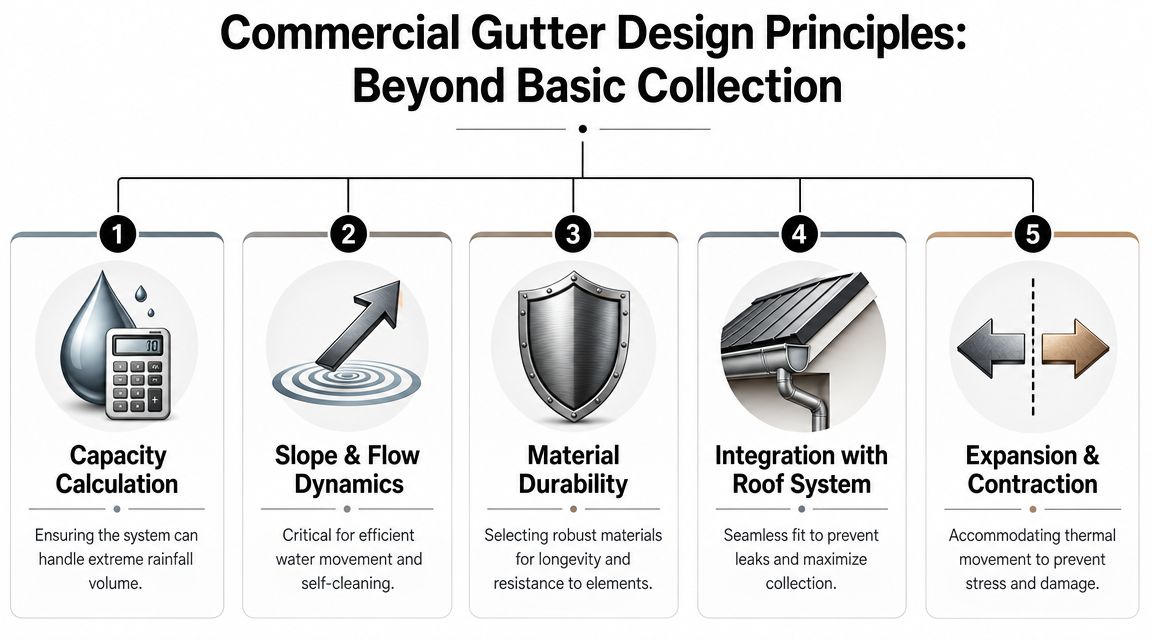
On site, that plays out in a few predictable ways:
- Large roof area changes everything. A warehouse roof, shopping strip canopy, or factory sawtooth roof can feed far more water into one section than an owner expects from ground level.
- Multiple contributing roof planes complicate flow. Valleys, parapets, and internal gutters can combine runoff into one box gutter or sump.
- Gradient matters. A gutter with poor fall holds water, traps silt, and loses capacity before a storm even peaks.
- Outlet spacing matters as much as gutter width. A wide gutter can still fail if too much water has to fight its way to too few outlets.
The full water path matters
Design doesn't stop at the gutter profile. One of the most common commercial mistakes is solving collection and ignoring discharge. Water still has to leave the building legally and safely.
For commercial and industrial sites, I always treat the drainage path as one system from roof sheet to final discharge point. That means asking:
- Where does the roof water collect? Eaves gutter, box gutter, valley, sump, rainhead.
- How does it leave the collection point? Outlet size, number of outlets, downpipe location.
- Where does it go after the downpipe? Surface discharge, lawful connection, charged line, pit, or site system.
- What happens if the primary path is overwhelmed? Overflow route, emergency discharge, or visible relief point.
- Can the site legally accept that runoff? This becomes critical on constrained blocks and redevelopment sites.
A commercial gutter only works if the building can get rid of the water after collection. Otherwise you've just moved the bottleneck.
That's why eaves gutters and box gutters shouldn't be treated as interchangeable. Standard eaves gutters suit simpler edges and smaller tributary loads. Box gutters are often the right answer where roofs drain inward, parapets hide the edge, or large catchments need concentrated collection. But a box gutter is less forgiving. If it's undersized, badly graded, or missing proper overflow relief, the water often ends up inside the building, not outside it.
Good design is plain and disciplined. Size to local conditions. Provide enough fall. Keep outlets close enough. Make overflows obvious. Check the discharge path. Anything less is hoping the next storm won't test the weak point.
Choosing the Right Gutter Materials and Profiles
People often start with material because it feels tangible. Steel or aluminium. Colorbond or Zincalume. PVC or not. On commercial roofs, that's only half the decision. The first question is the profile and duty level the building needs. The second is what material will survive the site conditions and maintenance reality.
Profiles first, material second
A retail awning, strata block, and distribution centre don't ask the same thing from a gutter. Some need visual consistency from the street. Some need high-capacity internal collection. Some need a durable profile that can handle debris load, thermal movement, and long runs without constant call-backs.
In practice, the usual commercial choices are:
- Standard external gutters for simpler roof edges and lower concentrated loads.
- Box gutters where roofs drain internally or behind parapets.
- Custom folded sections where outlet placement, fascia geometry, or overflow detailing needs a site-specific solution.
- Heavier-duty profiles on industrial buildings where roof areas are broad and maintenance access is limited.
Material then shapes durability, corrosion resistance, appearance, and repair approach. For owners comparing metal roof packages more broadly, this overview of commercial metal roofing options in Australia is a useful companion because gutter selection should match the roof system above it.
Commercial Gutter Material Comparison
| Material | Typical Lifespan | Relative Cost | Maintenance Needs | Best For |
|---|---|---|---|---|
| Colorbond steel | Varies by environment, coating selection, installation quality, and maintenance | Mid to premium | Moderate. Needs routine inspection for debris, scratches, joint issues, and corrosion at cut edges or fixings | Strata, retail, offices, warehouses where appearance and durability both matter |
| Zincalume steel | Varies by environment and exposure | Mid | Moderate. Needs checking in areas prone to standing water or aggressive runoff | Industrial and commercial projects where a practical metal solution is preferred |
| Aluminium | Varies by thickness, finish, and exposure | Mid to premium | Low to moderate. Still needs cleaning and fixing checks, but won't rust like steel | Coastal or corrosion-sensitive environments, lighter support structures |
| PVC | Generally lower-duty in commercial settings | Lower | Moderate to high over time. Movement, brittleness, and joint integrity need watching | Limited use on smaller ancillary buildings, not my first choice for demanding commercial roofs |
A few trade-offs matter more than brochures suggest.
Colorbond steel is often a sensible commercial choice because it balances appearance, compatibility with Australian metal roofing systems, and solid durability when detailed properly. It suits strata and visible commercial façades where owners care about colour consistency and a cleaner finished edge.
Zincalume steel works well where function matters more than presentation and the environment isn't especially aggressive. It's common on industrial buildings, but it still needs proper falls and regular cleaning. Any material will struggle if water sits in it.
Aluminium earns its place where weight and corrosion resistance are bigger concerns. It can be a smart option on coastal-adjacent or corrosive sites, though profile strength, expansion, and support spacing need proper attention.
PVC has a place on some low-demand structures, but I wouldn't treat it as a default commercial solution on large buildings. Long runs, heavy storm loads, and exposure tend to expose its limits faster.
Material won't rescue a bad design. A premium gutter installed with poor fall and undersized outlets still fails like a cheap one.
That's the primary ordering of priorities. Get the hydraulic design right. Choose a profile that suits the roof geometry. Then select a material that fits the environment, the maintenance plan, and the owner's long-term budget.
Navigating Australian Gutter and Drainage Compliance
Compliance gets dismissed as paperwork right up until water comes through a ceiling and everyone wants to know who approved the drainage detail.
On Australian commercial roofs, that attitude is expensive. Gutter and drainage design is tightly linked to national standards like AS/NZS 3500.3:2021, and commercial roofs often rely on engineered box gutters, sumps, and overflow provisions to manage high-intensity rainfall and reduce the risk of internal water ingress, as outlined in this reference to rain gutter standards and commercial roof drainage context.
What compliance looks like on a real roof
Compliance isn't abstract. It shows up in physical details that either protect the asset or leave it exposed.
On a commercial roof, that usually includes:
- Correct sizing logic based on the roof catchment and local conditions.
- Overflow provisions that let water discharge visibly before it rises into the building fabric.
- Sumps and outlets positioned where water can reach them without long dead sections.
- Downpipes and discharge paths that continue the system, rather than creating a hidden choke point below.
- Integration with the roof system so flashings, membranes, sheets, and gutters work together.
Box gutters are where poor compliance often hurts most. They sit close to the building interior. If water overtops the back edge, it usually doesn't fall harmlessly to the ground. It enters the structure.
Why owners should care even if the roof looks fine
Owners, builders, and strata managers don't need to memorise every clause to protect themselves. They do need to stop treating drainage as a trim item. A compliant system helps with certification, supports a clearer maintenance record, and gives insurers fewer reasons to challenge whether the building was properly designed or maintained.
Ask direct questions instead of broad ones:
- What standard is the roof drainage designed to?
- How are overflows handled in the box gutters?
- Where is the lawful discharge point?
- What happens if the primary outlet blocks during heavy rain?
- Has the design considered the full roof catchment, not just the visible gutter length?
Compliance is asset protection in technical form. It exists because commercial roofs don't fail gently.
The practical takeaway is simple. If a contractor can only talk about gutter profiles, colours, and leaf build-up, you're hearing a maintenance conversation. Commercial drainage needs a compliance conversation as well. That's the difference between a roof that looks finished and a roof that is properly protected.
Identifying and Preventing Common Gutter Failures
Commercial drainage defects tend to repeat. Different buildings, same patterns. The visible symptom might be overflow, staining, sagging metal, or rust at a joint. The underlying cause is usually hydraulic, structural, or both.
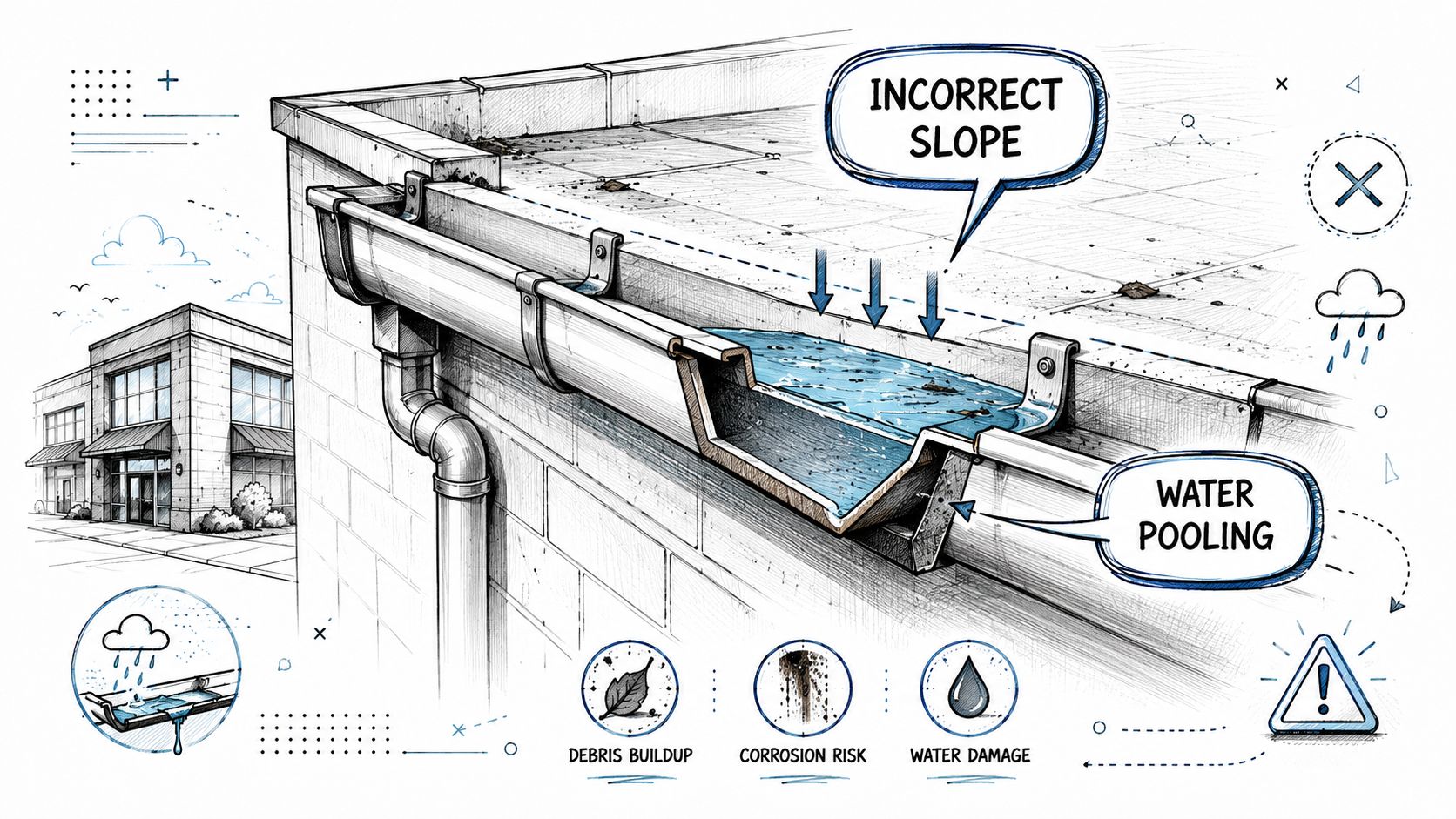
The usual failure points on commercial sites
The first one is incorrect fall. A gutter that doesn't drain cleanly becomes a sediment tray. Silt settles. Water ponds. Debris sticks instead of washing through. Then the owner blames the storm when the problem started with alignment.
The second is undersized capacity. This shows up on larger roofs where the gutter profile looked substantial enough, but the catchment feeding it was bigger than the design allowed for. Overtopping at one location during intense rainfall is a common clue.
Then there's the downstream bottleneck. For commercial buildings, that's often a significant issue. Sizing tools show that required gutter and downspout size changes materially with rainfall intensity and roof area, meaning a system must be engineered from the gutter to the final discharge point to avoid backflow and debris trapping, as discussed in SMACNA's downspout and gutter sizing calculator guidance. A generous gutter feeding too few outlets or undersized downpipes still backs up.
Other frequent failures include:
- Failed joints and seals where movement, age, or poor installation lets water escape before it reaches the outlet
- Corrosion at laps, cut edges, and fixings where trapped moisture sits too long
- Poor overflow detailing on box gutters, which turns a blocked outlet into an internal leak event
- Loose brackets or support failure that changes fall and creates local low points
If only one section overflows while the rest of the run looks clear, check the outlet, sump, and downpipe before blaming the whole gutter line.
What prevention actually looks like
Prevention starts before maintenance. It begins in design, continues through installation, and only then becomes a cleaning issue.
A sound prevention approach includes:
Set accurate falls during installation
Don't rely on visual straightness from the ground. Gutters need measured fall to the outlet, especially on long runs and box gutter sections.Match outlet spacing to the catchment
One outlet at the end of a long commercial run often isn't enough. Shorter travel distance to a sump or rainhead keeps water depth lower.Treat debris load as a design issue
Trees, roof grit, bird activity, and nearby industrial dust all affect how quickly outlets choke. Some sites need easier-access sumps and more frequent cleaning points.Detail for movement
Long metal runs expand and contract. Joints, brackets, and seals need to accommodate that movement without splitting open.Inspect after storms, not just on a calendar
A gutter can be serviceable in dry weather and fail the moment a storm shifts debris into a single outlet.
Failures usually don't come from one dramatic mistake. More often, they come from small compromises stacked together. Slightly flat fall. Slightly light outlet capacity. Slightly neglected cleaning. Then one hard rain exposes all of it at once.
Your Commercial Gutter Inspection and Maintenance Plan
A commercial maintenance plan shouldn't read like domestic advice scaled up. “Clean the leaves out” is part of it, but only part. The aim is to preserve hydraulic capacity, catch movement early, and confirm the building can still discharge stormwater the way the site allows.
For NSW properties, that final point matters more than many owners expect. Stormwater disposal must comply with local council and plumbing requirements, and for commercial sites on constrained lots, the question isn't only stopping leaks but also where the water can legally and safely be discharged, sometimes with on-site detention or retention systems involved, as described in this overview of stormwater discharge and site drainage constraints.
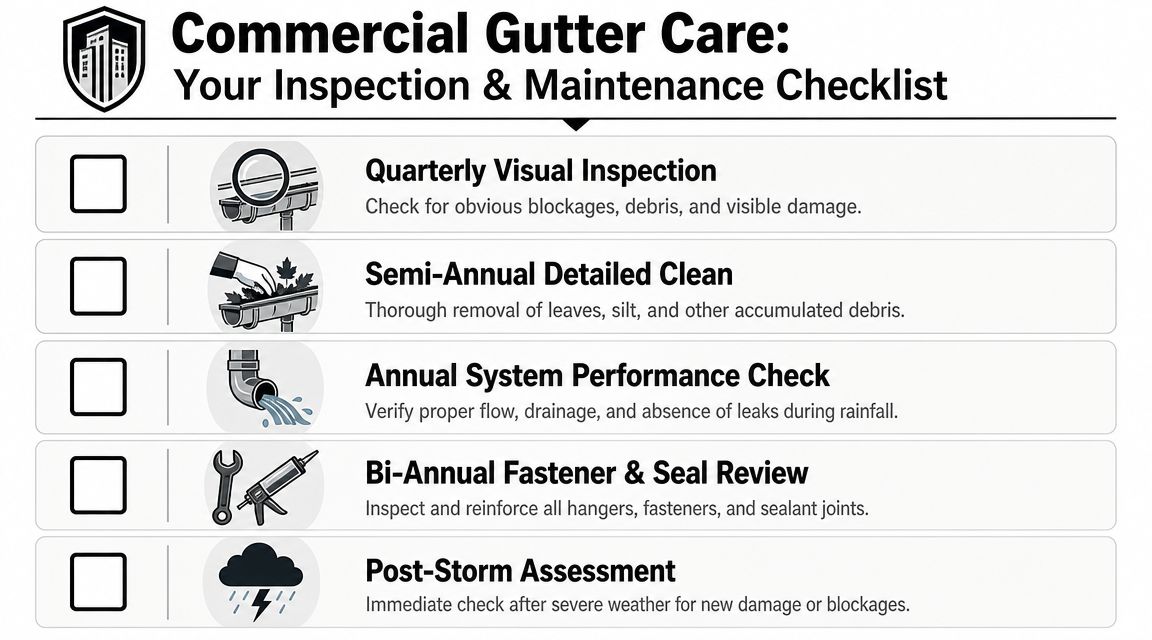
A practical inspection rhythm
I prefer a tiered plan because not every task needs the same level of labour.
Quarterly visual inspections should look for obvious blockage points, displaced sections, staining below joints, watermarks near overflows, and signs that one downpipe line is carrying more than it should. This can often be done from safe access points or during scheduled site walks.
Semi-annual detailed cleaning is the point where teams remove leaves, silt, roof grit, and debris from gutters, sumps, rainheads, and outlet mouths. The purpose isn't neatness. It's restoring flow area and exposing corrosion, split seams, and failed sealant that debris was hiding.
Annual performance review should test whether the system is still behaving properly as a system. Are water paths clear? Are downpipes discharging as intended? Are there signs of surcharge at pits or low points? Such an assessment demonstrates the value provided by a qualified commercial roofer or drainage-aware contractor.
A practical checklist looks like this:
- Visible debris load. Check gutters, box gutters, sumps, rainheads, and outlet strainers.
- Water staining and overflow marks. These often show the exact level where the system lost control in the last storm.
- Brackets, fixings, and support. Loose supports change fall and accelerate joint stress.
- Joint integrity. Look for separation, cracking sealant, rust bleed, or dampness around laps.
- Discharge path condition. Pits, downpipes, and lawful outlets need inspection too, not just the roof edge.
Maintenance should follow the water path. If you stop at the gutter, you may miss the real blockage.
Use major roof works to fix drainage properly
The best time to redesign gutter and drainage isn't always when it first leaks. Often it's during larger capital works, when access, scaffold, safety controls, and replacement scope are already in place.
If a roof is being replaced, stripped, or substantially upgraded, that's the time to ask whether the existing drainage layout still suits the building. A new roof sheet over an old undersized box gutter is a missed opportunity. The same goes for asbestos roof removal. Once the roof assembly is being removed and replaced under controlled conditions, owners can address outlet placement, overflow detailing, and downpipe rationalisation in one coordinated scope rather than patching the drainage later.
This is also where one capable contractor can simplify the process. For example, Commercial Roofers' roof installation services sit in the category of works where drainage can be reviewed alongside the roof system itself, rather than as a disconnected afterthought.
Post-storm inspections deserve their own place in the plan as well. A calendar schedule won't catch every problem. Debris can shift, a branch can deform a section, or one sump can choke in a single event. On commercial properties, the first inspection after a major storm often prevents the second incident.
A Checklist for Hiring the Right Commercial Roofer
The roofer you hire determines whether gutter and drainage gets treated as a trim accessory or a risk-managed system. That choice affects design quality, installation quality, documentation, and the odds that the next major storm becomes a maintenance note instead of an incident report.
Near the start of the process, it helps to look at actual commercial project capability rather than a polished sales pitch.

Questions that separate a roofer from a drainage contractor
Ask what kinds of commercial roofs they handle. A contractor who mostly works on homes may still be skilled, but large box gutters, internal gutters, rainheads, parapet details, and warehouse catchments are different work.
Then ask sharper questions:
- Can they explain how they assess roof catchment and outlet capacity?
- Do they understand overflow detailing on box gutters?
- Will they inspect the downstream path, not just the gutter line?
- Can they work within active commercial sites with safety controls and minimal disruption?
- Are they licensed and insured for the scope involved?
If the answers stay vague, that usually means the drainage side is being guessed.
A capable contractor should also be comfortable discussing documentation. On commercial work, owners need clear scopes, exclusions, access assumptions, and records of what was repaired versus redesigned.
What a good scope should include
The written scope should tell you whether you're buying a clean-out, a repair, or a genuine drainage solution.
Look for these inclusions:
- Defined inspection points such as gutters, box gutters, sumps, downpipes, joints, and discharge points
- Clear repair methodology for resealing, refalling, replacing sections, or upgrading outlets
- Material specification so you know what profile and finish is being installed
- Compliance awareness including how overflow and discharge issues will be addressed where relevant
- Site logistics and safety covering access equipment, protection of tenants, and timing around operations
Video can also help owners understand what competent commercial work looks like before they commit to a contractor:
The final check is whether the roofer talks in causes or just symptoms. “We'll reseal that leak” is not the same as “the outlet spacing and fall are causing surcharge at this box gutter”. The second answer is the one that protects the asset.
If you need a contractor who understands commercial gutter and drainage as part of the whole roof system, Commercial Roofers handles inspections, repairs, box gutter work, roof replacement and compliant commercial roofing projects across NSW.