
You've got water stains on the deck, a leaking box gutter, and a contractor telling you the fix is bigger than the patch job you hoped for. On a Sydney warehouse or strata asset, that's the moment the metal roof replacement cost question hits. It's not just what the sheet metal costs, it's what the job costs once access, compliance, and downtime are priced in.
That's why commercial owners get blindsided. In Australia, metal roof replacement costs are strongly influenced by labour and regulatory requirements, not just sheet price, and the specialist trade base is large, with the metal roof and wall cladding trade covering 17,300 businesses in 2023–24 according to ABS-based industry data cited in the market reference below. For Sydney projects, that means the quote usually reflects the roof, the crew, the access plan, and the paperwork, all at once, not just the profile you can see from the ground.
The right way to handle it is blunt. Treat the roof as a capital works project, not a maintenance nuisance. If you're comparing two quotes and one is materially cheaper, assume the cheaper one has hidden gaps until proven otherwise.
Table of Contents
- Introduction to Sydney Commercial Roof Costs
- Breakdown of Metal Roof Replacement Cost Components
- Factors Influencing Pricing in Sydney
- Sample Budgets for Common Commercial Building Sizes
- Project Timeline and Compliance Requirements
- Cost Saving Strategies and Lifecycle Value
- Conclusion and Warranty Insights
- Next Steps Checklist for Hiring Commercial Roofers
Introduction to Sydney Commercial Roof Costs
A Sydney warehouse manager usually doesn't call for a roof replacement because the budget allows it. The call comes after a leak, a failed inspection, a corroded sheet line, or an insurance concern lands on the desk. Once that happens, the question changes from “Can we patch it?” to “How much downtime can we tolerate, and what's the exact replacement number?”
Commercial roofs in Greater Sydney are not priced like suburban house roofs. Bigger spans, higher lifts, tighter site logistics, and compliance requirements push the quote beyond simple sheet supply. That's why commercial owners who focus only on the visible roof profile usually underbudget the project from the start.
The stronger market context matters too. ABS Building Approvals data recorded $7.1 billion in private non-residential building approvals in May 2024 in the reference brief, which shows how much commercial work is competing for labour and materials. On the labour side, ABS building construction jobs averaged about 40.3 hours per week in May 2024, which is a useful reminder that roof replacement is labour-heavy, schedule-sensitive work, not a quick materials swap ABS construction and approvals context.
Practical rule: if a Sydney quote doesn't clearly separate removal, access, compliance, and reinstallation, it's not a serious commercial quote.
For Sydney owners, the big mistake is assuming that all metal roof projects behave the same. A small retail canopy, a strata block, and a logistics shed can all be metal roofs, but their cost drivers are completely different. The useful benchmark is not a single headline figure, it's how the quote changes once the contractor prices access, waste, and safety into the job.
That's why this guide leans hard into commercial reality. The goal isn't to sell you a material. It's to show you where the money goes, which costs are unavoidable, and where you can still make sensible trade-offs without cutting corners.
Breakdown of Metal Roof Replacement Cost Components
How the quote is built
A commercial metal roof replacement quote should read like a project plan, not a single lump sum. The biggest mistake property owners make is comparing one number against another without checking what's bundled inside it. A quote can look cheap because the contractor has stripped out scaffolding, disposal, edge protection, or substrate repairs and left them to appear later as “extras”.
The most important cost split is simple. Installation typically makes up about 60% to 70% of total cost, so labour and site conditions usually dominate the budget more than the sheet itself installation share. That is exactly why Sydney projects need a line-by-line review. If the site is difficult, the labour share rises fast.
A useful way to inspect the quote is by component, not by overall pride-of-ownership language. Material choice matters, but it is only one part of the bill. Tear-off, repairs, flashings, insulation changes, access systems, and compliance work are where commercial budgets often expand.
| Cost Component | Percentage of Total Cost | Typical $/m2 Range |
|---|---|---|
| Sheet metal and fixings | Lower share than labour | Varies by profile and specification |
| Removal and disposal | Project dependent | Varies with access and waste handling |
| Labour and installation | 60% to 70% | Varies with complexity and duration |
| Access and safety controls | Significant on commercial sites | Varies with height and rigging |
| Insulation and ventilation upgrades | Optional but common | Varies with scope |
| Flashings, gutters, and edge details | Smaller line item, high skill impact | Varies with detailing |
If you want a practical reading of the market, start with the material system and then test the labour assumptions against the site. A basic steel profile can be economical, while premium systems cost more because they need more precision and more time. The reference guide on Australian metal roofing explains that installed pricing moves strongly with system choice and site conditions, which is exactly what commercial buyers need to internalise Australian metal roofing overview.
Bottom line: the cheapest metal roof quote is often just the quote with the fewest visible tasks.
Commercial owners should also keep a sharp eye on what's missing. If the contractor hasn't priced deck repairs after strip-off, or hasn't allowed for insulation changes, the final amount can move quickly. That's where the quote stops being an estimate and starts becoming a dispute.
Factors Influencing Pricing in Sydney
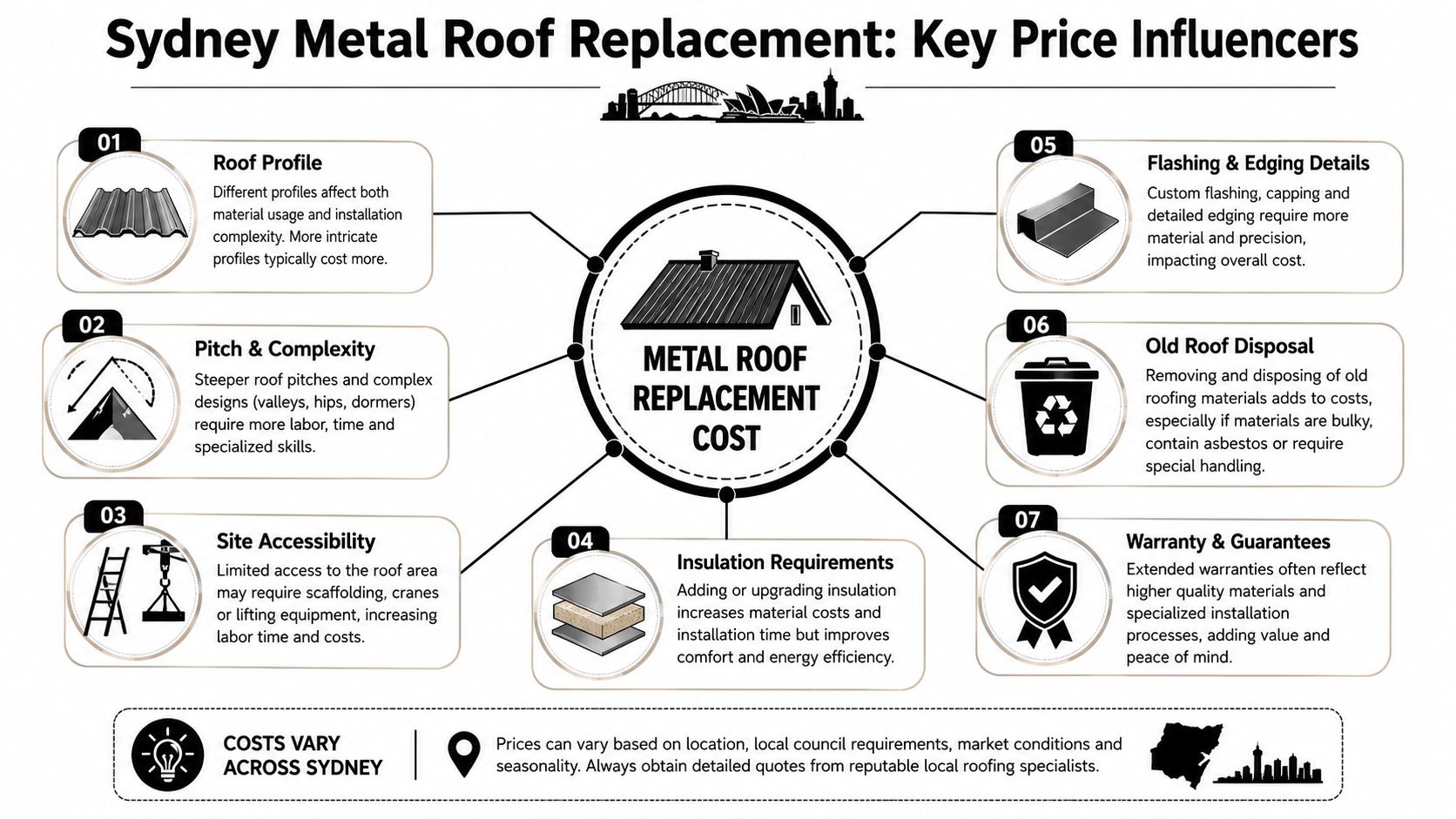
The seven variables that move the number
Sydney pricing shifts because every site is different. A straightforward low-pitch shed with easy truck access is one job. A live warehouse near traffic, with asbestos risk and limited laydown space, is another. The roof profile sits at the centre of it, but it's only one part of the story.
Roof profile changes both material choice and installation effort. Corrugated and ribbed systems are usually simpler to install, while standing seam needs more precision, more skill, and tighter detailing. Pitch and complexity push labour up because awkward angles, penetrations, and multiple roof planes slow the crew down.
Site accessibility matters more in Sydney than most owners expect. If the contractor has to use cranage, extended scissor lifts, or staged deliveries because the site is congested, the bill grows. Access and height also affect safety controls, which then affect time, which then affects cost.
Asbestos removal is one of the biggest hidden variables on older assets. If the existing roof contains asbestos, the project moves into a different category of cost and compliance. That's not a material upgrade, it's a regulated removal job, and it needs to be priced that way from the start.
Other cost drivers are more technical but just as important. Insulation requirements change the scope when thermal performance needs to be improved. Flashing and edging details create more labour because they need more precision and more handwork. Waste handling can also bite hard when strip-off volume is high, especially on larger commercial roofs.
A key lesson from Sydney is blunt. The headline square-metre rate is only the starting point. The quote changes once the contractor has walked the roof, checked access, and confirmed what's hiding under the existing sheets.
If you're comparing quotes, ask which factor is doing the damage. On commercial sites, the answer is rarely the sheet metal.
For a visual breakdown of these price movers, the Sydney-specific cost infographic above is worth using as a planning tool. It's a simple way to keep the conversation anchored to the actual project risks instead of letting the quote drift into vague “all-inclusive” language.
Sample Budgets for Common Commercial Building Sizes
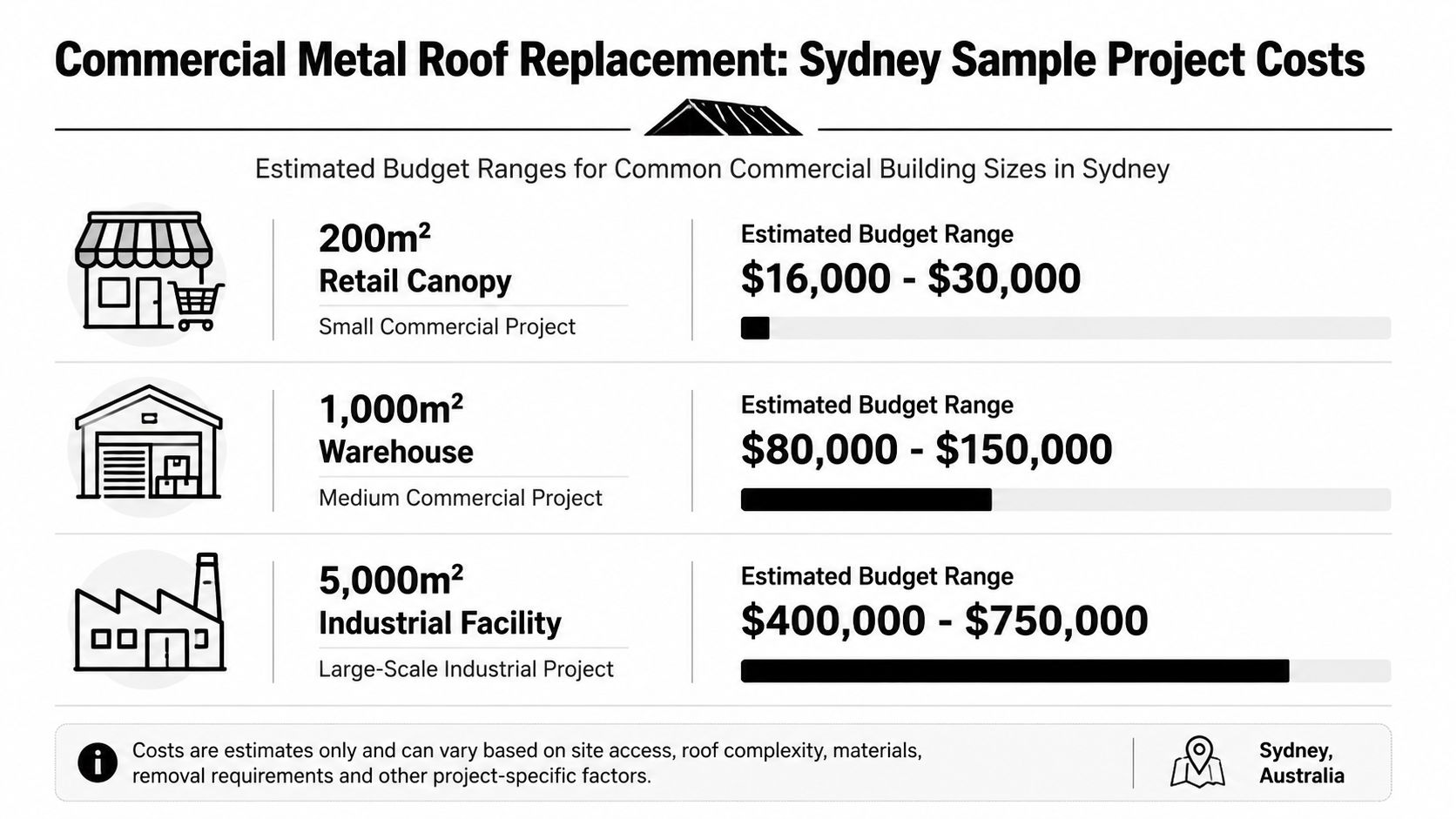
Three practical budget bands
A useful budget conversation starts with size and profile, then moves to risk. A 200m² canopy doesn't behave like a 5,000m² industrial facility, even if both are made from metal. Once you scale up, access staging, labour coordination, and program management become part of the cost structure.
For a 200m² retail canopy, a rough working budget of $16,000 to $30,000 is a sensible planning band for a Sydney commercial owner, depending on profile, access, and detailing. That range assumes the job stays relatively simple, with limited complexity and no major hidden repairs. For a 1,000m² warehouse, the planning band of $80,000 to $150,000 is more realistic because labour, logistics, and compliance start to dominate. A 5,000m² industrial facility can easily move into the $400,000 to $750,000 territory once scale, staging, and program length are factored in.
Those sample budgets line up with the wider pricing spread in market guides. Material-only steel panel pricing can begin around $2 to $5 per square foot, while standing seam can sit at $10 to $16 per square foot installed in the reference market guide metal roof pricing spread. The point is not to convert those figures mechanically into Sydney pricing. The point is that material choice alone can move the project from functional to premium very quickly.
How to read the budget bands
- Smaller canopy work: treat access and detailing as proportionally expensive, because fixed setup costs don't shrink much just because the roof is small.
- Mid-size warehouse work: expect the labour plan to matter more than the sheet price, especially if the building stays operational.
- Large industrial work: assume staging, access control, and program length will shape the quote as much as the profile selection.
A premium profile makes sense when the asset value, leak risk, or maintenance burden justifies it. A basic steel profile is usually the right call when budget discipline matters more than architectural finish. That's not a compromise. It's a commercial decision.
If you want one simple rule, use this. Small roofs get punished by fixed costs, medium roofs get punished by access, and large roofs get punished by time.
Project Timeline and Compliance Requirements
A commercial metal roof replacement in Sydney doesn't begin with demolition. It begins with inspection, documentation, and a clear scope. If the building is older, the contractor also needs to confirm whether asbestos is present before anyone starts stripping sheets.
The first stage is always the site walk and scope confirmation. That's where the contractor checks the roof condition, access points, safety setup, penetrations, and likely repair items under the old sheets. The second stage is compliance planning, which can include asbestos procedures, traffic management, and coordination with building operations so the site doesn't become a hazard to tenants or staff.
The middle of the job is where time starts to matter. Scaffold, lifts, and edge protection have to be in place before removal begins. Once the old roof is off, any deck repairs or insulation changes need to be completed before new sheets go down, because it's expensive to stop and restart a roof installation half-way through.
For Australian owners, standards and installation quality are not optional side issues. A practical reference on roofing standards is available here, and it's worth using as a checklist when you're reviewing a contractor's method statement: roofing standards in Australia.
What slows the job down
- Asbestos clearance and disposal. Older commercial buildings often need extra handling before strip-off can proceed.
- Weather and roof access. A site that can't be accessed safely or in one sequence usually drags the schedule.
- Material lead times. Custom profiles, flashings, and long runs of sheet metal can delay the program if they're ordered late.
- Live-site coordination. Warehouses and strata assets often need staged work so tenants can keep operating.
Practical rule: if the roof can't be isolated cleanly, the job will cost more and take longer.
Sydney owners should treat downtime as a cost line, not an inconvenience. If the replacement affects deliveries, retail foot traffic, or tenants, the schedule needs to be planned around business hours and site constraints. That's how commercial roofing becomes a cash-flow issue as much as a construction issue.
The best contractors make the compliance path visible from day one. They explain the removal sequence, the safety controls, and the sign-off process before the first sheet comes off. If they can't do that, they're not ready for a commercial roof.
Cost Saving Strategies and Lifecycle Value
Cheap roofing usually gets expensive later. That's the pattern owners regret. The lowest upfront quote can look smart on paper, then turn into a maintenance and rework cycle that eats the savings back over time.
The better strategy is to spend where failure is costly and save where it isn't. Combining roof replacement with insulation upgrades is one of the most sensible moves, because the roof is already open and the labour is already on site. If the building is going to carry a new roof for years, it makes sense to improve the envelope while the access cost has already been paid.
Material choice should be tied to asset use, not vanity. A concealed-fastener or standing seam system makes sense where durability, weather resistance, and lower maintenance matter more than first cost. For a warehouse or strata building, that can be the better financial decision even if the initial price is higher, because the building owner is buying fewer future headaches, not just a prettier finish.
The commercial-versus-residential distinction matters here. Homeowner-focused pricing advice often misses the operational reality of warehouses and strata assets, where disruption, access, and maintenance risk dominate the economics commercial and industrial difference in roof economics. That's the core reason a quote has to be judged on lifecycle value, not just the first invoice.
Where to push back on spend
- Overly complex detailing: simplify penetrations and unnecessary decorative work.
- Weak scope definition: demand itemised pricing for tear-off, repairs, and disposal.
- Unclear warranty terms: avoid paying premium pricing for vague coverage.
- Unplanned access costs: lock in site logistics before the job starts.
A good roof replacement should reduce maintenance demand, not create a new list of recurring repair calls. That's why premium systems often make sense on assets where interruption is expensive. The owner is paying to reduce the probability of repeat work.
If your building is a long-term hold, don't chase the cheapest number. Chase the lowest total burden over the roof's useful life. That's the commercial move.
Conclusion and Warranty Insights
The right way to read metal roof replacement cost in Sydney is simple. Labour dominates, compliance changes the number, and site conditions can move the quote as much as material choice. That's why commercial owners should stop asking for “a roof price” and start asking for a complete scope with removal, access, safety, and installation clearly separated.
The strongest quotes usually do three things well. They define the system clearly, they explain what's excluded, and they state who carries responsibility for compliance and workmanship. If those pieces are vague, the quote isn't cheap, it's incomplete.
Warranty terms matter because they're the final line between a one-off capital expense and a recurring problem. Material warranties protect against defects in the product itself. Workmanship warranties protect against installation failures, which is where a lot of commercial pain shows up. If the installer can't tell you exactly what is covered and for how long, that's a warning sign.
Practical rule: a strong warranty doesn't replace good installation, it confirms the contractor expects the roof to survive real weather and real use.
For Sydney owners, the point of warranty is not legal comfort alone. It's cost certainty. A roof replacement should buy years of stability, lower disruption, and fewer emergency repairs. If the contractor's warranty language is weak, the risk is sitting with you.
The cleanest decision framework is this. Compare the full scope, compare the access plan, compare the warranty, and compare the likelihood of hidden extras. The lowest headline number rarely wins once the project is finished.
Next Steps Checklist for Hiring Commercial Roofers
Before you sign anything, verify the contractor's licence, insurance, and commercial roofing experience. If the company can't show that upfront, walk away. A Sydney commercial roof replacement is not the place to discover missing paperwork after the roof is open.
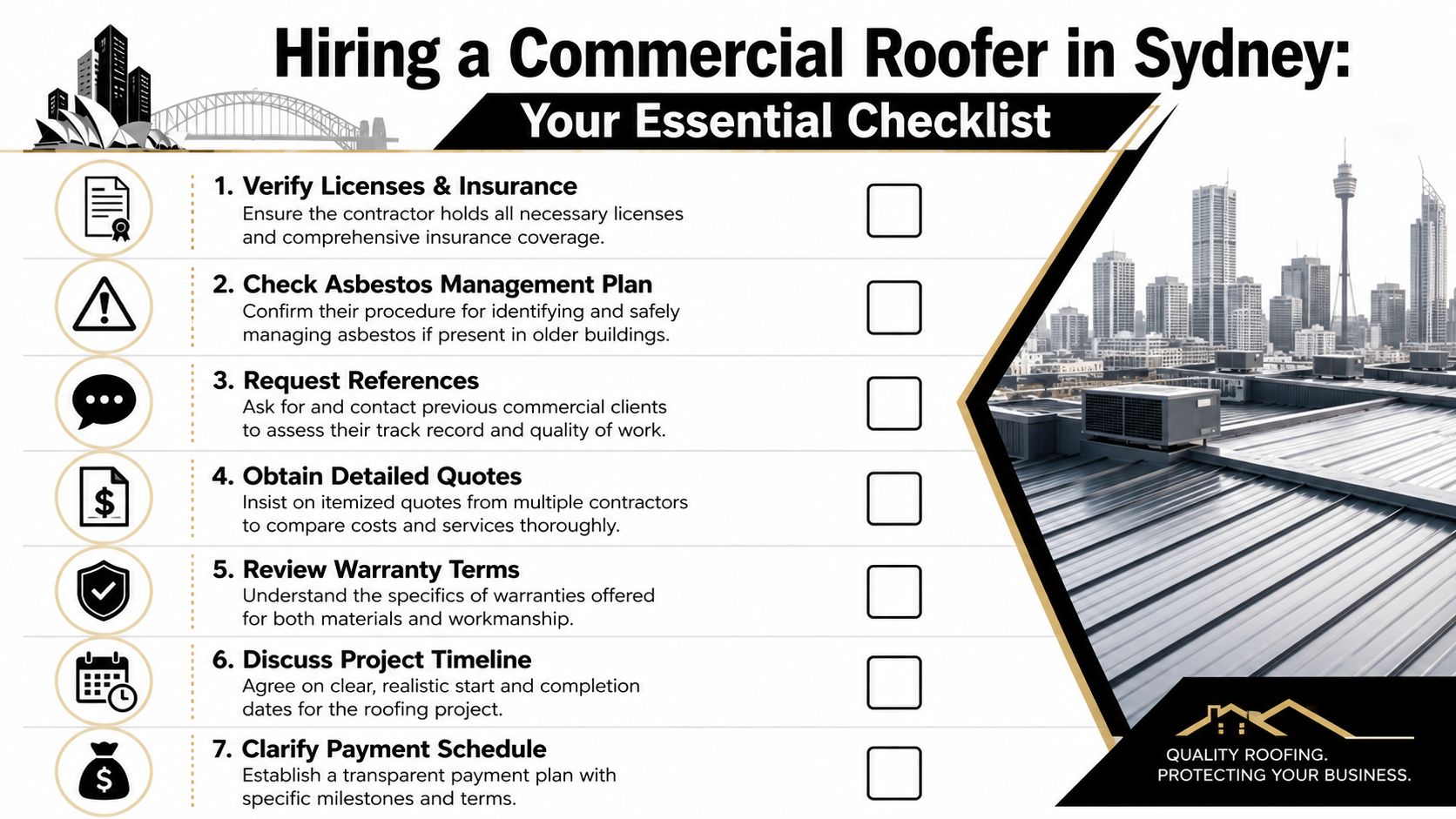
How to vet the contractor
- Verify licences and insurance. Ask for the paperwork before quoting discussions go any further.
- Check asbestos management procedures. Older Sydney buildings need a clear plan for identification and safe handling.
- Request recent commercial references. Talk to owners of warehouses, strata blocks, or retail assets, not just domestic clients.
- Demand itemised quotes. Separate removal, disposal, access, repairs, and installation so you can compare properly.
- Review warranty terms. Make sure materials and workmanship are covered in writing.
- Set the project timeline early. Agree on start, staging, and completion windows so your operations team can plan.
- Clarify payment milestones. Never rely on loose verbal terms when the roof is a major capital expense.
The internal guide on Sydney commercial roofers is a useful companion when you're shortlisting contractors and want to see how a professional commercial outfit should present itself: Sydney commercial roofers guide.
You should also insist on a clear site access plan. If the contractor says they'll “work around it”, press for details. Where will materials be stored, how will waste be removed, and what happens if tenants or deliveries need to keep moving? Those answers separate a true commercial roofer from a generalist with a ute and a ladder.
The best time to negotiate is before mobilisation, not after the first pallet arrives. Lock in the scope, lock in the exclusions, and make sure the warranty language is in the contract, not just in the sales pitch.
A CTA for Commercial Roofers.