
Bonded asbestos roof removal in Brisbane typically sits around $32–$46 per m², while friable material is roughly $107–$155 per m², and jobs over 10 m² need a licensed contractor. If you've just opened a warehouse file, seen ageing fibro sheets, and realised the roof may be pre-1990, the right move is to stop the work line and confirm exactly what's up there before anyone cuts, drills, or strips a sheet.
That's the practical starting point for asbestos roof removal Brisbane owners, because the issue is rarely just the roof material. It's the access plan, the licence class, the disposal pathway, the tenant schedule, and whether the building can keep operating while the job is handled properly.
Table of Contents
- Why Brisbane Commercial Roofs Still Contain Asbestos
- Inspecting and Testing Your Roof Safely
- Queensland Licensing and the 10 m² Rule
- Step-by-Step Safe Removal on Commercial Roofs
- Cost, Timeline and Downtime Planning
- Choosing the Right Replacement Roof System
- Vetting Your Brisbane Contractor and Final Checklist
Why Brisbane Commercial Roofs Still Contain Asbestos
A Brisbane warehouse owner often first notices it as weathered sheet edges, old fixing lines, or a roof that still looks like the original build. If the building predates 1990, the chance of asbestos-cement roofing being present is still real, and the decision point is not whether the roof has aged, it's what material it's made from and how it will be handled.
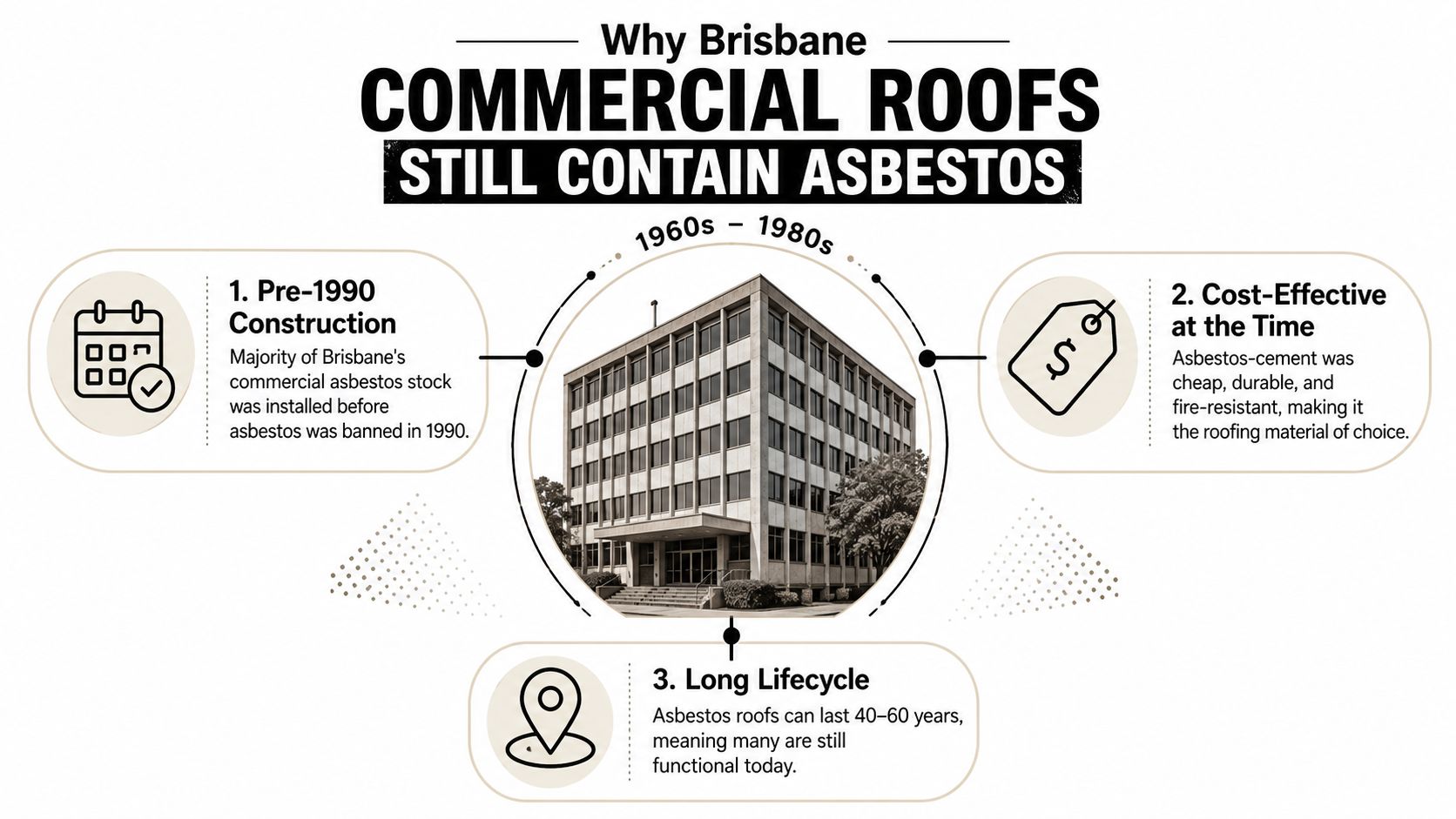
Nationally, asbestos is still a live legacy problem. An estimated 6.2 million tonnes of asbestos legacy material was still in the built environment in 2021, and asbestos makes up 21% of Australia's hazardous waste. Disposal volumes also rose from about 315,000 tonnes in 2006–07 to 1.7 million tonnes in 2018–19, before settling at 1.2 million tonnes in 2023–24 asbestos facts and figures guidance. That tells you removal work is still happening at scale, not fading away.
Bonded and friable are not the same problem
Most Brisbane commercial roofs you'll encounter are bonded asbestos, also called non-friable. The fibres are locked into a cement matrix, so the sheet is less likely to release fibres unless it's cut, broken, or badly weathered. Friable asbestos is the more dangerous category, because it can be crumbled by hand pressure and releases fibres much more readily.
That distinction drives almost everything. It affects the licence class, the level of containment, the cost, and whether the job is a controlled roof strip or a much more tightly managed removal project. It also explains why a visual guess is never enough on its own.
Practical rule: If the roof is old, brittle, patched, or uncertain, treat it as asbestos until a proper inspection confirms otherwise.
For Brisbane roof owners, the next move is straightforward, test before you disturb anything. On a commercial or industrial site, a wrong assumption becomes expensive fast because roof areas are larger, access is harder, and waste handling scales with the size of the building.
Inspecting and Testing Your Roof Safely
A proper roof check starts from the ground and moves up only as far as the condition allows. On a commercial roof, the inspector is usually looking for the same practical signs every time, sheet condition, broken edges, rusted fixings, lichen growth, water damage, stained laps, suspect gutter linings, and any areas where the surface looks soft or disturbed.
What a competent inspection should cover
A good report doesn't just say “possible asbestos”. It should identify the roof zones, note visible deterioration, record the material type if it can be confirmed visually, and say whether sampling is needed. If the building is occupied, that report also needs to factor in safe access, fall risk, and whether parts of the roof can be isolated without interrupting the whole tenancy.
I've seen too many jobs delayed because someone relied on a quick look from a ladder or an old file note from a previous tenant. That's not enough for a commercial reroofing decision. If the roof is under suspicion, a licensed sample collection and NATA-accredited lab analysis is the clean way to confirm what's there.
Don't let curiosity become disturbance. A roof sample should be taken by someone who knows how to minimise breakage and keep the area controlled.
If you're reviewing related rooftop access items at the same time, the safety sequence around anchors and access points matters too. A practical reference is the guidance on safety roof anchors, because access planning and asbestos control often intersect on the same roof.
What to ask for before you sign off on works
- Roof identification: Ask whether the report distinguishes bonded from friable material.
- Photo evidence: Insist on dated photos of the roof zones and any suspect defects.
- Lab confirmation: If samples are taken, ask for the laboratory result and chain of custody.
- Scope notes: Make sure the report says whether removal, encapsulation, or replacement is the likely path.
- Access risks: Check whether fall protection, edge protection, or tenant exclusion is required.
The purpose of the inspection is not paperwork for its own sake. It's to create a defensible scope before anyone touches the roof. Once that's in place, the contractor can price the actual job instead of guessing at it.
Queensland Licensing and the 10 m² Rule
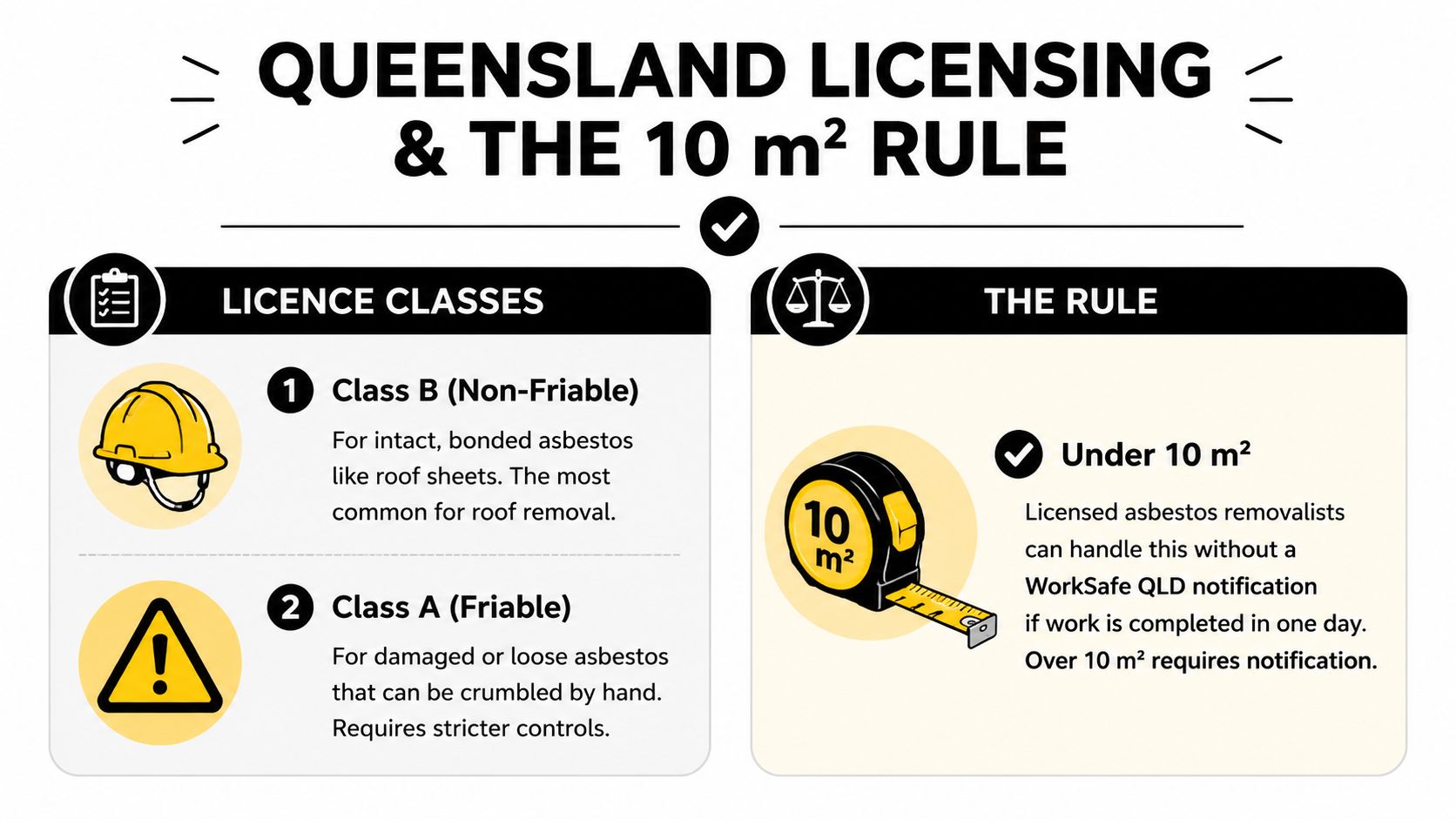
A Brisbane warehouse roof can look straightforward from the ground, then the paperwork tells the story. Queensland separates the work by material type and by quantity. Class B licence holders handle non-friable asbestos, while Class A licence holders are required for friable material. Queensland Health also draws a practical line for non-friable material, more than 10 m² moves the job into a licensed removal pathway. Smaller owner-builder or DIY work still needs safe procedures and, where relevant, a certificate Queensland homeowner certificate guidance.
For a commercial roof, the bigger issue is rarely just the licence class. It is whether the work can be carried out without disrupting tenants, dock access, deliveries, or plant rooms. That is why the compliance file needs to match the operating plan, not just the asbestos register.
A solid job file should include a risk assessment, a controlled method statement, a decontamination plan, a clearance certificate, and the waste dockets from licensed disposal. Those records let the owner, strata committee, or facility manager show the work was handled properly, and they also help the contractor sequence the job around occupied parts of the site.
The national standard sits over the top of that paperwork. Safe removal work must follow the Safe Work Australia code of practice with controlled techniques, decontamination, and clearance before reoccupation, while friable work adds air monitoring and formal clearance requirements. In practical terms, the licence only answers who is allowed to do the work. The job file shows how the control measures were applied.
How the rule affects the job plan
- Under 10 m² of non-friable material: Some owner-builder or small-job pathways may apply, but the work still has to be controlled and cannot be treated casually.
- Over 10 m² of non-friable material: A licensed removalist is expected, along with formal controls and documentation.
- Friable material at any size: Treat it as specialist work that requires the higher licence class and tighter containment.
If you are comparing contractors, ask a blunt question, “Who signs the clearance and who disposed of the waste?” If that answer is vague, the job file is weak. On a commercial asset, that usually means higher risk at handover and more friction if the tenant, insurer, or building manager asks for proof later.
For roof specification language, trade sequencing, and the way asbestos removal sits inside a wider reroofing scope, roofing standards Australia is a useful cross-check.
Step-by-Step Safe Removal on Commercial Roofs
On a commercial roof, the safe sequence is methodical, not dramatic. The Queensland trades guidance sets out the practical order, isolate the area, turn off electricity, wet the sheets with a fine spray, remove fixings without breaking the sheet, then double-wrap the waste and send it to a licensed disposal facility Queensland asbestos home renovators and trades guide. High-pressure water is off the table because it can drive fibres into the air.
For a warehouse, the roof plan has to work around people as much as materials. Tenants still need access to loading docks, staff still move through car parks, and plant may still be running below the work zone. That is why the job starts with controls on access and services, not with tools on the roof.
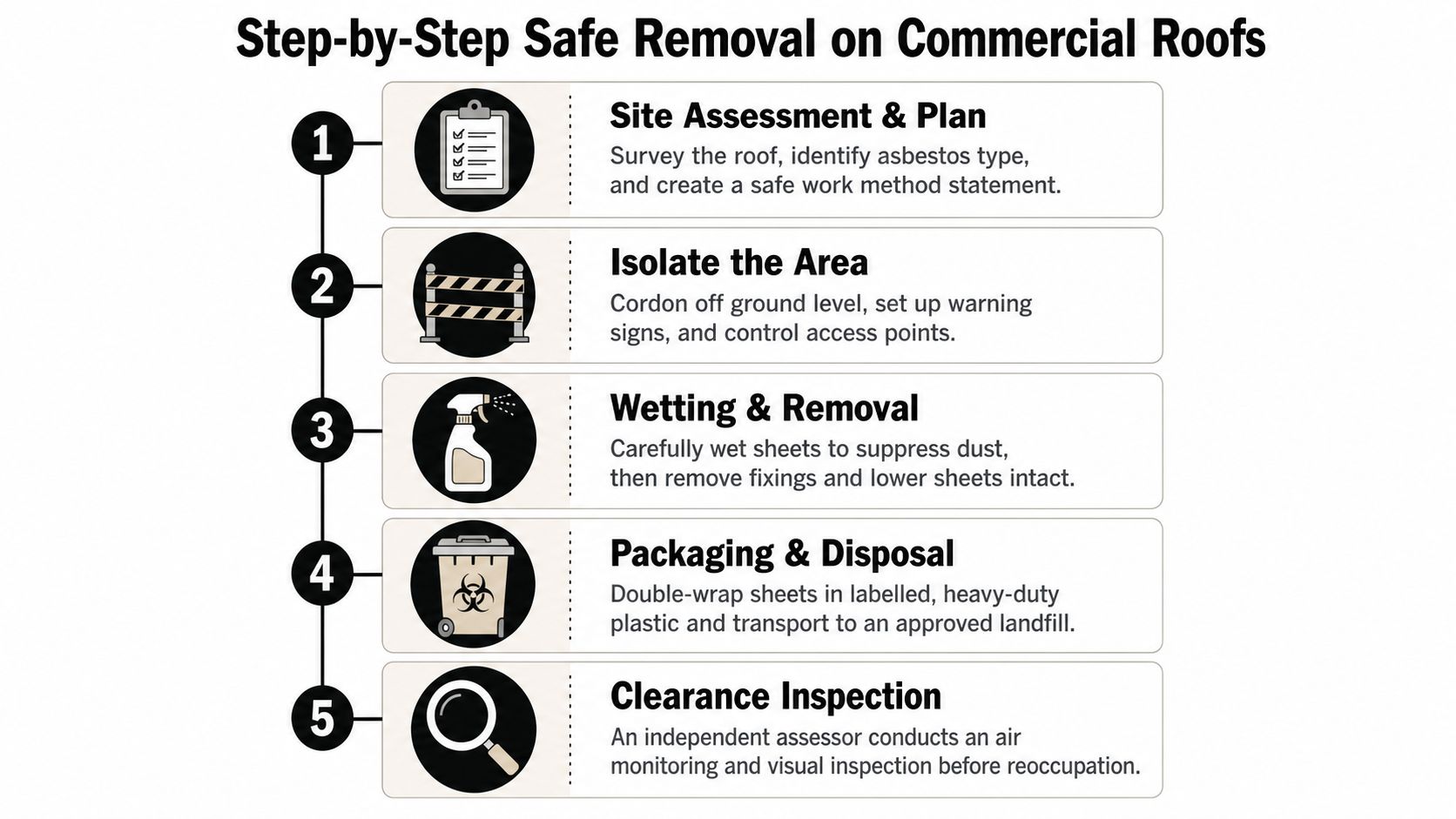
The first control is site isolation. Ground access gets cordoned off, signage goes up, and the team controls who can move through loading docks, car parks, and adjacent tenancy entries. Then the electrician isolates power where the roof work could affect services or plant.
After that, the crew wets the roof sheets with a fine spray. The wetting reduces dust, but it also creates a slip hazard, so fall protection and roof edge controls must be part of the method statement. Once the sheet is stable enough, the fixings are removed carefully so the sheet can come down intact instead of shattering on contact.
Wet method only works when the roof is still handled gently. Spray is not a licence to rush.
What a contractor should be doing on the day is straightforward.
- Controlled access: Keep tenants, staff, and contractors out of the active zone.
- Low-pressure wetting: Use moisture to suppress dust, not water blasting.
- Intact sheet removal: Lift, lower, and package sheets without breakage.
- Heavy plastic wrap: Double-wrap waste in labelled plastic for transport.
- Final clean-up: Use HEPA clean-up and decontamination before clearance.
The national code also requires decontamination and clearance before reoccupation, and that matters on occupied commercial sites. If a contractor's method skips a step, the risk does not stay on the roof. It shows up in the air, the gutters, the yard, and the disposal record.
What you want to see is a job plan that treats the roof as a live worksite, not a demolition shortcut. That is the difference between a compliant strip and a site that has to be re-cleaned, rechecked, or partially shut down.
Cost, Timeline and Downtime Planning
Brisbane pricing for asbestos roof removal is wide for a reason. The local guides place bonded asbestos removal at $32–$46 per m² and friable material at $107–$155 per m², while replacement-inclusive figures range from $8,000–$20,000, $14,000–$40,000+, and $18,000–$32,000 depending on the source and job profile Brisbane asbestos cost guide. Those figures don't mean your quote should land in one exact band. They show how much the scope can shift when the roof gets larger, more difficult, or bundled with replacement.
What pushes the number up
Roof size is only the starting point. Access matters, height matters, pitch matters, and whether the building is occupied matters. If the job needs scaffolding, crane lifts, extra exclusion zones, or a staged shutdown around tenants, the project becomes slower and more complex.
Bundling other work changes the cost profile too. Gutters, insulation, solar hardware, structural upgrades, and replacement sheeting all add coordination points. In practical terms, a removal-only job is usually simpler to program than a full reroof with weather protection, tenant communication, and separate trade sequencing.
How to plan around operations
On occupied warehouses and strata assets, the key consideration is downtime. A good contractor should tell you whether the roof can be phased by bay, whether tenants need a weekend move-out window, and whether loading dock activity can continue on the non-active side of the building. If they can't explain that, they're only quoting the material, not the disruption.
A useful way to budget is to separate the quote into three lines, removal, replacement, and contingency. The contingency isn't optional on a commercial roof, because once the sheets come off, hidden corrosion or failed battens can change the scope fast. That's not a scare tactic, it's standard project risk on older stock.
Ask for the quote to show what happens if the roof needs extra access equipment or unexpected structural repair. If it's not written down, it's usually not included.
If the site has customers, tenants, or production crews on it, schedule communication as part of the build plan. That usually means a work window, access notices, and a clear line on who closes what, when. A job that is priced well but communicated badly still costs you in interruption.
Choosing the Right Replacement Roof System
A roof replacement after asbestos removal should suit the building's use, span, and access requirements, not just the product brochure. On many Brisbane commercial and industrial sites, Colorbond metal roofing is the practical default because it is light, familiar to most crews, and works well over large spans. Where the building presents more to the street, standing seam or snap-lock profiles can give a cleaner architectural finish for premium façades and visible elevations.
The replacement decision also affects how the job is staged. A lighter metal system usually places less load on the structure, which matters if the existing frame is older or if the roof is being replaced while the building stays in use. Heavier options can still be suitable where the structure is built for them, but they change the engineering check, the install sequence, and often the lead time for coordination.
If you want a closer trade comparison, the material discussion in metal roofing Australia gives a useful reference point for how modern metal systems behave on Australian roofs.
What matters on a commercial roof
Warehouse and factory roofs usually come down to span, weight, and install efficiency. A system that stays light and goes on cleanly is easier to coordinate around tenants, dock traffic, and weather windows. Retail and strata sites often bring different priorities. Appearance matters more, and so does noise control if people work or live beneath the roof.
Concrete or metal tile can suit some buildings where the structure has been designed for it, but it is rarely the first choice for a broad industrial roof plane. Metal cladding profiles usually align better with larger commercial spans, and they leave more room for future work such as insulation upgrades or solar mounting. The question is straightforward, what does the roof need to do after the asbestos is gone?
What to compare in the quote
- Weight and span suitability: Confirm the existing structure can carry the new system without unnecessary strengthening work.
- Thermal performance: Ask how the new roof will work with insulation upgrades and internal heat control.
- Acoustic behaviour: Rain noise can matter on occupied sites, especially where there are offices, tenants, or residential interfaces.
- Warranty terms: Check both the material warranty and the labour coverage so there is no confusion later.
- Integration: Make sure the roof system suits gutters, flashings, skylights, and any solar hardware already on site.
The quote should also explain any interface work. If the new roof has to tie into existing gutters, old flashings, plant equipment, or a future solar plan, that detail belongs in writing before the job starts. Hidden coordination issues are what turn a simple replacement into a drawn-out site problem.
A roof replacement is not just a compliance exercise. It is a building performance decision, and the wrong system creates a maintenance issue after the asbestos problem is already solved. The right system gives you a cleaner envelope, a roof that suits the way the building is used, and a site that is easier to manage from that point on.
Vetting Your Brisbane Contractor and Final Checklist
A commercial asbestos roof job should be awarded on proof, not reassurance. Start with the licence, confirm the contractor has the correct QLD asbestos licence class, then ask for public liability and workers compensation evidence, the safe work method statement, the clearance process, and the disposal chain. If they're handling commercial work properly, none of that should feel awkward.
What to verify before you accept the quote
- Verify the licence: Confirm they hold the right QLD asbestos removal licence for the material type.
- Check the insurances: Ask for current public liability and workers compensation certificates.
- Request the documents: Get the safety plan, risk assessment, and commercial references.
- Hear the process: They should explain wetting, waste handling, and clearance testing clearly.
- Compare the quote detail: Make sure testing, removal, disposal, and clearance are separated.
That level of detail matters because Brisbane service pages often stop at “call for a quote.” For an occupied warehouse or strata building, the quote has to explain tenant communication, staging, and what happens if the crew finds friable material after opening the roof. If that possibility isn't addressed, you're not comparing like-for-like bids.
A practical rule is to ask for the disposal facility name and the waste docket path up front. If the contractor can't tell you where the waste is going, or how clearance is signed off, the paperwork chain is weak. On commercial sites, weak paperwork becomes a delay when the owner, insurer, or tenant asks for evidence.
The contractor you want is the one who can explain the job without overselling it.
If you want a single action from this point, book an assessment, get the roof identified, and collect two comparable quotes that spell out the licence, disposal, and clearance steps. If you're managing a live commercial asset, that's the fastest way to turn a discovery into a controlled project instead of a shutdown.
If you need a Brisbane commercial roof team that can assess asbestos risk, plan the removal sequence, and quote the reroofing work in a way that makes sense for an occupied site, contact Commercial Roofers and ask for a commercial roof inspection and written scope.