
The storm has passed, the yard is littered with debris, tenants are calling, and someone in the office has already asked the question that matters most: is the roof just dented, or do you have a real operational problem?
For Sydney commercial and industrial properties, that question can't be answered with a quick glance from the car park. A hail damage roof on a warehouse, factory, strata complex, retail site, or logistics building carries a different level of risk to a standard house. You may be dealing with long runs of metal sheeting, roof penetrations, box gutters, skylights, plant platforms, internal stock exposure, access restrictions, and in older assets, asbestos. The financial issue isn't just the roof repair. It's water entering stock areas, disruption to trading, WHS exposure, tenant complaints, and a claim that can go sideways if the damage is poorly documented.
A practical response has to do two things at once. It must reduce immediate loss, and it must protect the long-term value of the asset.
Table of Contents
- Responding to Sydney's Worsening Hail Threat
- Immediate Actions After a Hailstorm
- Documenting Damage for Your Insurance Claim
- Repair or Replace Evaluating Your Roof's Future
- How to Select and Manage a Sydney Commercial Roofer
- Building Resilience for the Next Storm
Responding to Sydney's Worsening Hail Threat
If you manage commercial property in Sydney, hail isn't a rare interruption anymore. It's part of the risk profile of the asset. Research tracking Australian hail conditions found that while hail-prone days fell across much of the country from 1979 to 2021, they rose by about 40% in heavily populated areas such as Sydney because of increased atmospheric instability, which means commercial roofs in NSW are exposed to more frequent hail events than they were in earlier decades (Australian hail trend research).
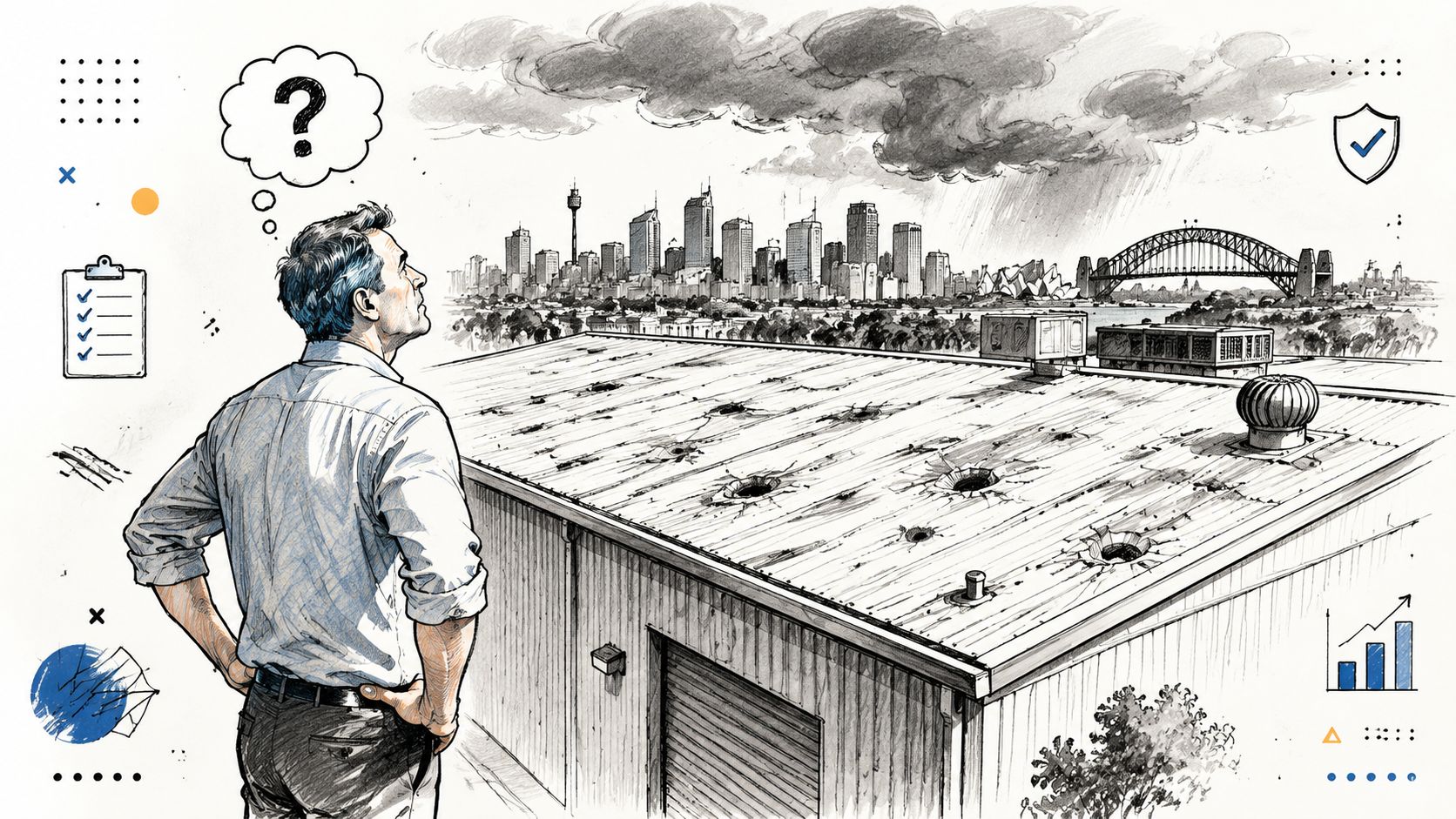
That matters because commercial roofs fail differently from house roofs. A dented sheet over a warehouse bay can become ponding. A chipped coating can become corrosion. A cracked skylight can become an internal safety incident. Water ingress over switchboards, racking, stock, medical spaces, food preparation areas, or common areas creates a chain of costs that usually outweighs the visible roof damage.
The commercial risk isn't only the sheeting
On Sydney industrial sites, the roof often sits over business-critical operations. One leak over dispatch can stall freight. One wet ceiling over a tenancy can trigger complaints and access issues. On strata and mixed-use assets, the pressure comes from multiple directions at once: owners, tenants, insurers, and contractors.
The practical problem after a hail event is that visible dents don't tell the whole story. A roof can still be shedding water today and still be on the path to future failure if laps are distorted, gutters are holding water, or coatings have been broken.
Practical rule: Treat hail as an asset-management problem, not just a maintenance call-out.
Why Sydney owners need a sharper response
Generic homeowner advice usually stops at “check for damage and call your insurer”. That's not enough for a factory, warehouse, shopping strip, school, health site, or strata block. You need to manage safety, preserve evidence, keep operations moving where possible, and make decisions that won't create trouble at the next claim.
The fastest way to lose control of a hail damage roof issue is to treat it as cosmetic before the roof has been properly assessed.
Immediate Actions After a Hailstorm
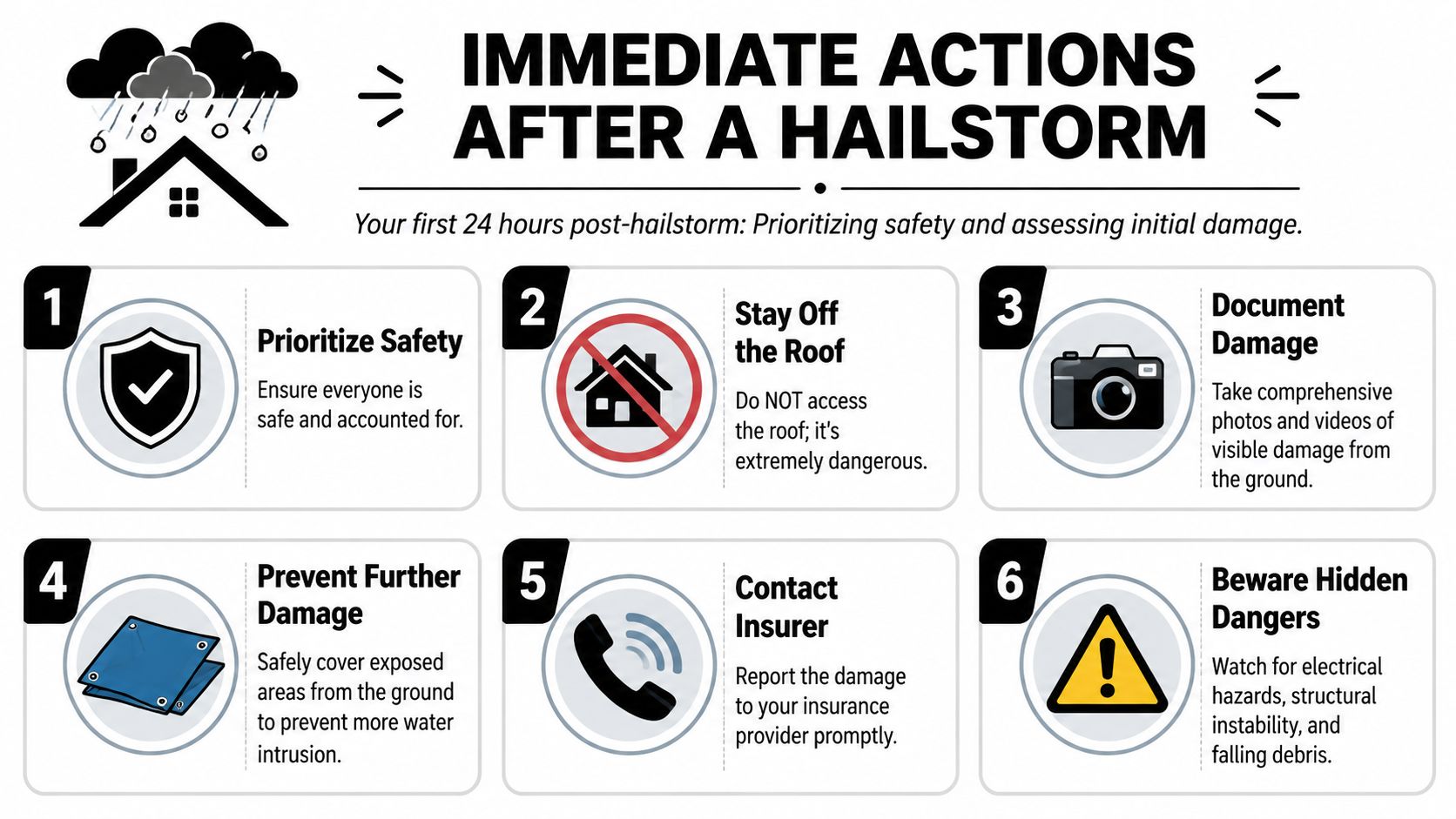
The first day matters. Not because you can complete the whole process in that window, but because the first decisions usually determine whether the loss stays contained or spreads into a bigger operational problem.
What not to do in the first few hours
Don't send staff onto the roof. That includes maintenance staff, warehouse managers, and anyone “just having a look”. After hail, roof sheets can be slippery, skylights may be compromised, debris can hide trip points, and any water ingress can create electrical hazards below.
If the building is older, don't disturb suspect asbestos materials. On older industrial and commercial sites, hail impact can crack or weaken brittle roofing products. Access, handling, and temporary works need to be considered through a safety and compliance lens, not just a maintenance lens.
Start with site control:
- Keep people clear of danger zones: Isolate areas under active leaks, ceiling sag, broken skylights, or falling debris.
- Protect electrics first: If water is entering near lighting, switchboards, or plant, get a qualified electrician involved before anyone starts makeshift containment.
- Stop unplanned roof access: One poor decision after a storm can create an injury claim on top of the property claim.
What to check safely from the ground and inside
A useful first inspection is done without climbing the roof. Walk the perimeter. Use binoculars if needed. Get inside the ceiling line or service areas only where it's safe.
Look for the signs that usually show up early:
- Metal impact marks on downpipes, flashings, roller doors, cappings, louvres, and exposed plant covers.
- Cracked skylights or rooflights, even if they haven't fully failed.
- Internal water entry such as ceiling stains, wet insulation, dripping purlin lines, moisture around penetrations, or pooling on floors.
- Blocked drainage points where leaf litter, broken material, or displaced debris may stop runoff.
- Damage spread across other surfaces like fencing, signage, wall cladding, and vehicles. That helps establish storm severity.
Record what you can see before cleaners, staff, or emergency trades change the evidence. If you need a formal condition report, book a commercial roof inspection in Sydney rather than relying on guesswork.
A roof can look serviceable from the ground and still have hail damage that affects overlaps, drainage, or protective finishes.
The reason this matters is simple. Testing presented on major Australian hail events showed that hailstones of 6 cm and larger caused significant damage to metal sheet roofs, with 4 out of 5 tested sheets damaged, including dents that can chip coatings and speed up corrosion (Australian severe hailstorm testing summary).
Temporary protection that actually helps
Temporary works should reduce loss, not create new liabilities. The best immediate measures are the boring ones done properly.
- Use internal containment: Buckets, floor protection, stock relocation, and isolation of wet zones can prevent damage escalation while you wait for roof access.
- Divert water carefully: If downpipes or gutters are overflowing, clear accessible ground-level discharge points only where it's safe.
- Cover exposed assets: Wrap pallets, move electronics, protect sensitive stock, and relocate vehicles or machinery from known leak paths.
- Install temporary external protection only with proper access equipment: Tarps thrown over a roof by unqualified people usually fail, flap loose, or make later inspection harder.
If you're managing tenants, send a written incident update early. State what areas are isolated, what temporary protections are in place, and when the formal inspection is expected. That reduces noise and preserves a record that you acted promptly.
Documenting Damage for Your Insurance Claim
Most commercial hail claims are won or lost on documentation quality. Not on how obvious the damage looks to you on day one.
The reason owners get caught is that insurers often separate functional damage from aesthetic damage. If your evidence only shows dents, the claim discussion can narrow very quickly. If your evidence shows likely effects on water shedding, coating integrity, laps, penetrations, gutters, or service life, the conversation changes.
Build evidence before opinions harden
Start with a dated photo and video record. Use your phone, but do it methodically. Don't rely on a handful of close-ups sent over text.
Capture the building in layers:
- Wide shots: Entire roof planes from multiple sides, building elevations, and surrounding site impact.
- Mid-range shots: Specific roof areas, gutters, box gutters, ridge lines, parapets, skylights, vents, and plant surrounds.
- Close-ups: Dents, chipped finishes, displaced laps, cracked translucent sheets, punctures, failed sealant, and internal leak points.
- Inside the building: Ceiling stains, wet insulation, stock impact, water on floors, affected electrical areas, and any temporary containment.
- Storm context: If safe, photograph hailstones, debris, damaged vehicles, dented downpipes, and neighbouring property impact.
Video is valuable because it shows continuity. Walk the perimeter slowly. Narrate location and what the camera is looking at. On large commercial sites, confusion about where a defect sits is common.
What insurers often call cosmetic
Many owners are at a disadvantage. The metal roof may still appear intact, but claim decisions often turn on whether the damage reduces water shedding capacity or lifespan. Industry guidance notes that commercial metal roof claims are often denied for minor dents because insurers may only cover damage that reduces water shedding capacity or lifespan, yet repeated hail impact can chip protective coatings and lead to hidden corrosion that isn't obvious in the first inspection (metal hail claim guidance for Australian owners).
That means your evidence should go beyond “the roof is dented”.
Ask your roofer to identify and photograph:
- Coating loss or breakage on impacted metal surfaces
- Deformed overlaps or side laps
- Areas where indentations hold water
- Damage around fasteners, flashings, penetrations, and gutters
- Any signs the storm affected the roof's likely service life
If you need a clearer sense of the financial side before agreeing to a scope, review a commercial roof repair cost guide so you can compare insurer allowances against realistic work items.
Claims advice: Don't argue “it looks bad”. Argue how the hail damage roof issue affects drainage, protection, compliance, or service life.
What to hand over to the assessor
When the assessor attends, give them an organised file, not a pile of random photos. A clean submission usually includes:
| Document | Why it matters |
|---|---|
| Incident timeline | Shows prompt action and supports mitigation efforts |
| Photo log by area | Helps connect each defect to a roof zone or tenancy |
| Video walkthrough | Gives context on spread and severity |
| Leak register | Ties roof impact to internal damage and business interruption |
| Independent roofing report | Supports technical issues beyond surface appearance |
| Temporary works record | Shows you acted to prevent further loss |
Keep communication in writing wherever possible. Confirm phone calls by email. If the assessor describes damage as cosmetic, ask them to respond specifically to ponding risk, overlap deformation, cracked translucent sheets, chipped protective finishes, and internal water entry.
A commercial claim is easier to manage when the roof report is technical, site-specific, and tied to consequences the insurer can't dismiss as mere appearance.
Repair or Replace Evaluating Your Roof's Future
The wrong question is “Can this be patched?” The better question is “What option gives this asset the safest and most economical service life from here?”
After a major hail event, repair may be the right answer. In other cases, it only delays a more expensive replacement while leaving you with ongoing leak risk, poor appearance, tenant complaints, and future insurance friction. The decision should be based on roof type, age, access, damage pattern, compliance exposure, and how critical uninterrupted operation is on the site.
When repair is reasonable
Repair usually makes sense when the roof system is structurally sound and the storm has caused isolated functional defects rather than broad deterioration.
For commercial COLORBOND® steel roofing, technical guidance from the steel industry states that 0.42 mm base metal thickness is the critical specification. Indentations may occur, but they generally don't shorten roof life unless they create ponding in low-pitched pans or deform overlaps. If hail creates ponding, the affected sheets should be replaced to prevent corrosion (technical bulletin on hail impact to steel roofing).
That gives owners a practical test. Dents alone are not the only issue. The main questions are:
- Does water still shed correctly?
- Have any sheet laps or overlaps distorted?
- Is there localised ponding after rain?
- Have penetrations, flashings, gutters, or translucent sheets failed?
- Can damaged sections be replaced without creating a patchwork roof with mismatched performance?
If the answer points to isolated problems, a targeted sheet replacement and detail repair can be sensible.
When replacement is the smarter commercial move
Replacement becomes more attractive when the damage is widespread, the roof is already late in its life, or the building carries higher compliance and continuity risk.
This is common on:
- Large warehouse roofs with repeated impact across broad sheet areas
- Industrial sites where corrosion risk can't be tolerated around stock, plant, or process areas
- Older roofs with pre-existing leaks, failed fasteners, brittle skylights, or poor drainage design
- Asbestos roofs where breakage, disturbance, or access limitations make piecemeal repair unsafe or non-viable
Asbestos deserves blunt treatment. If hail has affected an asbestos roof, the first issue is not appearance. It's safety, legal compliance, and whether any proposed repair method is even appropriate. Temporary patching may keep water out briefly, but it doesn't solve the underlying material risk. On many sites, certified removal and compliant replacement is the only defensible long-term path.
If hail has turned an old roof into a reliability problem, replacement is often cheaper than repeated emergency responses, tenant disputes, and patchwork claims.
Decision Matrix Repair vs Full Replacement
| Consideration | Favours Repair | Favours Replacement |
|---|---|---|
| Damage spread | Localised defects in specific areas | Broad impact across multiple roof planes |
| Drainage performance | No ponding, laps remain sound | Ponding, distorted overlaps, recurring overflow |
| Roof age and condition | Roof otherwise in solid serviceable condition | Existing wear, prior leaks, corrosion, brittle components |
| Material type | Modern metal roof with isolated replaceable sheets | Asbestos, heavily weathered systems, mixed old repairs |
| Business continuity | Repair can be staged with little disruption | Ongoing patching would repeatedly disrupt operations |
| Insurance position | Scope supports practical targeted rectification | Scope likely to become fragmented and disputed |
| Asset strategy | Short- to medium-term hold | Long-term hold, tenant retention, capital improvement plan |
The real trade-off owners often miss
Repair has a lower immediate spend. Replacement often gives the lower whole-of-asset risk.
That doesn't mean every dented roof should be replaced. It means you should weigh future call-outs, access costs, water damage exposure, presentation, compliance, and the quality of the remaining roof. A cheap repair on a high-value industrial building can become the most expensive option if it leaves you with recurring defects and a roof no one wants to stand behind.
Where owners get into trouble is approving a scope that fixes the visible failure but leaves drainage detail, old translucent sheeting, box gutters, and fragile accessories untouched. That's how the same roof returns to the maintenance list after the next heavy rain.
How to Select and Manage a Sydney Commercial Roofer
Storms attract opportunists. Some disappear after the deposit. Others produce vague scopes, use labour with the wrong tickets, or promise insurance outcomes they can't control. On a commercial site, poor contractor selection can create compliance problems long after the hail claim is closed.
The checks that matter before anyone starts work
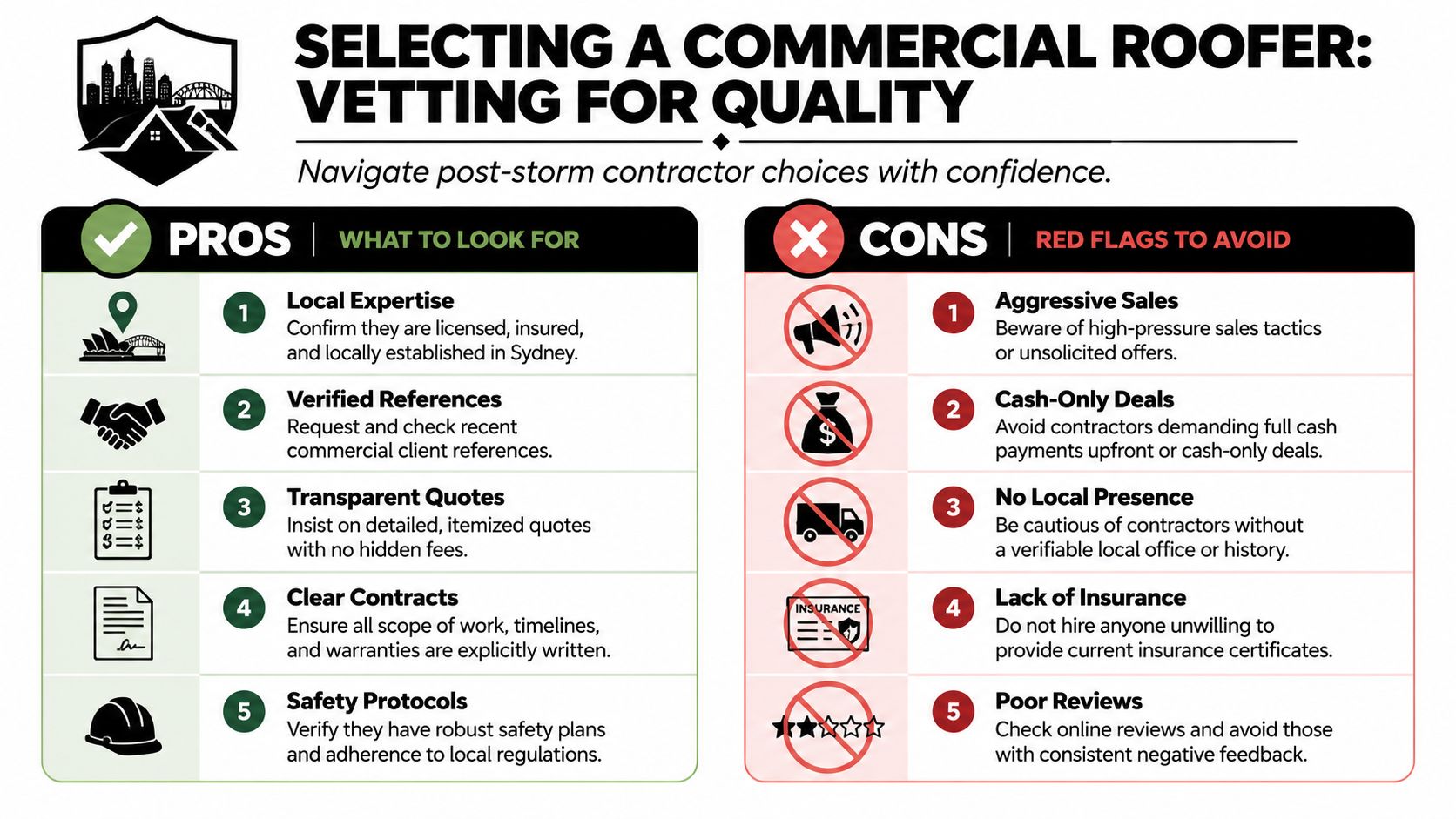
A proper commercial roofer should be easy to verify. Ask for documents, not promises.
Check these items first:
- Licensing and trade scope: Make sure the contractor's licence matches the actual work proposed. If asbestos may be involved, confirm the relevant licensed removal pathway rather than assuming it can be handled later.
- Insurance certificates: Public liability, workers cover, and any other project-relevant cover should be current and available for review.
- Commercial project history: Ask for recent examples involving warehouses, factories, strata blocks, schools, or other similar assets.
- Methodology: They should explain access, protection of occupants, staging, waste handling, weather contingency, and how they'll manage operations below.
- Detailed quote: You want sheet profile, thickness, finishes, flashing scope, gutter work, penetrations, skylight treatment, disposal, and exclusions spelled out.
A vague quote is dangerous because it lets essential items fall into “variations” later. If you're comparing contractors, use a consistent brief and compare like for like. If you need a starting point, review options from a Sydney commercial roofer near you and use that as a benchmark for what a credible service scope should cover.
Why cash settlement shortcuts often backfire
Many owners are tempted to take a cash payout and “sort it out privately”. On paper, that sounds efficient. In practice, it can create future problems that cost far more than the convenience is worth.
The issue isn't that private repairs are always wrong. It's that cash settlement decisions can carry hidden risks including non-compliant work, no warranty coverage, and future insurance denial where repairs can't be verified, which is a serious problem for commercial assets (discussion of risks around cash settlements and unverified repairs).
The risk is higher on commercial and industrial sites because the work often involves:
- licensed access systems
- engineered details
- compliant disposal
- asbestos controls
- fire and weatherproofing interfaces
- documented materials and warranties
If a future storm hits and the prior work can't be proven, owners can find themselves arguing not only about new damage, but about whether previous repairs were compliant at all.
Cheap storm work rarely stays cheap. It usually reappears later as a warranty dispute, a leak, or an insurance argument.
Managing the job without losing control of your site
Once you appoint a roofer, don't step back completely. Commercial roofing projects need active client oversight.
Set these rules at the start:
- One contact person each side. Mixed instructions cause delay and variation disputes.
- Written programme and staging. Agree which roof zones will be opened, when, and what weather controls apply.
- Tenant and staff communication. Advise noise, restricted access, and any shutdown requirements early.
- Safety documentation before mobilisation. SWMS, access methods, exclusion zones, and emergency procedures should be ready before work starts.
- Completion records. Keep photos, delivery dockets, warranties, and any compliance paperwork with the building file.
The best roofing contractor is not just the one who can install sheeting. It's the one who can control risk on a live site and leave a clear paper trail when the work is done.
Building Resilience for the Next Storm
A major hail event forces decisions you may not have planned to make this year. That's frustrating, but it can also improve the asset if you handle it properly.
The practical sequence is simple: inspect, document, protect, evaluate, then engage the right contractor. Owners who follow that order usually make better decisions than those who jump straight from storm damage to the cheapest quote.
A practical resilience plan
Long-term resilience starts with clearer standards for the roof, not just faster repairs after the next storm.
Focus on these areas:
- Scheduled inspections: Large roofs hide problems. Regular inspections pick up drainage defects, loose flashings, aging skylights, and corrosion before a storm turns them into internal damage.
- Detail upgrades: Box gutters, penetrations, laps, and roof-mounted services often cause more trouble than the main field of sheeting.
- Material selection: Where replacement is required, choose products and configurations that suit the building's exposure, pitch, use, and maintenance reality.
- Records management: Keep roof plans, prior reports, warranties, and repair history together. That file becomes valuable the next time an insurer asks what was there before.
Turn a forced repair into an asset upgrade
Sometimes the best outcome after a hail damage roof event isn't restoring the old roof exactly as it was. It's taking the opportunity to fix the weaknesses that were already costing you money.
That may mean replacing brittle rooflights, modernising drainage details, removing asbestos from the maintenance equation, improving access planning, or selecting a stronger metal roofing system for future events. On some assets, the side benefits matter as much as the storm recovery itself. Better presentation, cleaner drainage, reduced emergency call-outs, and a roof system that's easier to insure all improve the building's position.
A roof should do more than keep water out today. It should support continuity, compliance, and predictable ownership costs over time.
If your Sydney warehouse, factory, strata complex, or commercial building has taken hail damage, Commercial Roofers can help you move from emergency response to a compliant long-term fix. Their team handles inspections, reports, repairs, asbestos roof replacement, and full commercial re-roofing across Greater Sydney, with practical advice built around safety, insurance documentation, and minimal disruption to operations.