

If you're reading this, there's a fair chance you're dealing with one of three problems. Water is spilling over a warehouse edge in heavy rain, a strata building has recurring leaks around ageing joints, or you've been asked to replace a tired gutter system without disrupting tenants, deliveries, or site operations.
Commercial gutter installation isn't the same job as clipping a few lengths onto a suburban fascia. On industrial and multi-tenant properties, the implications of error are more serious. Roof areas are larger, runoff loads are heavier, access is harder, and a small error in fall, support, or jointing can turn into internal water damage, façade staining, slip hazards, and disputes about who approved what.
If you want to understand how to install new gutters properly on a commercial property, the job starts well before the first bracket goes up. Capacity, compliance, safe access, material selection, and watertight detailing matter more than shortcuts. Cheap work usually fails at the corners, the outlets, or the fixings.
Table of Contents
- Strategic Planning for Commercial Guttering Projects
- Selecting the Right Gutter System for Your Property
- The Core Installation Process for Commercial Gutters
- Creating Watertight Joints and Corners
- Final Checks and Troubleshooting Common Gutter Issues
- Gutter Installation Costs and Knowing When to Call a Pro
Strategic Planning for Commercial Guttering Projects
A commercial gutter job usually goes wrong before the crew arrives. The common failure is not fixing technique. It is poor planning around catchment, structure, access, approvals, and staging on a live site.
Start with the building, not the product list. A warehouse with long roof runs, a shopping strip with multiple tenancy entries, and an industrial facility with internal box gutters all shed water in different ways. Perimeter measurements are only part of the picture. You need to map how runoff collects, where overflow can escape safely, how many outlets the system needs, and whether the existing stormwater network can take the discharge volume.
That planning step matters more on commercial and industrial assets because the consequences are larger. Overflow at one section can dump water over loading docks, service yards, plant platforms, pedestrian paths, or tenant signage. On box gutter projects, poor early decisions can also create compliance issues if overflow provisions, support details, or falls do not match the roof design.
Council and site requirements need to be checked at the same time. Discharge points, containment, access restrictions, façade conditions, and work-hour limits can all affect the layout. On managed properties, there is also the practical side of tenant notifications, delivery access, and whether changes to profiles, colours, or visible edge details need approval before materials are ordered.
Check the structure, not just the old gutter
A failed gutter often points to a failed edge condition. Before replacement, inspect fascia boards, rafter ends, steel edge members, box gutter supports, overflow paths, and any patch repairs that may have changed the line of the roof edge. On industrial buildings, corrosion at fixing points is common. On older properties, timber movement and long-term water entry often mean the edge is no longer straight enough to accept a new run without correction.
Use a site checklist that covers:
- Mounting condition: Are fascia boards, edge members, and support brackets sound enough for new fixings?
- Roof edge geometry: Will the building take a standard external profile, or does it need box gutters, parapet details, purlin-mounted supports, or custom bracketry?
- Discharge path: Do the existing downpipes and stormwater points still suit the current roof layout and runoff pattern?
- Access and safety: Will the crew need scaffold, EWP access, edge protection, traffic control, or a staged work zone plan?
Practical rule: If the supporting edge is suspect, replacing the gutter first only hides the underlying defect.
For larger assets, staging needs its own plan. Full-perimeter replacement in one hit can leave too much roof edge exposed if weather changes or deliveries slip. A staged sequence usually gives better control around entrances, loading areas, plant zones, and tenanted sections. It also reduces the risk of pulling apart drainage at one end of the property before the replacement section is ready to be made weather-safe.
Where gutter replacement ties into broader reroofing work, review the edge details with the roof program early. Brackets, flashings, cappings, sheet overhangs, and outlet locations need to work together. On projects that include new roof sheeting or perimeter metal, this guide to commercial roof installation sequencing is a useful reference point.
Compliance needs to be settled early
Commercial managers run into trouble when compliance is treated as paperwork after the scope is set. It affects design, sequencing, defect liability, access methods, and handover standards.
If the guttering is relatively recent, check whether the work may still fall within statutory warranty periods before approving replacement. That can shift the right course of action from immediate removal to documenting defects properly and pursuing rectification through the original builder or roof plumber. On a large property, that can prevent avoidable spend and stop the site from paying twice for the same failure.
The same discipline applies to overflow provisions, stormwater connection points, and safe access for future maintenance. Commercial guttering is expected to do more than carry water off the roof. It has to perform under heavy rainfall, suit the building classification, and remain serviceable after handover. Cheap shortcuts at planning stage usually come back as leaks, ponding, corrosion, access problems, or tenant complaints.
Selecting the Right Gutter System for Your Property
A distribution warehouse with a wide roof span can dump a lot of water onto one gutter line in a short storm. If the profile is undersized or the metal is wrong for the exposure, the result is usually predictable. Overflow at entries, staining down the facade, corrosion around outlets, and repeat callouts that cost more than the original saving.
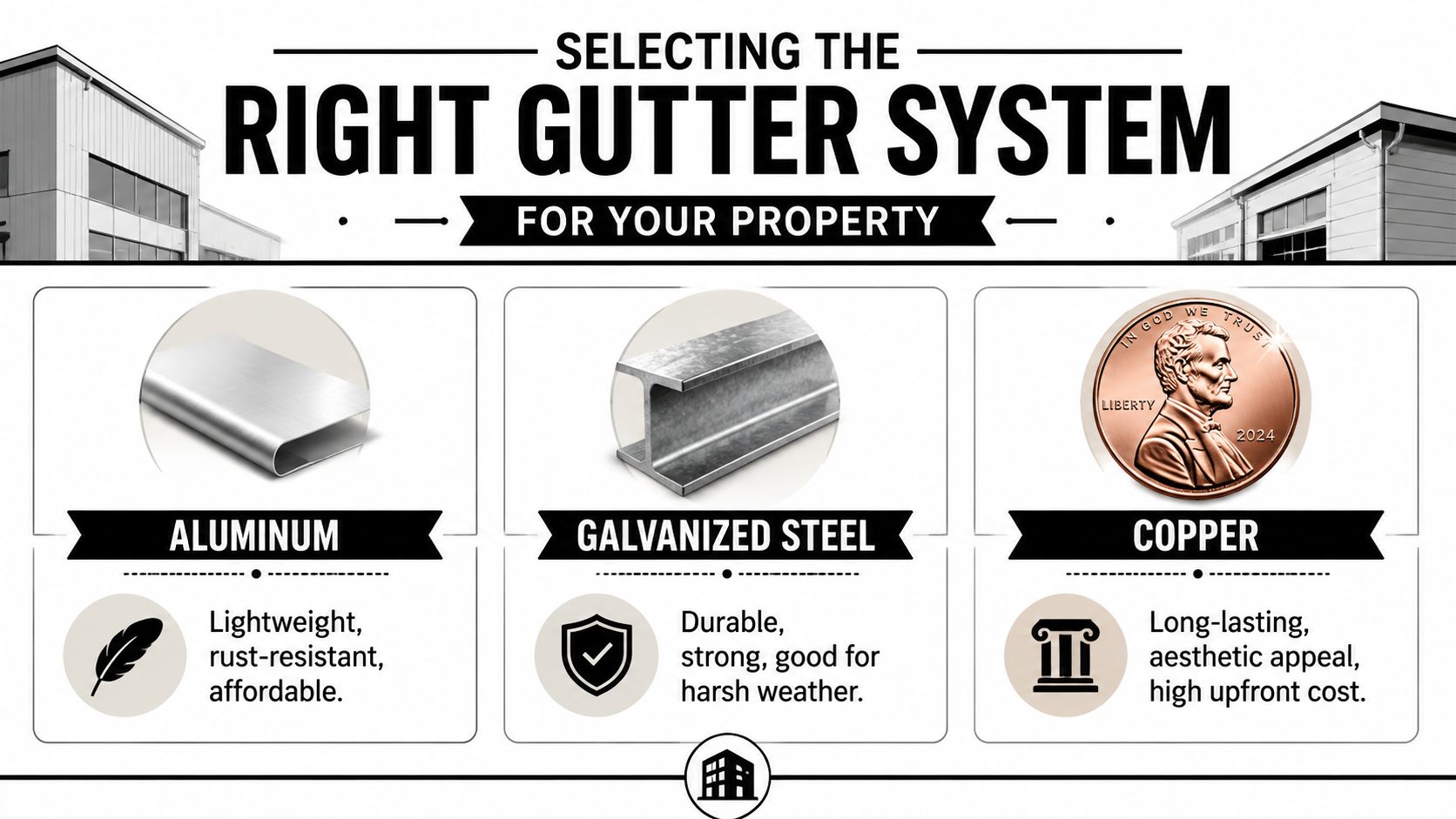
Commercial gutter selection starts with performance. Capacity, overflow behaviour, access for cleaning, compatibility with the roof edge, and expected service life all matter more than picking the cheapest profile in a catalogue. A system that works on a small office frontage can fail quickly on a factory, shopping strip, school, or logistics facility.
Match the profile to the building
Profile choice should follow roof area, rainfall intensity, outlet spacing, and how the building is used. On commercial work, the gutter often has to deal with long runs, concentrated discharge points, and maintenance constraints that residential guides barely touch.
A few common applications:
- Box gutters: Used on larger commercial and industrial roofs where high capacity and concealed drainage are part of the design. They need careful sizing, overflow detailing, and accurate support because failures inside the building envelope are expensive.
- Half-round profiles: Better suited to heritage or architectural projects where appearance is part of the brief and runoff volumes are more moderate.
- External steel gutters: A practical option on warehouses, strata buildings, and mixed-use sites where straightforward inspection, outlet access, and replacement matter.
The wrong habit is standardising one profile across every asset. Property managers get better long-term results when the gutter type is chosen for the building's drainage load and maintenance reality.
Compare material performance and cost
Material selection affects corrosion resistance, thermal movement, coating durability, and how often the site crew will need to get back up there. Supplied cost matters, but access difficulty, shutdown risk, and expected maintenance frequency often have a bigger effect on whole-of-life cost.
As noted earlier, common Australian supply rates vary by material. Zincalume usually sits at the lower end, Colorbond costs more where finish matching is important, and stainless steel commands a premium where corrosion resistance justifies it.
- Zincalume suits many standard commercial replacements in moderate exposure conditions, especially where budgets are tight and access for future maintenance is reasonable.
- Colorbond is often the better choice where the guttering needs to match adjacent roofing, fascia, or cladding and the presentation standard is higher.
- Stainless steel is worth pricing on coastal sites, food processing facilities, wash-down areas, and other aggressive environments where premature corrosion would trigger expensive replacement cycles.
If you're reviewing the entire edge drainage system, this guide to commercial gutter and drainage design considerations is a useful companion to the material decision.
Commercial Gutter Material Comparison
| Material | Cost per Metre (Supplied) | Estimated Lifespan | Best For |
|---|---|---|---|
| Zincalume | Lower-cost standard option | Varies by exposure and maintenance | Warehouses, standard commercial sites, budget-conscious replacements |
| Colorbond | Mid-range coated steel option | Varies by exposure and maintenance | Strata buildings, offices, sites where finish matching matters |
| Stainless steel | Premium option | Long-term option in harsh conditions | Coastal, corrosive, or high-spec commercial projects |
Service life depends less on the brochure and more on the site. Salt exposure, discharge from rooftop plant, debris build-up, incompatible metals, and poorly detailed joints will shorten the life of any gutter system.
Good commercial guttering holds capacity, drains cleanly, and stays serviceable without constant patch repairs. That is the standard worth paying for.
The Core Installation Process for Commercial Gutters
A commercial gutter install usually looks straightforward from the ground. Then the first heavy storm hits, one outlet backs up, water runs over a loading dock, and the maintenance budget starts taking the damage. Good installation prevents that. On large buildings, small errors in set-out, support spacing, or outlet position turn into overflow, staining, corrosion, and call-backs.
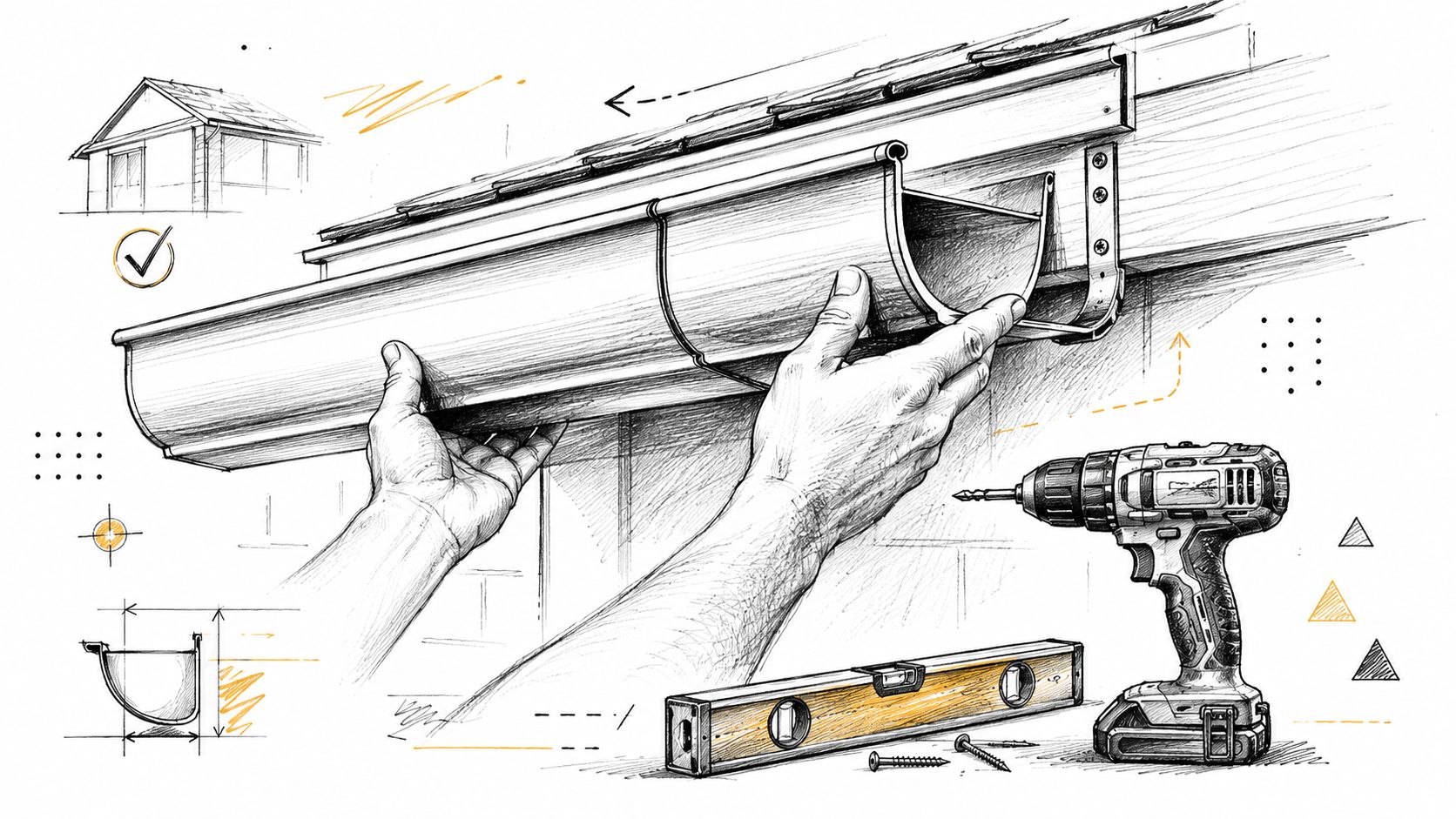
Set out the fall before fixing anything
Set-out decides whether the system drains or ponds. Start with the outlet locations, then establish the high and low points for each run and mark a consistent fall line across the full length. As noted earlier, commercial gutters need positive fall. On long runs, that line should be checked against the actual building, not just the drawings, because roof edges, fascia lines, and structural steel are often out by more than the eye suggests.
Use a laser where possible. On industrial sites with long elevations and multiple outlets, it saves time and exposes inconsistencies early. Chalk lines and string lines still have their place, but they need disciplined checking if access is broken up by plant, parapets, or scaffold lifts.
Do not let a crooked edge dictate the drainage line.
If the fascia waves or the supporting steel dips, hold the fall and adjust the bracket detail to suit. A gutter that looks parallel to the roof edge but traps water is a bad install.
Fix brackets and support points to suit the building
Bracket spacing and fixing method need to match the profile, the load, and the substrate. Commercial gutters carry more water than domestic systems, and box gutters in particular can place serious weight on supports during peak flow. Wide bracket centres might save labour on day one, but they increase the chance of sagging, poor line, and joint stress over time.
Match the support detail to the structure:
- Timber fascia: use fixings with proper embedment and corrosion resistance for the environment.
- Steel supports or purlin edges: use brackets and screws rated for the steel gauge and connection type.
- Concrete or masonry edges: use engineered brackets and anchors suited to the substrate and imposed load.
- Parapet or custom edge conditions: use fabricated support steel or purpose-made brackets that maintain fall and allow safe waterproofing.
A distinct difference exists between commercial work and residential advice, as many sites have no clean fascia line at all. Installers may be working off exposed structural steel, roofing support members, or fabricated outriggers, and each condition needs a fixing detail that can be inspected, maintained, and signed off with confidence.
If a section is bowed, settled, or uneven, add support where the gutter would otherwise belly between fixings. The straightest-looking line is not always the best-performing one. The best-performing one holds shape under water load.
Lift, place, and secure long gutter runs
Long lengths need planning before they leave the ground. Finished steel marks easily, heavy sections twist in the lift, and one rushed movement can deform a profile enough to create ongoing joint problems. On occupied commercial sites, the lift path also has to be controlled so materials do not swing into cladding, glazing, services, or pedestrian areas.
A practical sequence usually works best:
- Dry-fit each length first. Confirm alignment, outlet positions, expansion allowances, and bracket engagement before final fixing.
- Protect the finish during handling. Keep swarf, metal filings, and rough staging off painted surfaces.
- Seat the gutter progressively into brackets. Work along the run in order instead of forcing one end home and dragging the rest across supports.
- Check the line again after fixing. Long runs can shift as fasteners are tightened, especially near corners and outlet points.
A visual walkthrough helps if you're reviewing the method with a maintenance team or site supervisor:
Cut outlets and connect downpipes with flow in mind
Outlet work has to be clean and deliberate. A badly placed or poorly cut outlet throttles discharge, traps debris, and puts extra water pressure on the surrounding joint. Mark each opening accurately, cut it without distorting the metal, remove burrs, and make sure the dropper or outlet nozzle seats properly before fastening.
Capacity matters here. Commercial roofs can dump large volumes of water into a small number of outlets, especially on box gutter systems serving broad roof areas. If the outlet size, number, or position is wrong, the gutter may overflow even if the rest of the installation looks tidy.
Downpipes also need to work with the building layout. Keep discharge clear of entries, loading docks, walkways, tenant signage, plant platforms, and areas where overflow would create a slip hazard or nuisance complaint. On industrial properties, allow for future maintenance access as well. A downpipe tucked behind services might pass handover and still become a long-term service problem.
Adjust the installation method where standard details do not apply
Older commercial buildings and industrial sheds rarely give installers textbook conditions. Roof edges may be out of level, previous repairs may have left mixed substrates, and existing drainage points may not suit the new profile. Treat those issues as design constraints, not site annoyances.
The right response is to revise the fixing detail before installation continues. That may mean under-sheet supports, purlin-fixed brackets, custom angle brackets, or a parapet-mounted arrangement that protects the waterproofing while holding the required line. What matters is that the support method carries the load, preserves fall, and keeps the building envelope secure.
If the substrate does not suit the bracket, redesign the bracket. Do not try to patch a poor fixing detail with sealant and hope it lasts.
Creating Watertight Joints and Corners
Most gutter systems don't fail in the middle of a straight run. They fail where installers rush. Corners, laps, stop ends, and outlet connections are the points that decide whether the system stays dry or starts leaking into walls, soffits, and slab edges.
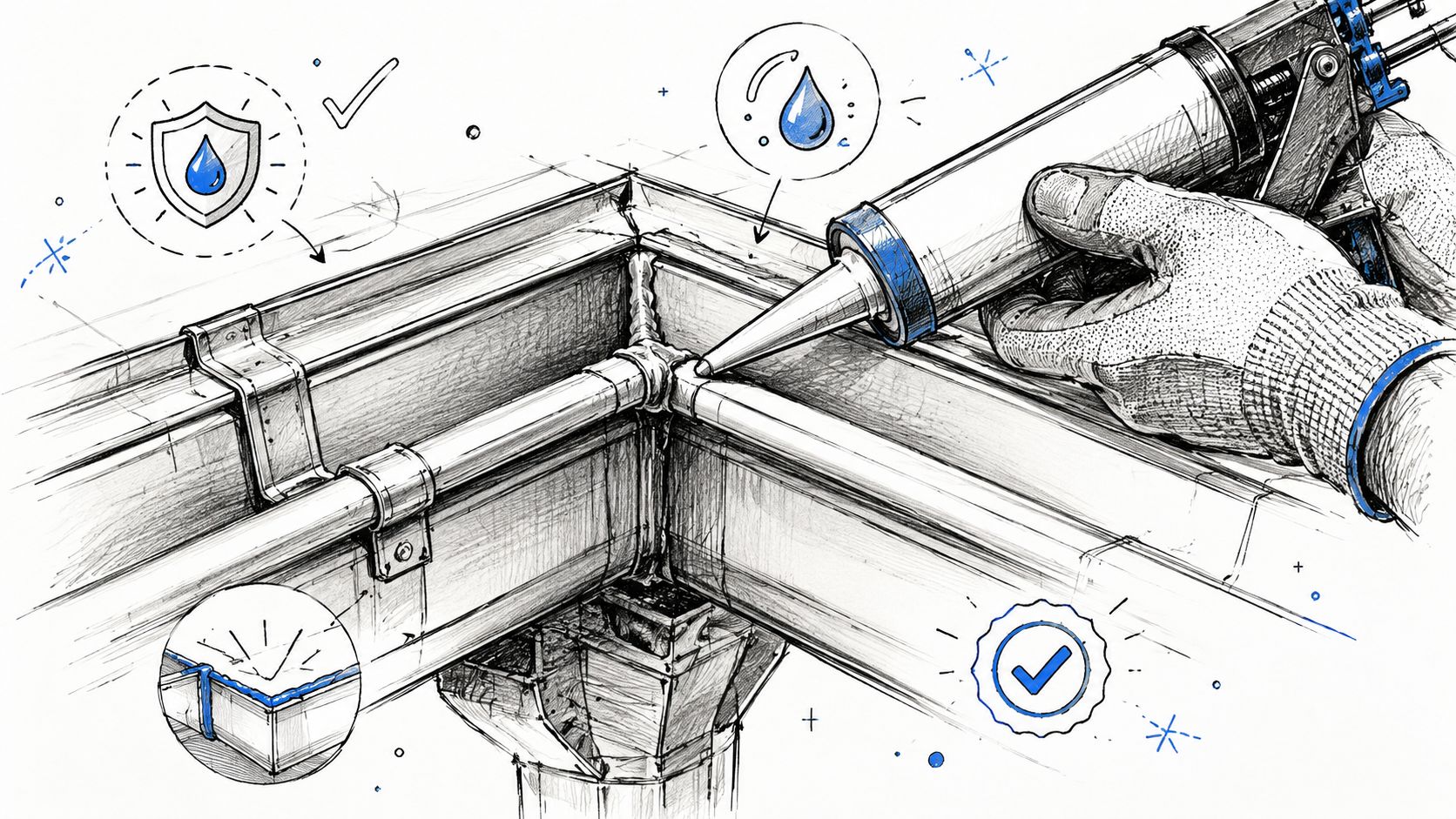
Prepare the metal before sealing
Sealant won't rescue a dirty joint. Before any silicone or sealant goes on, clean the mating surfaces, remove filings, check for oil or moisture, and make sure the overlap sits flat without distortion. If the metal is under tension, the seal will eventually open.
Commercial work needs neat, deliberate sealant application. Too little leaves voids. Too much hides a bad fit and makes future inspection harder. Apply sealant where the overlap seals, then fasten the joint so the sealant is compressed rather than smeared around empty gaps.
Build corners that stay sealed
Corner mitres deserve extra care because they take concentrated flow and often sit where thermal movement and building movement are most obvious. According to This Old House guidance on installing rain gutters, failing to properly miter-corner joints with an aluminium strip and sufficient pop rivets can lead to a 40% increase in corner-seam leakage during storm events.
That's the trade lesson in one line. Corners need proper backing, proper fastening, and proper alignment. A quick folded corner with a blob of sealant might pass a casual glance, but it won't hold up when water loads increase.
For stronger corners:
- Cut accurately: Poor mitre geometry creates gaps that sealant can't reliably bridge.
- Use backing where required: An aluminium strip reinforces the seam and supports the seal.
- Fasten adequately: Pop rivets or suitable screws should clamp the joint firmly and evenly.
- Allow for waste: Ordering extra material helps because corner work nearly always involves offcuts and recuts.
Corners don't forgive sloppy fabrication. If the fold, backing, and fastening are wrong, the leak may not show up until the first hard storm.
Straight joints need discipline too
Straight laps are simpler, but they still need the same discipline. Keep overlaps consistent, support the joint close to the lap, and don't place a join where runoff concentrates unless the design leaves no better option.
On box gutters and long custom runs, workshop-fabricated sections often produce a better result than too many site-made joints. Fewer joins usually mean fewer leak risks. The trade-off is transport, handling, and lifting, so the right choice depends on site access and run length.
Final Checks and Troubleshooting Common Gutter Issues
A commercial gutter job isn't finished when the last rivet goes in. It's finished when the system has been tested, defects have been corrected, and water is clearly reaching the stormwater discharge path the way the design intended.
Test the system before handover
Run a controlled water test across each completed section. You're not trying to flood the roof. You're checking how the installed system behaves under flow. Watch the line of travel, the outlet draw, the corners, the laps, and the stop ends.
During testing, look for these signs:
- Water sitting in the run: The fall is too shallow somewhere, or the support line has dipped.
- Overflow near an outlet: The opening may be undersized, poorly cut, or partially obstructed.
- Drips at a joint or corner: The seal is incomplete, the lap is under tension, or the fastening isn't pulling the metal together.
- Movement under load: Brackets or support points may be too sparse or poorly fixed.
A careful test also reveals something drawings don't always show. Water follows the actual building, not the ideal one. Minor roof irregularities, old movement, and hidden dips only become obvious when the system is wet.
Common faults and practical fixes
Some problems show up immediately and can still be corrected without major rework.
| Issue | Likely cause | Practical fix |
|---|---|---|
| Pooling water | Inconsistent fall or sag between supports | Reset the affected section and add or reposition support |
| Local overflow | Outlet detail is poor or discharge is restricted | Rework the outlet opening and check the downpipe path |
| Persistent leak at corner | Mitre fit or fastening is weak | Strip back, remake the corner, and refasten properly |
| Gutter line looks straight but drains badly | Installed to a crooked substrate instead of a true drainage line | Re-establish line from high to low point and refix |
If a section keeps failing after minor patching, stop patching it. Remove it and rebuild that area properly. Repeated spot fixes often cost more than one clean correction, especially on buildings where access gear has to be booked each time.
Gutter Installation Costs and Knowing When to Call a Pro
A warehouse can carry a gutter defect for months, then fail hard in one storm. Water spills over a blocked box gutter, runs behind the fascia or parapet, and suddenly the job is no longer a gutter replacement. It is an internal damage claim, a safety issue, and an emergency access problem.
Commercial gutter pricing reflects that risk. The spend is not limited to lengths of metal and install time. It covers access equipment, site-specific safe work methods, traffic control where needed, fabrication, disposal, waterproof detailing, and coordination around tenants, staff, stock, or production.

On commercial and industrial buildings, a few factors usually push costs up quickly:
- Height and access requirements: Multi-storey edges, fragile roof zones, and restricted perimeter access slow production and increase compliance requirements.
- Gutter type: High-capacity box gutters, internal gutters, and custom folded sections take more shop time and tighter installation tolerances than standard external profiles.
- Building geometry: Long runs, multiple sumps, odd corners, parapets, and service penetrations add labour and increase the chance of failure if details are rushed.
- Operational constraints: Schools, shopping centres, strata complexes, factories, and live warehouses often require staged work, after-hours scheduling, or tighter exclusion zones.
- Related rectification: Rusted substrate, damaged fascia, undersized outlets, failed downpipes, and stormwater connection issues often appear only after removal starts.
Material choice still matters, but on larger sites labour, access, and detail work usually drive the quote harder than the metal itself.
That is why two properties with similar perimeter lengths can price very differently.
A low-set shed with clear access and straightforward replacement runs may suit an experienced in-house maintenance team. A shopping centre, strata block, food facility, or multi-unit warehouse usually does not. Once the work involves height, custom fabrication, public interfaces, or internal box gutters, the risk profile changes. At that point, errors are expensive and the compliance burden is real.
Use a specialist contractor when any of the following apply:
- The building is multi-storey or needs scaffolding, EWPs, or edge protection.
- The gutter system is internal, oversized, or custom fabricated.
- Roof drainage capacity needs to be recalculated because of overflow history or change of use.
- Tenants, customers, staff, or plant operations will remain active during the works.
- The site needs documented SWMS, insurances, staging, defect management, and clear handover records.
For managers comparing contractors, this guide on how to choose a commercial roofer near you is a useful starting point.
The primary value in calling a pro is control. You get a contractor who can set out the falls properly, coordinate safe access, identify drainage design issues before installation, and carry the insurance and defect liability that a commercial property should demand.
Cheap gutter work often fails in the same places. Outlets are too small, support spacing is lazy, corners are rushed, and existing substrate problems are covered instead of repaired. On a house, that may mean a callback. On a commercial property, it can mean damaged stock, tenant disruption, slip hazards, ceiling repairs, and another mobilisation to fix work that should have been done once.
If you're planning a gutter replacement on a warehouse, strata complex, factory, retail site, or other commercial property in NSW, Commercial Roofers can help assess the scope, identify compliance and drainage risks, and deliver a safe, durable installation that suits the building.