
A minor roof leak repair in Wollongong typically costs between $270 and $865, with an average job costing around $375. If you're managing a commercial building, that's the cheap end of the problem. The expensive part starts when a “small leak” turns out to be failed flashing, corroded fixings, wet insulation, asbestos sheeting, or an insurance issue nobody documented properly.
That's where most building owners and managers get stuck. Water shows up in a ceiling tile, staff put a bucket underneath it, and everyone starts looking for the fastest patch. In Wollongong, that approach often fails because commercial roofs don't deteriorate in a neat, simple way. Coastal exposure, ageing materials, access constraints, tenant disruption, safety requirements, and insurer paperwork all change what the right fix looks like.
For a warehouse, strata complex, retail site, factory, or older industrial building, roof repair in Wollongong needs to be treated as asset management, not just maintenance. The goal isn't only to stop water today. It's to keep the building compliant, limit business interruption, avoid repeat callouts, and make sure the money spent now doesn't create a bigger liability later.
Table of Contents
- Beyond the Drip Strategic Roof Management in Wollongong
- A Commercial Roof Inspection Checklist
- Common Commercial Roof Repair Methods and Materials
- Wollongong Roof Repair Costs and Timelines for 2026
- Navigating Compliance Insurance and Warranties
- Choosing a Commercial Roofing Contractor in Wollongong
Beyond the Drip Strategic Roof Management in Wollongong
A commercial roof usually announces trouble through subtle signs. It starts with a stained tile in an office, damp stock in one corner of a warehouse, rust around a fastener line, or a tenant complaining that water appears only during wind-driven rain. By the time the leak is obvious indoors, the roof problem has often been developing for a while.
That's why roof repair in Wollongong can't be treated like a household handyman job. A commercial roof carries more risk. There are tenants, WHS obligations, plant and equipment below, electrical services, insulation, access systems, and sometimes legacy materials that create compliance issues before anyone lifts a sheet.
The broader market tells the same story. Australia's Roofing Services industry is projected to reach $4.4 billion in 2026, with 5,798 businesses operating across the country as of 2025, and recorded 1.1% CAGR between 2020 and 2025 according to IBISWorld's Australian roofing services industry data. That doesn't just show scale. It shows roofing is ongoing infrastructure work, not occasional cosmetic maintenance.
Why reactive patching costs more over time
On commercial sites, the first repair is rarely the only decision. You're deciding whether to:
- Contain a leak so operations can continue safely
- Repair the failed component without disturbing sound areas
- Restore the roof system where deterioration is broad but still manageable
- Replace the roof because the substrate, fixings, or sheeting no longer justify repair spend
A cheap patch can be the right move when the failure is isolated and the rest of the roof is sound. It's the wrong move when corrosion is widespread, laps are lifting, box gutters are undersized, or old asbestos sheets are involved.
Practical rule: Don't judge a roof by where the water appears inside. Water tracks. The entry point is often nowhere near the visible leak.
The Wollongong factor
Wollongong adds another layer. Coastal conditions punish roofs differently from inland sites. Salt, moisture, and storm exposure change maintenance cycles and shorten the margin for error. On an industrial building near the coast, “good enough” workmanship usually doesn't stay good enough for long.
Building managers who do this well tend to act early. They inspect before the next rain event, document what's failing, and separate make-safe work from long-term capital decisions. That's what protects the roof, the budget, and the building's operating life.
A Commercial Roof Inspection Checklist
A useful inspection doesn't begin with climbing onto the roof. It begins with knowing what kind of building you're dealing with, what roof system is installed, where leaks present internally, and whether there are any red flags such as brittle sheeting, known asbestos, or access hazards.
In Wollongong, metal roofs need close attention because coastal salt exposure accelerates corrosion. In exposed coastal zones, rust penetration can occur within 3 to 5 years without proper maintenance, as outlined in TomKat Roofing's Wollongong roof repair guidance. That makes early detection more than a maintenance issue. It's a durability issue.
Start from the ground and the ceiling, not the roof edge
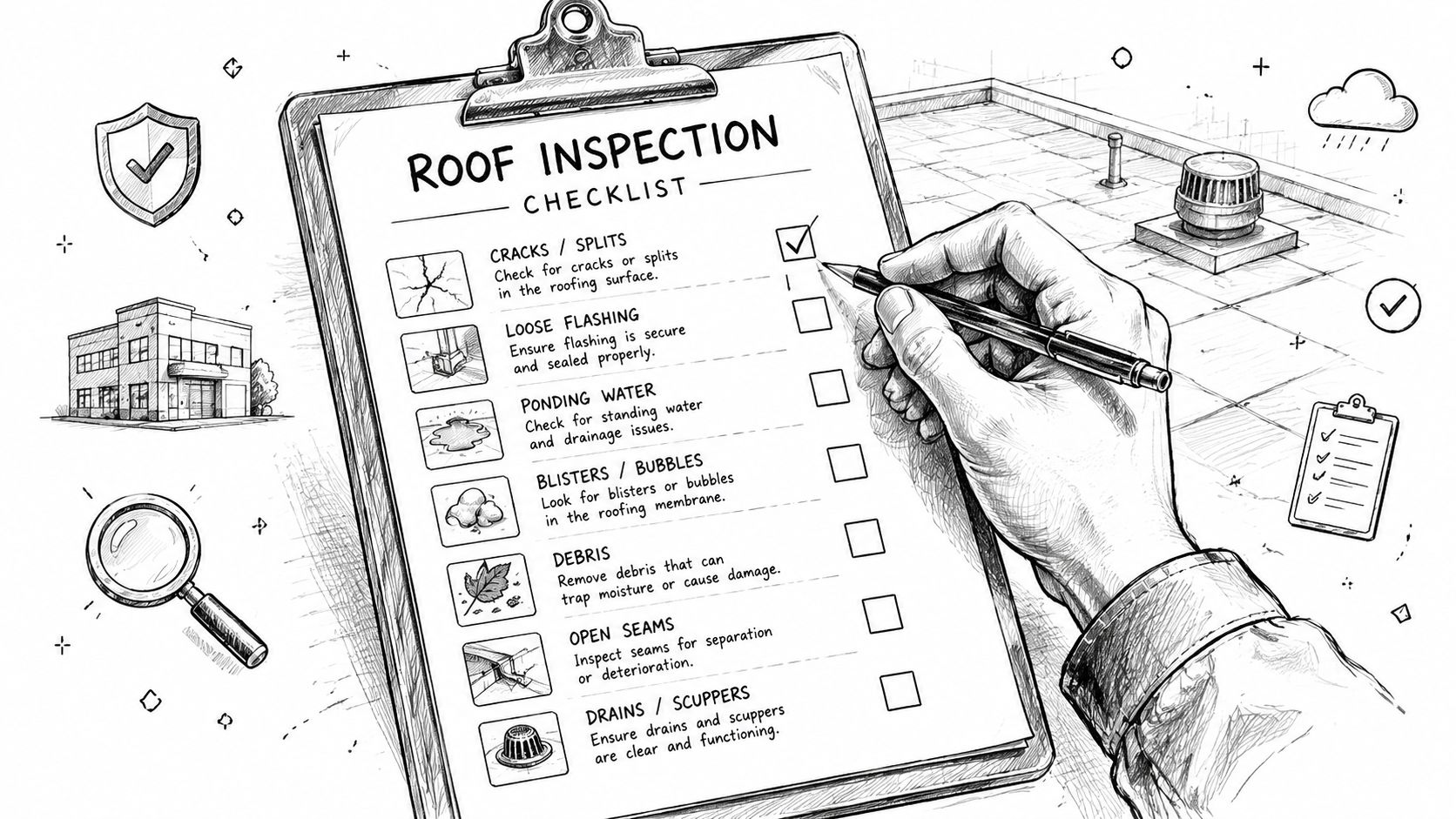
A practical pre-inspection checklist should include:
- Internal leak mapping: Mark the exact rooms, bays, or tenancies where water appears. Check ceiling tiles, insulation, wall junctions, purlin lines, and penetrations.
- Operational impacts: Note whether the leak affects stock, electrical boards, offices, plant, or public access areas.
- Visual signs from ground level: Look for displaced sheets, sagging gutters, blocked downpipes, debris buildup, staining on external walls, and rust runs.
- Building records: Pull any past reports, photos, asbestos registers, maintenance logs, and previous insurance correspondence.
If you want a simple framework for tracing visible moisture back to likely entry paths, this guide on how to detect roof leaks is a useful starting point.
What to look for on the roof surface
Once access is safe and properly controlled, the inspection should focus on failure points, not just obvious holes.
For metal roofs, pay attention to:
- Fastener condition: Loose screws, perished washers, missing fixings, enlarged holes
- Sheet laps and side laps: Early rusting, capillary entry points, lifted overlaps
- Flashing junctions: Penetrations, parapets, ridges, valleys, wall abutments
- Protective coating breakdown: Chalking, worn finish, exposed substrate
For low-slope commercial roofs, inspect:
- Ponding water: Low spots that hold water after rain
- Membrane laps: Open seams, shrinkage, punctures, edge failure
- Drainage points: Blocked sumps, outlets, leaf load, overflow issues
For older industrial roofs, add:
- Sheet brittleness
- Signs of previous patching
- Surface cracking or delamination
- Any indication that the roof may contain asbestos-containing material
A short visual explainer helps when you need to brief facilities staff or strata representatives before a contractor attends.
If a roof only leaks during wind-driven rain, look hard at laps, flashings, and vertical transitions. If it leaks after sustained rain, look hard at drainage, ponding, and saturated insulation.
When the signs point to urgent intervention
Some defects can wait for scheduled works. Others need immediate make-safe action.
Treat these as urgent:
- Active leaks over switchboards, server rooms, or plant
- Corroded sheets around fixings or laps
- Loose flashings after a storm
- Evidence of structural movement or substrate decay
- Suspected asbestos damage
What doesn't work is relying on silicone alone, surface coating over rust that hasn't been treated properly, or sending unqualified staff onto fragile roofing. A good inspection narrows the problem fast and stops guesswork from driving the repair scope.
Common Commercial Roof Repair Methods and Materials
Not all commercial roof repairs are equal. Some defects need a localised fix. Others need a system-level response. The right method depends on the roof type, the age of the materials, corrosion level, drainage performance, and whether the original installation was fit for the site.
Metal roof repairs that actually hold up
On metal commercial roofs, the common repair methods are fairly straightforward. The important part is applying them in the right situation.
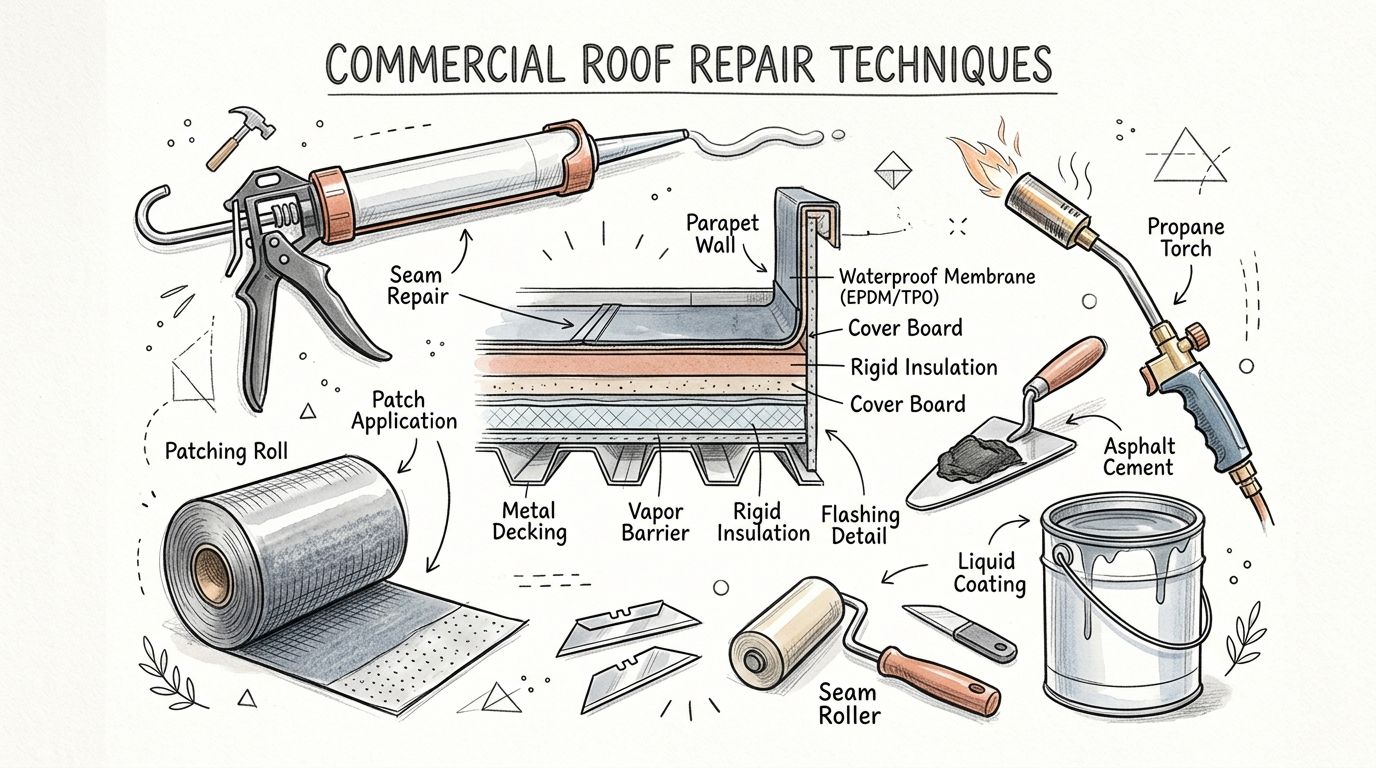
Typical methods include:
- Fastener replacement: Old fixings and failed washers are removed and replaced where the sheet is still sound.
- Local sheet replacement: Used when corrosion or impact damage is confined to specific runs or sections.
- Flashing replacement: Necessary when water entry occurs at penetrations, parapets, ridges, or wall junctions.
- Rust treatment and recoating: Suitable only where corrosion is still surface-level and the substrate remains structurally serviceable.
- Gutter and box gutter repair: Needed where overflow, failed joints, or corrosion are the direct source of water ingress.
For broader guidance on repair approaches for sheeted systems, this article on metal roofing repair gives a solid overview.
The trade-off is simple. If the roof has isolated failures, targeted repairs can preserve value. If the sheet profile is tired across the whole roof, coatings and piecemeal patching often become repeat spending.
Membrane and drainage repairs on low-slope roofs
On low-slope commercial roofs, leaks often have less to do with a puncture than with water movement. The roof may not be draining properly, which means the repair scope has to deal with both the waterproofing layer and the reason water is sitting there.
Common methods include:
- Reworking laps and seams
- Patching punctures with compatible membrane materials
- Rebuilding outlets or sumps
- Correcting isolated falls where practical
- Replacing failed penetration details
A membrane patch can stop a leak. It won't solve a drainage design problem.
If the roof keeps holding water, the leak usually returns somewhere else. That's why a proper commercial assessment looks beyond the wet spot.
Asbestos roofing is a compliance job, not a patch job
Many commercial owners often receive poor advice. Older industrial and commercial roofs in NSW can still contain asbestos sheeting. Once that's in play, the usual “quick repair” mindset becomes risky.
Patchwork on damaged asbestos roofs is often the wrong answer because:
- disturbance can create a compliance problem
- short-term sealing doesn't remove the underlying liability
- future maintenance becomes harder and more expensive
- insurers, buyers, and tenants may all treat the issue differently once identified
The responsible paths are usually encapsulation where appropriate and lawful, or licensed removal and replacement when the material is deteriorated, damaged, or unsuitable for continued service. The best long-term outcome for many commercial sites is to replace the legacy roof with a modern metal system designed for access, maintenance, and coastal durability.
That's especially true when the roof already has multiple old penetrations, recurring leaks, or widespread sheet fatigue. At that point, “repair” isn't really a repair. It's delay.
Wollongong Roof Repair Costs and Timelines for 2026
Commercial owners want straight numbers first. Fair enough. Budgeting for roof work usually starts with the immediate repair cost, then moves quickly to whether repair still makes sense compared with restoration or replacement.
2026 estimated roof repair costs in Wollongong
The verified local market figures below are inclusive of GST and provide a practical budgeting reference based on Wollongong roofing cost data for May 2026.
| Service Type | Average Cost Range |
|---|---|
| Minor leak repair | $270 to $865 |
| Average minor repair visit | Around $375 |
| Tile re-roofing | $110 to $240 per square metre |
| Colorbond re-roofing | $86 to $195 per square metre |
| Full Colorbond re-roof on a typical three-bedroom home | Approximately $20,700 |
| Full re-roof on a two-storey home | $16,200 to $43,200 |
| Roof restoration | $2,700 to $6,500 |
For commercial readers, the exact figure will depend on roof area, access, safety setup, penetrations, drainage complexity, and whether any non-routine compliance controls are needed. The residential examples still help as a local price reference point for material and labour direction.
Why one quote lands low and another lands high
Two roof repair quotes can look miles apart even when the leak description sounds similar. Usually the difference comes from scope, not margin.
The main variables are:
- Access and safety requirements: EWP access, edge protection, traffic management, or restricted work zones
- Roof configuration: Height, pitch, penetrations, plant platforms, skylights, valleys, parapets
- Extent of deterioration: One failed junction is different from systemic corrosion
- Material choice: Repairing existing tile, converting to metal, or specifying Colorbond and related flashings
- Underlying damage: Wet insulation, failed battens, substrate issues, or internal water damage
- Operational constraints: Night works, staged work, occupied tenancy coordination
If you're trying to sense-check pricing, this breakdown of roof repair cost factors is helpful.
How to think about timing
Timelines are harder to standardise because key variables are access, weather, approvals, occupied-site restrictions, and material lead times. A small leak repair can often be handled quickly once the defect is identified and safe access is arranged. A re-roof is a project, not a service call.
For commercial sites, the useful way to plan timing is in stages:
- Make-safe response to stop active water ingress
- Inspection and scope confirmation with photos and defect mapping
- Budget approval or insurance review
- Scheduled repair or replacement works
- Final handover documentation
Budget for the roof you actually have, not the leak you can currently see.
That mindset prevents under-scoping. It also helps owners compare a repair quote against the alternative, which is often restoration or replacement.
Navigating Compliance Insurance and Warranties
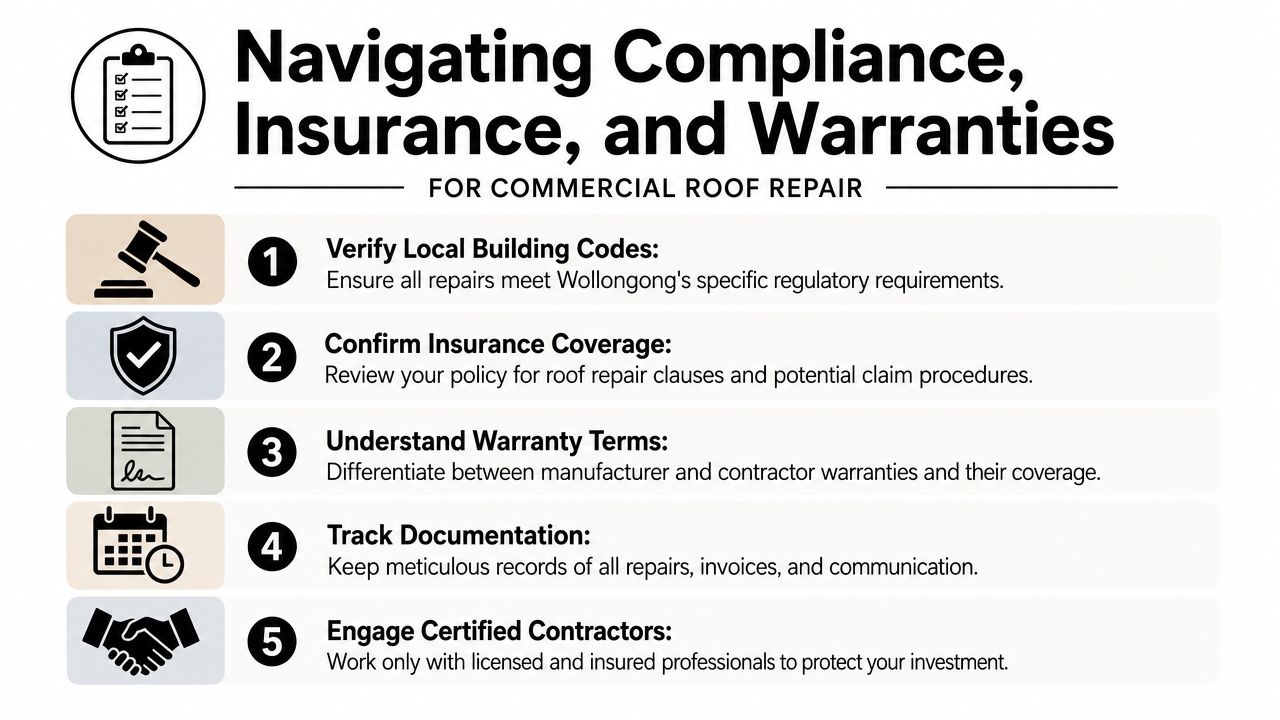
Commercial roof work goes wrong most often off the roof, not on it. The common failure isn't only poor workmanship. It's missing paperwork, unclear scope, no damage record, no asbestos pathway, and no documented link between the defect and the claim.
Existing Wollongong content often skips that part. As noted in this report on insurance claim management gaps for commercial roofs in Wollongong, local guidance regularly focuses on emergency response while failing to explain how commercial claims, asbestos issues, and compliant repair pathways are managed.
Why commercial claims go wrong
Commercial owners and strata managers often assume that if the roof is damaged, the insurer will ask for a quote and approve works. In practice, insurers usually want a coherent record.
That means:
- what failed
- where it failed
- what caused the failure
- whether the damage is sudden, progressive, or pre-existing
- whether hazardous materials are involved
- what immediate make-safe actions were taken
If asbestos is suspected or confirmed, the job changes immediately. The repair path has to account for legal handling requirements, site controls, and proper removal or treatment methods. Trying to shortcut that can damage a claim and create a separate compliance problem.
The paperwork that protects you
Good commercial roof documentation should include a mix of technical and administrative records.
A sound file usually contains:
- Condition photos: Wide shots and close-ups of defect areas
- Marked plans or roof sketches: Useful on large sites with multiple sections
- Inspection notes: Not just “leaking roof”, but the likely defect mechanism
- Asbestos checks or register review: Essential on older buildings
- Scope of works: Make-safe, repair, restoration, or replacement
- Material specification: Especially important for coastal and corrosive environments
- Completion records: Photos, invoices, and any maintenance recommendations
The insurer needs a clean story. If the documents are vague, the claim usually becomes slow, contested, or partial.
Warranties only matter if the scope is right
Owners often focus on warranty length before they focus on repair strategy. That's the wrong order.
A long workmanship warranty doesn't fix a poor scope. If a contractor applies a coating over unstable corrosion, seals over movement, or “repairs” a roof that really needs replacement, the warranty won't rescue the asset. It may only cover the narrow item they installed, not the roof system around it.
Ask for clarity on:
- who provides the workmanship warranty
- what the material warranty covers
- whether the warranty excludes coastal exposure conditions
- whether ongoing maintenance is required
- what happens if staged repairs are performed on an ageing roof
Commercial owners should also confirm that the proposed works match the failure mode. If the roof is deteriorated broadly, a local patch with a nice warranty document doesn't create long-term value. It only formalises a short-term fix.
Choosing a Commercial Roofing Contractor in Wollongong
Choosing the contractor matters as much as choosing the repair method. Commercial roofing isn't just labour on a roof. It's planning, safety, sequencing, documentation, and knowing when repair stops being responsible.
Questions worth asking before you sign
Don't ask only for a price. Ask how they think.
Good questions include:
What do you believe is the actual cause of the leak?
A capable roofer should talk about laps, flashings, drainage, fixings, corrosion, movement, or material failure. Not just “we'll seal it”.Is this a repairable roof, or are we spending money on a roof that should be replaced?
You want an honest answer, even if it's not the cheapest one.How do you handle asbestos risk on older commercial sites?
If the answer is vague, move on.What documentation do you provide for insurance or body corporate records?
Photos, marked-up scope, defect notes, and completion records should be standard.Will your crew work around tenants, plant, deliveries, or restricted operating hours?
Commercial experience shows up quickly in the answer to this question.Who's doing the work?
Find out whether the company uses its own crew or passes the job to others.
What a good commercial roofer sounds like
A reliable contractor usually sounds measured, not theatrical. They'll distinguish between make-safe work and final repair. They'll tell you what they know, what needs testing, and what risks remain if you delay. They won't promise that every leak can be fixed with sealant and a quick visit.
The right approach to roof repair in Wollongong is proactive, compliant, and tied to the building's long-term use. For commercial owners, the best outcome isn't the fastest quote. It's the repair strategy that keeps the asset dry, lawful, and serviceable without creating another problem six months later.
If you need a commercial opinion on a leak, corrosion issue, asbestos roof, or full replacement pathway, Commercial Roofers can assess the roof, document the defects, and recommend a compliant repair or replacement scope that suits the building, the site conditions, and the level of risk.