
A warehouse manager in Blacktown notices dark streaks across the roof, leaves sitting in the box gutters and water marks appearing near an internal wall. The roof still looks serviceable from the ground, so cleaning competes with other maintenance requests. Then a storm arrives, a blocked drainage path overflows, and a cosmetic concern becomes an operational problem.
That situation is common on commercial and industrial sites. Roof cleaning in Blacktown is not only about making a roof look newer. The right work can support drainage, protect coatings, reveal defects and provide useful maintenance records. The wrong method can disturb fragile materials, damage ageing tiles or create safety and runoff issues.
For facility managers, strata managers, warehouse owners and business operators, the decision is practical: identify the roof condition, choose a method that suits the material, control the site risks and compare quotes on the same scope. The following guide explains how roof soiling develops, when soft washing is appropriate, why asbestos and storm exposure matter locally, what a compliant contractor process should look like, and how to brief a roofing company clearly.
Table of Contents
- Introduction to Roof Cleaning for Blacktown Commercial Properties
- How Roof Cleaning Works and Why Blacktown Roofs Need It
- Choosing the Right Cleaning Method by Roof Type and Condition
- Benefits Beyond Appearance Including Lifespan Energy and Compliance
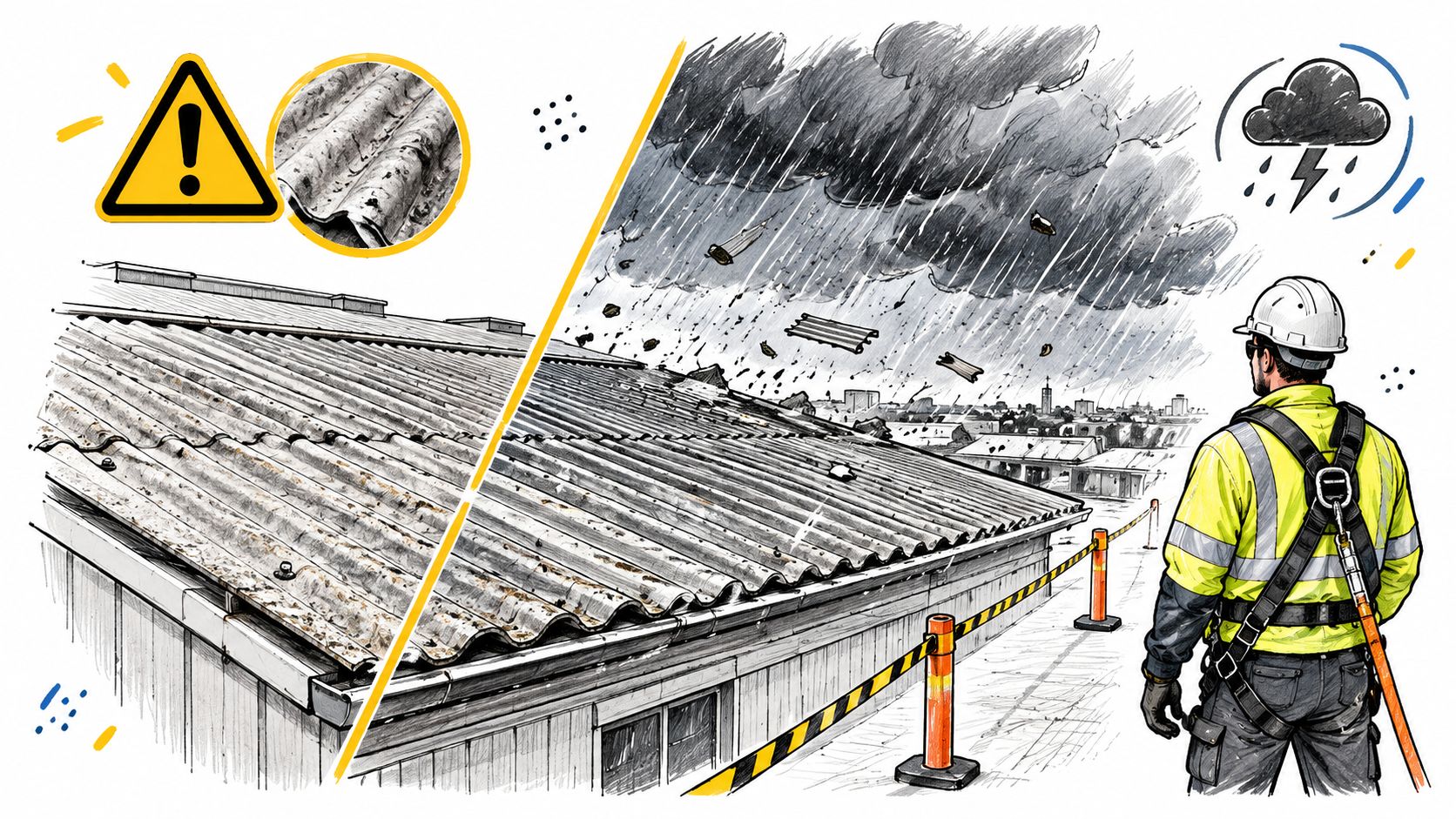
- Safety Asbestos and Storm Risks Every Blacktown Owner Must Understand
- What to Expect From Inspection to Reporting and How to Compare Quotes
- Local Examples Costs and Next Steps for Your Blacktown Property
Introduction to Roof Cleaning for Blacktown Commercial Properties
A facility manager may see dark staining on a roof, but the site risk often sits out of sight. Leaves can restrict drainage, old sealant can fail, and storm damage can remain unnoticed above stock, staff, tenants or plant. Cleaning decisions therefore involve access, noise, runoff and weather, not just the finished appearance.
Blacktown has many older commercial and industrial buildings with incomplete roof histories. A roof that has been repaired several times cannot be treated like a recently installed warehouse roof. Before selecting water pressure or a treatment, the contractor should identify the roof material, previous repairs, fragile areas and whether the surface can safely support the proposed work.
Supervisor's rule: A roof-cleaning quote is only useful when it explains what the contractor found and why the proposed method suits that roof.
A practical maintenance decision answers four questions:
- What is causing the problem? Moss, algae, lichen, black staining and trapped debris require different handling from cracked tiles, rust or failed flashing.
- What does the roof need? Cleaning may be suitable, or the work may need repairs, coating attention, drainage maintenance or a formal inspection first.
- How will the work affect the site? Plan around tenants, vehicles, loading areas, customers, staff, sensitive equipment and stormwater controls.
- What records will remain afterwards? Before-and-after photos, the completed scope, safety documents and listed defects support future planning and compliance records.
The roof should also be checked after severe weather, before cleaning proceeds. NSW emergency-response information has identified Blacktown among areas affected by roof damage during storms. The NSW storm-response reporting records a July 2024 cold front during which the NSW SES handled more than 500 requests statewide for downed trees and damaged roofs, including about 300 from Greater Sydney. It also reports an earlier hail event that generated 245 assistance calls to the SES in one day.
Access and material risks can change the method completely. Suspected asbestos cement, brittle tiles, restricted plant access and nearby drains require controls before any washing begins. In that setting, roof cleaning works like servicing a drainage system: the visible surface matters, but the key test is whether the work protects water flow, roof materials and the building below.
A useful brief asks for the roof condition, proposed method, exclusions, runoff controls, safety documents, photos and defects found. That makes “full roof clean” a defined scope rather than a vague promise, and helps compare proposals on the work included.
How Roof Cleaning Works and Why Blacktown Roofs Need It
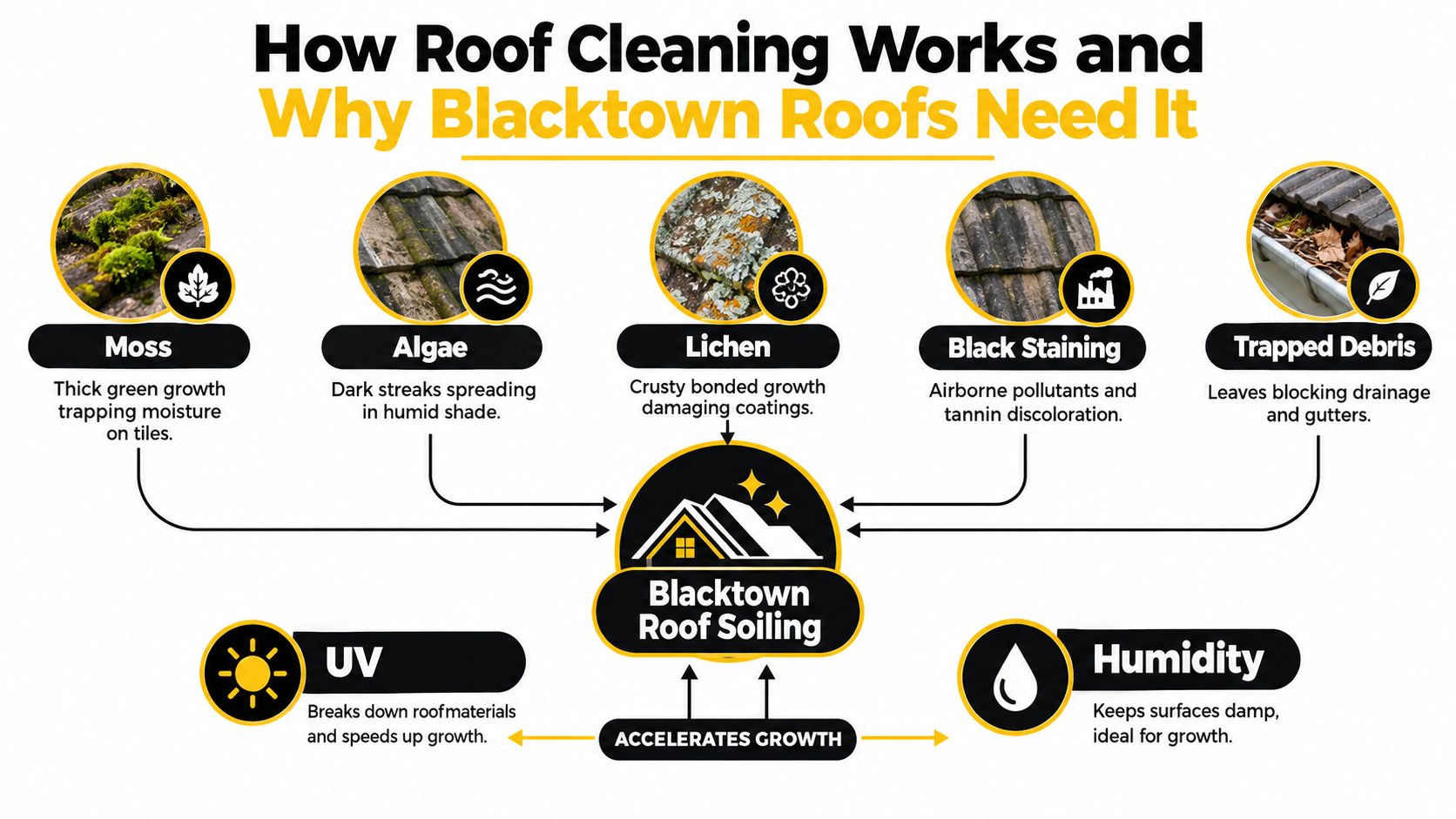
A roof above a Blacktown warehouse can look only dusty while its gutters are filling with plane-tree leaves, organic sediment and industrial fallout. Moss, algae, lichen, black fungal staining and organic debris hold moisture around laps, valleys, gutters and shaded areas. Summer rain, humidity, UV exposure and leaf matter can then support further growth after a quick rinse.
Roof cleaning works like clearing a drainage system. The visible growth is one part of the problem. The work must also protect water paths, roof materials, coatings and the building below. Blasting the surface may remove leaves and staining temporarily, but treating the biological growth first gives the residue time to loosen before controlled rinsing.
The basic soft-washing sequence
The crew should adjust the process to the roof, weather and site controls. The usual sequence is:
- Inspect the surface and drainage paths. Check brittle tiles, open laps, loose flashings, damaged penetrations, blocked gutters and possible entry points.
- Remove loose organic debris. Clear leaves, twigs and sediment without dragging material across fragile surfaces. Heavy leaf loads may require more collection and a larger rinse volume.
- Apply a suitable fungicide or algaecide. This targets the growth instead of depending only on mechanical force.
- Allow appropriate dwell time. The treatment needs time to work, while the crew prevents it drying where surrounding surfaces or roof materials could be affected.
- Rinse with controlled pressure. Remove dead growth and residue without forcing water under laps or stripping protective coatings.
- Check gutters and downpipes. Debris left in the drainage system can restrict flow and undermine the cleaning result.
The Blacktown roof-cleaning method guidance describes low-pressure soft washing with fungicide or algaecide for concrete, terracotta and Zincalume roofs, reducing the risk of surface damage while addressing biological growth. It also identifies April to September as a practical drier period, because drying conditions support dwell time and reduce rain washing treatment away.
The video below gives a visual introduction to roof-cleaning techniques. Use it as general context, then judge the method against the roof material, condition, access and drainage controls on your site.
Choosing the Right Cleaning Method by Roof Type and Condition
The safest method depends on more than the roof label. A “metal roof” could be a sound coated sheet, an aged surface with exposed corrosion or a roof with weak flashings and fragile penetrations. A tiled roof might have sound, well-bonded tiles, or it might have cracked surfaces and brittle ridge work that high pressure would worsen.
Start with the roof's age, coating condition, pitch, drainage design and growth severity. Then consider how water will behave during cleaning. If the roof has open laps, vulnerable flashings or internal areas that can't tolerate runoff, the contractor should explain those constraints before work begins.
Three methods, three different risk profiles
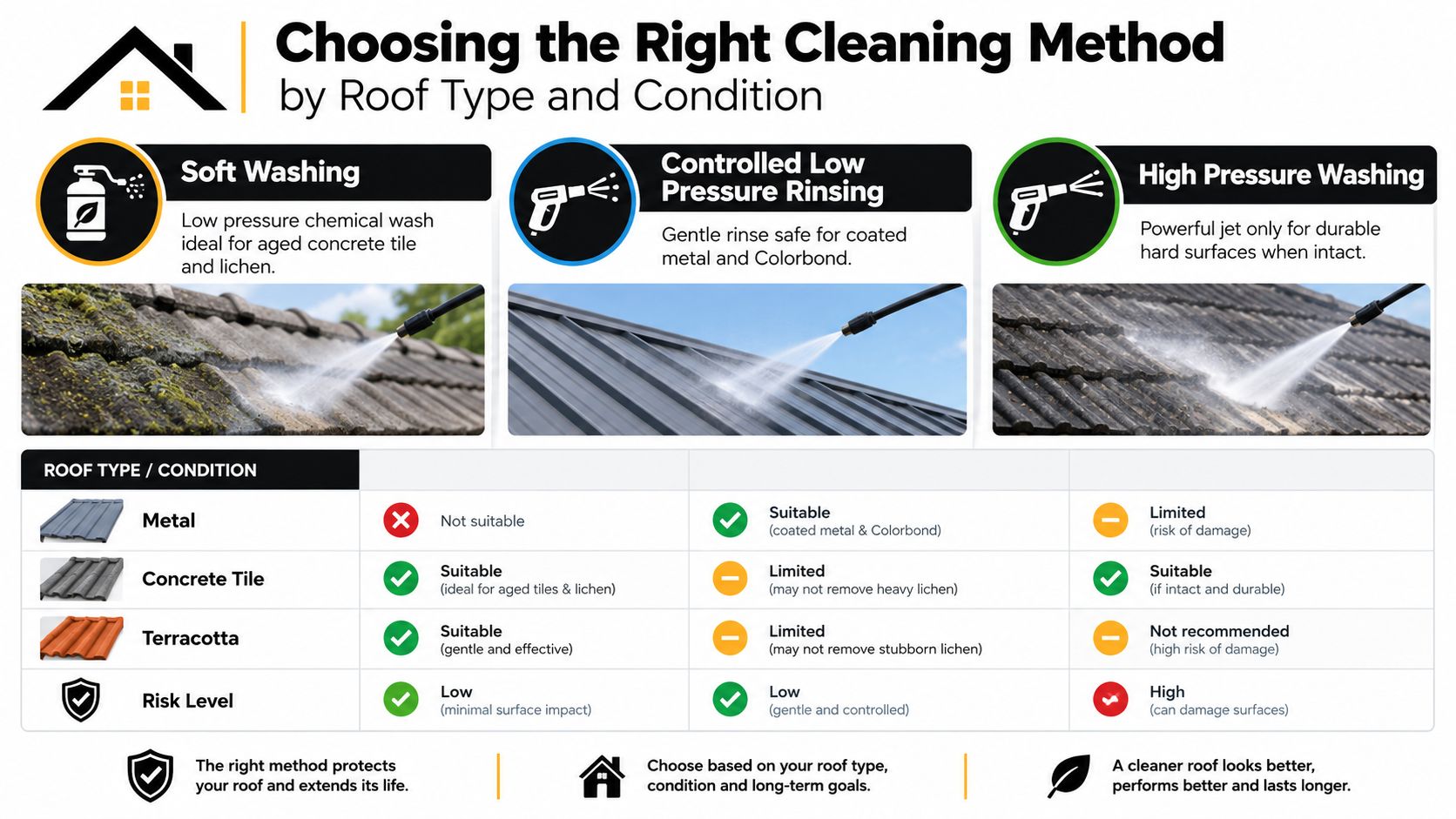
Soft washing uses a low-pressure application with a fungicide or algaecide. It suits biological growth on aged concrete tile, terracotta and other surfaces where aggressive mechanical cleaning could cause damage. The treatment deals with the growth at its source, while controlled rinsing limits stress on the roof.
Controlled low-pressure rinsing is useful where the roof needs gentle removal of loose dirt, residue or treated growth. On coated metal roofs, including Colorbond-type surfaces, the crew should protect the coating and avoid directing water beneath flashings or sheet joints. Guidance on metal roofing in Australia is useful background when the roof-cleaning decision forms part of wider metal-roof maintenance.
High-pressure washing has a narrower role. It may be considered on a durable, intact hard surface after a competent inspection, but it can lift tile laps, crack ageing tiles, strip coatings, drive water into defects or expose weaknesses that were previously sealed by surface residue. The question isn't whether a machine can remove dirt. It's whether the roof can tolerate the force.
Roof Cleaning Method Selector by Roof Type
| Roof Type and Condition | Recommended Method | Key Risk if Wrong Method Used |
|---|---|---|
| Aged concrete tile with moss or lichen | Soft washing followed by controlled rinsing | Cracked tiles, displaced laps or water entry |
| Terracotta with bonded growth or fragile finish | Low-pressure treatment and gentle rinsing | Surface damage, broken tiles or worsened defects |
| Coated metal in sound condition | Controlled low-pressure rinsing with compatible treatment | Coating damage or water forced under joints |
| Zincalume or other metal with biological staining | Low-pressure treatment matched to the coating | Scratching, coating deterioration or corrosion exposure |
| Any roof with suspected asbestos-cement materials | Specialist assessment and licensed handling controls | Fibre disturbance and unsafe exposure |
A contractor should also identify whether the roof has solar equipment, skylights, fragile translucent sheets, membrane areas or restricted access. Those details often determine the safe work zone more decisively than the roof's visible dirt.
Benefits Beyond Appearance Including Lifespan Energy and Compliance
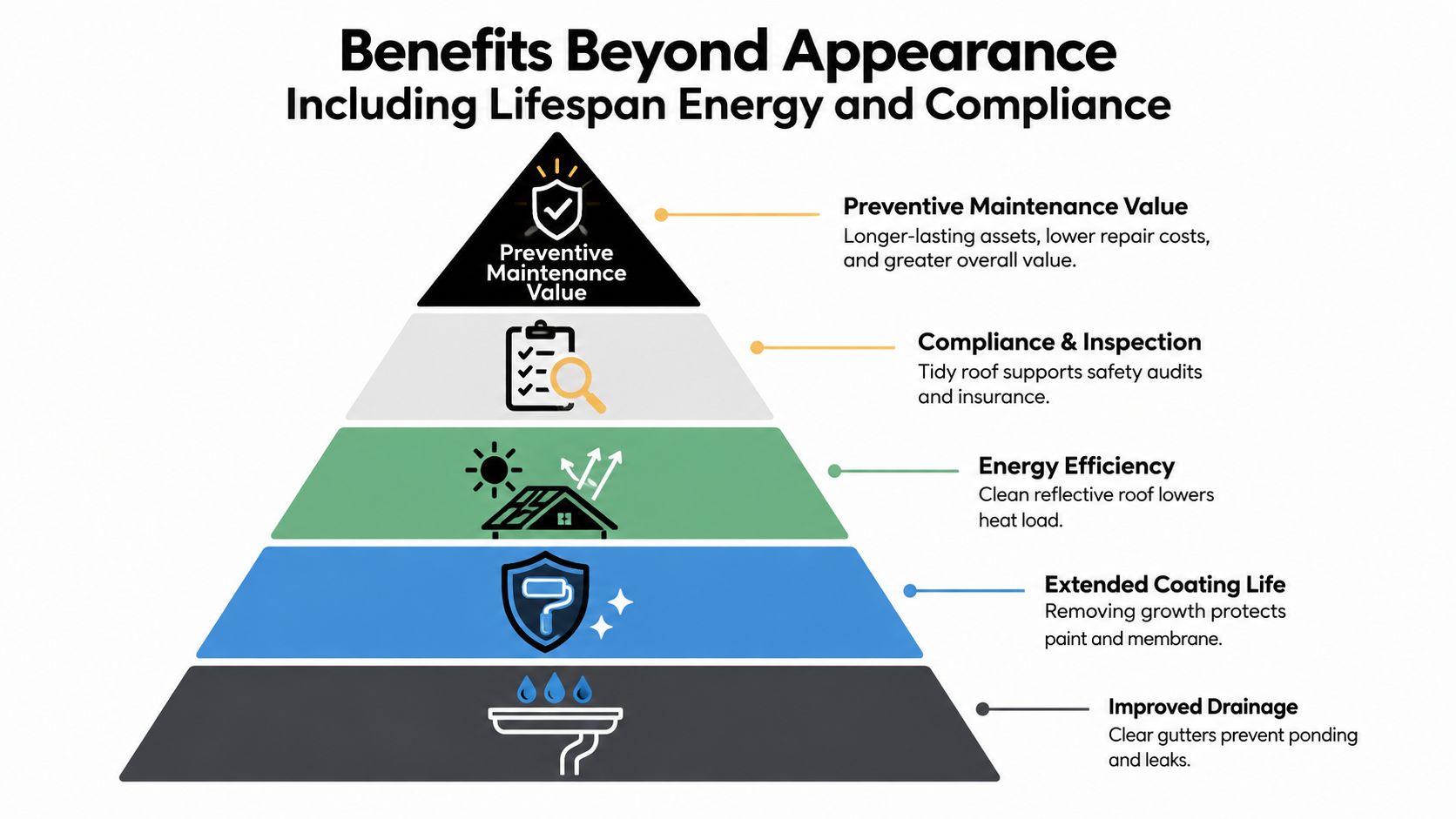
The strongest business case for cleaning is preventive maintenance. Removing biological growth and trapped debris can help keep drainage paths functional, expose defects during inspection and reduce the conditions that place ongoing stress on coatings and roof components. It doesn't repair a failed flashing or guarantee a leak-free roof, but it can give the maintenance team a clearer surface from which to assess the next action.
For a warehouse, the immediate concern may be water reaching stock or electrical equipment. For a retail centre, it may be customer disruption and visible deterioration. In a strata complex, the committee may need a documented scope that separates shared-roof maintenance from repairs to individual lots.
Drainage comes before appearance
Leaves and biological residue can restrict gutters, valleys and outlets. When water can't move as designed, it may pond, overflow at unexpected points or run back towards vulnerable roof details. A cleaning scope should therefore state whether gutters, sumps, valleys and downpipes are included, excluded or being assessed separately.
A clean surface can also make coating condition easier to judge. The contractor may identify chalking, peeling, corrosion, exposed substrate or failed fasteners that need repair before repainting. For coated roofs, cleaning should be treated as preparation and inspection, not as a substitute for a coating system.
The reflective roof coating guidance provides useful context when a facility manager is considering cleaning alongside restoration or recoating. A clean, sound and appropriately reflective surface can help manage heat load, but the result depends on the roof design, insulation, colour, coating condition and building use.
Records support maintenance decisions
A professional report can give the owner:
- Before-and-after photos: These show the original growth, the completed work and areas that couldn't be treated.
- Defect notes: Cracked tiles, loose flashings, rust, failed sealants or damaged penetrations should be recorded instead of hidden.
- Drainage observations: The report should identify blocked or damaged gutters and downpipes.
- Safety and chemical records: These help the facility team retain evidence of planned controls.
- Maintenance recommendations: The next inspection or cleaning decision should relate to the roof's condition, not an arbitrary routine.
Cleaning doesn't automatically extend a roof's service life. It can, however, prevent avoidable neglect, preserve access to inspection information and help the owner spend repair money in the right order.
Safety Asbestos and Storm Risks Every Blacktown Owner Must Understand
Blacktown's asbestos history changes the first question a contractor should ask. NSW Asbestos reports that roughly one in three homes in the state contain asbestos, while Blacktown City Council says asbestos-based building materials were widely used during the 1950s, 1960s, 1970s and 1980s. The Blacktown City Council asbestos guidance makes clear why older buildings need an informed assessment before roof work starts.
Commercial owners shouldn't assume that a roof is safe to wash because it appears intact. Asbestos-cement roofing, eaves and associated components can be disturbed by impact, abrasion, unsuitable tools or uncontrolled water movement. A suspected material needs an appropriate assessment, wet-work controls, disturbance minimisation and licensed handling where removal or other regulated work is required.
The contractor process should follow the risk, not the sales promise
First, review the building history. Ask whether asbestos registers, hazardous-material records, previous reports or renovation documents exist. Council-maintained asbestos information and hazardous-material references are useful starting points for local building records.
Next, inspect without disturbing the surface. The contractor should examine roof sheets, fixings, gutters, penetrations and access points from a safe position. If the material is uncertain, cleaning should pause until the appropriate person determines the next step.
Then, plan access and containment. Roof work is a high-risk environment under SafeWork NSW guidance. The SafeWork NSW roof-work guidance supports the need for fall-prevention systems, staged access and controls suited to the work. The plan should cover ladders, edge protection, harnesses, anchor points, fragile areas, exclusion zones and emergency arrangements.
Storm exposure adds another reason to inspect before cleaning. The NSW SES response figures cited earlier show that Blacktown has been named among suburbs affected by heavy rain, hail, wind and roof damage. A roof with displaced sheets, cracked tiles or compromised flashings may need storm repair before any wash-down.
Practical rule: Never use cleaning to hide storm damage. Clean only after the roof has been assessed as suitable for the proposed work.
Chemical handling and runoff need their own controls. Workers should protect sensitive surfaces, manage overspray and keep wash water from creating an uncontrolled environmental issue. Where NSW operational protocols require equipment cleaning, they specify warm water containing only natural soap, with chemical detergents prohibited in that context. The contractor should distinguish that equipment-cleaning requirement from the roof-treatment scope and document the products and procedures used.
The final stage is reporting. A useful handover records the roof condition, work completed, exclusions, defects and any recommendations for storm monitoring or future maintenance.
What to Expect From Inspection to Reporting and How to Compare Quotes
A reliable roof-cleaning job begins before the pressure washer or sprayer arrives. The contractor should inspect the roof, photograph relevant areas and define whether the proposal covers cleaning only or includes gutter clearing, minor repairs, treatment, coating preparation and reporting.
Ask for the scope in writing. “Roof restoration” can mean different things between contractors, and a low quote may exclude access equipment, waste handling, difficult sections, repairs or protection for surrounding assets.
A practical site sequence
- Initial inspection: The contractor identifies roof materials, access points, fragile areas, drainage routes, growth types and visible defects.
- Scope confirmation: The proposal states exactly which roof areas, gutters, valleys, downpipes and ancillary surfaces are included.
- Safety planning: Request the relevant safe work documentation, access plan, fall controls, exclusion zones and chemical-handling procedures.
- Site protection: The crew protects vehicles, stock, plant, landscaping, walls, windows and sensitive building entries from runoff or overspray.
- Cleaning and treatment: The selected method is applied at a pressure and chemical concentration suitable for the roof condition.
- Final inspection: The crew checks drainage, residue, affected surfaces and any areas excluded from treatment.
- Handover report: You receive photographs, defect notes, product information where relevant and recommendations for follow-up work.
For difficult or extensive roofs, a drone roof inspection may help document inaccessible areas before access equipment is arranged. A drone view doesn't replace close inspection where defects require physical verification, but it can improve the initial scope.
Compare quotes on equal terms
| Quote item | What to confirm |
|---|---|
| Roof area | Identify buildings, roof faces, valleys and excluded sections |
| Cleaning method | State soft wash, controlled rinse or any proposed pressure washing |
| Treatment | Name the purpose of the treatment and compatible roof materials |
| Access | Include scaffolding, elevated platforms, harness systems or other controls |
| Drainage | Clarify gutter, valley, sump and downpipe cleaning |
| Runoff | Explain protection, capture, containment and disposal arrangements |
| Repairs | Separate cleaning from tiles, flashings, sealants, rust treatment or coating work |
| Reporting | Require condition photos, completion photos and defect recommendations |
| Warranty | Separate workmanship, materials and coating warranty terms |
| Insurance and licensing | Confirm current documentation before award |
Red flags include a quote that doesn't identify the roof material, promises a uniform pressure clean across every surface, provides no safety information or offers a warranty without stating what it covers. Compare two or three proposals against the same written scope, not just the bottom-line figure.
Local Examples Costs and Next Steps for Your Blacktown Property
A Blacktown warehouse may need cleaning because blocked gutters are sending stormwater back across the roof, while a smaller strata site may need a slower, more controlled plan. Roof size, building height, access complexity, growth severity, drainage layout, roof material and cleaning method shape the labour, equipment and site controls required. Cost follows that scope, not roof area alone.
Set inspection frequency by condition and exposure. A roof beneath trees, exposed to recurring debris or affected by shaded growth needs closer checks than a clean, open roof. Coated metal, concrete tile and terracotta roofs also require different inspection points, especially where coating damage, corrosion or failed fasteners are visible.
Local operating examples show why the brief must fit the property:
- Warehouse: Prioritise blocked gutters, roof penetrations and limited disruption to deliveries. Include staging, exclusion zones, drainage checks and a defect report.
- Strata complex: Provide committee-ready records, control runoff carefully and select a method suited to shared or ageing roof materials.
- Retail or healthcare site: Plan around customers, patients, staff, noise-sensitive periods, access routes and protected building entries.
- Older commercial building: Confirm the roof material and asbestos status before selecting a cleaning method. Cleaning should wait until the condition and compliance path are clear.
A useful request brief can be sent in one line: roof type, approximate roof area, building height, access photographs, known asbestos register status, operating hours and drainage issues observed. Add recent leak or storm reports, roof plans and earlier photographs where available. Ask for a written scope that separates cleaning, repairs, coating work, access controls, runoff management and reporting.
Compare proposals against the same scope. Reject any quote that leaves the roof material, safety controls, drainage work or warranty coverage unclear. The cheapest figure can omit work needed to protect the roof or keep the site operating.
Commercial Roofers offers commercial roof cleaning, inspections, restoration, guttering and repair planning for warehouses, strata properties, retail sites and industrial buildings across Blacktown and Greater Sydney. Share the roof type, access conditions and maintenance concerns to request a clear scope covering drainage, safety, asbestos considerations and reporting before work begins.