
If you're dealing with leaks over stock, recurring patch jobs, rust around laps, or tenants complaining every time Sydney gets a hard southerly, you're probably past the point where another repair makes sense. Most commercial roof problems don't start with the field sheets. They start at penetrations, edges, box gutters, and details that were either rushed, guessed, or copied from a different roof system.
That's where choosing the right metal roofing installers matters. On a commercial project, you're not just buying new sheets. You're buying safe access, compliance, weather-tight detailing, site coordination, warranty protection, and a roof system that matches the manufacturer's requirements instead of a tradie's memory of how he did the last one.
Table of Contents
- Why Metal Roofing Dominates Commercial Projects in Sydney
- The Commercial Metal Roof Installation Process Explained
- Navigating Materials Certifications and Warranties
- The Critical Path for Asbestos Roof Replacement
- Budgeting Your Project and Understanding Cost Drivers
- How to Choose the Right Metal Roofing Installers in Sydney
- Sydney Commercial Roofing Projects in Focus
Why Metal Roofing Dominates Commercial Projects in Sydney
A facilities manager usually calls us after the same pattern repeats for too long. One leak gets patched over a loading bay. A month later, water shows up around a penetration. Then rust appears at laps, the gutter line starts overflowing, and every storm means another round of call-outs. At that point, the roof is affecting operations, safety, and maintenance planning.
That is why metal roofing is the default on so many Sydney commercial projects. It gives owners a roof system that can be inspected detail by detail, repaired in a traceable way, and replaced with far less guesswork than older mixed-material assemblies.
Why owners move from repairs to replacement
Commercial owners do not replace a roof for appearance. They replace it because repeated water entry starts reaching insulation, ceilings, services, stock, plant, and tenancies below. The roofing cost is only part of the problem. The bigger risk is interruption to the business underneath.
Metal roofing also gives building teams a clearer basis for decisions. Laps, flashings, penetrations, fixings, sumps, and drainage paths can be inspected without relying on assumptions hidden under patch repairs. This is important for facilities managers who need clear defect reporting and for owners who want to know whether they are dealing with one failed detail or a roof that is broadly at end of life.
Practical rule: Isolated defects can justify local repairs. Multiple recurring failures across different roof details usually point to replacement as the lower-risk option.
The other reason metal stays dominant is control. On a commercial job, the installer should be able to show exactly which product system is being used, which substrate repairs are allowed, what the fastener pattern is, how penetrations will be flashed, and where the manufacturer's details govern the work. For complex sites, ask them to walk you through that against the supplier's installation manual, not just a sales proposal. A commercial metal roof installation guide for staged replacement work is useful background, but the ultimate test is whether the contractor can match site conditions to the specified details without improvising.
Why metal suits Sydney conditions
Sydney roofs deal with strong UV, heat, coastal exposure in some corridors, hard rain, and wind-driven water at transitions and penetrations. Performance depends on the full assembly, not just the sheet on top. Profile selection, sheet length, coating suitability, fixing method, spacer and insulation build-up, flashing geometry, and drainage capacity all affect service life.
The compliance side matters as well. Commercial roof cladding products are generally specified and assessed against recognised Australian Standards for substrate and pre-painted finishes, including AS 1397 and AS/NZS 2728. On site, though, compliance is not proven by naming the standards in a quote. It is proven when the installer can show the exact product data, approved accessories, fixing requirements, and detail drawings that align with the selected system.
That is where experienced clients separate competent installers from crews that only know basic replacement work.
A metal roof usually suits Sydney commercial property because it offers:
- Clear defect visibility, so failures at penetrations, laps, and drainage points can be identified and documented properly
- Predictable replacement sequencing, which helps occupied warehouses, strata buildings, and retail sites stay safer during staged works
- Manufacturer-backed detailing, provided the installer follows the specified components and installation requirements
- Better long-term planning, because maintenance teams can inspect and report on a defined roof system instead of a patchwork of incompatible repairs
Metal roofing is not automatically the right answer on every building. A poorly detailed metal roof will still leak, corrode, or fail early. But on Sydney commercial assets, a correctly specified and properly installed metal system usually gives owners the clearest path to compliance, safer maintenance access, and lower long-term disruption than continuing to fund temporary repairs.
The Commercial Metal Roof Installation Process Explained
Commercial roof replacement should never feel mysterious to the client. If it does, the job usually hasn't been planned properly. A sound project follows a clear sequence, and every phase has a safety reason, a technical reason, or both.
What happens before the first sheet goes down
The process starts well before removal day. Site establishment, access planning, exclusion zones, material staging, and weather monitoring all matter because roofing crews are working at height, often above staff, customers, vehicles, or active operations.
Then comes assessment of the existing roof and supporting structure. On many older sites, you don't know the true condition of purlins, battens, fastener lines, or previous patchwork repairs until sections are opened up. Good installers plan for this instead of pretending every roof deck will be perfect.
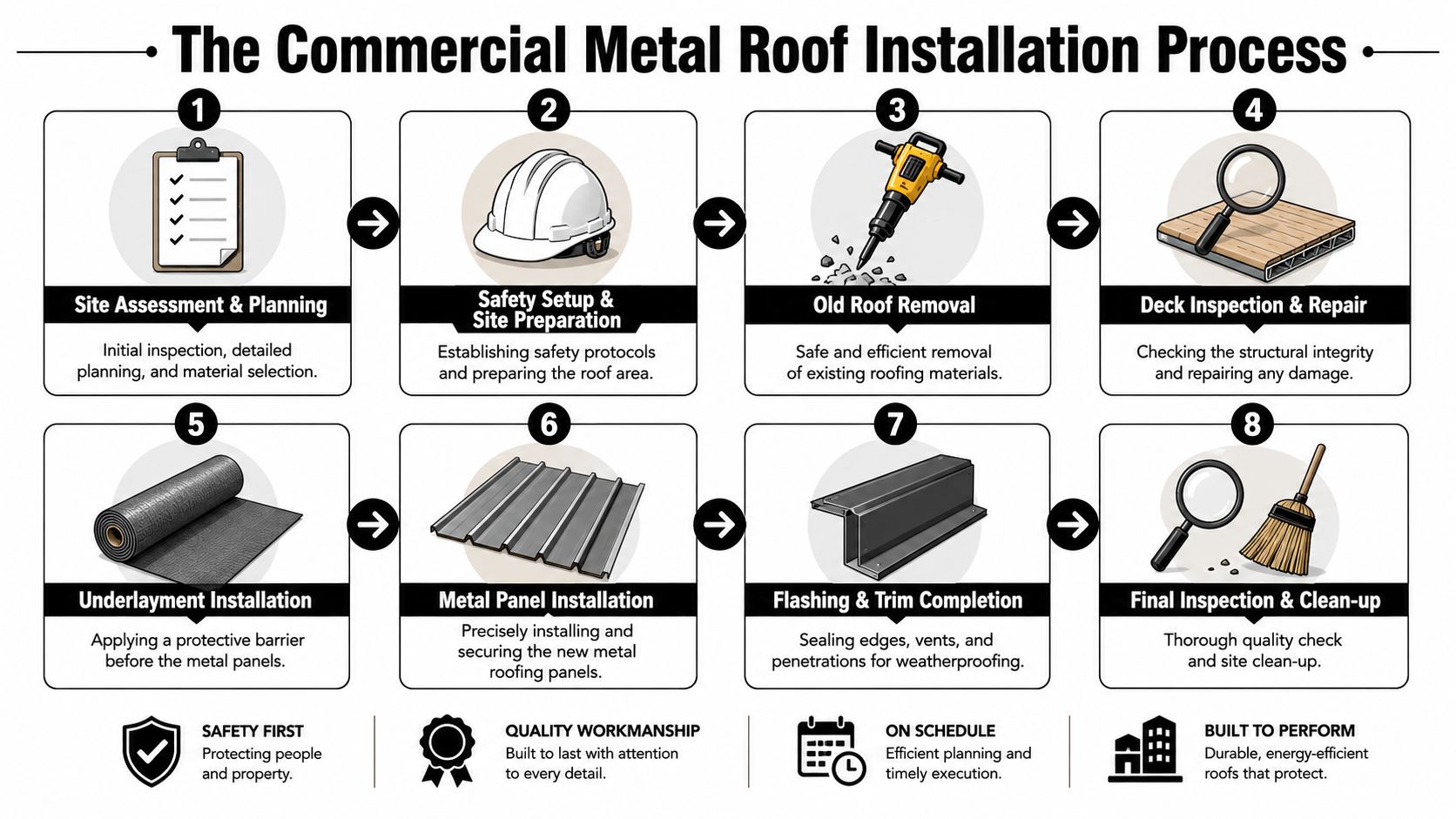
A straightforward overview of sequencing is useful, but what matters on site is control. Public access has to be managed. Deliveries must be staged so panels aren't damaged. Roof openings can't be left exposed without a plan. If you want a closer look at installation sequencing from a contractor's perspective, this guide to commercial roof installation works is a practical reference.
Where good installers separate themselves
A commercial metal roof is only as reliable as its details. Any crew can lay sheets across open spans. The critical work sits in transitions, penetrations, edges, laps, gutters, and movement allowances.
For standing-seam systems, concealed clips have to be installed at each seam joint in the location and spacing set by the panel manufacturer, and the system has to allow for thermal movement. Installation guidance commonly places clip spacing in the 12- to 24-inch on-centre range depending on wind zone and span, according to manufacturer installation data for standing-seam panels. The practical point is simple. If a crew over-restrains the panels, you can end up with oil-canning, seam stress, or fastener-related failures.
That same principle applies across the whole roof. The installer has to understand what the specific profile requires, not just metal roofing in general.
A competent process usually includes:
- Controlled strip-out of the old roof and immediate management of any exposed areas.
- Inspection of structure including purlins, battens, connections, and any corrosion or water damage.
- Installation of safety mesh, insulation, or underlay where specified by the system and project requirements.
- Panel installation with the right sheet alignment, fixing pattern, and movement allowance.
- Completion of flashings and trims at ridges, barges, parapets, penetrations, and roof-to-wall junctions.
- Final inspection and defect close-out before handover.
Good roofing crews don't rely on “how we always do it”. They work from the product details for that profile, on that building, in that exposure.
What a facilities manager should track during the works
You don't need to supervise every fastener, but you do need a short list of checkpoints. Ask for them in pre-start meetings and progress updates.
| Project area | What to confirm |
|---|---|
| Safety setup | Edge protection, exclusion zones, site access control, and overhead risk management |
| Substrate condition | Whether damaged purlins, battens, or supporting elements have been identified and documented |
| Weather-tight staging | How the crew will prevent water ingress during removal and changeover |
| Detail approvals | How penetrations, gutters, and wall junctions will be built before those areas are closed in |
A proper installer won't be irritated by these questions. On a commercial site, they're normal.
Navigating Materials Certifications and Warranties
A warranty argument usually starts long before the first defect notice. It starts at procurement, when the quote names a steel brand but nobody checks whether the full roof system, coating class, fixings, and detailing are suitable for that building in Sydney conditions.
That is why I separate this part of the review into two checks. First, confirm the material being supplied matches the specification and site exposure. Second, confirm the installer can prove they know how that product must be installed to keep the warranty intact.
What compliance means in project documents
If a contractor says the material is compliant, ask for the evidence in writing. For commercial metal roofing, that usually means product data sheets, test certificates where relevant, warranty terms, and installation manuals tied to the exact profile and finish being quoted. References to Australian Standards such as AS 1397 and AS/NZS 2728 should appear in manufacturer documentation, not as a vague verbal assurance from the contractor.
Compliant steel is only part of the picture. The coating system has to suit the environment. The fixing method has to suit the substrate and wind classification. The accessories have to be compatible with the roof sheet. A roof can be built from branded materials and still end up outside warranty conditions if those pieces do not match.
If you want a plain-English primer before reviewing submittals, this guide to metal roofing in Australia gives useful background. Then come back to the project documents and check that the selected system fits the building.
How to verify installer competence against the manufacturer specification
This is the step many owners skip, and it is where expensive problems start.
Do not settle for “we install this product all the time”. Ask the roofer to mark up the manufacturer installation details that apply to your project. On a commercial job, a competent installer should be able to point to the correct details for side laps, end laps, fastener type, fastener spacing, expansion considerations, roof penetrations, and flashing construction at parapets, ridges, and roof-to-wall junctions.
I also recommend asking three direct questions:
Which manufacturer manual and product detail set are you building to?
The answer should name the exact system, not just the steel brand.What project conditions change the standard detail?
A capable installer will mention exposure category, building height, wind loads, roof pitch, foot traffic requirements, and interface points with other trades.What records will you keep to show the roof was installed to that detail?
Good answers include inspection hold points, site photos, fastener and flashing checks, and as-built detail records.
That process does two jobs. It tests competence before work starts, and it creates a paper trail if a warranty issue appears later.
Material warranty and workmanship warranty cover different failures
Owners often treat “warranty” as one document. On a commercial roof, it rarely is.
The manufacturer's warranty applies to the supplied product, subject to its conditions, site classification, maintenance requirements, and correct use of compatible components. The installer's workmanship warranty applies to errors in installation. If a penetration is flashed badly, sheets are fixed outside the approved pattern, or incompatible metals are introduced into the detail, the product warranty may offer little help.
Use this split when reviewing proposals:
Material cover
Confirm the exact product, finish, coating suitability, site exposure assumptions, and any maintenance obligations written into the warranty terms.Installation cover
Confirm what the contractor will rectify if defects arise from flashings, fixings, sheet layout, water ingress at penetrations, edge detailing, or gutter connections.Exclusions and handover obligations
Confirm what happens if later penetrations are made by other trades, plant is added after completion, or maintenance records are missing.
A quote heavy on brand names and light on installation liability leaves the owner carrying too much risk.
At handover, keep four items together. Product identification, warranty documents, the installer's scope of warranty, and the as-built record of non-standard details. For a facilities manager, that file is far more useful than a brochure and a promise.
The Critical Path for Asbestos Roof Replacement
Older industrial and commercial roofs in Sydney often come with a second scope hiding inside the first. You think you're replacing roofing. In reality, you're managing hazardous material removal, site protection, disposal controls, programme risk, and then a new roof build.
Why asbestos jobs fail when the roofer treats them like normal replacements
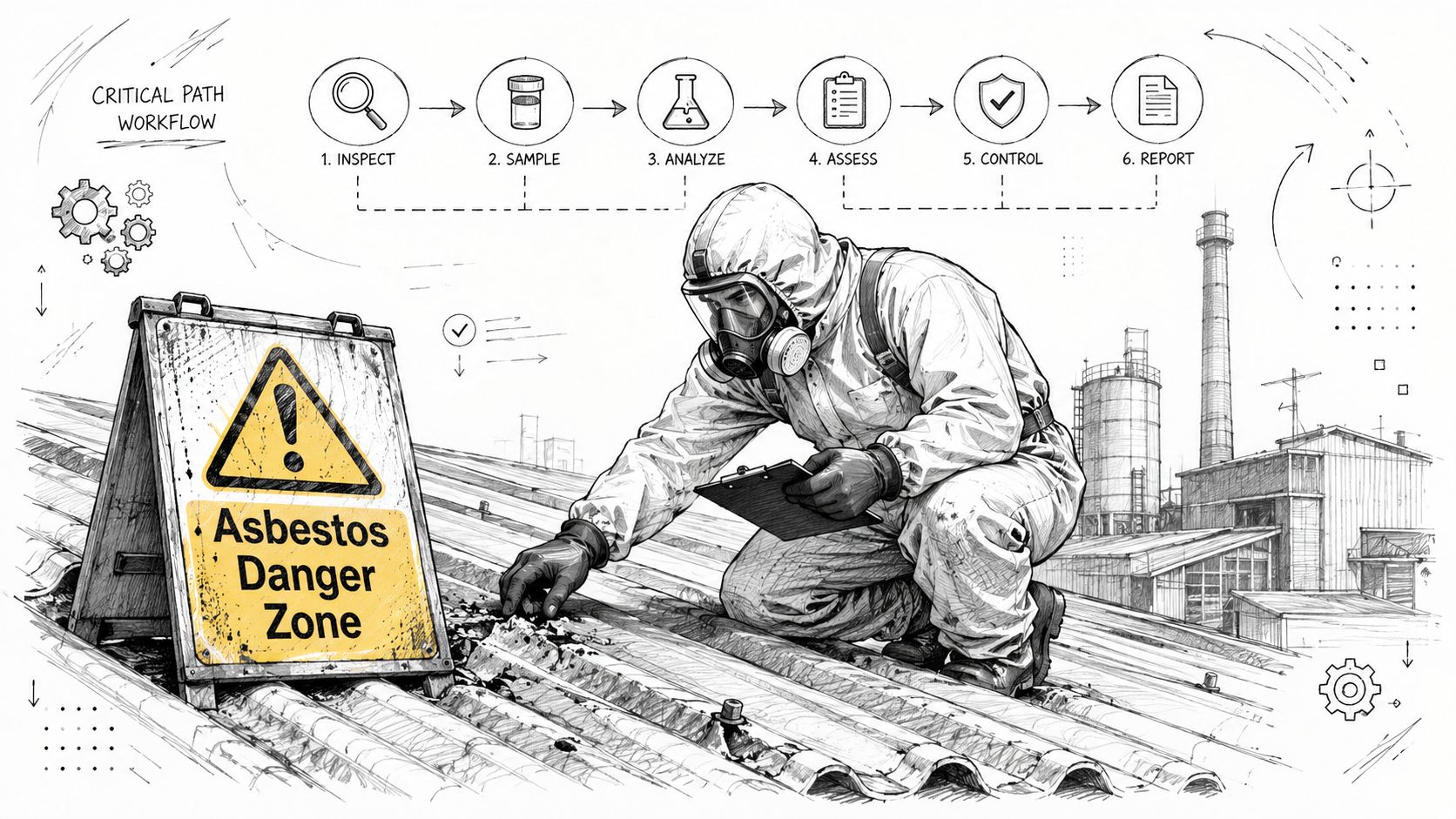
The biggest mistake is letting a standard roofing mindset drive an asbestos job. The sequence changes. The controls change. The paperwork changes. Access, packaging, transport, clearance, and reoccupation all become part of the critical path.
On these projects, the owner needs to know who is responsible for the hazardous materials component and how it interfaces with the roofing scope. If the answer is vague, the risk is already too high. Any contractor discussing asbestos replacement should be able to explain how the removal stage, clearance stage, and re-roof stage connect without exposing workers, occupants, or the public.
For a detailed look at how that broader process is typically handled, this guide to asbestos roof removal and replacement is worth reviewing before procurement.
Questions to ask before anyone touches the roof
Don't ask only whether they “can do asbestos”. Ask how the job will run.
Scope separation
Who handles removal, who handles the new roof installation, and who controls the interface between those activities?Site protection
How will they isolate the work area, protect occupants, and manage access around the building while the roof is being removed?Waste handling
How will asbestos-containing material be wrapped, transported, and disposed of under the required controls?Clearance pathway
What has to happen before the roof area is released for the next stage of work?
A good answer sounds procedural. A weak answer sounds casual.
On asbestos work, confidence means very little. Method matters.
There's also a budgeting consequence. Asbestos replacement isn't just “old roof off, new roof on”. It can change programme duration, staging, access, and the order of trades. That's why owners should ask for the asbestos-related scope to be described clearly in the quote and supporting documents, rather than buried inside a single lump sum.
Budgeting Your Project and Understanding Cost Drivers
If two quotes for a metal roof replacement are far apart, one of them usually includes a different job. That doesn't always mean anyone is being dishonest. It often means one contractor has priced access, safety, details, and latent conditions properly, and the other has priced only the visible roof area.
What actually moves the price
Roofing budgets move on complexity, not just size. A large, simple roof with clean access can be easier to deliver than a smaller roof full of penetrations, plant, staging constraints, and live-tenancy issues.
The main cost drivers usually include the following:
Roof geometry
Straight runs are easier than roofs with multiple levels, parapet junctions, awkward valleys, and tight transitions.Height and access
Busy sites, narrow boundaries, crane constraints, and public interface all change labour and safety planning.Existing condition
If the substrate, purlins, battens, or drainage details need remedial work, that has to be allowed for.Material selection
Different profiles, finishes, and architectural requirements can materially change fabrication and installation effort.Asbestos presence
Hazardous material removal changes the whole project pathway, not just one trade line.
There's another market reality that clients need to understand. The Australian roofing services industry includes 30,660 businesses, but only 1,033 employ staff while 29,627 are non-employing businesses, according to this summary of Australian roofing industry business counts. On commercial jobs, that fragmentation means you need to test whether the installer has the crew structure, insurance, supervision, and delivery capacity for your project, not just a sharp price.
How to read a quote without getting caught short
A quote should tell you what has been allowed for and what hasn't. If it doesn't, comparisons become meaningless.
Look for these items in writing:
| Quote area | What should be clear |
|---|---|
| Access and safety | Scaffolding, edge protection, exclusion zones, traffic management, site establishment |
| Removal scope | Existing roof removal method, waste handling, weather protection during changeover |
| Roof build-up | Underlay, insulation, mesh, panel type, flashing scope, guttering, penetrations |
| Latent conditions | How structural repairs or hidden defects will be identified, priced, and approved |
Then test what's missing. Ask whether downpipes are included. Ask who disconnects and reinstates services at roof penetrations. Ask how temporary weatherproofing is handled if rain interrupts the strip. Ask whether final clean-up includes swarf removal and site debris control.
The cheapest quote often wins by omission. That's why experienced buyers don't just compare totals. They compare scope clarity.
How to Choose the Right Metal Roofing Installers in Sydney
A facilities manager usually finds out the hard way. The new roof looks clean from the ground, the handover folder is thin, then the first hard storm drives water through a poorly finished penetration or parapet junction. On commercial metal roofing, failures usually sit in details that never appear in the sales photos.
Start with commercial capability, not a sales pitch
The first test is simple. Can the contractor talk through your project like a builder managing risk, or like a salesperson trying to close a quote?
A commercial roofing installer should be able to explain how the site will be staged, how public and worker safety will be controlled, what documents will be issued before work starts, how defects and variations are handled, and who is supervising the crew each day. If those answers are vague, the rest of the conversation does not matter much.
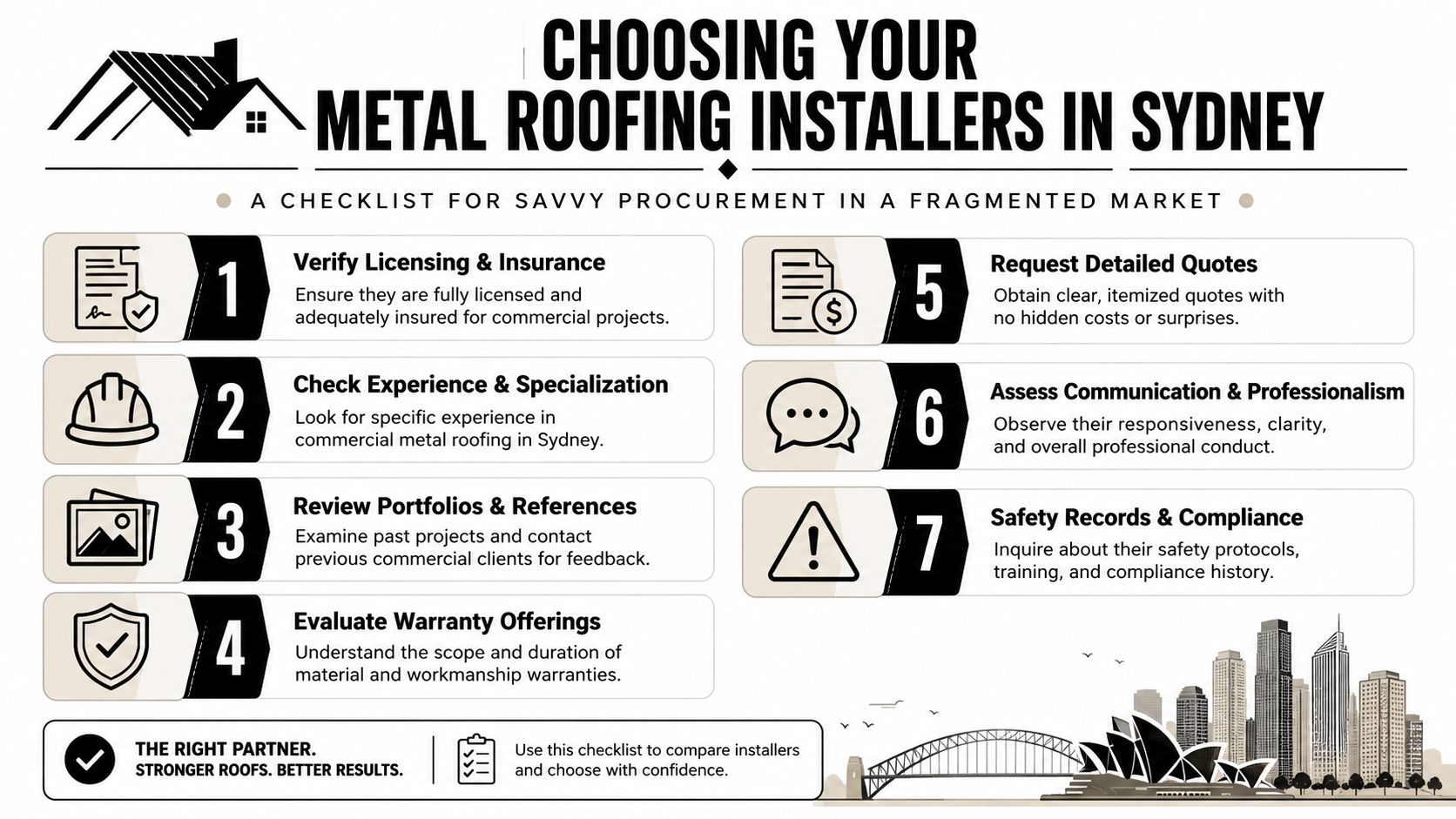
Use a shortlist that checks delivery capability before price:
Licensing and insurance
Ask for current licence and insurance details that match the scope, including clarity on who employs the labour on site.Crew structure
Ask whether the installer uses direct employees, regular subcontract crews, or labour hired job by job. That affects supervision, consistency, and accountability.Comparable projects
Ask for recent work that matches your building type, roof geometry, access limits, and occupancy conditions.Written scope
Ask for a document that identifies materials, roof safety controls, flashings, penetrations, gutters, drainage items, exclusions, and handover items.
One Sydney-based option in this market is Commercial Roofers, which states it uses in-house crews and handles commercial and industrial roofing work across NSW. That sort of operational detail is worth checking with any contractor, rather than accepting it at face value.
A quick video can help frame the broader procurement mindset before you start interviews.
How to verify technical competence against the manufacturer details
Many buyers lose control of the job when they ask whether the installer has used the product before, but they do not test whether the proposed installation method matches the roof system requirements.
For commercial projects in Sydney, that check matters. Wind exposure, thermal movement, long sheet runs, plant penetrations, roof-mounted services, and complicated interfaces all increase the chance of detail failure if the installer is working from habit instead of the manufacturer specification.
Use a simple verification framework during tender interviews and before award:
Request marked-up detail drawings
Ask the installer to provide or mark up typical details for penetrations, parapets, eaves, barges, box gutters, expansion provisions, and roof-to-wall junctions.Cross-check those details against the manufacturer literature
Compare fixing patterns, turn-ups, clearances, sealant locations, support requirements, and flashing methods with the published system documents for the nominated profile.Ask who signs off substitutions
If the installer proposes an alternate underlay, fixing, bracket, or flashing approach, ask whether the manufacturer accepts that change in writing and how it affects the warranty.Test their understanding of movement
Get them to explain how the roof will deal with expansion and contraction on long runs, especially around penetrations, end laps, and standing-seam or concealed-fix systems.Check how they handle interfaces with other trades
Mechanical supports, hydraulic penetrations, solar mounts, and access systems often create leaks because nobody owns the detail. A competent roofer will define who supplies, coordinates, and waterproofs each interface.Ask what details they refuse to install
Good installers know which shortcuts create failures. That answer is usually more useful than a polished capability statement.
A useful outside reference on this point is this technical advice on vetting metal roof installers.
On-site test: If a contractor answers detail questions with “we've always done it this way”, without referring back to the product system, keep looking.
Reviews and project photos have limits. They can tell you a crew left the site tidy. They cannot tell you whether the selected fastening method, flashing geometry, or penetration treatment complies with the roof manufacturer's requirements.
Red flags that should end the conversation
Some contractors are competent on small domestic jobs and still the wrong fit for a large warehouse, strata complex, school, or occupied retail site. The risk is not always obvious at tender stage.
Watch for these signs:
Weak safety planning
If they cannot clearly explain edge protection, exclusion zones, access control, weather shutdown procedures, and public interface measures, the project is exposed from day one.Thin documentation
A commercial installer should be comfortable issuing scope documents, inspection records, product data, SWMS, and warranty information.Too much attention on sheet price
Roof performance depends on drainage, flashings, penetrations, changeover sequencing, and coordination with other trades. If the discussion stays at panel cost, the job is being under-scoped.Resistance to technical questions
A good contractor will not be annoyed when you ask how a box gutter overflow is detailed or how a service penetration is flashed. They should expect that level of scrutiny.Little curiosity about the building
Good roofers ask about operations, leak history, rooftop services, corrosion exposure, after-hours access, and shutdown windows. Poor ones just measure and quote.
The right metal roofing installers in Sydney are usually the contractors who make hidden risk visible before work starts, then show you how their method lines up with the manufacturer specification, the site constraints, and the compliance requirements.
Sydney Commercial Roofing Projects in Focus
Real projects tend to prove the same point. Success rarely comes from a clever sales line. It comes from planning, detail control, and matching the installer to the building.
Warehouse replacement with operations still running
A typical Western Sydney warehouse job usually starts the same way. Active leaks over stock, old fixings failing, and patch repairs spread across different eras of roofing work. The owner doesn't just need a new roof. They need staging that lets the business keep operating.
On jobs like that, the winning approach is disciplined sequencing. Work zones are isolated, removal is staged so the building isn't left exposed, and penetrations are resolved as part of the build rather than treated as afterthoughts. The roofing result matters, but so does keeping forklifts moving, protecting deliveries, and avoiding water ingress during changeover.
Strata re-roof with tight access and public interface
Strata sites bring a different problem set. Residents, parked cars, pedestrian movement, neighbouring properties, and restricted access can make a straightforward re-roof feel crowded fast. On these jobs, communication becomes part of the roofing scope.
The better outcomes come from installers who control public interface well, issue clear notices, and keep roof-edge and debris risks tightly managed. Technical detailing still matters, especially around box gutters, parapets, and service penetrations, but resident coordination often decides whether the project feels professional or chaotic.
These examples aren't unusual. They're exactly why buyers should verify an installer's technical method, site controls, and commercial capability before signing a quote. A new metal roof should solve an operational problem for years. It shouldn't create a fresh one on handover.
If you're planning a re-roof, replacing an ageing industrial roof, or trying to verify whether a proposal is technically sound, Commercial Roofers can help with inspections, asbestos roof replacement, new metal roofing, and commercial roofing scopes across Greater Sydney.