
Your industrial roof is the first and most important line of defence for your entire operation. It’s what stands between your most valuable assets and the elements. That’s why thinking of industrial roof repair as a strategic investment, rather than just another expense, is fundamental to protecting your business and your bottom line.
Table of Contents
- Why Proactive Roof Maintenance Is a Smart Business Move
- A Practical Checklist for Spotting Roof Damage Early
- When Roof Repairs Get Serious: Asbestos and Structural Damage
- Choosing the Right Roofing Materials for Your Facility
- How to Budget for Industrial Roof Repair Costs
- Your Contractor Selection Checklist
- Your Industrial Roof Repair Questions Answered
Why Proactive Roof Maintenance Is a Smart Business Move
Think of your roof like the hull of a ship. A tiny, unnoticed crack might seem insignificant, but out on the open sea, it can quickly become a major breach. It’s the same with your roof; a small leak that goes unchecked can escalate into a full-blown crisis, halting production, destroying expensive machinery, and creating serious safety risks for your team.
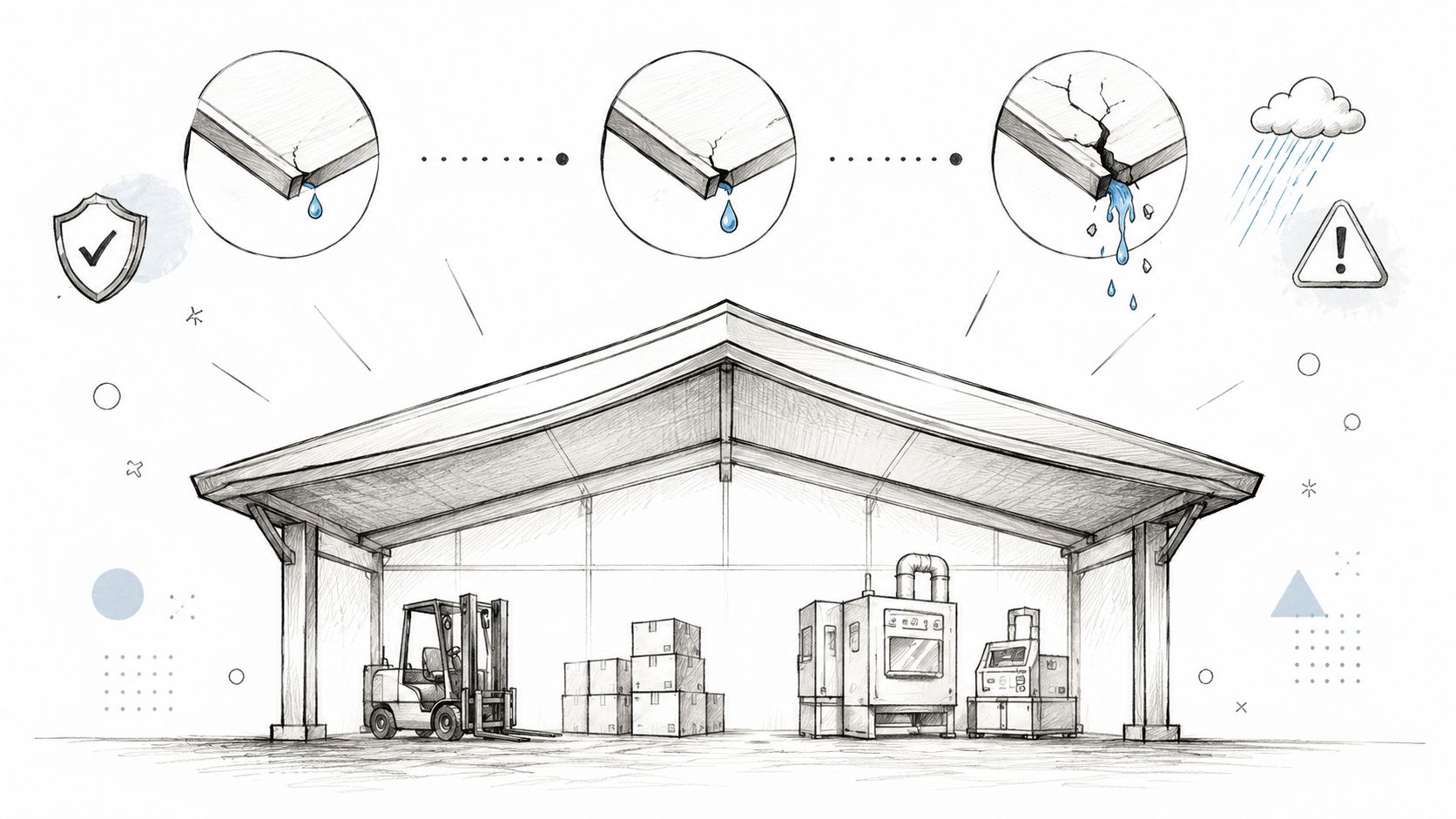
Here in Australia, our industrial roofs are constantly under assault from harsh weather, the natural aging of materials, and the general wear and tear of daily operations. Putting off repairs doesn't just kick the can down the road—it invites financial risks that dwarf the cost of a simple patch job.
The True Cost of Neglect
Ignoring a roofing issue is a false economy. The real price you pay goes far beyond the eventual repair bill; it’s the cascade of secondary damages that truly hurts.
These hidden costs quickly add up:
- Operational Downtime: A single leak dripping onto a critical production line can bring your entire operation to a standstill. Every hour of inactivity can mean thousands of dollars in lost revenue.
- Inventory and Asset Loss: Water can ruin finished goods, contaminate raw materials, and fry sensitive electronics. The result is direct financial loss and a disrupted supply chain.
- Structural Damage: Over time, water intrusion rusts steel supports, causes timber to rot, and can even compromise the building's core structural integrity. Your roofing problem has now become a much bigger, and more expensive, foundational issue.
- Safety Hazards: Wet floors are a major slip-and-fall risk. Worse, persistent dampness creates a breeding ground for mould, which can cause serious health problems for staff and lead to Work Health and Safety (WHS) compliance breaches.
Proactive maintenance is your best defence against these cascading failures. When you shift from a reactive, "fix-it-when-it-breaks" mindset to a strategic maintenance plan, you turn an unpredictable liability into a manageable, budgeted operational cost.
This guide is designed to give facility managers and business owners the practical advice you need. We'll walk through how to spot problems early, understand your repair options—including asbestos replacement and Colorbond installations—and make smart financial decisions. For a deeper look at budgeting for these works, you can learn more about managing roof maintenance costs in our detailed article.
A Practical Checklist for Spotting Roof Damage Early
Knowing what to look for is the difference between a small, manageable repair and a full-blown emergency that shuts down your operations. An obvious leak is easy enough to spot, but the most serious problems often start with subtle clues that are easily missed if you don't know what you're looking for.
Think of your roof's membrane as the protective skin of your building. Any breach in that skin is an invitation for trouble. A classic early warning sign is blistering or cracking on the roof’s surface. Blisters look like bubbles where the membrane has lifted away from the underlying material, creating a weak spot. Cracks are even more direct—they're an open door for water to get in.
From there, you need to think about how water behaves on your roof.
Checking for Water Damage and Corrosion
One of the biggest red flags is ponding water. If you see pools of water still sitting on your roof 48 hours after it has rained, you have a problem. This tells you one of two things: either your drainage is failing, or worse, the roof structure itself is starting to sag under the weight. That constant moisture and weight dramatically speeds up the decay of roofing materials, cutting years off its expected life.
You also need to get up close with the metal components. Corroded fasteners—the screws and bolts holding everything down—might seem like a minor detail, but they are a massive vulnerability. Once rust sets in, it expands, widening the screw hole and weakening the connection. This is one of the sneakiest ways water finds its way into your roof's structure.
Use this simple list to guide your regular visual checks:
- Ponding Water: Are there puddles on flat areas two days after a downpour?
- Membrane Damage: Can you spot any bubbles, blisters, cracks, or splits in the main roofing material?
- Rusted Fasteners: Are the heads of screws or any metal flashings showing signs of rust?
- Damaged Flashing: Pay close attention to the seals around vents, pipes, skylights, and air conditioning units. Look for gaps or material that’s peeling away.
- Clogged Gutters & Drains: Make sure box gutters and downpipes are clear. If they're blocked, water will back up and can be forced under the roof sheets.
A proactive inspection routine is the single most cost-effective approach to industrial roof maintenance. Finding a few corroded screws or a small area of ponding lets you make a targeted fix, preventing the kind of widespread water damage that leads to massive repair bills and operational chaos.
Focusing on Penetrations and Edges
The weak points on any industrial roof are always where something passes through it or where it ends. We call these penetrations (like vents and skylights) and perimeters (the roof edges). These spots are under constant stress from thermal expansion and contraction, causing sealants to pull away or crack over time. These tiny gaps are a common entry point for water.
By using this checklist during your regular walk-throughs, you’ll be much better prepared when you do need to call in the professionals. Instead of just saying "the roof is leaking," you can point to specific areas of concern. This ensures any quote you get for an industrial roof repair is accurate and targets the root cause of the problem, not just the symptom.
When Roof Repairs Get Serious: Asbestos and Structural Damage
Most of the time, industrial roofing issues are straightforward—a few leaky seams, some weather wear, or general maintenance. But every so often, you run into the big two: asbestos and major structural failure. These aren't your typical repair jobs; they are high-stakes projects where the health of your staff and the public is on the line.
When you’re facing these issues, the game changes completely. It becomes a matter of strict legal compliance and specialised expertise. Attempting to manage asbestos or structural repairs without the right qualifications isn't just risky—it's illegal and can have severe consequences for your business.
The Non-Negotiable Process for Asbestos Abatement
If your building went up before the 1990s, there’s a real chance its roof contains asbestos. Discovering asbestos means all standard repair plans go out the window, replaced by a rigid, legally mandated process that can only be handled by a Class A licensed professional.
This isn't just a "careful" roof replacement. It's a full-blown hazardous material operation:
- Confirmation and Assessment: It starts with a licensed assessor taking samples for lab testing. This confirms if asbestos is present and, if so, what type, which dictates the entire safety plan.
- Securing the Site: Before a single sheet is touched, the area is completely sealed off. Think heavy-duty plastic sheeting and negative air pressure units to create a containment zone, ensuring no fibres escape into the environment.
- Specialised Removal: Workers dressed in full personal protective equipment (PPE) then carefully remove the asbestos materials. They constantly wet down the sheets to suppress dust, and once removed, the entire area undergoes a thorough decontamination process.
- Compliant Disposal: The asbestos waste is then double-bagged, sealed, and placed in specially marked containers. From there, a licensed carrier transports it to an approved hazardous waste facility for final disposal.
Catching potential problems early is always the best strategy. Keep an eye out for these common warning signs that could point to deeper issues.
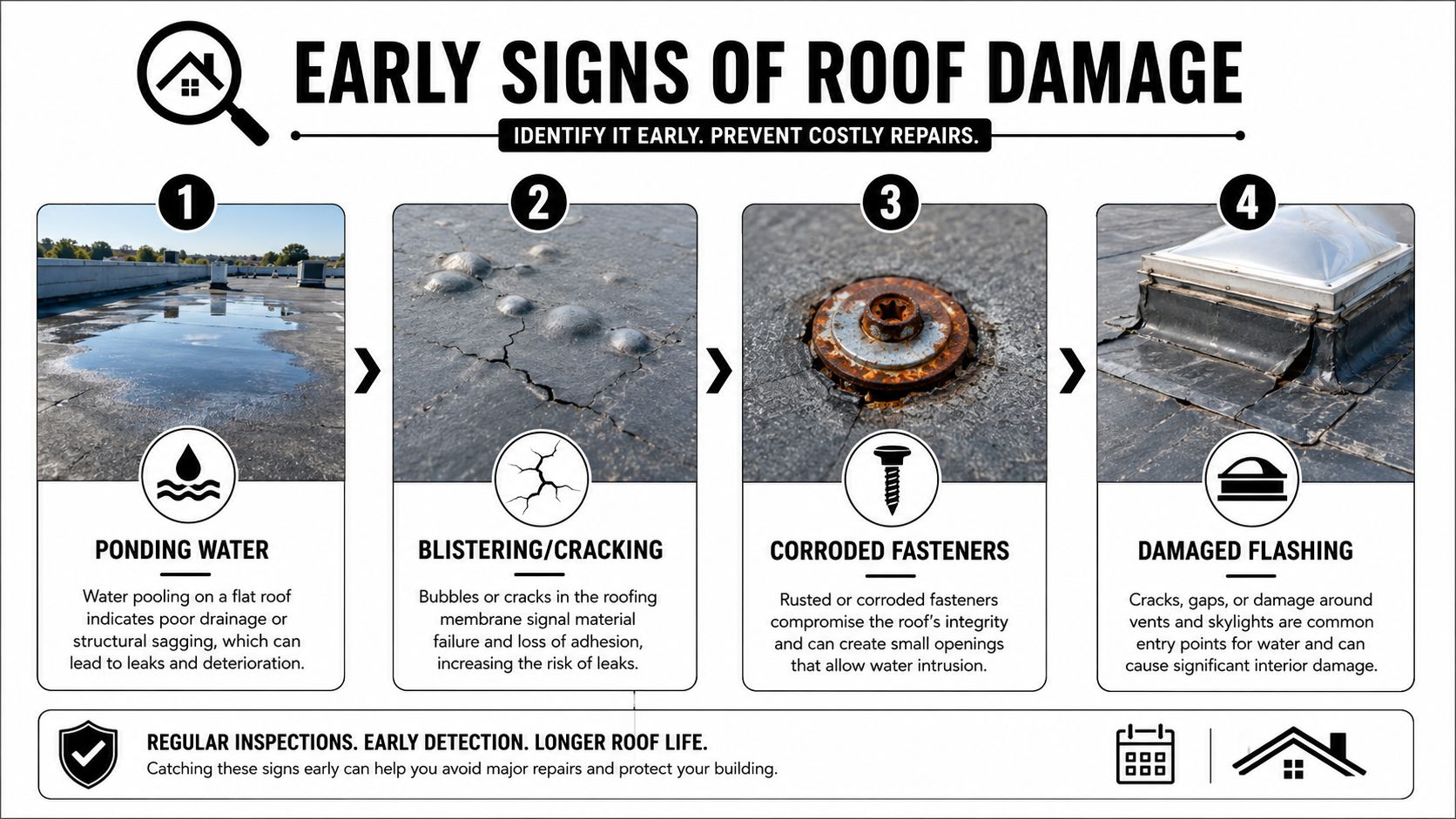
Noticing things like ponding water or failing fasteners gives you a chance to get a professional assessment before a small problem escalates into a structural crisis.
Timelines and Costs: The Reality of Major Repairs
The rigorous safety protocols for asbestos work have a significant impact on both the project timeline and the budget. In fact, asbestos removal is a major driver of industrial roof repair projects across Australia. With over 1.4 million commercial buildings in NSW alone thought to contain asbestos, it's a widespread issue.
According to Safe Work Australia, this has pushed the average project timeline for an industrial roof in Sydney from just 5 days up to 12 days when asbestos is involved. You can explore the full research on roofing market trends to get a bigger picture of the industry.
The key takeaway is this: asbestos roof work is not a standard repair. It's a specialised environmental and safety operation. Hiring a contractor without the specific licenses and proven experience is one of the biggest risks you can take as a building owner.
Similarly, serious structural damage like sagging roof purlins or widespread rust requires a deliberate and expert-led approach. A structural engineer must first inspect the building to determine the extent of the damage and design a safe remediation plan. This often involves installing temporary supports to brace the structure before any compromised sections are cut out and replaced, guaranteeing the building's stability from start to finish.
For a deeper dive into this critical subject, our guide on commercial asbestos roof removal and replacement covers the process in much greater detail.
Choosing the Right Roofing Materials for Your Facility
Once you’ve confirmed a roof repair or full replacement is on the cards, your next decision is the most critical: selecting the right material. This isn't just about plugging a leak; it's a long-term investment in protecting your entire asset. It’s a simple principle: you wouldn't put standard car tyres on a heavy-duty truck, and your roofing choice has to be just as fit-for-purpose.
The reality is that Australia's harsh climate puts incredible stress on industrial roofing. The wrong material can break down far sooner than expected, leading to a cycle of constant repairs and spiralling lifecycle costs. Our intense sun, in particular, is a major factor. For example, under the relentless UV exposure found in areas like Greater Sydney, a modified bitumen roof might only last 15–20 years. In contrast, a well-maintained metal roof can easily push past the 40-year mark.
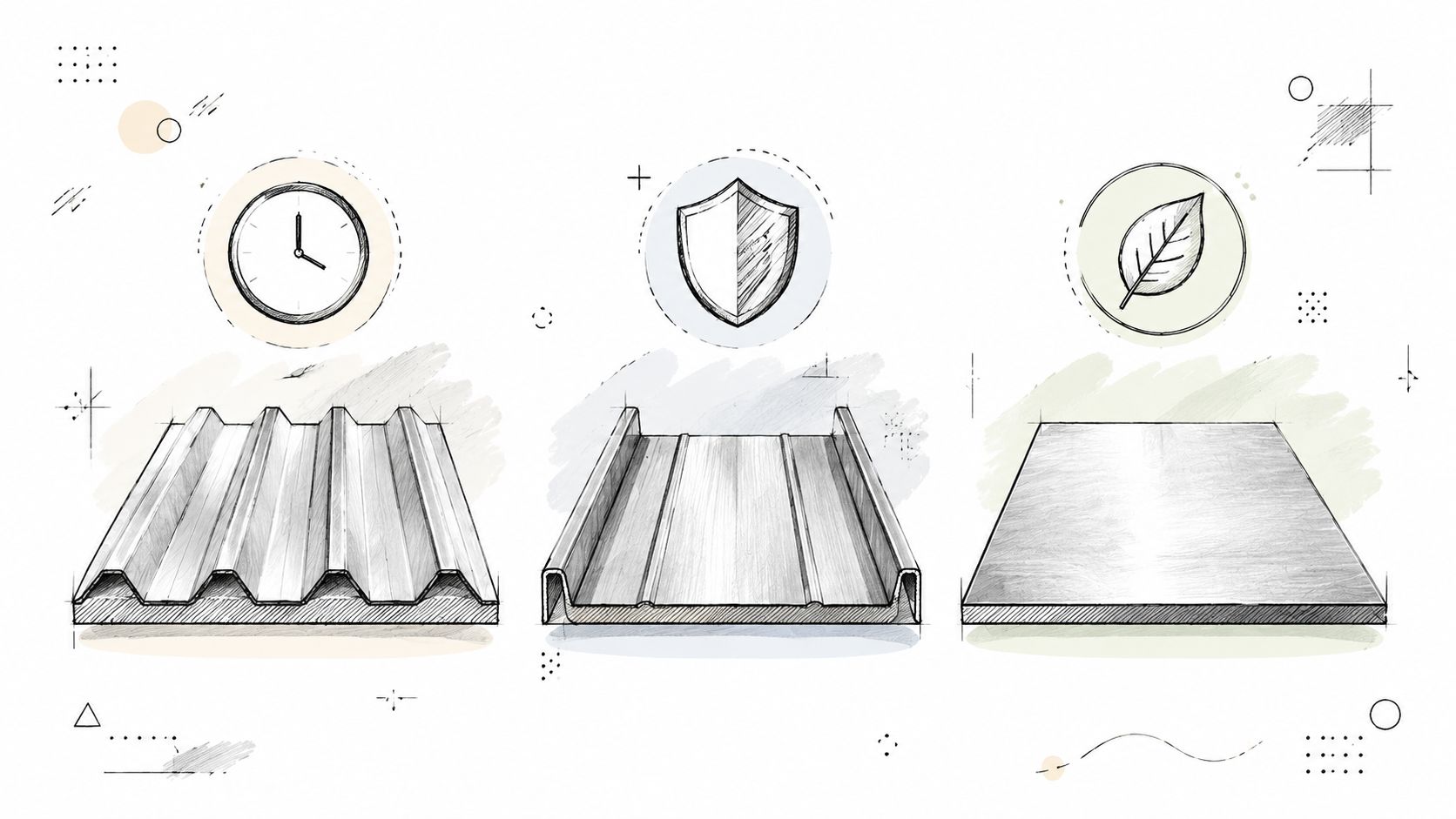
To help you navigate these choices, we've put together a comparison of the most common materials used for industrial facilities across Australia.
Industrial Roofing Material Comparison
| Material | Typical Lifespan (AU Climate) | Relative Cost | Key Benefits | Best For |
|---|---|---|---|---|
| Colorbond Steel | 40-70+ years | Medium | Excellent durability, corrosion resistance, wide colour range, thermally efficient. | The vast majority of warehouses, factories, and commercial buildings. |
| VM Zinc / Copper | 80-100+ years | Very High | Unmatched longevity, self-healing patina, superior corrosion resistance. | Architectural highlights, coastal areas, or facilities with chemical exposure. |
| Standing Seam Metal | 50-70+ years | High | No exposed fasteners (fewer leak points), sleek appearance, excellent for low-slope roofs. | Modern facilities, architectural designs, and buildings where water pooling is a risk. |
| Modified Bitumen | 15–20 years | Low | Low upfront cost, good waterproofing for flat or low-slope roofs. | Budget-driven projects, smaller flat roof sections, and less critical structures. |
As the table shows, there’s a clear trade-off between upfront investment and long-term performance.
Popular and Premium Material Choices
For most industrial jobs in Australia, Colorbond steel is the undisputed workhorse. Its baked-on paint finish over a zincalume steel core is engineered to handle everything our climate throws at it—from coastal salt spray to the searing inland heat. It hits the sweet spot of durability, performance, and cost-effectiveness.
That said, for certain facilities, a larger initial investment in a premium material can pay for itself many times over.
A value-based decision looks beyond the initial quote. It considers the total cost of ownership over the roof's entire lifespan, factoring in maintenance, energy savings, and potential replacement costs.
This is where specialist options really shine:
Standing Seam Profiles: These systems are clever because they hide the fasteners, which are the most common failure points on a traditional roof. By eliminating thousands of potential leak points, they provide a far more secure solution, especially on big, low-slope roofs where water doesn't run off as quickly.
VM Zinc or Copper: These are in a league of their own. With a lifespan that can exceed 80-100 years, they are essentially a permanent solution. Their incredible resistance to corrosion makes them a must-have for facilities near the coast, or those exposed to harsh industrial chemicals that would eat through standard steel in no time.
At the end of the day, making the right choice is about balancing your budget with the long-term demands on your building. To get a better feel for these options, take a look at our detailed guide to metal roofing in Australia. Getting this decision right ensures your repair isn't just a patch-up job, but a strategic upgrade that will safeguard your facility for decades.
How to Budget for Industrial Roof Repair Costs
So, you’ve got a roof problem. The first question that pops into your head is probably, "What's this going to cost me?" Trying to budget for an industrial roof repair can be tricky, because the final price isn't just about the size of your roof. It’s a mix of several factors that can swing the total cost one way or the other.
A few loose sheets that need re-fastening is one thing; widespread corrosion across your entire roof is another entirely. The scale of the damage is the obvious starting point, but let's break down the other key drivers that will shape the quote you receive.
Key Factors That Influence Your Budget
Getting a handle on your potential costs means understanding what goes into a professional roofer's quote. It's more than just materials and a day's labour.
Roof Accessibility: How easy is it for a team to get onto your roof and work safely? A single-storey warehouse with a flat, clear roof is relatively straightforward. But if we're talking about a multi-level building with tricky access, you might need to budget for specialised equipment like cranes or scissor lifts, which can add thousands to the bill.
Material Choice: As we've covered, your choice of materials has a direct impact. A standard Colorbond steel roof is a fantastic, cost-effective choice for most. Opting for premium architectural materials like VM Zinc, however, will push the budget higher.
Labour and Complexity: The nature of the job dictates the skills required. Replacing a few metal sheets is a very different task from a full-scale asbestos roof removal. Jobs that demand certified asbestos specialists, extensive safety protocols, and complex structural work will naturally come with higher labour costs.
Hidden Costs: These are the expenses that can catch you by surprise if you're not prepared. Things like council permits, structural engineering reports (if the damage is severe), and mandatory asbestos disposal fees can add a significant amount to the final invoice.
A transparent quote should itemise these costs clearly. If a contractor provides a single, unexplained number, it’s a major red flag—you need to know exactly what you're paying for to budget effectively and avoid surprise expenses.
Realistic Timelines and Cost Brackets
The timeline for a repair is just as variable as the cost. A minor leak might be sorted in a day. On the other hand, a full asbestos roof replacement on a large warehouse could easily take over a week once you factor in site containment, safe removal, and installing the new roof.
It's also worth noting that severe weather events across Australia are pushing both costs and timelines up. We've seen a dramatic increase, with the average warehouse roof repair jumping from $8,500 in 2022 to $14,200 in 2026. In some parts of Sydney, like Mount Druitt, the complexity of jobs has stretched the average repair timeline from three days to seven. You can discover more insights about these roofing statistics and what drives them.
To give you a clearer picture, here are some realistic cost scenarios for a typical industrial building in Sydney:
- Minor Leak Repair: For fixing a few loose sheets or replacing some faulty flashings, you could be looking at $800 – $2,500.
- Medium-Scale Repair: If you're tackling a larger area of damage, like replacing a 100m² section of rusted sheeting, the cost would likely be in the $10,000 – $25,000 range.
- Full Roof Replacement (Non-Asbestos): A full re-roof on a standard 1,000m² warehouse using Colorbond steel generally falls between $80,000 – $150,000.
- Asbestos Roof Replacement: That same 1,000m² roof with asbestos removal will be significantly more. Expect a range of $120,000 – $200,000+ to cover the strict safety and disposal requirements.
These figures should give you a solid baseline for your financial planning. They’ll help you set realistic expectations and make sure you allocate the right funds for a safe, compliant, and long-lasting roof repair.
Your Contractor Selection Checklist
Picking the right contractor for your industrial roof repair is hands down the most critical decision you'll make in this whole process. It's the difference between a roof that's fixed for good and a cheap patch-up that will inevitably fail, costing you far more in the long run. Don't think of it as just hiring a tradie; you're bringing on a specialist partner whose work will protect a major asset.
Be wary of the rock-bottom quote. In my experience, an unusually low price is a massive red flag, often pointing to cut corners, subpar materials, or—worst of all—a lack of proper insurance and licensing. A true professional has no problem proving their credentials and being transparent about what they do.
Core Credentials and Experience
Before you even glance at the price, you need to do some basic due diligence. This isn't just red tape; it’s your first and best defence against unqualified operators and ensures your project is above board from a legal and safety standpoint.
Here’s what you absolutely must verify:
- Licensing: Are they properly licensed for building work in NSW? Even more important, if you're dealing with asbestos, they must hold a specific Class A or Class B asbestos removal licence issued by SafeWork NSW. There are no exceptions to this.
- Comprehensive Insurance: Ask to see their current Certificates of Currency. You're looking for Public Liability Insurance—and for industrial jobs, $20 million in cover is the industry standard—as well as Workers Compensation. This is what protects your business from liability if an accident happens on your property.
- Proven Experience: Have they actually done this before? Ask to see a portfolio of projects similar in scale and complexity to yours. Don't be afraid to ask for references from other facility managers or business owners they've worked with.
Assessing the Quote and Guarantees
Once you’re confident they’re qualified, it’s time to look at the quote. A professional quote is a detailed breakdown, not just a single figure scribbled on a page. It should clearly list costs for labour, all materials, scaffolding or access equipment, and specific line items like asbestos disposal fees.
A vague quote is often hiding something. Real professionals are confident in their pricing and are happy to walk you through every line item, so you know exactly what you’re paying for.
Finally, get the details on warranties. You should be looking for two separate guarantees: one from the manufacturer covering the materials (like the metal sheeting or membrane), and another from the contractor covering their workmanship. A solid workmanship warranty is a great sign—it shows the contractor stands behind their work and is committed to a result that lasts.
Your Industrial Roof Repair Questions Answered
When it comes to industrial roofing projects, a lot of questions come up. We get it. It’s a significant investment, and you need clear, straightforward answers. Here’s what we hear most often from facility managers and business owners across Australia.
How Often Should I Get My Roof Inspected?
As a rule of thumb, you should have a professional look over your roof at least once a year. It's also non-negotiable to get an inspection done straight after any severe weather, like a big storm or hailstorm.
If your property is in a particularly tough environment—think coastal areas with corrosive salt spray or near industrial zones with chemical fallout—we strongly recommend bumping that up to twice a year. These regular checks are genuinely your best defence against small, easy-to-fix problems turning into major, costly headaches down the track.
Can My Business Stay Open During a Roof Replacement?
Yes, absolutely. In nearly all situations, your business can continue operating with minimal fuss. Any good industrial roofing contractor will work with you to create a detailed project plan that puts safety first and keeps disruptions to an absolute minimum.
This usually means tackling the job in managed sections, setting up clear safety zones with proper barriers and signage, and scheduling the loudest work for after hours or on weekends. The main objective is always to ensure you can carry on with business as usual, safely and smoothly.
What’s the Difference Between Roof Restoration and Replacement?
Think of roof restoration as a life-extending procedure for a roof that's still structurally solid. It’s a process where we give the roof a deep clean, fix any minor issues, and then apply a new, high-performance protective coating. It's a fantastic, cost-effective option when the roof's "bones" are still in great shape.
A full roof replacement, on the other hand, is exactly what it sounds like—a complete do-over. We strip everything off right down to the structural deck and install a brand-new system from scratch. This is the necessary route when a roof has widespread damage, has simply reached the end of its service life, or contains hazardous materials like asbestos that need to be removed completely and safely.