
Roof restoration is worth considering when the roof has a sound substrate, localised defects, and enough remaining service potential to justify the work. The University of Sydney's roofing standard uses a 50-year design life for structural elements and treats major maintenance as work costing more than 50% of the original project value, while the project must also anticipate NCC 2025 energy and solar requirements.
The popular advice is to repaint an ageing roof, stop the leaks, and postpone replacement. That advice is incomplete for a warehouse, factory, retail site or strata asset. A cheap coating over corroded sheets, failed drainage or asbestos-cement material can create a false sense of security while shortening the building's useful economic life.
The right question isn't just, “Will restoration stop water getting inside?” It's whether the proposed work will protect the roof structure, satisfy safety and compliance obligations, support future insulation and solar decisions, and reduce total ownership risk. If it only improves appearance, it isn't a commercial roof strategy.
Table of Contents
- The Commercial Roof Restoration Reality Check
- When Restoration Makes Financial and Structural Sense
- Restoration Versus Full Replacement for Commercial Assets
- Energy Efficiency and the Hidden ROI of Roof Upgrades
- The Essential Commercial Roof Inspection Checklist
- Navigating Asbestos Risks and NCC 2025 Compliance
- Next Steps for Commissioning a Defensible Roof Assessment
The Commercial Roof Restoration Reality Check
Roof restoration is not a cheaper version of roof replacement. It's a condition-dependent intervention that can preserve a serviceable roof, or conceal a failing one.
A proper restoration specification may include repairs to sheets, fasteners, flashings, gutters, valleys, penetrations and sealants, followed by surface preparation and compatible recoating. It may also require drainage improvements, insulation remediation, access controls and documentation for future maintenance. A contractor who offers only pressure cleaning and paint hasn't yet demonstrated that the roof is suitable for restoration.
Why cheap work can destroy asset value
A commercial roof can keep leaking after a new coating has been applied if water is entering through failed laps, loose fasteners, cracked flashings or ponding areas. Coating also won't correct structural movement, incorrect roof pitch, sheet-thickness loss or a deteriorated substrate. Those defects continue to affect stock, plant, interior finishes, tenants and daily operations.
The financial damage often comes from delay. A committee approves a low-cost treatment, then pays for repeated leak callouts, emergency access, damaged contents and another investigation when the coating fails. The original restoration cost hasn't replaced the capital requirement. It has consumed budget that could have funded a properly designed repair or replacement.
Commercial rule: Never approve a coating warranty as a substitute for a condition report.
Restoration must serve the next capital decision
A sound restoration proposal should answer four questions:
- What remains serviceable? The report should identify the roof profile, substrate condition, structural movement and areas with adequate remaining service potential.
- What will be replaced? It should separate repairable defects from sheets, flashings, fasteners or drainage components that need replacement.
- What will change operationally? The scope should address access, tenant activity, stock protection, plant clearances and business interruption.
- What future work must the roof support? Insulation upgrades, rooftop equipment and solar PV can change the loading, layout and compliance requirements.
The most defensible answer to is roof restoration worth it is therefore conditional but direct. Restore when the underlying system is sound and the scope fixes causes, not symptoms. Replace when defects are widespread, the substrate is compromised, or the proposed work leaves the building exposed to the same risks.
When Restoration Makes Financial and Structural Sense
The financial test starts with condition, not age. A roof that's older but structurally sound can be a stronger restoration candidate than a newer roof with widespread corrosion, movement or drainage failure.
The University of Sydney roofing standard specifies a 50-year design life for structural elements and roofing layers that are difficult to maintain or replace, plus a 25-year service life before the first major maintenance event. It defines major maintenance as work costing more than 50% of the original project value. These benchmarks appear in the University of Sydney roofing system standard, and they give owners a useful framework rather than a universal restoration rule.
Use a whole-project comparison
Ask the quantity surveyor, roofing consultant or facilities team to compare:
- The complete restoration scope, including repairs, access, preparation, recoating, drainage, safety controls and future maintenance.
- Full replacement, including removal, disposal, new materials, installation, temporary protection, plant relocation and operational disruption.
- The consequences of failure under each option, including water damage, tenant claims, lost stock, equipment exposure and emergency works.
- The likely timing of the next major capital intervention.
If restoration remains materially below the replacement option and the roof can perform reliably after the work, it may protect capital value. If the restoration budget approaches the major-maintenance benchmark or requires repeated temporary fixes, replacement deserves priority. For an additional budgeting reference, compare the proposed scope with average commercial roof restoration costs, but don't rely on a generic price guide instead of a site-specific assessment.
Localised defects are the dividing line
Restoration suits a roof where corrosion is superficial, the profile and falls remain serviceable, and defects can be mapped into discrete repair zones. Suitable work may include renewing fasteners, replacing damaged flashings, resealing penetrations, repairing gutters, improving drainage and recoating a properly prepared surface.
Replacement becomes the responsible option when corrosion affects large areas, sheets have lost significant thickness, the deck or substrate has failed, movement keeps reopening joints, or water is trapped across broad sections. A coating can't restore missing metal or stabilise a moving structure.
A board or strata committee should receive marked-up roof plans, photographs, defect categories, repair quantities and a clear explanation of what the coating system can and can't address. That documentation turns a contractor recommendation into a decision that can be reviewed, funded and defended.
Restoration Versus Full Replacement for Commercial Assets
Restoration preserves useful components and can defer the disruption of a tear-off. Replacement gives the owner a new roof system, a clearer design baseline and a more reliable response to widespread deterioration. Neither option wins automatically.
Independent Australian guidance reports typical service ranges of approximately 30 to 50 years for metal roofs and more than 50 years for concrete tiles. The same guidance explains that durability depends on material quality, installation, maintenance and exposure, with failures often starting in replaceable components such as coatings and flashings before the primary roof structure fails. See the Australian roof replacement guidance for that service-life context.
The decision matrix
| Decision Factor | Favours Restoration | Favours Replacement |
|---|---|---|
| Substrate | Structurally sound with adequate thickness | Widespread corrosion, rot, distortion or movement |
| Defects | Localised leaks, fasteners, flashings and sealants | Recurring failures across large roof areas |
| Drainage | Falls and drainage capacity can be corrected | Persistent ponding or fundamentally inadequate drainage |
| Capital planning | Restoration defers major expenditure without repeated temporary work | Restoration would consume a substantial share of replacement value |
| Operations | A staged project limits disruption | Ongoing failures threaten stock, plant, tenants or production |
| Future performance | Insulation, plant access and PV planning can be integrated | The existing system can't support future loading or compliance needs |
Where restoration earns its place
A metal roof may still have considerable service potential when the main sheets remain sound and the failures sit in fasteners, flashings, coatings, gutters or sealants. Replacing those components before preparation and recoating addresses the water paths rather than covering them.
Replacement is more persuasive when the roof has reached the end of its useful life and the contractor can't identify a stable substrate. Repeated patching can also create an uneven system with multiple repair materials, uncertain warranties and no reliable maintenance baseline. In that situation, a new roof may reduce future uncertainty even if the initial project is more disruptive.
Don't compare restoration and replacement only by headline price. Compare expected maintenance, safety management, waste handling, access requirements, business interruption and the cost of one preventable water event. A replacement budget can also be tested against commercial roof replacement costs in Sydney, provided the final recommendation remains based on the actual site.
Energy Efficiency and the Hidden ROI of Roof Upgrades
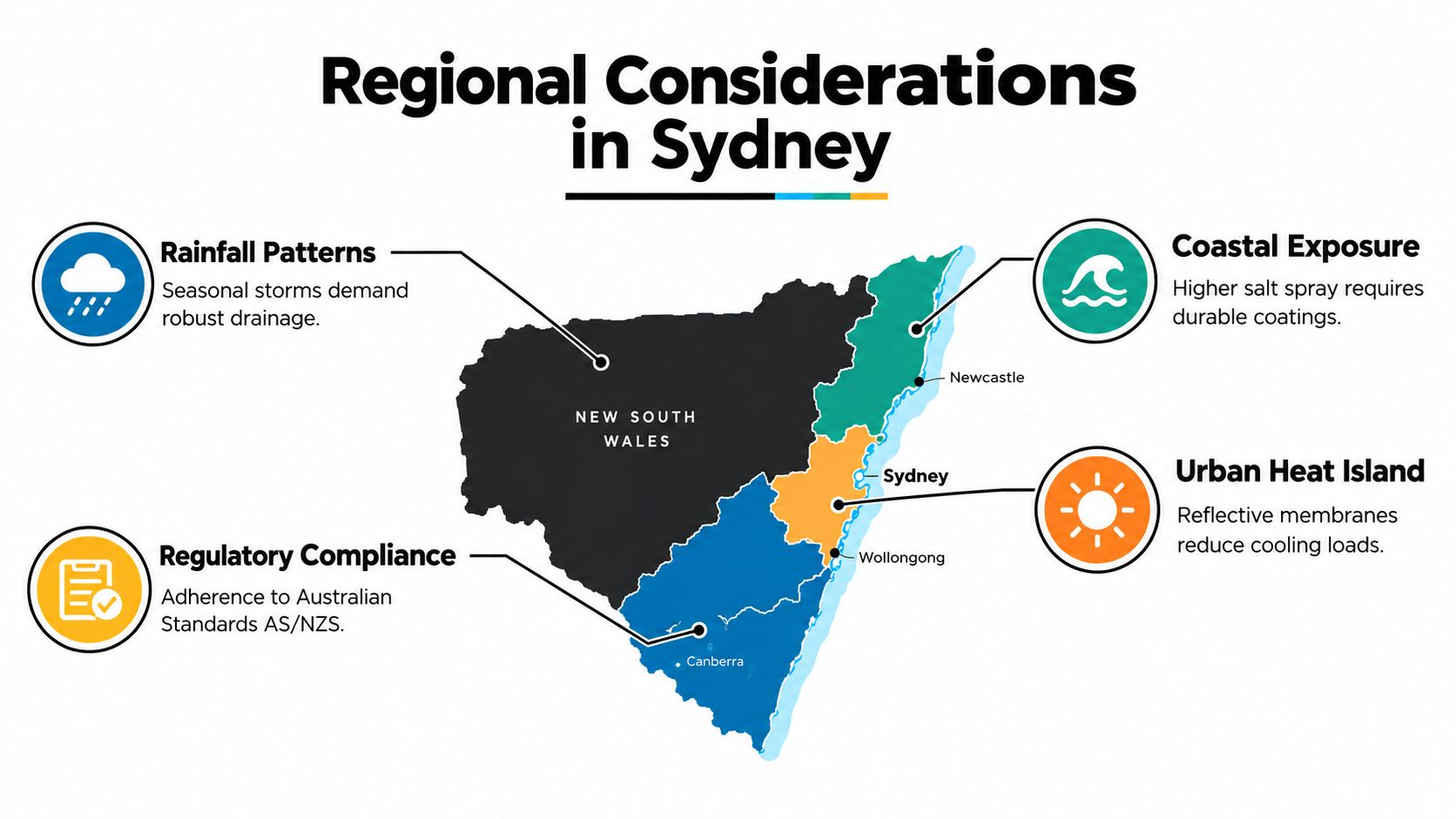
A reflective roof can help, but colour isn't an energy strategy. The building's roof-and-ceiling assembly determines whether restoration contributes to lower heat gain and more stable internal conditions.
The Australian Building Codes Board identifies roof Total R-Value, roof-surface reflectance and metal-roof emittance as relevant commercial performance parameters. Its guidance also makes the critical point that a high-reflectance coating can't compensate for inadequate ceiling-level thermal resistance. The ABCB commercial energy-efficiency material provides the basis for assessing those factors.
Test the assembly, not the paint
Before approving a reflective coating, inspect insulation for compression, moisture and gaps. Check thermal bridging around purlins, penetrations and plant supports, and review whether air leakage or HVAC operation is undermining the expected benefit.
A warehouse with poor insulation may receive limited value from a new reflective surface. A facility with sound insulation, substantial solar exposure and high cooling demand may have a stronger case, especially if roof repairs and thermal improvements are coordinated. The project should specify the coating's reflectance and emittance characteristics rather than relying on a colour name or a generic claim.
A reflective roof coating assessment should sit inside a broader building-performance review. The contractor's scope should explain compatibility, preparation, coverage, maintenance requirements and how the coating interacts with existing insulation and rooftop equipment.
Measure operational results
Facility managers should establish a pre-work baseline for electricity use, internal temperatures and peak cooling demand. After the work, compare results under similar weather, occupancy and operating conditions. This won't isolate every variable, but it gives stakeholders a more credible view of whether the roof upgrade contributed to improved performance.
Use restoration to coordinate related work:
- Insulation: Replace wet, compressed or missing insulation where access allows.
- HVAC: Review rooftop units, clearances, supports and maintenance access before finalising the roof surface.
- Penetrations: Repair seals and detail interfaces so thermal and waterproofing improvements don't create new failure points.
- Drainage: Combine performance upgrades with drainage repairs instead of reopening the roof later.
The strongest project isn't the one with the brightest finish. It's the one that reduces water risk while improving the roof's contribution to the building's operating plan.
The Essential Commercial Roof Inspection Checklist
A ground-level visual inspection isn't enough for a commercial restoration decision. The assessor needs to walk the roof safely, inspect representative areas, test suspect materials and record the relationship between defects and drainage.
For metal roofing, assess the work against SA HB 39:2015, which addresses metal roofing, wall cladding, weatherproofing and directing rainwater into stormwater drainage. The SA HB 39:2015 guidance supports a central conclusion: coating alone can't correct incorrect roof pitch, persistent ponding or advanced corrosion.
Start with the roof system
Use this sequence when reviewing a contractor's report:
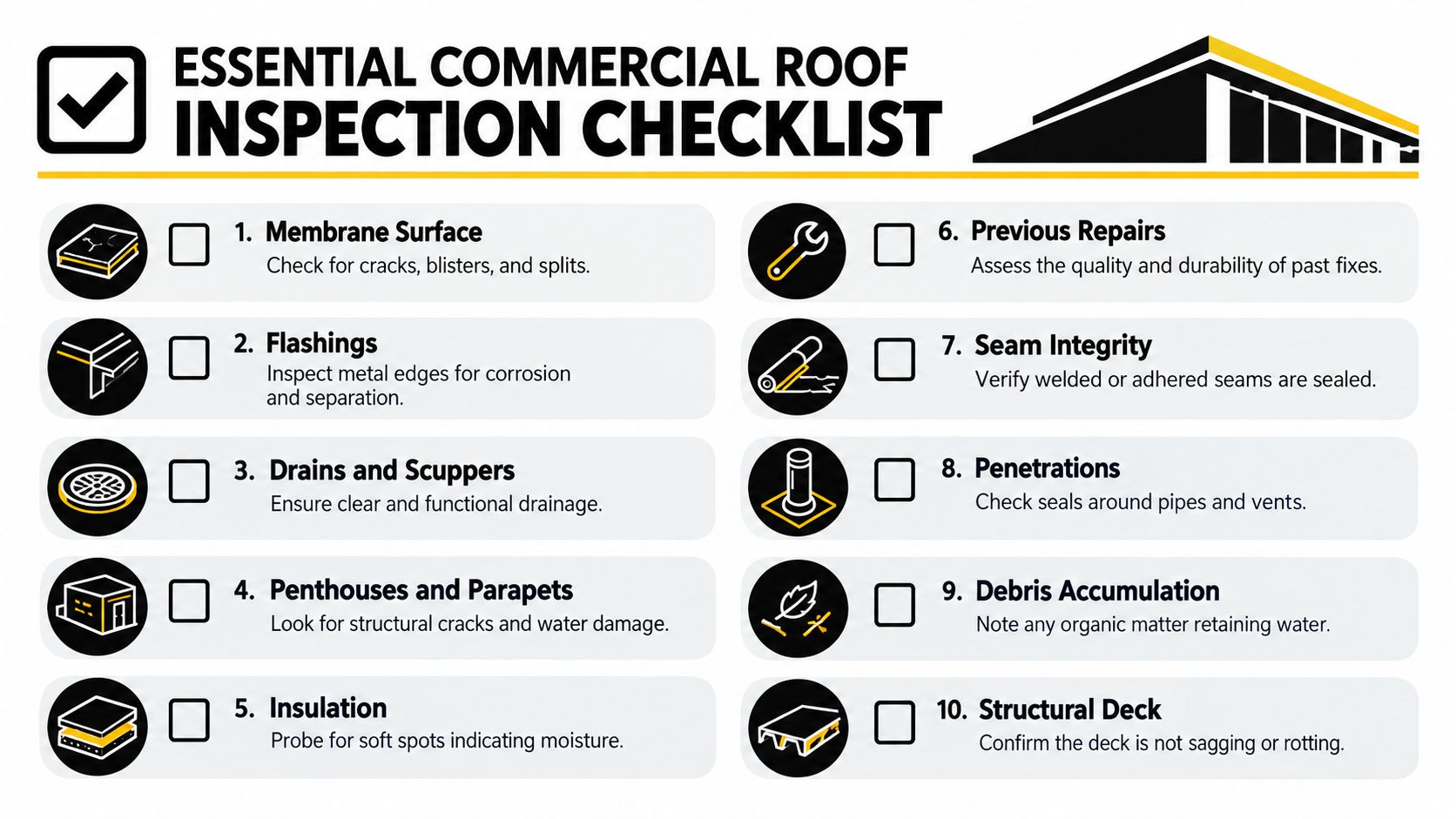
- Map the roof. Mark sheets, membranes, ridges, valleys, box gutters, penetrations, plant zones and access paths.
- Inspect the surface. Look for coating failure, splits, blisters, rust, impact damage, loose sheets and distorted profiles.
- Test the substrate. Probe soft areas, assess sheet thickness where corrosion is suspected, and identify moisture below the surface.
- Examine connections. Check fasteners, laps, seams, flashings, parapets and penetrations for movement or failed seals.
- Review drainage. Confirm gutters, outlets, scuppers and downpipes are clear, correctly connected and capable of managing runoff.
- Separate defects. Classify each area as clean and coat, repair then coat, replace before restoration, or replace as a complete system.
- Check access and safety. Identify fragile areas, fall risks, edge conditions, asbestos concerns and requirements for roof ladders or crawl boards.
- Record evidence. Require photographs, locations, test results, proposed materials and reasons for excluding any visibly damaged area.
Audit the proposed scope
A credible proposal should state how the surface will be prepared, which repairs occur before coating, how wet or corroded areas are handled, and what testing confirms substrate suitability. It should also identify exclusions. A quote that promises a uniform finish but says little about sheet replacement, drainage or penetrations is incomplete.
The report should explain whether recurring leaks originate from surface degradation or from design and installation problems. If ponding remains after the project, the roof may fail again regardless of coating quality.
Use the following video as supplementary visual context when discussing inspection planning and roof work, but don't treat generic footage as a substitute for a site-specific report.
Navigating Asbestos Risks and NCC 2025 Compliance
Two issues can change the restoration decision before a contractor applies a single product: asbestos and future energy requirements.
Older commercial and industrial buildings may contain asbestos-cement roof sheets. Australian workplace-safety guidance says those sheets must be removed intact and must never be pressure-washed or cut with power tools because disturbing the material can release hazardous fibres. The guidance also recommends controlled access measures, including roof ladders, crawl boards and edge protection. Review the Australian roof safety guidance for asbestos-cement work before approving cleaning or preparation.
Don't let a low quote conceal asbestos exposure
If suspect sheets are present, commission identification before selecting a preparation method. Pressure cleaning, aggressive mechanical abrasion and extensive drilling may be unsuitable even when they appear efficient. The assessment should cover identification, safe access, licensed removal where required, disposal, tenant protection and the comparison between encapsulation and replacement.
Asbestos doesn't automatically make replacement the only answer. Restoration can be defensible when the material is properly assessed, the method avoids fibre release and the remaining roof life justifies retaining the substrate. The decision is about controlled risk, not just treatment price.
Plan for projected NCC 2025 requirements
The ABCB's proposed NCC 2025 commercial provisions are a projection, not a current universal requirement. The proposal updates roof Total R-Values, solar absorptance and thermal-emittance performance, and targets near-zero operational energy and greenhouse-gas emissions for applicable building classes. It also introduces proposed on-site PV provisions for applicable buildings.
The ABCB commercial case material illustrates how roof work can interact with future planning. One Class 6 retail example increased roof insulation from R3.7 to R4.7 and adopted a lower metal-roof solar absorptance of 0.25. The proposal also introduces a 0.85 minimum thermal-emittance requirement for applicable roof cladding and includes a Class 5 example requiring either PV across all available roof area or output of 65 W/m² of conditioned floor area. These figures and examples are from the ABCB NCC 2025 commercial building energy-efficiency proposal.
A restoration that seals leaks but leaves weak insulation, unsuitable reflectance, poor roof loading capacity or an unusable PV layout can destroy asset value. Require the assessment to test future plant, solar layout, structural loading, clearances and electrical coordination before approving a cosmetic scope.
Next Steps for Commissioning a Defensible Roof Assessment
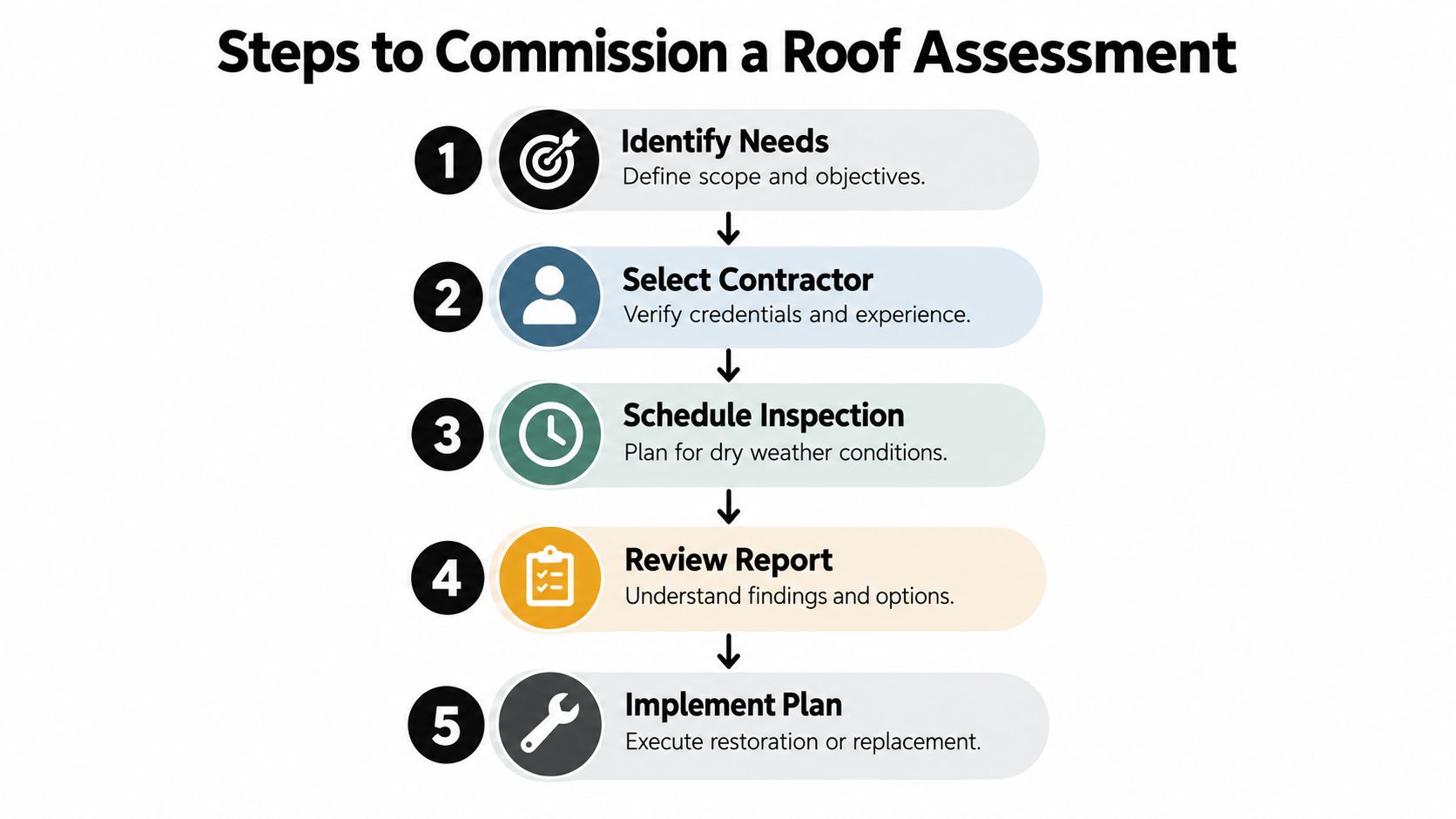
Start with a written brief, not a request for “a roof coating quote”. State the building use, known leaks, access constraints, rooftop equipment, suspected asbestos, operational sensitivities and future solar or insulation objectives.
Then require competing contractors to inspect the same areas and return the same evidence. Each proposal should include a defect map, photographs, substrate findings, drainage observations, repair quantities, replacement allowances, preparation method, product data, warranty conditions, safety controls and a staged programme.
Make the recommendation answerable
Ask the assessor to present three options:
- Restoration: Define the repairs, coating system, expected maintenance approach and remaining risks.
- Partial replacement: Identify the zones requiring new sheets or components while retaining serviceable areas.
- Full replacement: Explain access, staging, disposal, disruption, compliance and future performance provisions.
A strata committee should also record who will approve variations and how hidden defects will be handled. Facility managers should coordinate the programme with tenants, stock movements, production schedules, insurance requirements and emergency access.
If a contractor dispute, insurer disagreement or construction incident develops, obtain specialist legal advice. A resource such as hire a roof damage lawyer can help owners understand documentation and liability issues before the dispute becomes harder to resolve.
Commercial Roofers can inspect commercial roofs, document defects and develop restoration, repair or replacement scopes for warehouses, factories, strata assets and other NSW properties. Visit Commercial Roofers to request an assessment that considers roof condition, compliance, drainage, insulation, asbestos controls and future solar planning rather than offering a coating in isolation.