
If you're responsible for a warehouse, factory, retail complex, or strata asset in NSW and the roof is original to the building, you're probably dealing with two pressures at once. The roof is ageing, and every decision around it now carries more risk than a normal reroof. Once asbestos is in the picture, the job stops being a simple construction upgrade and becomes a compliance, liability, and continuity exercise.
That's why clients usually call when one of three things happens. A leak has turned into repeated patching. A buyer, insurer, or consultant has raised the asbestos issue. Or a planned capital works program has stalled because the roof can't be ignored any longer. In all three cases, the wrong move is to treat asbestos roof removal and replacement like standard roof repair.
A sound project starts with the right question. Not “How cheaply can this be patched?” but “What's the safest, most compliant way to remove the liability and keep the site operating?”
Table of Contents
- The Business Case for Asbestos Roof Replacement
- Initial Inspection and Compliance Framework
- Planning for a Safe and Compliant Removal
- Selecting Your Asbestos Removal Contractor
- The Removal and Replacement Process Explained
- Post-Replacement Checks and Future-Proofing Your Asset
- Frequently Asked Questions
- Can a business stay open during asbestos roof removal and replacement?
- What happens if more asbestos is found once the work starts?
- How do you stop water getting in while the roof is off?
- Is repair ever the right option instead of replacement?
- What should a strata manager ask for before approving the works?
- Why do timelines vary so much between contractors?
- What roof usually replaces asbestos cement on commercial buildings?
The Business Case for Asbestos Roof Replacement
A warehouse roof leaks during a storm, a contractor is called for a patch, and the next question is whether anyone has just disturbed asbestos cement sheeting. At that point, the issue is no longer a simple maintenance job. It becomes a liability, compliance, and operations problem that can affect tenants, insurers, staff, and the owner's future options for the site.
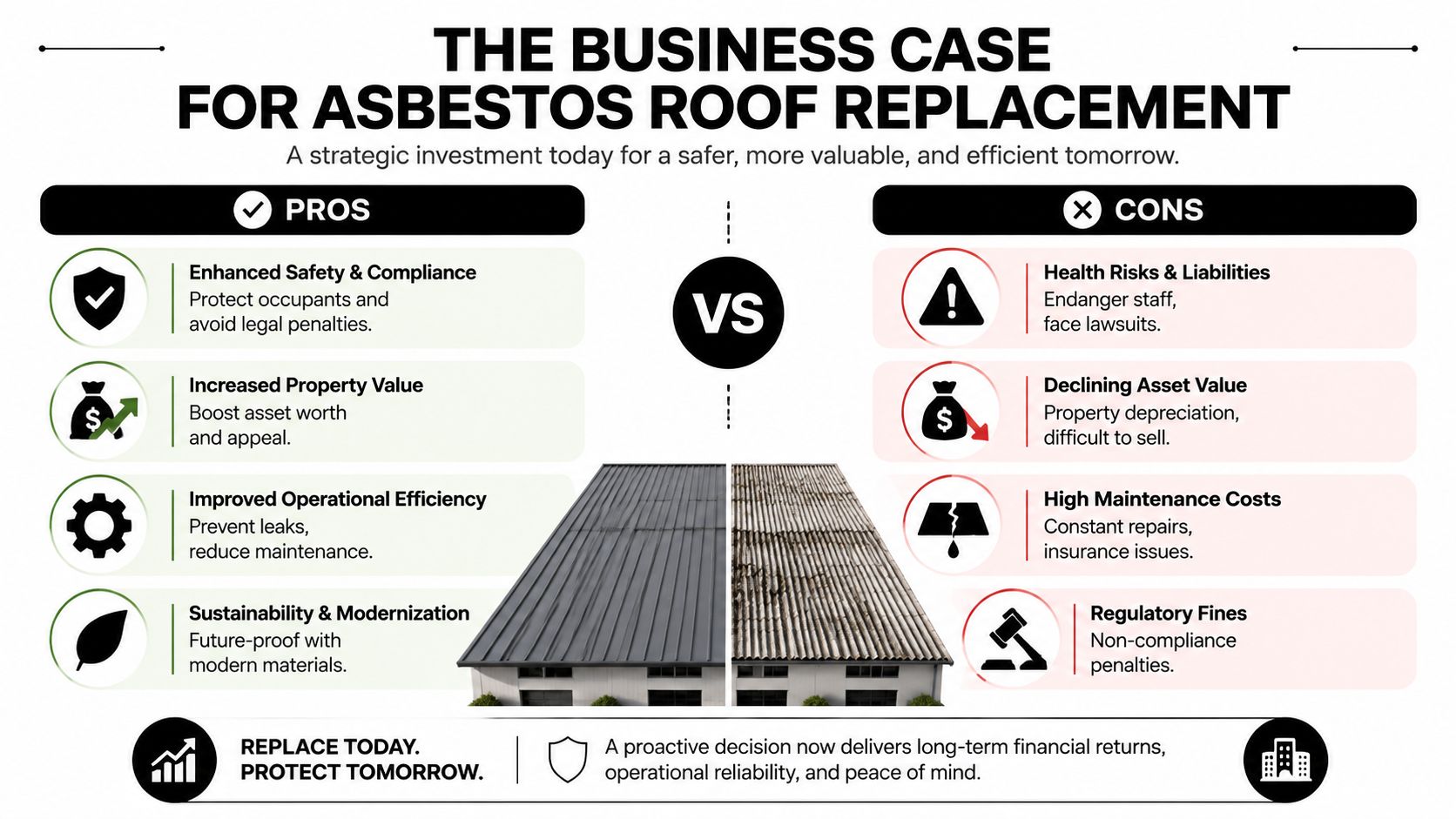
Owners often start by asking what replacement will cost. The better question is what continued delay will cost. An ageing asbestos roof can keep generating call-out fees, temporary repairs, water ingress, tenant complaints, consultant warnings, and restrictions on future works. Those costs rarely sit in one line item, which is why they are easy to underestimate.
Why patching usually becomes the expensive option
Patching an asbestos roof can look prudent on paper. On site, it often creates repeated exposure points. Every access visit, sheet crack, failed fastener repair, sealant attempt, and emergency leak response adds another disturbance risk and another record showing the roof remained in service despite known issues.
Owners and strata committees often compare one repair invoice with one replacement quote. That is the wrong comparison. A proper comparison considers cumulative repair spend, operational disruption, water damage risk, consultant involvement, insurance friction, and future project constraints versus a planned removal and replacement carried out under controlled conditions.
A simple view of the trade-off is below.
| Decision path | Short-term effect | Longer-term effect |
|---|---|---|
| Continue repairs | Lower immediate outlay | Ongoing maintenance, recurring access risk, harder capital planning |
| Full replacement | Higher initial commitment | Removes legacy roof liability and gives the asset a modern roofing platform |
For budgeting, the useful exercise is to total repeated call-outs over several years rather than reviewing each one in isolation. This guide to commercial roof repair cost considerations is a practical starting point if repair work is becoming routine rather than occasional.
Practical rule: If the roof is old enough to raise asbestos concerns and money is already being spent to keep it serviceable, the decision is about where that money goes. Reactive maintenance preserves the problem. Planned capital works remove it.
Liability extends well beyond the roof sheet
An asbestos roof affects more than maintenance. It can complicate due diligence during sale, change how building consultants report on condition, and limit what can be done with penetrations, solar installations, service upgrades, or structural alterations. Even minor future works become more expensive once asbestos controls have to be built into the scope.
For commercial and industrial owners, business continuity is usually the deciding factor. The roof sits over people, stock, plant, equipment, and tenanted areas. Once the material starts to degrade, each storm event increases the chance of leaks, access restrictions, damaged inventory, and urgent decisions made under pressure. Those are expensive conditions in which to manage regulated material.
Replacement changes the asset, not just the roof
A properly planned asbestos roof replacement removes a known hazard from the building envelope and replaces it with a modern roofing system that is easier to maintain, insure, and modify. In practical terms, that means fewer access restrictions, cleaner documentation, better support for future upgrades, and less uncertainty around ongoing ownership costs.
That is why replacement should be treated as a business decision, not just a safety response. The upfront spend buys control. It reduces the risk of unplanned shutdowns, limits future compliance complications, and gives the asset a roof system that supports operations instead of working against them.
Initial Inspection and Compliance Framework
The first mistake owners make is assuming the project starts with a quote for a new roof. It doesn't. It starts with identifying what's on the building and what legal obligations attach to disturbing it.
In Australia, asbestos roof removal is tightly governed because asbestos was widely used in roofing products before the national ban took full effect on 31 December 2003, and the replacement process for NSW commercial owners typically begins by identifying whether the roof is pre-2004 asbestos-containing material before removal proceeds under strict controls, as outlined in the World Health Organization asbestos fact sheet.
Age is the first screening tool
If the roof predates 2004, it should be treated as suspect until properly assessed. That doesn't mean every older roof contains asbestos. It does mean the age of the building is a legitimate trigger for investigation, especially on warehouses, workshops, strata blocks, and industrial buildings where asbestos cement sheeting was widely used.
Visual clues can help raise the question, but they don't close it. A responsible process relies on formal identification and documentation, not guesswork from ground level.
What the first inspection should establish
A proper initial inspection should answer five practical questions:
- What material is on the roof: The team needs to determine whether the roof appears to be asbestos cement sheeting, another legacy product, or a later non-asbestos system.
- What condition it's in: Cracking, weathering, movement, failed fixings, and previous patching affect both risk and scope.
- What sits underneath and around it: Penetrations, plant, skylights, gutters, wiring, and fragile sections shape the removal plan.
- Who occupies the site: A vacant shed and an operating distribution centre require very different staging.
- What records already exist: The asbestos register, prior reports, and maintenance history often reveal more than the roof itself.
If you need a benchmark for what specialist involvement looks like before work begins, this overview of an asbestos roof repair company is a useful reference for the kind of capability and compliance awareness the site should have from day one.
A pre-2004 roof should never be priced for demolition first and investigated later. That reverses the risk sequence.
The compliance side that owners must understand
Commercial owners and duty holders in NSW need to think beyond the roof sheet itself. The property should have an Asbestos Register where asbestos is known or presumed in the workplace environment, and that record needs to stay current. If the register is vague, outdated, or silent on the roof, that's a warning sign before any capital works are approved.
The practical distinction that matters on site is whether the material is friable or non-friable. Most asbestos cement roofing falls into the non-friable category when intact, but that status doesn't make it low consequence. Once removal starts, licensed handling, controlled methods, and regulated disposal come into play.
Why this framework matters before pricing
Clients often want a quick number. A contractor who gives one before the roof is properly assessed is usually pricing only the visible replacement, not the legal and operational reality of the job.
That's why the inspection stage isn't paperwork for its own sake. It sets the sequence, confirms who can legally perform the work, and prevents the project from drifting into avoidable delay once the roof is opened up.
Planning for a Safe and Compliant Removal
Once asbestos roofing has been confirmed or formally presumed, planning becomes the primary control point. The quality of the removal plan determines whether the project stays orderly or turns into a site disruption with exposure risk, schedule drift, and compliance issues.
For non-friable asbestos cement, removal in Australia is treated as a Class B removal activity, and the practical method is clear: keep sheets intact, wet them to suppress dust, and decontaminate the work area with HEPA vacuuming and air monitoring before reoccupation, as summarised in this explanation of the asbestos removal process.
What a proper removal plan includes
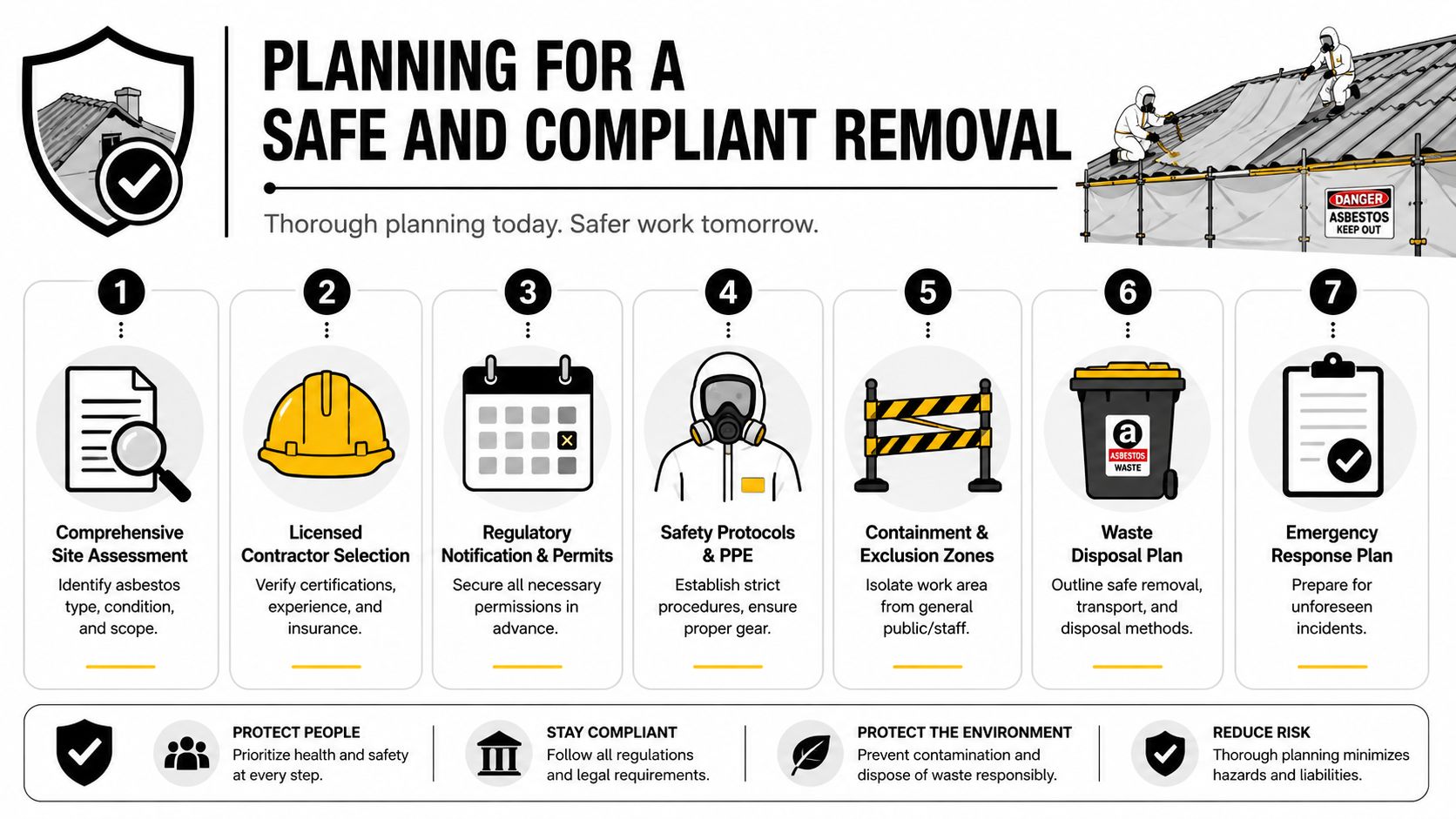
A compliant plan isn't one document. It's a coordinated set of controls that answer how the team will isolate the hazard, protect people, and prove the area is safe at the end.
The essentials usually include:
- Exclusion zones: The work area must be isolated so staff, tenants, visitors, and adjacent trades don't wander into the removal zone.
- Access control: Entry points, roof access, scaffold interfaces, and material drop zones need to be defined before mobilisation.
- Notification pathway: Neighbours, occupants, site managers, and relevant authorities need clear notice based on the scope and location of works.
- Dust suppression methods: Wet removal isn't optional. It's part of how fibre release is minimised during handling.
- Waste containment: Removed sheets need controlled wrapping, loading, and transport to licensed disposal, not ad hoc piling on site.
- Clearance process: Cleanup, visual inspection, and any monitoring or hygienist sign-off should be scheduled from the start, not added later.
What works on site and what doesn't
The safest asbestos roof removal and replacement jobs follow a calm sequence. Workers remove sheets whole where possible. They avoid snapping, grinding, sawing, and uncontrolled breakage. Waste moves from roof to ground in a controlled way. The area is then cleaned with methods designed for asbestos work, not standard builders' cleanup.
What doesn't work is the rushed version. Crews trying to “speed things up” with power tools, rough handling, mixed waste, or unclear boundaries usually create the exact delay they were trying to avoid. Once contamination concerns arise, everything stops while the issue is investigated and rectified.
On-site reality: Speed comes from planning. It doesn't come from rougher handling.
Questions owners should ask before approving the plan
You don't need to be a hygienist or licensed remover to test whether the plan is credible. Ask direct questions.
- How will the site be isolated while the building remains occupied, if applicable?
- How will sheets be removed intact and lowered safely?
- What is the decontamination method for surrounding surfaces, gutters, and work areas?
- Who is responsible for clearance and documenting reoccupation safety?
- How will asbestos waste be tracked from roof to disposal facility?
A strong contractor answers these cleanly and in writing. A weak one falls back on general reassurance.
Safe planning also protects business continuity
Experienced project management is vital. The removal plan has to work not only for compliance, but for operations. That means staging around loading docks, separating pedestrian routes, preserving emergency access, and matching weather windows to removal and replacement sequencing.
When the plan is built properly, safety and continuity support each other. When it isn't, the site pays twice. Once in disruption, and again in remediation.
Selecting Your Asbestos Removal Contractor
A poor contractor choice can turn a controlled roof replacement into a liability event. On an occupied warehouse, factory, or strata asset, the removal contractor affects far more than the roof. They influence tenant complaints, shutdown risk, regulator exposure, waste traceability, and whether the site can keep trading while works proceed.
A key point many owners miss is that on a legacy commercial roof, the project is not driven only by roofing skill. It is driven by asbestos removal capability, statutory compliance, and the contractor's ability to control the site without disrupting the business more than necessary. The new roof matters, but the higher commercial risk usually sits in the removal phase.
The checks that matter most
Tender review should focus on whether the contractor can carry legal responsibility for asbestos work and manage the commercial realities around it.
| What to verify | Why it matters |
|---|---|
| Asbestos removal licence type | Confirms the contractor is permitted to carry out the class of removal involved |
| Insurance that specifically responds to asbestos work | Many owners only discover exclusions after an incident, when a contamination claim or third-party loss is already in play |
| Experience on occupied commercial or industrial sites | Live sites need staging, access control, communication discipline, and a programme that works around operations |
| Waste tracking process | You need documented proof that asbestos went from roof level to a lawful disposal facility without gaps |
| Roofing integration plan | Removal, make-safe works, and replacement must be sequenced as one project or delays and water ingress risk increase |
Licences and insurance are the entry point. They are not the whole test. I look closely at who will run the site, who signs off hold points, and whether the contractor has handled live commercial environments before. A crew can be technically licensed and still be a poor fit for a busy distribution centre or multi-tenant property.
Questions worth asking in tender interviews
Strong contractors answer these clearly and in writing:
- Who performs the removal work day to day? If delivery depends on several subcontract layers, accountability can become blurred the moment conditions change on site.
- How is the programme split between removal, inspection, remedial works, and reroofing? A credible answer shows clear hold points and decision points, not a promise to “do it all quickly.”
- What happens if the deck, purlins, insulation, or flashings need repair once the sheets are lifted? This shows whether the contractor understands latent conditions and can keep the project moving without losing control of risk.
- How will disposal records, clearance documentation, and handover files be managed? Those records protect the owner long after the crew has left site.
- What comparable sites have you completed? A contractor who understands factories, warehouses, schools, or retail centres will speak in practical terms about access windows, shutdown periods, and occupancy controls.
The quality of these answers usually tells you more than the headline price.
Red flags clients should take seriously
Low pricing often signals that someone has underallowed for supervision, containment, weather risk, waste handling, or temporary make-safe measures. That shortfall does not disappear. It usually returns as a variation, a delay, or a dispute after the roof is open.
Watch for these signs:
- Thin documentation: A short quote with broad assumptions is a warning on regulated work.
- No clear sequencing: If the contractor focuses only on the replacement roof, they may not understand the control measures that govern the removal.
- Unclear responsibility: You should know who manages asbestos removal, clean-up, clearance coordination, weather protection, and reroofing from start to finish.
- Weak commercial planning: If they cannot discuss occupancy constraints, loading dock access, crane locations, emergency routes, or wet-weather contingencies, they are unlikely to manage a live site well.
Contractor selection is a risk decision before it is a procurement decision. Owners who treat it as a price exercise often pay more later through downtime, claims exposure, tenant friction, or remedial works that should have been prevented at tender stage.
Choose the firm that can show control of compliance, programme, documentation, and business continuity. That is what protects the asset and keeps the project commercially defensible.
The Removal and Replacement Process Explained
At 6:00 am the site looks normal. By 10:00 am, access routes have changed, roof sheets are coming down under controlled conditions, and every movement on site is being managed against a sequence that was locked in before work started. That sequence matters because asbestos roof replacement on a live commercial property is not just a roofing job. It is a contamination control exercise, a logistics exercise, and a business continuity exercise running at the same time.
Mobilisation and site setup
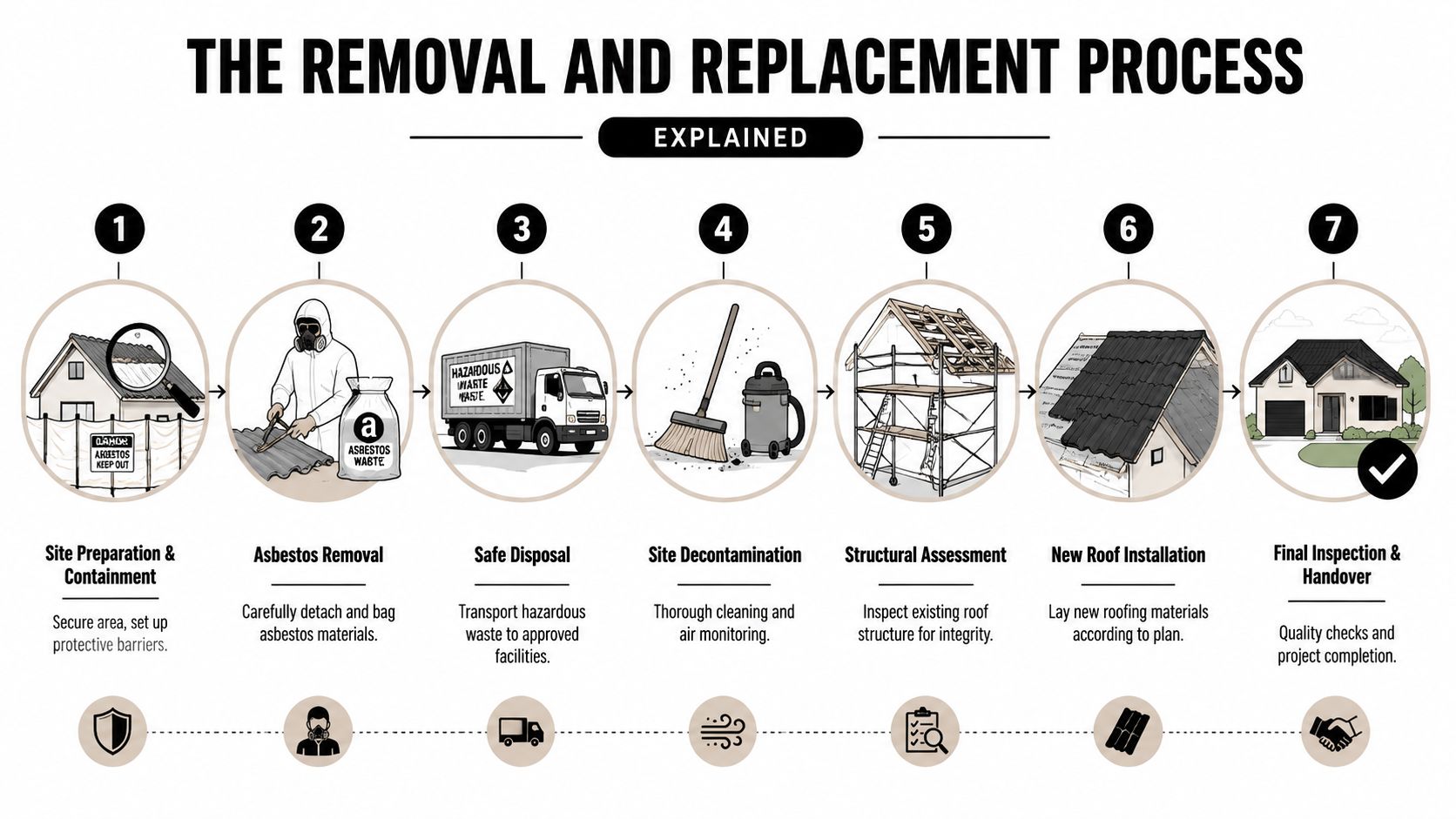
The first stage is mobilisation. Crews establish scaffold, edge protection, exclusion zones, waste holding areas, amenities, signage, and controlled access before removal starts. On an occupied warehouse or factory, this is also the point where truck movements, staff entry paths, and delivery timing are reset around the work zone.
Poor setup creates expensive problems later. If access is cramped, waste routes cross operating areas, or the crane position interferes with dispatch, the project starts consuming management time and disrupting trade before a single sheet is removed.
On better-run projects, the setup tells you the job is under control.
Removal of the existing asbestos roof
Removal is slow by design. Sheets are handled to keep them intact, lowered in a controlled way, packaged correctly, and transferred to approved transport without avoidable breakage. Clients sometimes expect dramatic demolition. What they should expect is discipline.
I tell clients to judge this stage by order, not speed. A crew that rushes asbestos removal usually pushes risk somewhere else, into contamination, damaged stock, avoidable clean-up, or arguments about who caused a shutdown.
Once the roof sheets are off, the structure can finally be seen properly. That is often when hidden defects show up, such as corroded purlins, failed fixings, deteriorated laps, or evidence of long-term water entry. Those findings can affect programme and cost, but it is better to address them with the roof open than to bury them under new materials and inherit the same failure points.
Cleanup, clearance points, and release for reroofing
There is a hard stop between removal and reroofing. The replacement crew should not be following directly behind removal as if this were a normal strip-and-resheet job. The area has to be cleaned, checked, and released in line with the project controls before the new roof build starts.
That pause protects the owner. It reduces the chance of contamination being carried into completed work, avoids disputes between trades, and creates a documented point where the old roof system ends and the new one begins. From a liability point of view, that separation matters.
Replacement works and new roofing installation
Once the work area is cleared for the next stage, the project becomes a roof replacement job in the conventional sense. The exposed frame is reviewed, defective elements are repaired or replaced, and the new system is installed to suit the building use, wind exposure, drainage layout, services, and maintenance requirements.
For many NSW commercial sites, the replacement material is a modern metal roofing system such as Colorbond because it suits large spans, is easier to maintain than aging asbestos cement sheets, and gives owners better long-term control over leaks, thermal performance, and future upgrade works. This guide to commercial metal roofing systems in Australia is useful if you are comparing replacement options.
The replacement phase usually includes:
- Structural rectification: damaged purlins, brackets, or fixings are dealt with before new sheets go down
- Roof build-up installation: safety mesh, insulation, sarking, flashings, box gutters, sumps, and roof sheeting are installed to the approved detail
- Penetration coordination: mechanical, electrical, hydraulic, fire, and solar interfaces are rebuilt so new leak paths are not created on day one
- Weatherproofing at each stage: temporary seals and staged completion are used so the building is not left exposed longer than necessary
Later in the project, clients often want to see what the field process looks like in practice. This short video is a useful visual reference.
Managing programme pressure on commercial sites
Programme pressure is usually highest on warehouses, factories, and distribution facilities because the roof is tied directly to revenue. Every extra day can affect production, dispatch, tenant obligations, or stock protection. That is why experienced teams build the programme around operational constraints first, then fit the roof sequence to that reality.
The practical questions are straightforward:
- Can the site stay partly operational, or is a staged shutdown cheaper overall?
- What weather exposure is acceptable once sections are opened?
- Are there long-lead items such as custom flashings, gutters, or safety upgrades?
- What happens if the structure is worse than expected once the old roof is removed?
- Who makes the call on day-to-day resequencing if operations or weather change?
These decisions drive cost more than many owners expect. A lower removal price can disappear quickly if poor sequencing interrupts dispatch, causes water ingress into stock, or forces after-hours recovery work to keep the business trading.
What clients should expect day to day
The day-to-day pattern is uneven. Some periods are busy and noisy, especially during lifting, fixing, or rainwater installation. Other periods are inspection-heavy and relatively quiet. The key from the client side is steady communication. Site managers, tenants, warehouse supervisors, and facilities teams need to know what area is active, what changes that creates, and what the next 24 to 48 hours look like.
Well-managed projects feel controlled because decisions are being made ahead of the work. Poorly managed projects feel reactive. That difference usually determines whether the roof replacement is remembered as a planned capital upgrade or as an avoidable business interruption.
Post-Replacement Checks and Future-Proofing Your Asset
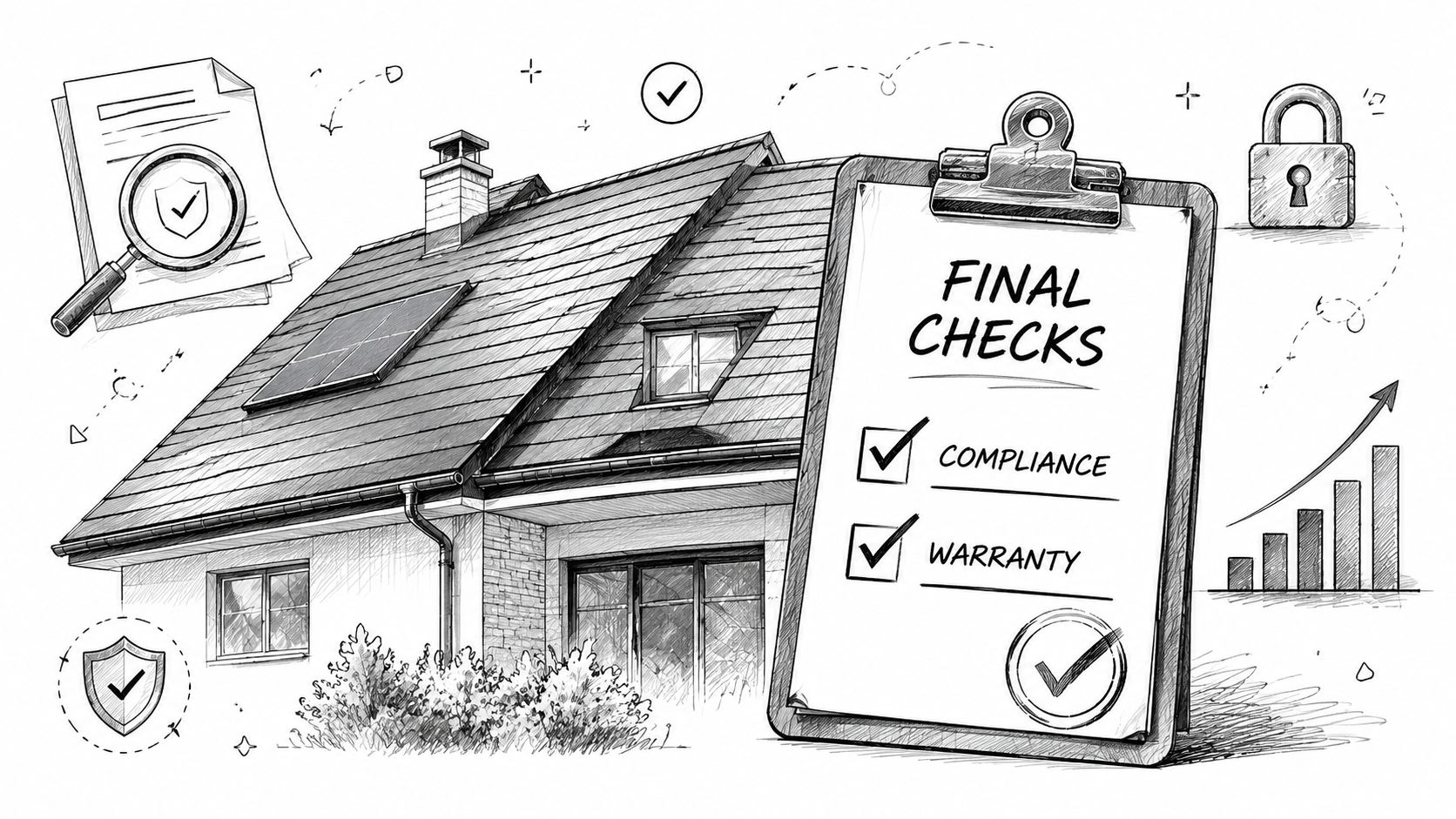
A roof isn't finished when the last sheet is fixed. It's finished when the documentation, inspections, and close-out records confirm the site is safe, compliant, and properly handed over.
That matters more on asbestos projects because the owner needs a complete paper trail. Without it, you may have a new roof overhead but still have unanswered questions when the insurer, purchaser, facility manager, or future contractor asks what was removed, where it went, and whether the area was cleared correctly.
The close-out documents you should receive
At minimum, owners should expect a structured handover pack detailing the asbestos side and the new roof side.
- Clearance documentation: This is the formal record that the relevant area has passed the required post-removal checks for reoccupation.
- Waste disposal records: The project should include evidence that asbestos waste was transported and disposed of at a licensed facility.
- Roofing warranties: Material warranties and workmanship warranties should be issued in a usable format, not promised verbally.
- As-built or updated maintenance information: Future contractors need to know what roof system is now installed and where services, penetrations, and special details sit.
Why the clearance stage matters
Owners sometimes treat clearance as a final administrative step. It isn't. It's the point where the project confirms that asbestos removal controls were completed properly and that reoccupation can proceed on documented grounds.
If that paperwork is missing, delayed, or unclear, push back immediately. Don't accept handover on assumptions.
Final handover test: If you had to sell the property or answer an insurer's query next month, would the project file stand on its own without verbal explanation?
Future-proofing the new roof
The replacement roof should do more than solve the asbestos problem. It should make the building easier to operate over the next maintenance cycle. That means the owner should leave the job with a clear maintenance plan for flashings, gutters, roof access, service penetrations, and any high-wear areas.
If the new system is metal roofing, it's worth understanding the maintenance expectations and material considerations that apply to contemporary commercial systems. This guide to metal roofing in Australia is a practical reference for what long-term ownership should look like after replacement.
Update the asset records immediately
Once the job is closed out, update the site records. The asbestos register, maintenance manuals, contractor files, and capital works records should all reflect that the old roof has been removed and replaced. That one administrative step prevents years of confusion later when new works are planned.
A clean close-out protects the investment. It also saves the next facilities manager from having to reconstruct what happened from old invoices and memory.
Frequently Asked Questions
Can a business stay open during asbestos roof removal and replacement?
Sometimes yes, sometimes no. It depends on the building layout, the occupancy, access routes, and whether the work can be staged safely. A warehouse with separable zones may keep part of its operation running. A site with public traffic directly below the work area may need broader shutdowns. The decision should come from the removal and staging plan, not from optimism at quote stage.
What happens if more asbestos is found once the work starts?
The project should pause in the affected area, the newly identified material should be assessed within the site's compliance process, and the scope should be updated before work continues there. This is one reason early investigation matters. Older buildings often carry asbestos risk beyond the visible roof sheets alone.
How do you stop water getting in while the roof is off?
By staging the work properly and preparing weather protection before removal progresses too far. On commercial jobs, the crew should sequence removals so exposed areas are controlled, not left open. Temporary weatherproofing, programmed material deliveries, and close monitoring of forecasts are standard parts of competent project management.
Is repair ever the right option instead of replacement?
If asbestos roofing is already at end of life, repeated repair usually isn't the smart long-term call. Minor interim actions may sometimes be used to manage immediate risk while replacement is being scheduled, but they shouldn't be mistaken for a durable solution. The roof still carries the same underlying liability.
What should a strata manager ask for before approving the works?
Ask for the asbestos assessment basis, the removal licence details, insurance confirmation, the proposed staging method, waste disposal process, clearance pathway, and the replacement scope. You also want one clear line of responsibility for communication during the job.
Why do timelines vary so much between contractors?
Because some are pricing only the roof installation, while others are accounting for the practical constraints of abatement, access, weather, occupancy, and clearance. On asbestos roof removal and replacement projects, the fastest-looking programme on paper is often the least reliable one.
What roof usually replaces asbestos cement on commercial buildings?
For many NSW commercial and industrial sites, modern metal roofing such as Colorbond is a practical replacement because it suits large roof areas, supports contemporary detailing, and gives owners a simpler long-term maintenance profile than an ageing asbestos cement roof.
If you're planning asbestos roof removal and replacement on a commercial, industrial, or strata property in NSW, Commercial Roofers can help you assess the roof condition, map the compliance pathway, and coordinate a replacement approach that prioritises safety, documentation, and business continuity.