

You're usually not searching “replace roof Sydney” because you woke up curious about roofing systems. You're searching because the problem has moved past a nuisance. A warehouse roof is leaking over stock. A strata report has flagged major capital works. An insurer has asked hard questions after repeated patch repairs. Tenants are complaining about heat, staining, or noise every time it rains.
At that point, a roof replacement stops being a maintenance task and becomes a business decision. You're not just buying new sheets, tiles, flashings, or gutters. You're managing risk, compliance, access, tenant expectations, programme, and the chance to improve the building rather than solely restore it.
That's the right way to look at it. Australia's roofing services industry is already a mature part of the construction market, with IBISWorld estimating $4.4 billion in 2026 and 5,798 businesses operating in 2025, with the industry classified under ANZSIC E3223 for roof tile installation, metal roof installation, and roof repair and maintenance (IBISWorld roofing services industry data). For Sydney owners, that matters because a commercial re-roof isn't unusual. It's a standard lifecycle event for long-held assets.
Table of Contents
- A Strategic Guide to Commercial Roof Replacement
- Auditing Your Roof Condition and Assessing Risks
- Navigating NSW Compliance and WHS Requirements
- Selecting Future-Proof Roofing Materials
- How to Select the Right Sydney Roofing Contractor
- Planning the Project to Minimise Business Disruption
- Ensuring Long-Term Performance and Warranty
A Strategic Guide to Commercial Roof Replacement
A commercial roof replacement usually starts with a false economy. Someone has spent years patching leaks, resealing laps, replacing isolated sheets, and cleaning blocked gutters. Those repairs can be sensible for a time. Then the pattern changes. Water gets in through more than one point. Fixes become reactive. Access costs repeat. Internal damage starts costing more than the roof.
That's the point where owners need to stop treating the roof as a trade callout and start treating it as a capital works project. The right question isn't “How much to stop the leak?” It's “What option protects the asset, keeps the site operating, and avoids avoidable compliance risk?”
Why the project needs a wider lens
A warehouse, factory, retail building, or strata complex has moving parts below the roofline. Stock, plant, ceiling cavities, electrical services, tenants, visitors, and insurance obligations all sit underneath the work. Replacing the roof affects each of them.
A sound brief should cover more than roof coverings. It should test:
- Failure pattern. Is the issue isolated, or is the roof system broadly at end of life?
- Operational exposure. What happens if water enters during staged removal?
- Compliance exposure. Are there asbestos, height safety, or access risks?
- Asset value. Should the replacement improve heat performance, drainage, or maintenance access?
Practical rule: If your roof problem is now affecting operations, insurance conversations, or sinking fund planning, you're no longer dealing with a repair issue alone.
That's why owners comparing patching against full replacement should look beyond the invoice amount. A cheaper short-term decision can lock in repeated callouts, internal damage, and tenant friction. A better process starts with a proper audit and a clear replacement brief, not with a price request sent to three contractors.
Why Sydney owners should treat this as routine asset management
A lot of people assume a full re-roof is rare or extreme. It isn't. In a market of this size, roof replacement is a normal part of managing long-life buildings, especially older industrial stock and strata assets. Sydney has plenty of properties where the roof has reached the stage where ongoing repair spend no longer makes technical or financial sense.
If you're trying to scope that early decision properly, it helps to understand the difference between recurring maintenance and replacement economics. A useful starting point is this guide to commercial roof repair cost factors, particularly if your current spend keeps rising without solving the root problem.
Auditing Your Roof Condition and Assessing Risks
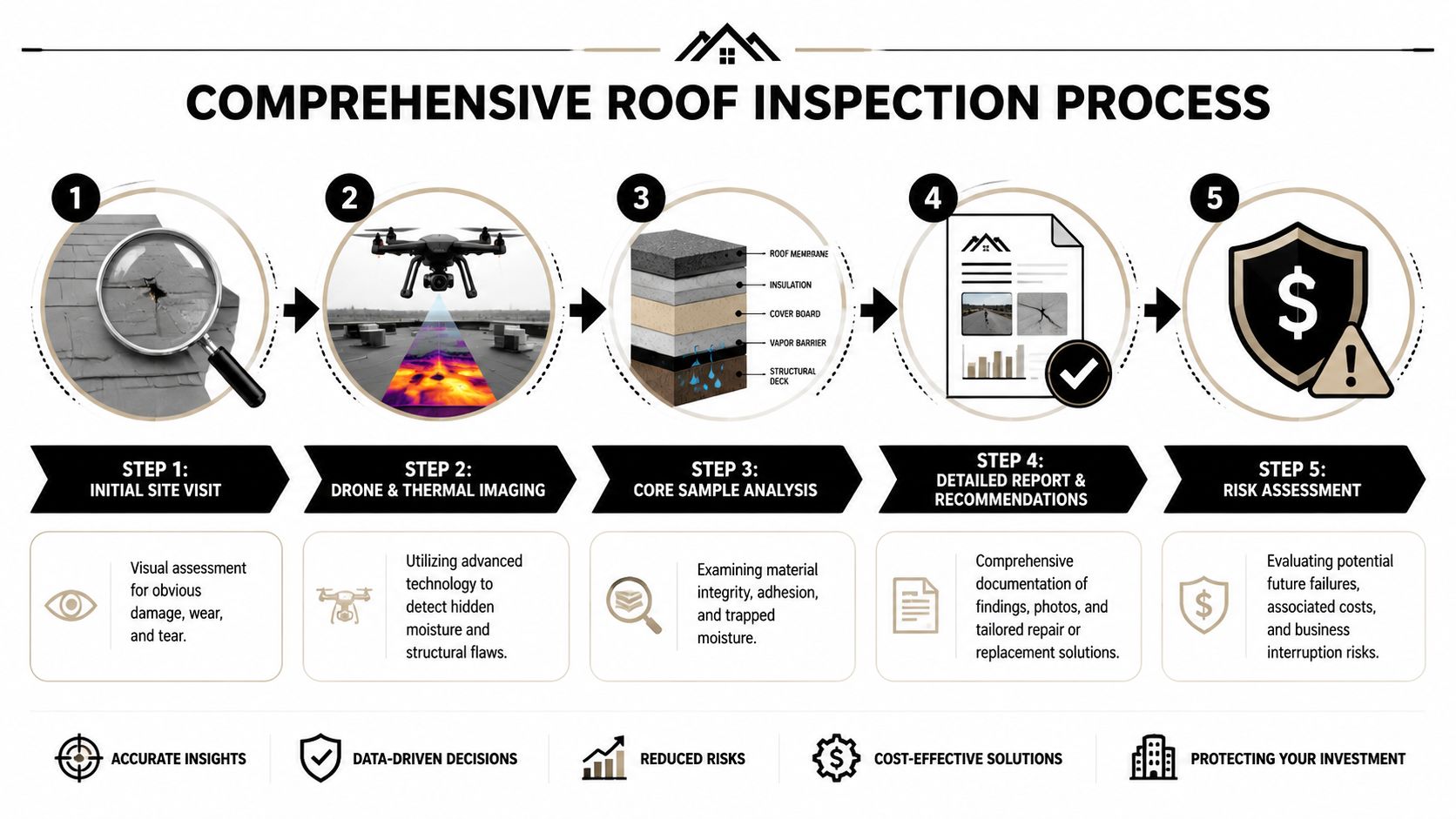
The first mistake owners make is relying on a quick visual walkaround. On a commercial site, that isn't an audit. It's a glance. A real inspection needs to tell you what's failing, why it's failing, what risks sit under the roof, and whether replacement is justified or premature.
What a real commercial roof audit includes
A proper audit looks at the roof as a system. Not just the top sheet.
That means checking the roof covering, fixings, penetrations, laps, flashings, box gutters, falls, drainage capacity, ponding points, signs of substrate movement, corrosion, and any evidence that previous repairs have trapped moisture rather than solved ingress. On industrial roofs, internal inspection matters just as much. Ceiling stains, wet insulation, rusting purlins, mould growth, and daylight through laps all tell a story.
A useful audit usually includes:
- External surface review for corrosion, cracked sheets, failed fasteners, loose cappings, and patch history.
- Internal moisture tracing to separate the visible leak point from the actual entry point.
- Drainage assessment around sumps, gutters, downpipes, and overflow behaviour.
- Substrate and structure checks where movement, rot, or corrosion may affect replacement scope.
- Risk and cost analysis that compares continued repairs against staged or full replacement.
A roof can look serviceable from the car park and still be failing across seams, fixings, and drainage lines.
For owners, the output should be a written record with photographs and a recommendation that is easy to challenge. If the advice is “replace it”, the report should show why repair won't hold. If the advice is “repair it for now”, the report should identify the threshold that would trigger replacement later.
The asbestos check that can't be skipped
If the building predates 1990, asbestos has to be treated as a live risk until proven otherwise. In NSW, improper asbestos management during roof tear-offs accounts for 35% of project delays, and commercial roofs on Sydney buildings built before 1990 have an 82% chance of containing asbestos. That's why a certified pre-work survey by a NATA-accredited lab is not optional.
The correct sequence is straightforward in principle and strict in practice:
- Survey first. A certified pre-work asbestos survey identifies whether asbestos-containing material is present before demolition starts.
- Contain the area. Where removal is required, the work area must be isolated appropriately, including containment controls.
- Use licensed specialists. Removal must be carried out by licensed asbestos personnel using compliant methods.
- Clear the area before installation. Air clearance testing must be completed before the new roof build begins.
The practical reason for this goes beyond paperwork. Once an unplanned asbestos discovery happens during tear-off, the programme can stop immediately, access can be restricted, and every following trade gets pushed back. That's how manageable projects turn into operational headaches.
Repair, partial replacement, or full replacement
Owners often ask the right question too late. Do we need a full replacement?
Independent guidance on alternatives to full roof replacement makes a sensible distinction. Localised damage is often better handled with repair or partial replacement, while full replacement is more appropriate when issues are widespread. That lines up with what works in commercial practice.
A full replacement is usually justified when you're seeing some combination of these conditions:
- Repeated leaks in multiple zones, especially after prior repair attempts
- Widespread fastener, lap, or sheet deterioration
- Drainage design problems that can't be corrected with minor works
- Material incompatibility or contamination issues
- Planned upgrades that make piecemeal work poor value
If the roof failure is confined to one area, partial replacement may be enough. If the whole roof system is aging in the same way across the building, selective repairs often just stagger the inevitable.
Navigating NSW Compliance and WHS Requirements
Compliance is where owners often lose control of the job. They assume the contractor “handles safety”, the roofer starts, and the paperwork sorts itself out. On a live commercial site in NSW, that approach is risky. The roof might be above the business, but the consequences land with the property owner, occupier, strata committee, facility manager, and principal contractor arrangement around the site.
Who carries responsibility
Roof replacement work usually involves several high-risk activities at once. Working at heights, demolition, material handling, live-site access control, weather exposure, and potentially asbestos. Each one needs planning before tools arrive on the roof.
Owners don't need to write the technical safety documents themselves. They do need to confirm they exist, match the site, and assign responsibilities clearly. If the contractor can't explain access control, edge protection, exclusion zones, weather triggers, or incident procedures in plain language, the project isn't ready.
A compliant approach should account for:
- WHS duties on a live occupied site
- Safe access and fall protection
- Asbestos procedures where relevant
- Traffic and loading management
- Protection of occupants, visitors, and neighbouring property
- Moisture ingress response if weather changes during works
What compliant project paperwork should show
The paperwork matters because it reveals whether the contractor has planned the actual job or just priced the visible roof area.
For commercial replacements, I'd expect the project file to show a site-specific safety plan, relevant Safe Work Method Statements, licence details where high-risk work is involved, insurance certificates, disposal arrangements for removed material, and a staged methodology that aligns with the building's operation. If the site is occupied, the plan also needs communication procedures. Who tells tenants when noisy works happen? Who signs off restricted access? Who controls loading zones?
Owners should read beyond the quote. A one-page price with “remove and replace roof” doesn't tell you how the contractor will control risk. A proper submission should show sequence, exclusions, assumptions, and how the building stays protected when sections are open.
For sites with potential legacy sheeting or contamination risk, this article on asbestos roof removal and replacement in NSW is worth reading before you sign anything. It helps owners ask better questions before the first sheet comes off.
Owner's test: Ask the contractor what happens if rain hits halfway through staged removal on an occupied building. If the answer is vague, the planning is vague.
Questions worth asking before works start
Instead of asking only “Are you insured?”, ask questions that expose how the contractor runs projects.
Try these:
- Who will supervise the site daily? You want a named person, not a generic company answer.
- Are crews in-house or fully subcontracted? That affects control, communication, and quality consistency.
- What's the staging plan for occupied areas? Especially for strata, retail, and warehousing.
- How are exclusion zones managed? Staff and tenants need predictable access routes.
- What documentation will I receive at handover? Warranty value depends on records.
Most compliance problems start before the job starts. The contractor either planned the work properly or didn't. Owners who check that early avoid the usual late surprises, work stoppages, and arguments over who was meant to organise what.
Selecting Future-Proof Roofing Materials
Material selection is where many roof replacement projects either gain long-term value or lock in a basic like-for-like outcome that misses the opportunity. Sydney commercial roofs deal with heat, UV, driving rain, and long service life. The right choice needs to suit the building use, not just the budget line.
Performance first, looks second
For warehouses and industrial sites, metal roofing remains the practical choice in most cases because it suits large spans, staged installation, and modern drainage detailing. For premium facades or architect-led projects, zinc, copper, and panel systems such as standing seam or interlocking profiles can make sense where appearance and detailing matter as much as enclosure.
The mistake is choosing by surface appearance alone. Owners should compare corrosion environment, maintenance access, roof geometry, penetrations, heat load, and how easy the system is to inspect years later. A roof with complex junctions and heavy services may need a different specification from a simple logistics shed.
If you're weighing profile types and system options, this overview of commercial metal roofing in Australia gives a useful grounding in how common systems differ in practice.
Commercial Roofing Material Comparison for Sydney Properties
| Material | Typical Lifespan | Maintenance Level | Energy Efficiency (Cool Roof Potential) | Best For |
|---|---|---|---|---|
| Colorbond-style steel roofing | Long service life when correctly specified and installed | Moderate | Good, especially with reflective finishes | Warehouses, factories, retail, strata upgrades |
| Standing seam metal | Long service life with strong detailing potential | Moderate | Good | Premium commercial buildings, architect-designed projects |
| Interlocking metal panels | Long service life | Moderate | Good | Facades and roofs where appearance is a priority |
| Zinc | Long service life | Low to moderate | Moderate | High-visibility commercial projects |
| Copper | Very long service life | Low | Moderate | Landmark or premium buildings |
| Fibre cement and legacy asbestos replacement systems | Depends on replacement specification | Varies | Varies | Buildings being upgraded from older roof types |
This table is intentionally qualitative because lifespan depends heavily on environment, detailing, maintenance, and workmanship.
Where cool roof thinking changes the brief
Material choice also affects thermal performance. That matters more in Sydney than many owners realise, particularly for top-floor offices, strata buildings, warehouses with mezzanines, and facilities with high daytime occupancy.
UNSW reports that cool roof technology can reduce indoor temperatures in residential houses by up to 4°C, cut the number of hours above 26°C by 100 hours per summer, and reduce city-scale peak outdoor air temperatures by 1.5°C to 2°C during summer. The same research notes cool roofs can be installed through a full roof replacement and that average cool-roof material costs are about AU$13 per square metre (UNSW cool roof research).
For commercial owners, the direct lesson is simple:
- Reflective finishes can improve occupant comfort
- Replacement is the right time to upgrade thermal performance
- Heat management belongs in the brief, not as an afterthought
If a building runs hot now, don't replace the roof on a like-for-like basis without at least testing a reflective or cool-roof option.
How to Select the Right Sydney Roofing Contractor
The contractor you choose will decide most of the project outcome. Not the brochure. Not the product brand. Not the lowest quote. Roofing failures on commercial projects usually come from poor diagnosis, weak staging, bad supervision, or installation shortcuts. All four sit with the contractor.
A cheap quote can be the expensive option
Owners often compare numbers before comparing scope. That's backwards.
One quote may include access equipment, staged weather protection, disposal, safety controls, detailed flashings, and documented handover. Another may price only removal and replacement at surface level, leaving half the risk as variations or owner responsibility later. They don't represent the same job.
You want a contractor who can price the project as it will be delivered. That means understanding the site, access, occupancy, roof build-up, drainage issues, and any compliance constraints before the contract is signed.
What to demand in a tender response
A good tender package makes quotes easier to compare. It should include site photos, roof plans if available, the building use, access restrictions, occupancy conditions, any known leak history, and whether asbestos investigation has already occurred.
Then ask each contractor to return the same categories of information:
- Scope clarity. What exactly is being removed, replaced, retained, and excluded?
- Methodology. How will the work be staged to keep the building protected?
- Supervision model. Who runs the site each day?
- Licence and insurance evidence. Don't accept “available on request” after award.
- Warranty terms. Both material and workmanship should be identified clearly.
- Handover documents. Ask what records you will receive.
One factual example in this market is Commercial Roofers, a Sydney contractor that states it uses in-house crews rather than subcontractors and handles commercial roof replacement, asbestos roof removal and replacement, standing seam, interlocking panels, and related industrial roofing works across Greater Sydney. That operating model matters because crew control and supervision affect consistency on live commercial sites.
Red flags that should stop the process
You can usually spot a risky operator before work begins.
Watch for these signs:
- Vague quotations with little detail on staging or exclusions
- No physical business presence or unclear trading identity
- Pressure to sign quickly before site-specific questions are answered
- Unclear asbestos position on older buildings
- Heavy reliance on verbal promises instead of written scope and methodology
The right contractor makes the job feel more defined, not more confusing.
Good contractors don't avoid hard questions. They answer them clearly, document the answers, and update the plan when site conditions change. That's what owners should pay for. Not just labour on a roof, but controlled delivery of a high-risk capital project.
Planning the Project to Minimise Business Disruption
A roof replacement on an empty site is one thing. A roof replacement over a trading business, live warehouse, medical tenancy, school, or occupied strata block is a different discipline. The work has to move forward without turning the building into a daily argument.
That's where staging matters. General service pages often under-explain this part, even though owners care about it most. Buyers want to know how to keep a warehouse, retail site, or occupied strata building running while the roof is removed and rebuilt, and that gap is one reason this topic deserves a more practical treatment than a standard quote page (Sydney roof replacement staging discussion).
How a staged replacement works on a live site
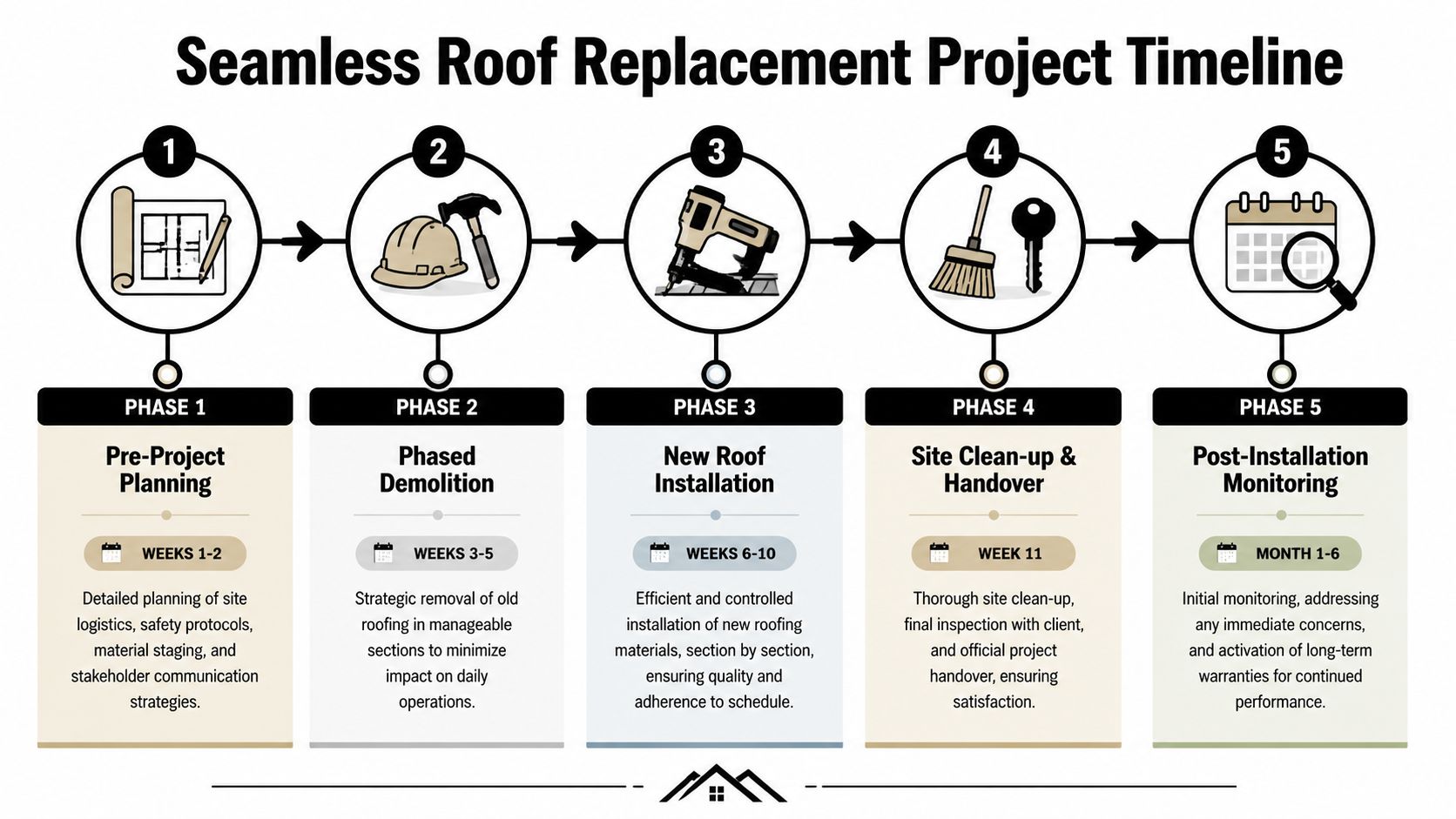
Take a typical Sydney warehouse with office space at the front, pallet racking in the middle, and dispatch operating all day. The roof can't be stripped in one pass. The site needs zones.
The practical approach is to divide the roof into manageable sections, sequence removal and installation so the building is never unnecessarily exposed, and align noisier or riskier activities with agreed operating windows. Front office areas may need a different schedule from dispatch or production. In strata, the same principle applies across stair cores, access ways, and resident notice periods.
A staged live-site plan usually includes:
- Zone mapping so everyone knows which area is active and which remains protected.
- Material staging that avoids blocking loading bays, fire access, or resident entries.
- Weather contingencies that define when works pause and how temporary protection is deployed.
- Communication protocols for tenants, staff, and site managers.
Business continuity measures that matter
Owners often focus on the roof programme and forget the downstream effects. Internal stock protection, dust control, forklift routes, plant shutdown windows, alarm interfaces, and after-hours access can be just as important as the roofing sequence itself.
These are the measures that usually make the difference:
- Protect high-value contents early. Move sensitive stock, electronics, or archives before work reaches that zone.
- Separate pedestrian and work routes. This matters on strata and mixed-use sites.
- Set noise windows in writing. Tenants tolerate disruption better when it's predictable.
- Coordinate trades around the business. Refrigeration, electrical, and fire systems may need their own attendance.
- Use daily close-out inspections. Don't leave internal protection or loose debris unresolved overnight.
Occupants don't judge a roof project by the specification. They judge it by whether they could still do their job during the works.
What owners should organise before day one
The best-run projects have owner input before mobilisation, not during a crisis on day three.
Before work starts, owners or managers should confirm:
- Who approves access each day
- Which internal areas are sensitive or restricted
- Where materials and skip bins can sit
- What weather escalation path applies
- How tenant or staff notices will be issued
- Who signs off variations or discovered defects
That level of planning doesn't make the project slower. It usually makes it calmer. On complex sites, calm is a real asset.
Ensuring Long-Term Performance and Warranty
The roof isn't “finished” when the last panel goes down. That's when the long-term value test starts. A new roof only performs as well as its installation details, handover records, and maintenance discipline.

Installation quality decides warranty value
A warranty sounds reassuring, but it isn't a magic shield. It depends on proper installation and documented compliance with the system requirements.
In NSW, 73% of commercial roof failures within the first 5 years are due to improper fastener placement or inadequate seam sealing. For standing seam and interlocking metal systems, a valid 10-year trade warranty is tied to correct installation, including technical standards in AS/NZS 4606:2021 such as fastener spacing not exceeding 400mm on flat panels and 300mm on ridges, with a minimum 6-inch offset between adjacent seams. The same technical framework notes a structured installation process, including deck inspection, continuous high-density underlayment of at least 1200g/m², precise panel alignment, mechanical seaming with certified tools, and final debris removal. Projects following that protocol achieve a 98% success rate in passing post-installation inspections, with only 2% requiring corrective work, and internal data cited for Sydney standing seam work reported 94% maintained full weather integrity through the 2023–2024 extreme rainfall events.
Those numbers tell owners one thing clearly. Warranty value sits on workmanship, not on marketing.
What your handover file should contain
A proper handover package should let the next facility manager understand exactly what was installed and how to maintain it.
That file should include:
- Material warranty documents
- Workmanship warranty documents
- As-installed scope records
- Relevant compliance and disposal records
- Maintenance guidance
- Photographs or marked-up plans for concealed areas where useful
A short explainer can help owners understand what a roof warranty depends on in practice.
A simple maintenance rhythm after handover
Most early roof problems aren't dramatic product failures. They're maintenance misses. Blocked gutters, unreported damage by service trades, sealant deterioration around penetrations, or debris left where water should drain.
A sensible post-handover routine includes:
- Regular visual inspections after major weather events
- Clearing gutters, sumps, and outlets
- Checking penetrations and flashings after any rooftop trade access
- Logging defects early before water reaches internal finishes
- Using the original contractor or a competent commercial roofer for remedial works so the warranty chain stays clear
If you're planning to replace a roof in Sydney, treat the final sign-off as the start of asset management, not the end of the project.
If you need a practical assessment before committing to major works, Commercial Roofers handles commercial and industrial roof replacement across Sydney, including asbestos roof removal and replacement, metal roofing systems, inspections, and staged project delivery for occupied sites.