
You walk into the warehouse after rain and see the first sign on the plasterboard. A brown ring. Then a drip over a pallet rack. Ten minutes later, the tenant calls about wet stock, someone from maintenance wants to get on the roof with a tube of silicone, and the operations manager wants to know whether this is a quick patch or a capital works problem.
That's the point where a roof leak stops being a maintenance nuisance and becomes a business decision. On commercial sites, water doesn't just stain ceilings. It reaches switchboards, insulation, stock, tenancy fit-outs, and access routes. It creates slip hazards, complaint trails, and sometimes insurance arguments that could've been avoided with a cleaner first response.
Repairing leaking roofs properly in NSW means treating the issue as risk, compliance, and asset protection. It also means understanding that the visible drip is often the least useful clue on site.
Table of Contents
- Your Essential Guide to Managing Commercial Roof Leaks
- First Response Inspection and Immediate Containment
- Professional Temporary Repairs to Stop Further Damage
- Choosing the Right Permanent Commercial Roof Repair
- The Critical Decision Repair or Full Replacement
- How to Select a Commercial Roofing Contractor in NSW
Your Essential Guide to Managing Commercial Roof Leaks
A commercial roof leak rarely arrives at a convenient time. It shows up during rain, over stock, above a tenancy, or in a section of the building everyone assumed was fine. By the time the water appears internally, it may already have moved through insulation, across purlins, under laps, or along services.
That's why good property managers don't treat leaks as random events. They treat them as predictable building issues that need a repeatable response. In Australia, 3.4% of all occupied private dwellings reported a roof leak in 2019, and the problem was more common in buildings constructed before 1970, according to the housing data referenced in this Australian roof leak planning summary. Commercial assets are a different category of building, but the lesson carries across clearly. Roof defects aren't rare.
Older commercial stock in Sydney proves the point every winter. Warehouses with ageing penetrations, strata blocks with neglected box gutters, factories with repeated service additions, and retail sites with patched membranes all develop the same pattern. A minor point of ingress gets ignored. Water travels. The damage bill expands into ceilings, linings, electrical checks, and tenant management.
Practical rule: The first leak you see is usually a sign of a broader roof management issue, not just a single bad joint.
The right response has four parts. Make the area safe. Trace the likely path of water without guessing. Stop further ingress with a proper temporary repair. Then decide whether the roof needs a localised permanent fix, a broader remedial scope, or replacement.
That's how you keep the problem commercial, instead of letting it become operational.
First Response Inspection and Immediate Containment
The first hour matters more than most owners realise. If you handle it well, you limit damage, preserve evidence, and make the repair cleaner. If you handle it badly, you spread water, create safety risks, and make diagnosis harder.
Start inside, not on the roof
When a leak is reported, the instinct is to send someone up top. That's often the wrong first move. On commercial sites, especially low-slope roofs, the internal signs usually tell you more in the first few minutes than a rushed rooftop look during wet conditions.
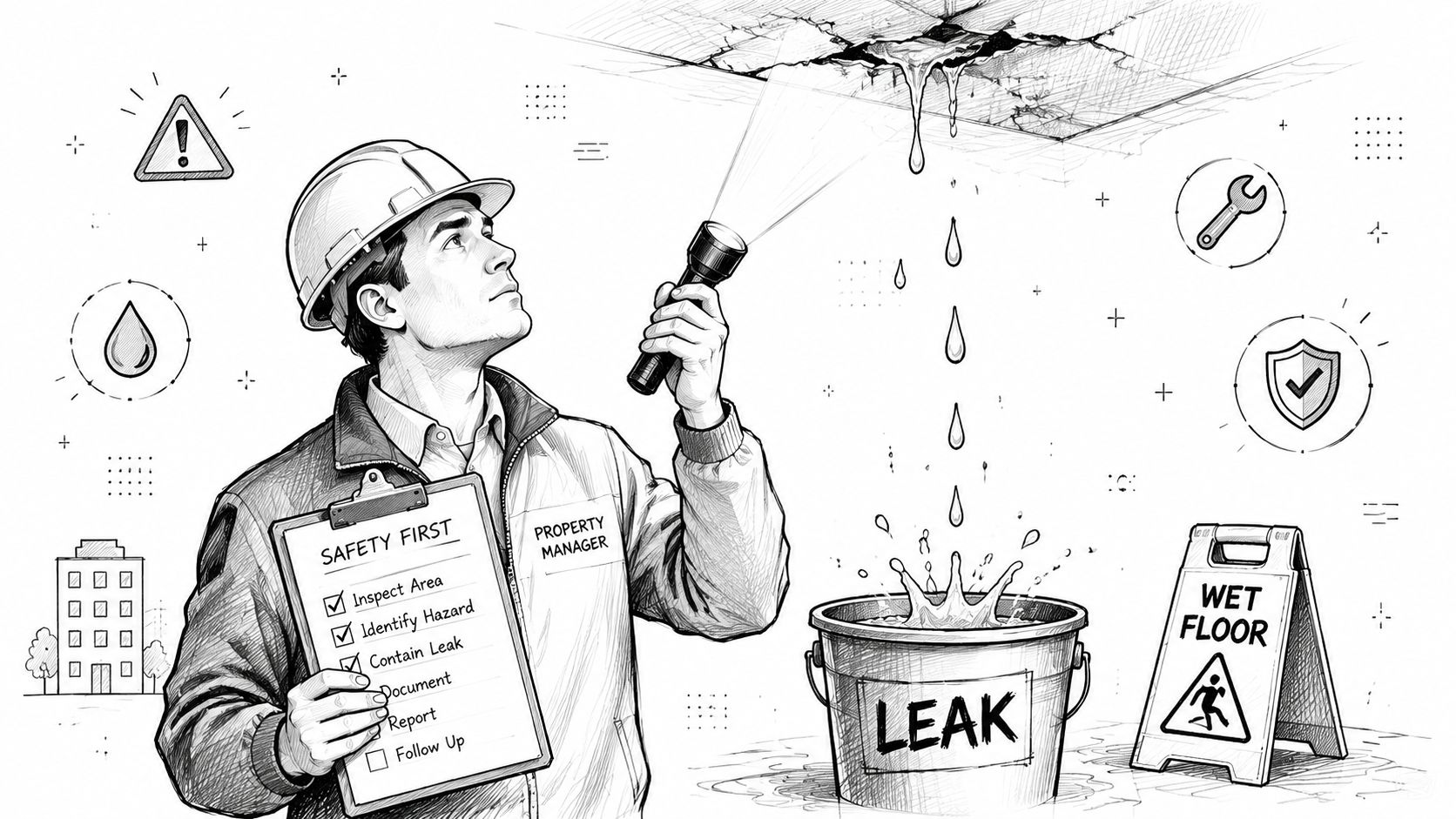
Start with the occupied space below the leak. Check for ceiling sag, wet tiles, staining patterns, damp wall junctions, and water around light fittings or conduits. If there's any chance water has reached electrical services, isolate the affected area through the site's proper electrical process and keep staff clear.
Then trace the leak path back. Water can run along beams, purlins, trays, conduit routes, or insulation before it drops. That's one of the hardest parts of repairing leaking roofs on industrial buildings. The drip point often isn't the entry point. The challenge is well described in this leak tracing explanation for roofs that appear intact, which notes that water can travel along rafters or through insulation and emerge metres from where it entered.
Use a torch. Look above the visible damage if roof space access is safe and authorised. Search for wet insulation, rust trails, tide marks on structural members, and discolouration around penetrations.
A quick checklist helps:
- Protect people first: Isolate slippery areas, put up temporary warning barriers, and keep staff away from sagging ceilings.
- Check electrics early: If water is near lighting, switchboards, or equipment, escalate immediately to the appropriate qualified trades.
- Record conditions: Take photos of the ceiling, stock, services, and any visible water path before cleanup starts.
- Map the likely zone: Mark the internal location relative to columns, walls, roller doors, or grid lines so the roofer can find the rooftop search area faster.
Contain the damage before you chase the cause
Containment isn't glamorous, but it saves money. Move stock, cover plant, and get buckets or collection tubs under active drips. If water is spreading across a floor, use absorbent materials and redirect foot traffic. In tenanted buildings, communicate early so the occupier knows what's being done and what areas are temporarily restricted.
If you suspect blocked drainage is part of the problem, note that for the contractor. Gutters, sumps, downpipes, and overflow paths are often part of the same failure chain on commercial buildings. Poor discharge can mimic a membrane or sheeting leak, which is why it helps to understand broader commercial gutter and drainage issues before anyone starts blaming the wrong roof component.
Don't let maintenance staff climb onto a wet roof to “have a quick look”. That's where simple leak events turn into fall incidents and liability problems.
What the property manager should do is coordinate, document, and contain. What the roofing contractor should do is access the roof safely, test likely ingress points, and confirm whether the issue is a failed lap, penetration, flashing detail, drainage backup, or moisture travelling from a distant point.
The better your first response, the fewer wasted repair hours you'll pay for later.
Professional Temporary Repairs to Stop Further Damage
On a commercial site, temporary repair work has one job. Keep water out without creating a bigger repair bill later. That means buying enough time to confirm the leak path, assess any hidden moisture, arrange safe access, and get the right materials on site for the permanent fix.
On industrial roofs, that window matters. You may be dealing with wet insulation, live plant below, restricted access hours, fragile skylights, or suspected asbestos-containing materials in older roof or gutter components. A quick patch that ignores those risks can turn a leak response into a compliance problem.
What a proper temporary repair looks like
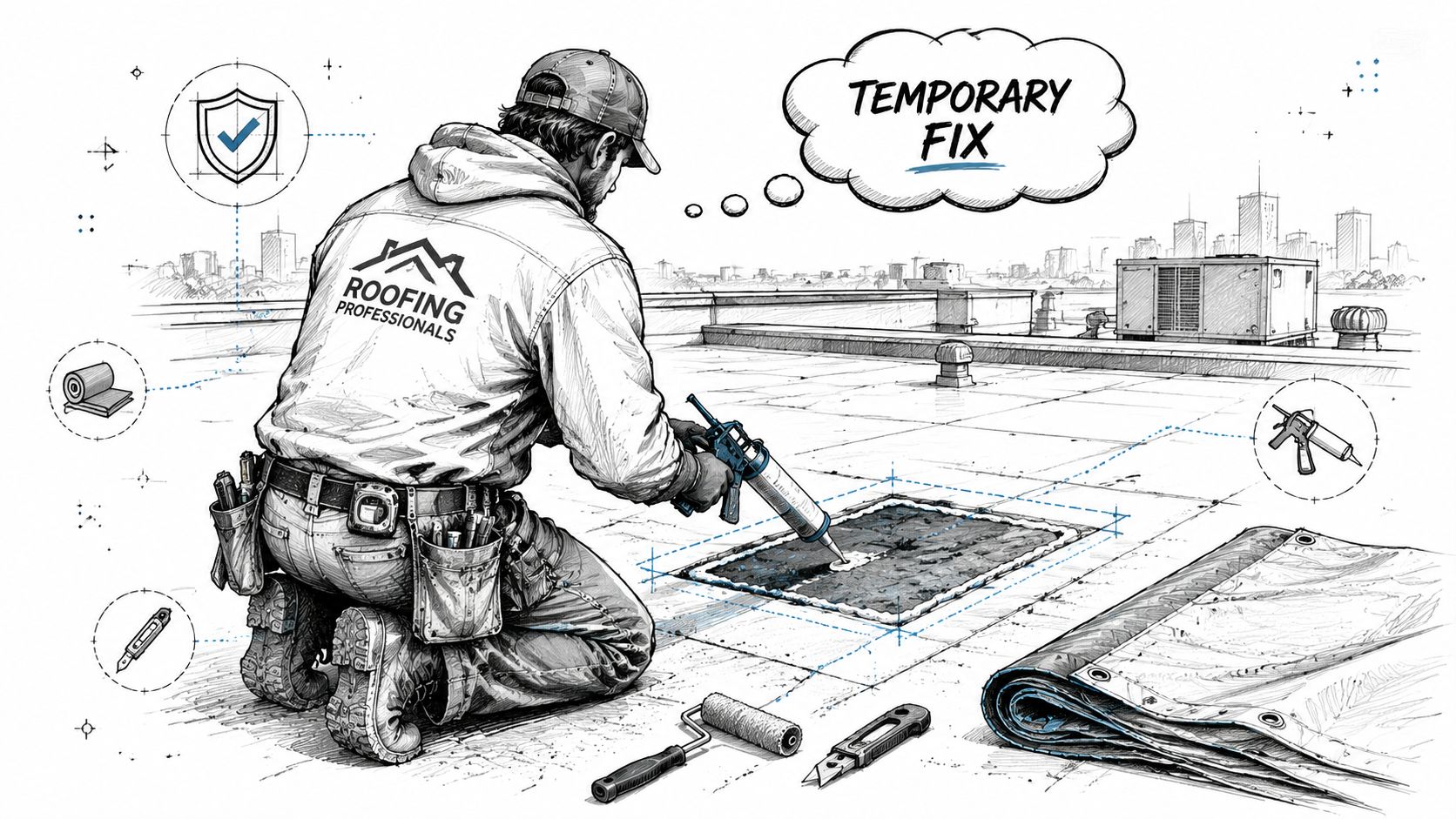
A sound temporary repair starts with the roof system in front of you. Metal sheeting, membrane, box gutters, penetrations, and plant platforms all fail differently, so the temporary method has to match the substrate and the way the roof moves. Good roofers clean the area, check whether the surface is dry enough to accept a patch, and confirm the surrounding material still has enough integrity to hold that patch for the short term.
Width matters. Coverage matters. Bond matters.
On joints and splits, a wide self-adhered repair tape usually performs better than a thin bead of sealant because it bridges movement and covers more of the likely water path. Around penetrations, short-term weatherproofing may involve a compatible patch, local resealing, or temporary flashing treatment. On storm-damaged sections, controlled tarping can be the right call if the affected area is too large for an immediate localised repair.
Typical temporary methods include:
- Repair tape over opened seams or splits: Suitable where the adjacent roof material is still stable.
- Short-term patching of isolated punctures: Used where damage is local and the substrate remains serviceable.
- Temporary treatment around penetrations and flashings: Common around pipes, vents, mechanical supports, and change-of-level details.
- Controlled tarping over larger failed areas: Used after storm impact or where replacement materials cannot be installed straight away.
What usually fails
The failures are predictable. The wrong product gets used. The surface is still wet. Or the repair goes onto the visible drip point instead of the actual entry point.
I see the wet-substrate mistake regularly on Sydney sites. Sealant gets applied before trapped moisture has been dealt with, then the patch loses adhesion or locks in water that keeps deteriorating the assembly below. It looks closed from above and keeps leaking into the tenancy.
Silicone causes plenty of problems as well. It is easy to buy and easy to apply, which is exactly why it gets overused. On many commercial roofs, especially where movement, corrosion, or failed laps are involved, it works poorly as a temporary measure and can interfere with later permanent repairs if the replacement system will not bond over the residue.
A temporary repair should protect the asset and preserve the permanent repair options.
There are also times when patching is the wrong decision. If moisture has spread through insulation, corrosion is running under side laps, the deck has softened, or blocked drainage is pushing water back into details, surface sealing only hides the underlying defect. In older NSW buildings, suspected asbestos is another stop point. Disturbing sheeting, flashings, or debris without the right identification and handling process is not acceptable.
The right temporary scope is often narrower than clients expect. Stop active ingress. Protect stock, equipment, and occupied areas. Then set up the permanent repair properly, based on how the roof failed.
Choosing the Right Permanent Commercial Roof Repair
A permanent repair has to restore how the roof is meant to shed water under real site conditions. On a commercial building, that means more than closing a hole. It means checking whether the surrounding assembly is still sound, whether water has travelled beyond the stain line, and whether the proposed fix suits the roof system that is in place.
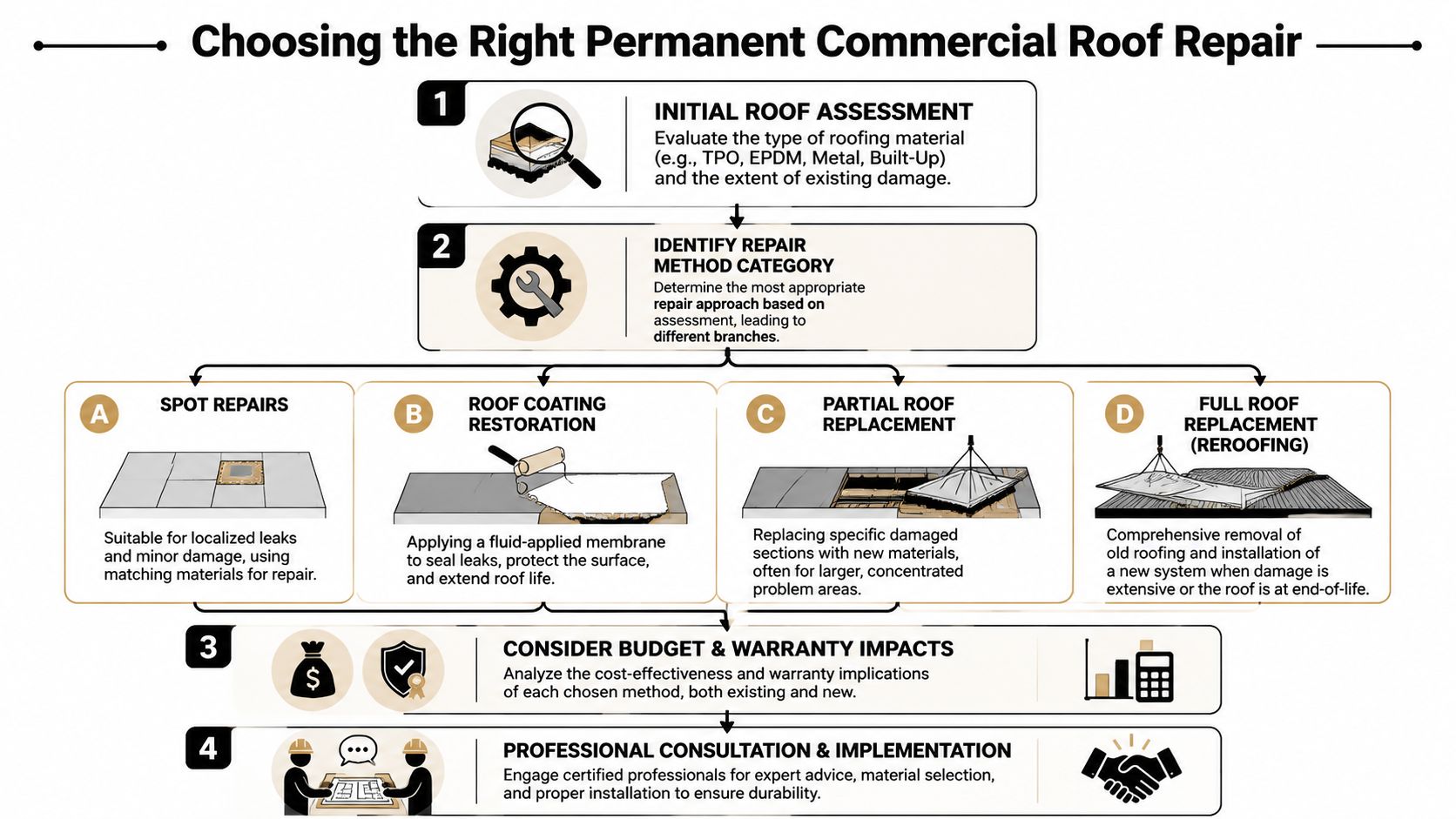
On Sydney commercial and industrial sites, the wrong permanent repair usually comes from one of three mistakes. A residential method gets applied to a commercial roof. The leak path gets oversimplified. Or the quote focuses on the cheapest visible fix instead of the defect chain that caused the ingress.
Match the repair to the roof system
Metal roofs, membrane roofs, box gutters, roof penetrations, and plant platforms fail in different ways. The repair scope has to reflect that.
For metal roofing, permanent work may mean replacing damaged sheets, correcting laps, refastening loose fixings, rebuilding penetrations, or renewing flashings that have lost shape or seal. For membrane roofs, the right answer is often a compatible patch or a local membrane replacement after moisture testing confirms the substrate is suitable. For box gutters, the primary issue is often poor falls, ponding, split joints, corrosion at sumps, or blocked discharge points rather than the adjoining roof sheet.
A proper scope checks four areas:
- Primary defect: split sheet, open seam, failed flashing, cracked penetration, pinhole corrosion, or fixing failure
- Surrounding build-up: insulation condition, deck or substrate integrity, battens, purlins, and any trapped moisture
- Drainage path: gutters, sumps, downpipes, overflow provisions, and discharge performance during heavy rain
- Movement and moisture drivers: thermal expansion, vibration, condensation, and failed ventilation components
This is also where cost needs to be read properly. A lower quote that only seals the symptom can cost more once access, reinstatement, and repeat disruptions are counted. For a practical breakdown of commercial roof repair costs and what changes the scope, look at the repair method, access difficulty, roof height, and whether internal damage has already started.
A short technical walkthrough is useful before any major decision:
Repairing asbestos roofs
Asbestos changes the job immediately. The issue is no longer just waterproofing. It becomes a compliance and risk-control matter involving identification, licensed handling, site isolation, disposal, and documentation.
Older warehouses and factories across NSW still have asbestos cement roofing or associated components. If that material is suspected, no one should be drilling, cutting, pressure cleaning, or breaking sheets to chase a leak. Even minor work around fixings, flashings, or brittle edges can create a much bigger problem than the leak itself.
In practice, repair options narrow fast on ageing asbestos roofs. If sheets are cracked, friable at fixings, or leaking across multiple laps, patching may keep water out for a period but still leave the owner carrying an ongoing compliance exposure. In many cases, replacement of the affected area is the cleaner long-term decision because it removes both the leak source and the asbestos-related maintenance burden.
Colorbond and metal roof repairs
Colorbond and other metal roof systems are often repairable if the defect is still localised and the surrounding sheets remain stable. The judgement call is the level of intervention.
A small isolated puncture may justify a local repair. A penetration leak usually calls for flashing replacement or a rebuilt detail. Once corrosion has spread under laps, sheet ends are deteriorating, or repeated patching has distorted the profile, full sheet replacement is usually the better option.
I look closely at profile match, fixing layout, sheet length, lap condition, signs of thermal movement, and whether the new work will be tied into material that is already near failure. That last point matters. A well-installed repair anchored to weakened sheets or corroded supports will not stay reliable for long.
If the repair does not restore water-shedding logic, it is still a patch.
Why system-level repairs last longer
Commercial roofs fail as assemblies. Water may show up at one point and enter somewhere else entirely. Plant penetrations, poorly detailed exhausts, blocked drainage, condensation, and movement at joints can all interact on the same roof.
That is why isolated spot sealing often disappoints on industrial buildings. The visible leak may stop for a while, but the roof keeps taking on moisture through the same weakness in the system. On warehouses and logistics facilities, I see this around exhaust penetrations, aging box gutters, poorly integrated services, and roof zones that have been modified several times without reworking the drainage or flashing logic.
The better question is not "where is the drip?" It is "what failure sequence let water get from the weather side to the inside of the building?" Once that is answered, the permanent repair scope becomes much clearer and much easier to defend on cost, risk, and expected service life.
The Critical Decision Repair or Full Replacement
Some roofs should be repaired. Some should be replaced. The expensive mistake is choosing repair because it feels cheaper this month, then paying for repeated failures, interior damage, and disruption over the next few years.
Commercial owners need to assess the roof as an asset, not just as a line item.
Australian repair economics point in the same direction. Early intervention matters because delaying action can turn a localised, repairable defect into broader damage affecting inventory, electrical systems, and compliance obligations, as noted in this practical overview of why leak response is a risk-management task. That's why the repair-versus-replacement decision should be based on total exposure, not on the lowest immediate quote.
What the decision should be based on
Look at history first. If the roof has one isolated defect, the surrounding areas are dry, and the assembly still has structural integrity, repair is usually the right call. If the roof has recurring leaks in multiple zones, widespread corrosion, repeated emergency patching, or ageing asbestos sheeting, replacement starts to make more sense.
Then look at business use. A lightly used storage building can tolerate more staged remediation than a food facility, medical site, retail centre, or logistics operation with strict uptime demands. The cost of failure is different on each site.
The shortlist I use is straightforward:
- Leak pattern: One isolated event favours repair. Repeated call-outs in different areas favour replacement.
- Roof condition around the leak: Sound surrounding material supports local repair. Broad deterioration does not.
- Operational sensitivity: If one leak can interrupt production, damage stock, or breach tenant obligations, replacement gets stronger quickly.
- Ownership horizon: If you're holding the asset long term, repeated patching often becomes false economy.
- Compliance burden: Older roofs with hazardous materials or chronic defects can absorb management time far beyond the roofing budget itself.
If you're comparing likely budgets for remedial works versus larger capital works, it helps to review a commercial roof repair cost guide before the committee or ownership meeting.
Decision Matrix Repair vs Roof Replacement
| Factor | Favours Repair | Favours Replacement |
|---|---|---|
| Extent of damage | Localised defect in an otherwise serviceable roof | Widespread failure across multiple zones |
| History of leaks | First known or rare event | Recurring leaks and repeated patch jobs |
| Roof substrate condition | Dry, stable, structurally sound | Saturated, corroded, brittle, or deteriorated |
| Building operations | Limited consequence if a small area is isolated during repair | High consequence from downtime, stock loss, or tenant disruption |
| Compliance exposure | Standard repair controls are adequate | Hazardous materials or broader compliance issues complicate ongoing patching |
| Asset strategy | Short to medium-term hold, with roof still offering useful service life | Long-term hold, upgrade strategy, or need for a cleaner warranty position |
The right answer often comes from one question. Are you fixing a defect, or are you managing the decline of a roof that has already told you it's near the end of its practical life?
If it's the second one, replacement is usually the more disciplined decision.
How to Select a Commercial Roofing Contractor in NSW
The contractor you choose will shape not just the roof outcome, but the safety file, the paperwork trail, the programme, and the level of disruption across the site. On commercial work, price alone is a poor filter.
You need a contractor who understands live sites, access restrictions, SWMS requirements, weather exposure, tenanted environments, and the difference between a neat patch and a compliant roofing repair.
What to verify before work starts
Ask for the basics, but don't stop at the basics. You want current licensing, insurance, and documented safety systems that fit the actual site conditions.
Check these points before approving the job:
- Licensing: Verify the contractor holds the appropriate NSW trade credentials for the scope being proposed.
- Insurance: Ask for current certificates covering public liability and workers compensation.
- Site safety documentation: SWMS should reflect roof access, fall protection, weather conditions, penetrations, fragile surfaces, and occupied-site controls.
- Commercial experience: Make sure they've worked on warehouses, strata complexes, factories, or similar assets, not just houses.
- Method clarity: The quote should state what will be repaired, what will be replaced, what is temporary, and what assumptions have been made.
Questions that reveal whether a contractor is commercial-grade
The fastest way to sort capable contractors from guessers is to ask sharper questions.
- Who will do the work? In-house crews usually provide tighter control over quality and safety than loosely managed labour.
- How will you confirm the leak path? A serious contractor will talk about tracing, testing, and checking related components, not just applying sealant.
- What happens if you find wet substrate or hidden deterioration? You want a clear variation process and documentation, not surprises at invoice stage.
- Have you worked on asbestos roofs or older industrial stock? If yes, ask how they separate licensed hazardous work from ordinary repair work.
- What warranty applies to the workmanship and materials? The answer should be specific and written, not verbal and vague.
A contractor's local commercial track record matters too. If you're still narrowing the field, a practical starting point is to compare providers who focus specifically on commercial roofers near your site in NSW, rather than general residential roofing businesses taking on occasional factory work.
A good contractor won't promise that every leak is simple. They'll explain where the uncertainty sits, what they know, what they need to inspect further, and how they'll protect the building while decisions are being made.
If you need a practical assessment of a leaking commercial or industrial roof in Sydney or wider NSW, Commercial Roofers can inspect the site, identify likely ingress paths, advise on repair versus replacement, and carry out compliant works for metal, box gutter, asbestos, and other commercial roofing systems.