
If you own or manage a commercial building in NSW, there's a fair chance you're dealing with the same pattern I see every week. The roof gets attention only when water shows up inside, a tenant complains, or a storm rips something loose. By then, the conversation has already become expensive.
That's the wrong trigger.
Good roofing and maintenance isn't a list of odd jobs. It's a risk-management program with records strong enough to stand up with insurers, manufacturers and buyers. Australia had 11.45 million dwellings as at the December quarter 2025, and roofing services generated about A$3.8 billion in annual revenue in 2025, with 1,242 roofing contractors in NSW, which tells you two things. The roof asset base is enormous, and maintenance demand is constant, not occasional (Australian roofing statistics).
For owners of warehouses, factories, strata blocks and retail sites, the useful question isn't “Who can patch this leak today?” It's “What evidence do we have about this roof, what's the failure pattern, and what work should we schedule before the next weather event turns a defect into downtime?”
Table of Contents
- Why a Planned Roofing and Maintenance Program Beats Reactive Repairs
- Setting Your Inspection Cadence and Documentation Standard
- Seasonal and Storm-Season Checklist for NSW Commercial Roofs
- Common Failure Modes on Commercial Roofs and Early Warning Signs
- Repair, Restoration or Replacement How to Decide
- Emergency Leak Response The First 60 Minutes
- Choosing a Commercial Roofing Contractor and Locking In a Maintenance Plan
Why a Planned Roofing and Maintenance Program Beats Reactive Repairs
A familiar Sydney scenario goes like this. Sunday night, heavy rain. Water starts dripping onto palletised stock in the inner west warehouse. Someone calls an emergency roofer at 2am, someone else moves product, and by Monday morning the insurer wants to know when the roof was last inspected and what maintenance records exist.
That's where reactive owners get hurt. Not only by the leak, but by the lack of proof.
What reactive repairs usually miss
An emergency patch has its place. If water is entering the building, containment comes first. But a roof managed one callout at a time usually develops the same weaknesses:
- No defect history: Nobody can tell whether the leak is new, recurring, or part of a wider failure around the same penetration or gutter line.
- No budget path: Spend jumps from nothing to urgent invoices, often at the worst time in the financial year.
- No evidence trail: When warranty or insurance questions come up, the owner has photos of damage inside but nothing showing roof condition before the event.
- No capital timing: Minor faults that could have been handled early get left to age into partial replacement work.
Practical rule: If the first written record of a roof defect is the emergency invoice, the owner is already behind.
A planned program changes the conversation. Instead of paying for panic, you're paying for visibility. Scheduled inspections pick up membrane fatigue, loose fasteners, blocked drainage, failed sealant lines and flashing movement before they present as internal water ingress. Just as important, each visit creates dated photos and a condition record.
What a planned program gives you
Owners should expect three outcomes from proper roofing and maintenance. Fewer leaks, more predictable spend, and a roof file that stays with the building.
That file matters. It helps with claim discussions, supports warranty positions, and gives asset managers something more useful than hearsay when they review upcoming capital works. The Australian roofing-services sector is estimated at about A$4.4 billion in 2026 with 5,798 businesses, and growth from 2020 to 2025 is described as only 0.3% CAGR, which is one reason disciplined work management matters more than ad hoc callouts (NATSPEC maintenance management guidance).
| Cost Driver | Reactive Callouts | Planned Program |
|---|---|---|
| Leak detection | Found after internal damage starts | Found during scheduled inspection |
| Spending pattern | Irregular and urgent | Budgeted and staged |
| Insurance position | Weak if records are thin | Stronger with reports and photos |
| Tenant impact | Complaints and disruption arrive first | Issues are often handled before occupants notice |
| Capital planning | Replacement timing is guesswork | Renewal planning can be staged over years |
Setting Your Inspection Cadence and Documentation Standard
Most roof inspections fail for one reason. They happen as a walk, not as a record.
A facility manager and a licensed roofing contractor can spend an hour on a roof and still leave you with nothing useful if the findings aren't documented properly. For insurance, budgeting and contractor accountability, consistency matters more than theatrics.
Use a repeatable inspection rhythm
For most commercial roofs in NSW, the practical baseline is:
- Two scheduled visual inspections each year: One pre-summer and one post-winter
- One annual close-up assessment: Best done after the hottest stretch, when heat movement, UV damage and sealant fatigue show themselves clearly
- Post-event checks: After severe weather and after other trades have been on the roof
Owners dealing with older roofs or sites with a history of water ingress often need tighter intervals. Guidance used in the Australian market commonly treats professional maintenance reports as an insurance requirement, with roofs surveyed at least annually, more often after extreme weather, and quarterly inspections for high-risk or older roofs (commercial roof maintenance reports for insurance).
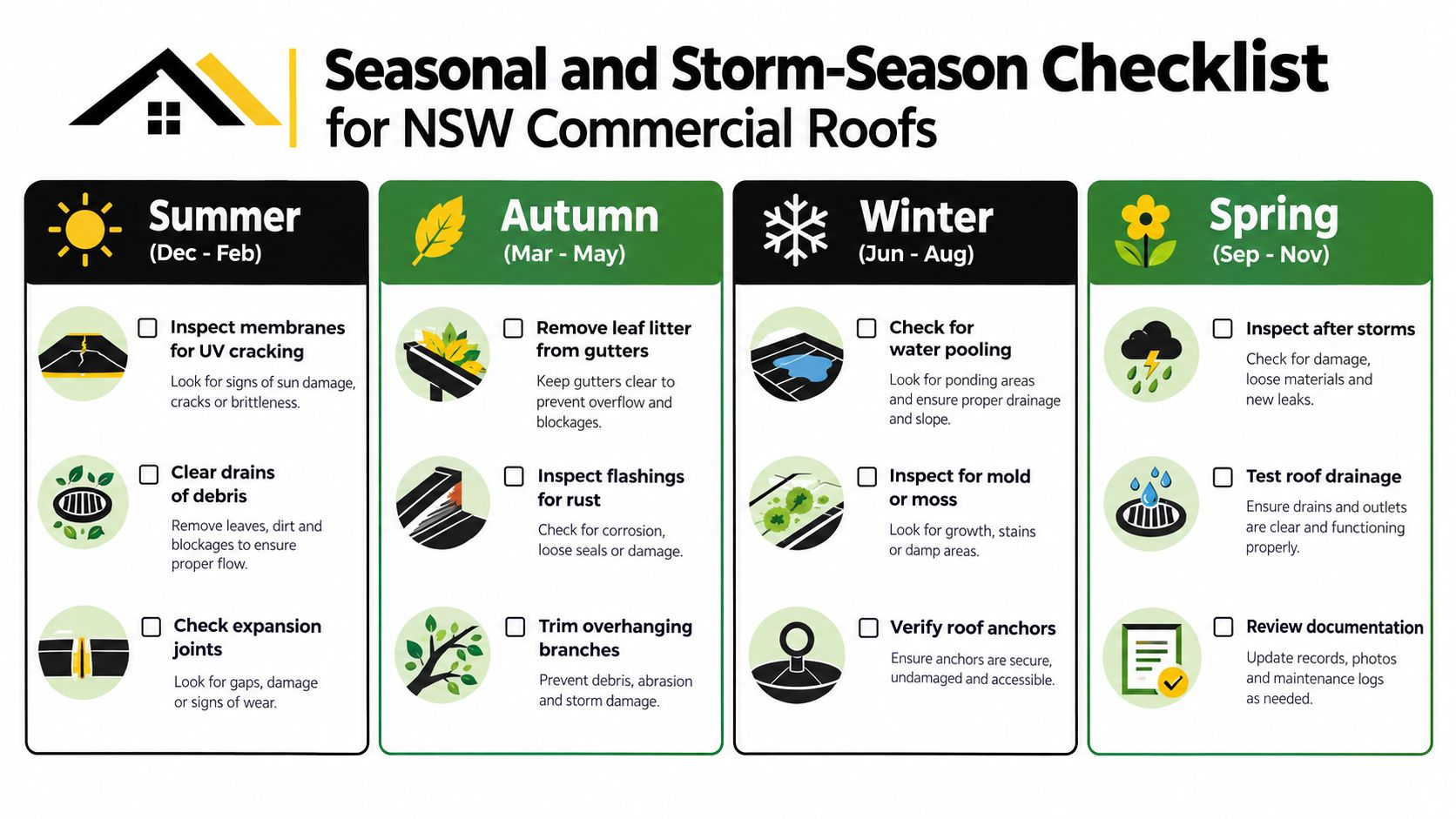
This is the seasonal checklist I'd expect a manager to keep handy:
What each visit should actually capture
The contractor and site contact should check the same core items every time:
- Seams and laps: Look for opening joints, movement and failed sealants.
- Flashings and terminations: Pay attention around parapets, penetrations and equipment curbs.
- Drainage points: Gutters, sumps, box gutters, rainheads, overflows and downpipes must be clear and free-flowing.
- Ponding or staining: Water marks tell you where drainage or falls are not behaving as intended.
- Substrate condition: Soft spots, movement, corrosion around fixings and any sign of deck deterioration need to be logged.
A simple external reference can help site staff understand what to look for in drainage components. A practical roof gutter inspection checklist is useful as a prompt before the contractor arrives, especially on sites where blocked gutters trigger most leak reports.
The documentation standard that turns a walk into evidence
Require four deliverables every time:
- Dated photos with location context
- Annotated roof plan marking defect positions
- Written condition report with clear severity ratings
- Defect register showing action, responsibility and sign-off
Keep the report as a searchable PDF and store the raw photo folder with it. If you need a starting point, this commercial roof inspection report template is the sort of format that keeps reporting standard across multiple sites.
The best report isn't the thickest one. It's the one your next contractor, insurer or buyer can follow without making phone calls.
Seasonal and Storm-Season Checklist for NSW Commercial Roofs
NSW roofs don't fail on a neat calendar, but weather patterns still give you good maintenance windows. If you run industrial, strata or retail property, your checklist should be tied to seasons and storm exposure, not vague reminders.
Print it, laminate it, keep a copy in the services folder, and make sure someone signs it off each time.
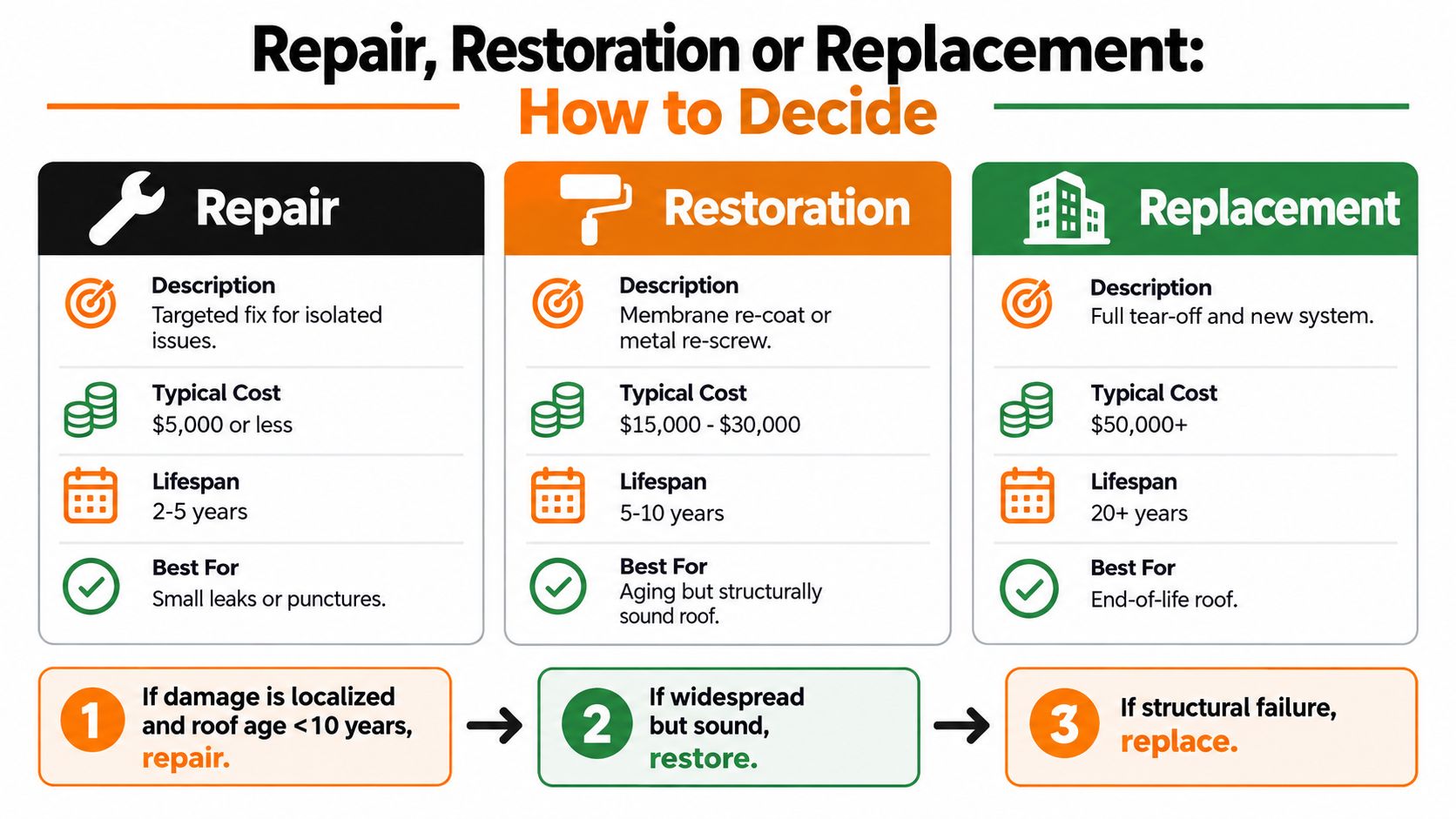
For quick visual guidance on the treatment path, this is a useful decision graphic to keep with the checklist:
Late winter and pre-summer checks
By late winter, I want debris off the roof, drainage paths clear, and any ponding pattern noted. Cold periods can leave seams stressed and minor splits unnoticed until the next burst of heat and rain.
Use August and October for the heavier visual work:
- Clear debris: Gutters, valleys, sumps and overflows first
- Inspect sheet laps and flashings: Loose sections won't improve by themselves
- Check downpipes and leaf guards: If water can't exit quickly, internal leaks aren't far behind
- Photograph known weak points: Previous repair zones, rooftop plant areas and box gutters
Mid-summer and after storms
January is when heat-driven issues show up. Membranes can blister, sealants split, and older metal systems start showing movement around fasteners and penetrations.
After a severe event, inspect the roof as soon as it's safe. The basic scan should look for displaced sheets, torn membrane, blocked drainage and fresh staining inside the building. I'd want that done within a short window, not weeks later when the trail has gone cold.
No one should access a wet or wind-loaded commercial roof. Wait until conditions are safe and use trained personnel with the right access controls.
Later in your safety planning, it helps to look beyond local rules and review how other trade-focused guides explain harness and edge-protection thinking. This overview of fall arrest for UK roofers is useful as a plain-language safety reference, even though site compliance must follow Australian requirements.
A short explainer is worth keeping in the file for managers who need to brief staff or tenants before works begin:
The tasks that should happen every cycle
Don't overcomplicate the checklist. The repeatable tasks are what count:
- Tighten what has moved: Fasteners, clips and accessible fixings
- Reseal vulnerable details: Terminations, joints and approved flashing interfaces
- Clear sumps and overflows: Water needs an exit path every time
- Log anything new: New cracks, rust bleed, staining, punctures, movement around plant
Common Failure Modes on Commercial Roofs and Early Warning Signs
On NSW commercial roofs, the expensive failures are rarely dramatic at the start. They begin as small changes that busy sites ignore. A little rust at a fixing. A lap that's lifted slightly. A blocked outlet after windblown debris. Six months later, the repair is still straightforward. Leave it long enough and you're pricing partial replacement.
The maintenance mindset should be simple. Catch defects while they're localised. Once moisture gets past the roof skin and starts affecting substrate, insulation, framing or stock, the roof problem stops being just a roof problem.
The failures that show up again and again
These are the ones I'd tell any owner or manager to watch for:
| Failure Mode | Early Sign | Late Sign | Likely Consequence |
|---|---|---|---|
| Failed laps and sealants on metal roofing | Fine separation at overlaps, sealant cracking | Active water entry, rust staining below laps | Leak spread across larger sheet runs |
| Membrane shrinkage at terminations | Tension at edges, slight pull on flashing lines | Flashings detach, membrane splits at perimeter | Water ingress at walls and penetrations |
| Blocked drainage and ponding | Slow discharge, debris build-up, minor standing water | Persistent ponding, internal staining, overflow issues | Structural stress, recurring leaks |
| Fastener back-out and corrosion | Raised screw heads, washer deterioration | Enlarged holes, sheet movement, rust spread | Wind vulnerability and widespread leaks |
| Failed flashings around penetrations | Sealant fatigue, minor movement | Open junctions around pipes and curbs | Local leaks that become hard to trace |
| Perished skylight and HVAC curb seals | Brittle seals, minor staining nearby | Cracked seals, repeated internal drips | Water entry around rooftop plant |
| Concrete spalling or cracked tiles on older strata roofs | Hairline cracking, isolated loose pieces | Broken sections, exposed substrate | Falling hazards and ongoing moisture entry |
What a non-roofer can spot safely
You don't need to be a roofer to notice warning signs from ground level or inside the building. Look for:
- Ceiling staining: Especially after rain, even if it dries out later
- Rust bleed on external sheets or fascia lines: It usually points to a fastening or lap issue
- Overflowing gutters in moderate rain: That often means blockage, not just heavy weather
- Water marks around services: HVAC penetrations and skylights are repeat offenders
If you're checking internal signs, walk the building, not the wet roof. Look up at purlin lines, insulation, ceiling tiles and wall junctions.
A lot of owners underestimate flashing details. If you want a simple example of why these joints matter, this guide on how to fix flashing properly is useful because it shows how small interface failures become leak paths fast.
Slow leaks are usually the costliest leaks. They don't always trigger an emergency, so they sit there damaging substrate, stock and trust.
Repair, Restoration or Replacement How to Decide
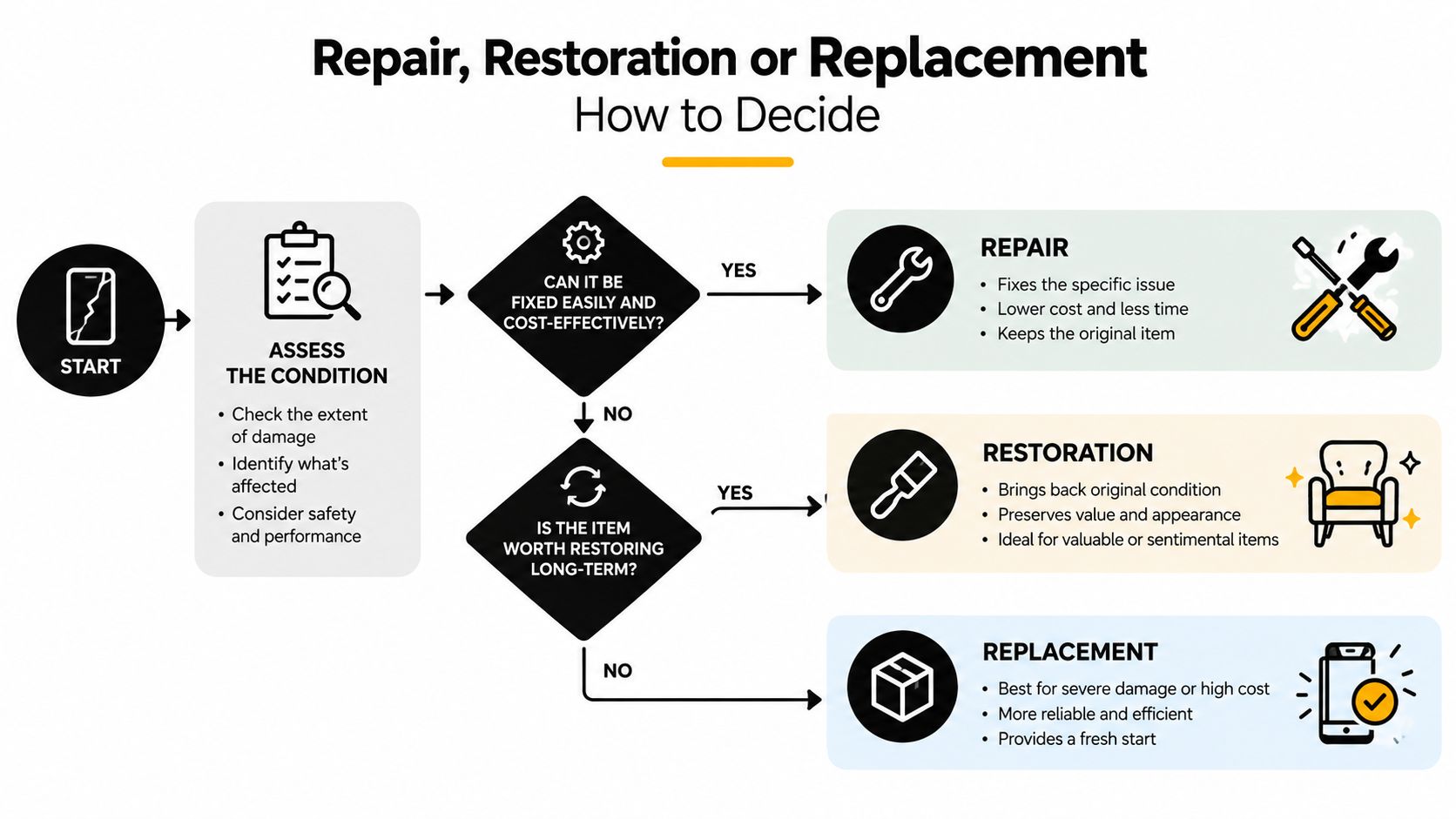
Most bad roofing decisions happen because someone jumps straight from “there's a leak” to “replace the whole thing,” or does the opposite and keeps patching a roof that has already run out of road.
The better approach is to test the roof against four questions. How old is it relative to its service life. How much of the roof area is failing. Is the substrate still sound. What happens to your business if the roof fails at the wrong time.
This visual flowchart helps sort the decision before you approve a scope:
When repair still makes sense
Repair is the right call when defects are isolated and the surrounding roof system is still performing. A few failed fasteners, a puncture near plant, local flashing breakdown, or a short run of damaged sheeting can often be fixed cleanly if the underlying deck is dry and stable.
What doesn't work is calling a series of isolated patches “maintenance” when the same roof is leaking in new spots every season.
When restoration earns its keep
Restoration sits in the middle. Metal roofs with widespread fastener fatigue but sound structure may suit a re-screw and seal scope. Some membrane systems may suit recoating or targeted surface renewal where the field of the roof is serviceable and the failure is mostly weathering, not structural breakdown.
This is the point where owners should insist on method, not sales talk. Scope should identify what gets cleaned, what gets replaced, what gets sealed, what prep is included, and what remains excluded. For owners comparing options, this overview of what is roof restoration is a practical reference.
Replacement is justified earlier than some owners think
Replacement becomes the sensible option when defects are widespread, substrate issues are present, or the building's interruption risk is high enough that another rainy season of patching is false economy. A new system also resets warranty value, which is a real asset if you plan to hold, refinance or sell.
One part of the decision is historical. Corrugated galvanised iron suitable for corrugation was first produced in the 1840s, became widely used in Australia from about 1850, and local large-scale production stepped up when John Lysaght opened a Newcastle corrugating and galvanising works in 1921. Another major material shift came in 1976, when BHP introduced ZINCALUME, made of 55% aluminium, 43% zinc and 1.6% silicon (NSW corrugated roofing heritage information). If your building carries older metal systems, the roof details and corrosion profile may be very different from current products, which changes the repair-versus-replace equation.
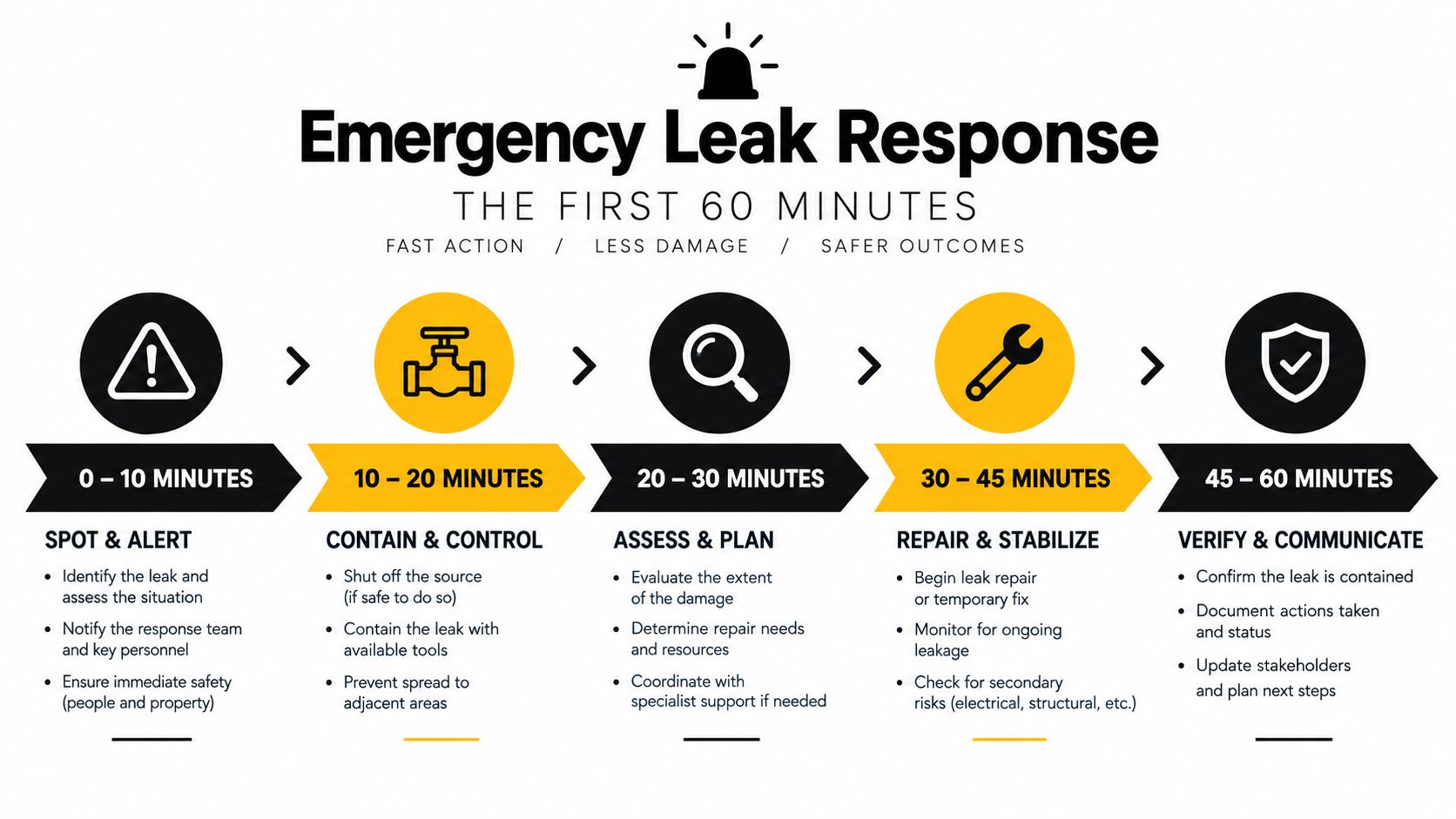
Emergency Leak Response The First 60 Minutes
It is 2:15 pm, rain is pushing sideways across the roof, and water has started dripping onto stock, switchboards or a common corridor. The first hour decides how much damage the building carries into the next week, and how strong your claim file looks if insurers or strata managers start asking questions later.
Treat the response as loss control and evidence collection. A rushed patch without records can cost more than the leak itself.
First actions inside the building
Start inside. The priority is people, electrics, stock and documenting what happened before anyone disturbs the scene.
- Make the area safe. Isolate electrical hazards if your team can do that safely. Keep people clear of active drips and barricade slippery floor areas.
- Protect stock and equipment. Move pallets, cover sensitive plant, place buckets and tarps, and put absorbent mats on any traffic path that must stay open.
- Map the spread. Check ceiling tiles, insulation sag, wall junctions, penetrations and nearby services. Water often shows up metres away from the entry point.
On commercial roofs, the leak point inside is rarely the failure point above. Water tracks along purlins, foil, cable trays and slab soffits. That is why random sealant work in the first few minutes usually muddies the diagnosis.
Capture evidence before the site changes
Before anyone starts guessing, build a basic incident record. For owners and facility managers, this is not admin for its own sake. It is the start of an insurance-grade file that shows timing, extent, mitigation steps and probable cause.
Take timestamped photos of:
- The internal entry point
- Water spread and staining
- Affected stock, equipment or finishes
- Ceiling or deck condition where safely visible
Record the time the leak was first noticed, which areas were protected, who attended, and the weather conditions at the time. If safe internal access is available, photograph the underside of the roof deck before it dries out. Those underside images often do more to support a defect diagnosis than a wet rooftop photo taken in a hurry.
This response sequence is worth sharing with site teams:
Call the right contractor and control the first visit
When you call a roofer, give them the roof type, building use, exact leak location, whether the leak is still active, current weather, access constraints, and whether the roof is under warranty. If you already have a maintenance contractor, call them first. They should already have photos, prior repair history and known risk points on file.
A proper emergency response should do two jobs at once. It should contain water ingress if safe conditions allow, and it should document findings clearly enough that the temporary fix does not destroy the evidence needed for the permanent repair scope.
Three mistakes cause trouble fast:
- Do not drill holes in roof sheets, flashings or ceiling elements to release trapped water
- Do not smear silicone over laps, penetrations or flashings without identifying the entry path
- Do not allow unsupervised roof access by an unknown tradesperson with no induction, no records and no reporting trail
If you need a practical benchmark, this guide to emergency roof leak repairs for commercial buildings sets out what an urgent callout should cover.
Severe weather losses can turn a small leak into a long argument about timing, cause and preventable damage. Owners who keep photos, attendance records, weather notes and follow-up inspection reports are in a much stronger position. Good emergency response is not just about catching water in buckets. It is part of a documented risk-management program that reduces claim disputes, limits interruption and gives the repair contractor a clean starting point for the fix.
Choosing a Commercial Roofing Contractor and Locking In a Maintenance Plan
A tidy quote doesn't tell you much. I've seen plenty of roofing scopes that look professional and still leave the owner exposed because the contractor hasn't defined what they will inspect, how they'll report, or what happens when an emergency hits.
Pick your contractor the same way you'd pick any trade responsible for a critical building asset. Verify the basics first, then test how they document work.
What to verify before you accept a quote
Start with essentials:
- NSW licensing and supervision: Check the business is properly licensed and can supervise commercial roofing work lawfully.
- Current insurance: Public liability and workers compensation certificates should be current and easy to produce.
- System familiarity: If your roof is membrane, metal, tiled or mixed, make sure the contractor works on that system regularly.
- Comparable project experience: Warehouses, strata blocks and plant-heavy roofs all behave differently.
One option in this market is Commercial Roofers, which provides commercial roof inspections, maintenance, repairs and replacement across NSW. That's relevant if you want one contractor to handle both reporting and remedial scopes, but the same selection checks should apply to any firm you shortlist.
What the written scope must include
If the proposal doesn't spell out deliverables, don't sign it.
A proper maintenance plan should itemise:
- Inspection points: Seams, flashings, gutters, drainage, penetrations, rooftop plant zones
- Photo deliverables: Not just “photos supplied” but enough labelled images to identify defect locations
- Reporting turnaround: You need a timeframe for written findings
- Emergency response process: Who attends, what gets made safe, how temporary repairs are documented
- Warranty terms: Separate materials and workmanship terms clearly
Reject lump-sum mystery quotes. If access costs, safety setup, after-hours attendance, disposal, exclusions or temporary weatherproofing are not stated, you'll usually discover them later when approval pressure is highest.
The maintenance plan owners should lock in this quarter
Keep the plan simple enough that it gets used. The best ones usually include:
Asset register details
Building name, roof type, approximate age, access notes, drainage layout, known weak points.Inspection log
Last inspection date, weather conditions on the day, attendees, findings, urgent actions.Defect register
Each issue listed with priority, proposed action, budget allowance, target completion date and sign-off.Document storage rule
Reports, invoices, marked-up roof plans and raw photos all stored in one shared location.
For owners with multiple assets, portfolio planning is becoming more structured. Nearmap launched an AI-powered roof assessment for portfolio-scale roof planning in Australia in February 2026, which shows where the market is heading. Less guessing roof by roof, more remote triage and capital planning across sites (Nearmap roof assessment announcement).
That's the direction smart owners are moving in. Not more paperwork for its own sake. Better evidence, faster prioritisation, and fewer surprises.
If you want a commercial roofing and maintenance program that goes beyond patch jobs, Commercial Roofers can help with inspections, reports, leak response, restoration planning and replacement scopes across Sydney and NSW. The useful part isn't just the repair. It's building the roof file, photo record and maintenance history you'll need when weather, warranty or insurance questions land on your desk.