
For an Australian commercial roof, restoration typically costs roughly $40 to $65 per square metre for tile work, while complete projects commonly fall between $2,000 and $12,000 or more, depending on roof size and complexity. In 2026, commercial jobs scale primarily by area, access and substrate condition.
That's the figure property owners need to start with, but it isn't the figure they should finish with. A warehouse roof isn't priced like a house, and a strata complex with difficult access can cost more per square metre than a large logistics building with clear access and straightforward metal cladding.
The practical question is whether restoration will preserve a sound roof at a sensible lifecycle cost, or whether the building is already approaching replacement territory. Cleaning and coating a failing substrate may look cheaper on the tender summary, but it can leave the owner paying twice for the same roof.
Table of Contents
- What Roof Restoration Means on a Commercial Building
- Average Cost of Roof Restoration by Size and Per Square Metre
- Key Cost Drivers on Commercial and Industrial Roofs
- Restore vs Replace on Commercial Roofs
- Ballpark Estimates for Common Commercial Scenarios
- Budgeting Procurement Quotes and Warranties
- Making the Right Call for Your Building
What Roof Restoration Means on a Commercial Building
Commercial roof restoration is a planned refurbishment of an existing roof system. The contractor retains the main roof structure, then cleans, repairs, reseals and recoats the surface to control water entry and slow further deterioration. It's different from an emergency leak repair, which targets an immediate failure, and from a full re-roof, which removes and replaces the roof system.
On a warehouse, factory or strata building, a proper restoration scope may include:
- Surface preparation: Cleaning removes dirt, lichen, loose coating and contaminants that would stop new products bonding properly.
- Localised repairs: Damaged tiles or sheets are replaced where necessary, rather than coating over visible failures.
- Rust treatment: Corroded metal is prepared and treated before primer and protective coatings are applied.
- Fixings and flashings: Failed screws, washers, flashing joints and penetrations are renewed or resealed.
- Coating application: A compatible primer and membrane or protective topcoat are applied to the prepared surface.
- Water-shedding details: Valleys, ridges, box gutters, roof penetrations and service openings receive specific attention.
A restoration preserves the existing asset. It doesn't automatically correct structural movement, saturated insulation, widespread substrate corrosion or defective roof design. Structural remediation, complete gutter replacement, asbestos removal and insulation upgrades should appear as separate scope items or provisional sums, not disappear inside a vague “restoration” allowance.
Owners who want broader background on preserving existing building fabric can also review this historic building restoration guide, which provides useful context on why preparation and condition assessment matter before cosmetic work begins. For a roofing-specific definition, see what roof restoration involves.
Restoration, repair and replacement
Reactive repair makes sense when the roof is sound and one leak, flashing or fastener has failed. Restoration becomes appropriate when the surface has reached a condition where cleaning, localised repairs and a compatible coating can address broader wear.
Full replacement is different. It involves removing the existing system, dealing with disposal and installing new sheets, tiles, membranes, insulation or supporting components. A restoration can extend the serviceable life of a sound roof by 10 to 15 years, according to an Australian commercial roofing cost guide covering restoration pricing and lifecycle considerations. That extension is valuable only when the substrate underneath can support it.
Practical rule: Never approve a coating proposal until the contractor identifies what happens to rusted sheets, wet insulation, failed fixings and damaged flashings.
Average Cost of Roof Restoration by Size and Per Square Metre
Australian pricing guides show why a single “average cost of roof restoration” is a poor procurement figure. One guide places smaller roofs of about 80 square metres at roughly $2,000 to $4,000, medium roofs around 150 square metres at approximately $3,750 to $7,500, and larger roofs over 200 square metres at more than $10,000 in some cases. It gives an Australia-wide range of about $2,000 to $12,000, with area and complexity driving the spread. See the Australian roof restoration cost breakdown by roof size.
For commercial owners, those residential bands are only a starting reference. Small strata and retail roofs often carry fixed costs for mobilisation, edge protection, access and site management. A larger warehouse can achieve a lower rate per square metre because the crew, equipment and preparation process are distributed across more roof area.
The following table is a practical commercial budgeting framework. The building-size ranges and commercial totals are planning bands, not verified national averages. The $40 to $65 per square metre benchmark for tile restoration comes from Australian pricing guidance on roofing costs and restoration rates. Other commercial rates must be confirmed through a site inspection and like-for-like tender.
| Building Size | Roof Area (m²) | Typical Total Cost (AUD) | Cost per m² | Typical Scope |
|---|---|---|---|---|
| Small strata or retail building | Under 500 | Site-dependent, often above residential minimums | Tile work commonly $40-$65/m² | Cleaning, tile repairs, ridge and valley work, resealing and coating |
| Mid-sized warehouse or factory | 500-2,000 | Site-dependent, with scale reducing the unit rate | Often below small-site rates where access is straightforward | Metal preparation, fasteners, rust treatment, flashings and membrane coating |
| Large logistics facility | Over 2,000 | Site-dependent, with major variation from access and substrate condition | Frequently lower per m² where the roof is open and uniform | Staged works, access planning, large-area preparation and coating |
| Small Australian roof reference | About 80 | Roughly $2,000-$4,000 | Varies by scope | Basic restoration work |
| Medium Australian roof reference | About 150 | Roughly $3,750-$7,500 | Varies by scope | Broader restoration work |
| Larger Australian roof reference | Over 200 | Can exceed $10,000 | Varies by scope | Larger or more complex restoration |
A commercial tender should separate roof area pricing from fixed project costs. Mobilisation, safety systems, access equipment, traffic management, testing and supervision can dominate a small roof. On a large site, the substrate may dominate instead, particularly where old asbestos-cement sheets, widespread corrosion or wet insulation are present.
Use commercial roof maintenance cost guidance to frame the wider maintenance budget, but don't use a published square-metre figure as a substitute for a measured roof plan and condition report.
Key Cost Drivers on Commercial and Industrial Roofs
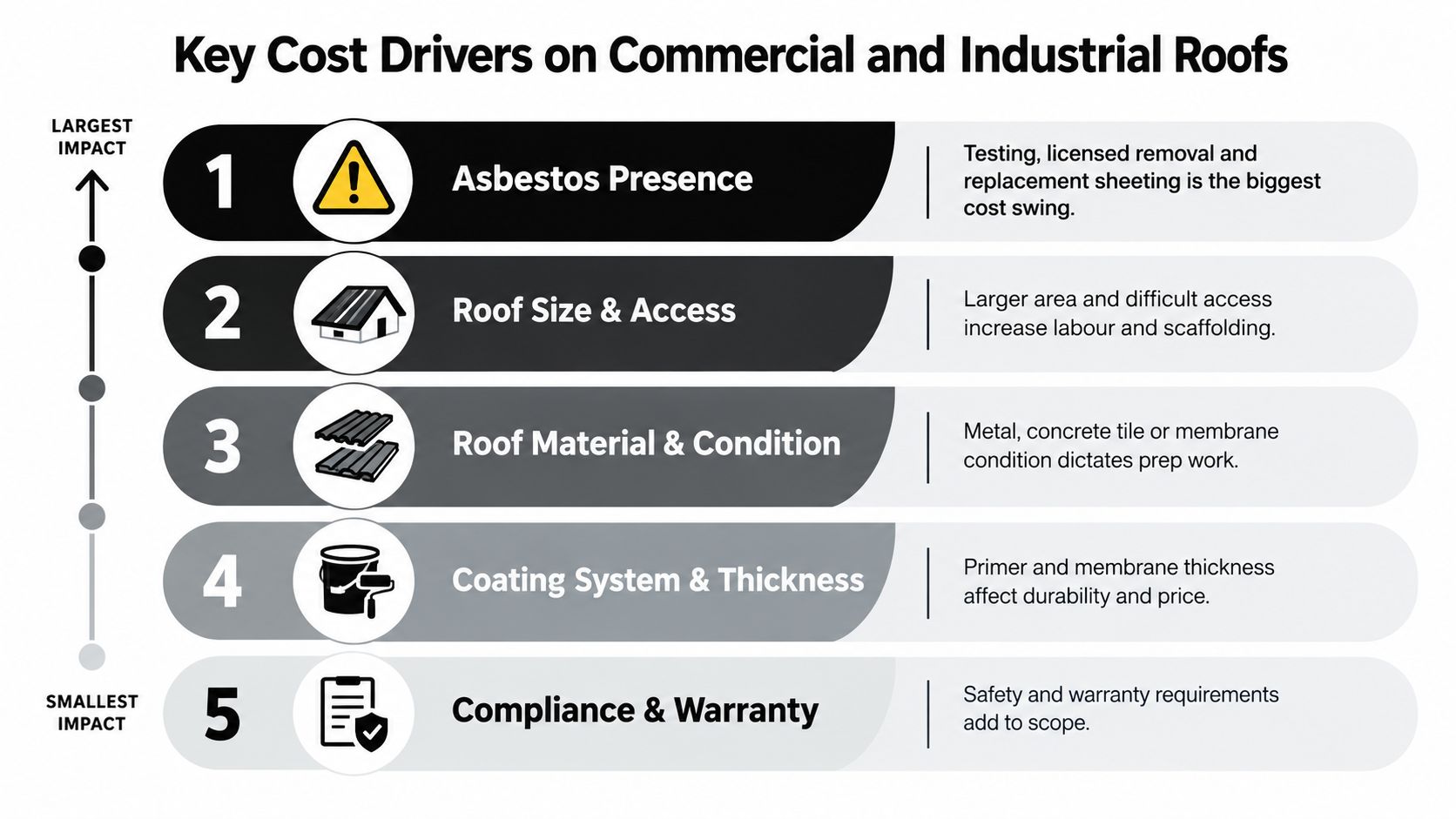
The roof area sets the scale, but the site conditions decide whether a quote stays within that scale. In NSW commercial work, asbestos, access, roof material, coating specification and substrate condition usually create the largest differences between two apparently similar projects.
Asbestos changes the job
Asbestos-cement roofing demands a different procurement and safety pathway from ordinary metal cladding or tiles. The contractor may need sampling, a licensed asbestos specialist, controlled removal or encapsulation, air monitoring, disposal documentation and replacement sheeting. Those are not coating extras. They can change the project from restoration into a regulated roof replacement or partial re-cladding programme.
Never accept a quote that says “allow for asbestos if found” without explaining who tests, who holds the licence, how the work area is controlled and how disposal is documented. The cheapest initial price often excludes the risk that matters most.
Access affects labour before work begins
A roof above active loading areas, narrow driveways or tenant operations needs a proper access plan. Height, edge protection, scaffolding, elevated work platforms, crane access, exclusion zones and traffic control all affect the programme. A broad warehouse with clear perimeter access may be relatively efficient, while a compact factory surrounded by live operations can require more planning and supervision.
Roof pitch, panel placement and accumulated surface contamination also influence cleaning methods. This guide for homeowners on roof cleaning offers useful general context on why roof geometry affects cleaning requirements, although commercial sites require a separate work-at-heights assessment.
Material and condition determine preparation
Corrugated metal, concrete tile, asbestos-cement and standing-seam systems don't take the same preparation. Metal may need rust removal, fastener replacement and corrosion-compatible primers. Tile work may involve broken tiles, ridge bedding, repointing and valley repairs. Membrane roofs require close inspection of seams, penetrations, ponding areas and adhesion.
The coating system also matters. Acrylic, polyurethane and silicone products have different preparation, compatibility and durability requirements. Ask for the specified product, primer, number of coats, dry-film thickness and curing requirements. A thin or incompatible coating can make a low tender look attractive while leaving the owner with inadequate protection.
Damage can end restoration
Once sheets have lost structural integrity, insulation is wet or membrane seams have failed across broad areas, coating becomes a cosmetic response to a system failure. The contractor should mark damaged zones on a roof plan and state clearly which defects restoration will rectify and which it will only defer.
A restoration quote is only useful when it tells you what the contractor refuses to coat over.
The final cost driver is operational. Work over live warehouses, medical facilities, strata driveways or logistics yards may require staged shutdowns, out-of-hours work, tenant notices and daily housekeeping. Those controls protect people and keep the business moving, but they belong in the price from the start.
Restore vs Replace on Commercial Roofs
Restoration wins when the roof structure and substrate remain sound. Replacement wins when the contractor would otherwise spend heavily repairing a system that still has widespread underlying failure.
Australian guidance places a sound-roof restoration at about $2,500 to $6,000, while full re-roofing for a typical 200 square metre roof is cited at roughly $18,500 to $32,000 in 2026. The same Australian coverage warns that restoration estimates can range from about $2,500 to $12,000 or more, depending on size and condition. These figures come from Australian roofing cost guidance comparing restoration and replacement.
For commercial buildings, compare the scope rather than copying residential totals. Restoration can retain the existing sheets or tiles, while replacement may include demolition, disposal, new fixings, insulation, structural upgrades, flashings and new roof drainage details. A low restoration tender may therefore omit the very work that makes replacement more expensive.
| Factor | Roof Restoration | Full Roof Replacement |
|---|---|---|
| Existing roof | Retained where structurally sound | Removed and replaced |
| Main work | Clean, repair, reseal, prime and coat | Demolish, dispose, install and commission |
| Best use | Sound substrate with localised defects | Widespread corrosion, saturated insulation or systemic failure |
| Disruption | Usually lower, with staged work possible | Usually higher because the roof is opened and rebuilt |
| Cost question | Does preparation solve the actual failure? | Does the new system remove recurring risk? |
| Asset outcome | Preserves the existing system | Resets the roof specification and remaining service life |
On a metal roof, the commercial metal roof restoration guide is useful for understanding the difference between surface restoration and deeper replacement work. It should not replace a roof condition assessment.
Finding the tipping point
There is no universal damage percentage that automatically decides the outcome. A single failed structural zone can justify replacement, while broad surface rust may still be treatable if the sheet thickness and fixings remain adequate. The decision should follow testing, roof opening where appropriate, moisture checks and a mapped defect schedule.
Insurance adds another layer. Insurers generally assess the cause, extent and policy response to a loss, not the cheapest contractor proposal. After storm or water damage, document the event, protect the building from further damage where safe, and obtain a scope that separates insured damage from deferred maintenance. Coordinate the proposed restoration or replacement with the insurer before work starts.
Ballpark Estimates for Common Commercial Scenarios
A useful estimate starts with a building that resembles yours. The following scenarios are planning examples based on the supplied commercial scope descriptions, not completed case studies or guaranteed prices.
A 250 square metre strata complex with concrete tile roofing may need ridge repointing, valley resealing, replacement of damaged tiles and a protective membrane coating. The planning range is $12,000 to $18,000. Small strata sites often carry a relatively high unit cost because access, resident communication, protection of common areas and setup work don't shrink in proportion to roof size.
A 1,200 square metre warehouse with metal cladding presents a different profile. Screw replacement, rust treatment, flashing repairs and a high-build acrylic or polyurethane membrane system can place the project around $55,000 to $85,000, subject to the condition revealed during cleaning. Clear perimeter access and an uninterrupted work zone can keep the programme efficient. Live loading docks, narrow yards and tenant movements can push it higher.
A 4,000 square metre logistics facility with asbestos-cement sheeting belongs in a separate procurement category. Licensed removal or encapsulation, air monitoring, controlled work zones, disposal and re-cladding can place the project in the $250,000 to $450,000 or more bracket. That is not a standard coating job, and the owner should expect specialist compliance documentation and a carefully staged programme.
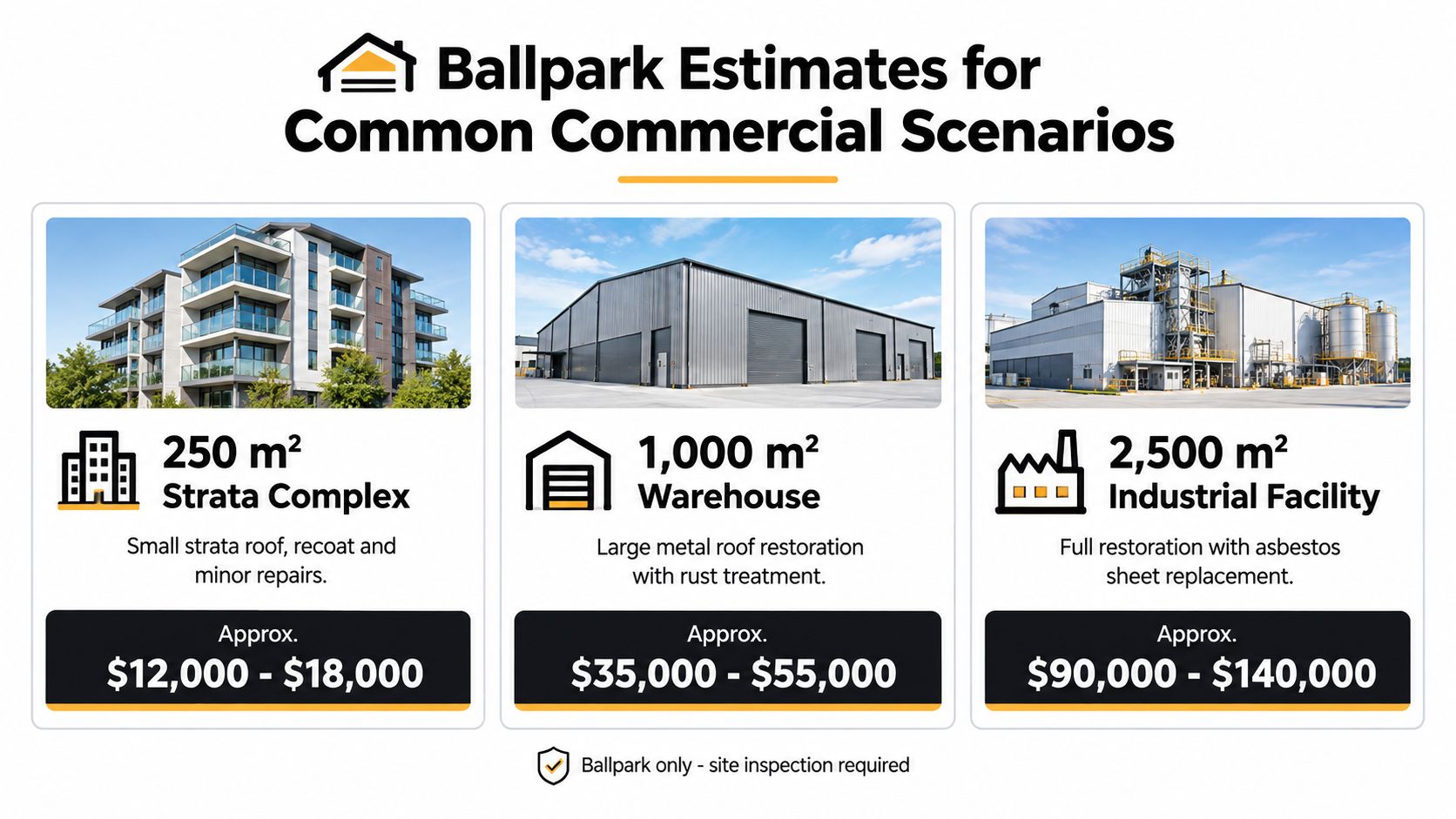
These examples show why a published average can mislead. The roof area matters, but asbestos status, height, access, substrate condition and live operations often decide the final number. A contractor should confirm the measured area, roof type, repair schedule and site controls before converting any planning figure into a tender.
Don't treat an asbestos allowance as a minor contingency. If the building's records are unclear, testing and a documented management approach should happen before the owner compares restoration quotes.
Budgeting Procurement Quotes and Warranties
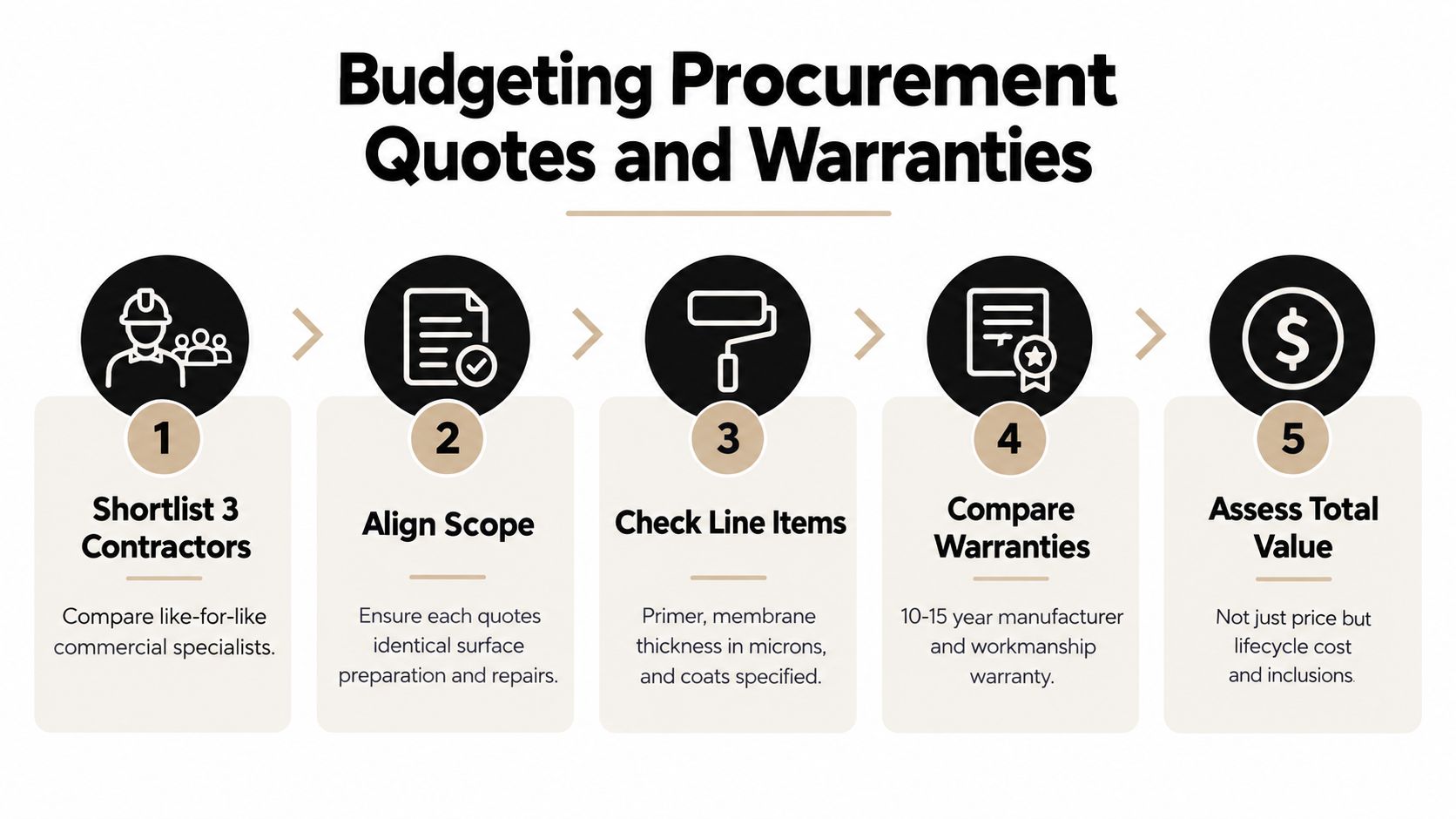
Commercial buyers should issue a defined scope to at least three contractors and require each tenderer to price the same work. Comparing three different scopes creates the illusion of competition while hiding exclusions.
Require line items for:
- Preparation: Cleaning method, rust treatment, removal of loose coating and disposal of waste.
- Repairs: Tile or sheet replacement, fasteners, flashings, penetrations and gutter interfaces.
- Coating specification: Product name, primer, number of coats and membrane thickness in microns.
- Asbestos provisions: Testing, licensed removal or encapsulation, air monitoring and disposal responsibilities.
- Access and safety: Scaffolding, edge protection, raised platforms, exclusion zones and traffic management.
- Handover: Roof plan, photographs, product data sheets, completion records and warranty documents.
A lower price isn't automatically cheaper. It may exclude flashings, specify less preparation, use a thinner coating or transfer latent-damage risk to the owner through provisional sums. Ask each contractor to identify assumptions in writing, then compare inclusions line by line.
Budget a contingency for concealed damage discovered after cleaning exposes the substrate. The exact allowance should reflect the inspection quality and roof age, rather than applying an arbitrary percentage to every project.
Warranty language matters
Separate the product warranty from the workmanship warranty. The manufacturer may stand behind the coating product, while the contractor remains responsible for preparation, application and rectification of installation defects. Ask what voids the warranty, who inspects the roof, how ponding or movement is treated and whether maintenance is required.
Commercial Roofers offers inspections, restoration, cleaning and painting, asbestos roof removal and replacement, and industrial roofing services across Greater Sydney. It's one contractor option for owners who want the inspection findings, scope, safety controls and warranty position coordinated in a single proposal.
Insurers, landlords and strata committees may also require a certificate of currency, evidence of working-at-heights compliance, licensed asbestos documentation where relevant and a tenant communication plan. Put those requirements into the tender before contractors price the job.
Making the Right Call for Your Building
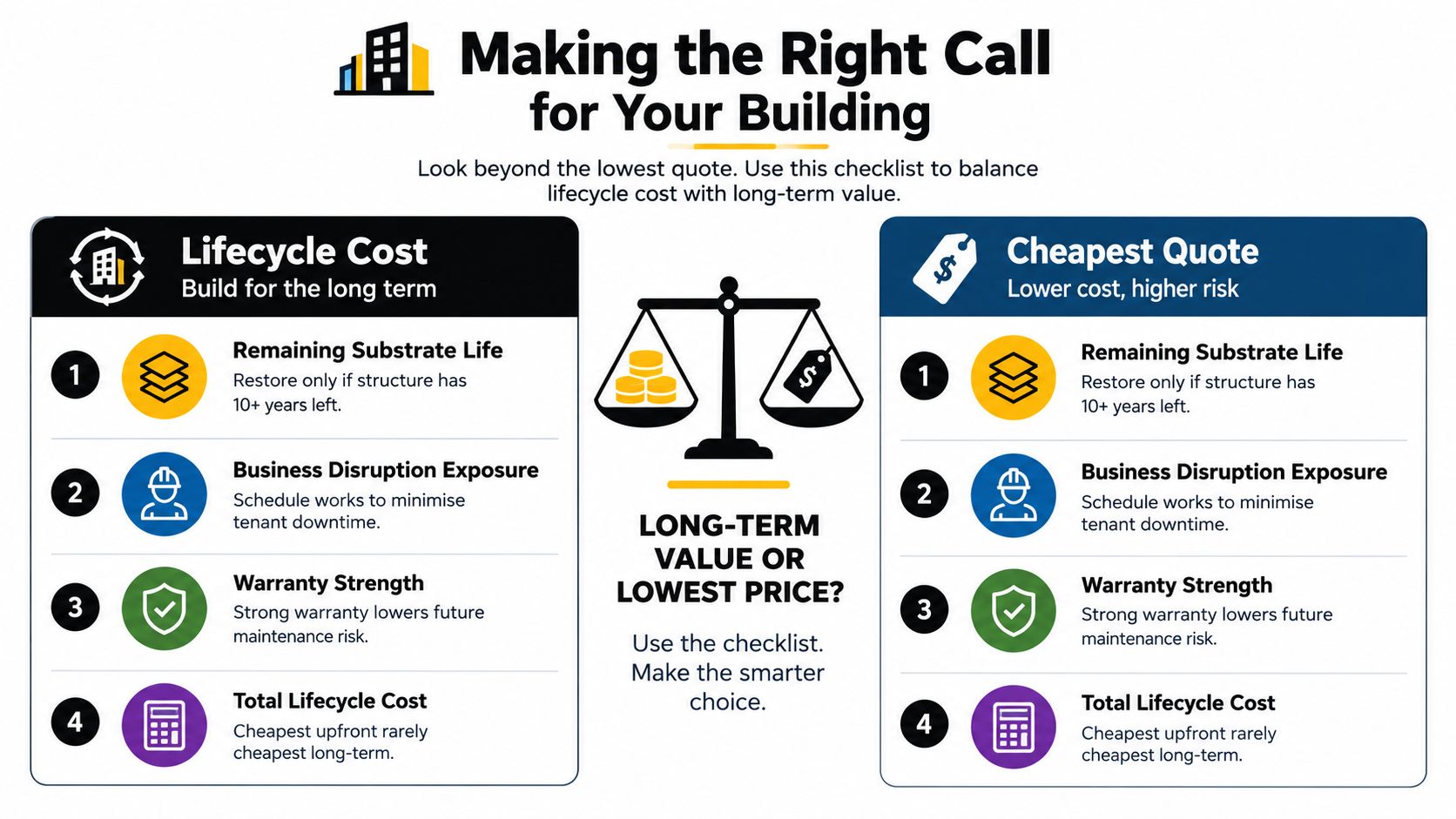
The cheapest commercial restoration quote rarely represents the lowest lifecycle cost. A proper decision weighs substrate condition, disruption exposure, access planning, warranty strength, insurance requirements and the work needed to keep tenants or operations moving.
Score every proposal against the same questions:
- Substrate: Is the existing roof suitable for restoration?
- Scope: Are preparation, repairs, flashings and penetrations included?
- Access: Does the programme protect workers, tenants, vehicles and stock?
- Warranty: Is the obligation shared clearly between manufacturer and contractor?
- Lifecycle: What maintenance and inspection requirements follow completion?
A proposal with a stronger coating specification, complete rectification allowance and credible warranty may cost more at tender stage but carry less operational risk. A low figure that leaves failed fixings, wet insulation or corroded sheets unresolved is not a saving. It's deferred expenditure with a leak attached.
Treat the roof as an operating asset, not a one-off maintenance invoice. Demand a measured scope, condition evidence and a written explanation of why restoration is more suitable than replacement.
Commercial Roofers provides roof inspections, detailed reporting, restoration, asbestos removal, industrial roof replacement and guttering solutions for warehouses, factories, logistics facilities and strata properties across NSW. Visit Commercial Roofers to request a site assessment and a transparent scope that shows the restoration cost, exclusions and replacement trade-offs before you commit.