
You're already in the hardest part of the job. The roof is leaking, the strata committee wants answers, the warehouse tenant is pressing for a fix, and every contractor's website says the same thing, fast, reliable, experienced. That's exactly where mistakes get expensive, because a commercial roof isn't a place to buy on charm or the lowest quote. It's a place to demand proof.
Table of Contents
- The Commercial Roofing Contractor Search Challenge
- What Green Frog Roofing Offers in the Sydney Market
- Core Capabilities for Commercial and Industrial Roofing Projects
- How to Vet a Commercial Roofing Contractor in Greater Sydney
- Green Roof Systems and Cool Roof Strategies for Sydney Commercial Buildings
- Why In-House Crews and Transparent Warranties Matter for Commercial Projects
- Your Next Steps for Choosing the Right Commercial Roofing Partner
The Commercial Roofing Contractor Search Challenge
A facility manager searches for a roofer after a storm, clicks through a few results, and lands on pages full of suburbs, phone numbers, and broad promises. That's not enough for a warehouse, factory, or strata complex in Greater Sydney. You need to know who can manage access, safety, scheduling, warranty exposure, and the risk of interrupting operations.
That gap is common in this market. Many roofing pages are built to attract enquiries, not to help a buyer compare commercial capability. If you're responsible for a roof that protects stock, tenants, plant, or common property, generic marketing copy tells you almost nothing about whether the contractor can handle compliance, scope control, or trade coordination.
Practical rule: if a contractor can't show you how they manage risk before the job starts, don't assume they'll manage it well once the work begins.
The right starting point is not “Who has the slickest site?” It's “Who can prove they've done this kind of work under similar constraints?” That means asking for documentation, not just a quote. It also means treating a contractor search like a procurement decision, not a quick booking.
For a useful way to think about local search behaviour, the phrase commercial roofer near me is often the entry point, but the essential work begins after that click. Use it to find a shortlist, then test the shortlist against evidence. A good first-pass resource is this commercial roofer near me guide, which reflects the way buyers usually narrow options before they ever speak to a tradesperson.
The pattern is simple. Residential roofers sell speed and convenience. Commercial roofing buyers need technical fit, accountability, and a contractor who understands that a failed roof can trigger insurance disputes, tenant complaints, and avoidable downtime. If your current search only gives you a phone number, you're still at the brochure stage, not the decision stage.
What Green Frog Roofing Offers in the Sydney Market
Green Frog Roofing's public-facing presence is easy to find, but it's light on the details commercial buyers need. The visible material leans toward general roofing, home-oriented content, and broad service references rather than a deep commercial capability dossier. That doesn't make the business unsuitable, it just means you can't assume commercial readiness from branding alone.
The company's site shows location and general roofing services, but it doesn't give you enough evidence to judge how it handles commercial risk, access planning, or regulated work. For strata managers and warehouse owners, that's the difference between a vendor and a serious project partner. A contractor can have a clean website and still be weak on documentation, supervision, or warranty clarity.
What you can verify and what you can't
The public material is useful for one thing, confirming that the contractor exists and presents itself as a roofing business in the Sydney market. It is not enough for assessing whether the team is ready for a commercial roof with tenants, plant room interfaces, or asbestos exposure risk. That distinction matters more than a polished layout.
What's missing matters more than what's visible. You want direct answers on:
- Licensing and compliance scope, especially for commercial work.
- Insurance coverage, including public liability and any project-specific requirements.
- Worksite control, such as how crews manage occupants, deliveries, and exclusion zones.
- Warranty terms, including what is covered, for how long, and whether labour is included.
- Asbestos handling capability, if the building is older or the existing roof system is suspect.
A contractor who can't produce those documents quickly is asking you to trust the brand, not the process. That's the wrong way round for commercial property.
Questions that expose the real capability
Ask straight questions and don't soften them. Who will supervise the site? Are the crews in-house or subcontracted? Can they show evidence of similar commercial jobs? If the answer turns vague, you already have your signal.
The right approach is to use public information as a starting filter, then move immediately to direct verification. Commercial work is too exposed to rely on assumptions, and a contractor's website rarely tells you whether they're built for complex sites or just basic roof replacements. If you're comparing providers, treat Green Frog Roofing the same way you'd treat any other contender, by testing the paperwork, not the promise.
Core Capabilities for Commercial and Industrial Roofing Projects
Commercial roofing is not residential roofing with bigger sheets. The job changes the moment a roof has multiple occupants, higher access risk, plant interfaces, or older materials that may be contaminated. That's why the contractor's service list matters less than the systems behind it.
A serious commercial roofer should be able to show competence in asbestos roof removal and replacement to Australian standards, industrial metal roofing, detailed restoration work, and reporting that gives owners a defensible record. If they also handle architectural cladding, standing seam profiles, and modern box gutter systems, that tells you they've moved beyond patch-and-fix work.
Capability compared with evidence
| Capability | Evidence Required | Risk if Missing |
|---|---|---|
| Asbestos roof removal and replacement | Licence details, disposal process, safety documentation | Health exposure, project shutdown, liability |
| Industrial metal roofing | Similar warehouse or factory examples, crew supervision model | Poor detailing, leaks, premature failure |
| Waterproofing and roof restoration | Scope sheets, product specs, inspection reports | Hidden defects, repeat repairs, warranty disputes |
| Architectural cladding systems | Manufacturer familiarity, installation references | Incompatible fixings, finish failure, appearance issues |
| Detailed inspections and reporting | Pre-work photos, condition reports, follow-up records | No baseline, weak accountability, harder claims handling |
Use that table as a filter, not a wish list. A contractor doesn't need to offer every specialty on every job, but they do need to explain where their competence begins and ends.
What competence looks like on site
A competent commercial roofing team knows how to sequence work so it doesn't interrupt business operations. They protect access routes, manage waste, and keep the site readable for the owner or strata manager. They also understand that roofing choices affect not just the membrane or cladding, but the whole building envelope.
A good commercial roofer leaves behind fewer questions than they found.
The practical difference shows up in the details. Do they use documented inspections before quoting? Do they separate materials and labour in the warranty paperwork? Can they explain how a roof repair will affect drainage, penetrations, and future maintenance access? Those are the questions that expose whether a contractor is commercial-grade or just broadening their residential pitch.
How to Vet a Commercial Roofing Contractor in Greater Sydney
Start with documents, not sales talk. Ask for current insurance certificates, proof of compliance for the work being proposed, and written confirmation of who will supervise the job. If the building might contain asbestos, ask about the licence and the removal pathway before the site visit is even booked.
The fastest way to filter out weak operators is to force specificity. A contractor who works on commercial sites should be comfortable discussing scope, exclusions, site access, and change control in plain language. If they dodge those topics, they're not ready for a building where tenants, owners, or insurers will later want a clear paper trail.
The vetting sequence that actually works
- Check credentials. Verify licensing, insurance, and whether the business can legally do the work you need.
- Review experience. Ask for examples that match your building type, not just generic roofing jobs.
- Ask for references. Speak to past clients who had similar constraints, especially live sites.
- Inspect past work. Photos help, but a completed project visit tells you far more.
- Compare written quotes. Make sure scope, exclusions, and assumptions are explicit.
- Confirm safety planning. Ask how the contractor manages exclusion zones, fall risk, and tenant or staff access.
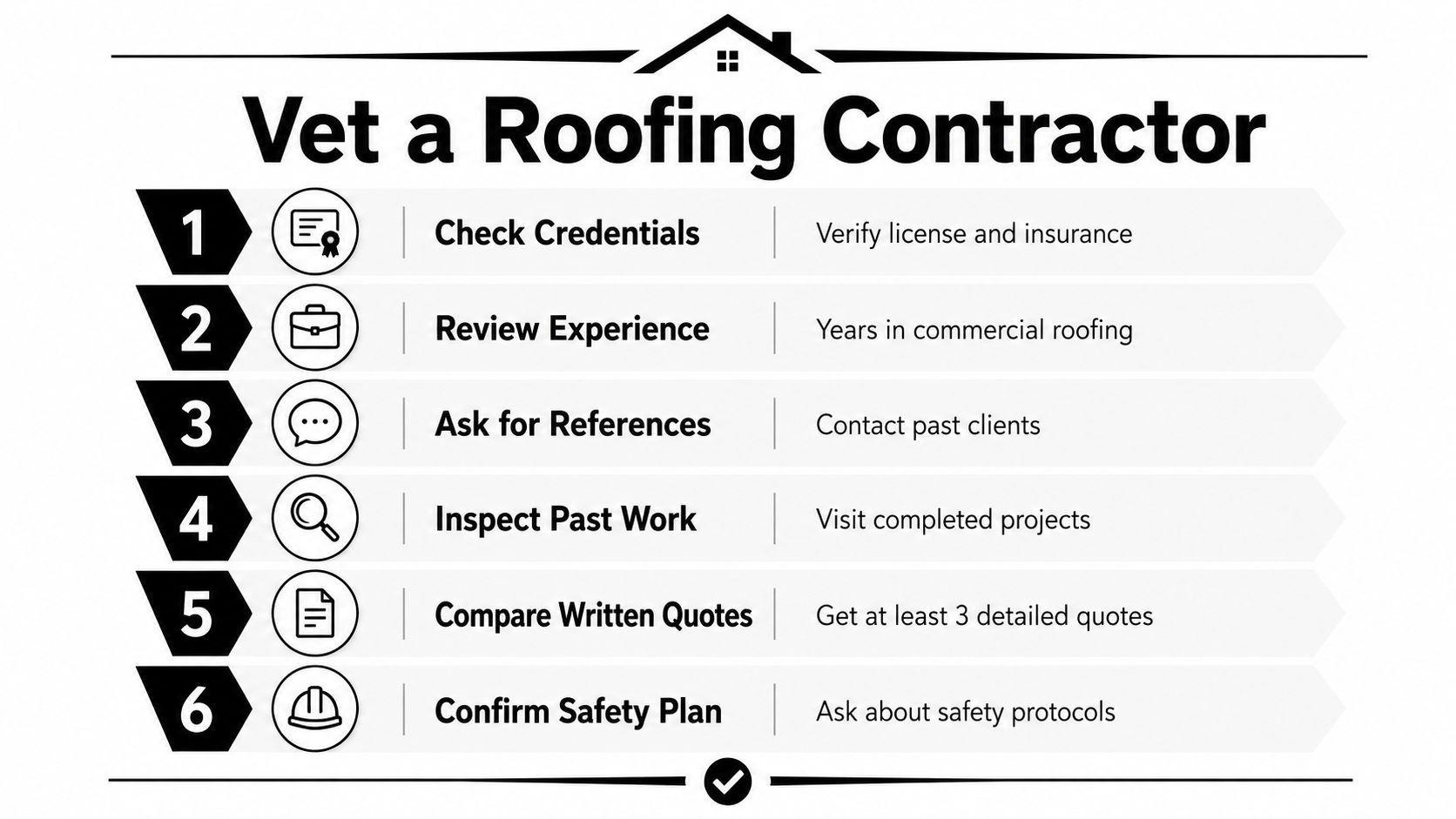
The important detail is not the list itself, it's the discipline. Each step removes a different type of risk. Licensing protects you from regulatory failure. References reduce the chance of hiring a contractor who can't handle your building type. Safety planning protects the people who still need to use the site while the work is happening.
If you want a deeper baseline on Australian roofing expectations, the roofing standards Australia guide is a useful companion read. Use it to sharpen your questions before you compare quotes.
The warning signs are usually obvious. Vague scopes, resistance to putting warranties in writing, and a reluctance to identify who is doing the work all point in the same direction. Don't rationalise those signs away because the quote is attractive.
Green Roof Systems and Cool Roof Strategies for Sydney Commercial Buildings
A Sydney warehouse owner can like the sustainability story and still make the wrong roof decision. Start with the building, not the brochure. A green roof only works if the structure can carry the load, the drainage is designed properly, and the system can be maintained without creating new access and safety problems. A cool roof only works if the coating suits the substrate and the surface condition is right for long-term adhesion.
For vegetated roof systems, the substrate specification is where many jobs go off track. The DC green roof guidance recommends roughly 70 to 80% inorganic aggregate and no more than 30% organic matter, with maximum water retention around 30% DC green roof guidance. That mix is not just a technical preference. Too much organic content can increase nutrient leaching and clog the filter layer, while lighter mixes help keep dead load down on the structure.
What a proper system needs
The broader technical guidance also points to substrate bulk density targets of about 1.0 to 1.5 kg/L for extensive systems and 1.2 to 2.0 kg/L for intensive systems GRO green roof code. On the waterproofing side, Factory Mutual guidance calls for minimum roof slopes of 2% on concrete decks and 3% on other systems such as metal decks. If you ignore slope or load, expect ponding, membrane stress, and drainage problems that will show up in maintenance calls and insurance questions.
The performance case is real, but only if the roof can support it. The U.S. EPA notes that green roofs can reduce roof-surface temperature by up to 56°F and nearby air temperature by up to 20°F U.S. EPA via industry survey reference. They can also retain substantial rainfall in summer, which helps reduce runoff pressure on sewer systems Architizer green roof overview.
The common mistake owners make
Many owners assume green roofs only suit flat roofs. That assumption is wrong. Technical guidance shows systems can be engineered for slopes up to 45° Architizer green roof overview. That gives you more options on pitched buildings, but it also raises the standard for detailing, anchorage, and access planning. If the contractor cannot explain how those issues are controlled, the project is too risky for a commercial site.
Reflective coatings deserve the same practical scrutiny. A reflective roof coating guide is a useful check when you are comparing heat-reduction options for an existing roof. In many Sydney commercial settings, the cleaner decision is the one that fits the structure, the maintenance budget, and the site's tolerance for ongoing access. Vegetable cover is not a substitute for engineering, and a white coating is not a cure-all either.
Why In-House Crews and Transparent Warranties Matter for Commercial Projects
Subcontracting isn't automatically bad, but it increases the number of handovers, and handovers are where accountability gets blurry. If a site has a leak six months later, you want one team responsible for the workmanship, the documentation, and the fix. In-house crews make that cleaner.
That matters even more on commercial roofs because the building owner is usually juggling tenants, insurers, maintenance budgets, and safety obligations. Direct employment usually means more consistent training, clearer supervision, and a stronger safety culture. It also gives you a better sense of who is accountable when something goes wrong.
Commercial rule: if the warranty sounds broad but the exclusions are buried, treat it as weak protection.
Transparent warranties are essential. You need to know whether the warranty covers materials, labour, or both, and how the contractor handles remediation if a problem appears after completion. If they're evasive, you're not looking at confidence, you're looking at ambiguity.
Older buildings add another layer of risk. If asbestos is present, the contractor's handling process matters as much as the replacement system itself. One mistake there can turn a roofing job into a health and liability problem that no strata committee wants on its minutes.
Choose the contractor who can explain the chain of responsibility without hesitation. If they control the crews, document the work, and stand behind the warranty in writing, you reduce the chance of finger-pointing later. That is worth more than shaving a little off the headline price.
Your Next Steps for Choosing the Right Commercial Roofing Partner
Shortlist contractors who can answer technical questions without drifting back into marketing language. Then ask for the paperwork that proves they can deliver on a live commercial site. If they hesitate, move on.
What to request before you sign
- Current insurance certificates, including public liability.
- Written warranty terms, with materials and labour clearly separated.
- A defined scope of works, including exclusions and assumptions.
- A site safety plan, especially if tenants, staff, or stock will stay on site.
- Evidence of similar projects, preferably commercial and industrial.
- Inspection reporting, so you have a baseline before work starts.
Don't compare quotes on price alone. Compare how clearly each contractor describes the work, how realistic the timeline sounds, and how they handle variations. A cheap quote with vague exclusions is rarely cheap once the extras start landing.
If you manage strata or a warehouse, insist on a pre-project inspection and a written condition report. That gives you a reference point if a dispute arises later, and it helps both sides understand what was already there before the trades arrived. It's basic risk control, and too many owners skip it.
The best decision is the one that survives scrutiny after the job is complete. Ask direct questions, demand written answers, and choose the contractor who makes the job easier to govern, not harder. If you're ready to compare commercial roofing capability properly, start with a team that can show safe, compliant, in-house delivery and then visit Commercial Roofers to assess how a Sydney-based commercial specialist frames the work before you invite anyone onto your roof.