

Queensland's household solar panel recovery pilot found 600,000 to 800,000 solar panels are being decommissioned from homes in the state each year Queensland Household Solar Panel Recovery Pilot Final Report 2025. That volume changes the conversation for commercial property owners in NSW. Solar panel removal is no longer an occasional nuisance, it's a recurring roof, electrical, storage, and compliance job that has to be planned like any other major building work.
For strata committees, facility managers, builders, and owners of warehouses or industrial sites, the hard part isn't just lifting panels off the roof. The true cost sits in coordination, temporary power isolation, roof access, asbestos checks, reinstallation sequencing, and getting every stakeholder to sign off before the first panel comes down.
Table of Contents
- Why Solar Panel Removal Is Now a Major Commercial Concern
- Common Triggers for Commercial Solar Panel Removal
- The Removal and Reinstallation Workflow on Commercial Sites
- Safety, Compliance, and Permit Considerations
- Cost Ranges and Project Timelines for Commercial Removal
- Disposal, Recycling, and Trade Coordination
- Contractor Selection Checklist and Key Questions
Why Solar Panel Removal Is Now a Major Commercial Concern
Australia is moving into a high-volume solar panel removal phase, not because solar has failed, but because roofs age, storms hit, systems get upgraded, and buildings get repurposed. Queensland's pilot is the clearest local proof point, and it also says the current forecasting models are underestimating removals Queensland Household Solar Panel Recovery Pilot Final Report 2025. That matters in NSW commercial work because the same triggers show up on strata roofs, industrial sheds, retail centres, and mixed-use assets.
The scale is no longer small enough to treat casually
Once a building carries a roof-mounted array, panel removal becomes part of normal asset management. On commercial roofs, that can be triggered by reroofing, storm remediation, mount failure, or a tenant change that affects the site's electrical layout. The Queensland pilot makes the broader point clear, household systems alone are already creating a large recurring logistics stream, and commercial and industrial systems add more pressure on top of that Queensland Household Solar Panel Recovery Pilot Final Report 2025.
That is why the work can't be handed off as a simple roofing add-on. A roofer might control access and roof sequencing, but the panels are still part of an electrical system, and the removal path has to account for de-energising, storage, labelling, reinstatement, and the risk of a delay between detach and reset.
Practical rule: if a roof project affects the array, treat the panels as a separate workstream with their own staging, sign-off, and reactivation requirements.
Commercial roofs add more moving parts than homes
The same task that looks straightforward on a small house becomes more complicated across a strata block or warehouse. Roof access may be limited, tenants may be active, and the array may sit over a production area or shared plant room. In that setting, the challenge is not the panel count alone, it's the sequencing between roofing, electrical, safety, and building management.
A good way to think about it is this. Residential removal is often a repair decision. Commercial removal is a coordination decision. That difference is why managers who plan only for the physical lift often get caught by delays in compliance, access, or temporary storage.
Common Triggers for Commercial Solar Panel Removal
The trigger tells you how broad the job will be. If the problem sits in the roof, the array usually has to come off, either fully or in stages. If the problem sits in the system, the scope may be limited to a targeted detach and reinstall. If the problem sits in ownership or tenancy, the first dispute is often about responsibility and access, not roofing.
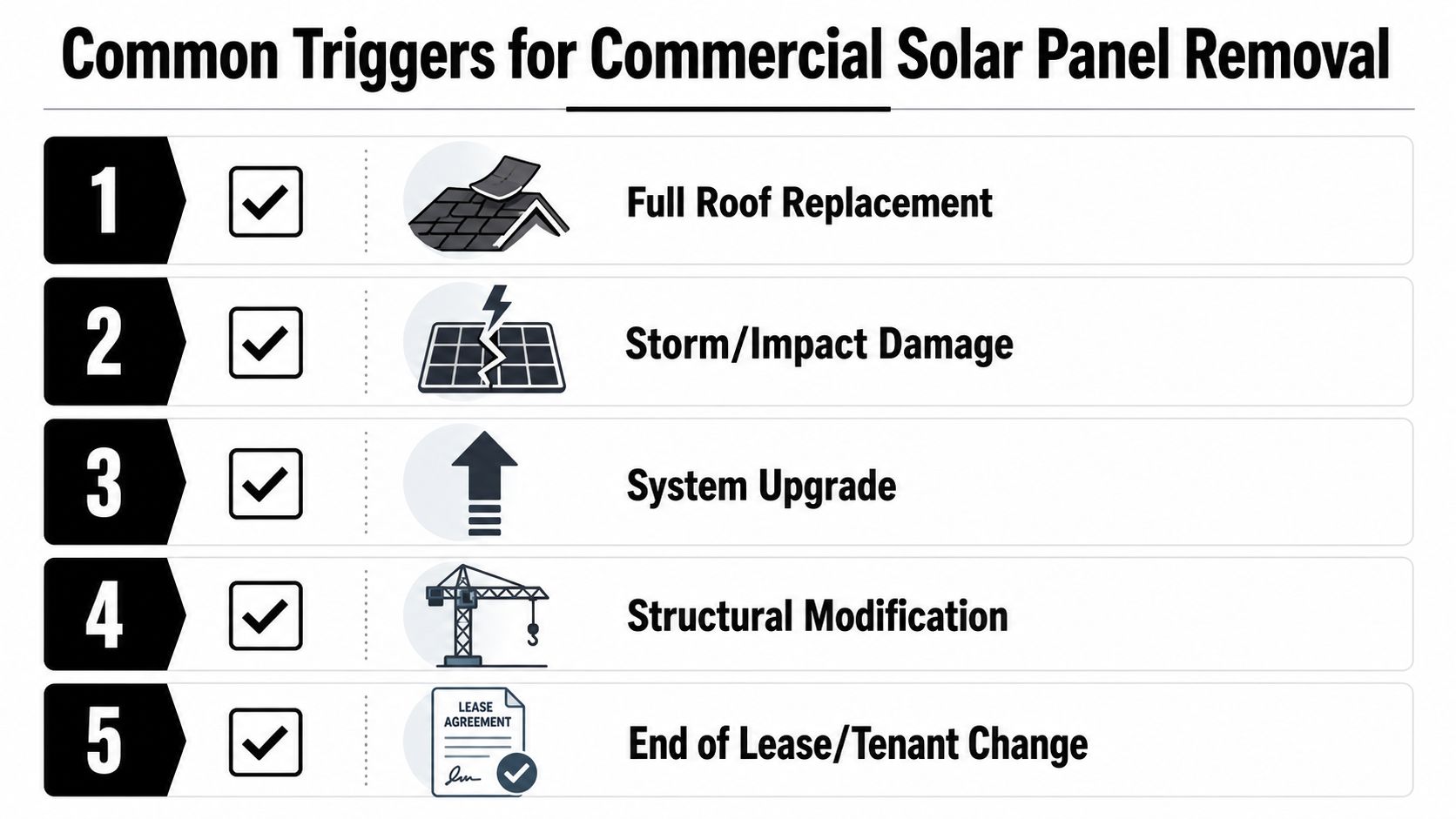
Five situations that usually force action
Full roof replacement. The roof membrane, sheeting, or insulation has reached the point where the panels can't stay in place. The array comes off, the roof is repaired or replaced, then the panels go back or are decommissioned if the owner chooses to stop using them.
Storm or impact damage. A weather event can crack panels, shift mounts, or damage flashings. On NSW sites, this often turns into a fast assessment of what can stay, what must be isolated, and what has to be stored until the roof is safe again.
System upgrade. New panels or inverter changes can require access under the old array. Sometimes it's a partial detach, sometimes it's a full reset if the mounting layout is being changed.
Structural modification. Add a plant platform, skylight, service penetration, or new rooftop equipment, and the solar layout may need to be reworked around the new structure.
Lease or strata change. Ownership, tenancy, or common property arrangements shift, and the original assumptions about who controls the array no longer hold.
The hidden cost is usually coordination. A strata committee may need approvals from owners, a landlord may need to deal with a tenant, and the electrician, roofer, and site manager all need the same shutdown window. On commercial roofs, that paperwork and sequencing can take longer than the physical lift.
Temporary removal or permanent decommissioning
Not every project ends with the panels going back on. If the array is old, damaged, or poorly matched to the upgraded roof, permanent decommissioning can make more sense than reinstalling weak hardware. If the panels are in good condition and the roof works are short, temporary removal is usually the cleaner option.
A quick self-check helps:
- Roof scope first: if the roofing contractor cannot complete their work safely around the array, removal is usually unavoidable.
- Electrical isolation needed: if wiring, inverter access, or mounting work sits underneath the array, plan for detach and reset.
- Storage risk: if panels must sit offsite for a period, they need a secure, dry staging plan.
- Ownership clarity: if the site has strata or leased areas, confirm who approves removal and who pays before work starts.
For leak-related roof work, the roof problem drives the array decision. A useful reference point is our guide on roof leak detection, because early detection makes it easier to coordinate the panels around the repair rather than working around a spreading failure.
The Removal and Reinstallation Workflow on Commercial Sites
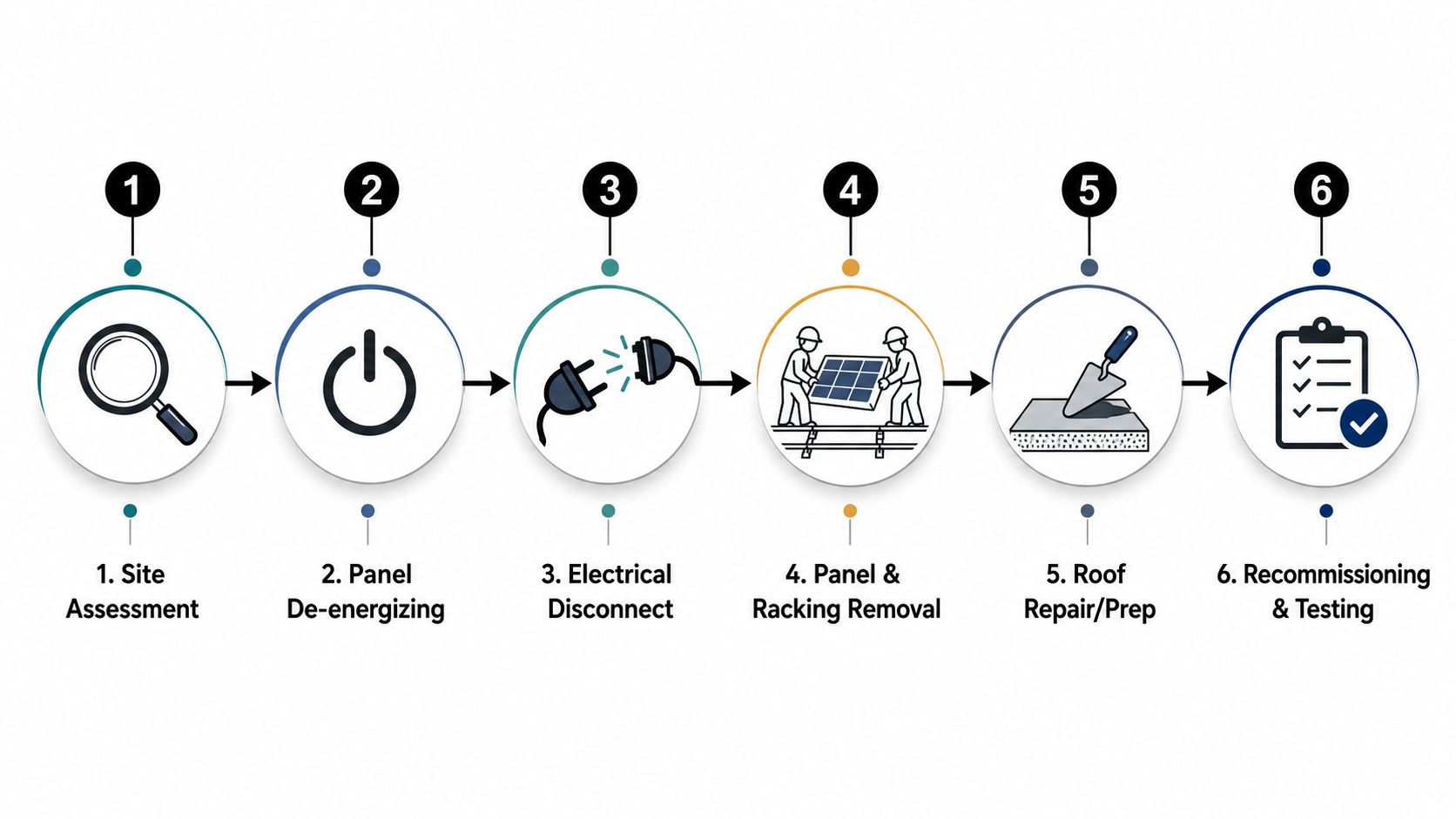
On a live commercial site, the sequence matters more than any single task. A clean project usually starts with a joint site walk, because the roofer, electrician, and building manager all see different risks. The roofer notices access, flashings, and roof integrity. The electrician looks at isolation, cabling, and recommissioning. The building manager tracks tenants, shutdown windows, and what has to keep operating.
What happens before the first panel is touched
The first pass is documentation. The array layout, mounting type, inverter location, cable routes, and roof penetrations should all be recorded before dismantling begins. That record becomes the map for putting everything back correctly, especially when multiple trades are working at once.
From there, the system must be shut down and isolated before panels are disconnected. Safe handling also calls for insulated tools rated to at least 1,000V DC, arc-flash PPE, and avoidance of wet conditions because live DC conductors can retain hazardous voltage even after shutdown Photovoltaic panel removal guidance. On commercial roofs, that isolation step should be treated as a controlled handoff, not a casual disconnect.
How the roof and electrical trades should hand off
The roofer's scope usually begins with protection, access, and panel lift-off. Once the array is disconnected and labelled, the roofing team can work on the roof substrate, flashings, sheeting, or membrane. If racking is being retained, it needs to be protected and stored in a way that keeps each component traceable.
The easiest project to manage is the one where every panel, rail, clamp, and fastener has a known place before dismantling starts.
After roofing is complete, the electrical team reconnects the system, checks the wiring path, and recommissions the array. A rushed job often falls apart here. If the labels are vague, the storage is messy, or the roof repairs changed the mounting geometry, reinstallation takes longer and the risk of rework rises.
A good example of sequencing discipline is the way rooftop access and anchor planning should be considered together. Our guide on safety roof anchors sits in the same practical space, because the crew, the access system, and the temporary work platform all have to fit the roof program.
Storage and testing close the loop
Panels should not just be stacked and forgotten. They need dry, secure storage with traceable grouping so the reinstallation crew knows what goes where. Once the system is back up, diagnostic testing should confirm the array is behaving as expected before the site hands back to occupants.
That final test is the difference between a completed job and an unresolved one. On commercial sites, unresolved electrical issues can disrupt tenants, delay occupancy certificates, or leave the owner with a fresh round of callbacks.
Safety, Compliance, and Permit Considerations
A commercial solar panel removal job usually fails at the coordination stage, not the physical lift. The roof crew, the electrical contractor, the insurer, the strata manager, and sometimes the asbestos consultant all need the same sequence and the same paperwork. If one part is missing, the site can sit idle while everyone waits for clearance.
Electrical work has to be treated as electrical work
A DC solar array is a live electrical system until it is isolated and made safe. Panels should be de-energised before any disconnection starts, and the removal sequence needs qualified people who understand PV hazards, isolation points, and the risk created by damaged cabling or exposed connectors. The removal guidance provided for photovoltaic panels also points to insulated tools, arc-flash PPE, and dry conditions as part of safe work on a live roof environment Photovoltaic panel removal guidance.
Commercial roofs raise the stakes because access is tighter, the equipment is bulkier, and the work area often sits above tenants or occupied spaces. If a contractor cannot explain how isolation, lockout, and re-energisation will be controlled, that is a practical warning sign. You should expect a clear method statement, named electrical responsibility, and a shutdown plan that fits the building's operating hours.
Asbestos changes the job completely
Older Australian roofs can bring asbestos into the job, and once that is identified the removal scope changes fast. Roof replacement, penetrations, degraded sheeting, and disposal all need tighter control, because a simple panel lift can turn into a regulated building and waste-handling exercise.
That is where the roofing standard and compliance side needs to line up with the solar plan. The material in roofing standards Australia is relevant here because roof works, certification, and penetrations often determine whether the solar crew can remove and return equipment without triggering rework.
A proper pre-work check should include:
- Electrical licensing verification: confirm the people disconnecting and reconnecting the array are licensed for the task.
- Asbestos register review: check whether the roof, penetrations, or adjacent materials are listed.
- Safe work method statements: make sure the contractor has documented the sequence and hazards.
- Permit and access review: confirm site rules, shutdown windows, and any building notifications.
- Insurer notification: tell the insurer early if the removal is linked to damage, replacement, or a claim.
Compliance gaps create delay, not just risk
Generic advice usually stops at “use a professional.” That leaves out the parts that stall commercial jobs. If the panel removal starts before permits are clear, or the asbestos status is still unconfirmed, the building can be left half-stripped while the paperwork catches up. If the electrical work is not documented properly, the site can also be harder to recommission cleanly, and the owner ends up paying for repeat attendance.
The trade-off is simple. Fast mobilisation helps only if the approvals, isolation plan, and roof scope are already aligned. On strata and leased sites, the main cost often sits in coordination, notifications, and stop-start delays, not in the physical removal itself.
Practical rule: if a contractor treats the solar array, roof substrate, and compliance paperwork as separate jobs, the owner ends up carrying the coordination burden.
Cost Ranges and Project Timelines for Commercial Removal
The clearest cost signal in the available material is that labour usually dominates when the hardware can be reused. Industry guidance clusters around about A$275 per panel for remove-and-reinstall work, and whole-system budgets often land around A$8,000 to A$11,000 for average homes Solar removal pricing guidance. For commercial planning, the important point is not to copy those figures blindly, but to understand the cost drivers behind them, panel count, roof complexity, travel time, staging, and whether any mounts or flashings need replacement.
Typical planning ranges by project scale
| Project Scale | Panel Count | Estimated Cost Range (A$) | Typical Timeline |
|---|---|---|---|
| Small commercial array | Lower count, site-specific | Often based on labour, access, and reinstallation scope | Short, if roof access and shutdown windows are simple |
| Medium commercial array | Moderate count, multiple trades | Higher than small sites due to staging and sequencing | Longer, because the roof and electrical teams need tighter coordination |
| Large commercial array | Higher count, complex roof layout | Strongly driven by labour, access, and recommissioning time | Longest, especially where roof replacement or asbestos controls apply |
That table is a planning tool, not a quote. A clean proposal should split removal, storage, roof works, electrical reconnect, and testing so the committee can see where money is going.
Who pays depends on the project structure
The question owners ask first is often not how much, but who carries the cost. On commercial sites, that can sit with the building owner, tenant, insurer, or body corporate depending on the trigger, the lease, the strata by-laws, and the insurance position. That's one of the biggest gaps in generic content, because the answer changes with contract wording and site governance.
If the roof needs work and the solar was installed as part of a broader tenancy or strata arrangement, the cost conversation should start with documents, not assumptions.
Timelines are just as sensitive. The project can move quickly when the roof scope is simple and the array is easy to access. It can also stretch when the work needs permits, insurer approval, asbestos review, or tenant shutdowns. The safest approach is to schedule removal only once the reinstallation window is locked in, because split timing usually creates double handling and extra site disruption.
Disposal, Recycling, and Trade Coordination
Once panels are off the roof, the job is only half done. The owner still has to decide whether the panels are going to be reused, recycled, stored, or discarded, and those choices affect both cost and compliance. In Australia, end-of-life panels are treated as solid waste once discarded, and they can also become hazardous waste if testing shows hazardous characteristics End-of-life solar panel regulations and management.
Post-removal handling needs a paper trail
On a commercial site, good coordination means the panels, racking, and inverter-related components are tracked from roof to storage to final disposition. That trail helps with waste compliance, insurance records, and any later dispute about whether the array was damaged during the project or already compromised.
Recycling should be planned before dismantling begins, not after the panels are stacked in a corner of the yard. If a recycler is lined up early, the roofing contractor can sequence lift times around collection windows and avoid double handling. If the site needs temporary storage, the staging area should be dry, secure, and clearly separated from roof debris and other trade materials.
Trade coordination is the hidden cost
The most efficient projects are the ones where the roofing crew, electrical contractor, and waste handler all work from the same sequence. The roofer needs the array off at the right time. The electrician needs clear access for disconnect and recommissioning. The recycler needs the panels released in a condition that matches the agreed handling plan.
For that reason, handover documentation should be simple and complete. Keep the panel count, storage location, removal date, and any visible damage notes together. If the site has a strata manager or facility team, they should receive that record before the roof is handed back.
The practical lesson is straightforward. Disposal is not an afterthought, it's part of the project logistics. If it's left to the end, it usually becomes the slowest and least controlled part of the job.
Contractor Selection Checklist and Key Questions
Price per panel can be misleading on its own. A contractor who is cheap on the front end can become expensive fast if they miss electrical sequencing, mishandle labels, or leave the roof team guessing about what goes back where. For commercial solar panel removal, the right question is whether the contractor can manage the whole detach-and-reset chain without pushing risk onto the owner.
What to verify before you sign
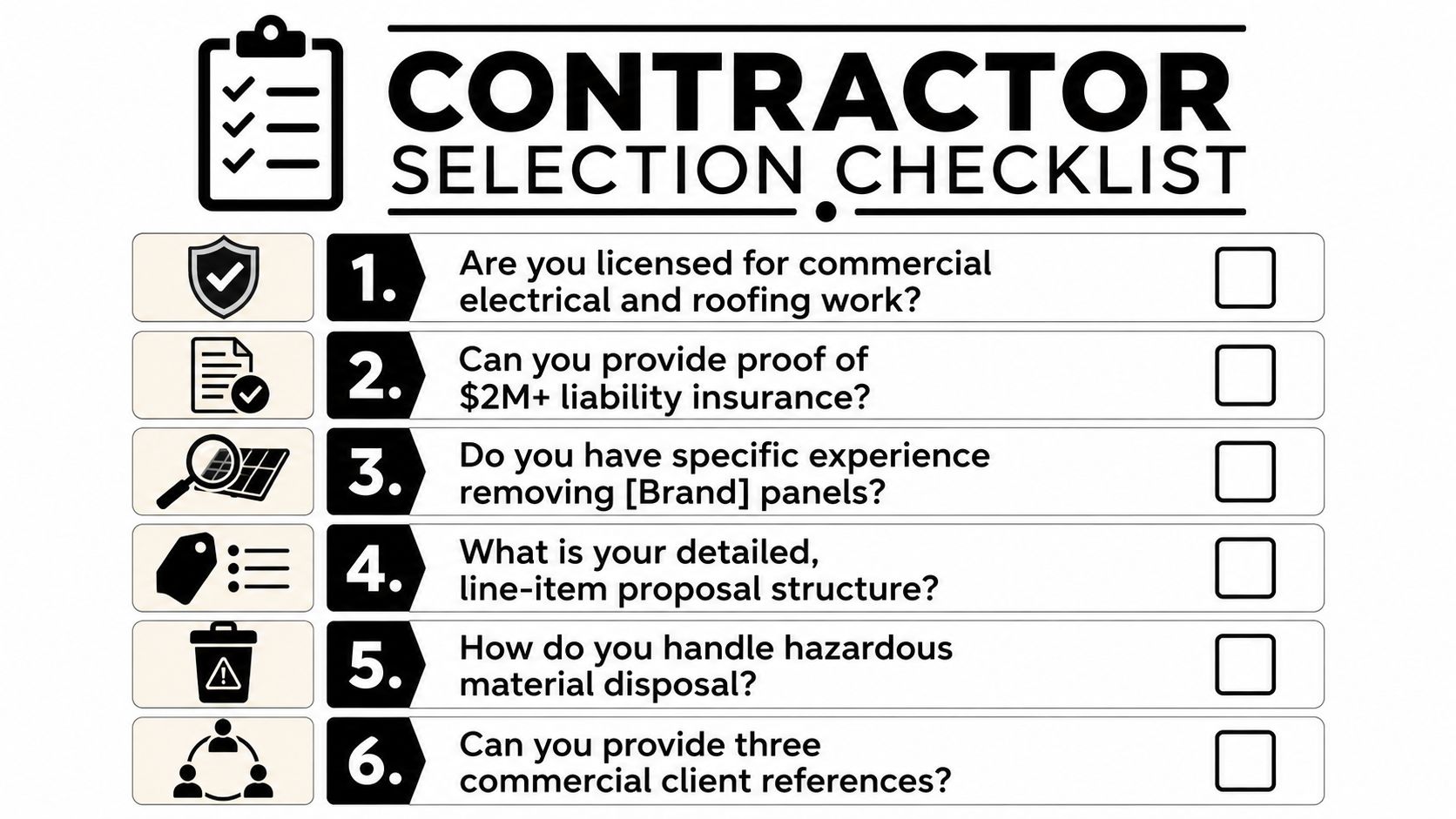
- Commercial licensing: confirm the contractor can legally handle the roofing and electrical parts of the job.
- Insurance coverage: ask for current proof of public liability and relevant project cover.
- Asbestos experience: if the roof is older, ask how they manage asbestos interfaces and stop-work triggers.
- Line-item quoting: insist on a proposal that separates removal, storage, roof works, reconnect, and testing.
- Waste handling plan: ask where panels go, who transports them, and what documentation you'll receive.
- Commercial references: request recent projects of similar size and complexity.
Those questions matter more than a flashy sales pitch because the failure points on commercial jobs are usually coordination failures, not technical drama. A contractor who can explain the sequence, the handoffs, and the reactivation process is already ahead of the one who only quotes a lump sum.
Why the cheapest quote often costs more later
The lowest price often leaves out the messy parts, temporary storage, roof protection, or post-reinstall testing. That creates change orders, delays, and disputes just when the committee wants the roof handed back. In strata and commercial settings, the contractor should be judged on how well they reduce friction between trades, not how aggressively they trim the first invoice.
Choose the team that can show you how the panels come off, where they sit, and how the site gets put back into service.
For owners, developers, and strata managers, that discipline is the difference between a controlled roof project and a month of avoidable callbacks.
If you need a commercial roofing team that understands how solar array removal, asbestos-sensitive roof work, and reinstallation sequencing fit together on NSW sites, visit Commercial Roofers. They handle commercial and industrial roofing across Sydney and surrounds, and they're set up for the kind of coordinated roof work that keeps strata, tenants, and insurers aligned.