
In Sydney, asbestos roof removal usually sits between $40 and $100 per square metre, and a standard home often falls in the $3,000 to $10,000 range. That's the starting point, not the decision, because the question for a strata manager is whether you're paying only to remove a hazard or using the project to improve the asset at the same time.
If you're reviewing a maintenance budget, dealing with a defect report, or trying to respond to a worried owner after asbestos roofing has been identified, cost matters. But in practice, the cheapest line item rarely gives you the cleanest outcome. Roof asbestos work affects access, tenant communication, legal compliance, downtime, and what you'll have to spend next if the roof still needs replacement after the asbestos is gone.
Table of Contents
- Your Guide to Asbestos Removal Costs in Sydney
- The Bottom Line Typical Asbestos Roof Removal Costs
- Key Drivers That Determine Your Final Project Cost
- Removal vs Full Replacement with Colorbond A Strategic Decision
- Navigating Sydney's Strict Safety and Legal Obligations
- A Strata and Commercial Managers Project Checklist
- Making an Informed Decision for Your Property
Your Guide to Asbestos Removal Costs in Sydney
A typical strata scenario starts the same way. Water ingress prompts a roof inspection, the report identifies suspected asbestos cement sheeting, and the committee wants a number before it wants a plan.
That is the wrong order.
For a strata or commercial property, asbestos work is a budgeting issue, a compliance issue, and an asset decision at the same time. The question is not only what removal will cost. It is whether the building should pay once for a controlled removal scope, or pay twice by separating removal from the roof upgrade that is likely coming anyway.
Roof asbestos projects change building operations. They can affect tenant access, work staging, contractor coordination, and the timing of other capital works. On occupied sites, those factors often matter as much as the removal contract itself.
I advise managers to frame the job around two decisions from day one:
- Risk decision: Does the current roof condition, planned disturbance, or maintenance history justify removal now?
- Asset decision: If the roof is already being stripped, does full replacement deliver better value than leaving the building with a cleared roof package and a second procurement process later?
That distinction matters because a cheap-looking removal scope can become an expensive overall outcome. If the roof is near the end of its service life, removal-only may reduce the immediate spend while increasing total disruption, extending programme time, and creating another round of access and tenant management costs.
Budgeting also needs to reflect how these jobs are delivered. Licensed removal, site controls, waste handling, clearance requirements, and roof access planning sit inside the cost decision whether the roof area is large or small. The square metre rate only becomes useful after the scope is clear and the end state is defined.
A reliable budget answers practical questions before the quote is signed. Is the site occupied during works? Does access require traffic control or restricted lift zones? Is the contractor pricing removal only, or removal and reinstatement sequencing? What condition must the property be left in at handover?
Those details drive the business case.
The managers who handle these projects well do not start by chasing the lowest number. They start by deciding what problem the building is solving, what downtime the property can tolerate, and whether the proposed scope protects both the current occupants and the long-term value of the asset.
The Bottom Line Typical Asbestos Roof Removal Costs
For budgeting, this section is less about repeating a rate card and more about reading what a roof removal quote means for the building.
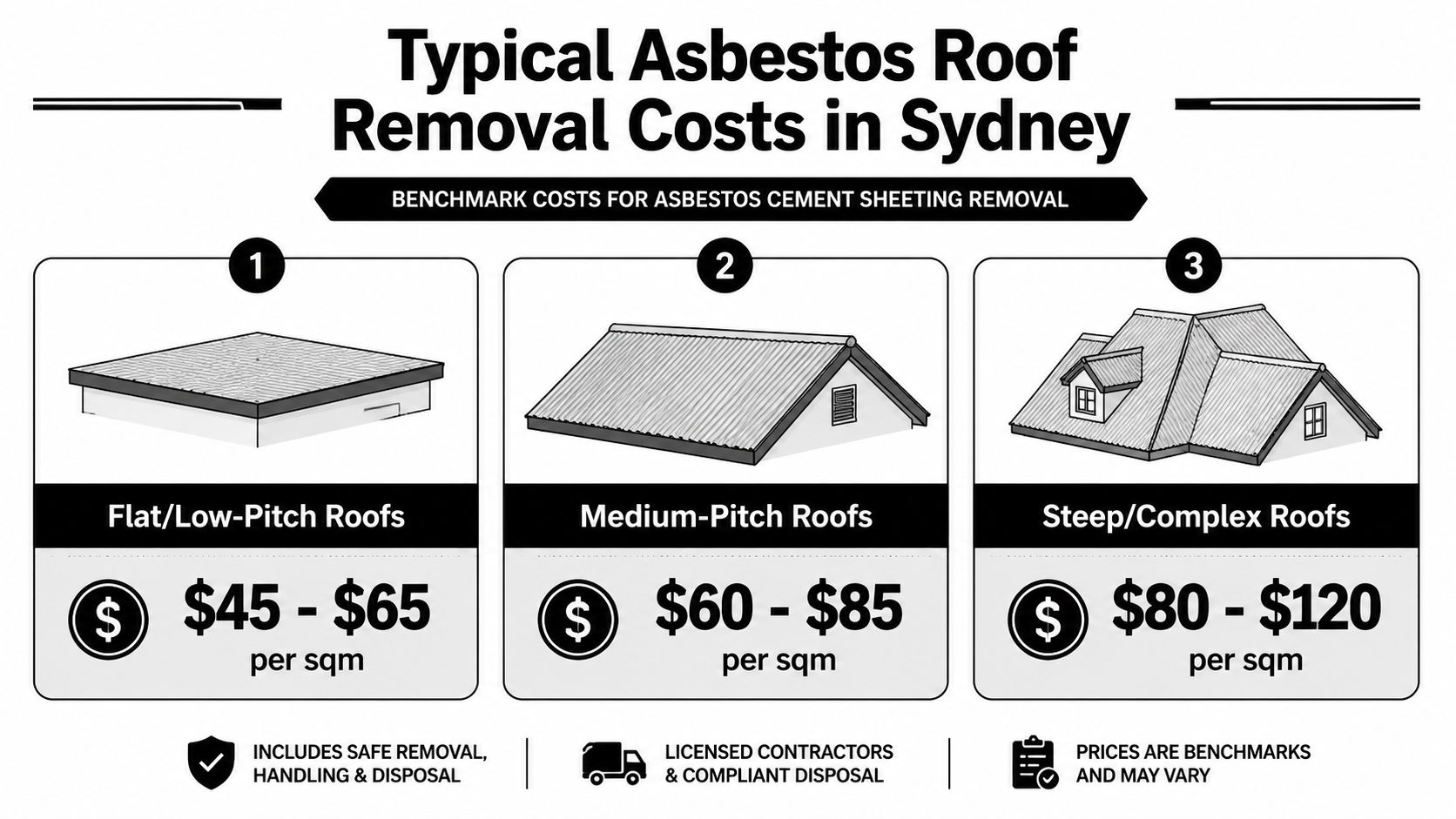
A low headline number can still produce the more expensive decision if it leaves the property with an exposed next step, another procurement cycle, and another period of tenant disruption. That is why experienced strata managers read asbestos roof pricing in two layers. First, the removal scope itself. Second, what that scope commits the asset owner to after the removal crew leaves site.
What the benchmark covers
The benchmark discussed earlier is only useful if the scope matches the way the job will be delivered on site. A compliant roof removal price usually carries more than labour and truck time.
In practical terms, the allowance often needs to absorb:
| Project element | What it means for the budget |
|---|---|
| Licensed removal scope | Trained crew, controlled method, and supervision suited to asbestos roof work |
| Site establishment | Exclusion zones, access control, protection measures, and setup before removal starts |
| Waste handling and disposal | Packaging, transport, and lawful disposal of asbestos waste |
| Clearance and handover requirements | Steps needed to leave the site in the agreed condition for the next trade or for temporary make-safe arrangements |
That is why two quotes for the same roof area can be materially different without either contractor being wrong. One may price a complete compliant package to handover. Another may price only the visible stripping work and leave key downstream costs outside the contract.
Why small roof areas still attract serious costs
Small roof jobs are rarely cheap in method.
The crew still needs to mobilise, establish controls, protect occupants and neighbouring areas, remove the material in a controlled way, and send waste through the proper disposal path. On a strata or commercial site, those fixed steps can outweigh the benefit of having fewer sheets to remove.
This catches committees out. They see a limited affected area and expect the quote to fall neatly with the square metreage. Roof work does not behave that way, especially where access is shared, tenants remain in occupation, or loading out the waste path is awkward.
Read the quote as an asset decision
For a property manager, the better question is not only "what does removal cost?" It is "what does removal-only commit us to next?"
If the existing roof is near the end of its service life, a removal-only package may protect this quarter's budget while increasing total project cost across the next 6 to 12 months. You may pay twice for access setup, tenant notices, traffic management, protection measures, and consultant involvement. You also extend the period where the building is operating around roof works.
By contrast, a coordinated removal and replacement programme usually carries a higher initial contract value but can reduce total disruption and close out the risk in one project window. That is often the better commercial decision for occupied strata schemes, retail assets, and industrial buildings where downtime has a real operating cost.
The point is simple. The cheapest removal quote is not automatically the lowest-cost outcome for the asset.
Key Drivers That Determine Your Final Project Cost
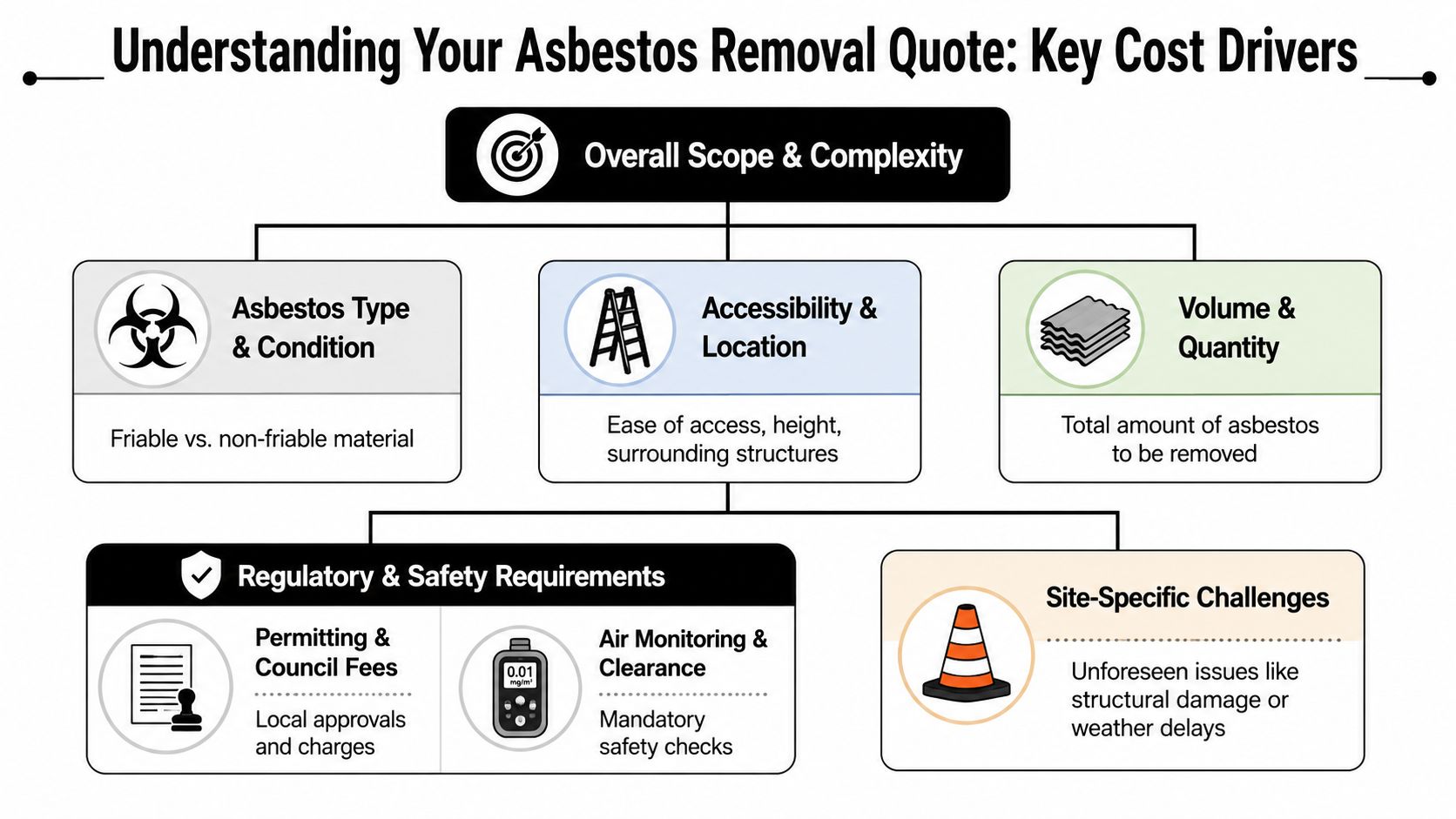
The final quote moves on scope and complexity. Not in theory. In very practical ways that affect crew size, site controls, sequencing, and how much of the property stays usable while the work is underway.
Scope changes the method, not just the invoice
The biggest pricing differences usually come from how the job must be executed, not just how much material is on the roof.
Consider the main cost drivers:
- Material condition: Stable bonded sheeting is handled differently from roofing that is cracked, degraded, or already disturbed. The more fragile the sheets, the slower and more controlled the removal needs to be.
- Access conditions: A roof over an open warehouse perimeter is one thing. A roof above occupied units, retail frontage, awnings, service lanes, or shared parking is another.
- Site operations: If businesses remain open, the contractor may need staged works, exclusion zones, tighter delivery windows, and more communication with occupants.
- Roof geometry: Valleys, penetrations, plant, brittle skylights, and mixed roof levels all slow production and increase risk controls.
- Waste path: It matters how the material leaves the roof, where it is temporarily handled, and whether the site allows clean separation from the public.
One quote can look higher because it deals with these realities properly.
Cheap quotes usually leave something out
A low number is not always a good number. In asbestos roofing, it often means one of three things has been softened: site protection, programme realism, or close-out compliance.
Ask yourself whether the proposal clearly addresses:
| Question | Why it matters |
|---|---|
| How is the removal area isolated? | Occupants, neighbouring lots, and the public must be protected. |
| How is the waste moved off site? | Roof work needs a planned and controlled waste route. |
| Who manages clear communication with tenants? | Poor communication creates complaints and pressure on the programme. |
| What happens if damaged substrate is found underneath? | Hidden issues affect whether the roof can be reinstated immediately. |
Manager's note: The quote that saves money is the one that reduces rework, dispute, and downtime. Not the one with the smallest headline figure.
For commercial assets, the business case is broader than removal alone. If the roof must come off, the better question is often whether to combine removal with replacement while access systems, traffic controls, and tenant notices are already in place. That's where project value is usually won or lost.
Removal vs Full Replacement with Colorbond A Strategic Decision
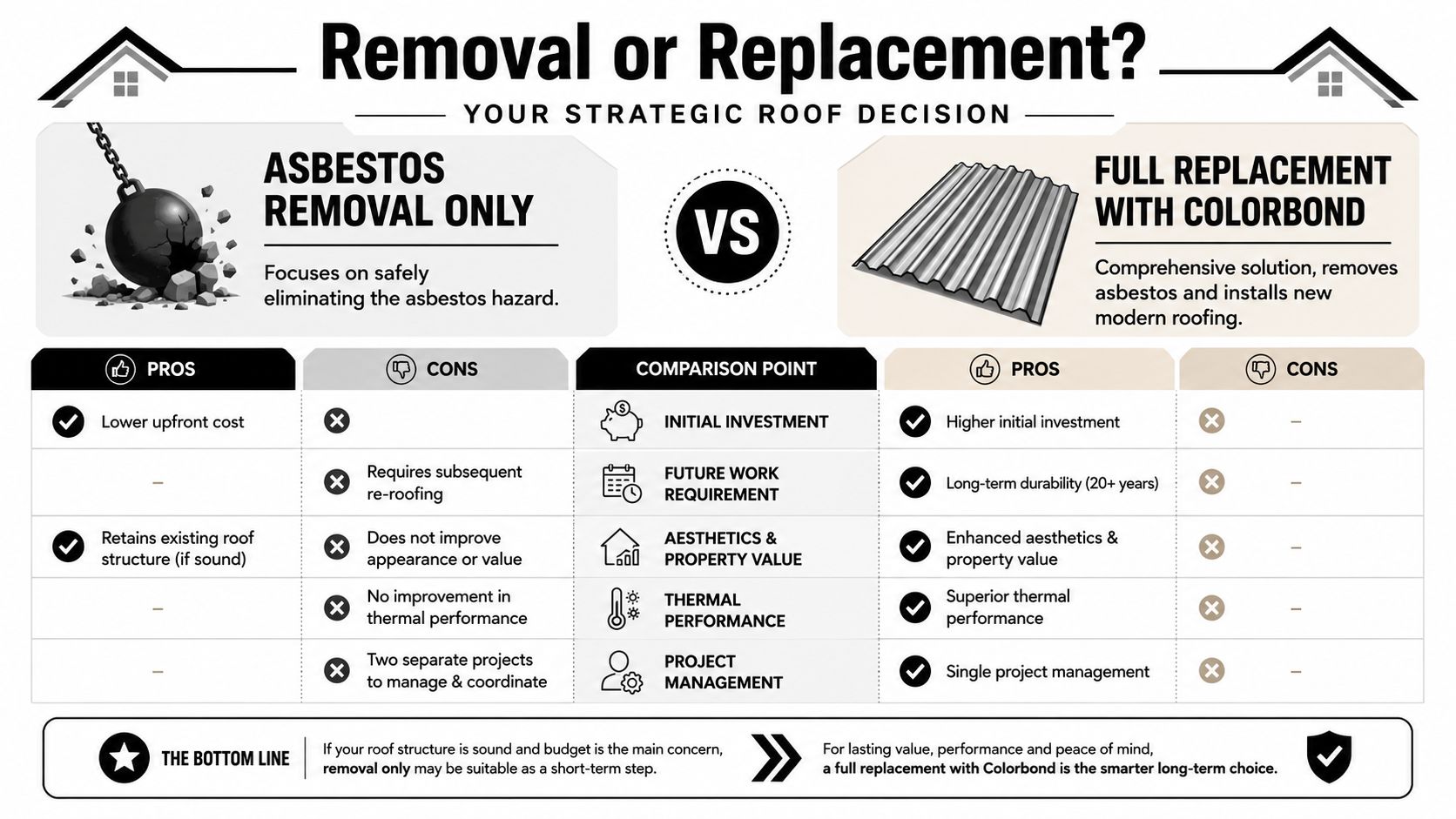
This is the decision that separates a maintenance response from asset planning. You can remove asbestos only, or you can remove it and complete a full re-roof in one coordinated programme.
When removal only makes sense
Removal-only can be the right call when the scope is isolated, the supporting roof structure remains suitable, or a broader redevelopment decision hasn't been made yet. It can also make sense where the owner needs to eliminate the asbestos risk now and stage replacement works later under a separate capex plan.
That approach works best when the follow-on roofing strategy is already defined. If it isn't, you can end up paying for mobilisation and disruption twice. First to remove the asbestos, then again to return for the new roof.
A removal-only pathway generally suits:
- Targeted hazard reduction: You need the asbestos gone because the area is damaged or likely to be disturbed.
- Short-hold ownership situations: The owner wants compliance managed before a later disposal or redevelopment decision.
- Staged capital programmes: The building has competing priorities and roofing replacement has been pushed to a later budget cycle.
When replacement is the stronger business decision
If the roof is ageing, leaking, or already under review, full replacement is often the better decision. Not because it is cheaper upfront, but because it reduces duplicated access costs, repeated tenant disruption, and the management burden of splitting one roof problem into two projects.
A modern metal roof system such as Colorbond is often chosen because it gives the owner a finished asset outcome rather than an incomplete remediation outcome. If you're weighing that path, a separate review of Colorbond roof installation cost for commercial projects helps frame the replacement side of the budget.
Here's the practical comparison:
| Option | Best fit | Main drawback |
|---|---|---|
| Asbestos removal only | Immediate hazard elimination where broader roof replacement is deferred | You still need a replacement roofing plan |
| Full replacement with Colorbond | Buildings where the roof is already due for renewal or upgrade | Higher initial capital approval |
If you already need access systems, site controls, and tenant communication for asbestos removal, bundling the replacement often gives the cleaner operational outcome.
There's also a governance benefit. Committees and owners respond better to a project that solves the compliance issue and leaves the building with a clear long term roof position. By contrast, removal-only can create a half-finished story. The hazard is gone, but the asset question remains unresolved.
For strata and commercial managers, that's the strategic lens. Don't ask only what asbestos removal costs. Ask what outcome the building needs once the asbestos is gone.
Navigating Sydney's Strict Safety and Legal Obligations
In Sydney, asbestos roof work has to be procured as a compliance exercise first and a trade package second. If that order is reversed, the risk sits with the owner, the manager, and everyone using the site.
You don't need to become a technical asbestos specialist to manage the process well. You do need to know what a proper proposal looks like, what documents should exist before works begin, and what warning signs mean the quote should be put aside.
What a compliant procurement process looks like
A sound process usually follows this order:
- Confirm what's present. Don't rely on visual assumptions alone where testing or prior documentation is available.
- Define the scope in writing. List the affected roof areas, access constraints, occupancy conditions, and whether reinstatement is part of the same contract.
- Check licence suitability and insurance. The contractor should be able to show the credentials relevant to the material and the work type.
- Review the removal method. The proposal should explain control measures, waste handling, and how the site will be left safe.
- Set communication responsibilities. Someone must notify tenants, occupants, contractors, and any nearby stakeholders impacted by access changes.
- Require proper close-out. The project isn't finished when the sheets are off the roof. It's finished when the site is handed back with the required compliance records.
If you're comparing suppliers, it helps to understand how a specialist asbestos roof repair company approaches roof risk, rectification, and compliance planning.
What to question before you sign
A professional quote should be easy to interrogate. If it's vague, that's already a problem.
Look closely at these red flags:
- Missing methodology: If the quote says removal and disposal but doesn't explain site controls, ask for detail.
- No clear exclusions: Ambiguity around reinstatement, temporary weatherproofing, or substrate repairs usually becomes a variation later.
- Unclear programme assumptions: Occupied sites rarely allow a simple uninterrupted run of work.
- No close-out path: The contractor should be explicit about how the job reaches practical completion from a compliance perspective.
The safest asbestos project is usually the one that feels the most organised before work starts.
Managers sometimes worry that more paperwork means more cost. Usually it means fewer arguments and fewer surprises. In this category of work, documentation isn't bureaucracy for its own sake. It's how everyone confirms the site was planned, controlled, and handed back properly.
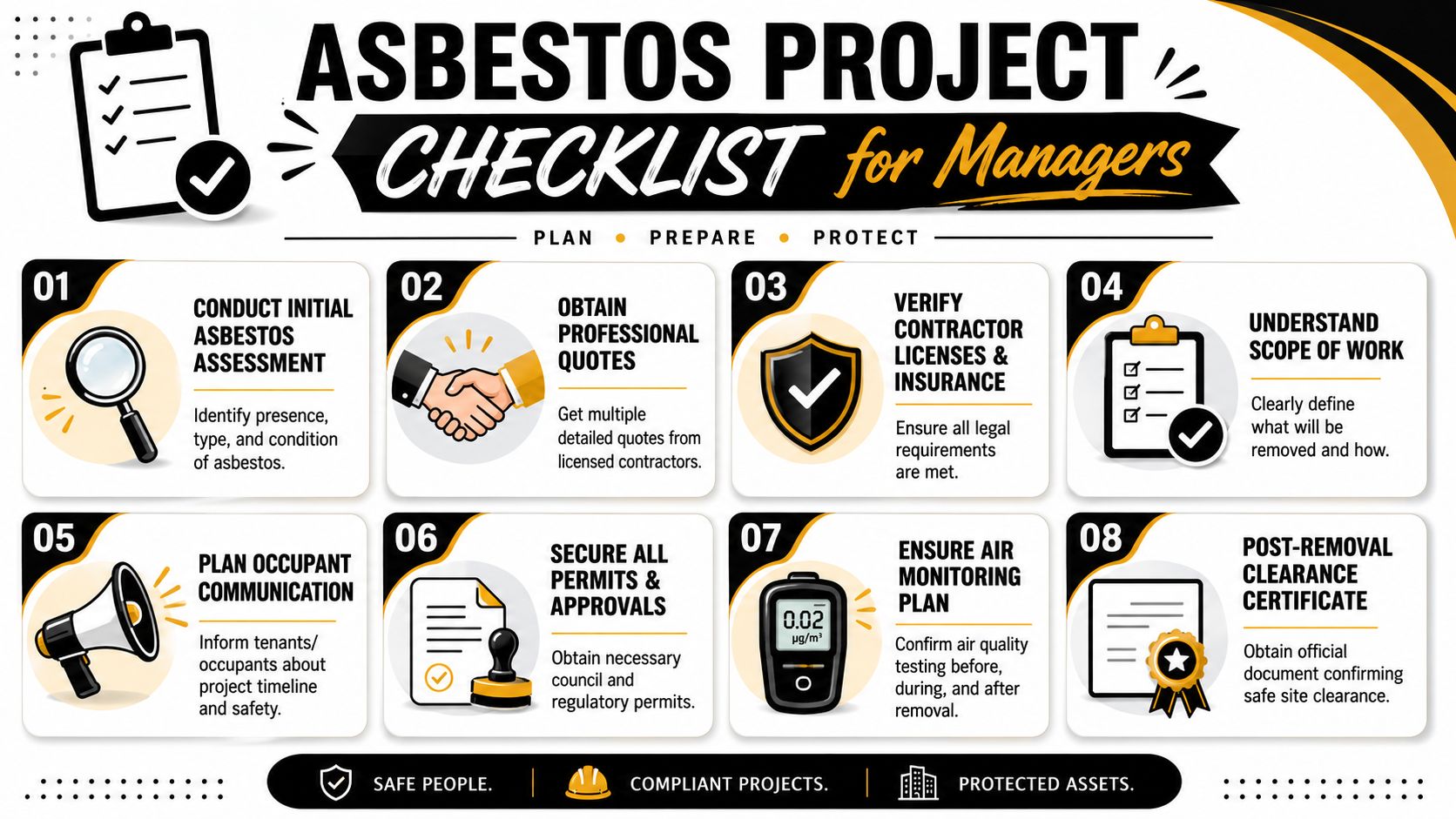
A Strata and Commercial Managers Project Checklist
For most managers, the easiest way to stay in control is to run the project through a checklist. That keeps the discussion grounded when owners, tenants, and contractors all want different answers at the same time.
Pre works planning
Use this before quotes are finalised and before any works approval goes to the committee or client.
- Confirm the asbestos register or testing position: Make sure you know whether the material has been identified by record, sample, or consultant report.
- Define the roof outcome early: Decide whether you're tendering for removal only or a full removal-and-replacement scope.
- Request detailed quotes, not summary totals: The scope should identify access assumptions, removal area, disposal, and handover expectations.
- Verify licences and insurance: Don't leave this to verbal assurances or expired documents.
- Map the occupant impact: Note loading zones, parking loss, access closures, noisy periods, and any businesses that need special coordination.
A practical way to shortlist contractors is to compare how they communicate scope, not just price. A local commercial roofer near you should be able to discuss roofing logistics, occupied-site sequencing, and reinstatement planning in the same conversation.
During works and close out
Once the project is approved, most of the manager's value comes from keeping decisions and communication aligned.
- Issue the communication plan: Residents, tenants, and facilities staff should know what happens, when access changes, and who to call.
- Review the control plan before start date: Confirm how the removal zone, waste path, and delivery areas will be managed.
- Nominate one site contact from management: Too many approval points create delay and conflicting instructions.
- Track variations tightly: Hidden roof damage, wet substrate, or structural issues can emerge once sheets are removed.
- Hold completion until documents are received: Don't close the file on physical completion alone.
Good asbestos project management is mostly disciplined administration. The roof crew handles the removal. The manager protects the process.
If you want one operational rule to keep, it's this: never let urgency collapse procurement discipline. The project may be urgent, but it still needs the right scope, the right paperwork, and the right close-out.
Making an Informed Decision for Your Property
A key lesson in asbestos removal Sydney cost is that the square metre rate is only the entry point. The meaningful decision is whether the project solves a short-term hazard only, or whether it also improves the building's long-term roof position.
That's why the best outcomes usually come from matching the scope to the asset. If the roof still has a clear future and only isolated asbestos work is required, removal-only can be justified. If the roof is already deteriorating, causing maintenance issues, or due for renewal, combining removal with replacement is often the stronger operational and financial decision.
For strata and commercial properties, the job should be judged on four things:
- Safety: Is the site controlled properly for workers, occupants, and the public?
- Compliance: Is the documentation and close-out strong enough to protect the owner?
- Disruption: Are access, communication, and programme impacts being managed realistically?
- Asset value: Will the building be in a better position when the work is complete?
One capable market option for this type of project is Commercial Roofers, which handles commercial asbestos roof removal and replacement work in Sydney as part of broader roofing scopes. That matters when the roof decision is not just about removal, but about what gets installed and managed afterwards.
If you're responsible for a strata block, warehouse, factory, or commercial facility, don't approve the project on a headline rate alone. Approve the option that gives the property the safest path, the clearest compliance trail, and the fewest repeat disruptions.
If you need a site-specific view of your asbestos roofing risk, replacement options, or procurement scope, speak with Commercial Roofers . A detailed inspection and written proposal will give you a clearer basis for budgeting, committee approval, and planning the least disruptive path forward.