
For a Sydney commercial property, asbestos roof replacement cost often starts around $15,000 to $20,000 for smaller sites, and the removal phase alone can run $45 to $100 per square metre before the new roof is installed. On larger buildings, the all-in cost usually lands well above what simple online roof calculators suggest because the job includes hazardous material removal, disposal, access setup, compliance controls, and then the replacement roof itself.
If you're a strata manager staring at an engineer's report, or a warehouse owner who's just been told the existing fibro sheets contain asbestos, the first question is usually blunt: what's this really going to cost? The second question comes a few minutes later: why is it so much more than a standard re-roof?
The short answer is that this isn't just a roofing job. It's a compliance project first and a roofing project second. In Sydney, the budget rises or falls on how safely the asbestos can be removed, how the site can be accessed, how waste is handled, and how smoothly the new roof can go on once the site is cleared.
Most residential guides don't help much when you're dealing with a warehouse, factory, school block, mixed-use strata building, or a site with tenants underneath. Commercial projects bring different pressures. Access is harder. Staging matters more. Downtime costs money. And if the quote leaves out the compliance side, you don't have a cheap quote. You have an incomplete one.
Table of Contents
- Your Commercial Property Has an Asbestos Roof Now What
- The Six Core Components of Your Replacement Quote
- Sydney Asbestos Roof Replacement Price Ranges
- Worked Examples for Commercial & Industrial Properties
- Navigating Safety and Compliance in NSW
- Project Timeline Staging and Minimising Disruption
- Frequently Asked Questions on Asbestos Roof Replacement
Your Commercial Property Has an Asbestos Roof Now What
The usual scenario is simple. A leak appears, an inspection gets ordered, and someone identifies old asbestos cement sheets on the roof. From that point on, the job changes category.
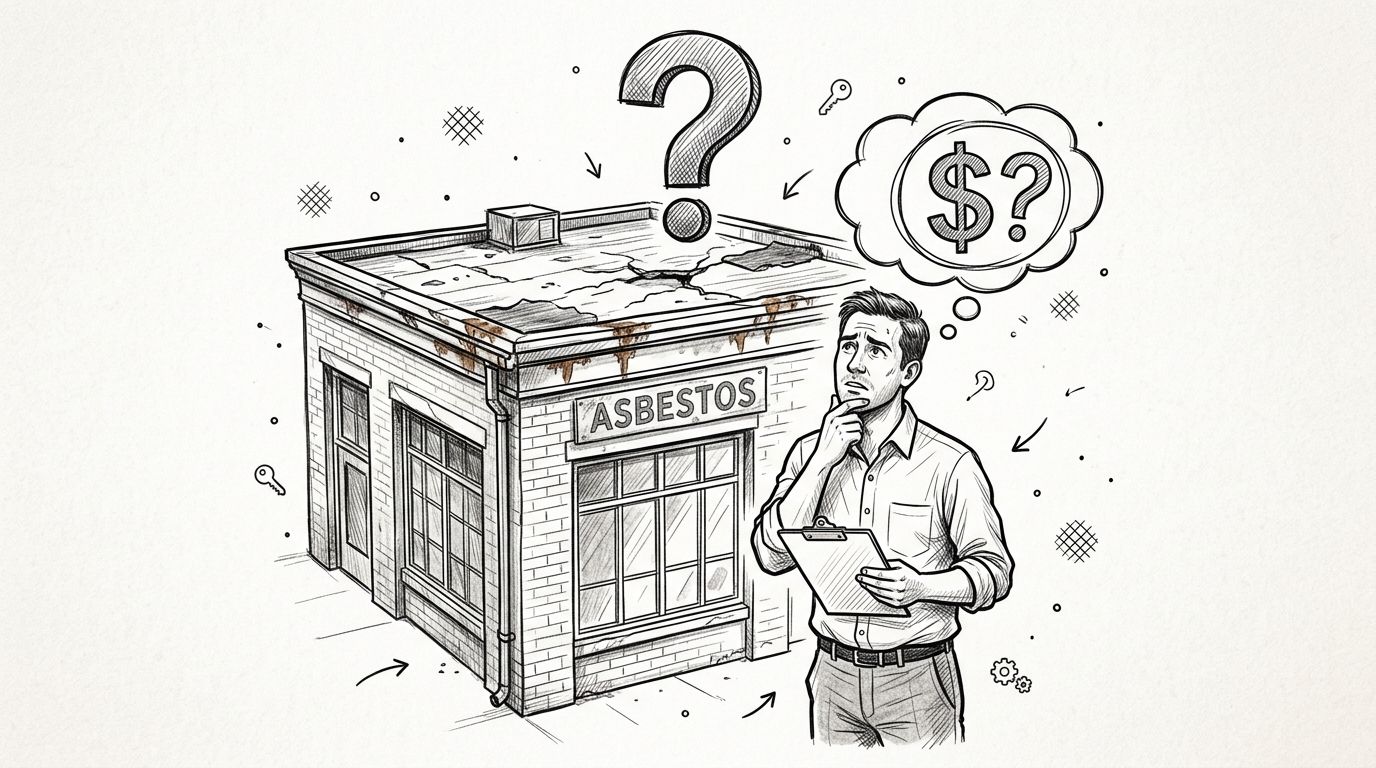
A standard roofer can't just strip it, dump it, and start laying new sheeting. Once asbestos is involved, the project sits inside a stricter set of safety, handling, and disposal requirements. That's why experienced owners look for a contractor who understands both abatement and roofing logistics, not just one side of the job. If you're comparing providers, it helps to see how a commercial roofer near you handles hazardous roofing scopes rather than ordinary replacement work.
The first decision is not material choice
Many committees start by asking whether they should replace the old roof with Colorbond, insulated panels, or another metal system. That matters, but it isn't the first cost driver. The first driver is whether the asbestos removal can be done cleanly, legally, and without shutting down the site more than necessary.
On a commercial property, the scope often includes more than the visible roof sheets. The contractor has to think about access points, fall protection, loading areas, tenant movement, weather exposure during changeover, and how waste leaves the site. Those practical issues are what separate a realistic budget from a number that looks good on page one and then grows during the project.
Practical rule: If a quote treats asbestos roof replacement like ordinary re-roofing with one demolition line and one installation line, it probably isn't showing you the full cost.
What owners actually need at this stage
You need four things quickly:
- Confirmation of scope: Is the roof at end of life, partly repairable, or due for full replacement?
- A compliant pathway: Who is handling licensed removal, site controls, and disposal?
- A budgeting range: Enough detail to take to a committee, board, or owner group.
- A staging plan: How the work will happen while keeping the property functioning.
The cost can feel steep at first glance, but it becomes manageable when you break it into the right categories. That's where most confusion disappears.
The Six Core Components of Your Replacement Quote
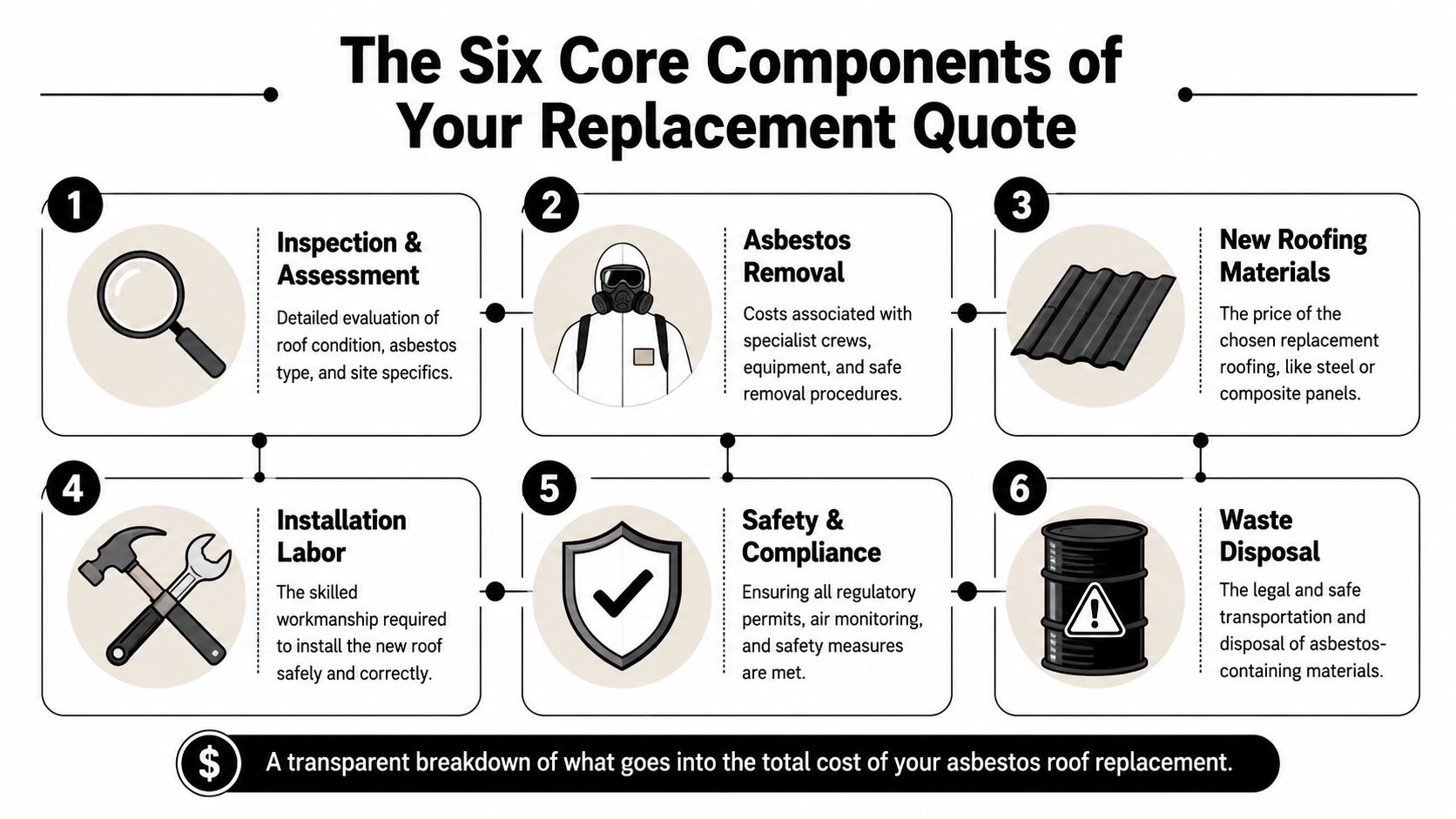
The easiest way to read an asbestos roofing quote is to stop thinking of it as one price. It's a stack of separate costs bundled into one project. The mistake I see most often is owners comparing a quote that includes the full compliance scope against one that only prices removal and new sheeting.
Why commercial quotes vary so much
A major reason for variation is the hidden compliance overhead. Australian guidance notes that asbestos roof removal can range from $45/m² to $100/m² depending on access, with up to $450 in tipping fees, and those costs sit separately from the new roof itself according to Australian guidance on asbestos removal when re-roofing.
That one point explains a lot. If one contractor has allowed for containment, access difficulty, waste handling, and project controls, while another has priced only the visible roofing work, the cheaper number won't stay cheaper for long.
A short explainer on the topic is worth watching before you compare proposals:
The six items that should be visible
A proper commercial quote should usually separate these components, either as line items or as clearly described inclusions:
Inspection and assessment
This covers the roof review, site conditions, access risks, and the planning work needed before anyone touches the sheets.Licensed asbestos removal labour
This is specialist labour, not standard roofing labour. The crew, handling methods, PPE, containment approach, and removal sequence all affect cost.Waste transport and disposal
Asbestos waste can't be treated like ordinary demolition material. It has to be packaged, moved, and disposed of under the required process.Scaffolding and site access
On commercial work, access can be a major line item. Edge protection, perimeter scaffold, high access gear, and traffic control can materially change the budget.New roofing materials
Once the hazardous material is gone, you still need the replacement roof. For many Sydney commercial sites, that means a modern metal system such as Colorbond or another specified sheeted profile.Installation labour and project management
This includes the actual re-roofing crew, flashing work, detailing around penetrations, sequencing, weather management, and coordination between trades and occupants.
On commercial sites, the new roof is only one part of the bill. The site controls around it are often what decide whether the job runs smoothly or becomes a dispute.
What works and what doesn't when comparing quotes
What works is asking each contractor to identify exactly what is included under removal, disposal, access, and reinstatement. What doesn't work is comparing a headline figure with no breakdown.
Use this quick screening list:
- Ask for removal scope: Does the quote say who performs licensed asbestos removal?
- Ask for disposal detail: Does it mention waste transport and tipping as a defined inclusion?
- Ask about access assumptions: Is scaffold, edge protection, or machinery included or excluded?
- Ask about roof changeover: Does the contractor explain how the building stays protected during staged replacement?
- Ask who manages the whole program: Split responsibility between separate firms can work, but only if someone clearly owns sequencing and handover.
If any of those answers are vague, the number on the front page won't tell you much.
Sydney Asbestos Roof Replacement Price Ranges
For smaller commercial sites in Sydney, replacing an asbestos roof with a modern Colorbond system typically starts around $15,000 to $20,000, while the removal phase alone generally runs $45 to $100 per square metre depending on access and containment needs, as outlined in Angi's asbestos removal cost guide. That's the most useful baseline for setting expectations.
What the numbers usually look like
When owners ask me for a fast budgeting rule, I don't give one flat rate and pretend it applies to every building. A warehouse with wide access and clear laydown space is one thing. A strata block with tight boundaries, neighbouring properties, and occupied units underneath is something else entirely.
The cleanest way to think about price is in two phases:
- Phase one is removal and disposal. The hazardous material is managed during this phase.
- Phase two is the replacement roof. During this phase, the building gets its long-term weatherproofing system.
The all-in project cost on commercial properties often ends up above the simple residential benchmark because Sydney commercial jobs carry more access complexity, more staging pressure, and more coordination requirements. That doesn't mean every large roof is overpriced. It usually means the quote is finally showing the full scope.
For owners who are also weighing whether a full replacement makes more sense than ongoing patch repairs, this broader guide to commercial roof repair cost in Sydney can help frame the decision.
A simple budgeting table
Here's a practical budgeting view based on the verified market figures and how commercial projects are usually structured.
| Cost area | Typical benchmark | What pushes it higher |
|---|---|---|
| Asbestos removal | $45 to $100 per m² | Difficult access, more containment, awkward roof geometry |
| Tipping and disposal | Up to $450 | Waste handling logistics and disposal requirements |
| Smaller site full replacement with Colorbond | $15,000 to $20,000 | Access constraints, site controls, complex detailing |
That table is intentionally simple. It's not a substitute for a site inspection. It is a good way to stop a committee from relying on generic online calculators that ignore compliance costs.
Why one site lands at the low end and another doesn't
Two buildings can have the same roof area and produce very different quotes. In practice, the biggest variables are usually:
- Access to the roof: Clear truck access and uncomplicated perimeter conditions help.
- Roof shape: A plain sheeted roof is easier than one broken up by penetrations, plant, skylights, and gutters.
- Occupied status: Working over active tenants or production areas slows the sequence and tightens controls.
- Changeover risk: If the building can't be exposed to weather, staging becomes more deliberate and labour-heavy.
- Material choice for reinstatement: Premium steel systems and upgraded profiles cost more, but many owners choose them because they reduce future maintenance headaches.
A good quote doesn't just give you a range. It tells you why your property sits where it does within that range.
Worked Examples for Commercial & Industrial Properties
Commercial owners usually understand the theory once it's explained. The harder part is placing their own building on the spectrum. These examples are the kinds of scenarios that regularly shape the final asbestos roof replacement cost, even when the roofs look similar on paper.
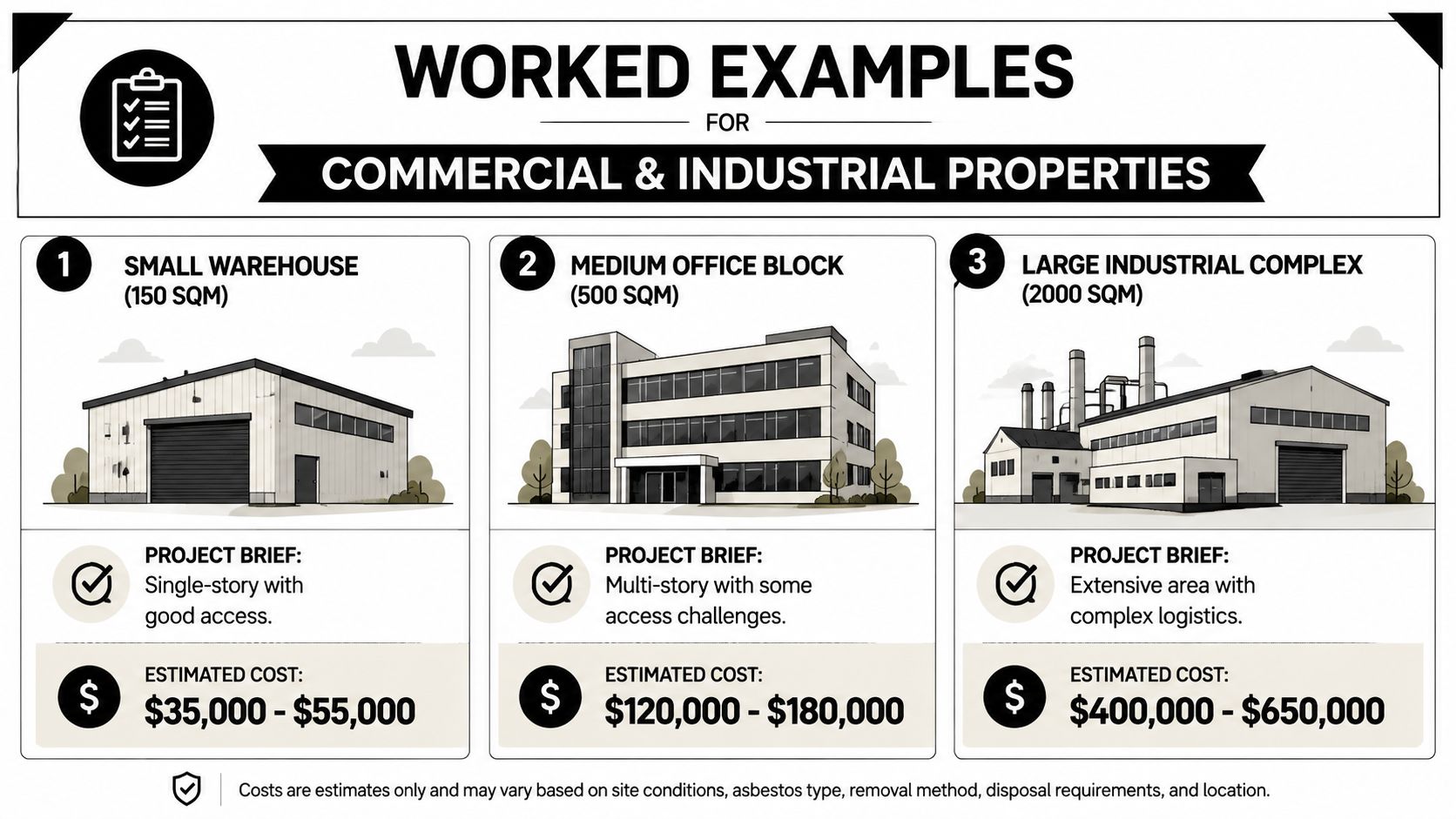
Example one single level warehouse with clean access
A warehouse with a simple footprint is usually the most straightforward commercial case. There's good truck access, clear perimeter space, and fewer interruptions on the roof itself. The client's main concern is often continuity of operations and protecting stock during the changeover.
In that scenario, the cost pressure usually comes from three places:
- Removal setup: Licensed removal still has to be done correctly, even if access is good.
- Weather staging: The sequence has to keep the building watertight as sections are changed over.
- Replacement specification: If the owner chooses a premium steel roof, the material side becomes a larger share of the project.
What works here is a staged zone-by-zone program with clear loading areas and minimal double handling of materials. What doesn't work is trying to compress the schedule too aggressively and creating exposure risk inside the warehouse.
Example two factory roof with penetrations and staging issues
Now take a factory roof with vents, skylights, services, and multiple penetrations. The roof area may not be dramatically larger, but the labour profile changes immediately.
Every penetration slows removal and replacement. Flashings need more detailed work. The crew spends more time moving around plant and services. If operations continue below, the sequencing gets tighter again because one bad handover between removal and reinstatement can create a production interruption.
A factory roof with lots of penetrations is rarely expensive because of square metres alone. It becomes expensive because every detail on that roof takes longer to remove safely and longer to rebuild properly.
This is also where quote quality matters most. A vague proposal often underprices the complexity and then reaches for variations once the roof is open.
Example three strata complex with resident coordination
Strata projects have their own cost structure. Even when the roof itself is technically manageable, resident communication, access restrictions, parking impacts, noise control, and site segregation create a different job altogether.
The committee often wants one number. In reality, the project manager is juggling several practical layers at once:
| Strata issue | Cost effect |
|---|---|
| Resident access and notifications | More coordination time and stricter staging |
| Limited laydown areas | Slower material handling and tighter logistics |
| Perimeter and height constraints | More complex access planning |
| Occupied units below | Higher weatherproofing and sequencing pressure |
On these jobs, the best results usually come from early planning and very clear communication. One option some committees consider is using a contractor that handles both the licensed removal coordination and the replacement roofing under one management stream. For example, Commercial Roofers' asbestos roof repair and replacement service is one type of Sydney commercial provider owners may review alongside other qualified firms when they want a single point of coordination.
The practical lesson from all three
The same roof area can produce very different project costs. Clean access lowers friction. Penetrations raise labour. Occupied strata sites add coordination and staging pressure.
That's why budget calculators miss the mark. They tend to price area. Commercial projects are priced by area plus logistics plus compliance plus consequence if sequencing goes wrong.
Navigating Safety and Compliance in NSW
Owners sometimes treat compliance as the paperwork part of the job. On asbestos roofing projects, that's the wrong mindset. Compliance is the operating system for the entire project.
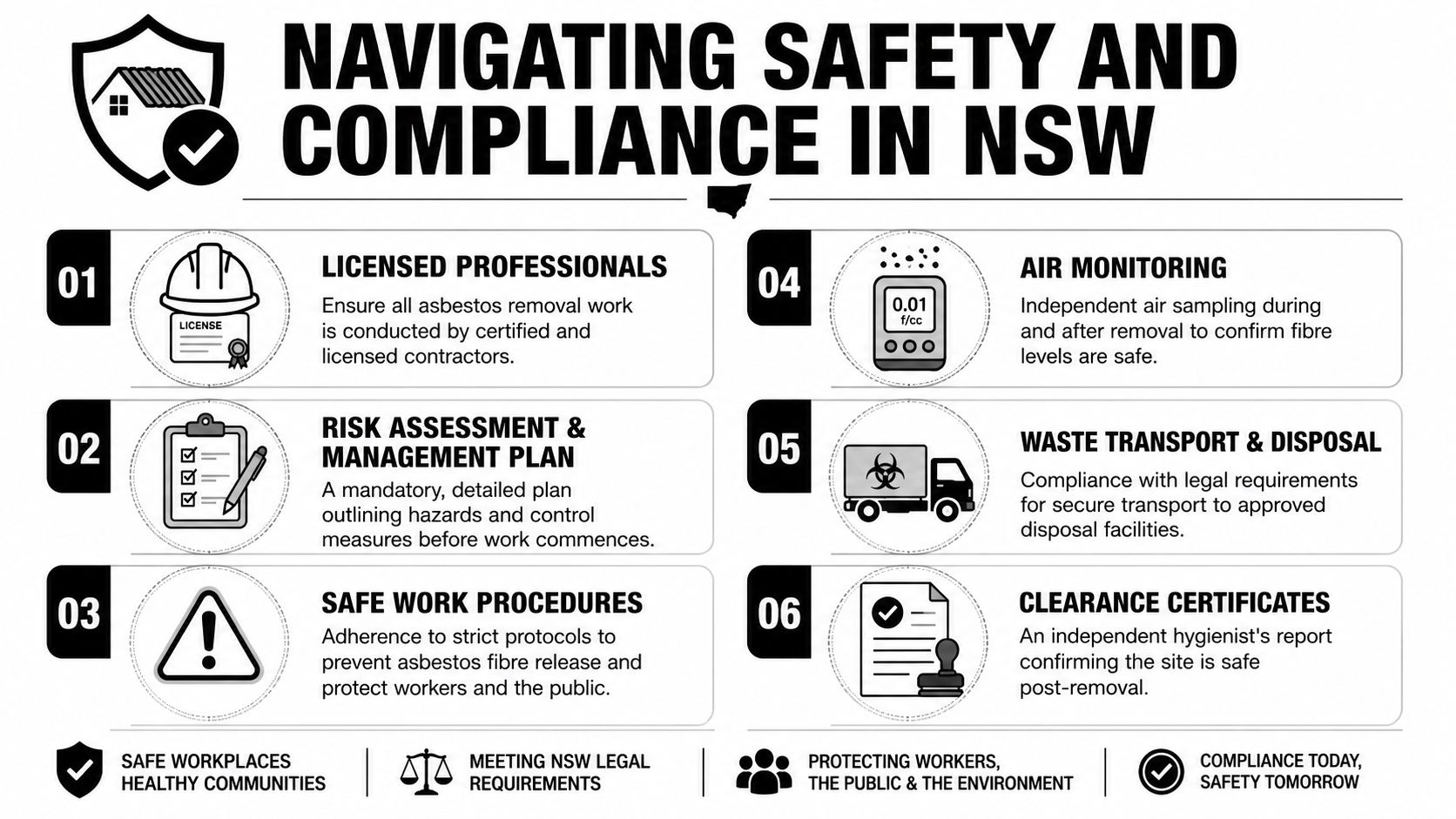
What compliant asbestos roofing work looks like
Australian guidance states that asbestos removal must be performed by licensed professionals, and technical roof complexity such as low pitch or steep rise can drive removal costs up to $100 per square metre because stricter protocols are required under NSW work health and safety rules. That's why complex roofs don't just cost more to roof. They cost more to make safe.
A compliant commercial project usually includes these controls:
- Licensed removal personnel: The people taking the asbestos off the building must be authorised to do that work.
- A defined removal plan: The work needs a clear method, not improvisation on site.
- Site segregation: Occupants, visitors, and adjacent trades need to be kept out of the work zone.
- Air and clearance processes: Independent verification matters before normal occupation resumes.
- Controlled waste handling: Removed material must leave the site through the correct pathway.
None of that is window dressing. Each step protects the owner as much as it protects the crew.
Why cheap shortcuts create expensive problems
The most dangerous quote is not always the highest one. It's often the one that makes the hard parts disappear on paper.
If a contractor glosses over removal licensing, air monitoring, clearance, or disposal documentation, the owner carries the risk when questions get asked later. On a commercial property, that can affect tenants, insurers, facilities managers, and the committee itself. Once you look at it through that lens, compliance isn't overhead. It's risk control.
If the contractor can't explain the safe sequence from removal to clearance to reinstatement, don't assume they'll work it out on the day.
The standard you should expect from a contractor
A by-the-book operator should be able to explain, in plain language:
- Who is licensed to remove the asbestos
- How the work area will be isolated
- How occupants and neighbouring areas will be protected
- How clearance is obtained before reoccupation
- How waste is tracked out of the site
- How the new roofing crew takes over once the site is cleared
That explanation should be simple, direct, and specific to your building. If it sounds generic, it probably is.
Project Timeline Staging and Minimising Disruption
The question after price is usually timing. Owners want to know how long the building will be affected and whether operations can continue. The honest answer is that every commercial site needs its own programme, but the sequence is usually more predictable than people expect.
A practical commercial sequence
Most projects run best when they're staged in clear phases rather than treated as one continuous demolition and rebuild exercise.
Pre-start planning comes first. This is when the site is inspected properly, access is confirmed, responsibilities are mapped out, and the sequence is set around the property's operating needs.
Site establishment follows. Access gear goes in, work zones are created, and the team prepares the building so removal can happen without uncontrolled interaction with tenants, staff, or visitors.
Removal then clearance is the key turning point. The asbestos comes off under the approved process, the area is cleaned and checked, and only then does the reinstatement side take over.
Roof installation and handover closes the loop. The replacement roof goes on, flashings and details are completed, and the site is progressively returned to normal use.
How disruption is reduced on occupied sites
On live commercial sites, the right contractor doesn't just ask how to replace the roof. They ask how to replace it while the site keeps functioning.
That usually means working through practical controls such as:
- Staged work zones: Only part of the roof is opened at a time where the building layout allows it.
- Planned access routes: Trades and occupants are separated from removal and loading areas.
- Weather-conscious sequencing: The crew doesn't expose more roof than can be safely managed.
- Communication windows: Building managers, tenants, and supervisors know what's happening and when.
- Early identification of sensitive areas: Plant rooms, stock areas, medical uses, education spaces, or resident entries all need special handling.
A warehouse may stay operational with a staged programme. A strata building may need tight resident notices and access controls. A factory may require weekend or off-peak works around critical production zones. The principle stays the same. The programme must fit the building, not the other way around.
Good staging doesn't make the project invisible. It makes the disruption predictable, controlled, and easier to manage.
Where timelines go wrong
Projects usually slip for familiar reasons. Access assumptions were wrong. The roof had more detail than the quote allowed for. The client didn't realise how tightly removal and replacement needed to be coordinated. Or the contractor tried to rush the front end and then lost time fixing preventable issues mid-job.
The best timeline is not the shortest one on paper. It's the one that realistically balances safety, weather protection, labour flow, and site operations.
Frequently Asked Questions on Asbestos Roof Replacement
Can insurance cover asbestos roof replacement
Sometimes, but not usually as a simple maintenance claim. If the roof is old, deteriorated, or at end of life, insurers commonly treat that as wear and tear rather than an insured event.
Where insurance may become relevant is when an insured event, such as storm damage, forces the issue. In that case, the owner should document the damage, notify the insurer promptly, and confirm whether the policy responds to the resulting roof work. The asbestos itself doesn't automatically create cover. The triggering event and the policy wording do.
For strata properties, the committee should also confirm who owns the policy response process and who provides the technical scope to the insurer.
Are there grants or rebates in NSW
Commercial owners shouldn't assume there are active grants or rebates available for asbestos roof replacement. In practice, business and strata projects are usually funded as capital works, maintenance planning, or insurance-linked remedial projects where applicable.
The safest budgeting approach is to treat the job as owner-funded unless you have a current programme in writing from a government body or another funding source.
What changes the price most
The biggest pricing shifts usually come from access, roof complexity, and how much compliance setup the building requires.
Here's the practical version:
- Easy roof access lowers labour friction
- Steep, awkward, or broken-up roofs raise removal cost
- Occupied or sensitive sites need tighter staging
- Complex penetrations slow both removal and replacement
- Higher-spec replacement materials lift the reinstatement side of the budget
There's also the basic material question. Non-friable asbestos cement roofing is generally simpler to handle than more hazardous material types because intact sheets can often be managed more predictably. Once the material condition or removal conditions become more difficult, the labour and control requirements increase with it.
How do you know a quote is complete
A complete quote should tell you what the contractor is doing, not just what they're charging. If you can't see the scope, you can't compare it properly.
Use this checklist:
| What to check | Why it matters |
|---|---|
| Licensed removal responsibility | Confirms who is accountable for hazardous material work |
| Disposal inclusion | Avoids surprise waste and tipping charges later |
| Access and scaffold assumptions | These items often move the budget materially |
| Replacement roof specification | Ensures you know what product is being installed |
| Project sequencing | Reduces risk of weather exposure and site disruption |
| Clear exclusions | Shows what is not included before the job starts |
A quote is usually worth trusting when it's detailed enough to expose its own assumptions. The weak ones hide behind lump sums and broad language.
Is replacement usually better than ongoing repair
For ageing asbestos roofs on commercial sites, repeated patching often turns into false economy. You still carry the compliance issue, you still have an ageing roof, and you may end up paying multiple mobilisation costs over time.
Replacement usually makes more sense when leaks are recurring, sheets are deteriorating, or the roof has reached the point where each repair becomes more difficult to justify. The upfront spend is larger, but the decision is cleaner and easier to defend to stakeholders.
What should a strata committee or warehouse owner do first
Start with a proper site inspection and a scope that separates removal, disposal, access, and reinstatement. Once those items are visible, the budgeting discussion gets much easier.
For a committee, that means asking for a quote that can stand up at a meeting. For a warehouse owner, it means asking how the contractor will protect operations while the roof is changed over. In both cases, the right first step is clarity on scope, not chasing the cheapest headline number.
If you need a commercial-first view of your asbestos roof replacement cost, Commercial Roofers can inspect the site, explain the removal and replacement scope in plain language, and provide a transparent quote for Sydney warehouses, strata buildings, factories, and other occupied commercial properties.