

A reflective roof coating can cut roof surface temperature by up to 50% and lower indoor temperature by 6–9 degrees according to industry guidance on reflective roof performance from the Roof Coatings Manufacturers Association. For Sydney commercial property owners, that shifts the conversation. This isn't just about making a roof look cleaner. It's about lowering heat load on the building, reducing pressure on cooling plant, and protecting an asset that takes a beating through long summers.
On large warehouses, strata buildings, factories and logistics sites, the roof usually carries more of the heat problem than people realise. A broad metal deck or dark membrane can turn into a heat sink by midday. Once that happens, air conditioning has to fight the roof all afternoon. A well-specified reflective roof coating changes that equation without forcing a full roof replacement.
Table of Contents
- Your Defence Against Sydney's Rising Energy Costs
- The Science of Cool Roofs Explained
- Coating Types and Commercial Roof Compatibility
- The ROI of Reflective Coatings in Sydney
- Navigating Australian Standards and Compliance
- The Professional Application Process Matters
- Selecting the Right Product and Contractor
- Maintenance Plan and Project Checklist
Your Defence Against Sydney's Rising Energy Costs
Sydney commercial roofs do hard labour. They sit exposed all day, soak up solar load, and transfer that heat into tenancies, warehouse space, plant rooms and common areas. If you manage a large roof over air-conditioned space, heat gain isn't a comfort issue alone. It's an operating cost issue.
That's why a reflective roof coating deserves to be treated as an asset strategy, not a line item for paint. On the right building, it can reduce heat entering the structure, ease strain on rooftop units, and slow the kind of surface deterioration that pushes owners toward premature capital works. For industrial owners and strata committees, that matters because roofs rarely fail from one dramatic event. They usually degrade through steady exposure, movement, UV and deferred maintenance.
A coating also fits a gap that many owners face. The roof may still be serviceable, but it's too hot, too weathered, or too expensive to ignore. In that middle zone, a reflective system can improve performance without the disruption of full replacement.
Why Sydney buildings are strong candidates
Warehouses, factories and strata complexes in Sydney often share the same traits:
- Large roof footprints that absorb significant solar load
- Metal or dark roof surfaces that run hot through summer
- Roof-mounted HVAC equipment working above a heated deck
- Occupied spaces below where comfort complaints and cooling costs rise together
Practical rule: If the roof is still structurally serviceable but the building runs hot, coating is worth assessing before you jump straight to replacement.
The owners who get the best outcome are usually the ones who stop thinking in trade silos. Roofing, energy use, tenant comfort and maintenance budgeting are linked. A reflective roof coating sits right in the middle of those decisions.
The Science of Cool Roofs Explained
A reflective roof coating changes how the roof handles heat. For Sydney commercial buildings, that matters most on large metal roofs over warehouses, factories and strata blocks, where summer solar load pushes up cooling demand and keeps plant working harder for longer.
Two properties do the heavy lifting. Reflectivity reduces how much solar energy the roof absorbs. Emissivity helps the roof release the heat it still takes on. The combination keeps the roof surface cooler through the day and helps it drop heat faster once conditions ease.
The shirt comparison gets used a lot because it works. Dark surfaces absorb more heat. Light surfaces reflect more. Roofing adds another layer to that equation because some surfaces stay hot long after the sun has shifted, while better-performing coatings shed that heat faster.
Earlier industry guidance cited in this article sets a benchmark for aged performance rather than day-one appearance. That distinction matters on commercial assets. A coating has to keep doing its job after years of UV, dust, rain and rooftop traffic, not just when the project is handed over.

Reflectivity and emissivity in plain English
Here's how I explain it to owners comparing data sheets and trying to work out what will make a real difference to operating costs.
| Term | What it means on the roof | Why it matters |
|---|---|---|
| Reflectivity | How much sunlight the surface sends back | Less heat enters the roof assembly in the first place |
| Emissivity | How efficiently the surface sheds retained heat | The roof cools down faster instead of radiating heat into the building for hours |
On a Sydney warehouse, that can mean the difference between a roof that keeps loading heat into the building all afternoon and one that settles earlier, reducing strain on the space below. Owners feel that through lower cooling pressure, fewer comfort complaints, and less punishment on rooftop HVAC.
Why not all white coatings are cool roof coatings
Owners often get caught here. A coating can look bright from the ground and still perform poorly once it gets dirty, ages, or loses adhesion. Colour alone is not the test.
Commercial performance comes back to four things. Tested solar performance, compatibility with the existing roof, specified film thickness, and proper installation. Miss one of those and the building owner can end up paying for a cosmetic job dressed up as an energy upgrade.
That problem shows up regularly on older metal roofs. If you are comparing restoration options against replacement, this guide to commercial metal roofing systems in Australia helps frame the broader decision.
A proper reflective system keeps the roof skin cooler during peak heat and slows the daily expansion and contraction cycle that wears roof systems out. For commercial properties in Sydney, the science only matters because of the business result. Lower heat load into occupied space, steadier internal conditions, and more years from a serviceable roof before major capital works are back on the table.
Coating Types and Commercial Roof Compatibility
The right reflective roof coating starts with the roof you already have. Product choice should follow substrate, drainage behaviour, movement, existing condition and how the building is used. If someone recommends one coating type for every commercial roof, they're simplifying a job that shouldn't be simplified.
What works well on metal roofs
Sydney warehouses and factories are full of metal roofs. Some are older galvanised sheets. Many are painted steel systems, including common profiles used across industrial estates. Metal roofs are usually strong candidates for reflective coating if corrosion, laps, fixings and penetrations are dealt with first.
Acrylic systems are often considered where owners want reflectivity and a cost-conscious restoration path. They can work very well on metal when the substrate is stable and properly primed. The weakness is that prep standards need to be high. Rust, failed fasteners, open laps and chalky surfaces can ruin adhesion.
Silicone is often considered where ponding or long-term moisture exposure is a bigger concern. Polyurethane systems can be useful where traffic, impact or mechanical wear are part of the roof's daily reality. Each has a place. None should be chosen in isolation from the roof condition.
For owners comparing roof options more broadly, this guide to commercial metal roofing in Australia gives useful context on how metal systems behave over time.
Modified bitumen and membrane roofs
Modified bitumen roofs can often be coated, but they need a closer eye. Surface condition, embedded moisture, previous patching and membrane stability all matter. On these roofs, the coating isn't there to hide defects. It's there to protect a roof that is still sound.
Common issues that need attention first include:
- Blisters and splits that indicate movement or trapped moisture
- Open seams and failed details around penetrations
- Soft or unstable areas that won't hold a coating system properly
- Ponding zones where water exposure changes system choice
The trade-off on membrane-type roofs is straightforward. Coating can be an excellent restoration move when the roof is serviceable. It's a poor decision when the substrate is already failing across large areas.
Concrete roofs and plant deck areas
Concrete roofs and roof slabs can also take reflective systems, especially on commercial buildings with top-floor heat problems. But concrete behaves differently to metal. Surface porosity, cracking, previous sealers and moisture movement all affect adhesion and long-term performance.
What works on these roofs usually comes down to disciplined preparation and the right primer. The coating has to bond to the substrate you have, not the one everyone hopes is there under the dirt and old repairs.
A good compatibility assessment should answer four questions before product selection:
- Is the substrate sound enough to coat?
- Are there leaks that point to broader failure?
- Does the roof hold water?
- Can the chosen system move with the roof without splitting or peeling?
If those answers are vague, the specification is too.
The ROI of Reflective Coatings in Sydney
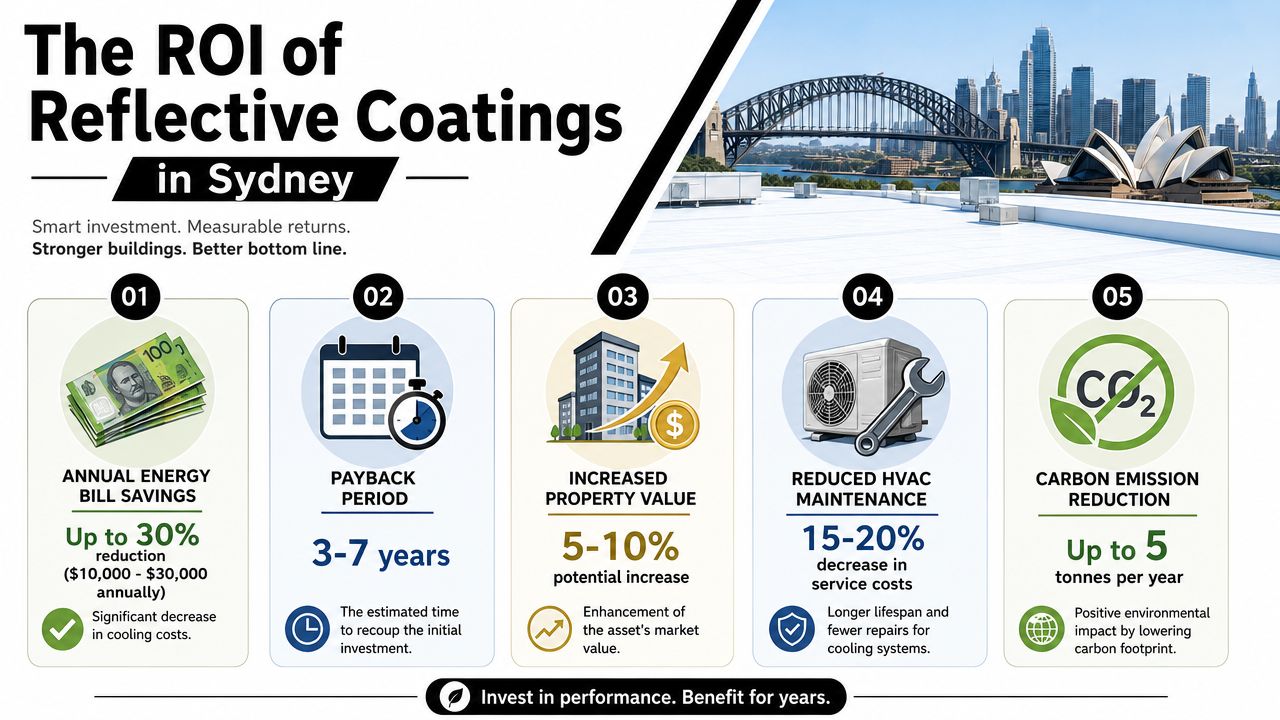
The return on a reflective roof coating doesn't come from one line item. It comes from stacking several practical benefits into one project. Lower heat load is the headline, but the full business case is broader than that.
The technology itself isn't fringe. The global reflective and cool roof coatings market was estimated at USD 4.9 billion in 2024 and is projected to reach USD 9.4 billion by 2034, growing at a 6.9% CAGR, according to Global Market Insights market analysis. For Sydney owners, that matters because it signals a mature and expanding category, not an experimental fix.
Where the financial return actually comes from
Start with cooling demand. On a warehouse or industrial building, a hot roof pushes heat into the envelope all day. If the occupied area below is air conditioned, plant has to work harder and longer. Reduce the heat entering the structure and you reduce that burden.
Then look at roof preservation. Sydney sun is hard on exposed roof surfaces. Reflective systems can help shield the existing roof from ongoing UV exposure and temperature cycling. That can slow surface ageing and help owners defer more expensive replacement work, provided the roof was suitable for coating in the first place.
The third gain is operational. Cooler roof surfaces generally create better conditions around rooftop plant and service access. That won't turn a neglected HVAC system into a good one, but it can reduce the punishment equipment takes when it sits above a heat-soaked deck.
Business view: The strongest coating projects are the ones where owners count energy, maintenance and capital deferral together. Looking at just one bucket understates the value.
A roof coating can also fit better into annual budgeting than replacement. If the choice is between controlled restoration now or a larger reactive spend later, many owners prefer the option that buys performance and time.
For planning discussions around roof spend more broadly, this article on commercial roof repair cost is useful background.
Why owners choose coating over replacement
Replacement is sometimes the right call. If the roof has major corrosion, widespread failure, saturated insulation, or repeated leak history that points to deeper defects, coating won't solve the root problem. Good contractors should say that clearly.
But many Sydney assets sit in the middle ground. The roof may be tired, discoloured and hot, yet still structurally viable. In that situation, a reflective coating can offer several advantages:
| Business issue | What coating may help with |
|---|---|
| High summer heat load | Reduces heat absorption at the roof surface |
| Ageing but serviceable roof | Extends usefulness of the existing roof assembly |
| Rising maintenance pressure | Pairs repairs and protection in one program |
| Budget constraints | Avoids immediate full replacement if the roof qualifies |
For strata buildings, there's another practical layer. Committees and managers often need a solution that improves comfort and controls costs without turning the whole property into a construction site. Coating can be a lower-disruption option than full tear-off work.
The mistake is treating coating as magic. It isn't. Its ROI depends on roof condition, the right specification, and disciplined installation. When those three line up, the business case is strong.
Navigating Australian Standards and Compliance
Performance claims in roofing need to be checked, not just repeated from a brochure. When you're assessing a reflective roof coating, independent rating frameworks matter because they give owners something firmer than marketing language.
What the ratings actually tell you
In practice, many Australian specifiers and manufacturers reference the Cool Roof Rating Council framework and ENERGY STAR-style performance thresholds when discussing reflective roof performance. Those benchmarks help owners compare products on measurable properties rather than colour alone.
The key point is simple. A coating should be judged on tested reflectivity and emissivity, including how those values hold after weathering. That helps separate high-performing systems from products that only look bright on day one.
When reviewing submittals or proposals, ask for:
- Tested reflectivity data rather than colour descriptions
- Aged performance information where available
- Substrate-specific approval for your roof type
- Installation requirements tied to the product warranty
Why compliance still needs a project view
Compliance isn't just about the coating pail. It includes the roof beneath it, the detailing around penetrations, and whether the project supports the building's broader energy objectives under the National Construction Code.
A product can have strong claimed performance and still fail on the building if the substrate is contaminated, unstable or wet. That's why documentation needs to line up with actual site conditions.
A compliant specification on paper won't rescue a roof that wasn't prepared properly.
Owners should also remember that a reflective roof coating is only one part of roof performance. Insulation levels, ventilation, HVAC design, drainage and maintenance standards all affect the outcome. The coating helps most when it's selected as part of a building-wide decision, not as a standalone cosmetic upgrade.
The Professional Application Process Matters
Most reflective roof coating failures aren't product failures first. They're preparation failures. Dirt left in place. Wet substrate. Leaks coated over. Film thickness guessed. Wrong primer. Wrong weather window. That's how owners end up paying twice.
Technical installation guidance for reflective roof coatings states that surfaces should be dry and free of contaminants before application, with some systems requiring a minimum roof-surface temperature of 24°C and at least 24 hours of dry weather after application, according to technical installation guidance for reflective roof coatings. The same guidance notes that coverage and film build materially affect performance.
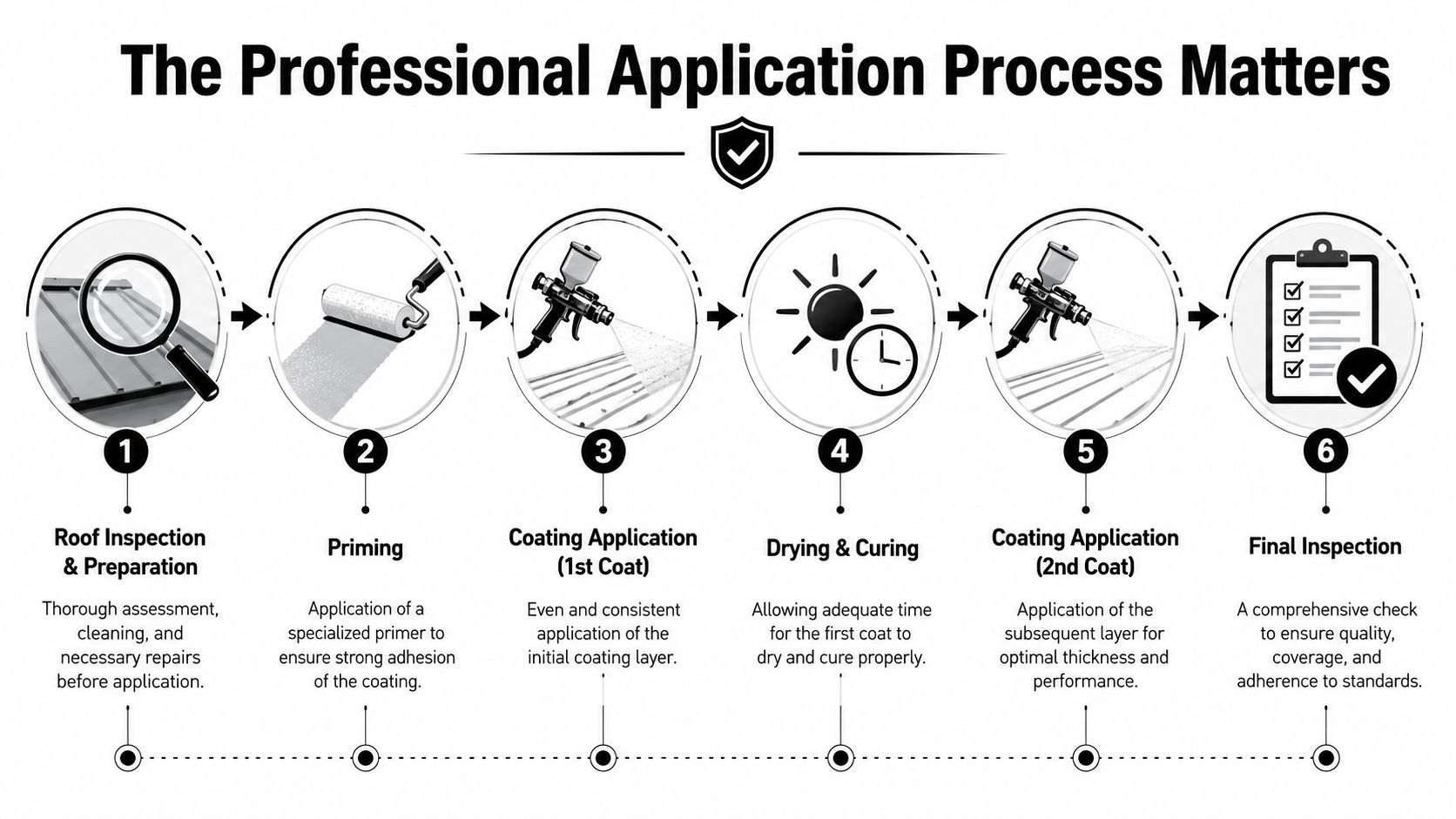
A professional process is easier to understand when you follow the job in sequence.
What a proper coating job looks like on site
The job starts with inspection, not spray equipment. The crew needs to identify leaks, corrosion, failed laps, loose fasteners, damaged flashings, ponding zones and any sign that the roof may be unsuitable for coating. If those issues aren't mapped first, the coating stage becomes guesswork.
Cleaning comes next. Commercial roofs hold more contamination than owners expect. Dust, oils, biological growth, loose coatings and airborne grime all interfere with adhesion. A roof can look clean from access level and still be nowhere near ready.
After cleaning, repairs are done before the coating system starts. That can include sealing joints, replacing damaged sections, tightening or changing fixings, and correcting localised defects. Then comes priming, where required by substrate and product system.
This walkthrough shows the process visually in the field:
The coating itself has to be applied at the specified build. Too thin and you underdeliver on performance and durability. Too thick in the wrong places and curing or adhesion can suffer. Professional crews track coverage, sequence the work around weather, and check the finished surface rather than assuming it's fine because it looks uniformly white.
Where coating projects usually go wrong
The failures repeat themselves from site to site:
- Leaks are coated, not repaired. Water keeps travelling beneath the new surface.
- Application happens in poor weather. Moisture gets trapped or curing is compromised.
- The wrong primer is used, or none at all. Adhesion problems follow.
- Film build isn't controlled. The roof looks complete but won't perform as specified.
- Ponding water is ignored. The system chosen doesn't suit actual roof conditions.
On-site lesson: A reflective roof coating is a membrane system, not a cosmetic paint job.
That's why specialist roofing knowledge matters. Good application isn't about speed. It's about sequencing, substrate judgement and respecting the product's limits.
Selecting the Right Product and Contractor
Procurement mistakes usually happen when owners compare prices before they compare scope. Two quotes can both say “reflective roof coating” and describe completely different jobs. One includes repairs, primer, reinforcement and measured film build. The other is little more than surface colour.
What to check on the product side
Start with the technical data sheet and warranty conditions. The questions should be practical.
Ask what substrates the system is approved for. Ask what preparation is required. Ask whether the system is suitable for the roof's drainage behaviour. Ask what happens to the warranty if rust treatment, seam repair or primer stages are skipped.
A good product review should also cover:
- Compatibility with your existing roof material
- Required preparation before application
- Specified dry film thickness or coverage target
- Warranty terms tied to maintenance and substrate condition
- Aged performance data rather than appearance claims alone
If the answer to everything is “it depends”, keep asking until the dependency is clear.
What to check on the contractor side
Contractor selection matters as much as product choice. The right crew should be able to inspect the roof, identify what can and can't be solved with coating, and explain the sequence in plain language.
Use this shortlist when vetting:
| Check | What you want to hear |
|---|---|
| Commercial experience | They've handled similar warehouse, industrial or strata roofs |
| Inspection quality | They identify defects before pricing the coating |
| Insurance and licensing | Current and suitable for commercial roofing work |
| Scope detail | Repairs, cleaning, primers and coating stages are written clearly |
| References | They can point to comparable completed work |
Be cautious of anyone who promises coating before they've seen the roof properly. The honest answer on some buildings is that coating isn't the right remedy. That answer usually comes from the more credible contractor.
Maintenance Plan and Project Checklist
A reflective roof coating isn't a fit-and-forget upgrade. It performs best when owners maintain the surface, keep drainage working and deal with minor damage early. Ignore it for years and even a good system will underperform.
A simple maintenance plan that preserves performance
Keep the plan straightforward. Commercial owners don't need theatre. They need repeatable checks.
- Annual visual inspection. Look for coating wear, cracks, lap movement, impact damage and changes around penetrations.
- Periodic cleaning. Dirt and biological growth can dull reflectivity and hide defects.
- Spot repair. Small failures should be fixed before water gets underneath the system.
- Drainage check. Clear outlets, gutters and sumps so water doesn't sit where it shouldn't.
- Re-coating review. Assess the roof condition periodically and decide whether local repair or broader renewal is the smarter move.
For budgeting and planning those ongoing works, this guide to commercial roof maintenance cost is a practical reference.
Project checklist for owners and strata managers
Before approving a project, run through this list:
- Confirm the roof is suitable for coating. Don't assume. Inspect it properly.
- Identify leaks and defects first. Repairs come before reflectivity.
- Match the coating to the substrate. Metal, membrane and concrete don't behave the same way.
- Review the technical data sheet. Focus on compatibility, preparation and application requirements.
- Check the contractor's commercial track record. Similar roofs matter more than generic painting experience.
- Compare scope, not just price. Preparation and detail work often separate a lasting result from a short-lived one.
- Plan the weather window. Stable dry conditions matter.
- Inspect the finished work. Don't sign off from the car park.
- Set a maintenance schedule. Protect the investment while the roof is still in good order.
A reflective roof coating can be one of the smarter upgrades available to a Sydney commercial property. But only when the roof qualifies, the system matches the substrate, and the application is done properly.
If you're weighing up whether a reflective roof coating is the right move for your warehouse, strata complex or industrial site, Commercial Roofers can assess the roof condition, explain the repair-versus-coating decision clearly, and deliver a compliant commercial roofing solution across Sydney and NSW.