
A warehouse manager arrives after a night of wind-driven rain and finds water tracking across the ceiling, running into a wall cavity and dripping beside stored stock. The visible stain may be several metres from the entry point, while a blocked box gutter, lifted flashing or failed penetration detail continues feeding moisture into the building.
That's why commercial roof leak repair isn't a matter of applying sealant where water appears. The repair has to protect stock, electrical systems, tenants and the building envelope, while producing a result that can be explained to an insurer, strata committee or facilities team.
Table of Contents
- Why Commercial Roof Leaks Demand More Than a Quick Patch
- Finding the Real Leak Source Before You Repair Anything
- Temporary Fixes Versus Permanent Repairs and Choosing Right
- Repair Methods and Materials for Commercial Roof Systems
- Safety, Asbestos and Compliance Considerations
- When to Call Professional Commercial Roofers
- Preventative Maintenance That Stops Leaks Returning
Why Commercial Roof Leaks Demand More Than a Quick Patch
Commercial roofs behave as complete systems. Metal sheets, membranes, flashings, gutters, outlets, penetrations, parapets and junctions all work together to move water away from the building. When one component fails, water can travel through laps, insulation, ceiling spaces and wall cavities before it becomes visible.
A ceiling drip tells you where the water became noticeable, not necessarily where it entered. Wind can drive rain beneath a flashing, across a roof sheet or into a poorly sealed penetration. Gravity then carries the water along the easiest route, which may leave the original defect far behind.
The business cost sits below the surface
A leak can interrupt warehouse operations, damage stock, stain internal finishes and create hazards around lighting, machinery and electrical equipment. In a strata property, the same defect can affect common property, multiple lots and the relationship between owners, managers and contractors.
Australian building-sector research gives useful context. About 21% of managers of non-residential buildings identified waterproofing or weatherproofing defects, including roof leaks, while 30% of buildings had external leaks. The same source reported serious waterproofing issues in 42% of new NSW strata apartment buildings, with the estimated annual economic cost of waterproofing defects in new Australian residential apartment construction ranging from $121 million to $314 million. These figures are documented in the Australian disaster resilience analysis of building waterproofing and weatherproofing defects.
Those figures don't turn every leak into a major failure, but they do show why owners shouldn't treat recurring moisture as a minor maintenance nuisance. The asset risk grows when a repair only hides the symptom and leaves the entry path active.
Practical rule: Protect the inside of the building immediately, but investigate the outside of the building before approving a permanent repair.
A useful general explanation of how roof leaks and water damage develop can help non-roofing stakeholders understand why internal staining often appears after the original failure. On a commercial site, though, the response must go further. The roof system, drainage paths and junction details need to be assessed together.
The right starting point is therefore not “Which sealant should we use?” It's “What roof system is installed, where is water entering, and what allowed it to get there?” That shift prevents a cheap patch from becoming an expensive repeat call.
Finding the Real Leak Source Before You Repair Anything
Start with the roof system, not the stain. A commercial building may have a metal roof, a concrete deck with a membrane, a box gutter arrangement, rooflights, plant platforms or several systems joined during past alterations. Each material has different movement, joint and compatibility requirements.
The investigation should follow a repeatable sequence.
Identify the roof and trace the water
First, record the roof construction and its apparent condition. Look for membrane type, metal profile, sheet laps, box gutters, parapets, skylights, penetrations, expansion joints and previous patching. Unknown repair products are a warning sign because an old silicone, bitumen or acrylic patch may not accept the new material.
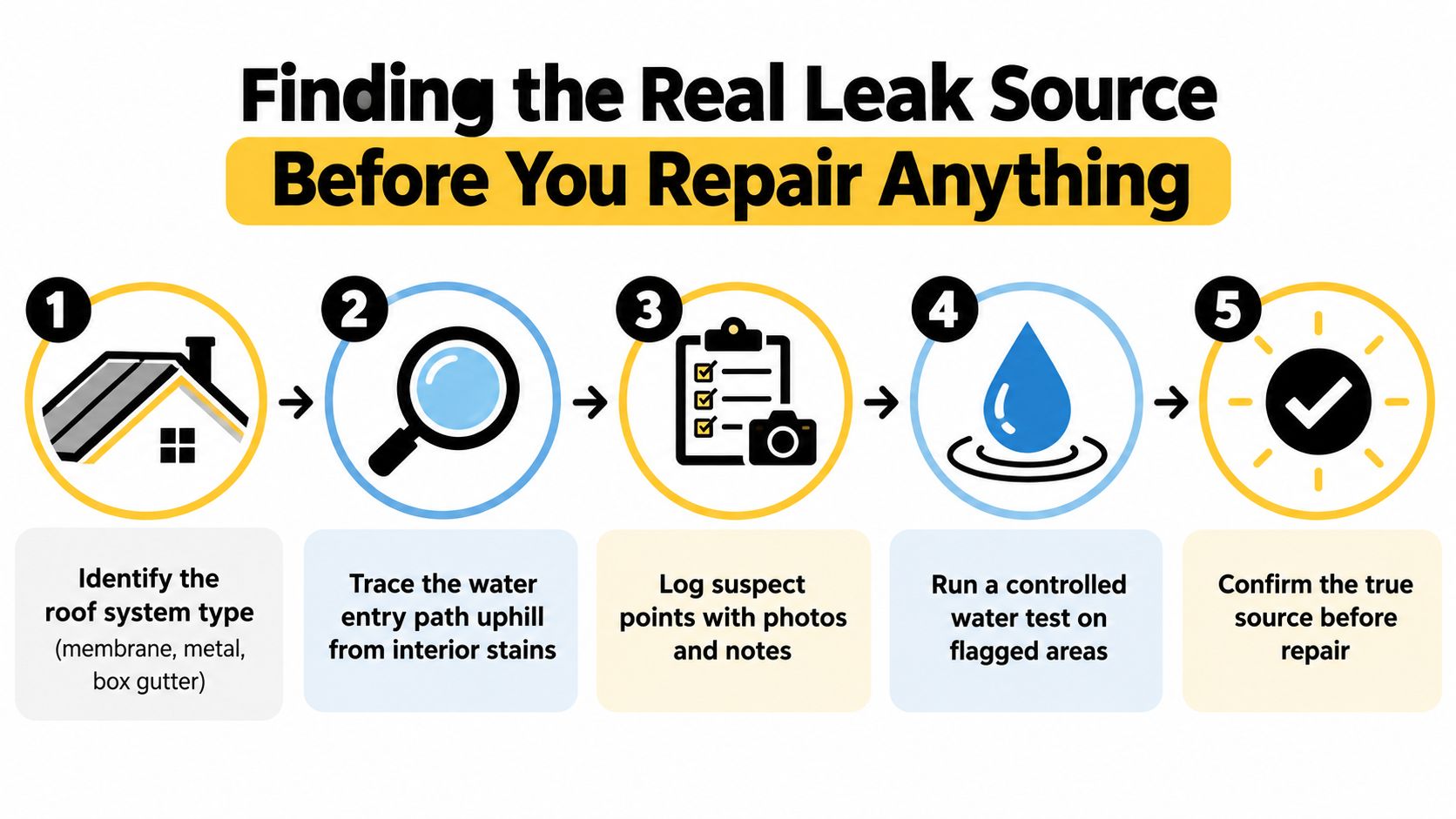
From inside, map the stain, damp insulation, damaged plasterboard and any affected wall cavity. Then work uphill and outward from that evidence on the roof. Check every transition where water can change direction, including:
- Flashings and upstands: Look for open joints, loose edges, corrosion, inadequate laps and sealant that has shrunk away from the substrate.
- Penetrations and rooflights: Inspect pipe boots, mechanical plant supports, skylight frames, fixings and the surrounding membrane or sheet.
- Drainage points: Check outlets, sumps, gutters, overflow paths and box gutters for debris, blocked entries, damaged joints or backfall.
- Movement zones: Examine expansion joints, sheet laps, membrane seams and areas where different materials meet.
- Ponding areas: Note standing water, soft substrate, blistering, distortion or evidence that falls direct water towards rather than away from the building.
The commercial roof leak detection guide is a useful reference for organising this inspection, especially where the internal stain doesn't line up with an obvious external defect.
Match the evidence to the weather
Rainfall conditions matter. A defect may only leak during wind from a particular direction, during intense rainfall, or when a blocked outlet fills a gutter. A dry-day visual inspection can identify likely entry points, but it can't prove that every suspect detail is the source.
A controlled water test can help, provided the technician isolates zones and allows time for water to travel through the assembly. Flooding an entire roof at once creates ambiguous results and can introduce water into areas that weren't previously leaking.
Thermal imaging, moisture meters and drone imagery can add evidence, particularly on large roofs or inaccessible areas. None of these tools replaces judgement. Thermal patterns can reflect insulation, sun exposure or trapped moisture, while a moisture meter only means something when the operator understands the roof build-up.
Document before authorising work
A defensible report should identify the roof system, inspected areas, access limitations, weather conditions, visible defects and the evidence supporting the proposed source. Add roof plans or marked-up photographs where possible, and state whether the inspection occurred after rain or included a controlled wet test.
The report should distinguish between confirmed source, probable source and untested areas. That distinction protects the owner from approving a narrow repair on incomplete evidence and gives an insurer or strata committee a clear record of what the contractor could and couldn't verify.
Waterproofing is the most common serious defect type in surveyed NSW buildings, accounting for 22% of serious defects, while 53% of surveyed buildings showed serious defects overall, according to Australian guidance on building repairs and maintenance. The same guidance reinforces the practical point that water can enter through flashings, penetrations, ponding and drainage faults rather than the place where the ceiling gets wet.
Temporary Fixes Versus Permanent Repairs and Choosing Right
A temporary fix has a legitimate role. If rain is entering above stock, electrical equipment or a tenant's occupied area, immediate containment can limit damage while the roof dries or safe access becomes available. The mistake is allowing that emergency measure to become the permanent scope by default.
Temporary work may include a secured tarp, a controlled diversion of water, emergency-compatible sealant at an exposed opening, or protection beneath the leak. It should be recorded as temporary, dated and followed by a proper inspection. Loose plastic, unapproved sealants and improvised fixings can create a second defect or make the eventual repair harder.
| Factor | Temporary Fix | Permanent Repair |
|---|---|---|
| Purpose | Limit immediate water entry and protect people, stock and equipment | Restore the failed roof system and remove the underlying cause |
| Suitable conditions | Active rainfall, unsafe access, urgent internal exposure or no safe weather window | Dry, accessible conditions with enough time to prepare and test the repair |
| Typical action | Tarping, temporary diversion, protection of stock and isolation of affected areas | Replacement or reinstatement of membrane, flashing, sheet, joint or drainage detail |
| Main limitation | Doesn't prove or correct the leak source | Requires diagnosis, compatible materials and proper substrate preparation |
| Record required | Location, date, limitation and follow-up requirement | Defect photographs, materials, workmanship, testing and warranty information |
| Wrong application | Left in place until it cracks, shifts or conceals ongoing moisture | Specified as a cosmetic patch without correcting ponding, movement or failed laps |
What a cosmetic patch leaves behind
Sealant can close a visible gap, but it can't restore a missing lap, correct backfall or replace a corroded flashing. If the substrate is damp or contaminated, the new material may bond poorly. If the roof moves, a rigid patch can split beside the original defect.
Australian waterproofing defect data attributes 83% of failures to a combination of design and workmanship issues, with the remainder primarily associated with workmanship alone, as reported in the Australian Building Codes Board waterproofing analysis. That finding supports a broader repair scope when the detail itself is poorly designed or installed.
A permanent repair should explain what failed and what will change. For example, replacing a deteriorated penetration boot may require renewing the surrounding flashing, checking the supporting kerb and confirming that water doesn't pond against the detail. Resealing a box gutter joint may require cleaning, substrate repair and inspection of the outlet and overflow path.
For a clear view of the stages involved in more extensive work, review the commercial roof restoration process. The important distinction is simple: emergency containment buys time, while permanent repair removes the reason the water entered.
Repair Methods and Materials for Commercial Roof Systems
The correct method depends on the roof build-up, the defect and the condition of the surrounding area. A contractor who proposes the same tape or sealant for every commercial roof hasn't yet done enough diagnosis.
Membrane roofs need continuity restored
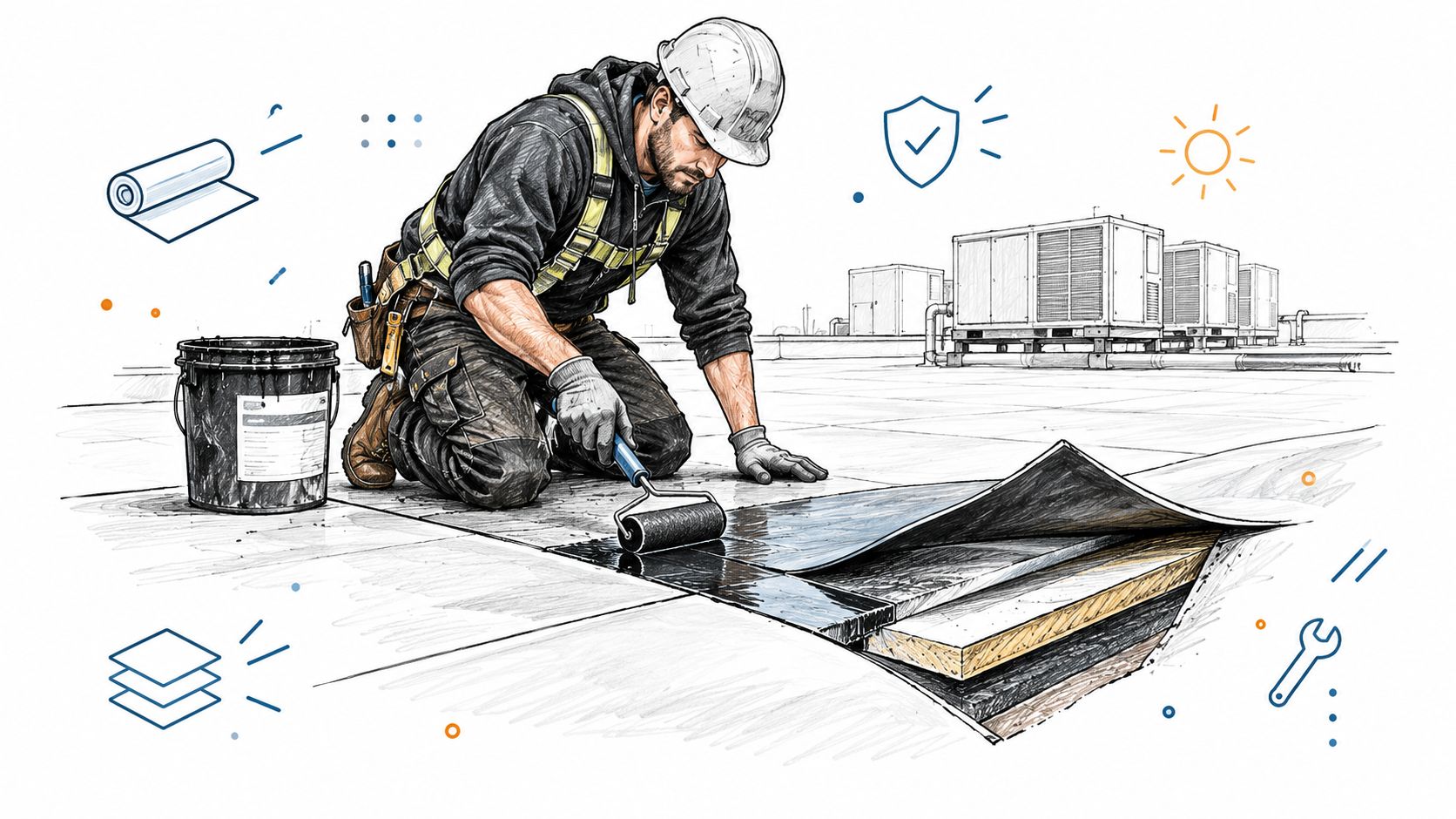
On a membrane roof, the visible split is only one part of the detail. The repair must account for membrane continuity, substrate condition, falls, laps, junctions, penetrations and edges. A patch applied over wet insulation or a loose membrane may seal the top surface while moisture remains trapped below.
NSW guidance requires roof membranes on horizontal surfaces to comply with AS 4654.1 and be designed and installed to AS 4654.2. The guidance means a compliant repair should trace the leak path, verify the substrate, then reinstate membrane continuity, falls, junction detailing and drainage at penetrations and edges, as set out in the NSW building defects library.
A sound membrane repair normally involves cleaning and drying the area, removing failed material, checking adhesion and substrate stability, and using a compatible patch, welded detail or liquid-applied system. The repair should extend onto sound membrane and be formed without creases, fishmouths or unsealed corners. If ponding remains, the water-management problem still exists after the patch cures.
A technician should also check whether the membrane has shrunk, cracked broadly, blistered or separated across several zones. Local repair suits local failure. Widespread deterioration usually calls for a refurbishment assessment or replacement decision.
This video provides a visual introduction to commercial roof repair work and the preparation required before materials are applied.
Metal roofs require detail work, not just sheet work
On a metal roof, inspect the sheets, side laps, end laps, fasteners, washers, flashings, gutters and penetrations as one assembly. A failed screw washer can admit water, but replacing that screw won't solve a flashing that terminates incorrectly or a gutter that holds water against the sheet end.
Depending on the defect, the work may involve replacing damaged sheets, renewing fasteners with compatible washers, rebuilding a flashing junction, resealing a properly prepared lap or replacing a corroded gutter section. Sheet replacement should include an assessment of the supporting structure and adjacent sheets, because corrosion and movement can extend beyond the first visible hole.
Box gutters deserve particular attention. Check the gutter lining, seams, sumps, outlets, overflow provisions and the condition of any adjacent roof sheets. Clearing debris is useful maintenance, but it isn't a repair for failed lining or incorrect falls.
The same discipline applies to flashing selection. Profiles, metals, coatings and sealants must be compatible with the existing roof and exposure conditions. The commercial roof flashing types guide can help an owner understand why a flashing quote should identify the profile and location rather than just say “replace flashing”.
Ask the contractor to specify the roof system, defect location, preparation method, materials, affected area, drainage work, testing method and warranty exclusions. A vague “patch and seal” line item doesn't give the owner enough information to compare quotes or manage future maintenance.
Safety, Asbestos and Compliance Considerations
A commercial roof isn't a safe place for untrained staff to investigate. Large roofs contain fragile skylights, unprotected edges, wet surfaces, hidden voids and plant or service penetrations. Working-at-height controls, suitable access, exclusion zones and fall protection need to be arranged before anyone walks onto the roof.
Internal investigation has risks too. Wet ceilings can fail without warning, and water near electrical equipment requires isolation by the appropriate qualified person. Facility staff can photograph stains and protect stock from a safe position, but they shouldn't climb onto the roof to chase a leak.
Older roofs need material identification
Older Sydney warehouses and industrial buildings may contain asbestos cement roofing or other hazardous materials. Drilling, cutting, pressure cleaning or breaking a suspect sheet can release fibres and expose workers, tenants and neighbouring areas.
If asbestos is suspected, stop intrusive work and arrange assessment by a competent asbestos professional. Removal and replacement must follow Australian requirements, including the use of appropriately licensed contractors where required, controlled handling, disposal and clearance processes. Painting over or casually sealing damaged asbestos sheeting isn't a substitute for a documented risk assessment.
Build a repair record that survives scrutiny
A useful commercial repair file should contain:
- Site and access details: Record the roof areas inspected, access restrictions and any zones not reached.
- Condition evidence: Keep dated photographs of internal damage, roof defects, flashings, outlets, penetrations and previous repairs.
- Defect classification: Separate urgent safety or water-entry issues from defects that can be monitored.
- Repair scope: State the materials, preparation, affected roof zones and any exclusions.
- Verification: Record whether the repair was visually checked, wet-tested or inspected after rain.
- Follow-up: Note outstanding work, monitoring requirements and the next condition review.
This information supports an insurance notification without assuming that every defect is storm damage. Notify the insurer promptly when an event may be covered, protect the site from further damage where safe, retain failed materials when practical and avoid disposing of evidence before receiving direction.
Strata managers should also circulate a clear summary to the committee and affected owners. The record should explain what was found, what was contained, what remains uncertain and what decision is recommended. That clarity reduces disputes when a leak returns or when a broader project becomes necessary.
When to Call Professional Commercial Roofers
Escalate the job when the leak source remains uncertain, the same area has leaked repeatedly, several roof zones are aging or safe access is restricted. Multiple wet areas after one storm can indicate a broader envelope or drainage failure rather than several unrelated pinholes.
Replacement or partial renewal deserves consideration when the roof has widespread deterioration, recurring failed patches, saturated insulation, soft substrate, extensive ponding or details that no longer provide a reliable repair surface. A low-cost spot fix may be false economy if the remaining service life is short and each return visit disrupts tenants or operations.
Recent Australian reporting templates call for zone-by-zone risk priorities, photo logs and follow-up timing, allowing owners to compare repair cost with residual service life and business disruption, as described in guidance on when to order a roof report. That approach turns a leak call into an asset-management decision.
A suitable commercial roofer should provide:
- A site inspection that identifies likely ingress paths.
- A written report separating confirmed defects from limitations.
- A repair-versus-replacement recommendation.
- A transparent quote with materials, preparation and exclusions.
- Evidence of licensing, insurance and safety controls.
- Clear workmanship and material warranty terms.
- A programme that accounts for tenants, stock, access and operating hours.
Don't select a contractor solely because the first quote is the smallest. Compare the scope, diagnosis and residual risk. The cheapest patch is only cheap if it stops the leak without creating a larger problem.
Preventative Maintenance That Stops Leaks Returning
Prevention starts with the full roof catchment, not just the sheet or membrane. Gutters, box gutters, flashings, outlets, overflows, penetrations and junctions determine where stormwater travels and whether it can escape safely.
After Cyclone Larry, 75% of homes had some form of water ingress damage. In a separate Queensland assessment of 19 damaged strata-title buildings in Airlie Beach, 10 had roofing damage, eight had significant water-ingress issues and seven had flashing damage. In Proserpine, water ingress affected 41% of damaged buildings, compared with roofing at 14% and guttering at 13%, according to the Australian severe-weather damage assessment.
The practical lesson for NSW commercial assets is that a roof maintenance plan must include the components that direct and contain water. A clean roof sheet won't compensate for a blocked outlet or failed flashing.
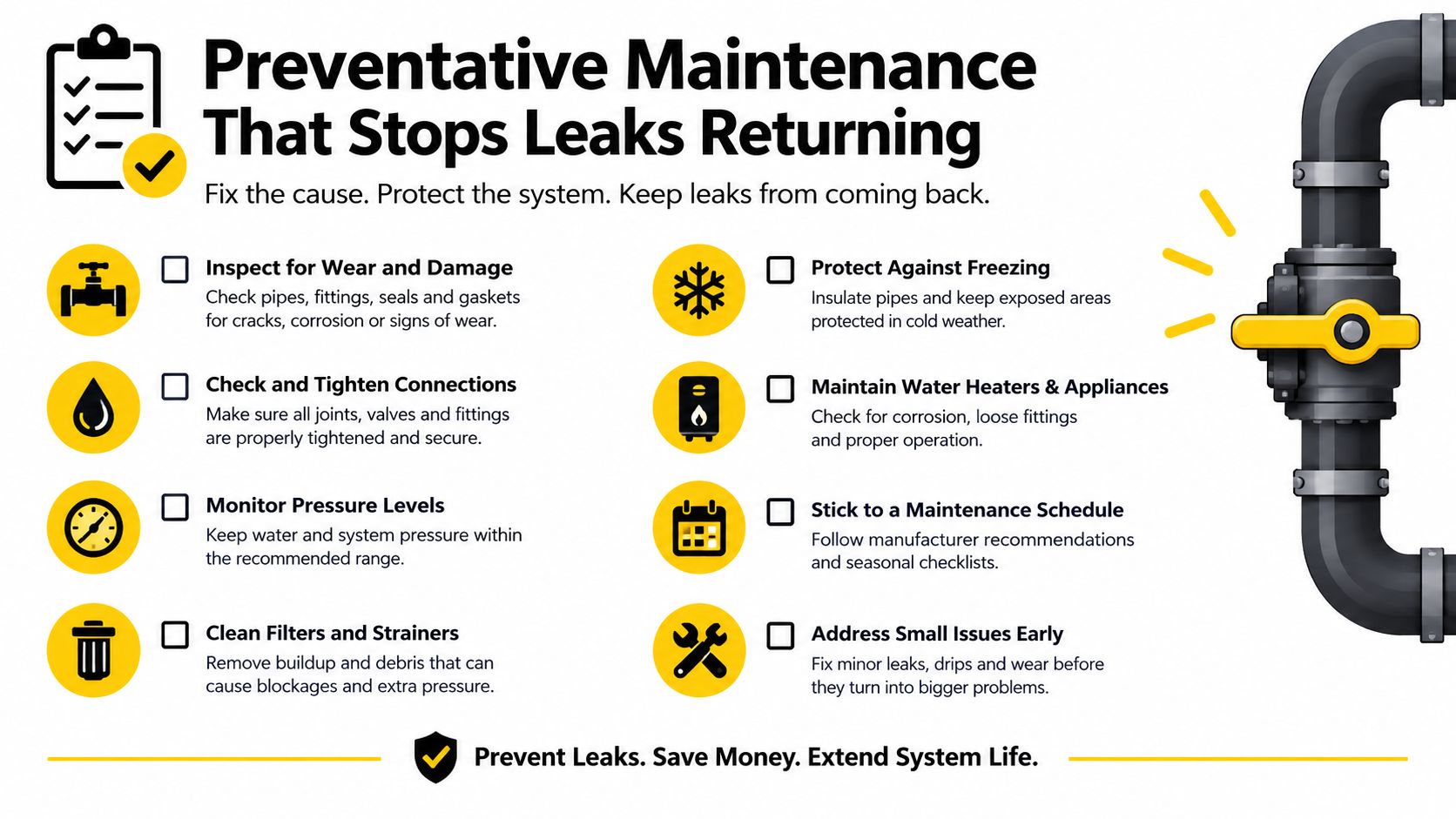
Give the facilities team a usable checklist
- Schedule condition reporting: Arrange periodic inspections and record changes by roof zone.
- Clean drainage paths: Remove debris from gutters, sumps, outlets and box gutters before heavy-rain periods.
- Inspect flashings: Look for open joints, corrosion, movement, loose edges and failed sealant.
- Check penetrations: Review pipe boots, plant supports, skylights and service penetrations for movement or cracking.
- Look for ponding: Photograph standing water and investigate falls, blocked outlets or backfall.
- Track previous repairs: Keep material details, photographs, dates and warranty information together.
- Review after severe weather: Inspect vulnerable areas after wind-driven rain, hail or falling branches.
- Plan renewal: Compare recurring repair costs with condition, remaining service life and operational disruption.
A maintenance record also protects future decisions. When the same zone appears in several reports, the owner can see that the problem is persistent rather than authorising another isolated patch without context.
The most reliable way to repair roof leaks is to confirm the entry path, correct the failed detail, test the result and monitor the roof afterwards. That diagnostics-first habit protects the building and gives the facilities team evidence for the next repair, renewal or insurance decision.
Commercial Roofers offers commercial and industrial leak inspections, ingress-path diagnosis, compliant repairs, flashing and gutter work, restoration and full roof replacement across Sydney and NSW. If your building has recurring leaks or uncertain roof condition, visit Commercial Roofers to request an inspection and discuss a repair plan built around the roof system, safety requirements and operational needs.