
The roof is leaking above the loading area, summer electricity bills are climbing, and a full replacement would disrupt tenants, stock movements and production. That's the position many Sydney warehouse and factory owners face. An industrial roof coating can help, but it isn't a tin of paint rolled over a dirty roof. It's a specified membrane system that only works when the existing roof, substrate, drainage, exposure and installation method all line up.
The right coating can protect weathered metal, improve reflectivity and defer disruptive replacement work. The wrong product, applied over trapped moisture or corrosion, merely hides the problem until the next leak appears. The commercial decision is therefore broader than the purchase price. You're buying a roof management strategy, with compliance, access, maintenance and future recoat costs built into the result.
Table of Contents
- Understanding the Industrial Roofing Challenge
- Types of Industrial Roof Coatings Available
- Performance Metrics and Australian Standards
- Selecting the Right Coating for Your Facility
- Application Process and Contractor Safety
- Lifecycle Costs and Maintenance Schedules
- Key Takeaways for Commercial Property Owners
Understanding the Industrial Roofing Challenge
Large industrial roofs take a beating. Sydney's strong sunlight, salt carried inland from coastal areas, wind-driven rain, plant exhaust, foot traffic and repeated temperature changes all place stress on roof sheets, fasteners, flashings and existing membranes. A warehouse may look serviceable from ground level while failed sealants, open laps or damp insulation are already increasing the risk of internal damage.
Cooling is another pressure point. Australian federal guidance says painting roofs white or applying special reflective coatings can significantly reduce air-conditioning loads, particularly on large buildings and in hotter inland climates. Independent Australian commentary estimates that commercial and industrial roofs represent about 400 million square metres of building area, and notes that if 25% is air-conditioned, the associated cooling demand becomes substantial. The same commentary cites field trials in which reflective roof coating approaches delivered around 50% air-conditioning energy savings, alongside national installation of about 500,000 square metres of SkyCool roofs. These figures are reported in Australian commercial roofing commentary, and they show why reflectivity is now considered alongside waterproofing and asset protection.
Coating is not a substitute for roof repairs
A coating can bridge minor surface defects and create a continuous protective layer, but it won't correct structural movement, failed drainage, widespread corrosion or saturated insulation. Before anyone discusses colour or product selection, the roof needs a condition assessment that identifies:
- Active leaks: Trace water entry back to laps, penetrations, box gutters, flashings and drainage points rather than coating over internal stains.
- Substrate condition: Check adhesion, rust, chalking, loose finishes and compatibility with the proposed primer.
- Moisture: Test areas where insulation or the roof deck may have retained water.
- Access and use: Account for plant, roof traffic, skylights, exhausts and maintenance routes.
- Building records: Confirm previous repairs, warranties, hazardous materials and any planned redevelopment.
Practical rule: A coating preserves a sound roof. It doesn't turn a failed roof structure into a sound one.
The hidden cost is often operational. A poorly planned project can restrict forklift routes, interrupt dispatch, require temporary weather protection or force tenants to relocate sensitive stock. A properly scoped coating project should be scheduled around the facility's production pattern, with clear controls for overspray, wet-weather delays, roof access and curing.
For owners, the useful question isn't just, “How much does coating cost?” Ask instead, “What roof failures am I preventing, what cooling load may I reduce, and what work will still be required before application?” That framing exposes the lifecycle cost before the contract is signed.
Types of Industrial Roof Coatings Available
No single coating suits every industrial roof. Product choice depends on the existing substrate, ponding risk, chemical exposure, movement, desired appearance and the quality of preparation. Reflectivity matters, but it must sit inside a complete waterproofing and maintenance specification.
Acrylic systems
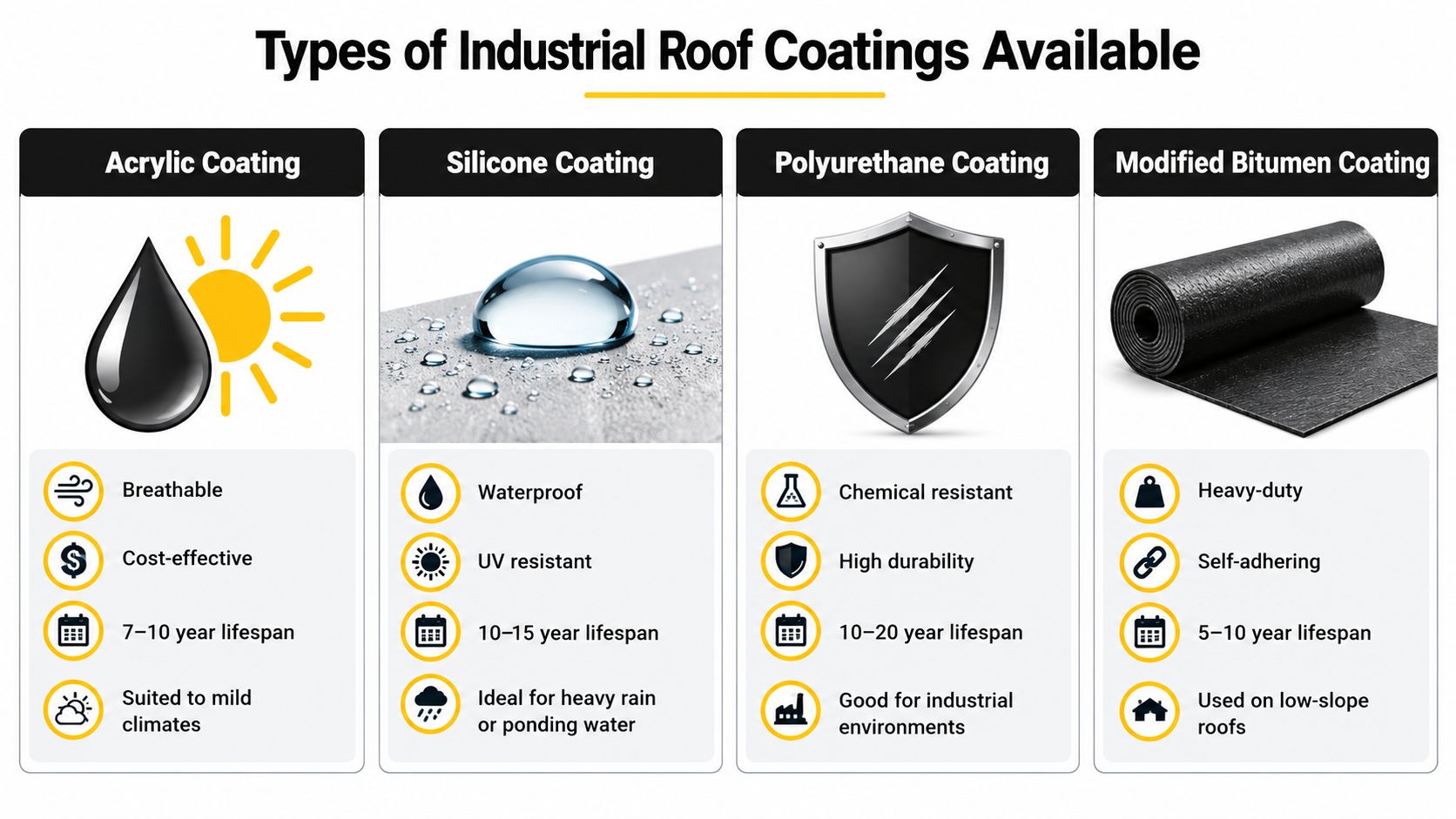
Acrylic coatings are commonly considered for metal roofs and other sound substrates where UV resistance, colour retention and solar reflectivity are priorities. They're generally easier to apply than heavier systems and can be a sensible option where the roof has adequate drainage and limited exposure to persistent ponding.
Their weakness is water management. An acrylic finish shouldn't be selected merely because it's bright and reflective if the roof holds water after rain. The contractor still needs to correct drainage issues and confirm that the product's technical data supports the site conditions.
Silicone systems
Silicone is often shortlisted for low-slope roofs exposed to heavy rain or areas where short-term ponding is difficult to eliminate. Its water-shedding characteristics and UV resistance can make it suitable for demanding roof environments, provided the existing surface is clean, dry and compatible.
Silicone also brings trade-offs. It can be difficult to recoat with another chemistry, and the finished surface may require careful detailing around walkways and maintenance zones. A specification should identify where technicians can safely stand and how future repairs will bond.
Polyurethane and polyurea
Polyurethane systems are useful where abrasion, impact or chemical exposure places more stress on the roof than ordinary weathering. Factories with aggressive atmospheres, service areas and roofs subject to regular maintenance traffic may need the added toughness of a reinforced system rather than a basic reflective layer.
Polyurea cures rapidly and can produce a highly durable membrane when installed with specialist equipment and tight process control. That speed is valuable where downtime must be limited, but it also leaves less room for poor preparation or inconsistent spraying. Crew experience, substrate moisture and edge detailing become decisive.
Modified bitumen and restoration membranes
Modified bitumen coatings and membranes remain relevant on low-slope roofs, particularly where compatibility with an existing bituminous system is important. They can provide heavy-duty waterproofing, but they aren't automatically the best answer for a roof whose main problem is heat gain. Existing blisters, open seams and wet areas still require repair before the membrane is installed.
BlueScope's Thermatech commercial and industrial facts sheet reports that COLORBOND steel with Thermatech in moderate to hot climates can reduce annual cooling energy use by up to 20%, with an average reduction of about 5%, and can lower peak roof temperatures by up to 11°C. The same sheet says some architectural sandwich panels can be up to 13°C cooler on their external skin. Those figures relate to tested steel and panel systems, not a blanket promise for every liquid coating, so the product evidence must match the proposed roof assembly.
For a practical comparison of reflective systems and their application considerations, see this guide to reflective roof coating options. The useful outcome is not choosing the most advanced chemistry. It's choosing the simplest system that can handle the roof's actual exposure and be maintained by the next contractor.
Performance Metrics and Australian Standards
“Reflective” and “waterproof” are not complete specifications. A coating can look white and still perform poorly if the substrate is dirty, the film thickness is inconsistent or insulation allows heat to pass into the building. Performance needs measurable criteria, documented preparation and a clear warranty scope.
The Australian Building Codes Board's 2024 technical basis paper for NCC 2025 identifies a cool-roof criterion of total solar reflectivity above 0.55 and emissivity above 0.85. These values provide a technical benchmark for reflective roof systems in commercial and industrial design discussions.
What the measurements mean
Solar reflectivity describes how much incoming solar energy the surface reflects. Thermal emissivity describes how effectively the surface releases absorbed heat. A good cool-roof specification considers both, rather than relying on colour alone.
The coating also needs to perform as a membrane. That includes adhesion, crack accommodation, resistance to weathering, water exposure and compatibility with the roof below. The written specification should state the target dry-film thickness, primer requirements, reinforcement at vulnerable details and the inspection method used to verify coverage.
| Standard or metric | Purpose | Key requirement |
|---|---|---|
| Solar reflectivity | Indicates how much solar energy the surface reflects | The NCC 2025 technical basis paper identifies a cool-roof criterion above 0.55 |
| Thermal emissivity | Indicates how effectively the surface releases absorbed heat | The same criterion identifies emissivity above 0.85 |
| AS 4654.1:2012 | Addresses external above-ground waterproofing membranes | Specify the coating system for the relevant substrate and exposure |
| AS 4020:2018 | May apply where membrane systems are adjacent to potable water | Confirm suitability where water-contact requirements exist |
| Film thickness and adhesion | Confirms installation quality and expected membrane performance | Require manufacturer targets and documented site checks |
Australian projects commonly specify external above-ground waterproofing membranes against AS 4654.1:2012, while systems near potable water may also be assessed against AS 4020:2018, as outlined in this commercial and agricultural membrane guidance. The standard alone doesn't select the product. Exposure, slip resistance, water contact and substrate compatibility still need to be addressed.
“Reflectivity is one performance measure. It isn't permission to ignore drainage, insulation or detailing.”
The Australian roofing standards guide is useful when assembling the broader compliance checklist. In practice, request current technical data sheets, safety data sheets, application instructions, test evidence and warranty conditions. Also confirm whether the stated performance applies to the exact product, colour, thickness and roof build-up being proposed.
Selecting the Right Coating for Your Facility
Start with the building, not the product brochure. A weathered Colorbond roof in a western Sydney warehouse has different needs from a concrete deck above a plant room or a low-slope membrane roof beside the coast. The right system follows a sequence of site decisions.
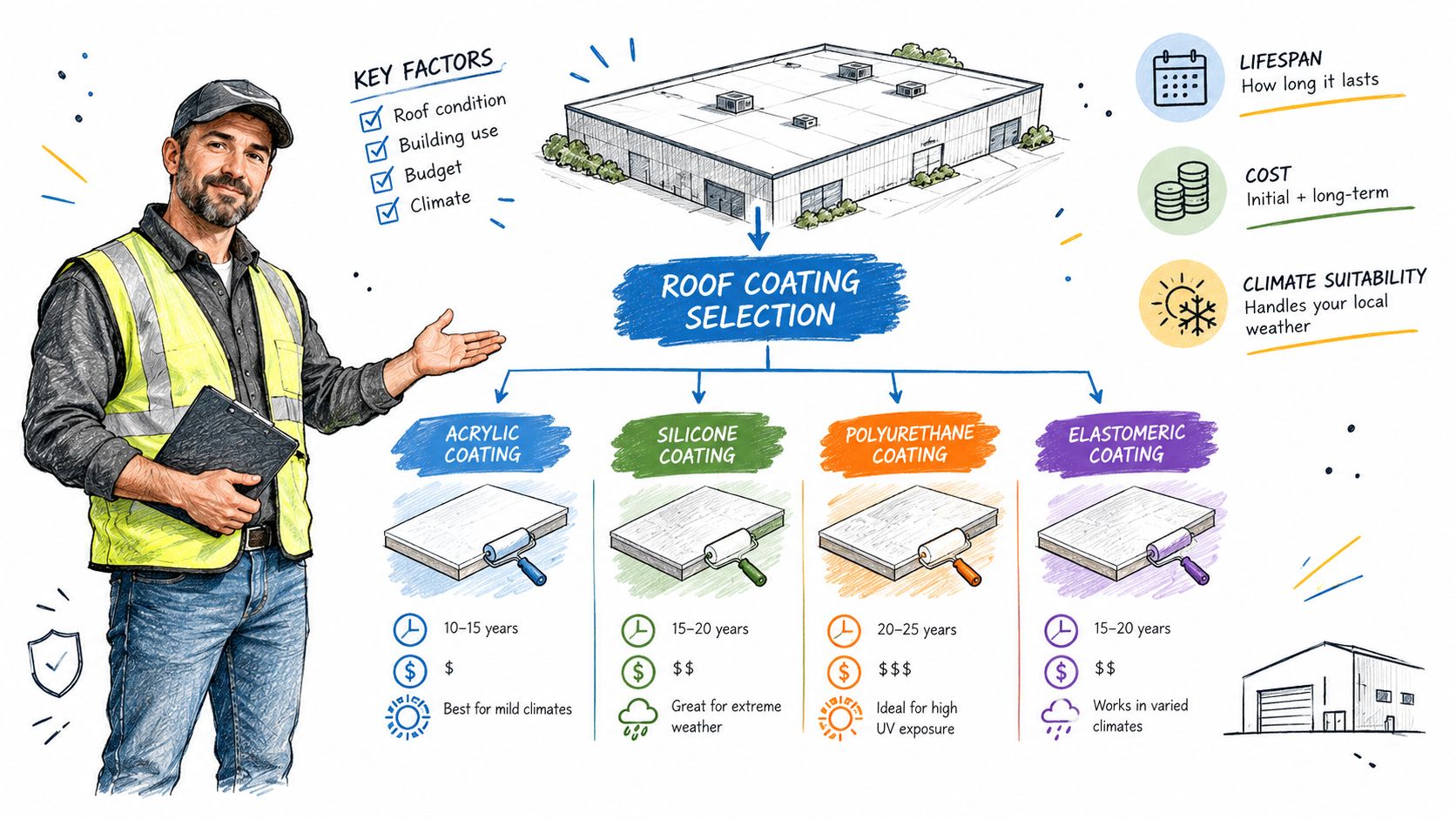
Step one is substrate and roof condition
Identify the roof material, age, previous coatings and areas of corrosion. Galvanised steel, COLORBOND, concrete, modified bitumen and existing membranes each require different cleaning and priming methods. If rust has reduced sheet thickness or fasteners are failing, restoration may be inappropriate in those areas.
A roof with sound sheets but degraded surface protection may be a strong coating candidate. A roof with widespread movement, saturated insulation or failing structural supports is a replacement or major repair project first.
Step two is geometry and water behaviour
Flat and low-slope roofs demand close attention to ponding, outlets, sumps and box gutters. Walk the roof after rain if possible, inspect drainage paths and ask where water remains. Don't choose silicone only to tolerate a drainage defect that could be corrected more reliably with falls, outlet work or repairs.
Pitched metal roofs may place greater emphasis on corrosion control, fastener sealing, laps and UV exposure. Walkways to air-conditioning plant should be designed as part of the project, not added later by dragging equipment across a newly cured coating.
Step three is the facility's atmosphere
Factories can expose coatings to oils, solvents, fumes or process chemicals. Coastal and near-coastal sites face salt contamination and corrosion risk, while inland locations may experience more severe heat loading. Sydney's UV exposure and hot summer periods can accelerate surface ageing, particularly where colour, thermal movement and poor ventilation combine.
Use this decision check:
- If water sits on the roof, resolve drainage and select a system whose water resistance is documented for the condition.
- If corrosion is active, remove unstable material, treat the substrate and replace compromised components where necessary.
- If chemicals are present, obtain compatibility evidence for the actual substances, not a general “industrial” label.
- If cooling is a priority, evaluate reflectivity alongside insulation, HVAC operation and internal heat loads.
- If access is difficult, plan staging, edge protection, overspray control and maintenance routes before pricing.
Australian membrane selection should also account for exposure, slip resistance and water-contact requirements, not just the roof material. That principle is reflected in the guidance linked earlier, and it's especially important for strata, healthcare and mixed-use assets where occupants may be affected by odour, access restrictions or wet surfaces.
A site-specific scope should list repairs, preparation standard, primer, coating chemistry, application thickness, colour, exclusions, warranty and maintenance obligations. A low quote that omits those items isn't comparable to a detailed system proposal.
Application Process and Contractor Safety
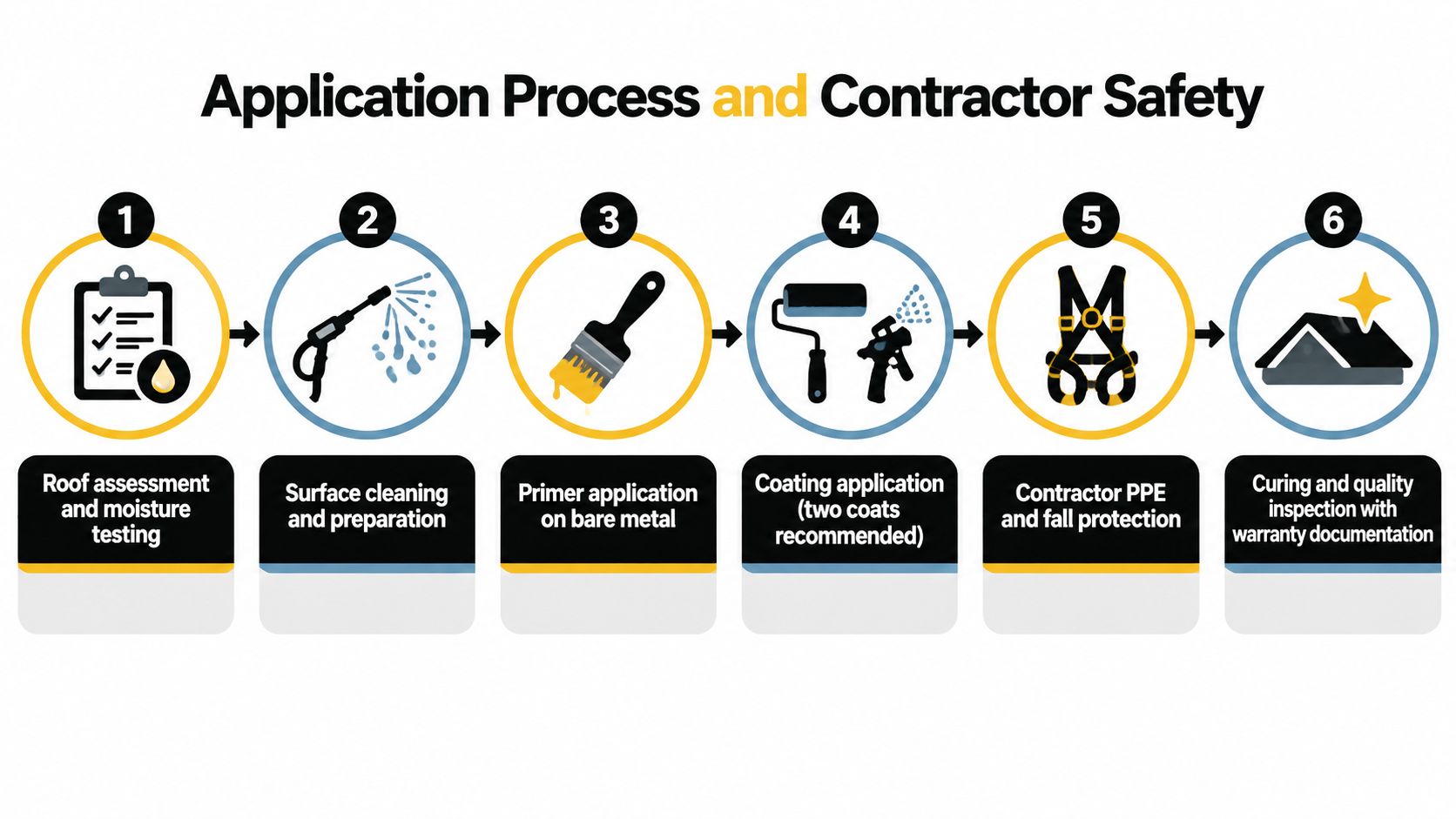
The finished membrane reflects the preparation beneath it. A contractor who sprays over chalking paint, damp insulation or loose rust may produce an attractive surface that fails prematurely. Proper work starts with an inspection and ends with documented quality checks, not with the final roller pass.
A controlled application sequence
Inspection comes first. The contractor should map leaks, corrosion, open joints, penetrations, skylights, gutters and areas of moisture. Internal inspection matters too, because ceiling stains can reveal failures that aren't visible from the roof surface.
Cleaning determines adhesion. Dirt, chalk, bird contamination, salts, grease and loose coating must be removed using a method suitable for the substrate. Pressure washing may be appropriate, but runoff control is essential around tenants, drains, stock and neighbouring properties.
Repairs and priming follow. Replace failed fasteners, repair flashings, reinforce movement joints and treat exposed metal before the main membrane. Primer is not a universal step, but bare or difficult substrates commonly need a specified bonding layer.
Application requires control. The crew should follow the manufacturer's recoat window, wet-film or dry-film targets and weather limitations. Spray application can be efficient on large roofs, while rollers and brushes remain important around penetrations, edges, fasteners and detailed repairs.
Curing and inspection close the job. The roof needs suitable conditions to cure, and the contractor should record completed areas, thickness checks, photographs, repairs and warranty documentation. A handover without maintenance instructions leaves the owner guessing about future inspections.
An older industrial roof may contain asbestos cement. Before pressure cleaning, mechanical preparation, drilling, cutting or replacement, arrange appropriate identification and follow the applicable Australian and NSW safety requirements. If asbestos is present, coating is not automatically safe or suitable. The proposed method must prevent fibre release, and some roofs may be too fragile or degraded to justify coating rather than controlled removal and replacement.
Safety is part of the specification: It covers hazardous materials, fall protection, access systems, weather, electrical risks, traffic separation and overspray control.
The embedded video below provides a visual reference for the application sequence and the site controls that should accompany it.
Low-VOC products may help manage odour and environmental requirements, but “low VOC” doesn't remove the need for ventilation, product-specific PPE or exclusion zones. Australia-focused market coverage identifies environmental regulation, demand for low-VOC systems and weather resistance as important considerations in the sector. It also reports a heat-reflective roof coating market value of USD 85.7 million in 2025, projected to reach USD 141.8 million by 2034, at a 5.59% CAGR, as described in this Australia roof coatings market coverage. Those figures describe market coverage, not a guarantee of project performance.
Lifecycle Costs and Maintenance Schedules
The cheapest coating quote can become the most expensive option if it excludes repairs, access controls, future inspections or recoat planning. Lifecycle costing starts with the roof's current condition and considers what the owner will spend to keep the system serviceable after the crew leaves.
A useful budget separates four categories:
- Preparation: Cleaning, corrosion treatment, removal of failed material and repairs.
- Installation: Primer, membrane coats, reinforcement, access equipment and safety controls.
- Ownership: Inspections, gutter cleaning, touch-ups, leak response and records.
- Future intervention: Recoating, replacement of failed details or eventual roof renewal.
Maintenance should be planned, not reactive
Inspect the roof after severe weather, following major plant work and before the wet season. Look for cracking, peeling, exposed fasteners, damaged flashings, blocked outlets, new ponding, biological growth and areas where foot traffic has worn the surface. Keep photographs and mark defects on a roof plan so small failures don't become a recurring mystery.
The maintenance schedule must also reflect the building's operation. A logistics roof with frequent air-conditioning access needs protected walkways and clear rules for contractors. A strata or healthcare site may need tighter controls for odour, public access and work hours. Coastal exposure may require more frequent attention to salt deposits and corrosion-prone details than a sheltered inland facility.
An Australian tested heat-reflective coating report estimates a 3% reduction in cooling load for commercial buildings and a 17% improvement in internal thermal comfort for unconditioned industrial buildings. The report also notes that the NCC doesn't impose roof reflectance requirements, so the energy result depends heavily on combining the coating with insulation and climate-zone design choices. Review the Australian industrial coating test report when assessing whether the evidence relates to your building.
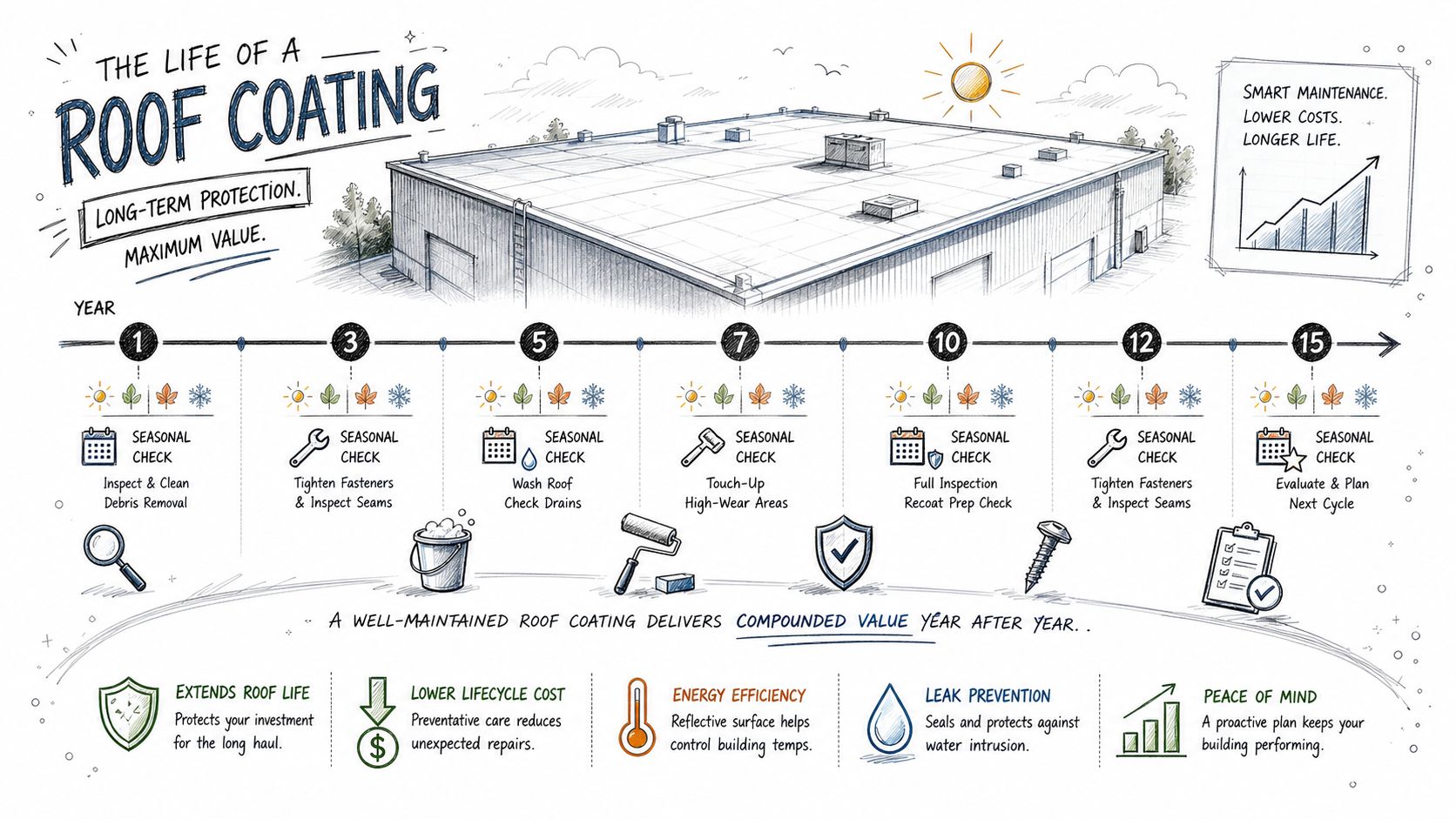
Don't model savings from a coating using a generic payback promise. Use the site's roof area, HVAC profile, electricity invoices, operating hours, internal heat sources, insulation condition and actual roof colour. Compare the proposed coating against targeted repairs, staged restoration and replacement, then include the cost of disruption and future access.
For pricing context, the commercial roof restoration cost guide can help frame the scope, but no online figure replaces a measured inspection. A durable system may cost more upfront and still offer better value if it reduces emergency repairs, protects stock and avoids unnecessary tear-off. The contractor should state what is included, what is excluded and what maintenance is required to preserve the warranty.
Key Takeaways for Commercial Property Owners
An industrial roof coating makes sense when the existing roof is structurally sound, the substrate can be prepared properly and the selected system matches the site's water, chemical, UV and access conditions. Reflectivity can support cooling performance, but insulation, HVAC demand and climate design determine the actual result.
Before approving the work, ask:
- Has the roof been inspected for moisture, corrosion and asbestos?
- Are repairs, preparation standards and film thickness written into the scope?
- Does the system address AS 4654.1:2012 and any AS 4020:2018 water-contact requirement?
- Are drainage, walkways, overspray and tenant access covered?
- What inspections, touch-ups and recoating conditions apply to the warranty?
- Is the contractor licensed, insured and providing material and labour documentation?
Treat the coating as part of asset management, not cosmetic maintenance. That approach protects the roof and gives the owner a clearer basis for judging the investment.
Commercial Roofers offers commercial roof inspections, roof restoration, cleaning, painting and reflective coating work for warehouses, factories, strata properties and other NSW assets. Their in-house crews also handle asbestos removal and replacement, industrial roof replacement, guttering and detailed project reporting, with safety controls designed to minimise disruption. Visit Commercial Roofers to arrange an assessment of your roof's condition and discuss a coating or replacement strategy suited to the building.