

A commercial roof leak rarely starts as a dramatic failure. It starts with a ceiling tile that goes brown after a storm, a damp smell in a plant room, a slippery patch near a warehouse wall, or a tenant calling before you've had your first coffee. In Sydney, that small sign can quickly turn into a compliance issue, a safety risk, an insurance problem, and a budget fight.
If you need to repair a commercial roof, speed matters, but panic doesn't help. The right move is a controlled response: make the area safe, document what you can see, get the roof assessed properly, and decide whether you're dealing with a localised repair, a broader restoration, or a roof that's reached the point where replacement makes more financial sense. Sydney adds its own complications. Older sites may still carry asbestos cement sheets. Coastal suburbs punish the wrong metal choice. Some projects need permit checks, tenant coordination, and tighter site controls than generic roofing articles ever mention.
Table of Contents
- Your Guide to Navigating Commercial Roof Repairs in Sydney
- First Response How to Safely Assess Roof Damage
- The Critical Decision Repair Restore or Full Replacement
- Sydney's Material Challenges Asbestos Colorbond and Compliance
- Vetting Your Contractor How to Hire a Qualified Sydney Roofer
- The Repair Project Quote Permits and Final Handover
Your Guide to Navigating Commercial Roof Repairs in Sydney
A strata manager gets the call at 6:30 am. Water is dripping through a ceiling grid, a tenant wants answers before opening, and someone on site is already asking for a quick patch. That pressure is exactly how building owners end up paying for the same roof problem twice.
Commercial roof repairs in Sydney need a clear process and the right diagnosis. A leak showing up over a tenancy does not automatically mean the failure sits directly above it. Water can travel along purlins, insulation, service penetrations, and slab edges before it appears inside. If you want a useful starting point, this guide on how to detect roof leaks in commercial buildings explains the early signs that help narrow the search.
Sydney adds complications that generic roofing advice usually misses. Coastal sites deal with salt exposure and faster corrosion. Older industrial and commercial buildings can trigger asbestos controls the moment sheets are disturbed. Access restrictions, live tenancies, traffic management, and council or strata approval pathways can slow a job before a single fastener is removed.
Practical rule: Treat the visible leak as a symptom, not the diagnosis.
The right repair method depends on the roof system, the age of the building, the condition of the substrate, and the compliance risks tied to the site. A warehouse in Western Sydney with metal decking and long sheet runs fails differently from a low-slope retail roof in the eastern suburbs. An older fibro-clad structure needs a different plan again, because suspected asbestos changes who can touch the roof, how samples are handled, and what paperwork must be in place before work starts.
A proper repair process starts with inspection, safe access planning, and defect mapping. Then it moves into scoping, quote review, approvals where required, repair execution, and final sign-off. Good contractors also look past the leak itself and check what caused it, failed laps, loose fixings, blocked drainage, flashing movement, corrosion at cut edges, damaged penetrations, or previous patchwork that has reached the end of its life.
For Sydney owners and strata committees, the goal is not just to stop water getting in today. The goal is to choose a repair path that stands up to NSW compliance requirements, keeps occupants safe, and avoids a larger capital spend caused by delays, repeat failures, or the wrong recommendation.
First Response How to Safely Assess Roof Damage
The first response should be calm and boring. That's a good thing. People get hurt when they rush onto roofs, step onto wet sheets, or start moving ceiling panels under active water ingress. Leave the roof access to trained crews with the right fall protection and site controls.
What to do in the first hour
Start inside the building.
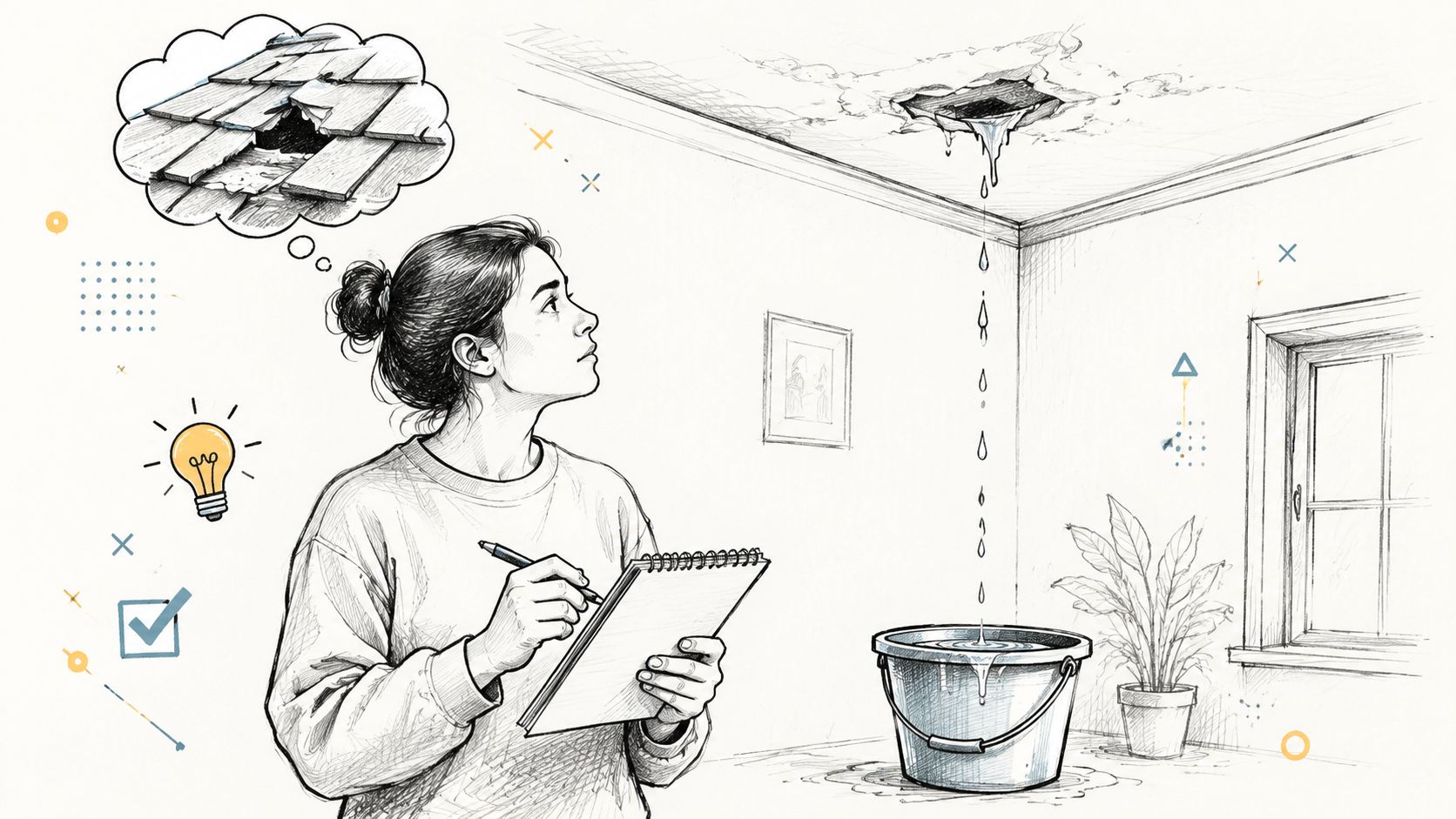
Use a simple triage sequence:
- Protect people first. Keep staff, tenants, and visitors away from wet floors, bulging ceilings, and any area where water is tracking near lights, switchboards, plant, or power outlets.
- Contain the water. Use buckets, bins, plastic sheeting, and temporary floor protection to reduce internal damage.
- Isolate immediate hazards. If water is approaching electrical equipment, get a qualified person involved immediately. Don't guess.
- Preserve evidence. Don't start pulling everything apart. You need the pattern of staining, drip points, and spread of moisture visible for the inspection.
Water inside a commercial building creates two emergencies at once. The leak itself, and the hazard created by people trying to work around it.
If you're trying to brief a roofer clearly, ground-level observations help. Note whether the problem appeared during heavy rain, after wind-driven rain, or only hours later. Delayed dripping often points to water travel along purlins, insulation, cable trays, or internal framing before it shows itself.
What to document before the roofer arrives
Take photos and short videos from safe positions only. Good documentation can save hours in fault-finding and helps support insurance communication.
Capture these items:
- Internal leak points: Stains, drips, saturated insulation, ceiling collapse risk, mould smell, and damaged stock or fitout.
- External clues from the ground: Lifted sheets, missing cappings, blocked downpipes, rust streaking, debris build-up, or overflow marks at gutters.
- Weather timing: Record when the leak started and whether it followed a particular storm event or persistent rain.
- Building location details: Mark the affected tenancy, bay number, grid line, plant area, or nearest internal room so the crew doesn't waste time searching.
- Safety issues: Wet floors, tripping hazards, compromised ceiling tiles, and any electrical proximity.
If you need help recognising typical entry points before booking an inspection, this guide on how to detect roof leaks gives a useful fault-finding overview for commercial buildings.
One point gets missed often. Don't let maintenance staff “test” suspect areas by walking the roof or applying hardware-store sealant. Poor temporary patching can contaminate the surface, trap moisture, and make the final repair less reliable. The Australian repair methodology is strict on documentation and on isolating safety risks the same day they're found. It also requires the repair area to be properly cleaned and dried before any bonded repair is done. Skip that step and the patch often fails early.
A measured first response gives your contractor a cleaner starting point. That usually leads to a better diagnosis, fewer return visits, and less argument about what happened.
The Critical Decision Repair Restore or Full Replacement
The biggest mistake owners make is asking the wrong question. They ask, “Can you patch it?” The better question is, “What option makes sense for this roof, this building, and the next phase of ownership?” They're not the same thing.
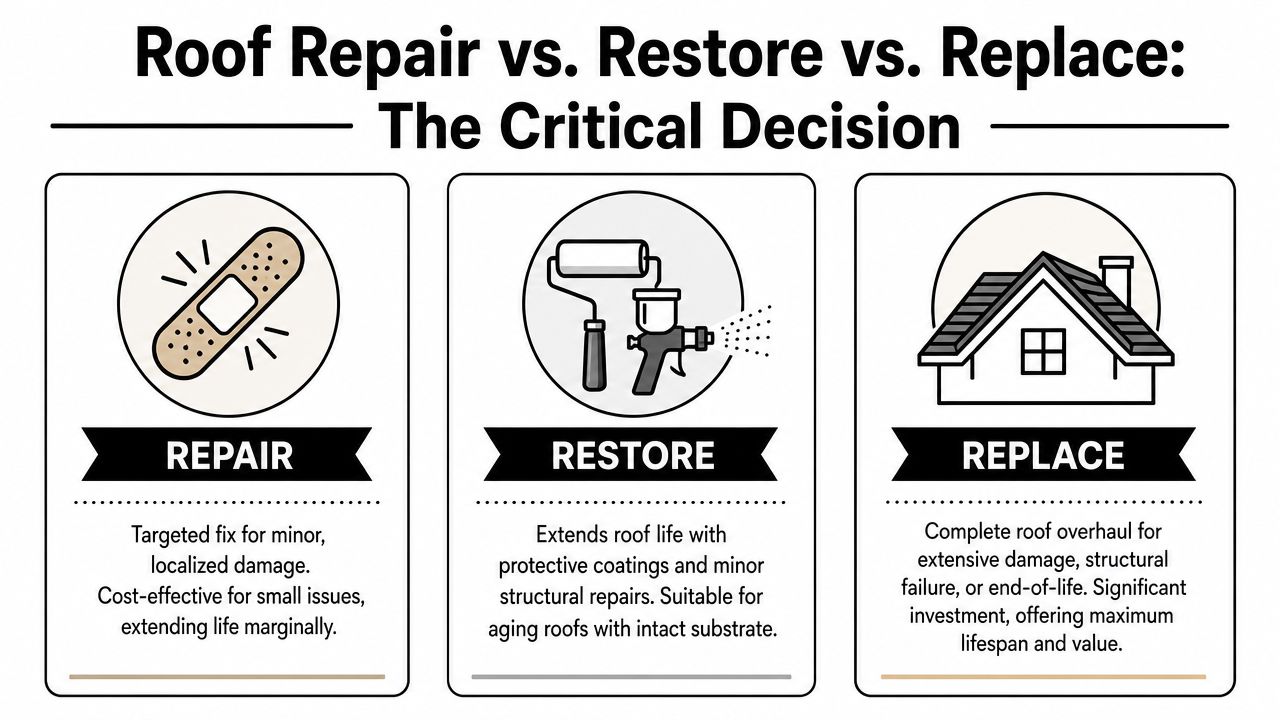
A repair solves a defined defect. A restoration improves the performance of an ageing roof that still has a sound base. A replacement resets the roof system when defects, age, risk, or compliance pressure make smaller works a false economy.
When a repair is enough
A focused repair is usually the right call when the roof failure is isolated and the surrounding roof system is still performing. Typical examples include a failed penetration seal, a damaged metal sheet, loose flashing, or a localised lap joint issue.
On Australian commercial buildings, over 90% of new roofs are metal, and those roofs can offer a service life of up to 50 years when properly maintained, while minor commercial roof repairs such as re-sealing penetrations or replacing damaged sheets typically cost between $1,500 and $8,000, according to Australian Roofers' commercial roofing statistics. In practice, that means a targeted repair can be sensible if the defect is local and the roof hasn't developed systemic issues.
Repair tends to work well when:
- The leak source is identifiable: The contractor can tie the internal evidence to a clear external failure point.
- The surrounding sheets or membrane remain sound: There's no sign that the defect is repeating across the roof.
- The substrate is still serviceable: The issue sits at the weathering layer rather than deeper structural failure.
- The building needs a fast operational fix: Warehouses, retail sites, and active strata complexes often need immediate defect removal with minimal disruption.
When restoration makes more sense
Restoration suits roofs that are ageing but not finished. The key test is whether the underlying system is still worth saving. If the deck is sound and the defects are widespread but manageable, restoration can buy useful life and improve presentation and weather resistance without a full tear-off.
This option often includes local repairs first, then broader remedial works such as treatment of rusted sections, replacement of failed flashings, fastener upgrades, detailed sealing, and protective coatings where appropriate to the roof type and specification. Restoration is not “painting over problems”. If that's the proposal, walk away.
A restoration only works when the preparation is serious. Cleaning, drying, and detail repairs are where the job succeeds or fails.
When replacement is the smarter call
Some roofs are technically repairable but strategically wrong to repair. That happens more often now because owners aren't only responding to leaks. They're also responding to audits, insurer questions, and future capital planning.
Recent Australian trends show 54% of commercial roof rectification projects were triggered not by immediate leaks but by ESG reporting requirements and insurer scrutiny demanding defensible condition ratings and service life estimates, as noted in Allied's discussion of leak detection and rectification drivers. That changes the decision framework. A patch might stop water this winter but still leave you with an asset that can't satisfy reporting, renewal, or lifecycle scrutiny.
Use this comparison to frame the call:
| Option | Best fit | Main upside | Main risk |
|---|---|---|---|
| Repair | Localised defect on an otherwise serviceable roof | Fastest and least disruptive | Can become repeat spending if the problem is broader |
| Restore | Ageing roof with sound substrate and multiple manageable defects | Extends useful life without full tear-off | Fails if hidden moisture or structural issues are ignored |
| Replace | End-of-life roof, major deterioration, asbestos changeover, or compliance-driven upgrade | Clears accumulated risk and resets service life | Higher upfront cost and more project planning |
Choose replacement when repeated leaks keep appearing in new locations, when corrosion is no longer isolated, when the roof profile or detailing is seriously flawed, or when asbestos and access issues make partial work inefficient. It's also the right move if a cheap interim repair only postpones a larger compliance problem.
A good contractor should be able to explain why the recommended option fits the building. If the quote jumps straight to replacement without evidence, be cautious. If it offers a tiny patch on a roof with obvious systemic decline, be just as cautious.
Sydney's Material Challenges Asbestos Colorbond and Compliance
Sydney roofs tell you the building's age and risk profile before anyone says a word. Old fibro and Super Six sheets still turn up on industrial sites. Post-war factories often have layers of modifications around vents and skylights. Newer warehouses rely heavily on metal deck systems, and coastal buildings age differently from inland ones. You can't repair all of them the same way.
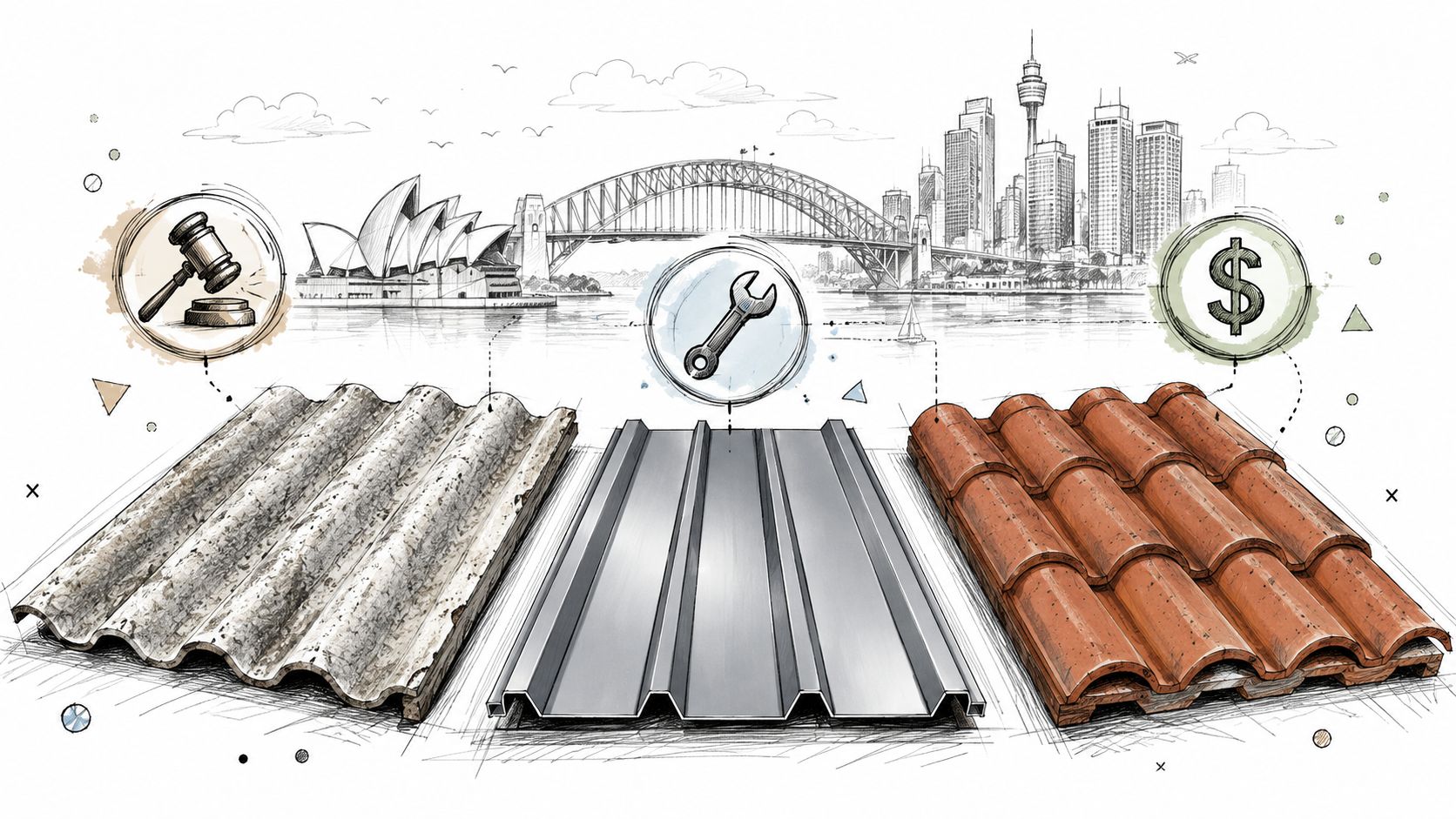
Asbestos changes the whole job
If the roof may contain asbestos, stop treating it like a standard leak repair. The issue isn't just water entry. It's disturbance risk, licensing, waste handling, air monitoring requirements where applicable, and how the site remains safe during the works.
On older Sydney industrial properties, owners often want “just one sheet replaced” to avoid cost and downtime. Sometimes that's not the cleanest path. If sheets are brittle, fixings are degraded, and access itself risks breakage, staged replacement can be safer and more economical than repeated intervention.
The practical questions are straightforward:
- Has the material been identified properly? Assumptions are dangerous on older sites.
- Can the defect be addressed without disturbing brittle sheeting?
- Will a partial fix leave you with the same asbestos management problem next year?
- Does the contractor hold the right licensing for the work involved?
Where asbestos is confirmed, the roofing discussion becomes a broader asset decision, not just a repair decision.
Metal roofing needs the right repair method
For many Sydney commercial roofs today, metal dominates modern commercial roofing, and the repair method has to match the specific profile and failure point. Klip-Lok, Trimdek, Custom Orb, box gutters, apron flashings, expansion details, and penetrations all fail differently.
The common faults aren't mysterious. They're usually one or more of the following:
- Failed fasteners or washers that allow water entry around penetrations or sheet lines.
- Corrosion at laps, gutters, or flashings where water sits or incompatible repairs were done years earlier.
- Movement-related cracking around penetrations, curbs, and service mounts.
- Bad previous repairs using mastics or tapes that were never suitable for long-term exposure.
For owners comparing options, this primer on metal roofing in Australia helps explain why profile type, coating selection, and detail work matter so much on commercial sites.
The wrong sealant on the right roof is still the wrong repair.
Coastal and council issues owners often miss
Near the coast, salt exposure shortens the tolerance for poor material choice and poor detailing. The roof may need a more suitable metal specification, and all associated components have to match. There's no value installing quality sheeting if fixings, flashings, or gutter interfaces are the weak link.
Council and building approval issues can also enter the picture when works move beyond like-for-like repair. If you're altering the roof form, changing drainage design, replacing significant sections, or dealing with heritage or industrial planning constraints, permit checks matter early. Don't leave that until materials are ordered.
This is one reason many owners now favour a more complete solution when the roof is already under review. Small isolated repairs are useful when the roof is generally healthy. Once asbestos, corrosion setting, and compliance pathways enter the conversation, the cheapest immediate scope is often not the least expensive decision.
Vetting Your Contractor How to Hire a Qualified Sydney Roofer
Hiring the right roofer matters as much as the repair itself. Sydney commercial roofs bring extra risk that generic contractors often miss. One wrong call on asbestos, a poor detail near the coast, or a contractor who does not understand council triggers can turn a repair into a compliance problem and a second invoice.
The roofing market is crowded, as noted earlier. That means owners and strata managers need to screen hard before accepting a quote, especially if the building is older, close to salt air, or occupied during the works.
What to verify before you accept a quote
Start with documents and site logic, not promises.
- NSW licence details: Check the contractor's current licence and confirm it matches the work being priced.
- Insurance currency: Ask for current public liability and workers compensation certificates, not whatever was attached to a proposal six months ago.
- Asbestos process: On older Sydney sites, suspected asbestos changes the entire method. Ask who identifies it, what licences apply, how the area is controlled, and how disposal is documented.
- Commercial experience on similar buildings: A crew that mainly does houses can come unstuck on strata blocks, factories, schools, and retail centres with access limits and live operations.
- Who will be on your roof: Some businesses quote the work, then pass it to subcontractors you never met. Ask who supervises, who installs, and who signs off.
- Safety planning: The contractor should be able to explain access, edge protection, weather holds, exclusion zones, and how they will keep tenants, staff, and visitors out of the work area.
- Compliance awareness: If the repair scope could expand into partial replacement, drainage changes, or asbestos removal, the contractor should flag approval checks early rather than after materials are ordered.
If you are comparing local firms, this guide on how to find a commercial roofer near me in Sydney is a practical place to start.
Commercial Roofers is one example of a company that states it handles commercial and industrial roofing, including inspections, repairs, asbestos roof removal and replacement, and larger replacement works across NSW. That broader scope can matter when an apparent leak repair turns out to involve corroded sheets, unsafe substrate, or non-compliant old materials. You still need to verify licence class, insurance, and fit for your site.
Questions that expose weak operators fast
Weak operators usually struggle when the questions get specific.
Ask these in writing:
- What is the likely leak entry point, and what evidence supports that conclusion?
- What preparation is included before coatings, sealants, or replacement sections are installed?
- What is excluded from the price?
- How will weather risk be managed if the roof is opened up?
- How will asbestos be handled if suspected material is found once work starts?
- What completion documents will be handed over?
- What is workmanship cover, and what sits under manufacturer warranty only?
This short video is worth watching if you're assessing contractor quality and project expectations.
If a roofer cannot explain the failure clearly, they usually cannot repair it properly.
Watch the wording in the quote. “Seal roof leaks” tells you almost nothing. A proper commercial proposal should identify defect locations, repair method, materials, access assumptions, safety controls, disposal responsibility, and whether testing or return inspection is included.
Price still matters. It just should not be the first filter. The better hire is usually the contractor whose diagnosis is specific, whose paperwork is current, and whose method makes sense for your building, your tenants, and Sydney's compliance requirements.
The Repair Project Quote Permits and Final Handover
Once you've chosen a contractor, the job should become more predictable. Not perfectly convenient. Roofing works on live commercial sites never are. But you should know what happens next and what good project control looks like.
What a proper quote should include
A solid quote reads like a work plan, not a rough guess. It should describe the defect area, the proposed scope, the materials to be used, access method, safety controls, and what is excluded. If the roof type needs profile-specific components or if there's suspected asbestos, that should be obvious in the document.
Watch for these red flags:
- Vague repair language: “General sealing” without defect detail.
- No access allowances: Nothing about height access, traffic management, or tenant coordination.
- No mention of preparation: On commercial roofs, clean and dry preparation is a make-or-break issue.
- No disposal detail: Especially important where old sheeting, contaminated material, or failed insulation may be removed.
- No timeline assumptions: You need at least a reasonable window, even if weather remains a variable.
How the site should run
A well-run roof project is quiet from the client side. That doesn't mean nothing is happening. It means the contractor has controls in place.
On a typical Sydney commercial site, the sequence usually looks like this:
| Stage | What you should expect |
|---|---|
| Pre-start | Site check, access planning, confirmation of work zones, tenant or staff notification |
| Set-up | Safety controls installed, materials staged, exclusion areas marked |
| Defect opening and repair | Damaged areas exposed carefully, substrate checked, repair carried out to the agreed scope |
| Testing and close-up | Water testing where appropriate, clean-up, final checks |
| Client update | Photos, completion notes, and any variation or further defect advice discussed clearly |
If permits or council checks are needed, that should be sorted before the roof is opened up, not discovered halfway through. This matters on major alterations, some replacement works, and sites with planning sensitivities.
Communication should stay simple. You need one contact person, regular progress updates, notice of any hidden defects found during the works, and fast approval pathways if the scope changes.
Good roof work is methodical. The crew shouldn't look like they're improvising in real time.
What you should receive at handover
Handover is where a lot of owners lose their advantage. The leak has stopped, everyone wants to move on, and the paperwork gets forgotten. Don't let that happen.
At minimum, ask for:
- A completion summary describing what was repaired or replaced
- Progress and completion photos
- Warranty information separating workmanship from manufacturer-backed materials where applicable
- Any compliance or disposal documentation relevant to the work performed
- Maintenance guidance for the roof area, especially around gutters, plant penetrations, and access restrictions
If the contractor found broader deterioration outside the repair scope, that should be recorded too. That note protects you later. It gives you a basis for budgeting and reduces disputes about whether the next issue is “the same leak” or a different defect.
The final step is maintenance. Not a huge programme. Just a sensible plan for inspections, cleaning of drainage points, and early attention to penetrations and flashings. Commercial roofs rarely fail without warning. People usually just miss the warnings.
If you need a Sydney contractor to inspect, diagnose, and repair a commercial roof with clear scope, compliance attention, and documented handover, Commercial Roofers handles commercial and industrial roofing projects across NSW, including leak repairs, asbestos roof replacement, metal roofing, restoration, and full roof replacement.