
Proactive commercial roof maintenance in Sydney typically costs $3.50 to $5.50 per square metre annually or about 1.5% to 2.0% of the roof's installation value. Leave it until there's an emergency and costs can jump to 5.0% to 7.0% of installation value, with $1,500 to $8,000 in internal water damage per incident before you even deal with the roof itself.
If you're reading this after a leak, you're probably already dealing with the true cost. A tenant is calling. Ceiling tiles are stained. Stock, plant, offices or common areas are at risk. Someone wants a contractor on site today, and nobody likes the quote because emergency roofing is never priced like planned roofing.
That's why roof maintenance cost needs to be treated as an asset management decision, not a patch-job question. For a Sydney warehouse, strata complex or retail site, the smart question isn't “what will this repair cost me today?” It's “what annual budget stops this roof from becoming a capital works problem?”
Owners who wait usually pay three times. First for the urgent repair. Then for internal damage. Then again when the roof ages out early. Owners who budget for inspections, drainage cleaning, seam checks and minor repairs usually keep control of timing, access, contractor costs and tenant disruption. If you're already dealing with a leak, start with practical guidance on repairing leaking roofs, then put a proper maintenance plan behind it so it doesn't happen again.
Table of Contents
- Introduction The True Cost of a Leaking Commercial Roof
- Why Proactive Maintenance Is Cheaper Than Emergency Repairs
- The 5 Key Factors That Drive Your Maintenance Costs
- Sydney Commercial Roof Maintenance Costs Per Square Metre
- Sample Cost Scenarios for Sydney Properties
- How to Budget and Procure Roofing Services Effectively
- Long-Term Strategies to Maximise Roof Lifespan
- Conclusion Secure Your Asset with a Proactive Plan
Introduction The True Cost of a Leaking Commercial Roof
A leaking commercial roof rarely stays a roofing problem. In Sydney, it quickly becomes a tenancy issue, a safety issue, a facilities issue and a budget issue. Water gets into insulation, wall cavities, electrical zones, stock areas and lift lobbies. By the time you're chasing buckets and calling contractors in the rain, the cheap fix has already been missed.
That's the mistake I see most often. Owners focus on the visible leak point and ignore the system that failed around it. On commercial roofs, the weak link is often a box gutter, flashing, lap joint, penetration, drainage point or membrane seam. The leak you see inside is usually the last stage, not the first.
What owners get wrong about roof maintenance cost
Inquiries about roof maintenance cost often anticipate a repair price list. That's the wrong frame for a commercial asset. The core issue is whether you want a controlled annual operating cost or a string of unpredictable emergency invoices tied to internal damage and accelerated roof deterioration.
Building and Energy WA's maintenance guidance, referenced in this overview of roof repair cost and upkeep, makes the core point clearly. Routine roof upkeep is materially cheaper than waiting for defects to become major repairs, because minor issues can escalate into expensive structural and water-damage work if neglected.
Practical rule: If your roof budget only appears after a leak, you don't have a maintenance strategy. You have a response strategy.
The commercial view is different from residential advice
Generic residential articles don't help much when you're responsible for a warehouse in Mount Druitt, a strata block in Parramatta or a retail centre with multiple roof penetrations and drainage runs. Commercial roofs are bigger, flatter, more exposed to ponding and overflow, and far more sensitive to access, safety and tenant disruption.
The financially disciplined approach is simple. Budget for planned inspections, drainage cleaning and minor repairs before defects spread. That keeps your roof functioning as a long-term building asset instead of turning it into a recurring emergency.
Why Proactive Maintenance Is Cheaper Than Emergency Repairs
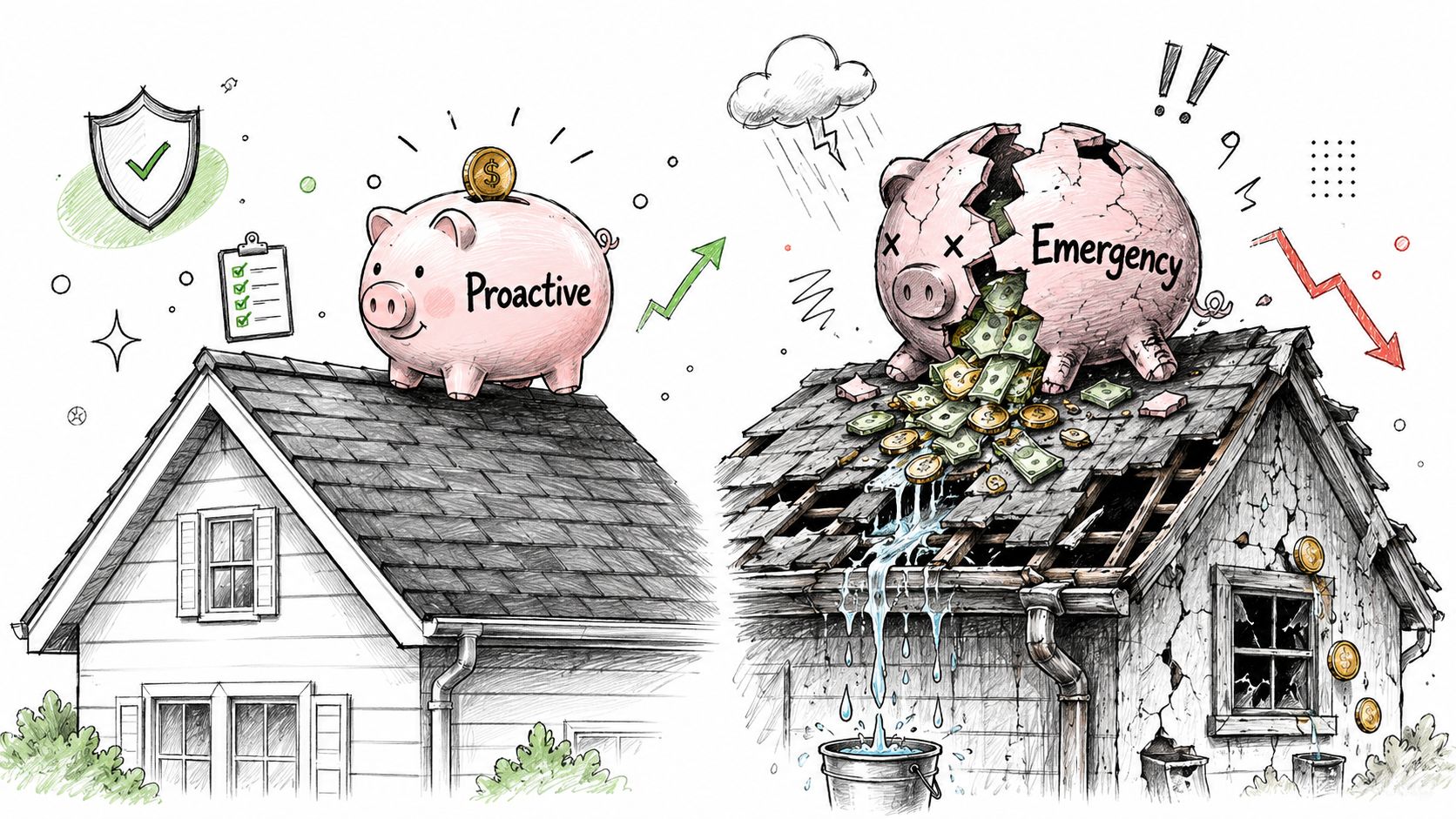
The “fix it when it leaks” approach sounds cheaper because it delays spending. In practice, it usually increases total spending and strips you of control. Commercial roofs fail progressively. Sealant opens up. Fasteners loosen. Box gutters collect debris. Water sits where it shouldn't. Then one storm turns a maintenance issue into an urgent works order.
Small defects create expensive chains of failure
A commercial roof works like a drainage network. If one section stops moving water properly, pressure shifts elsewhere. Overflow stresses flashings. Wet insulation holds moisture. Steel components corrode. Internal linings stain. What started as a blocked gutter or failed lap joint ends up affecting several building elements, not just the roof covering.
That's why proactive maintenance is so much cheaper in the long run. In Australian market research used for roof maintenance planning, proactive maintenance averages about 14 cents per square foot per year, while reactive maintenance averages 25 cents per square foot, with an 11-cent per square foot annual difference. The same research ties proactive care to a 21-year maintenance cycle versus 13 years for reactive care, which is a direct lifecycle cost argument, not just a repair cost argument, as summarised in Angi's maintenance cost discussion.
Reactive work costs more because everything is harder
Emergency roofing is harder to plan and harder to price. Access has to be arranged fast. Safety controls often need to go in urgently. Materials may need temporary solutions first, then permanent repairs later. Tenants, staff and operations are already affected.
The roof itself may not even be the biggest invoice. For Sydney commercial roofs, neglecting preventive work can lead to overflow events that cause $1,500 to $8,000 in internal water damage per incident, excluding structural roof repair. That's why emergency work almost never ends at the leak point.
Preventive maintenance protects more than the roof covering. It protects ceiling spaces, insulation, services, finishes, tenancy operations and your ability to choose when work gets done.
Regulators already treat roof care as preventive work
This isn't just contractor talk. Australian building regulators and state agencies increasingly frame roof care as a preventive maintenance issue, not an emergency one. That's the right mindset for owners. Spend modestly and predictably while defects are still minor, or spend heavily and reactively after water has already moved through the building envelope.
The 5 Key Factors That Drive Your Maintenance Costs
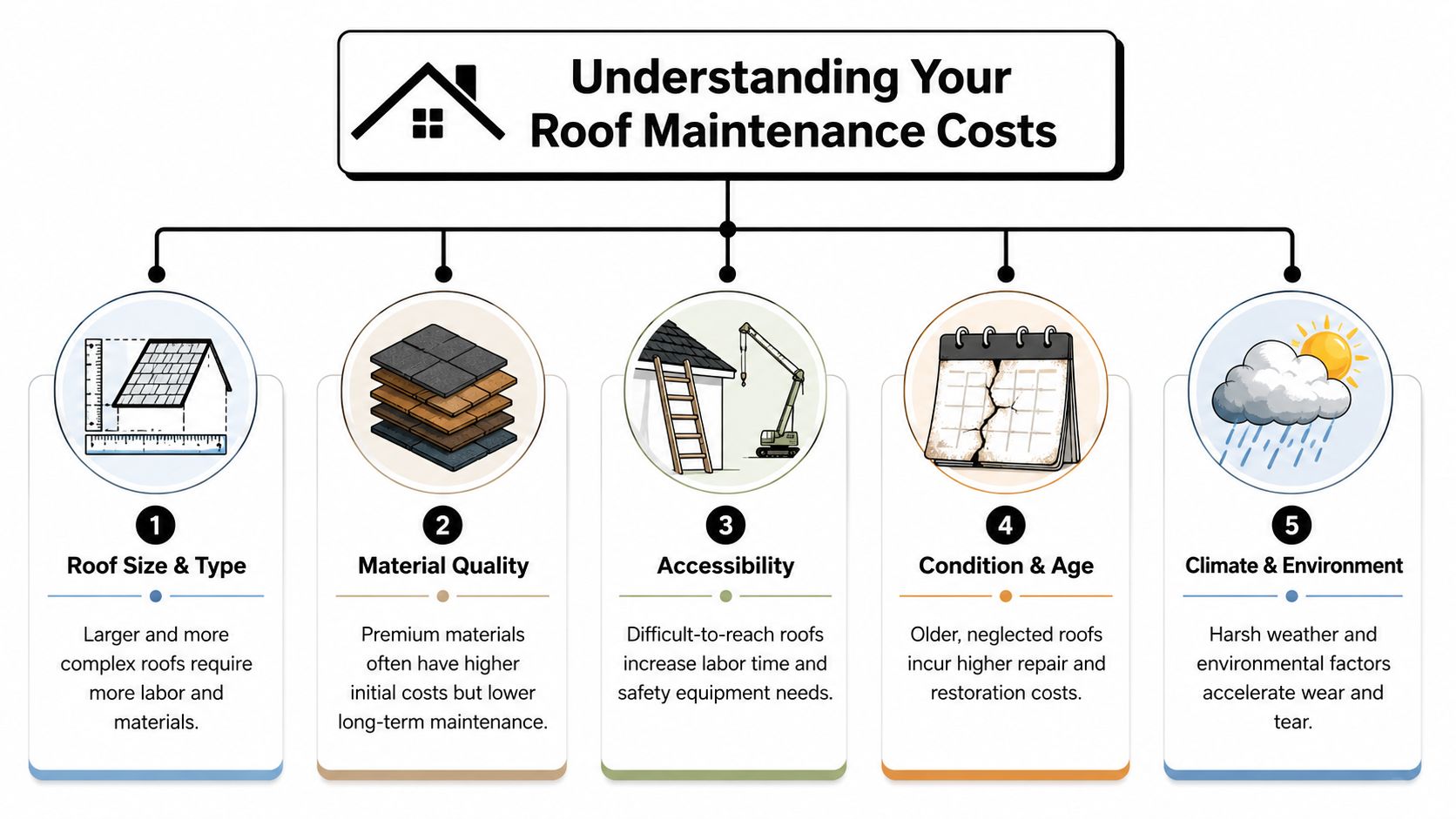
Roof maintenance cost isn't set by one number. Two buildings with the same roof area can have very different annual budgets because the work isn't just about square metres. It's about how difficult the roof is to inspect, clean, access and keep watertight.
Roof size and complexity
A simple warehouse roof is one thing. A multi-level commercial building with plant platforms, parapets, penetrations and mixed roof zones is another. Size matters, but layout matters just as much.
Road maintenance offers a useful comparison. A single straight road is cheap to inspect and keep clear. A tangled street network with intersections, bottlenecks and service crossings takes more time every visit. Roofs work the same way.
Roof material and failure points
Metal roofs, membrane roofs and tiled sections don't fail in the same places. Metal roofing often needs close attention at fixings, laps, flashings and box gutters. Membrane systems rely heavily on seams, upturns and penetrations. Older mixed-material roofs often need more careful inspection because different elements move and age differently.
For drainage-heavy roofs, box gutter and drainage maintenance is where many owners either save money early or lose a lot later. Ignore those components and the rest of the roof starts carrying the consequences.
Access and safety requirements
Access changes price fast. A low warehouse with clear perimeter access is usually straightforward. A high-rise strata roof with restricted entry, limited tie-off points, active plant and occupied levels below is not.
Safety obligations aren't optional. If the contractor needs specialised access systems, more site controls or extra time to work around occupants and services, your maintenance cost goes up for good reason. Cheap quotes often leave these realities out, then recover them later as variations or shortcuts.
Here's a practical way to look at it:
| Cost driver | Lower-cost condition | Higher-cost condition |
|---|---|---|
| Roof layout | Simple open spans | Multiple levels, penetrations, plant |
| Material system | Uniform roof type | Mixed materials and junctions |
| Access | Easy ladder or hatch access | Height restrictions and complex safety setup |
| Drainage | Clear simple falls | Box gutters and ponding-prone areas |
| Occupancy impact | Minimal disruption | Live tenancies or sensitive operations |
A short technical explainer helps if you want to see how roof components are typically assessed on site:
Current condition and roof age
A newer roof in good order usually needs inspection, cleaning and minor seal maintenance. An older roof with a history of leaks often needs repeated defect management until the owner decides whether restoration or replacement is the better move.
Condition matters more than age on its own. I've seen relatively recent roofs cost more to maintain than older ones because nobody looked after the drainage points and flashings from day one.
Special compliance issues in NSW
Some roofs trigger extra planning because of asbestos, heritage controls, access restrictions or council and strata compliance obligations. These don't automatically make maintenance unaffordable, but they do make proper scope definition essential. If your contractor doesn't ask about these issues before quoting, the quote is probably incomplete.
Sydney Commercial Roof Maintenance Costs Per Square Metre
If you want the clearest benchmark for Sydney, use the annual preventive cost per square metre first, then adjust for the factors above. That gives you a practical budgeting number instead of a vague “it depends” answer.
What the benchmark includes
For Sydney commercial roofs, a thorough preventive maintenance cycle, including cleaning box gutters and checking seams, costs between $3.50 and $5.50 per square metre annually. Neglecting that work can lead to overflow events causing $1,500 to $8,000 in internal water damage per incident, excluding the structural repair itself.
That benchmark matters because it reflects commercial problem areas. Sydney roofs often fail at drainage, seams and junctions long before the owner thinks the whole roof is at risk.
A simple Sydney cost comparison
The easiest way to understand roof maintenance cost is to compare planned annual spend with unplanned emergency exposure.
| Metric | Proactive Maintenance Program | Reactive (Emergency) Repairs |
|---|---|---|
| Budget structure | Planned annual cost | Unpredictable event-driven cost |
| Sydney benchmark | $3.50 to $5.50 per square metre annually | Can escalate to $1,500 to $8,000 in internal water damage per incident, excluding structural repair |
| Typical work type | Gutter cleaning, seam checks, inspection, minor repairs | Leak response, temporary make-safe, urgent repairs, remediation |
| Operational impact | Scheduled and controlled | Disruptive and often urgent |
| Financial outcome | Better cost control | Higher volatility and collateral damage |
If you manage a large roof area, even modest annual maintenance rates are easier to absorb than one emergency that spreads into internal remediation and tenant complaints.
How these numbers play out on real properties
A Mount Druitt warehouse with broad flat roof areas and long box gutters usually benefits from recurring cleaning and inspection because overflow is the obvious risk. A Parramatta strata building often spends more attention on access, penetrations and membrane junctions. A retail centre may need tighter observation around signage interfaces, services and corrosion-prone edges.
The benchmark doesn't replace a site inspection. It gives you a disciplined starting point. If your current budget is near zero and your roof is older, leak-prone or drainage-heavy, you're not saving money. You're just deferring invoices into a less convenient quarter.
Sample Cost Scenarios for Sydney Properties
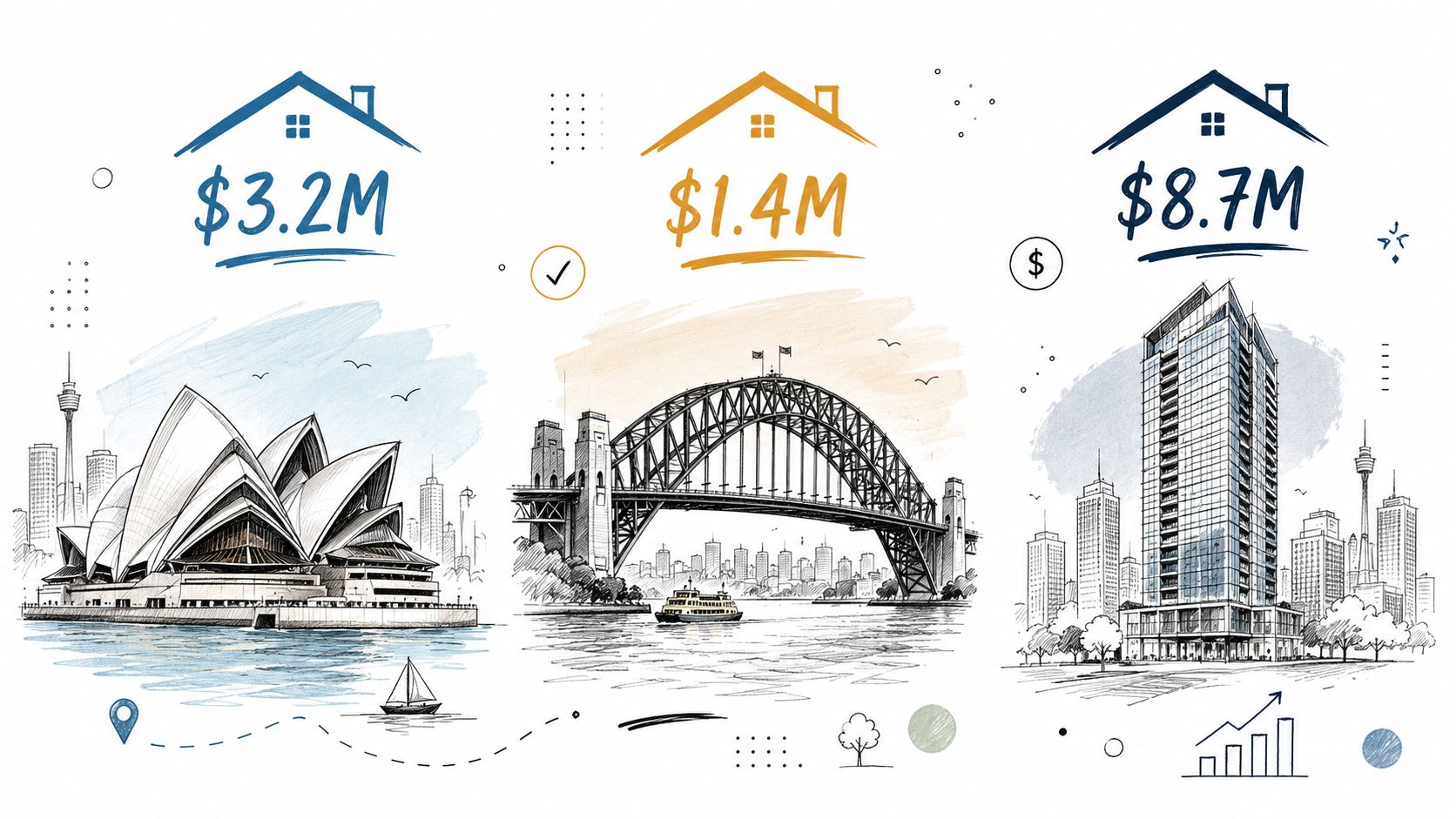
Numbers make more sense when you can picture the building. Here's how I'd think about three common Sydney property types when setting a maintenance strategy.
Mount Druitt warehouse with box gutters
This is the classic industrial scenario. Big roof area. Flat or low-pitch profile. Long drainage runs. Box gutters that carry more risk than many owners realise.
For a warehouse like this, the maintenance budget should prioritise scheduled gutter cleaning, seam checks, corrosion spotting and fast action on failed sealants. If you leave debris in the gutters and wait for heavy rain, the likely outcome isn't just a leak. It's overflow into stock areas, wet insulation and downtime while someone scrambles to make it safe.
The right question here isn't “how cheap can a contractor do a visit?” It's “how reliably can they keep water moving off the roof?”
Parramatta strata tower with difficult access
A tall strata building is a different animal. Roof maintenance cost rises less because of roof area and more because of access, safety systems, service penetrations and occupant sensitivity. If there are condenser units, communication equipment, parapets and limited work zones, every inspection takes more planning.
The smart strata committee treats this roof as a managed risk item, not a once-a-year afterthought. They want photo reporting, defect tracking and clear prioritisation of what needs immediate repair versus what can sit in the next planned cycle. Chasing one-off leak repairs in a tower almost always creates repeat costs because the underlying waterproofing detail rarely gets reviewed properly under emergency pressure.
Coastal retail complex managing corrosion risk
Near the coast, the roof may look fine from the car park while corrosion is already developing around fasteners, flashings, edges and architectural interfaces. Retail properties also have another problem. Water ingress affects customer-facing areas fast, and nobody wants a visible ceiling leak over trading space.
For this type of site, a maintenance plan should focus on early corrosion treatment, sealing details, drainage and regular checks around rooftop services. The owner who keeps pushing work out because “it's only cosmetic” usually ends up paying for visible damage plus concealed deterioration underneath.
What these scenarios have in common
Different buildings fail differently, but the management logic is the same:
- Set an annual budget first: Don't wait for the first storm event to decide if the roof matters.
- Prioritise drainage: Box gutters, outlets and downpipe connections cause disproportionate damage when neglected.
- Track recurring defects: If the same area leaks twice, stop patching and investigate the assembly properly.
- Use reporting, not memory: Photos, condition notes and repair history make future decisions cheaper and faster.
A commercial roof doesn't need constant major work. It needs consistent attention in the right places.
How to Budget and Procure Roofing Services Effectively
A good roof budget is boring. That's the point. It should sit in your annual plan, get approved without drama and prevent surprise capital works conversations later.
Budget like an asset owner, not a crisis manager
For commercial properties in NSW, proactive roof maintenance programs are benchmarked at approximately 1.5% to 2.0% of the total roof installation cost annually, while reactive maintenance strategies often escalate to 5.0% to 7.0% of installation cost due to unchecked damage. That's the budgeting line owners should work from.
If your current approach is to spend nothing most years and then approve urgent repairs when tenants complain, you're effectively choosing the reactive band. That's not disciplined cost control. It's deferred exposure.
What a proper maintenance scope should include
A contractor should be pricing more than a walk-around. For most Sydney commercial roofs, a credible scope includes:
- Scheduled inspections: At minimum, tie inspections to likely risk periods and weather exposure, not just ad hoc complaints.
- Drainage cleaning: Gutters, box gutters, outlets and downpipes need to be cleared so water can exit the roof as designed.
- Minor preventive repairs: Sealant failures, small flashing issues and localised corrosion should be dealt with before they spread.
- Reporting with photos: You need a documented condition record, not just a verbal “looks alright”.
- Repair prioritisation: Separate urgent defects from items that can be planned into the next maintenance cycle.
Use a qualified local commercial roofer when you're building this program, not a contractor who mainly prices small residential jobs. Commercial roofing is a different risk profile.
How to compare contractors properly
Don't compare quotes on price alone. Compare scope, exclusions and whether the contractor understands your roof type.
Ask direct questions:
- What exactly is inspected and cleaned each visit?
- How are defects documented?
- What access and safety assumptions are included?
- What kinds of minor repairs are covered in the scheduled program?
- What isn't included?
The cheapest quote often wins by leaving out the awkward bits. Access setup, plant coordination, wet-area checks, penetrations, photo reports and minor repair allowances are common omissions. Then the owner gets a low headline number and a pile of extras later.
Procure maintenance the way you'd procure any building-critical service. You want competence, documentation, compliance and continuity. Lowest price is a poor filter.
Long-Term Strategies to Maximise Roof Lifespan
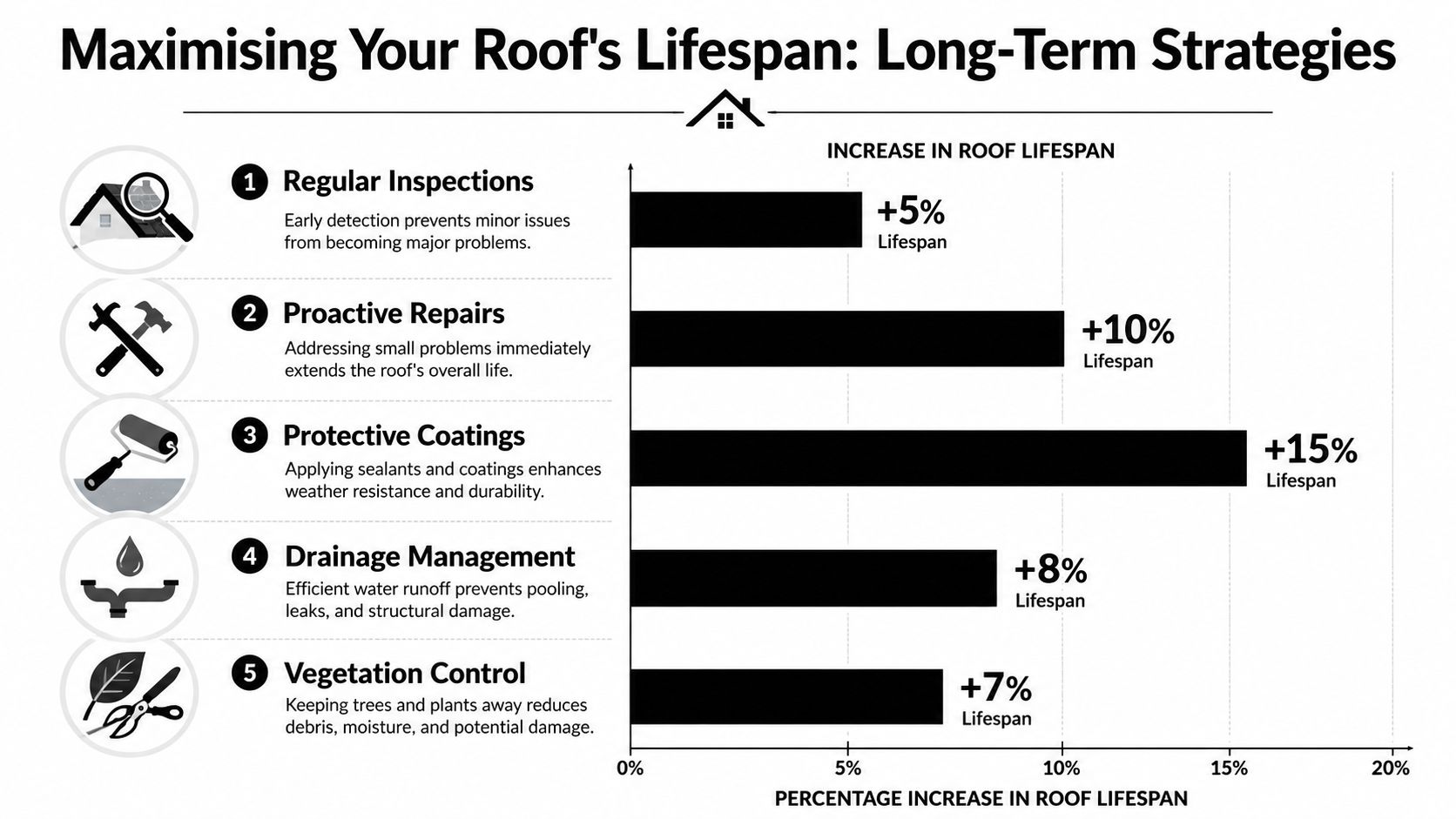
If you only think about roof maintenance cost as an annual line item, you'll miss the bigger financial win. This payoff comes from stretching useful roof life, delaying replacement and avoiding the operational mess that comes with repeated internal leaks.
Think in decades, not repair callouts
Asset-management models illustrate the point well. A maintained roof can have an annualised cost of around $17,000 per year over 40 years, compared with an unmaintained roof costing $25,000 per year over a shorter 20-year life, based on the lifecycle modelling discussed in this asset-management video. That's the difference between treating maintenance as a controlled investment and treating replacement as an avoidable surprise.
This is why material choice, restoration timing and maintenance discipline belong in the same conversation. A durable roof system still needs upkeep. A neglected roof system rarely delivers its full design life.
Know when maintenance should shift to restoration or replacement
Not every ageing roof should be endlessly patched. Some roofs reach a point where ongoing reactive work becomes inefficient and disruptive. The job then shifts from maintenance to restoration, coating, membrane renewal or full replacement.
Good decision-making usually follows this sequence:
- Maintain early: Keep drainage clear, defects minor and water out.
- Restore strategically: If the substrate is still viable, targeted restorative work can defer full replacement.
- Replace decisively: If structural components, insulation or waterproofing integrity are broadly compromised, stop feeding the roof with patch budgets.
The worst option is drifting in the middle. Owners who neither maintain properly nor commit to upgrade usually spend the most and still end up with a failing asset.
Conclusion Secure Your Asset with a Proactive Plan
For Sydney commercial properties, roof maintenance cost is not just a repair issue. It's a budgeting, risk and lifecycle issue. Planned maintenance sits in a predictable annual range. Reactive work blows out, damages interiors and shortens roof life.
If you own or manage a warehouse, strata building or commercial facility, stop treating the roof like a hidden cost centre. Put it on a maintenance program, insist on proper reporting and make decisions before the next storm makes them for you.
If you seek a site-specific maintenance plan instead of guesswork, Commercial Roofers can assess your roof, identify key failure points and provide a customized proposal for your Sydney commercial or industrial property. That's the fastest way to turn roof maintenance cost from an unpredictable headache into a controlled operating expense.