
You're usually not searching for roof replacements near me because everything is fine. You're searching because the leak has come back, a tenant is complaining, an insurer wants documentation, or a recent inspection has flagged rust, movement, ponding, or suspect asbestos-containing materials. At that point, the job stops being a basic maintenance issue and becomes a business risk issue.
For Sydney commercial owners, strata managers, and facility teams, the main challenge isn't only finding someone who can replace a roof. It's working out whether replacement is the right move, how to keep the site operational, and how to get through compliance without delays, surprises, or an unsafe shortcut.
Table of Contents
- Is Your Commercial Roof A Ticking Time Bomb
- Strategic Replacement Triggers And Material Choices
- Your Commercial Roof Replacement Project From Start To Finish
- Understanding The Costs Of A Commercial Roof Replacement
- Sydney Compliance Safety And Asbestos Removal Explained
- Your Vetting Checklist For Choosing A Sydney Roofing Contractor
- Maximising Your Investment And What To Do Next
Is Your Commercial Roof A Ticking Time Bomb
A lot of commercial roof failures don't start with a dramatic collapse. They start with a stain on a ceiling tile, a wet section of insulation, a rusted fastener line, or a tenant who says the leak only happens in wind-driven rain. Owners often patch those issues for months or years because each isolated repair seems manageable.
The problem is that recurring defects usually point to a broader lifecycle issue. Flashings fatigue. Box gutters hold debris and overflow. Old metal sheeting thins around fixings. Previous repairs create a patchwork of details that no longer work together as a system.
That's why roof replacement should be treated as asset planning, not just emergency spending. In Australia, the median age of occupied private dwellings was 27 years in 2021, according to the Australian housing age data referenced here. The same ageing pattern matters to commercial and industrial property owners because many buildings are reaching the point where ongoing repairs cost more, disrupt more, and achieve less than a planned replacement.
Why this matters in Sydney
Sydney has a large stock of older warehouses, strata complexes, retail buildings, and light industrial properties. Many of them have metal roofs, tiled sections, old drainage details, or legacy materials that have already been through several maintenance cycles. Once a roof gets to that stage, each repair has a lower chance of solving the root cause.
Practical rule: If the same roof area keeps failing at laps, penetrations, gutters, or sheet fixings, treat it as a system problem first and a leak problem second.
A planned replacement gives you control over timing, access, tenant communication, safety controls, and procurement. A reactive replacement usually happens after further internal damage, more operational disruption, and a rushed contractor selection process.
If you're searching for roof replacements near me right now, the smarter question isn't only who's close. It's whether your building has moved from maintenance mode into renewal mode.
Strategic Replacement Triggers And Material Choices
Some roofs clearly need replacement. Others sit in the grey area where owners keep paying for repairs because the capital decision feels bigger than the maintenance decision. That hesitation is common, but it gets expensive when the roof has already crossed the point where patching is just buying time badly.
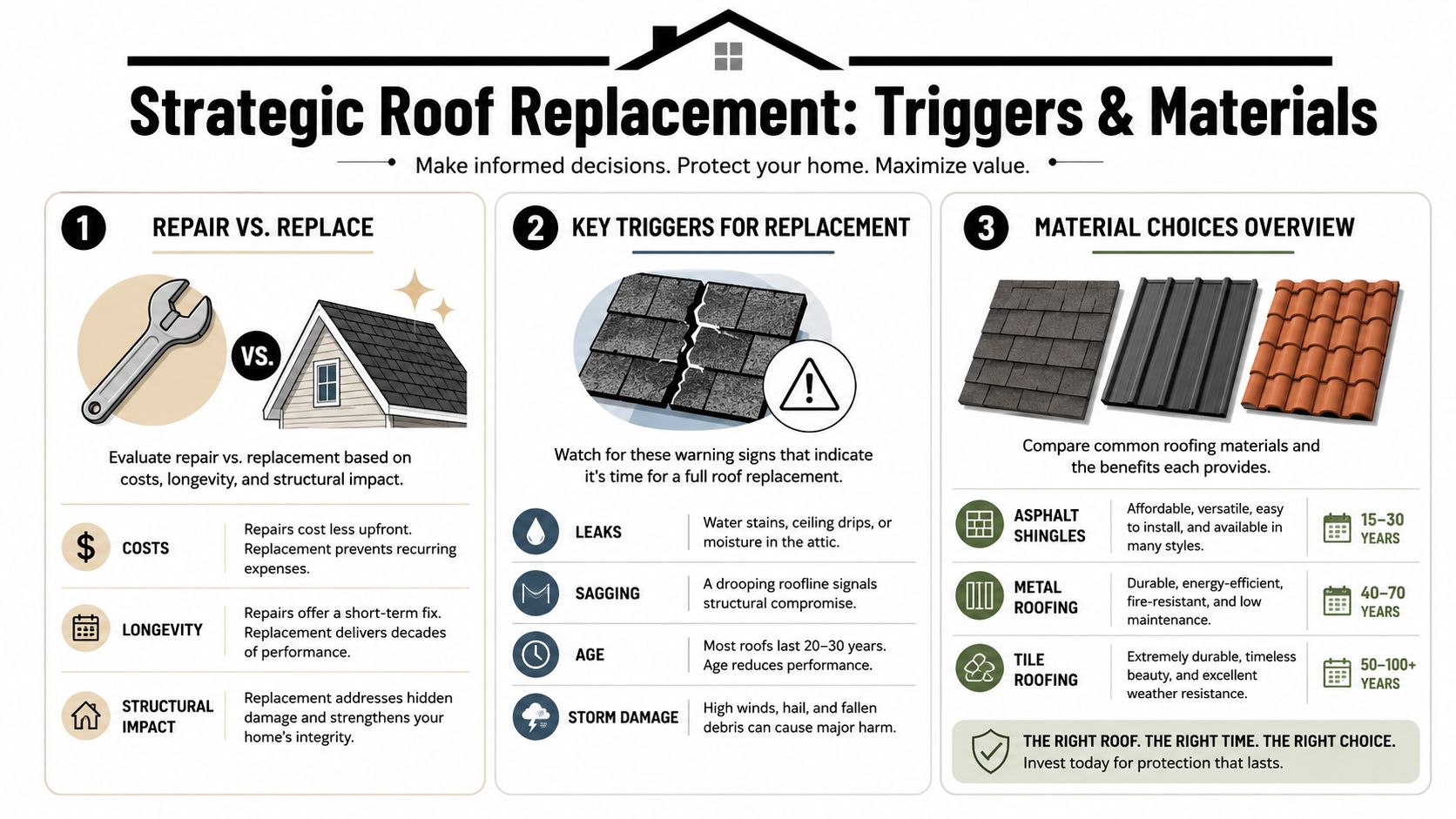
When repair stops making sense
There are a few triggers that usually justify serious replacement planning:
- Repeated leak history: If the same defects return after multiple service visits, the roof assembly is often failing at multiple points, not one isolated location.
- Storm or catastrophe damage: The Insurance Council of Australia reported more than 236,000 claims from the 2022 East Coast floods, with insured losses of about A$5.85 billion, as noted in this 2022 flood claims reference. For commercial owners, large weather events often push a roof from repairable condition into full-scope replacement.
- Refurbishment or compliance works: Major upgrades often expose roof issues that can't be ignored once other trades are involved.
- Asbestos scope: Once asbestos roofing or associated materials are confirmed, the job has to be planned around licensed removal, containment, clearance, and safe re-roofing.
- Operational risk: A roof above stock, plant, medical fitout, or tenant spaces carries a different risk profile than a shed used for dry storage.
A cheap repair quote can look attractive until it leaves the old substrate, old fasteners, old drainage weaknesses, and old compliance risks in place.
Another practical trigger is lifecycle planning. Most online searches for roof replacements near me focus on urgent quotes. There's much less guidance on whether a building should be restored, partially replaced, or fully renewed, even though that's the decision that affects long-term cost and disruption most.
For owners comparing options, this guide to metal roofing in Australia for commercial buildings is useful background if you're weighing replacement materials.
Material choices for commercial sites
For Sydney commercial roofs, metal systems are often the preferred replacement route because they suit warehouses, industrial buildings, strata assets, and larger low-slope roof forms. The right choice depends on exposure, budget, detailing complexity, and appearance requirements.
| Material | Typical Lifespan | Maintenance Level | Best For |
|---|---|---|---|
| Colorbond steel | Varies by site, specification, and environment | Low to moderate | Warehouses, strata, retail, factories |
| Zinc | Long-term architectural option | Moderate, with specialist detailing | Premium commercial facades and roof forms |
| Copper | Long-term architectural option | Low once properly installed | Landmark or design-led buildings |
| Standing seam metal | Depends on substrate, profile, and exposure | Moderate | Complex roof shapes, architectural projects |
| Tile replacement systems | Varies by product and structure | Moderate | Buildings where appearance or planning context matters |
The table is deliberately qualitative because lifespan depends heavily on environment, maintenance, installation quality, drainage, and surrounding contaminants. Near coastal areas or industrial fallout zones, material selection and coating choice matter even more.
Your Commercial Roof Replacement Project From Start To Finish
Most problems on commercial reroofing jobs happen before the first sheet comes off. They start with poor scoping, rushed assumptions, or a quote that treats replacement like a simple remove-and-install job. It isn't.
A proper commercial roof replacement follows a sequence, and each stage affects cost, safety, and how much the work interrupts your site.
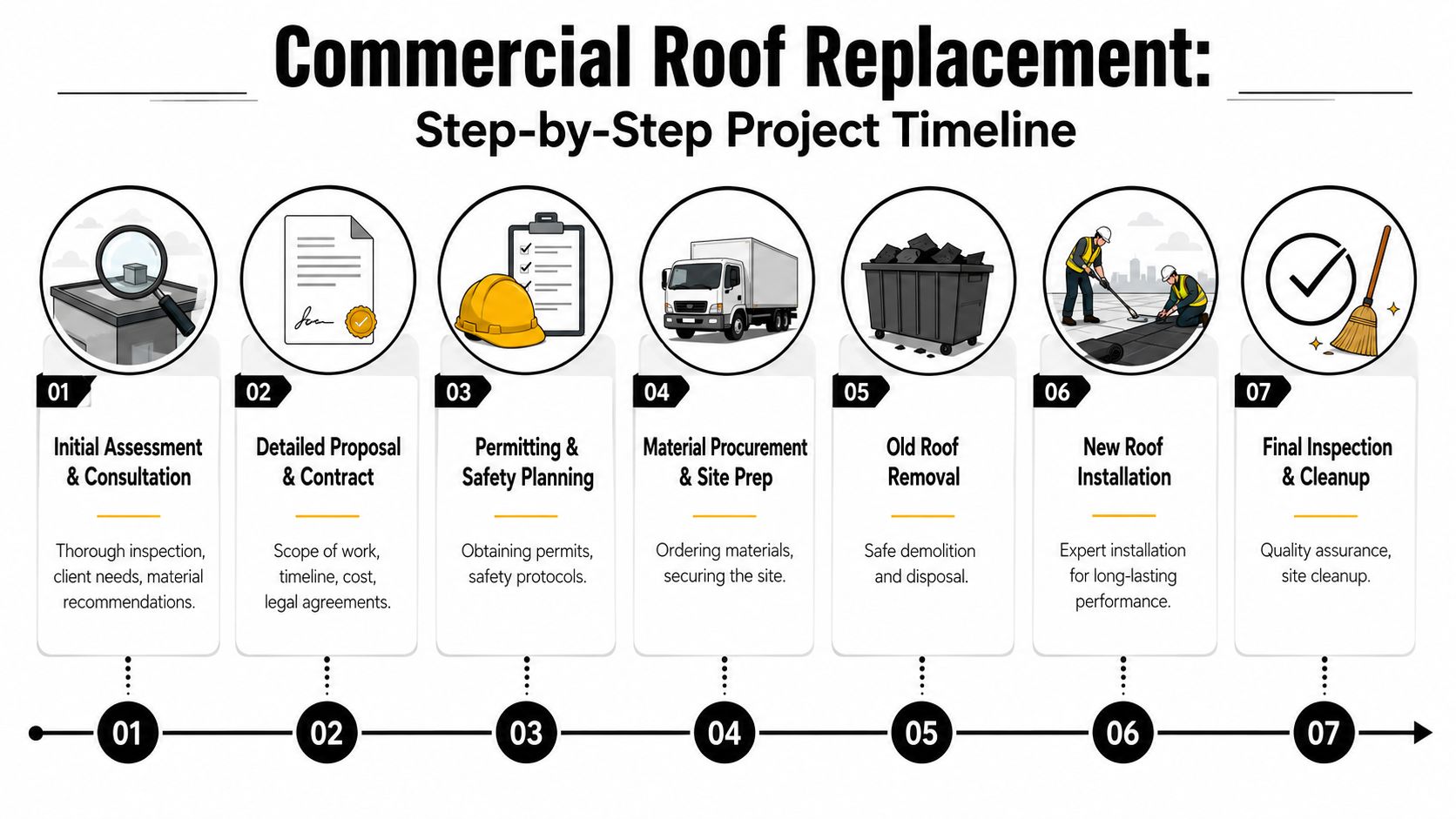
The assessment stage sets the whole job
The first site assessment should look beyond visible roof cladding. A compliant commercial roof replacement isn't a simple sheet swap. It requires assessing the existing structural load path, purlin spacing, and fastener condition against current Australian Standards for the site's specific wind region, as outlined in this commercial roof structural assessment reference.
That matters because the new roof has to work with the building beneath it. If purlins are corroded, spacing is inconsistent, or edge restraint is inadequate, the project scope changes. The same applies where earlier modifications were done without proper detailing around penetrations, plant platforms, or gutter transitions.
A solid assessment phase usually includes:
Roof inspection and defect mapping
The contractor documents leaks, corrosion, failed flashings, ponding points, penetrations, damaged insulation, and drainage issues.Structural and fixing review
This checks whether the support structure and fixing pattern are suitable for the proposed replacement system.Hazard identification
Asbestos, fragile roof sections, electrical hazards, skylights, and access constraints need to be identified early.
From contract to installation
Before materials are ordered, the scope should be locked down in writing. That includes what is being removed, what stays, what gets upgraded, who handles waste, what weather allowances apply, and what documentation will be handed over at completion.
For owners who want a benchmark, Commercial Roofers is one Sydney contractor that handles inspections, asbestos roof removal and replacement, metal reroofing, and occupied-site project coordination through in-house crews. The key point isn't the brand. It's the delivery model. In-house supervision and clear site management usually reduce communication gaps during live commercial work.
This video gives a useful overview of how a roof replacement timeline is staged on site:
Once contracts and planning are settled, the on-site sequence usually looks like this:
- Site establishment: Edge protection, access equipment, exclusion zones, amenities, and deliveries are organised before removal begins.
- Removal works: Existing roofing, flashings, and affected components are stripped in a controlled sequence. If asbestos is involved, a different control regime applies.
- Substrate remediation: Damaged purlins, battens, insulation, or drainage elements are repaired or replaced.
- Installation of the new system: Sheets, flashings, cappings, box gutters, penetrations, and safety-related details are installed to the approved specification.
- Weather management: Temporary waterproofing plans matter on staged jobs, especially on occupied sites.
Don't judge a program by the day the roofing crew arrives. Judge it by whether the planning before that day has removed surprises.
Handover is more than a final look
The job isn't complete when the last sheet is fixed. Handover should include final inspection, defect rectification, site clean-up, waste tracking where relevant, and documentation such as warranties, material details, and any compliance records promised in the contract.
On commercial sites, that paperwork matters almost as much as the roof itself. Strata committees, facilities managers, insurers, and future maintenance contractors all rely on it.
Understanding The Costs Of A Commercial Roof Replacement
Owners often ask for a square metre rate because it feels like the quickest way to compare contractors. It's not useless, but on commercial projects it can be misleading. Two roofs with the same area can be priced very differently if one has easy crane access and the other has asbestos, tenant constraints, fragile skylights, old box gutters, and structural rectification.
What actually moves the price
Several factors drive the final quote:
- Roof design and complexity: A large simple warehouse roof is different from a strata roof with multiple penetrations, plant bases, parapets, and change-of-level details.
- Material specification: Basic through-fix metal sheeting, concealed-fix systems, zinc, copper, and architectural profiles all sit in different cost bands.
- Access conditions: City-fringe sites, tight loading areas, live retail precincts, and buildings with limited laydown space need more coordination.
- Structural remediation: If purlins, battens, or supports are degraded, the project is no longer just a reroof.
- Safety controls: Edge protection, scaffold, traffic management, exclusion zones, and occupied-site staging all affect labour and preliminaries.
- Waste handling: Removal, transport, and disposal costs vary sharply depending on the material coming off the roof.
If you're comparing repair and replacement budgets, this breakdown of roof repair cost factors for commercial properties helps frame what belongs in a proper scope.
How to read a quote properly
A low quote can still become the expensive option if it leaves out key scope. Look for these items before you compare totals:
| Quote item | Why it matters |
|---|---|
| Scope of demolition | Confirms what is being removed and what remains |
| Structural allowances | Shows whether the contractor has considered substrate defects |
| Safety setup | Reveals whether the job is priced to run legally and safely |
| Flashings and drainage | These details often decide whether the new roof stays watertight |
| Waste disposal | Prevents surprise variation claims later |
| Handover documents | Important for insurers, strata records, and future maintenance |
A good quote also states assumptions clearly. If asbestos is only “assumed absent” rather than tested or scoped, the budget risk still sits with you. If access equipment is provisional, the final price may move once the site setup is properly reviewed.
The cheapest number on page one often comes from scope omissions on page three.
Sydney Compliance Safety And Asbestos Removal Explained
Commercial reroofing in NSW lives or dies on compliance. Owners usually see the visible work. The greater risk sits in what happens around it: site controls, worker access, tenant protection, hazardous materials handling, and documentation.
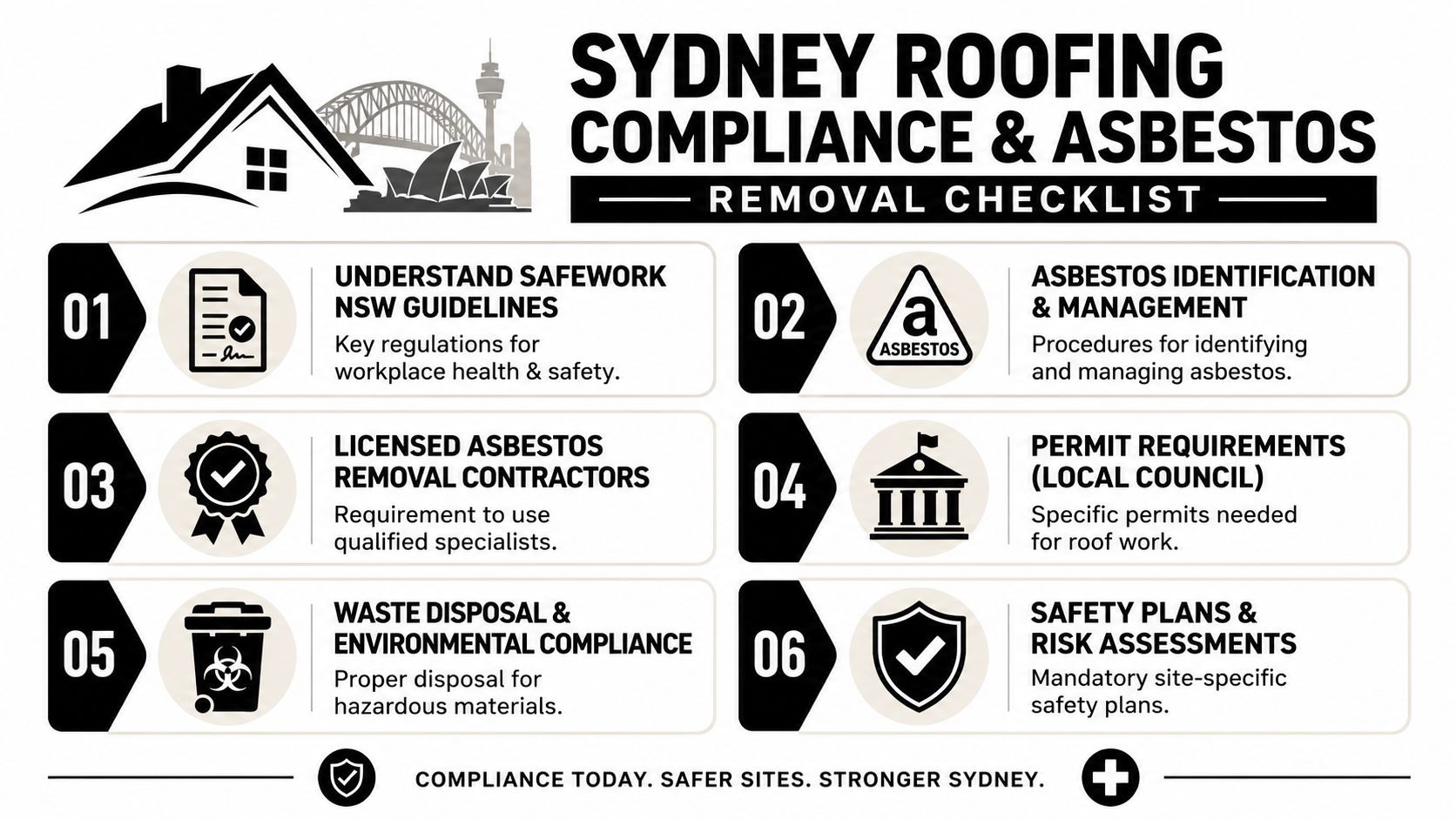
What compliance looks like on a real site
A compliant Sydney roof replacement starts with identifying the site-specific risks. That includes the roof type, height, access points, adjoining public areas, electrical services, skylights, fragile sections, weather exposure, and whether the building remains occupied during works.
Contractors also need to coordinate with the owner's operational requirements. A healthcare site, warehouse, school, and strata complex won't be staged the same way. Noise windows, delivery times, emergency access, and sensitive internal areas all change the sequence.
At minimum, owners should expect:
- Site-specific safety planning: Generic paperwork isn't enough for live commercial work.
- Clear access controls: Roof access, exclusion zones, and separation from occupants must be managed.
- Council or site approval checks: Some jobs require additional local approvals, particularly where access, traffic, or waste logistics affect surrounding areas.
- Documented communication: Tenants, staff, and facility teams need notice of noisy works, shutdowns, or restricted zones.
Asbestos changes the program
While many contractors can replace a roof, fewer deal properly with the operational side of asbestos roof replacement, including how to keep tenants in place where possible, how to sequence works around business hours, and how to provide the records insurers and strata managers expect, as noted in this commercial asbestos replacement planning reference.
If asbestos-containing roofing or associated materials are present, the project must be treated as a hazardous materials job first and a roofing job second. That affects:
- Who performs the removal
- How the area is isolated
- Whether air monitoring is required
- What clearance process applies
- How waste is packaged, transported, and documented
- When other trades can re-enter the area
For owners looking into specialist help, this page on asbestos roof repair and replacement services is a useful starting point.
The moment asbestos is confirmed, program, cost, access, and occupancy planning all need to be recalculated.
Keeping the building operating
Some occupied buildings can keep running during roof replacement. Some can't. The answer depends on the roof layout, the asbestos scope, the tenancy type, and how effectively the works can be isolated.
A workable operational plan usually includes a mix of measures:
- Staged work zones: One section is removed and replaced while other sections remain active.
- After-hours activities: Noisy or high-interruption tasks are shifted outside normal operating times where practical.
- Internal protection: Sensitive stock, equipment, and work areas are protected before removal starts.
- Tenant notices and escalation contacts: Occupants need one clear line of communication, not conflicting messages from multiple parties.
Project management is of utmost importance. The technical roof solution can be sound, but if the site sequencing is poor, the business still suffers.
Your Vetting Checklist For Choosing A Sydney Roofing Contractor
If you're comparing contractors from a search for roof replacements near me, don't start with the quote total. Start with the risk profile. Commercial roofing is full of contractors who can price a job quickly and explain it vaguely. That's not enough for an occupied Sydney site.

Questions that expose risk quickly
Ask direct questions, and insist on direct answers.
Who will be on my roof each day?
You need to know whether the company uses in-house crews, labour hire, or layers of subcontractors. The more fragmented the labour model, the harder it is to manage quality and site communication.Can you show experience on occupied commercial sites like mine?
A contractor who mainly does houses may not be set up for warehouses, strata committees, healthcare tenancy constraints, or live loading docks.What safety system will govern this specific site?
Ask how they'll manage edges, fragile areas, public separation, weather stops, and emergency procedures.How are asbestos risks identified and handled?
A serious contractor won't brush this aside. They'll explain investigation, licensed removal where required, clearance steps, and how that changes staging.What's excluded from the quote?
This question often tells you more than asking what's included. Exclusions reveal whether the contractor has thought through structure, drainage, access, and waste.What handover documents do I receive?
You want warranties, scope records, product information, and any compliance-related documentation promised under the contract.
If a contractor can't explain the sequence of the work in plain language, they probably can't control the sequence on site either.
One more check matters. Ask who will be your day-to-day contact once the contract is signed. A commercial reroofing job moves faster and more cleanly when one supervisor owns communication, variations, weather calls, and tenant coordination.
Maximising Your Investment And What To Do Next
A commercial roof replacement isn't just a construction task. It's a capital works decision that affects operations, compliance, insurance, and future maintenance. The owners who get the best outcome usually make the decision early enough to plan it, not late enough to be cornered by it.
Once the new roof is installed, protect the investment. Keep the handover documents in one place. Understand the warranty conditions. Schedule routine inspections, especially around gutters, penetrations, flashings, and roof-mounted plant. Most online results for roof replacements near me focus on emergency quotes, but practical planning around replacement versus restoration and reducing disruption is often what matters most for commercial owners, as discussed in this commercial roofing planning reference.
A well-managed roof should become easier to own after replacement, not more demanding.
If you need a clear scope, a site inspection, or advice on staging a replacement with minimal disruption, speak with Commercial Roofers. They handle Sydney commercial and industrial reroofing, including asbestos removal and occupied-site planning, with detailed quoting and project coordination.