
You get the call on a wet Monday morning. A tenant has water coming through the warehouse ceiling, maintenance has taken a look from below, and someone mentions the roof sheets might be asbestos cement. From that point, the issue stops being a simple leak repair. It becomes a compliance job, a risk management job, and a project sequencing job.
That's the part many property managers aren't told early enough. The immediate worry is usually health and safety, which is fair. Right behind that come the practical questions. Can the site keep operating? Who needs to be notified? Are you repairing, encapsulating, over-cladding, or heading straight to replacement? How do you brief owners, tenants, and insurers without causing confusion or panic?
In Sydney and across NSW, an asbestos roof can still be managed properly if the work is planned correctly. The wrong response is improvising with a handyman, a pressure cleaner, or a patch-and-hope approach. The right response is to treat the roof as a controlled commercial project with clear decisions, documented risk controls, and a contractor who understands both roofing and asbestos obligations. If you're trying to frame likely budget pressure before quotes arrive, it also helps to understand commercial roof repair cost drivers in plain terms.
Table of Contents
- Your Commercial Property Has an Asbestos Roof What Now
- Understanding Your Legal and Safety Obligations in NSW
- The First Step Professional Inspection and Testing
- Decision Point Repair Encapsulate or Full Replacement
- The Asbestos Roof Remediation Process Explained
- How to Hire the Right Asbestos Roof Repair Company
- Asbestos Roofing FAQs for Property Managers
Your Commercial Property Has an Asbestos Roof What Now
If your building has an older roof and someone has flagged asbestos, slow the job down before anyone goes up there with tools. That first pause matters. A lot of problems start when people treat asbestos cement roofing like standard sheet metal, then create unnecessary disturbance trying to chase a leak, replace fixings, or cut in a new service penetration.
On commercial sites, the first workable mindset is this. You're not dealing with just a roof defect. You're dealing with a regulated building material that happens to be leaking. Once owners understand that distinction, the next steps become clearer and less stressful.
Most portfolios run into this in familiar settings:
- Warehouses with recurring leaks where maintenance history is patchy and nobody is sure what the original sheeting is
- Strata industrial units where multiple lot owners need a single decision and no one wants to own the asbestos risk
- Older factories and workshops where roof access is frequent because of plant, exhausts, skylights, or electrical work
The first good decision is usually not a repair. It's getting the roof properly identified, assessed, and controlled.
A capable asbestos roof repair company won't rush to offer one universal answer. It should help you establish the roof condition, likely disturbance risk, site constraints, and whether the building needs a short-term holding measure or a proper remediation plan.
That shift in thinking helps when you brief stakeholders. Instead of saying, “We've got a dangerous roof,” you can say, “We've identified a regulated material in the roof system and we're managing it through inspection, controlled work methods, and a staged decision on repair versus replacement.” That's a much better starting point for owners, tenants, and facility teams.
Understanding Your Legal and Safety Obligations in NSW
The legal side needs to be clear before anyone starts pricing works. In Australia, the nationwide all-out ban on the manufacture, import, transport, sale, storage and use of asbestos and asbestos-containing products took effect on 31 December 2003, and asbestos remains a legacy risk in older buildings, particularly where roofing and wall materials were widely used before the ban, as noted in guidance on asbestos in older building products.

What changes once asbestos is confirmed
Once asbestos is identified or strongly suspected, the job has to be planned around compliance, not convenience. That affects access, contractor selection, documentation, waste handling, and how the site operates during the works.
For NSW property managers, the practical obligations usually include:
- Stop ad hoc works: Don't let maintenance teams drill, cut, pressure clean, grind, or break sheets while “making safe”.
- Control access: Restrict who can get onto the roof and who can work underneath affected areas.
- Document the issue: Update the site records, notify the relevant people internally, and make sure the asbestos management process reflects the roof condition.
- Use the right contractor pathway: Depending on the work scope and risk level, you may need licensed asbestos professionals, not just a roofer with general trade experience.
Non-negotiable: If the method creates unnecessary disturbance, it's the wrong method, even if it looks cheaper on the quote.
Owners often fall into the trap of comparing a compliant scope against a standard roofing scope and thinking the asbestos quote is inflated. It isn't necessarily inflated. It includes controls the other quote has ignored.
What owners and managers need in place
A commercial site shouldn't treat asbestos roof work as a one-line maintenance item. It should sit within the building's broader asbestos management obligations and safety systems.
In practice, that means checking for the following before work starts:
| Requirement | Why it matters on a live site |
|---|---|
| Asbestos register | Gives contractors and maintenance teams a clear reference point |
| Management plan | Sets out how the risk is being controlled |
| Site-specific method | Matches the work method to the roof condition and occupancy |
| Contractor licence and insurance | Reduces legal and commercial exposure if something goes wrong |
| Communication plan | Helps tenants, staff, and visitors understand restrictions |
The legal risk is only part of it. There's also executive risk. If an unplanned disturbance affects workers, tenants, or neighbouring occupiers, owners may find themselves answering difficult questions long after the leak itself has been forgotten.
A seasoned asbestos roof repair company should speak plainly about this. If your contractor only talks about membranes, screws, and sheet coverage but not isolation, licensing, waste handling, and records, they're not managing the full job.
The First Step Professional Inspection and Testing
The first site visit should answer one question before any scope is finalised. What exactly are we dealing with, and what condition is it in? Without that, every quote is guesswork.
A proper inspection is more than a quick look from the ladder. On commercial roofs, the assessor needs to understand roofing failure points and asbestos risk at the same time. Leaks might be coming from laps, flashings, penetrations, failed fixings, gutters, or rooflights. The presence of asbestos changes how those defects can be investigated and fixed.
What a proper roof assessment looks like
A useful inspection usually includes visual condition mapping across the roof area, not just the spot where water showed inside. Commercial roofs often fail in patterns. One internal leak can be the symptom, not the source.
Expect the inspection process to cover:
- Sheet condition: Cracking, weathering, edge breakdown, impact damage, and previous patch repairs
- Common water entry points: Laps, ridges, penetrations, flashings, rooflights, gutters, and fixings
- Signs of prior disturbance: Cut edges, drilled services, broken corners, or inconsistent replacement patches
- Safe sampling if required: Material testing should be done in a controlled way, not by random break-off pieces taken by site staff
If there's uncertainty about the material, laboratory confirmation is worth doing properly. It settles the argument early and prevents costly confusion later in the project.
Why friable versus non-friable matters
The most important technical distinction is whether the asbestos sheet is still non-friable and intact or whether it has become weathered, cracked, or otherwise damaged. As noted in technical guidance on asbestos roof assessment and solutions, fibre release risk rises when the cement matrix is damaged, and the work method has to minimise disturbance.
Consider old laminated glass. If the layers are intact, you manage it one way. If the bonding has failed and the material is breaking down, the risk profile changes immediately.
A roof in poor condition can turn a simple leak response into a controlled asbestos project very quickly.
That's also why experienced contractors favour lower-disturbance options where suitable. On some roofs, encapsulation or over-cladding is more sensible than trying to carry out direct invasive repairs to ageing sheets. On others, damage has gone too far and controlled removal becomes the more reliable option.
The inspection should finish with a decision brief, not just photos. You want a practical recommendation that tells you what can be left, what must be controlled, what can be repaired, and what pushes the building toward replacement planning.
Decision Point Repair Encapsulate or Full Replacement
Once the roof condition is known, the next decision is commercial, not just technical. Do you repair and hold the asset, encapsulate it to reduce disturbance and stabilise performance, over-clad it to gain a new outer roof system, or remove and replace the lot?
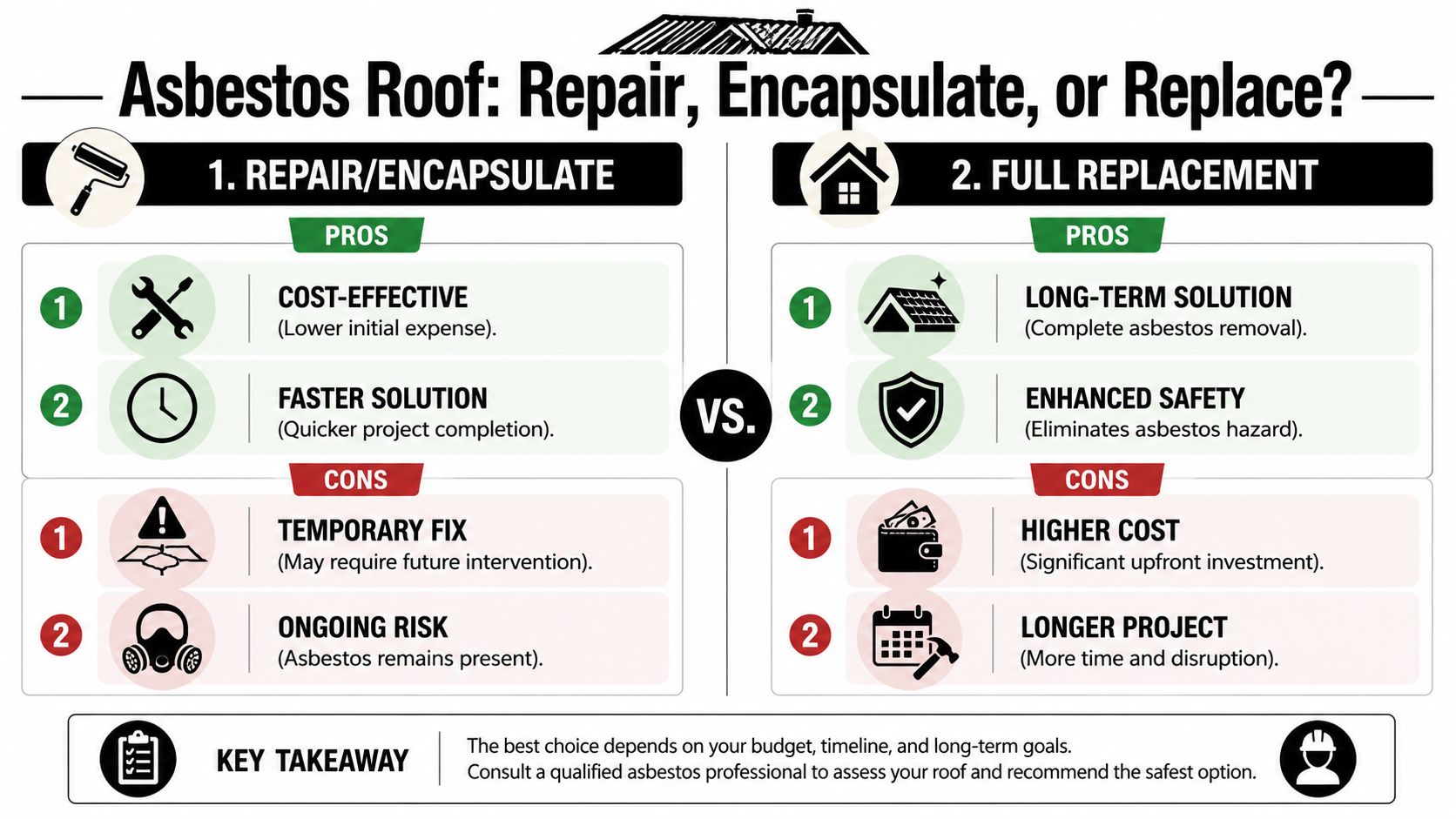
Safe Work Australia guidance notes that asbestos-containing materials in good condition can sometimes be left in place, but damaged or weathered material increases the need for removal, as discussed in guidance on when asbestos materials may stay in place versus require removal. That's the right starting point. There isn't a single yes-or-no rule.
When repair or encapsulation makes sense
Repair or encapsulation suits roofs that are still broadly intact, where the immediate issue is leakage or surface weathering rather than widespread failure. The attraction is obvious. Lower initial disruption, less intrusive works, and a way to manage risk while deferring a larger capital job.
That said, it only works when the roof sheets are stable enough for a low-disturbance method. It does not work well when the roof has widespread cracking, repeated breakage around fixings, or a history of piecemeal patching that has already compromised the sheet.
Good candidates often include:
- Isolated defects around flashings or penetrations
- Surface weathering where the sheet remains bonded
- Sites that need a short-to-medium-term hold strategy before redevelopment or staged replacement
Poor candidates include roofs that have become brittle, have multiple damaged zones, or need frequent intrusive access.
When over-cladding is the better commercial decision
Over-cladding sits in the middle ground. You retain the existing asbestos roof beneath, manage it as part of the building fabric, and install a new roofing system over the top under a carefully designed method. For many operating industrial sites, that can be the most practical answer because it limits disturbance while improving weather performance.
The trade-off is straightforward. You haven't removed the asbestos liability. You've managed it within a new roof build-up. That can be a sensible decision for some owners and the wrong decision for others.
This is often where a modern metal roofing system becomes part of the conversation. If you're comparing long-term roof types, this overview of commercial metal roofing options in Australia is useful background.
When full replacement is the cleaner long-term move
Full replacement is usually the cleanest answer when the building has a long future, the roof is failing more broadly, or owners want to remove ongoing asbestos management from the asset. It creates more planning pressure up front, but it also resolves a lot of recurring problems in one move.
From a portfolio perspective, replacement often makes sense when:
| Option | What you gain | What you take on |
|---|---|---|
| Repair | Fast intervention on specific defects | Ongoing asbestos remains in service |
| Encapsulation or over-cladding | Lower disturbance and improved weatherproofing | Future management of retained asbestos |
| Full replacement | Removal of legacy material and a new roof asset | More complex sequencing, approvals, and site disruption |
One practical point gets overlooked. Mechanical methods can escalate exposure risk quickly. U.S. EPA and NESHAP guidance notes that using a rotating-blade roof cutter on Category I nonfriable asbestos roofing can create regulated asbestos-containing material once removal reaches 5,580 ft², which is a useful technical benchmark showing how quickly poor methods increase risk, even though it isn't Australian law, as outlined in EPA roofing guidance on mechanically disturbed asbestos materials.
That's why careful contractors avoid turning a manageable roof into a high-risk event through aggressive cutting or abrasion. The right method is often the one that looks slower on paper but creates less exposure and less chaos on site.
The Asbestos Roof Remediation Process Explained
Property managers usually relax once they can see the workflow. Most asbestos roof jobs feel overwhelming because the project is being imagined as one big shutdown. In practice, the work is usually staged, isolated, and documented.
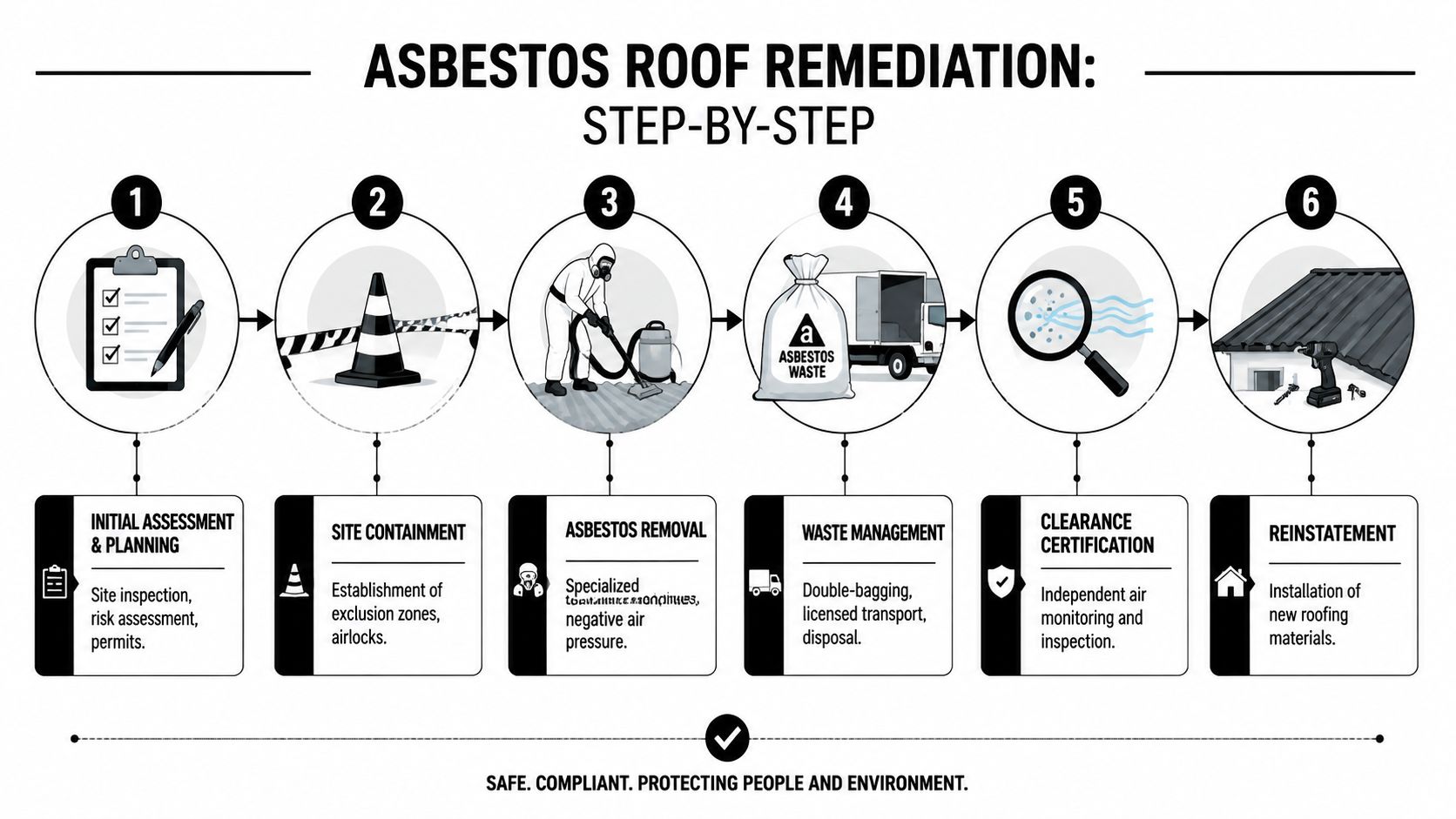
To make that sequence easier to picture, here's the typical flow.
A NSW project plan needs to account for notification periods, risk controls such as air monitoring where required, and licensed waste transport. On commercial sites, business interruption and tenant access constraints can materially affect the timeline, as noted in guidance on planning asbestos roof projects around operations and waste transport requirements.
How a live commercial site is usually staged
Day one is rarely “start removing roof sheets”. It usually starts with paperwork confirmed, site access rules agreed, exclusion zones marked, and everyone clear on who can move where.
A typical remediation sequence looks like this:
Initial planning and notification
Scope is locked in, site risks are reviewed, and the work method is aligned with the actual roof condition.Site setup and isolation
Work zones are separated from staff, tenants, customers, vehicles, or stock handling areas.Controlled roof works
The crew uses low-disturbance methods, suppression controls, and strict handling procedures suited to the roof type and condition.Waste packaging and removal
Materials are wrapped, labelled, and moved through the agreed route for licensed transport and disposal.Cleaning and verification
The area is cleaned with appropriate methods, often including HEPA-based cleanup where required by the work approach.Reinstatement
The new roof build or repair system is installed and the site is handed back in stages or as one package.
This can be paired with a new roofing installation program. For owners planning the rebuild phase, it helps to understand how commercial roof installation is typically sequenced after asbestos works are completed.
Here's a useful video that shows the kind of controlled approach these projects require:
Where projects usually slow down
The delays usually don't come from swinging hammers. They come from coordination failures.
Common pressure points include:
- Tenant access restrictions: Shared driveways, loading docks, and pedestrian routes often need temporary changes.
- Weather windows: Roof work and containment planning still depend on safe conditions.
- Waste logistics: Licensed transport and disposal don't run on the same casual timeline as standard demolition bins.
- Stakeholder sign-off: Strata committees, corporate owners, and site operators often need staged approvals.
Practical rule: The smoother job is usually the one with the longer pre-start meeting.
A good asbestos roof repair company will tell you early whether the site can stay live, whether work needs to be phased by tenancy or bay, and what activities below the roof need to pause during the hazardous parts of the job. That clarity is what protects operations, not vague assurances that “we'll work around you”.
How to Hire the Right Asbestos Roof Repair Company
This decision should never be made on headline price alone. If a contractor prices asbestos roof work like an ordinary leak repair, they're either missing part of the scope or pushing risk back onto you.
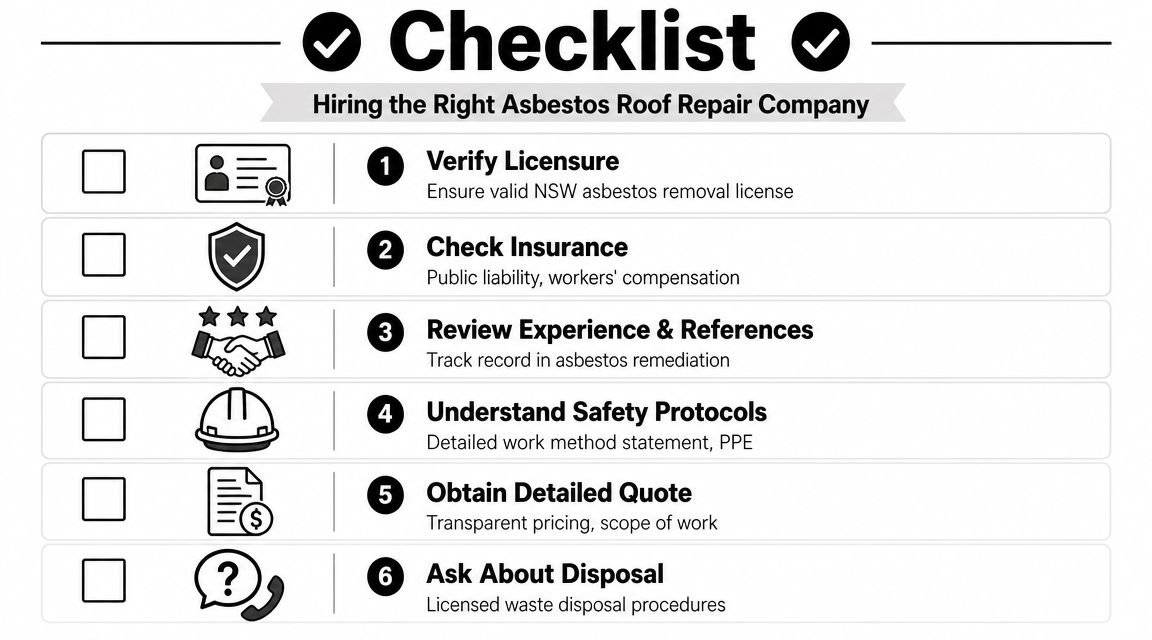
The safest hiring approach is to assume every quote is incomplete until it proves otherwise. A proper asbestos roof repair company should show competence in roofing, asbestos control, planning, and documentation. If one of those pieces is missing, the project will wobble later.
What a proper quote should show
A serious quote should make the work legible. You should be able to see what is being done, how it will be controlled, and what assumptions the contractor has made about the site.
Check for these basics:
- Scope clarity: Which roof areas are included, what defects are being treated, and whether the proposal is repair, encapsulation, over-cladding, or removal
- Method summary: How the contractor will minimise disturbance, manage access, and sequence the work
- Licence and insurance evidence: Not promised later. Shown up front
- Waste pathway: Packaging, transport, and lawful disposal arrangements
- Handover records: What documentation you'll receive at completion
If you're comparing Sydney contractors, one example in the market is Commercial Roofers, which handles asbestos roof removal and replacement on commercial and industrial sites alongside general roofing scopes. That kind of combined capability matters when the project doesn't stop at removal and needs a coordinated reinstatement.
Questions that separate serious operators from cheap risks
Ask direct questions and listen for direct answers.
Try these:
- What licence class applies to this work, and who will supervise it on site?
- How will you keep tenants, staff, or stock separated from the work area?
- What does your method avoid doing to reduce disturbance?
- What happens if the roof condition is worse than the survey suggests?
- Who handles waste transport and what records do we receive?
- What assumptions in your quote could change the final cost or programme?
If a contractor can't explain the work method in plain English, they probably can't manage it cleanly on a live site.
You also want proof of experience with similar buildings. A small workshop and a multi-tenancy warehouse aren't the same project. Nor are a vacant factory and an occupied strata complex. The best contractor for your job is the one whose past work looks operationally similar to your site, not the one with the cheapest square-metre rate on a spreadsheet.
Asbestos Roofing FAQs for Property Managers
Will insurance cover asbestos roof work
Sometimes yes, sometimes no. It depends on the policy, the cause of damage, and whether the claim is for sudden damage, resulting water ingress, or planned replacement of ageing materials. Don't assume asbestos removal itself is automatically covered. Send the insurer the inspection findings, scope, and photos early.
Can the business keep operating during the works
Often it can, but not always in full and not always everywhere. The answer depends on roof condition, work method, tenant density, access routes, and whether the project can be isolated in stages. For warehouses and industrial sites, partial occupation is common when planning is tight and exclusion zones are respected.
What warranties should you expect after the job
That depends on what's being delivered. A repair scope, an encapsulation scope, and a full roof replacement won't carry the same warranty structure. Ask separately about workmanship warranty, materials warranty, and any exclusions tied to retained asbestos in adjacent areas.
How is asbestos waste disposed of legally
It needs to be packaged, labelled, transported, and disposed of through the proper licensed pathway. Property managers should expect records, not just verbal assurance. If the contractor is vague about disposal, stop there and ask more questions.
Should you repair first and replace later
Sometimes that's the right call. It works best when the roof is still manageable, the building has short-term operational constraints, or capital approval for replacement isn't ready. It's a poor strategy when the roof already needs repeated intervention or the sheet condition is deteriorating quickly.
What should you tell tenants and stakeholders
Keep it factual. Confirm that asbestos-containing material has been identified or suspected, say that the site is being managed through controlled professional assessment and compliant work methods, and set out any access or timing impacts clearly. Calm, specific communication avoids unnecessary alarm.
If you need a practical assessment of an asbestos roof on a Sydney commercial or industrial property, Commercial Roofers can help map the condition, explain whether repair or replacement is the better path, and scope the work around compliance, access, and business continuity.