

Rain hits overnight. By 8:15 am, a tenant emails photos of a stained ceiling tile above the reception desk. By 9:00, maintenance has a bin under a steady drip. By lunchtime, someone's asking whether this is “just a quick patch job” or the start of a bigger problem.
For a Sydney commercial property, that decision matters more than most owners expect. A roof leak can interrupt operations, damage stock, create slip hazards, trigger disputes with tenants, and expose weaknesses in drainage, flashing, or penetrations that have been building for months. The internal stain is only the visible part of the problem.
Roof leak repair in Sydney works best when it's treated as an asset-protection decision, not a handyman task. In a trade market that IBISWorld classifies as ANZSIC E3223 Roofing Services, with an industry projected at $4.4 billion in 2026, 5,798 businesses operating in 2025, and revenue growth of 0.3% CAGR from 2020 to 2025, owners should expect a fragmented field where capability, pricing, and repair quality vary widely by roof type and job complexity, as noted in IBISWorld's Australia roofing services industry profile.
Table of Contents
- Your Commercial Property's First Line of Defence
- Immediate Steps to Mitigate Leak Damage
- Finding the True Source of Your Roof Leak
- Navigating Asbestos Safety and Sydney Compliance
- How to Choose a Sydney Commercial Roofing Partner
- From Reactive Repairs to Proactive Asset Protection
Your Commercial Property's First Line of Defence
A commercial roof doesn't usually announce failure with a dramatic collapse. More often, it starts with a quiet sign that someone almost ignores. A damp patch in a warehouse corner. A musty smell after heavy rain. A drip appearing near a service penetration above an office fit-out.
Those early signs matter because the roof is your building's first weather barrier. Once water gets through, it doesn't stay in one place. It moves into insulation, ceiling systems, wall cavities, electrical pathways, stock storage zones, and tenant spaces. In a strata or industrial setting, that can quickly become a dispute about responsibility, access, disruption, and repair scope.
Small symptoms can carry large business risk
Owners sometimes treat the first leak as a minor maintenance item because the visible damage looks modest. That's where costs grow. The stain on the ceiling tile is cheap. The reason behind it might involve failed flashing, blocked drainage, corroded sheet laps, movement around penetrations, or wet substrate that has been deteriorating for some time.
Practical rule: Judge the leak by what it can affect, not by the size of the drip.
In commercial properties, the actual exposure isn't only roofing labour. It's downtime, damaged goods, tenant frustration, safety hazards, and the possibility that the same area leaks again after the next storm because no one proved the source.
Cheap patches often create expensive uncertainty
The worst outcome isn't paying for a proper repair. It's paying twice. First for a fast patch that doesn't solve the cause, then again for further investigation, reinstatement, and damage control after another weather event.
A better approach is to treat the first sign of leakage as a trigger for three decisions:
- Containment first: Protect people, stock, and electrical risk before anyone worries about finish quality.
- Diagnosis second: Find the actual entry point and understand whether the defect is isolated or part of wider roof deterioration.
- Repair strategy third: Decide whether targeted repair is sensible, or whether broader remedial work will lower risk over the life of the asset.
That mindset is what separates routine maintenance from responsible asset management.
Immediate Steps to Mitigate Leak Damage
When a leak is active, the first job isn't roofing. It's damage control. The aim is to keep people safe, protect assets, and preserve evidence so the repair scope is based on facts rather than guesswork.
What to do in the first half hour
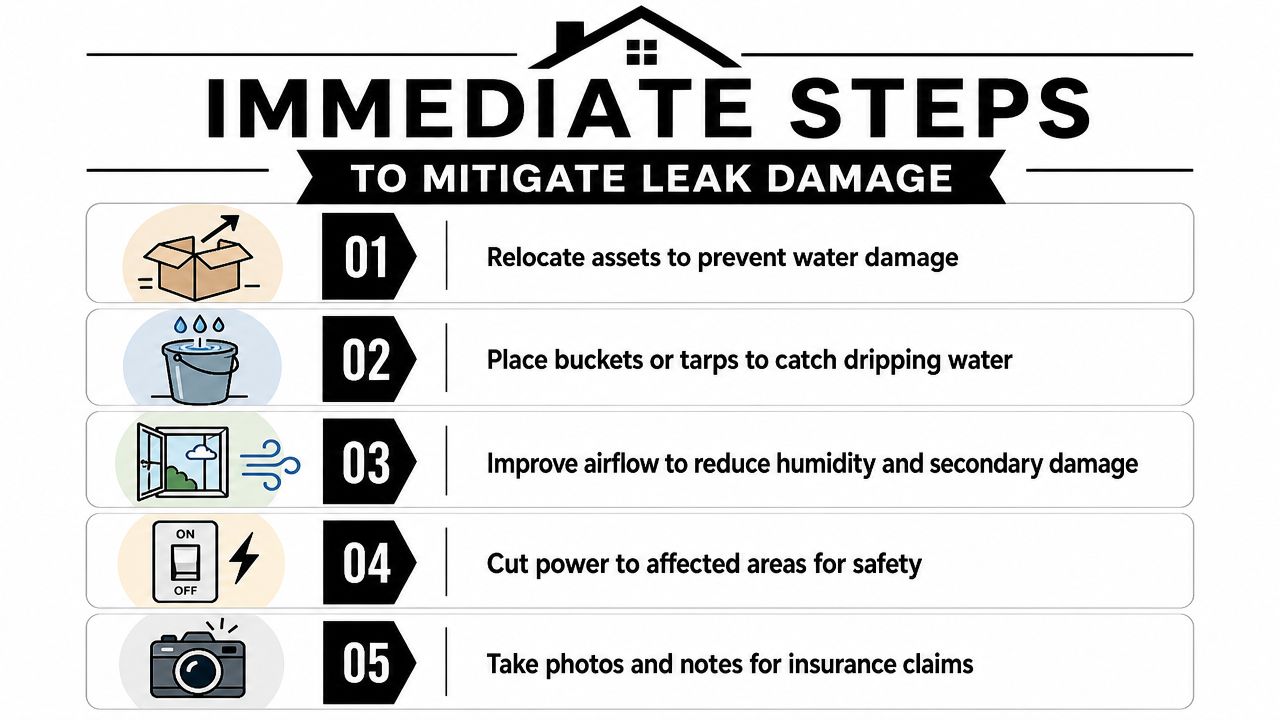
Start with the area below the leak, not the roof surface. If staff are walking through the zone, if power is nearby, or if stock is getting wet, those risks outrank everything else.
- Isolate the area: Use cones, tape, or temporary barriers to stop foot traffic under the leak. Wet polished concrete, tiled foyers, and painted warehouse floors become slip hazards quickly.
- Protect stock and equipment: Move cartons, archive boxes, electronics, and movable furniture out of the fall zone. If relocation isn't practical, cover assets with tarps or plastic sheeting and raise them off the floor where possible.
- Catch and redirect water: Buckets help with drips. Tarps can help with broader spread. If ceiling tiles are bulging with trapped water, don't start puncturing them casually unless you can control the release and do it safely.
- Manage electrical risk: If water is near light fittings, switchboards, power points, plant, or data equipment, isolate power to the affected area through the appropriate site process.
- Improve airflow: Open the area where safe and use air movement to reduce humidity and secondary moisture damage while waiting for inspection.
- Document the damage: Take photos of the ceiling stain, floor condition, damaged goods, and any weather conditions relevant at the time.
Water damage claims and repair scopes are easier to manage when someone records what happened before temporary cleanup starts.
What not to do
A lot of secondary damage comes from well-meaning actions taken too early.
- Don't send untrained staff onto the roof: Commercial roofs can involve brittle sheets, slippery membranes, concealed skylights, and unsafe access points.
- Don't assume the drip point equals the entry point: Water often travels before it shows internally.
- Don't bury the evidence: If you repaint, replace ceiling tiles, or strip out wet materials before inspection, you make diagnosis harder.
- Don't rely on sealant as your plan: A tube of sealant can be a temporary holding measure in the right hands, but it doesn't replace a repair strategy.
A simple site record helps later
If you manage multiple properties, keep a short leak log for each event. It doesn't need to be elaborate.
| Record item | Why it matters |
|---|---|
| Date and weather conditions | Helps correlate leak activation with rainfall and wind |
| Exact internal location | Supports source tracing later |
| Photos before cleanup | Useful for insurers, tenants, and contractors |
| Assets affected | Helps prioritise protection and reinstatement |
| Recurrence history | Shows whether this is isolated or part of a pattern |
That short record often reveals the difference between a one-off defect and a recurring failure point.
Finding the True Source of Your Roof Leak
The most common mistake in roof leak repair Sydney jobs is fixing what the occupant can see. That's understandable. The stain is visible, the complaint is immediate, and patching it feels productive. It's also how repeat leaks happen.
Independent practitioner commentary on leak repairs keeps returning to the same point. The key is to find where it's leaking, not just tidy up the symptom, as discussed in this roof leak diagnosis commentary on YouTube. For commercial properties with penetrations, plant mounts, parapets, box gutters, and long water paths, that distinction is critical.
Why the ceiling stain lies
Water rarely drops straight down from the entry point. It can travel along purlins, insulation facings, membrane laps, deck ribs, and structural members before it appears inside. That's why a neat stain over a meeting room can originate from a flashing failure, blocked drainage point, or penetration several metres away.
When a contractor responds by quoting a patch without source tracing, you're not buying certainty. You're buying an attempt.
What a proper source-tracing inspection looks like
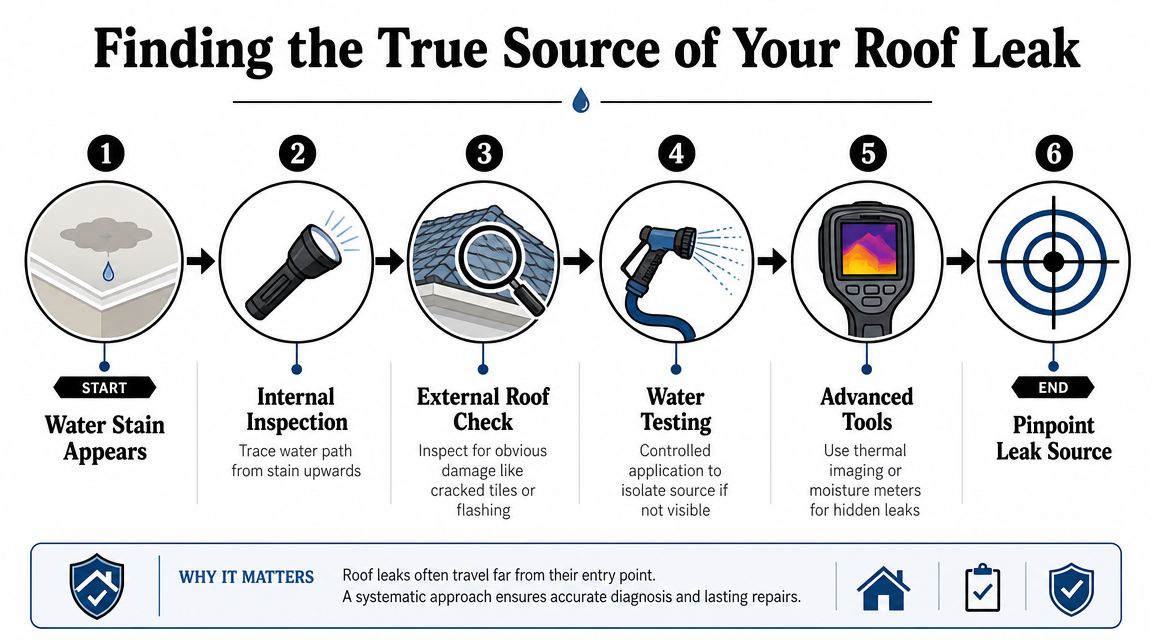
Australian repair guidance emphasises a source-tracing inspection rather than a visible-stain repair. Water can travel away from the entry point before it appears inside, so the recommended process is to inspect the roof space during or immediately after rain, map wet insulation, mould, or discoloured substrate back to likely ingress points such as flashings, penetrations, and roof intersections, then use a workflow of ground-level triage, controlled roof-space inspection, and targeted opening or repair of the suspect assembly, as outlined in this Australian roof leak step-by-step guide.
That sequence matters because each stage narrows the field before anyone starts dismantling assemblies or applying repair materials. A good leak investigation usually includes some mix of the following:
- Internal mapping: Checking the roof space, insulation condition, stained substrate, mould traces, and likely water paths.
- External review: Looking at flashings, penetrations, laps, cappings, gutters, outlets, fixings, and obvious impact or corrosion points.
- Controlled testing: If the source isn't obvious, targeted water testing can help isolate the entry path.
- Targeted opening-up: Removing only what's needed to confirm the defect, not tearing into large areas blindly.
A video walkthrough can help you recognise what a methodical inspection looks like in practice.
Questions that expose patch-only thinking
You don't need to be a roofer to tell whether a contractor is diagnosing properly. Ask better questions and listen for direct answers.
- “How will you confirm the entry point?” If the answer starts and ends with sealant, keep looking.
- “What roof components will you inspect besides the visible stain?” You want to hear about flashings, penetrations, junctions, drainage paths, and roof space evidence.
- “How will you tell whether hidden moisture has spread?” Commercial roofs often hold moisture out of sight.
- “What will make you recommend repair versus broader remedial work?” A serious contractor should be able to explain the decision logic.
A leak is only solved when the roofer can explain the path water took, the component that failed, and why the proposed repair restores the assembly.
That's the financial logic too. Root-cause diagnosis costs less than recurring uncertainty.
Navigating Asbestos Safety and Sydney Compliance
Not every leak involves asbestos. But many Sydney commercial and industrial sites include older roof materials, linings, or ancillary elements where asbestos is a real possibility. Once that risk exists, the job changes immediately.
Why roofing work changes when asbestos is possible
If a roof or adjoining material may contain asbestos, the question isn't whether the repair looks simple. The question is whether disturbing the assembly could release fibres. That affects access, cutting, drilling, removal method, disposal, site controls, and who is legally permitted to do the work.
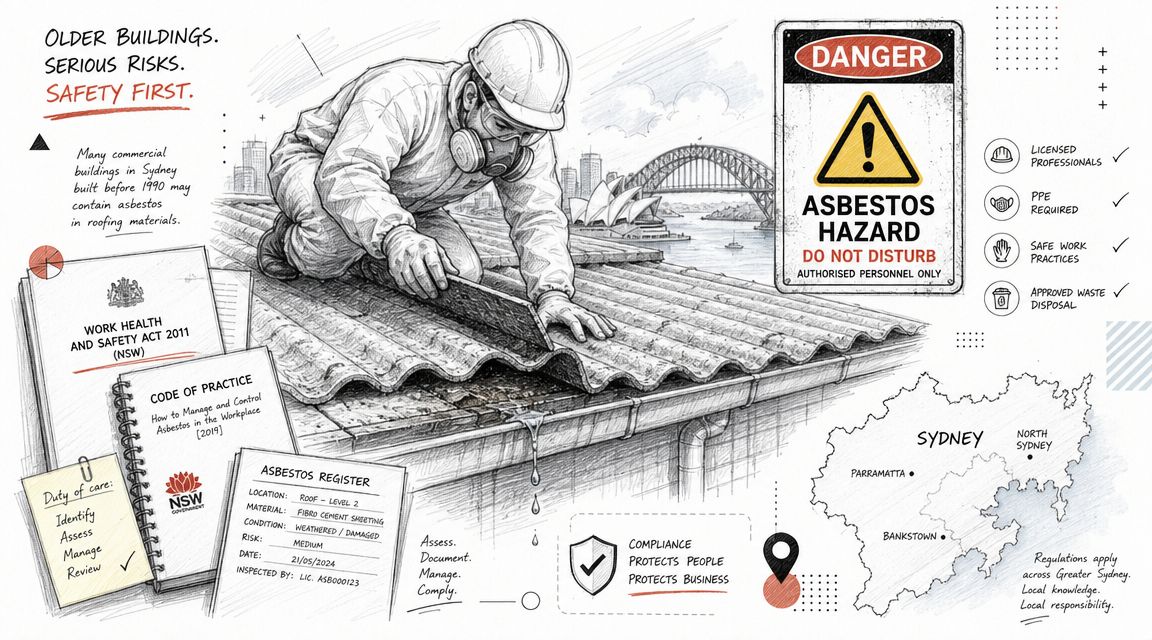
Owners often get into trouble by treating a leak as “just maintenance”. If someone disturbs suspect material without the right process, the problem stops being a roofing defect and becomes a health, compliance, and liability issue.
For buildings with older metal systems, ancillary sheeting, or mixed roof upgrades over time, it also helps to understand how replacement pathways differ from patch repairs. This overview of metal roofing in Australia gives useful context on where modern replacement systems fit into commercial decision-making.
What owners and managers should insist on
If asbestos is suspected, don't accept verbal reassurance. Insist on a documented process. The exact compliance pathway depends on the material and scope, but the principles are straightforward.
- Identify before disturbing: If the material history is unclear, treat it cautiously until properly assessed.
- Match the contractor to the risk: Roofing competence alone isn't enough where asbestos licensing is required.
- Control access: Staff, tenants, and visitors shouldn't be moving through areas where contaminated work could affect them.
- Document disposal and clearance: Commercial clients need records, not assumptions.
Compliance isn't admin overhead. It's part of the repair scope.
Why this matters commercially
A non-compliant roofing job can delay tenant reoccupation, complicate insurance discussions, trigger regulator attention, and damage trust with building occupants. Even when the leak itself is localised, the consequences of mishandling suspect material spread much wider than the roof line.
For property managers, the practical position is simple. If the building age, roof type, or previous works suggest asbestos could be present, build that assumption into procurement and site planning from the start. It's easier to slow down early than to explain later why a “quick repair” created a bigger exposure.
How to Choose a Sydney Commercial Roofing Partner
Choosing a roofer for a commercial leak isn't only about who can attend fastest. It's about who can inspect properly, quote clearly, work safely, and leave you with a roof assembly that performs after the next storm.

The Sydney market is broad. That creates choice, but it also means many quotes aren't directly comparable. Some contractors price a visible patch. Others price investigation, access, repair, and verification. Those are not the same service.
Read the quote like a risk document
A useful quote should tell you what the contractor believes has failed, what they're going to do about it, what assumptions they've made, and what is excluded. If it doesn't, budget certainty is an illusion.
Look for these details:
- Defined scope: Which roof area, which components, and what defect has been identified.
- Repair method: Replacement, resealing, refixing, flashing work, drainage clearing, local sheet repair, membrane repair, or broader remedial work.
- Access assumptions: Work at height, traffic management, tenant coordination, after-hours attendance, plant shutdowns, or restricted zones.
- Verification process: Whether the contractor intends to test the area after repair and inspect adjoining junctions.
- Compliance position: Especially where older materials, permits, or hazardous materials may be involved.
One Sydney-based option in this space is Commercial Roofers' roof repair cost guide, which is useful as a framing reference when you're comparing the structure of repair scopes and cost expectations.
Set realistic cost expectations
For Sydney leak repairs, independent pricing guidance places minor repairs at $200 to $600, moderate repairs at $600 to $2,500, and major repairs at $2,500 to $7,000+. Emergency attendance can add $200 to $500, and inspections can cost $250 to $600, according to this Sydney roof leak repair cost guide.
For larger jobs, that same guidance notes that a major leak repair on a 10-metre roof at 3 metres height is about $4,500 on a normal slope, rising to $6,300 for zincalume or Colorbond roofing and $7,200 for terracotta tiles. Even though those examples aren't commercial pricing schedules, they're a useful reminder that material type and access conditions materially change cost.
That matters for warehouses, strata complexes, and industrial buildings where:
- the leak point may be over active tenancy areas
- the roof may require edge protection or specialised access
- plant, penetrations, and drainage complexity increase labour
- one defect may expose several adjoining weak points once opened
Red flags during procurement
Some warning signs show up before any work starts.
| Red flag | Why it matters |
|---|---|
| The quote only says “seal leak” | No diagnosis, no repair logic, no measurable outcome |
| The contractor avoids roof-type questions | Commercial roofing systems differ sharply in detail and repair method |
| No discussion of access or safety | Site reality hasn't been priced or planned |
| No mention of testing or final inspection | You may be left with a patch, not a verified repair |
A good commercial roofer doesn’t need to sound polished. They need to sound specific. They should ask about roof age, materials, prior leak history, access, safety constraints, occupancy, and whether the leak is active during rain or only afterwards. Specific questions usually lead to specific repairs.
From Reactive Repairs to Proactive Asset Protection
A permanent repair doesn’t mean “the drip stopped today”. It means the roof’s water-shedding system has been restored so runoff is managed correctly through the assembly, not forced into weak points.
What a permanent repair actually restores
Repair guidance for Sydney roofs points to a clear benchmark. Permanent work should replace damaged roof material, reseal or replace corroded or dislodged flashing, re-secure the assembly with fasteners placed to manufacturer specification, fully cover exposed substrate with underlayment, maintain correct overlaps at seams, and finish with a water test and final inspection of junctions. The same guidance highlights blocked gutters and deteriorated flashing as repeated weak points in storm conditions, which is why post-repair benchmarking should include cleared drainage paths and inspection of all junctions, as outlined in this roof repair process guide.
That’s the difference between repair and concealment. Sealant over a failed detail may slow water briefly. It doesn’t rebuild laps, drainage falls, flashing geometry, fixation, or weatherproof continuity.
If the repair doesn’t restore how water is meant to shed off the roof, it isn’t a permanent repair.
Turn leak history into a maintenance plan
Once a commercial property has leaked, you have valuable information. You know where water found a path, which details were vulnerable, and what internal areas are sensitive to disruption. Use that information.
A practical maintenance approach usually includes:
- Scheduled inspections: Especially after severe weather and before wetter periods.
- Drainage housekeeping: Keep gutters, sumps, and outlets clear so water doesn’t back up into roof details.
- Detail review: Recheck penetrations, flashings, laps, and previous repair areas.
- Asset records: Keep photos, scopes, and dates so future contractors start with context rather than guesswork.
- Capital planning: If repeated leaks cluster around ageing sections, budget for remedial works before emergency callouts dictate the timing.
This changes roofing from a reactive cost centre into a managed building system. Owners get fewer surprises. Strata committees make better funding decisions. Tenants see a building that’s maintained rather than merely patched.
For commercial sites in Sydney, that’s the genuine value of handling a leak properly. You’re not just stopping water. You’re protecting continuity, compliance, and the long-term performance of the asset.
If you need a commercial assessment rather than a surface-level patch, Commercial Roofers handles Sydney commercial and industrial roofing work including leak repairs, roof replacements, and asbestos roof replacement with Colorbond. A useful next step is to arrange an inspection that identifies the likely entry point, the hidden damage risk, the safety constraints on your site, and whether repair or broader remedial work is the lower-risk option.