
Minor roof leak repairs in Australia commonly cost $250–$800, with a typical midpoint of about $500, while the national average range is $400–$1,000. Commercial jobs often exceed those figures once access, roofing material, safety controls and the full remedial scope are included.
A warehouse manager usually discovers the problem at the worst possible time. Heavy rain has passed through Sydney, water is staining a ceiling tile, stock is being moved away from a drip and someone is asking whether a bucket will be enough until morning. The visible water may come from a failed fastener, but it may also have travelled along a roof sheet, entered a box gutter or soaked insulation before appearing inside.
For a commercial or strata property, roof leak repair cost reflects the whole roofing system and the conditions required to work on it. A short patch on an accessible metal roof is a different job from tracing water across a low-slope warehouse roof, isolating electrical plant and removing damaged asbestos-containing material.
Table of Contents
- Why Commercial Roof Leak Repair Cost Is Rarely Simple
- Typical Roof Leak Repair Price Ranges in Australia
- How Roof Type and Access Change the Final Invoice
- Inspection and Reporting Fees Before Any Repair
- Insurance Claims and Strata Considerations in NSW
- Real NSW Commercial Scenarios and Cost Escalation
- Getting Accurate Quotes and Understanding Warranties
- A Practical Decision Checklist for Commercial Owners
Why Commercial Roof Leak Repair Cost Is Rarely Simple
A stain on a warehouse ceiling doesn't identify the entry point. Water can run beneath roof sheets, along purlins, through insulation and across internal linings before it finally drips above a tenant's workspace. By the time someone sees the damage, the original failure may be several metres away.
A straightforward repair usually has three characteristics: the leak source is visible, the surrounding roof remains serviceable and the contractor can reach the area without unusual equipment or disruption. Replacing a failed fastener, resealing a small flashing junction or repairing a limited section of sheet may fit that description.
A broader remedial scope looks different. The contractor may need to investigate multiple penetrations, clear a blocked drainage path, remove wet insulation, replace corroded components or coordinate access around operating machinery. In a strata complex, the contractor may also need to work around residents, common-property boundaries, building records and committee approvals.
The visible drip is only one part of the job
Commercial roofs create more variables than most residential roofs. They often contain air-conditioning plant, exhaust fans, skylights, roof penetrations, parapets, box gutters and long sheet runs. Each transition can become a failure point, and each can affect the time required to diagnose the leak.
Safety requirements also influence the scope. Height, fragile surfaces, restricted roof access and occupied premises can require controlled work zones, edge protection, traffic management or staged works. Those controls protect workers and building users, but they also form part of the cost.
Practical rule: A quote that prices only the visible hole, without explaining how the contractor traced the water path, may not solve the leak.
The Australian benchmarks provide a useful starting point, not a promise of a commercial invoice. Australian roof leak repair cost guidance places minor repairs commonly at $250–$800, with a typical midpoint around $500, while another benchmark places the national average at $400–$1,000. Commercial owners should treat those figures as an initial reference and then test the assumptions behind any quote.
Patch or remedial work
Ask the contractor to state whether the recommendation is:
- Localised repair: One confirmed failure, with adjacent materials in reasonable condition.
- Diagnostic repair: Investigation is still required before the final scope can be confirmed.
- Remedial work: Several connected defects, water-damaged components or drainage problems need attention.
- Replacement planning: The roof has widespread deterioration, making repeated local patches difficult to justify.
That distinction matters more than a low headline price. A cheap patch that leaves saturated insulation or a failing box gutter untouched can turn a manageable maintenance issue into an operational problem.
Typical Roof Leak Repair Price Ranges in Australia
Australian pricing guides are useful for setting an initial allowance, but they are not a commercial quote. The final invoice depends on the defect, roof system, access conditions and damage below the roof surface. For NSW strata and warehouse owners, the main question is whether the work is a contained repair or the first stage of a wider remedial job.
| Repair Type | Typical Cost Range AUD | Common Midpoint |
|---|---|---|
| Minor roof leak repair | $250–$800 | Around $500 |
| National roof leak repair benchmark | $400–$1,000 | About $750 for a minor-to-moderate asphalt shingle leak |
| Very small leak fix | From around $150 | Not specified |
| Cracked or broken tile replacement | $300–$1,000 | Not specified |
| Ridge capping repair | $400–$1,200 | Not specified |
These ranges are summarised in Australian roof repair pricing guidance, which also identifies very small fixes from around $150, cracked or broken tile replacement at $300–$1,000, and ridge capping repairs at $400–$1,200.
How to read the lower end
The lower end generally applies to a confirmed defect with straightforward access and sound surrounding materials. Typical work may include replacing a limited number of fasteners, resealing a junction or repairing a small area of roofing where the substrate has not deteriorated.
A small ceiling stain does not guarantee a small roofing invoice. The contractor may need to trace water beneath sheets, tiles or membranes, carry out water testing, or remove an overlying component. In commercial buildings, plant, restricted entry, fragile roof areas and tenant operations can add labour and safety controls before the repair begins.
A quote should state whether access equipment, traffic controls and out-of-hours attendance are included.
Why the middle and upper ranges matter
Tile and ridge capping work sits in a different cost category because it can involve lifting adjacent components, replacing bedding or mortar, and checking whether water has entered the roof space. Replacing the visible tile may not address movement, failed flashing or deterioration around the ridge.
Commercial roofs also carry less obvious cost risks. Wet insulation can lose performance and require removal, while damaged internal linings, electrical isolation, asbestos-containing materials or a blocked box gutter may fall outside the basic roofing line item. Emergency callouts can further change the allowance when temporary protection or immediate access is required.
Before comparing prices, classify the scope. A localised defect with no evidence of spread should not be priced like widespread ingress, recurring leaks or a corroded roof surface. Ask the contractor to identify exclusions and provisional work, particularly for insulation, internal make-good, asbestos handling and drainage repairs. Clear assumptions make the range useful and reduce invoice disputes.
How Roof Type and Access Change the Final Invoice
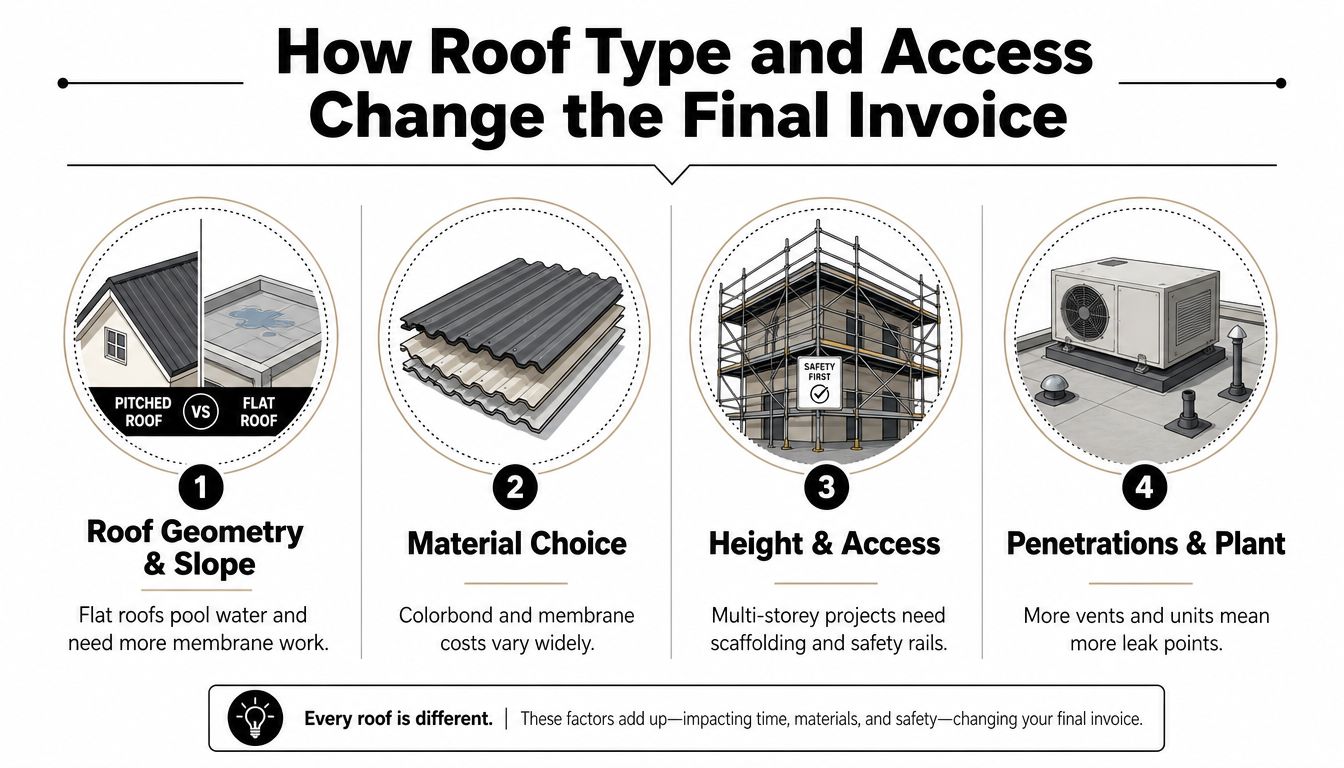
Roof geometry, material and access can move a repair from a routine maintenance task to a major commercial intervention. A useful Australian benchmark shows the difference on a 10-metre roof at 3 metres high. For a major leak repair, the reported figures are $4,500 on a normal-slope roof, $5,400 on a steep-slope roof, $6,300 for zincalume or Colorbond roofing and $7,200 for terracotta tiles, as outlined in this Australian roof repair cost benchmark.
The benchmark in practical terms
The normal-slope figure of $4,500 provides the reference point. Moving to a steep slope raises the benchmark to $5,400, which the source describes as roughly a 20% increase. A terracotta roof reaches $7,200, a 60% increase over the normal-slope reference.
Those differences aren't material mark-ups. Steeper roofs take longer to work on and demand more fall-prevention planning. Terracotta tiles require careful handling, and matching or integrating replacement materials can add complexity. Metal roofing brings its own requirements, including compatible flashings, fasteners, sealants and attention to thermal movement.
Access often decides the method
A roof may be physically close to the ground yet still be difficult to access. Plant platforms, narrow service corridors, neighbouring structures, fragile roof lights and occupied loading areas can restrict where equipment goes and how materials reach the work face.
For a strata manager, access may also involve resident notices, temporary closure of driveways or coordination with building services. For a warehouse owner, the contractor may need to protect stock, maintain forklift routes and schedule noisy or disruptive work outside operating periods.
The cheapest roof repair method is the one that reaches the actual failure safely and leaves the surrounding system watertight.
Penetrations create another layer of risk. An HVAC unit, vent or exhaust fan can interrupt the roof membrane and complicate flashing details. Box gutters and parapet junctions also deserve careful attention because water can travel along concealed edges before appearing far from the original defect.
If the leak involves flashing, the differences between profiles and installation details matter. A useful reference on commercial roof flashing types can help owners understand why a flashing repair quote should identify the junction being repaired, the material proposed and how the new detail will shed water.
Use this benchmark before requesting quotes. Note the roof's slope, material, height, penetrations, access route and operating constraints. Giving contractors that information early produces more comparable proposals and reduces the chance that a low initial allowance will be revised after mobilisation.
Inspection and Reporting Fees Before Any Repair
A proper inspection is a diagnostic service, not just a walk across the roof. A contractor should establish where water is entering, how it is travelling and whether the surrounding roof system has conditions that will defeat a local repair.
A quick visual check can identify obvious damage, but it may miss moisture trapped beneath insulation or a defect hidden behind a flashing termination. Commercial owners should expect a written report when the leak is recurring, the roof is complex, an insurer is involved or the proposed work may affect common property.

What a useful report contains
Before approving a repair, check that the report identifies:
- Observed entry points: The contractor should distinguish confirmed failures from areas that only look suspicious.
- Water path evidence: Photos, moisture mapping or controlled testing can explain why the internal stain doesn't align with the roof defect.
- Roof condition: The report should note corrosion, failed sealants, damaged sheets, blocked drainage and vulnerable penetrations.
- Recommended scope: Each repair should state what will be removed, replaced, resealed or tested.
- Limitations: The contractor should disclose areas that weren't accessible and assumptions that may affect the quote.
A report with photographs gives a strata committee or facilities team something concrete to review. It can also support discussions with an insurer, a building manager or a tenant who needs to understand why access restrictions are necessary.
Treat diagnosis as cost control
Inspection fees can feel unnecessary when water is already coming inside. In practice, misdiagnosis creates repeat callouts, temporary patches and disruption without resolving the source. Paying for a detailed inspection may prevent the owner from approving a repair that only addresses the point where water became visible.
The report should also separate urgent protection from permanent repair. A temporary measure may limit further ingress while the contractor arranges safe access, asbestos assessment or replacement materials. It shouldn't be described as a completed solution unless the contractor has confirmed that the roof system is permanently restored.
For a structured document, use this commercial roof inspection report template as a reference when reviewing what your contractor has recorded. The exact format can vary, but the report should let a non-roofer understand the defect, the risk and the proposed next action.
Insurance Claims and Strata Considerations in NSW
The first decision after a commercial roof leak is not always “repair or replace”. It is usually what happened, who controls the roof and which evidence must be preserved.
Sudden storm damage may be treated differently from deterioration, failed maintenance or long-term water entry under a policy. Owners shouldn't assume that a leak is covered because it appeared after rain. They should document the event, prevent further damage where safe and notify the relevant insurer or broker before extensive permanent work changes the evidence.
A practical claim pathway
Start with photographs and written observations. Record the affected rooms, ceiling damage, stock or equipment at risk, the date the leak was noticed and any recent weather conditions. Avoid removing damaged materials unnecessarily until the insurer or loss adjuster has had an opportunity to inspect, except where immediate action is needed to protect people or property.
A contractor's report can support the claim when it clearly separates:
- Likely cause: Storm impact, failed flashing, corrosion, drainage overflow or another observed condition.
- Immediate protection: Temporary measures taken to reduce further water entry.
- Permanent scope: Roofing repairs, replacement of damaged components and testing.
- Related damage: Wet insulation, internal linings, stock or plant affected by the leak.
- Maintenance context: Available inspection records and previous repair history.
Strata responsibilities need early confirmation
In a NSW strata scheme, the roof commonly involves common property, but responsibility can still depend on the scheme plan, by-laws, exclusive-use arrangements and the location of the damage. A strata manager should confirm the responsibility pathway before instructing a contractor, particularly where a lot owner, tenant or adjoining building is affected.
The committee may need to approve expenditure, obtain multiple quotes or manage emergency authority under the scheme's procedures. Waiting for a meeting while water continues to enter is poor risk management, but authorising a broad replacement without records can create a different governance problem.
Claim, self-fund or combine
Self-funding may be practical where the defect is clearly maintenance-related or the repair is limited. A claim may be appropriate where sudden insured damage is supported by evidence. A combined approach can also work, with urgent protection and approved building repairs handled promptly while disputed or excluded deterioration remains separately documented.
Keep the cause, emergency response and permanent repair as separate line items. That structure helps insurers, committees and owners see what each payment covers.
Real NSW Commercial Scenarios and Cost Escalation
A warehouse in Western Sydney can present as a small leak above a staff area. The first visible sign may be a stained ceiling panel, but lifting the roof sheet can reveal damp insulation and corrosion around several fasteners. The roofing repair then needs to address the entry point and the material that has retained moisture, while the owner separately considers internal drying and reinstatement.
The cost escalation comes from scope discovery, not from the original drip. Insulation can hide the water path, and a contractor who replaces only the obvious fastener may leave the adjacent failure active. A better investigation records the affected area and makes clear whether insulation replacement is included, excluded or subject to a concealed-condition allowance.

Box gutters can turn local water entry into a drainage project
A retail property may show leaking near an internal wall, while the issue sits in a box gutter or outlet. Debris, poor falls, failed joints and corrosion can hold water against roof interfaces. Sealing the visible internal stain won't restore drainage capacity.
The warning signs include recurring leaks after ordinary rain, overflow marks, corrosion along gutter edges and water appearing at several internal points. The quote should identify the gutter section, outlet condition, access method and testing procedure. If the contractor recommends a replacement section, ask why patching would be unreliable and how adjoining roof details will be protected.
Asbestos changes the work plan
An older industrial building may contain asbestos cement roofing. A contractor shouldn't drill, cut or remove suspect material as if it were ordinary sheet metal. The work may require identification, controlled handling, compliant removal procedures and a replacement system that suits the existing structure.
The owner should ask whether an asbestos assessment is included, who will manage the removal, and how the work area will be isolated. A low repair allowance can become misleading if it assumes standard access and ordinary sheet replacement where hazardous material controls are required.
For larger deterioration, compare the repair proposal with a planned replacement assessment using a Sydney commercial roof replacement cost guide. The decision isn't based on the leak alone. It depends on the roof's remaining serviceability, recurring failures, access costs and the disruption associated with another repair cycle.
Getting Accurate Quotes and Understanding Warranties
Accurate quotes start before the contractor arrives. Send clear photos from inside and outside, describe when the leak appears, identify affected rooms and disclose whether the building contains roof plant, fragile roof lights or suspected asbestos. Include access restrictions and operating hours so the contractor can price the job as it will be performed.

Compare scope, not just totals
Request written proposals from suitable commercial contractors and compare the line items side by side. A useful quote should state:
- Diagnosis: What defect has been identified and what evidence supports it?
- Preparation: Are access equipment, safety controls, isolation and protection included?
- Materials: Does the quote name the sheet, membrane, flashing, fasteners, sealant or replacement components?
- Removal: Will damaged insulation, failed sheets or contaminated materials be removed and disposed of?
- Testing: How will the contractor confirm that the repair has stopped water entry?
- Exclusions: Are internal repairs, painting, electrical work, drying or concealed damage outside the price?
- Programme: When will work start, how long will it take and what disruption should occupants expect?
A quote that says “repair leak” without defining the defect and method is difficult to compare. The lowest number may exclude access, investigation or reinstatement that another contractor has included.
Check the warranty language
Ask whether the warranty covers materials, workmanship or both. Clarify its duration, the conditions that could void it, the maintenance expected from the owner and the process for reporting a problem.
A warranty shouldn't replace a sound scope. It won't compensate for a repair that never addressed the failed box gutter, deteriorated substrate or incorrect flashing detail. Confirm the contractor's NSW licence, public liability cover, workers compensation arrangements and whether the quoted crew is responsible for the work from inspection through completion.
Commercial Roofers offers commercial and industrial leak repairs, inspections, asbestos roof removal and replacement, guttering, box gutter systems and full roof replacement across NSW, with written quotes and in-house crews. Owners can compare that offering with other suitably licensed contractors, provided each proposal is assessed against the same scope and access assumptions.
A Practical Decision Checklist for Commercial Owners
Before authorising work:
- Make the area safe: Protect people, stock and equipment, and isolate hazards where necessary.
- Document the leak: Photograph internal damage, roof defects and affected assets.
- Confirm the cause: Request a report that traces the water path and identifies limitations.
- Check hidden risks: Ask about insulation, box gutters, asbestos, penetrations and structural damage.
- Review insurance and strata authority: Separate sudden damage from maintenance and confirm who can approve the work.
- Compare written scopes: Check access, materials, exclusions, testing, programme and warranties.
- Plan beyond the patch: If failures recur, compare remedial work with a staged replacement strategy.
Commercial Roofers provides leak inspections, emergency protection, commercial repairs, box gutter work, asbestos solutions and roof replacement planning for warehouses, strata properties and industrial sites across NSW. Visit Commercial Roofers to arrange a practical assessment and request a quote that separates diagnosis, access, repair scope and any concealed-risk allowances.