
After heavy rain, the strata manager walks through a Sydney warehouse and finds dark water marks beneath several ribs. A few fasteners have backed out, sealant is lifting around a flashing, and the first request to the roofer is usually simple: “Add more screws.”
That response can make a bad roof harder to repair. Extra penetrations may distort sheet laps, hide failed washers, and leave rusted purlins or corroded panels untouched. Roofing screws for a metal roof are part of a load, sealing and corrosion system, not a bag of interchangeable hardware.
Australian commercial work also has a compliance baseline. AS 3566.2:2025 covers self-drilling screws used in roofing and cladding, including corrosion resistance for the relevant environment, while the NCC controls fixing methods and patterns. BlueScope requires fasteners for its roofing and walling products to meet, at minimum, AS 3566.2:2025 Class 3, with higher corrosion resistance recommended wherever possible (AS 3566.2:2025, BlueScope Technical Bulletin TB 16).
Table of Contents
- Why the Right Screw Matters on a Metal Roof
- Self-Drilling and Self-Tapping Screws Explained
- Head, Thread, Point and Washer Anatomy
- Materials, Coatings and Corrosion Classes
- Sizing, Gauge and Fixing Patterns for Commercial Profiles
- When Re-Screwing Is the Wrong Fix
- Procurement, Warranty and Long-Term Maintenance
Why the Right Screw Matters on a Metal Roof
After a Sydney warehouse roof starts leaking, the first request is often to add more screws. That can be the wrong repair. A commercial fastener must hold the sheet to its support, clamp it without distortion, seal the penetration, and withstand the site environment, from an inland warehouse to salt-laden coastal air.
Roofing screws for a metal roof are part of a load, sealing and corrosion system, not interchangeable hardware. The point, thread, head, washer, coating, length and installation pattern must suit the complete roof assembly. A suitable screw in the wrong support can strip, snap, or fail to develop adequate pull-out resistance. A correctly coated screw with a damaged washer can still leak.
Diagnose the warehouse leak first
Loose heads on otherwise sound Colorbond sheet may justify replacing the affected fasteners with compliant roofing screws. They must be driven straight and tightened correctly. That targeted repair works when the sheet, purlin and original load path remain serviceable.
The decision changes when holes have elongated, the sheet has pitted around the fasteners, or corrosion has reduced the purlin section. Installing screws beside failed fixings adds penetrations without restoring damaged material. It can also alter wind-load transfer if the new pattern is not supported by the roof manufacturer's tables or the original design.
Practical rule: Treat a leaking screw as a symptom to investigate, not an automatic instruction to install another screw.
Compliance starts with the roof system
The National Construction Code requires metal sheet roofing to be fixed through the roofing or with concealed fasteners. For pierced-fastener roofs, the NCC describes self-drilling screws at every second rib, while corrugated roofs use every fourth rib in the relevant application (NCC Part 3.5.1 Sheet roofing and wall cladding). The applicable pattern still depends on the profile, support arrangement, wind region and manufacturer's instructions.
A purchase order should identify the roof profile, substrate, sheet thickness, exposure category, washer system and fixing pattern. “Galvanised roofing screws” is not a sufficient specification. In a coastal or industrial part of NSW, corrosion resistance affects service life as much as installation accuracy, so re-screwing should follow the roof system requirements rather than serve as a blanket response to leaks.
Self-Drilling and Self-Tapping Screws Explained
The difference is the first job the screw performs. A self-drilling screw has a drill-shaped point that makes its own hole through the metal before the threads engage. A self-tapping screw generally goes into a pre-drilled hole, with its threads cutting or forming the mating thread.
On a commercial roof, the fastener must pass through the sheet and hold properly in the support below. A drill point suited to light steel may fail in a thicker purlin or a sheet and spacer assembly. It can overheat, snap, or leave an oversized hole. Excess drilling capacity creates unnecessary swarf and can damage the surrounding coating.
Match the point to the support
Steel purlins commonly take self-drilling fasteners, often called Tek screws or drill-point screws. Select the point for the combined thickness of the roof sheet and steel support. The thread must engage the purlin, not pass through it.
Timber supports may require a sharp self-piercing or self-tapping roofing screw, subject to the specified product and any pilot-hole requirements. Steel and timber provide different thread engagement. Substituting a steel fixing into timber, or a timber screw into steel, can leave the connection with inadequate holding capacity.
A repair near an existing hole requires more than a sharper point. A self-tapping fastener may suit a repair specification that calls for a pre-drilled or replacement hole, but the new screw still needs the correct washer, coating, penetration and fixing pattern. A screw being able to make a hole doesn't prove that it belongs in the roof.
Don't rely on trade labels alone
Terms such as metal-tec, drill-point and Type 17 describe point or thread characteristics used by suppliers. They do not establish compliance by themselves. Check that the product meets the roof system's requirements under AS 3566.2:2025 and suits the exposure class and installation method.
BlueScope Technical Bulletin TB16 requires fasteners piercing cladding to be installed normal to the roof plane and sealed against leakage. Driving at an angle can lift the washer on one side, leaving uneven compression even when the screw feels tight. The fixing pattern must also align with the NCC and the roof manufacturer's documentation, so replacing leaking screws is not automatically the correct repair.
Use this selection sequence:
- Identify the support, steel or timber.
- Measure the combined sheet, spacer and support thickness.
- Select a point with enough drilling capacity for that assembly.
- Confirm the thread form and holding requirements.
- Verify the corrosion class, washer material and fixing pattern against the roof documentation.
Head, Thread, Point and Washer Anatomy
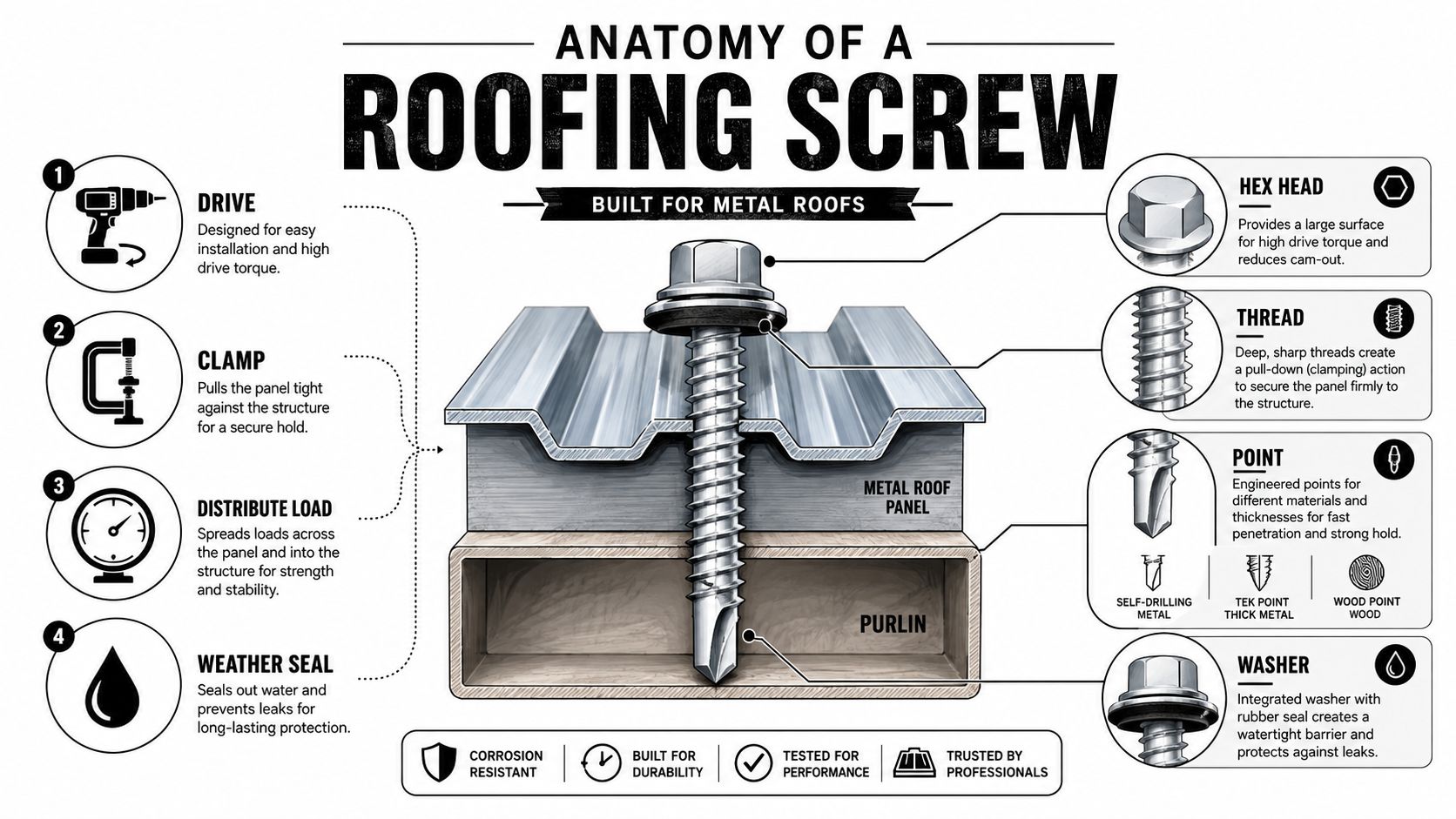
A roofing screw performs four connected jobs. It must drive, clamp, distribute load and seal. A failure in one part can undermine the others, so changing only the screw body while reusing a damaged washer is false economy.
The drive and clamp
A hexagon head is common on exposed commercial profiles because it accepts a nut setter and transfers drive torque efficiently. It also gives the installer a clear visual check of seating. Low-profile or wafer-style heads can suit concealed systems, but they shouldn't be substituted into an exposed-fix roof unless the profile and manufacturer specify them.
The thread controls how the fastener pulls the sheet down and grips the support. Coarse threads generally suit timber or lighter material engagement, while fine threads are commonly selected for steel supports. The pitch, diameter and length must be treated as a combination. A heavy-looking screw can still perform poorly if too little thread engages the purlin.
The point controls the installation
A drill point should cut cleanly through the sheet and support without excessive heat or wandering. Installers should keep the drill aligned with the roof plane and use a controlled driver rather than forcing the fastener at an angle. Loose swarf should be cleared because metal filings can stain coatings and contribute to local corrosion.
The point isn't merely an installation convenience. It determines whether the screw reaches the support cleanly and whether the hole remains controlled enough for the washer to seal.
The washer is the weather seal
An exposed-fix roofing screw normally relies on a bonded sealing washer, commonly using EPDM, with a metal backing to distribute pressure. The washer should sit square against the panel and compress evenly. Under-driving leaves a path for water, while over-driving can flatten, split or extrude the seal and dimple the sheet.
Don't reuse washers from removed screws. UV exposure, compression set and physical damage may not be obvious from ground level, and a new screw cannot restore a washer that no longer flexes against the panel.
A suitable screw with the wrong washer is still the wrong roofing fastener.
Head finish and colour are secondary decisions. Select the structural fastener and sealing system first, then choose a painted head that matches the roof where appearance matters.
Materials, Coatings and Corrosion Classes
For an Australian commercial roof, choose the screw by corrosion exposure and the roof manufacturer's requirements, not by the packet colour or material name. AS 3566 sets the corrosion classes, and AS 3566.2:2025 is the current reference for roofing and cladding self-drilling screws. It replaced AS 3566.2:2002, so an old specification should not be treated as current (current standard listing).
BlueScope roofing and walling products require at least Class 3, with higher resistance recommended where the site warrants it, as set out in its fastener requirements. Class 3 generally suits inland and suburban exposure. Class 4 is more appropriate where coastal salt, marine aerosol or industrial pollutants place greater demand on the coating.
Compare the specification, not the sales label
| Corrosion Class | Typical NSW Site | Recommended Screw | Coating System | Expected Service Life |
|---|---|---|---|---|
| Class 1 | Sheltered, low-exposure inland location | Only where the roof documentation permits it | Basic corrosion-resistant finish | Must be confirmed for the specific system |
| Class 2 | Low to moderate urban exposure | Coated carbon steel matched to the roof system | Zinc or equivalent approved coating | Must be confirmed for the specific system |
| Class 3 | General suburban and inland commercial exposure | AS 3566.2:2025-compliant roofing screw | Approved Class 3 coating and sealing washer | Must be confirmed for the specific system |
| Class 4 | Coastal, marine-aerosol or industrial exposure | Higher-resistance coated screw or approved stainless option | Class 4-rated system | Must be confirmed for the specific system |
| Class 5 | Severe exposure requiring project-specific design | Fastener selected by the roof manufacturer or engineer | Project-specific high-resistance system | Must be confirmed for the specific system |
The table avoids promising a fixed service life. Roof material, condensation, wash-down water, pollutants, salt deposits, installation quality and maintenance all affect performance. A supplier's marketing statement does not replace a class certificate or project specification.
Coated carbon steel can suit an inland site when the coating class matches the roof system. Stainless steel may provide greater resistance, but the grade, washer, panel material and galvanic compatibility still require checking. Mixing metals without that check can create a corrosion problem rather than solve one.
Colour matching comes last. Confirm the corrosion class, fastener system and washer first, then select a painted head where appearance matters. For sheet compatibility and the differences between common Australian products, review this Zincalume and Colorbond comparison with the roof manufacturer's instructions. If a commercial roof is leaking, corrosion class is only one diagnosis point. Re-screwing should follow inspection of sheets, laps, penetrations, flashings and drainage, not replace that inspection.
Sizing, Gauge and Fixing Patterns for Commercial Profiles
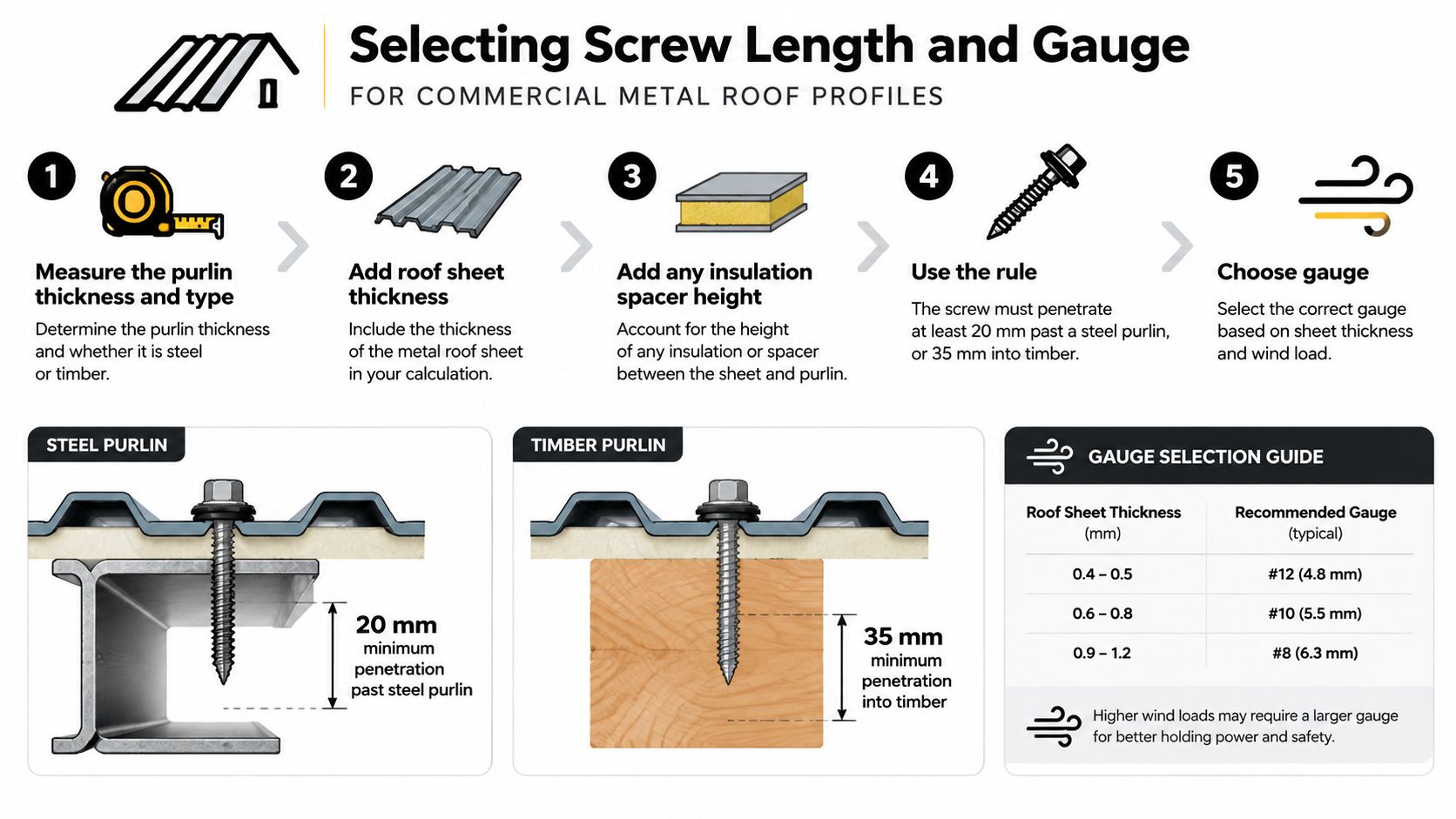
Screw selection begins at the purlin or batten, not at the exposed sheet. Measure the sheet, insulation blanket, spacer and support thickness, then confirm the required engagement for the roof system. As a working guide, allow at least 20 mm past a steel purlin or 35 mm into timber, with the final length checked against the manufacturer's tables and the project fixing schedule.
Length affects both holding power and risk. A screw that barely emerges through a steel purlin may appear installed while providing inadequate thread engagement. An unnecessarily long fastener can clash with concealed components or services, particularly where insulation or spacers increase the build-up.
Gauge must match the profile and structural demand. Corrugated sheets commonly use 12 to 14 gauge fasteners. Taller-rib trapezoidal profiles often specify 12 gauge, while lower-rib wall cladding may permit 14 gauge. Those sizes are not interchangeable by habit. Wind region, support spacing, sheet thickness, substrate and the approved product system determine the correct choice.
Check the assembly before ordering
For a corrugated roof over steel, add the sheet, blanket or spacer, and purlin thickness. The drill point must pass through the complete assembly while leaving the specified penetration into the steel. Check the washer and thread arrangement as well, because a correct overall length does not compensate for the wrong fixing system.
A trapezoidal panel over an insulation blanket can require a longer stock length than the same sheet fixed directly to a purlin. Confirm that the screw reaches the support without relying on the point alone for engagement. The fixing must also suit the profile crest or valley location and the manufacturer's installation method.
Follow the approved pattern
Fixing locations depend on the profile, wind demand and support layout. NCC sheet-roofing requirements and manufacturer tables commonly call for closer fixing at ridges, edges, corners and end laps than across the main roof field. Treat the NCC requirement as a starting point, then use the product-specific schedule for the actual roof.
Cyclonic-rated screws are made for Category 3, 4 and 5 areas, showing how fastener selection and fixing patterns change in severe wind regions, as set out in the Stramit Corrugated Product Technical Manual. On a Greater Sydney project, confirm the applicable wind-region information and approved table rather than importing a cyclonic pattern without design support.
Under-fixing leaves sheets vulnerable to movement and wind uplift. Random extra screws create unnecessary penetrations and can complicate later maintenance. Record the sheet type, support spacing, screw size, washer system and edge treatment in the schedule. For profile-specific examples, use this guide to corrugated metal roofing.
When Re-Screwing Is the Wrong Fix
A leaking screw is often the most visible part of a larger failure. Re-screwing is sensible when the washer has perished or a fastener has loosened but the surrounding sheet and support remain sound. It isn't a responsible remedy for a panel that has lost material around the fixing or for a purlin that can no longer hold the thread.
Start with the water path, not the number of loose screws. Water can travel beneath laps and flashings before appearing inside the warehouse, so the ceiling stain doesn't necessarily identify the failed penetration.
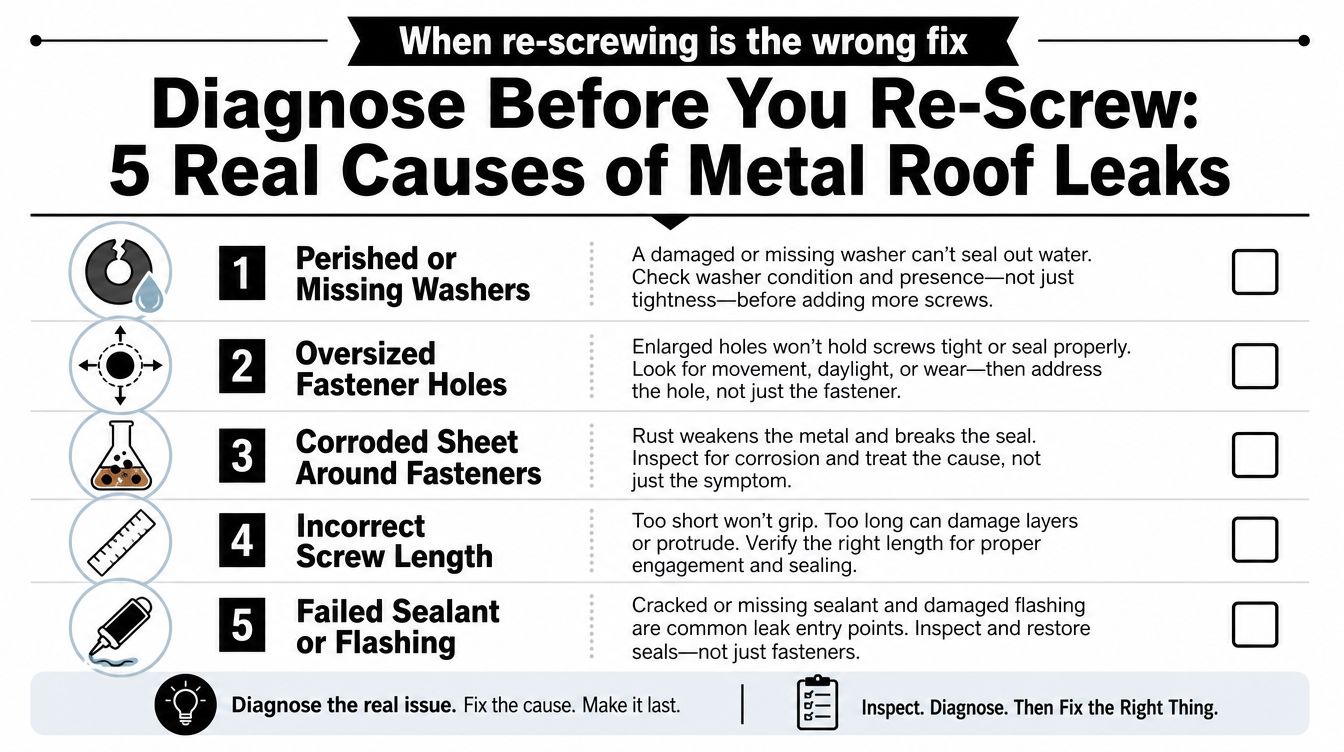
Five causes that need different repairs
- Perished or missing washers: Replace the complete fastener with a compliant washer system when the sheet around the hole remains sound.
- Oversized fastener holes: A larger screw may not seal a hole that has become elongated or torn. The repair may require a correctly specified new fixing position and sealing of the redundant penetration.
- Corroded sheet around fasteners: White rust, pitting or thinning at the rib or lap means the sheet may no longer distribute clamp load safely.
- Incorrect screw length: A fastener that doesn't engage the support adequately can loosen under movement, while an unnecessarily long screw can interfere with concealed components or services.
- Failed sealant or flashing: Replacing roof screws won't repair a split flashing joint, failed lap sealant or blocked drainage path.
The strata decision
Re-screw when inspections confirm sound sheet, usable holes and failed washers or loose fasteners. Over-screw only where the original pattern is demonstrably inadequate and the revised pattern has been checked against the roof design. Replace panels or the roof when corrosion, fatigue, damaged laps or degraded supports prevent a reliable seal and load path.
Additional fasteners can change load paths and sheet stresses. They may also create compliance issues under the roof system's requirements, including AS 1562.1, if the altered arrangement no longer matches the tested or specified installation. The Australian metal roof repair guide is useful background, but the site decision still requires inspection of the actual roof.
If the panel is failing around the old screw, more screws spread the problem. They don't restore the lost metal.
A committee should compare the cost of repeated access, internal water damage and disrupted operations with the cost of a planned replacement. The relevant question isn't whether a new screw is cheaper today. It's whether the repair leaves the building with a compliant, maintainable roof.
The following video provides a visual reference for diagnosing common metal-roof issues:
Procurement, Warranty and Long-Term Maintenance
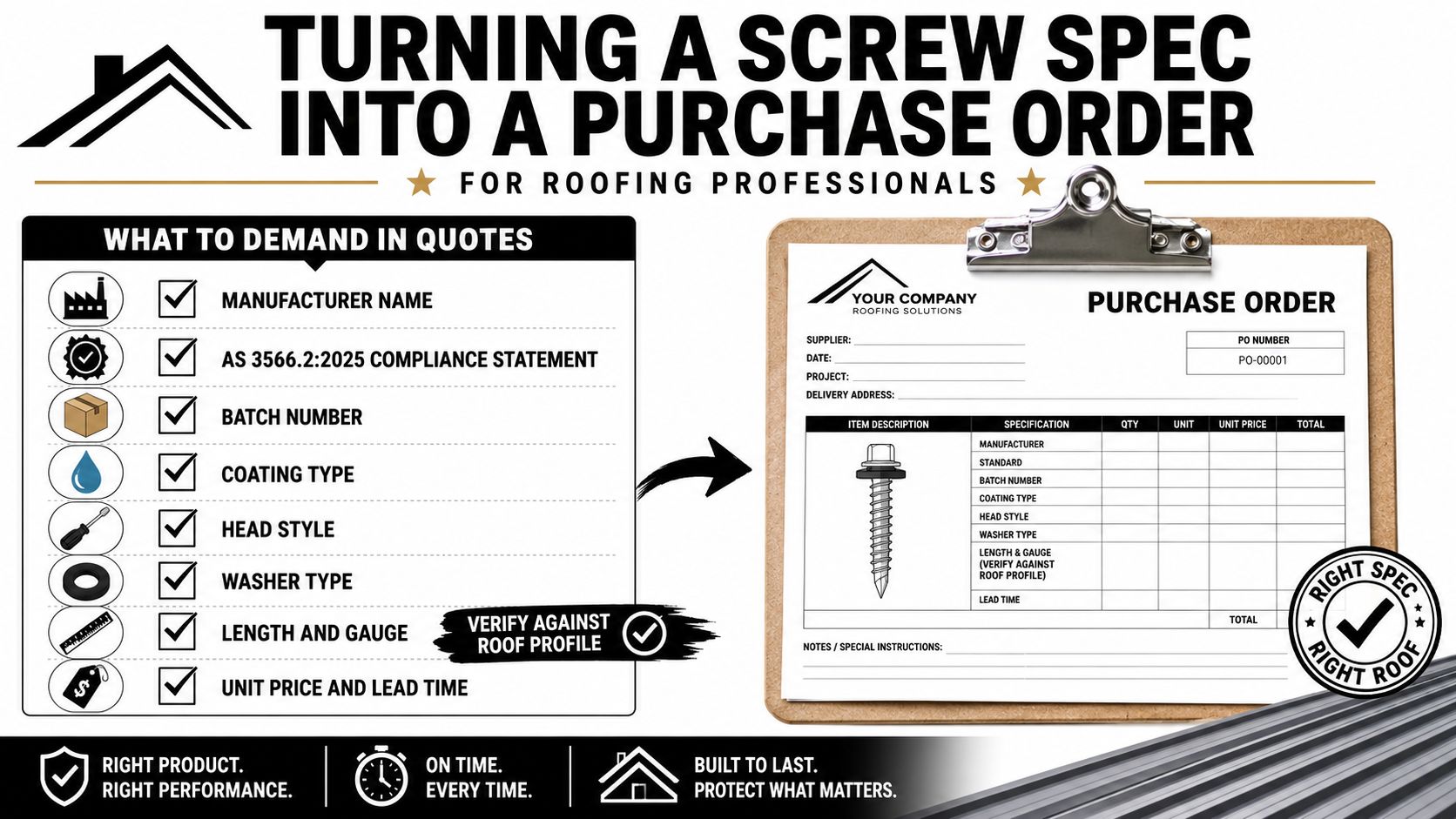
A good purchase order turns a general request for “roof screws” into a checkable specification. Ask the contractor or supplier to identify the manufacturer, screw type, head, washer, gauge, length, coating and corrosion class. The quote should also state how the selection matches the roof profile, substrate and exposure.
For projects using BlueScope products, request a statement that the fasteners meet the applicable AS 3566.2:2025 requirement. Where the project specification calls for additional coating references, ask for the relevant documentation rather than relying on a colour name or a sales description.
What to record before delivery
- Manufacturer and product: Record the exact fastener range, head style and point type.
- Compliance evidence: Request the AS 3566.2:2025 compliance statement and applicable corrosion classification.
- Washer system: Identify the bonded washer material and backing, not just “seal washer”.
- Batch traceability: Keep the lot or batch number from the packaging with the project records.
- Roof compatibility: Match length, gauge, coating and colour to the profile and support.
- Installation requirement: State the fixing pattern, driver requirements and inspection method.
Product warranties and installation warranties are different documents. A fastener manufacturer may cover a product defect, while the installer's warranty concerns workmanship. Over-driven washers, crooked screws, unsealed redundant holes and unapproved substitutions can complicate both.
A long material warranty also has limited value if the building owner can't show that the roof was inspected and maintained. The maintenance plan should record visible corrosion, loose heads, washer condition, flashing joints, laps, gutters and any areas affected by plant access or wash-down.
Make maintenance observable
Inspect the roof visually after major weather events and schedule routine condition checks. A commercial inspection should look beyond screw heads, including sheet edges, penetrations, support condition and drainage. Higher-exposure sites need a more disciplined programme because salt, industrial contaminants and repeated wetting can accelerate deterioration.
At end of life, patching suits isolated damage on otherwise sound sheets. Recovery can suit a structurally viable roof where the existing substrate and drainage are assessed first. Full replacement is more responsible when corrosion is widespread, supports are compromised, leaks recur across many areas, or previous screw repairs have left the roof with no reliable fixing pattern.
Commercial Roofers provides inspections, reporting, leak repairs, industrial roof replacement and new metal roofing across Greater Sydney, so a strata manager can have the screw specification assessed as part of the complete roof system rather than in isolation.
Commercial Roofers can inspect your warehouse, strata or industrial metal roof, identify whether re-screwing is appropriate, and specify compliant fasteners for the profile, substrate and exposure. Visit Commercial Roofers to arrange a practical assessment and receive a clear repair or replacement recommendation.