
A leaking warehouse roof usually doesn't stay a roof problem for long. It becomes a stock problem, a safety problem, a downtime problem, and eventually a budgeting problem. If you're looking at an ageing commercial roof in NSW, especially one over a warehouse, factory, retail site, or strata complex, you're probably weighing the same questions most owners ask. Repair it, patch it again, or replace it with something that will hold up properly.
A corrugated metal roof stays on the shortlist for good reason. It's familiar, widely specified, and well suited to large commercial and industrial buildings when it's designed and installed to Australian requirements. But not every corrugated roof is equal. The profile, coating, fastening method, drainage design, and installer discipline all matter. In older buildings, asbestos replacement can also turn a straightforward reroof into a tightly managed compliance job.
Table of Contents
- Your Introduction to Commercial Corrugated Metal Roofing
- Understanding Corrugated Materials and Profiles
- Weighing the Pros and Cons for Your Business
- Structural and Drainage Design Essentials
- The Professional Installation and Asbestos Replacement Process
- Budgeting Maintenance and Ensuring Compliance
- How to Choose the Right Commercial Roofing Contractor
Your Introduction to Commercial Corrugated Metal Roofing
Commercial owners usually don't start researching roofing because they're curious about profiles and coatings. They start because something has already gone wrong. Water has shown up under insulation, ceiling sheets have stained, tenants have complained, or maintenance staff are spending too much time chasing the next leak.
That's where a corrugated metal roof becomes more than a standard product. On Australian commercial and industrial buildings, it's a practical system that can handle wide spans, harsh sun, driving rain, and demanding service conditions when the design is right. It also suits many asbestos replacement projects because it's familiar to builders, engineers, and facility teams, and it can be specified to meet local compliance requirements.
The important part is separating what works on a brochure from what works on a live site. Material selection matters. So do wind exposure, drainage layout, sheet lengths, penetrations, fasteners, and the way flashings are detailed around plant and parapets.
Practical rule: A commercial roof should be judged by how reliably it stays watertight, how safely it can be installed and maintained, and how little disruption it causes over its service life.
Understanding Corrugated Materials and Profiles
A warehouse owner in Newcastle can install corrugated roofing that performs well for decades. Put the same specification on a salt-exposed site closer to the shoreline, or on an older NSW factory being re-roofed after asbestos removal, and the margin for error gets much smaller. The profile may look familiar, but the material choice behind it directly affects corrosion risk, maintenance frequency, compliance, and whole-of-life cost.
Why the profile still matters
Corrugation works because the shape stiffens the sheet and helps it carry load across battens or purlins without the weight of heavier roof systems. That makes it a practical option for many commercial and industrial buildings, especially where owners want a proven profile that roof plumbers, builders, and maintenance teams already know how to work with.
The sheet still needs to be the right sheet.
For Australian commercial roofing, the steel grade, base metal thickness, coating class, and profile geometry all matter. A proper specification tells you what is being supplied and what performance the roof has been designed to achieve. If a proposal is vague on sheet thickness, coating, or fixing compatibility, treat that as a warning sign, not a paperwork issue.
Standard corrugated profiles used on commercial projects are commonly selected because they are familiar, repairable, and available through established supply chains. They also suit many replacement projects where the existing roof form, support layout, and flashing details make a more complex profile unnecessary.
Material choice is really a corrosion decision
Owners often ask whether galvanised, Zincalume, or Colorbond is "best". The better question is which product suits the building's exposure, use, and maintenance plan.
| Material/Finish | Best For | Corrosion Resistance | Typical Lifespan |
|---|---|---|---|
| Galvanised steel | Utility applications where appearance is secondary | Moderate, depends heavily on exposure and detailing | Varies by environment and maintenance |
| Zincalume® | Many inland commercial and industrial roofs | Strong corrosion performance when correctly specified | Varies by environment and maintenance |
| Colorbond® | Projects where finish, presentation, and exposure conditions matter | Strong corrosion performance with pre-painted finish when correctly specified | Varies by environment and maintenance |
Galvanised steel still has a place on some utility buildings, but it is usually not my first recommendation for a long-term commercial asset where corrosion exposure is more demanding or presentation matters to tenants, staff, or customers.
Zincalume is often a sensible choice for inland warehouses and industrial buildings where owners want durability and cost control. Colorbond usually earns its keep where the site is customer-facing, where brand presentation matters, or where the project needs a pre-painted finish from day one.
Coastal sites need more caution. Near salt, the conversation should not stop at the roof sheet colour or brand. Fasteners, flashings, cappings, gutters, insulation facings, rooftop plant supports, and any dissimilar metals all need to be compatible. If they are not, the roof can start failing at the accessories long before the main sheets reach the end of their service life.
Profile selection affects more than appearance
On commercial work, corrugated is rarely chosen for looks alone. It is chosen because it is widely understood, readily replaced in isolated areas, and adaptable across older industrial buildings as well as newer logistics and manufacturing facilities.
That said, the profile has limits.
Corrugated sheeting can be a very good fit on large roof areas with straightforward geometry. It becomes less forgiving where there are low pitches, heavy plant congestion, frequent foot traffic, or complicated drainage paths. In those cases, owners need the profile assessed as part of the full roof system, not selected in isolation. For a broader look at local roof system options and where they suit best, see this guide to metal roofing in Australia.
What commercial owners should check before approving the spec
Before signing off on a corrugated roof replacement or new roof package, confirm these points:
- the sheet thickness and coating are clearly specified
- the product matches the site exposure, especially in coastal or industrial environments
- fixings, flashings, gutters, and penetrations are compatible with the roof material
- the profile suits the building pitch, support spacing, and drainage layout
- any asbestos replacement scope has been separated from the new roof specification so compliance responsibilities are clear
That last point matters in NSW. On asbestos replacement jobs, owners sometimes focus so heavily on removal that they give too little attention to the new roof build-up. The replacement roof should not be treated as an afterthought. It needs to be specified for the building's actual service conditions so the site does not trade one problem for another.
Corrugated roofing is not one standard product. On Australian commercial buildings, long-term performance depends on the sheet, the coating, the exposure conditions, and the compatibility of every metal component fixed to the roof.
Weighing the Pros and Cons for Your Business
Corrugated roofing can be a very smart commercial choice. It can also be the wrong choice if the building, budget, or maintenance expectations don't line up with the system. Owners make better decisions when they look at the trade-offs objectively.
Where corrugated roofing performs well
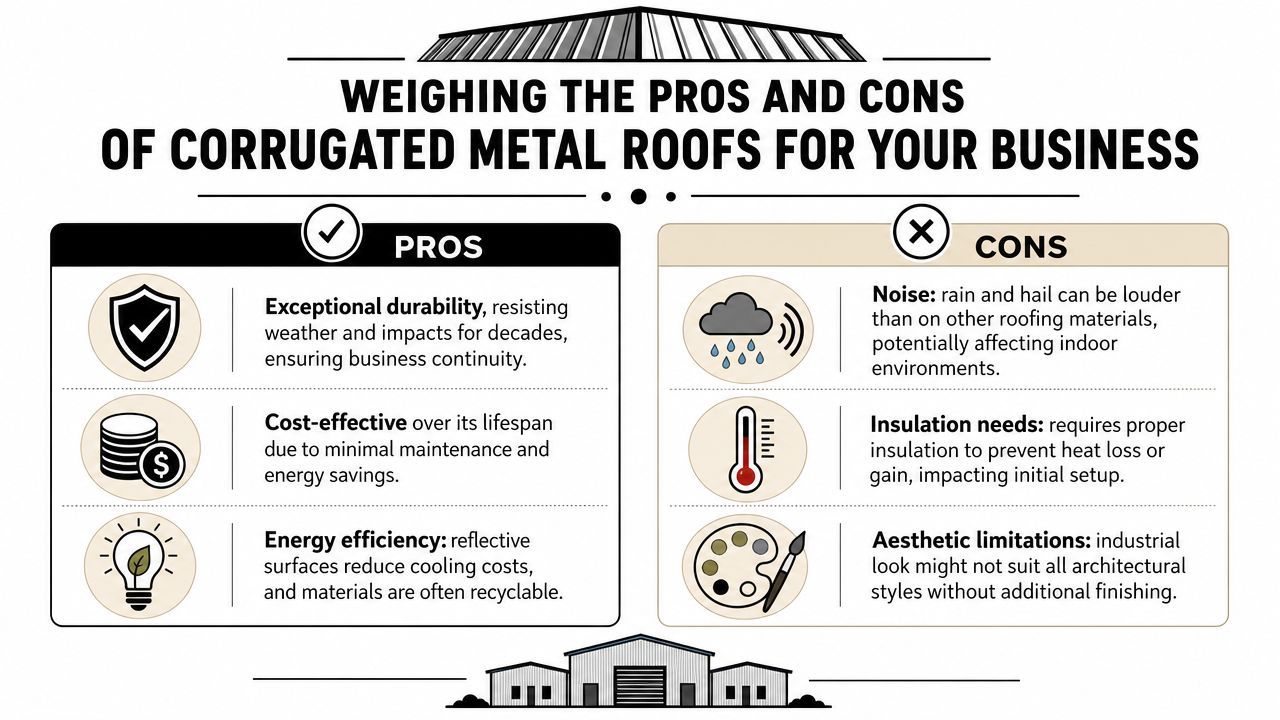
For many warehouses and industrial buildings, corrugated sheeting remains attractive because it's practical to install across large roof areas and straightforward to repair when isolated damage occurs. The profile is proven, parts are widely understood in the trade, and replacement works can often be staged around ongoing operations.
Another advantage is installation speed. Research comparing corrugated and standing seam systems notes that corrugated panels are only 2.25 to 3 standing seam panels in width, which helps explain why crews can cover roof area quickly, as discussed in this review of metal roofing considerations across Australia and other markets. On large commercial roofs, faster coverage can reduce the time a building remains exposed during changeover.
Owners also like the familiar industrial look. On factories, storage sites, transport depots, workshops, and agricultural-commercial hybrids, the profile often suits the building rather than fighting it.
Where owners get caught out
The biggest mistake is assuming corrugated means simple. It doesn't. It means exposed-fastener roofing, and exposed-fastener roofing is unforgiving when installation quality drops.
That same roofing analysis points out that corrugated panels expose thousands of fasteners, which creates leak vulnerabilities in high-wind Australian climates and undercuts the common idea that corrugated roofing is a low-risk DIY option. On a commercial site, every failed washer, poorly aligned screw, overdriven fixing, or badly detailed penetration becomes a maintenance point.
Noise is another real issue. Rain and hail sound different on metal than they do on heavier roof systems. On a warehouse this may be acceptable. On offices, schools, healthcare facilities, or mixed-use sites, acoustic insulation and ceiling design matter much more.
A few trade-offs are easier to manage if they're addressed early:
- Noise control: Add suitable insulation and ceiling treatment during the reroof, not after complaints start.
- Impact resistance: Choose an appropriate BMT and don't under-specify for service traffic or maintenance access.
- Appearance expectations: Corrugated roofing suits industrial architecture well, but it won't deliver the same visual effect as concealed-fix architectural systems.
- Maintenance reality: Exposed-fix roofs need periodic inspection. That's part of the ownership model.
A corrugated metal roof is often cost-effective, but only when the owner accepts the maintenance profile that comes with exposed fasteners.
Structural and Drainage Design Essentials
On commercial roofing, the shape of the sheet is only half the story. The other half is how that sheet behaves once it's fixed over a large structure that heats up, cools down, drains rainwater, and moves under wind.
What the base sheet specification means in practice
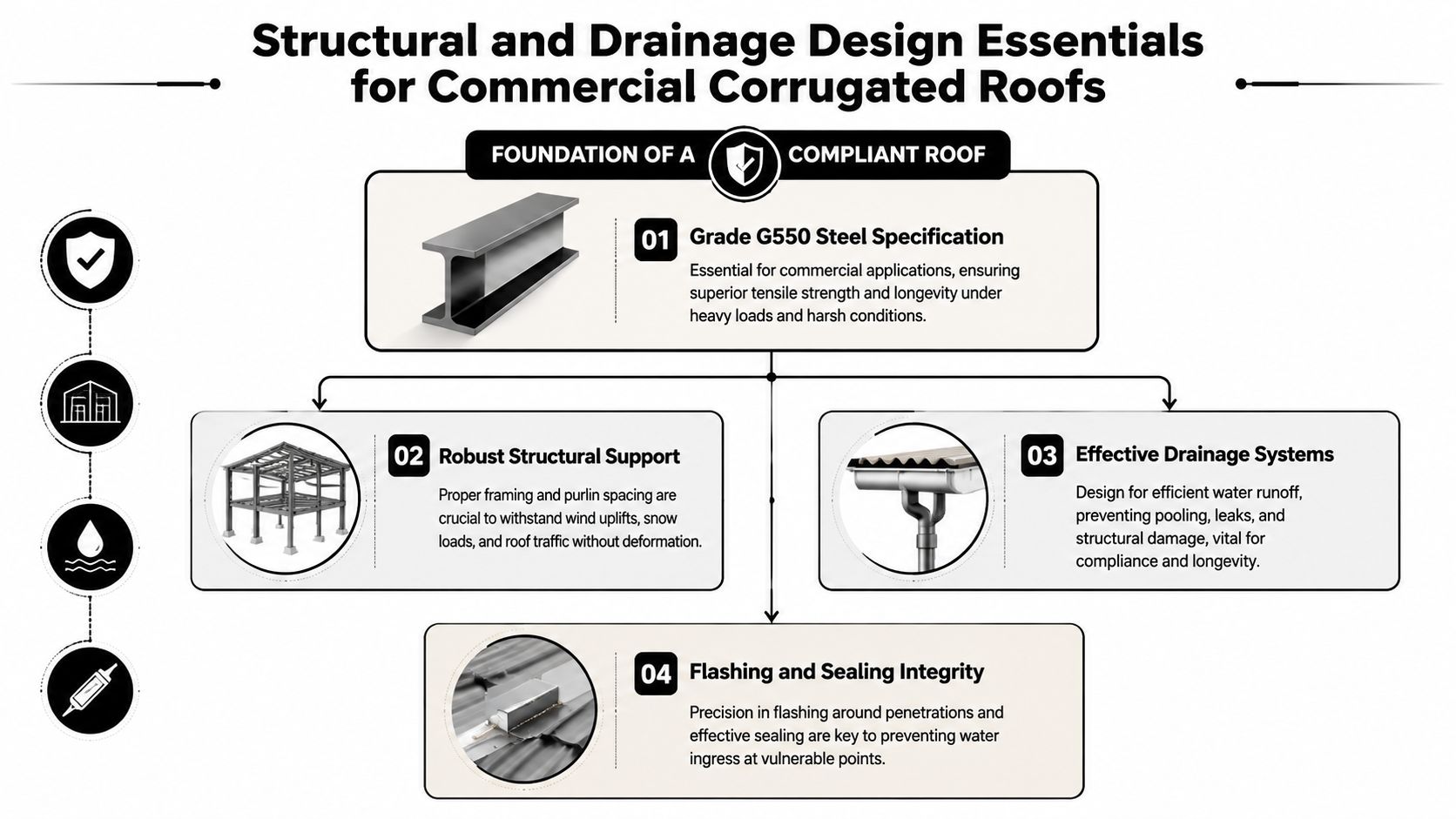
A compliant corrugated roof starts with the correct sheet. For Australian applications, that means using the specified G550 steel and the correct base metal thickness for the design. Owners don't need to become engineers, but they should recognise that these specifications are tied directly to structural integrity, wind resistance, foot traffic tolerance, and how the roof performs over time.
On commercial buildings, under-specification usually shows up later as oil-canning, distortion, loose fixings, ponding-related deterioration, or recurring maintenance at laps and penetrations. These aren't random failures. They're often the result of a roof system that was never detailed properly for the building's span, exposure, and service conditions.
Drainage deserves the same level of attention. A large roof doesn't forgive poor falls. If water can't move quickly to gutters and outlets, it lingers around laps, fixings, flashings, and penetrations. On industrial roofs with plant, skylights, services, and retrofit patches, drainage paths can become messy very quickly.
Drainage and movement are not minor details
Thermal movement is one of the most misunderstood parts of corrugated roofing. Steel moves. A long run of sheet under Australian sun will expand and contract, and if that movement hasn't been accounted for, the roof starts fighting itself.
For Australian pierced-fixed corrugated roofing, sheet runs must not exceed 25 metres between end fasteners, and flashings need expansion joints at 24-metre intervals, or 12 metres near corners, with minimum lap overlaps of 250mm, or 100mm near corners, to manage movement and maintain water shedding, according to the Stramit technical guidance on corrugated roofing.
That matters because thermal stress rarely announces itself politely. It shows up as distorted sheets, stressed fixings, split sealants, noisy movement, and eventually water entry. On a distribution centre or factory, one design shortcut can become an ongoing defect list.
A sound drainage strategy usually includes the following checks:
- Roof falls: Water needs a clear path off the roof surface and into the drainage system.
- Gutter capacity: Box gutters and overflow provisions must match the roof area and site exposure.
- Penetration detailing: Services should be flashed and supported so they don't interrupt drainage paths.
- Movement allowances: Long sheet runs and long flashing lines must be detailed for expansion.
If your building has persistent overflow, blocked drainage paths, or ageing box gutters, this overview of commercial gutter and drainage issues is worth reviewing before a reroof specification is finalised.
Most commercial roof leaks don't start in the middle of a clean sheet. They start where water slows down, where metal changes direction, or where movement was ignored.
The Professional Installation and Asbestos Replacement Process
Installation quality decides whether corrugated roofing performs like a durable commercial system or turns into a leak-chasing exercise. On older industrial buildings, the process often starts before the new roof goes on, especially if the existing sheeting contains asbestos.
What a compliant installation looks like on site
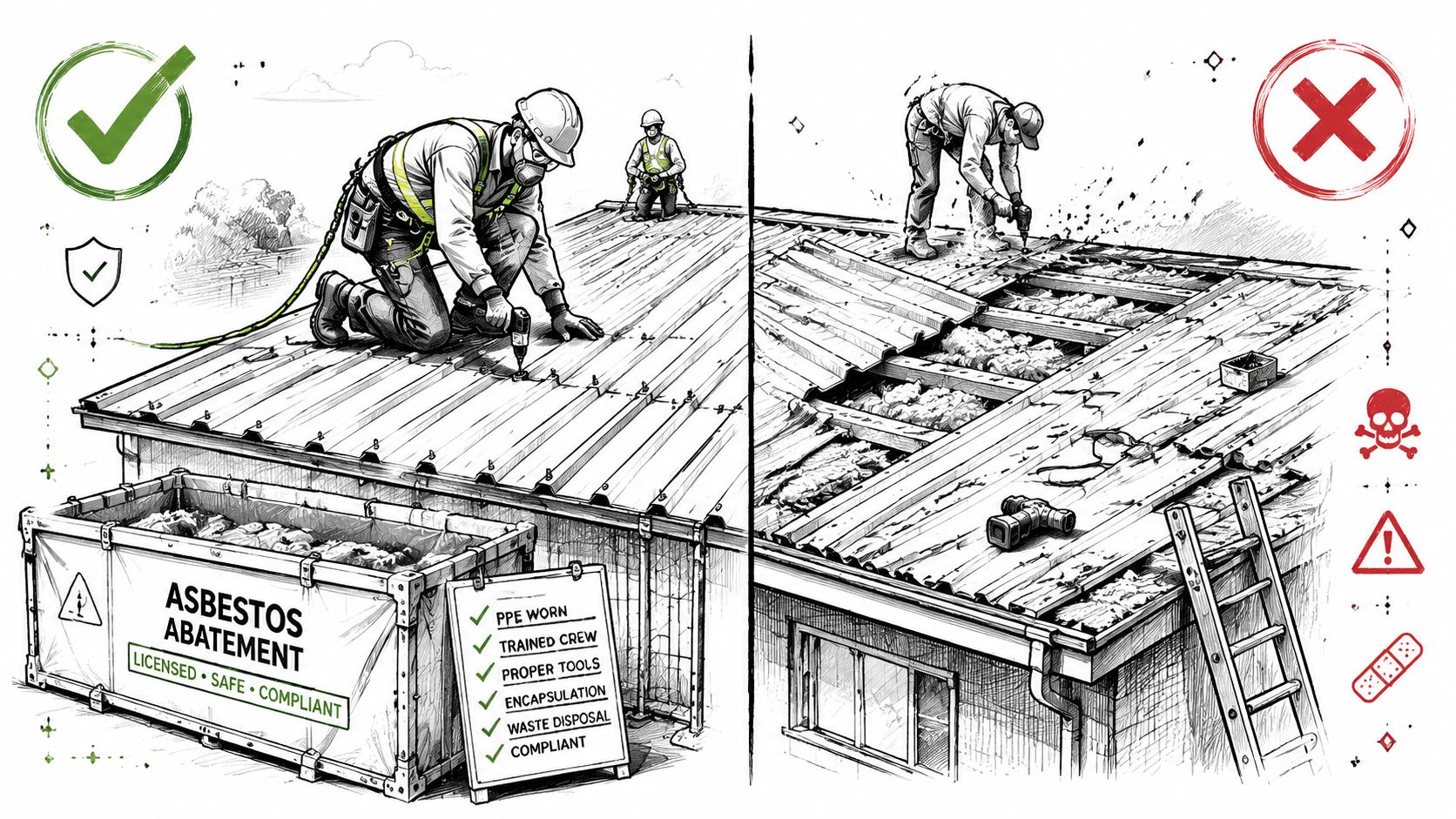
A proper commercial installation is methodical. The crew doesn't just screw sheets down and hope the laps behave. They control substrate condition, fixing layout, lap direction, flashing geometry, and weatherproofing around every interruption in the roof plane.
Australian guidance requires chemically compatible metals across the roofing system to prevent galvanic corrosion, particularly where fasteners, gutters, flashings, and roof sheeting interact. It also requires sealed blind rivets overlaid with neutral-cure silicone, side laps oriented away from prevailing weather, and flashings folded to a minimum 10° fall for effective water shedding, as outlined in BlueScope's guidance for specifying steel roofing and walling in Australia.
Those details matter most in places owners don't often see from the ground:
- Around penetrations: Cut ribs need support close to the cut edge so the sheet doesn't deform and open a leak path.
- At side laps: Orientation must suit local weather exposure, not installer convenience.
- At transitions and flashings: The metal has to shed water decisively, not almost.
- At fixings: Sealing and placement must be consistent across the whole roof, not just the easy areas.
A good commercial crew also sequences the work to keep the building operational. That can mean staging roof zones, protecting stock, coordinating shut-down windows, and maintaining safe pedestrian and vehicle separation below.
How asbestos replacement should be handled
Asbestos reroofing is not a normal tear-off with extra paperwork. It's a regulated removal process followed by a roofing project. Owners should expect clear separation between hazardous material controls and the new roof installation works.
A competent process usually looks like this:
Site assessment and scope confirmation
The contractor identifies the roof type, confirms access constraints, reviews occupancy conditions, and maps out how removal and replacement will be staged.Licensed asbestos removal planning
The removal methodology, containment approach, waste handling, and site controls are established before any sheet is disturbed.Safe removal and decontamination
The old roof is removed under controlled conditions, the area is cleaned appropriately, and the site is prepared for reroofing.Structural review before new sheeting
This is the moment to identify damaged battens, corroded framing, failed gutters, or outdated details that shouldn't be buried under a new roof.Installation of the replacement roof system
New corrugated sheeting, flashings, rainwater goods, insulation, and safety accessories are installed in line with the project specification.
For owners dealing specifically with legacy asbestos roofs, this guide to asbestos roof removal and replacement gives a practical overview of what the process should involve.
The following video gives additional context on roof replacement considerations in the field.
Unsafe asbestos handling doesn't just create a roofing defect. It creates a health and liability issue that can affect workers, tenants, neighbouring properties, and the business itself.
Budgeting Maintenance and Ensuring Compliance
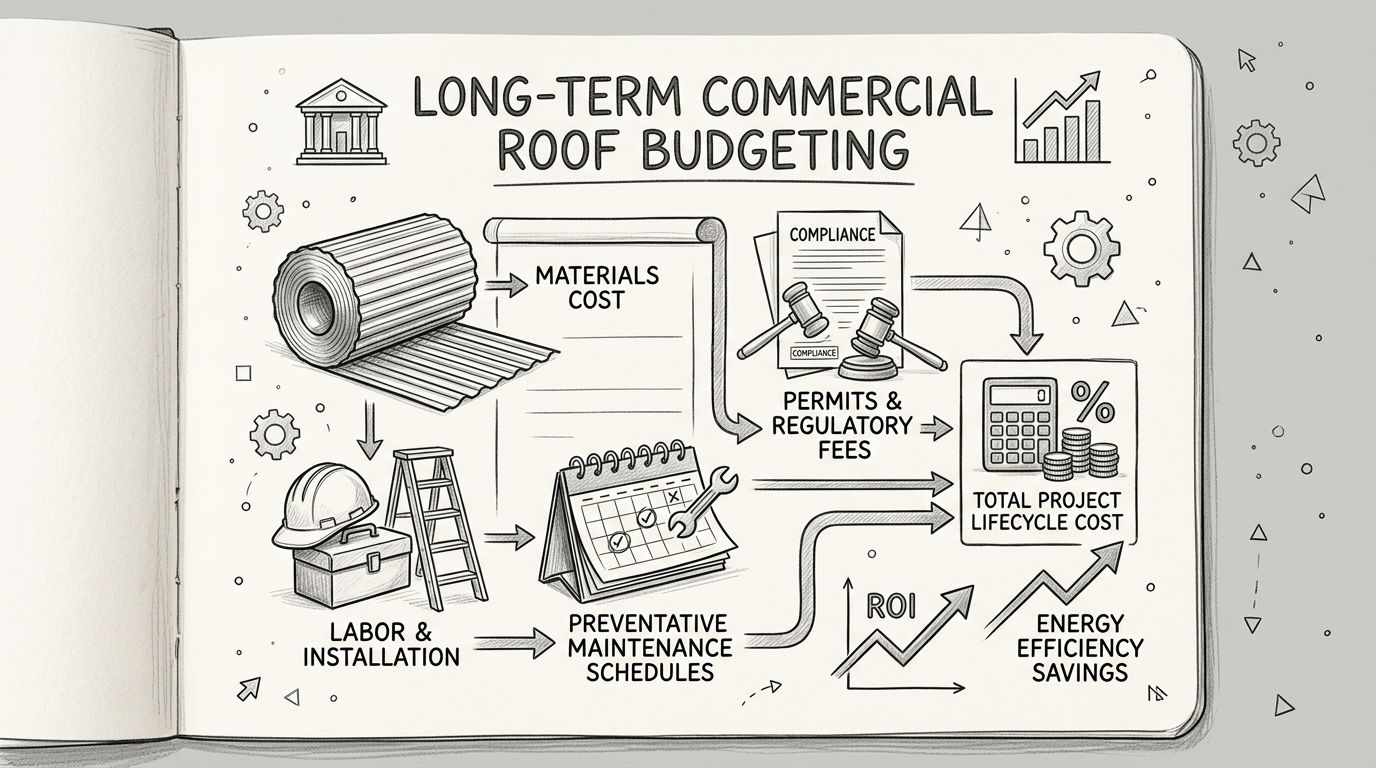
Owners often ask for a square metre rate as if that will settle the budget. It won't. On commercial reroofing, the total cost sits inside access requirements, safety controls, demolition scope, weather exposure, penetrations, drainage upgrades, and whether the building stays live during the works.
What really shapes the budget
Material selection is one variable, but it's rarely the only major one. A straightforward inland warehouse with clear access, limited penetrations, and no hazardous material is a different proposition from an occupied factory with rooftop plant, traffic management, edge protection, staged delivery windows, and coastal corrosion exposure.
One budgeting item many owners don't hear about early enough is material inefficiency. Corrugated metal roofs can require 10 to 12% more material purchased than the actual roof area because of panel-side laps, which directly increases total project cost, as discussed in this analysis of corrugated metal roofing material waste.
That's one reason like-for-like quotes can still differ. Two contractors may be pricing the same roof area but handling waste allowance, flashings, penetrations, and site complexity very differently.
A realistic budget review should consider:
- Access and safety setup: Scaffold, raised work platforms, edge protection, exclusion zones, and traffic separation all affect cost.
- Roof complexity: Skylights, vents, services, parapets, box gutters, and junctions add labour and detailing time.
- Insulation and sarking: Important for thermal performance, condensation control, and occupant comfort.
- Asbestos removal: A separate regulated scope, not a small line item.
- Operational constraints: Night works, weekend works, staged weatherproofing, and tenant coordination often change the programme.
Maintenance that protects the investment
A corrugated roof usually rewards disciplined maintenance. It doesn't reward neglect. Exposed-fix systems should be checked regularly by someone who knows what failure looks like before it becomes internal water damage.
A sensible maintenance routine often includes:
- Gutter and outlet clearing: Remove debris before rain events can back water up under sheeting or flashings.
- Fastener inspection: Look for loose, overdriven, corroded, or backed-out fixings.
- Sealant review: Penetrations, laps, and flashing junctions should be checked for deterioration.
- Surface condition checks: Coating wear, staining, isolated corrosion, and impact damage should be identified early.
- Post-storm review: After severe weather, inspect the roof promptly rather than waiting for the next leak.
Compliance is part of long-term value, not a one-off approval hurdle. A roof that aligns with Australian requirements for material compatibility, drainage, and installation detail is less likely to expose the owner to avoidable defects, emergency callouts, or disputes over remedial work.
Maintenance on a commercial roof works best when it is planned. Emergency maintenance is almost always more disruptive and more expensive.
How to Choose the Right Commercial Roofing Contractor
A good corrugated metal roof depends as much on the contractor as the material. The market is full of businesses that can quote a reroof. Far fewer can manage access, safety, sequencing, detailing, compliance, and communication well enough to protect a live commercial site.
Non-negotiables before anyone starts
Start with licensing and insurance. In NSW, you should confirm the contractor's licence status through NSW Fair Trading and ask for current evidence of public liability and workers compensation cover. If the project involves asbestos, make sure the relevant removal licensing and controls are in place for that scope.
Then look at actual commercial experience. A team that mostly handles small residential reroofs isn't automatically equipped for a warehouse, strata complex, shopping strip, school, or logistics facility. Commercial roofing involves different access planning, documentation, safety systems, and client coordination.
Ask what safety documents they prepare and use on site. You want to hear practical answers about SWMS, site inductions, exclusion zones, fall protection, weather response, and supervision. Vague reassurance is not enough.
Use this checklist:
- Verified licence status: Confirm the business is appropriately licensed for the work being proposed.
- Insurance currency: Ask for certificates, not verbal assurances.
- Commercial project history: Request examples similar in scale, access difficulty, and occupancy type.
- Safety systems: They should be able to explain how they control live-site risk.
- Crew model: Find out whether the people quoting the work are the people delivering it.
Questions worth asking before you sign
The best questions are specific. They force the contractor to explain how they work, not just what they promise.
Ask these before accepting a quote:
Who will supervise the site each day?
If no one owns the day-to-day delivery, details get missed.Do you use in-house crews or subcontractors?
This affects quality control, scheduling, and accountability.How will you keep the building watertight during staged works?
This matters on occupied sites and during changeable weather.How do you handle penetrations, gutters, and roof-to-wall junctions?
A strong answer will mention detailing, not just “standard practice”.What happens if you uncover hidden issues after strip-off?
Good contractors have a clear variation and communication process.What warranties are provided on workmanship and materials?
Get the answer in writing and make sure responsibilities are clear.
One more point matters. Pay attention to how the contractor communicates before the job starts. If the quote is unclear, exclusions are buried, and questions are answered slowly now, that usually doesn't improve once the roof is open.
The right contractor should make you feel that the project is controlled, documented, and understood. Not just priced.
If you're planning a commercial reroof, replacing an ageing warehouse roof, or managing an asbestos roof upgrade in NSW, Commercial Roofers is a Sydney-based specialist worth speaking with. Their team works across commercial and industrial properties with in-house crews, compliant safety systems, and a strong focus on durable, low-disruption roofing outcomes.