
Asbestos roof removal usually starts at $40 to $100 per square metre for bonded asbestos roofing in Australia, but for commercial properties that figure is only a starting point. On warehouses, factories and older strata buildings, the final asbestos roof removal cost is often driven less by roof area and more by access, compliance, waste handling, and whether the roof is a double-skin system with insulation.
If you're pricing up an ageing commercial roof right now, you're probably already seeing the problem. One quote looks surprisingly cheap, another is much higher, and neither seems easy to compare. That usually happens because two contractors can measure the same roof area but allow for very different scopes of work.
Commercial asbestos projects aren't just larger residential jobs. They involve occupied premises, traffic management, work-at-height controls, staging, waste documentation, and often a replacement roof installed immediately after removal. If the building is an older warehouse or industrial unit, hidden complexity in the roof build-up can change the cost quickly.
Table of Contents
- Planning Your Commercial Asbestos Roof Removal Project
- Asbestos Removal Price Per M2 A Detailed Breakdown
- Key Factors That Drive Up Your Final Cost
- The Asbestos Removal and Replacement Process Step by Step
- Replacing with Colorbond What to Expect
- How to Get Accurate Quotes and Choose a Contractor
- Frequently Asked Questions About Asbestos Roof Removal
Planning Your Commercial Asbestos Roof Removal Project
A common starting point is a warehouse roof that has leaked for years, with patch repairs around penetrations, a few cracked sheets, and a planned tenancy change coming up. On paper, it looks like a simple removal job. Once the roof is opened up, it often turns out to be a commercial assembly with insulation, liners, walkways, services, and access constraints that change the price fast.
That is why early planning matters more on a commercial site than on a house. Residential guides can help with broad context, but they do not reflect the cost structure of a factory, shopping strip, school building, or strata complex where the roof has to be removed safely while the property still functions.
The first question is not just whether the top sheet contains asbestos. It is what the full roof build-up looks like. On many commercial and industrial properties, the expensive jobs are not single-layer asbestos sheet removals. They are double-skin roofs, insulated sandwich-style assemblies, or old roof systems that have been overclad, patched, and modified over decades. Once insulation, internal liners, and trapped moisture are part of the scope, labour, waste handling, and reinstatement all move upward.
A commercial asbestos roof removal project usually needs four budget lines:
- Removal works: Licensed asbestos removal, roof access setup, sheet handling, and controlled lowering.
- Access and protection: Edge protection, raised work platforms, scaffolding, traffic control, and protection for staff, tenants, stock, or plant below.
- Compliance and disposal: Air monitoring where required, clearance procedures, waste transport, disposal charges, and the paperwork that proves the job was handled correctly.
- Make-safe and replacement works: Temporary weatherproofing, substrate or purlin checks, rectification of damaged areas, and installation of the new roof system.
One point catches commercial owners out more than any other. Insulated double-skin roofing can change the job from a straightforward strip and replace into a staged demolition and rebuild. You are not only paying to remove asbestos sheeting. You may also be paying to dismantle liner trays or internal sheets, handle contaminated insulation, isolate services, protect operations below, and rebuild a roof system that meets current performance requirements.
If I am pricing a warehouse or plant room roof, I want to know what sits under the asbestos sheet before anyone starts talking about a rate per square metre. The roof profile, thickness of insulation, presence of skylights, suspended services, solar, restricted access zones, and whether the building stays live during works all affect labour hours and sequencing. On active sites, lost trading time or interrupted production can outweigh small differences between contractor quotes.
Useful planning work at the start is simple and practical. Confirm the asbestos-containing material, inspect the roof build-up, review access from ground to roof level, and identify what happens inside the building directly under the work area. That gives you a budget that reflects the actual job, not a residential benchmark carried over to a commercial site.
If a quote is built on square metres alone, it is only a partial number.
Asbestos Removal Price Per M2 A Detailed Breakdown
A rate per square metre helps with early budgeting, but commercial owners should treat it as a starting point only. For bonded asbestos roofing, the market usually talks in broad per m2 ranges for straightforward removal work. On a warehouse, factory, shopping strip, or strata complex, that figure rarely represents the full project cost.
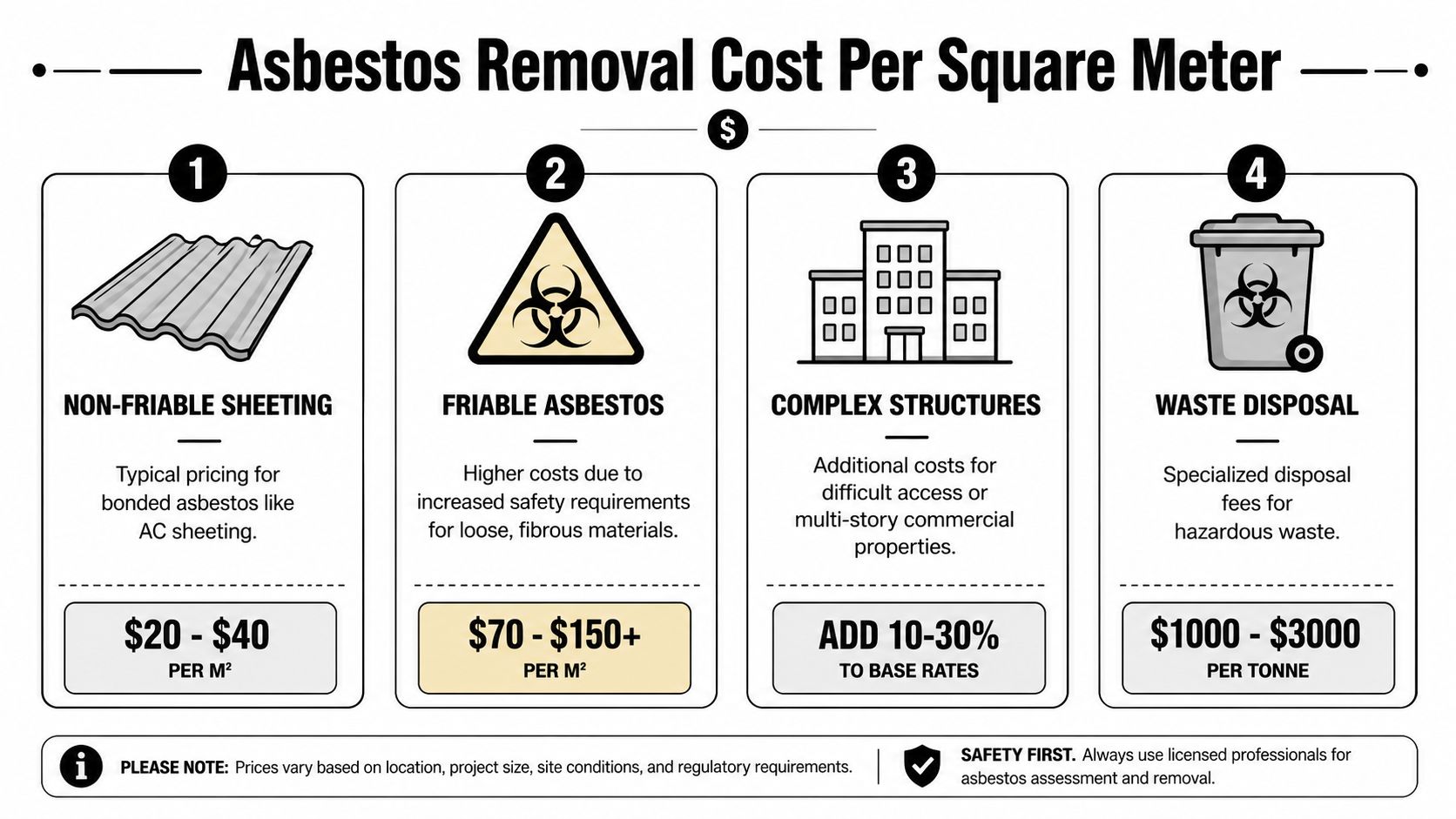
The main reason is simple. Residential benchmarks usually assume single-skin bonded sheets, reasonable access, and a clean removal scope. Commercial roofs often involve longer sheet runs, higher working heights, stricter site controls, live operations below, and more waste handling. If the roof is an insulated double-skin assembly, the square metre rate can move well beyond the basic bonded-sheet benchmark because the crew is removing and separating more than one layer.
What the benchmark rate usually covers
A base per-metre rate for bonded asbestos roofing generally covers the licensed removal of the asbestos sheet itself, standard setup for a contained work area, labour to remove and lower the sheets safely, and basic packaging for disposal.
That is the narrow part of the job.
It may also include some allowance for routine site supervision and standard PPE, but commercial clients should never assume the quote covers every compliance item, every access method, and every waste cost. Those details need to be stated clearly.
A practical way to read a per m2 quote is this:
| Cost element | Usually part of the base removal rate | Often variable |
|---|---|---|
| Bonded asbestos sheet removal | Yes | Depends on profile and condition |
| Basic site setup | Usually | Depends on site rules |
| Labour | Yes | Changes with access and complexity |
| Disposal | Sometimes partly allowed | Often adjusted after inspection |
| Monitoring and clearance-related items | Not always | Common on commercial sites |
What often sits outside the headline rate
Commercial pricing usually increases once the contractor has inspected the roof build-up and site conditions. Disposal is one of the first items to shift, especially where sheet condition, packing volumes, crane lifts, or transport distances increase handling time. Air monitoring, clearance support, and site-specific safety controls are also commonly separated from the base rate rather than bundled into it.
The largest gap between a guide price and the actual outcome usually comes from scope that sits around the asbestos sheet rather than the sheet alone. On commercial and industrial roofs, that can include:
- Insulated double-skin construction: Internal liners, insulation, extra fixings, and slower separation work can change the labour and waste profile significantly.
- Access equipment: Scaffolding, EWPs, edge protection, and traffic management are often costed separately.
- Operational constraints: After-hours work, staged removal, noise limits, and internal protection for occupied areas add time.
- Service isolation: Solar, mechanical plant, electrical runs, sprinkler lines, and suspended services may need temporary disconnection or protection.
- Waste logistics: Packaging, lifting, cartage, and licensed disposal charges can move sharply on larger sites.
I tell clients to read low square metre rates carefully. A cheap removal figure can stop looking cheap once access, monitoring, disposal, and staging are added back in.
For commercial budgeting, the better question is not the rate alone. It is whether the quote reflects the roof type, the building use during works, and the full removal scope sitting above and below the asbestos sheets.
Key Factors That Drive Up Your Final Cost
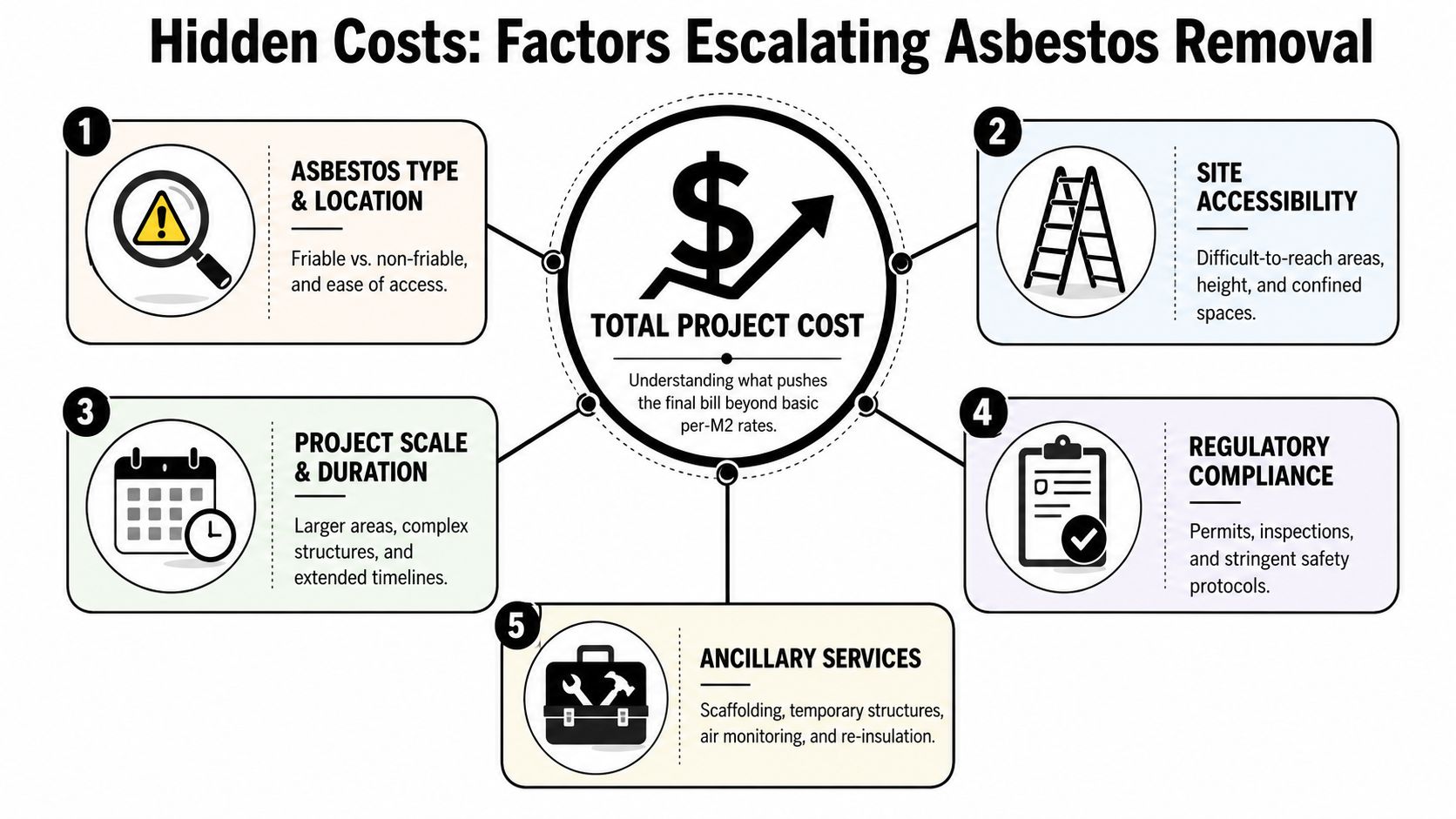
The biggest pricing mistakes happen when owners assume roof area is the main driver. It matters, but on commercial projects key multipliers are usually hidden in the roof assembly and the way the site operates. That's where asbestos roof removal cost can move well beyond the basic bonded-sheet benchmark.
Roof build-up matters more than most guides admit
The most overlooked commercial cost factor is double-skinned roofing with insulation. According to industry analysis discussed in this video reference, insulated double-skin roofing can add up to 70% to the base removal price. That's the detail many residential-style guides and calculators miss.
Why does it cost more? Because the contractor isn't just removing one sheet layer. They may be dealing with corrugated cement above, insulation trapped between layers, extra fixings, more awkward separation, more careful packaging, and heavier waste loads. The work is slower and the containment burden increases.
The same analysis notes that standard residential-style rates of $40 to $100 per square metre usually assume single-skin sheets. It also points out that double-skinned Trafford profile or Big 6 corrugation with insulation can escalate pricing from £40 to £60 per square metre to more than £100 per square metre, with 70% additional fees tied to insulation removal and safe packaging. The currency figure isn't directly useful for an Australian budget, but the pricing pattern is. Once insulation and layered roof construction are involved, the square-metre shortcut stops being reliable.
If your warehouse was built in the 1970s or 1980s, ask one question early: is this a single-skin asbestos roof, or an insulated double-skin assembly?
Access and operating conditions change labour fast
Commercial roofs often look simple from the ground and difficult from the roofline. Parapets, overhead services, brittle skylights, narrow access paths, loading docks, and active plant below all slow the removal sequence.
A contractor can remove bonded asbestos efficiently when sheets are accessible, lifting paths are clear, and exclusion zones are easy to maintain. The same crew will move much more slowly if they need to protect a live tenancy, coordinate around deliveries, or stage waste removal through a constrained yard.
Common site conditions that push cost higher include:
- Occupied buildings: Tenants, staff, customers, or production lines mean tighter programming and more communication.
- Restricted access: Limited room for equipment or waste bins stretches labour time.
- Complex roof geometry: Valleys, penetrations, changes in level, and patched sections all break the production rhythm.
- Weather exposure: Once removal starts, temporary protection and sequencing become critical.
What works here is pre-planning the site like a logistics exercise, not just a roofing job. Owners who provide clear access windows, isolate sensitive areas, and align removal with quieter operating periods usually get a cleaner project and fewer variations.
Disposal and compliance are not side issues
Commercial clients sometimes treat disposal and compliance as paperwork at the end. In reality, they shape the whole method. Packaging, handling, transport, and documented disposal all need to be planned around the roof type and waste volume.
With older industrial buildings, disposal cost isn't only about roof area. It's also about how much material is coming off the building once insulation, degraded accessories, and contaminated packaging are included. That's another reason double-skin assemblies hit the budget harder than expected.
A useful quote should make it obvious whether these items are part of the contract sum or provisional:
| Cost driver | Why it raises cost |
|---|---|
| Double-skin roof build-up | More labour, more waste, more packaging |
| Insulation between layers | Extra handling and containment |
| Difficult access | Slower removal and more safety equipment |
| Occupied site controls | Tighter staging and disruption management |
| Disposal complexity | Heavier and bulkier waste streams |
The Asbestos Removal and Replacement Process Step by Step
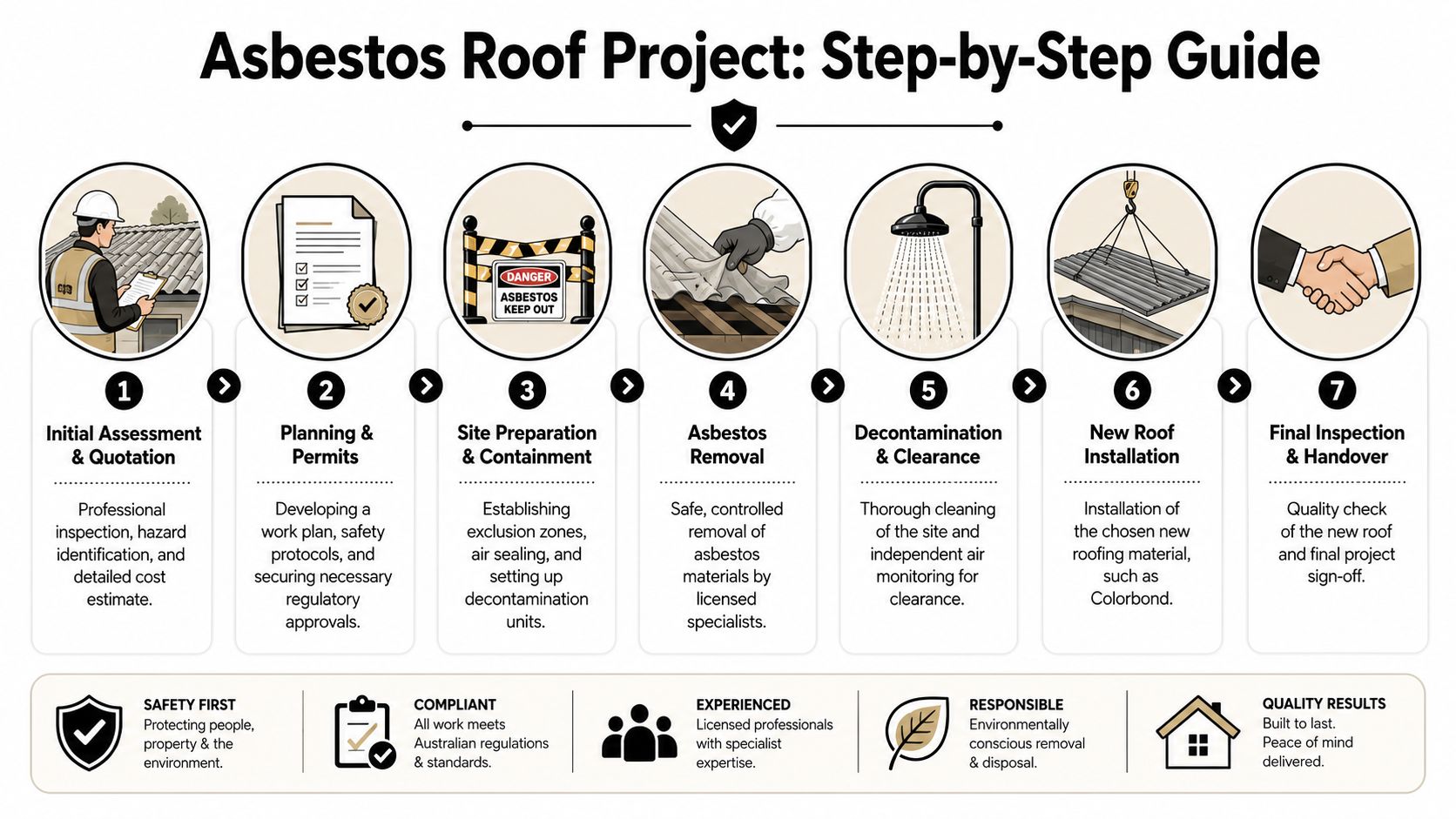
Owners usually feel more comfortable with the cost once they understand the sequence. A properly run project is controlled, documented, and staged so the building isn't exposed unnecessarily.
Before removal starts
The first phase is inspection and scoping. The contractor needs to confirm what is on the roof, how it is fixed, what access exists, and whether the building can keep operating during the works. On commercial sites, that early review also picks up traffic issues, fragile zones, tenant interfaces, and replacement sequencing.
Then the paperwork starts. The removal plan, site-specific safety controls, waste arrangements, and programme all need to line up before anyone starts taking sheets off. If removal and reinstatement are being coordinated together, the handover between the asbestos team and the new roofing crew has to be tight.
For a fuller overview of the combined scope, this guide to commercial asbestos roof removal and replacement is a useful reference point.
A visual walk-through helps if you're trying to explain the process internally to tenants or committee members.
During removal and site control
The site is prepared before the first sheet is disturbed. That usually means exclusion zones, controlled access, fall protection, and measures to stop unnecessary disturbance of the asbestos material. On occupied premises, project management matters most. The roof crew and the building operator need the same plan.
Removal itself should be methodical. Sheets are handled carefully, lowered in a controlled way, and packaged for transport without turning the roof into a demolition site. Good contractors avoid rough handling, because rushing brittle asbestos roofing often creates the exact risk the project is meant to remove.
Keep the project moving in sections. On large roofs, staged removal and staged replacement usually protect the building better than stripping everything at once.
Clearance and replacement handover
Once the asbestos material is removed, the site is not yet "finished". The area needs cleaning, checking, and formal handover before replacement work is treated as complete. On commercial projects, this stage matters for records as much as safety. Owners should expect proper documentation, not verbal reassurance.
After clearance, the replacement roof goes on. That can include new metal sheeting, insulation, flashings, gutters, penetrations, and rainwater detailing. The best outcomes come when the replacement scope has already been coordinated with the removal sequence, so the building isn't left exposed longer than necessary.
By handover, the owner or strata manager should have a clean record of what was removed, where it went, and what has replaced it.
Replacing with Colorbond What to Expect
For many commercial buildings, Colorbond becomes the practical replacement choice because it suits large roof areas, handles Australian conditions well, and gives owners a cleaner maintenance path than ageing asbestos cement systems. The replacement budget, though, is never just "new sheets on old framing". The details underneath decide whether the new roof performs properly.

Material decisions that affect the replacement budget
The material scope usually includes the roof sheeting itself, insulation, sarking where relevant, flashings, cappings, fasteners, and rainwater goods that need to be upgraded to suit the new profile. On older industrial roofs, replacement can also expose issues with purlins, spacing, or unsupported areas that weren't obvious while the asbestos roof remained in place.
That's why a cheap replacement allowance can be risky. If the quote only names "Colorbond roof" but doesn't spell out insulation type, flashing treatment, penetrations, box gutters, or edge details, you don't yet know the full scope.
For owners comparing systems, this page on Colorbond roof installation for commercial projects gives a useful overview of what a complete replacement package can include.
Labour and detailing usually decide the real outcome
Material quality matters, but installation quality decides whether the roof stays watertight and easy to maintain. Commercial roof replacements often need custom flashings, step sequencing around active areas, and careful treatment of skylights, exhaust penetrations, and parapet interfaces.
The practical trade-off is straightforward:
- Lower upfront scope: Fewer inclusions, less detailing, and a bigger chance of callbacks.
- Better specified scope: Cleaner interfaces, stronger weatherproofing, and easier maintenance later.
A replacement roof only pays off if the details are solved at install time. Most post-handover leaks come from interfaces, not the field sheets.
Colorbond also gives owners a simpler long-term maintenance profile than an ageing asbestos roof. It is easier to inspect, easier to patch correctly when needed, and easier to integrate with future upgrades such as new penetrations or rooftop plant. For a commercial asset, that matters just as much as the initial replacement figure.
How to Get Accurate Quotes and Choose a Contractor
If you're collecting quotes, the main job isn't getting the cheapest number. It's making sure every contractor has priced the same scope. That is the only way to control financial risk on an asbestos project.
What a useful quote should spell out
Ask for a written scope that identifies the roof build-up, the removal method, what site controls are included, and what documentation you will receive at the end. If a contractor has inspected the roof properly, the quote should read like they understand the building, not like they copied a template.
Use this checklist when comparing proposals:
- Roof description: The quote should identify whether the roof is single skin or layered, and whether insulation or additional linings are present.
- Access assumptions: It should state what access equipment, edge protection, or staging is included.
- Waste handling: Look for clear wording around packaging, transport, and lawful disposal.
- Monitoring and close-out: The contractor should explain how compliance records and clearance-related documents will be handled.
- Replacement interface: If new roofing follows immediately, the quote should explain who takes responsibility for weather protection between stages.
If you're still shortlisting firms, reviewing local commercial roofer options near you can help you build a list of contractors with relevant project types.
Red flags that usually cost more later
The first red flag is a low quote with very little detail. On asbestos work, vagueness is rarely a bargain. It usually means exclusions, assumptions, or variation claims later.
The second is poor questioning. A contractor who doesn't ask about occupancy, access windows, internal operations, or replacement timing probably hasn't thought through the job properly.
Watch for these warning signs:
- No site inspection: Desktop pricing on a commercial asbestos roof is a weak start.
- Thin scope wording: If disposal, access, or records are barely mentioned, ask why.
- Pressure to decide quickly: Good contractors don't need to rush you past scope review.
- No commercial experience shown: Removing a small detached roof is not the same as staging works over an operating warehouse.
A strong contractor should be comfortable answering direct questions about licences, insurance, similar roof types, waste procedures, and final documentation. If those answers are evasive, move on.
Frequently Asked Questions About Asbestos Roof Removal
Can the business keep operating during asbestos roof removal
Sometimes yes, sometimes no. It depends on roof access, the layout below the work area, tenant sensitivity, and whether sections can be isolated safely. Warehouses and strata sites often stay partly operational if the project is staged carefully, but that decision should be made from a site-specific plan, not assumed at quote stage.
Will insurance pay for asbestos roof removal
Sometimes insurers contribute when asbestos removal is tied to an insured event, but many owners find that ageing, deterioration, and compliance-driven replacement are treated differently from storm damage. The only reliable approach is to ask your broker or insurer for a position on your specific claim and building circumstances before works start.
What paperwork should I receive at the end
At minimum, owners should expect documentation that shows what was removed, how waste was handled, and that the project reached formal close-out. On commercial jobs, keep those records with the building file. If you sell, refinance, re-lease, or carry out future works, that paperwork matters.
If you're planning an asbestos roof project in NSW and want clear scope advice, staged project management, and a quote that deals with removal and replacement properly, speak with Commercial Roofers. They handle commercial and industrial roofing across Sydney with a focus on compliant asbestos removal, practical programming, and durable replacement outcomes.